History of AstronomyAncient Cultures to Isaac Newton
Early CivilizationsA practical approachPredicting seasonsNavigation
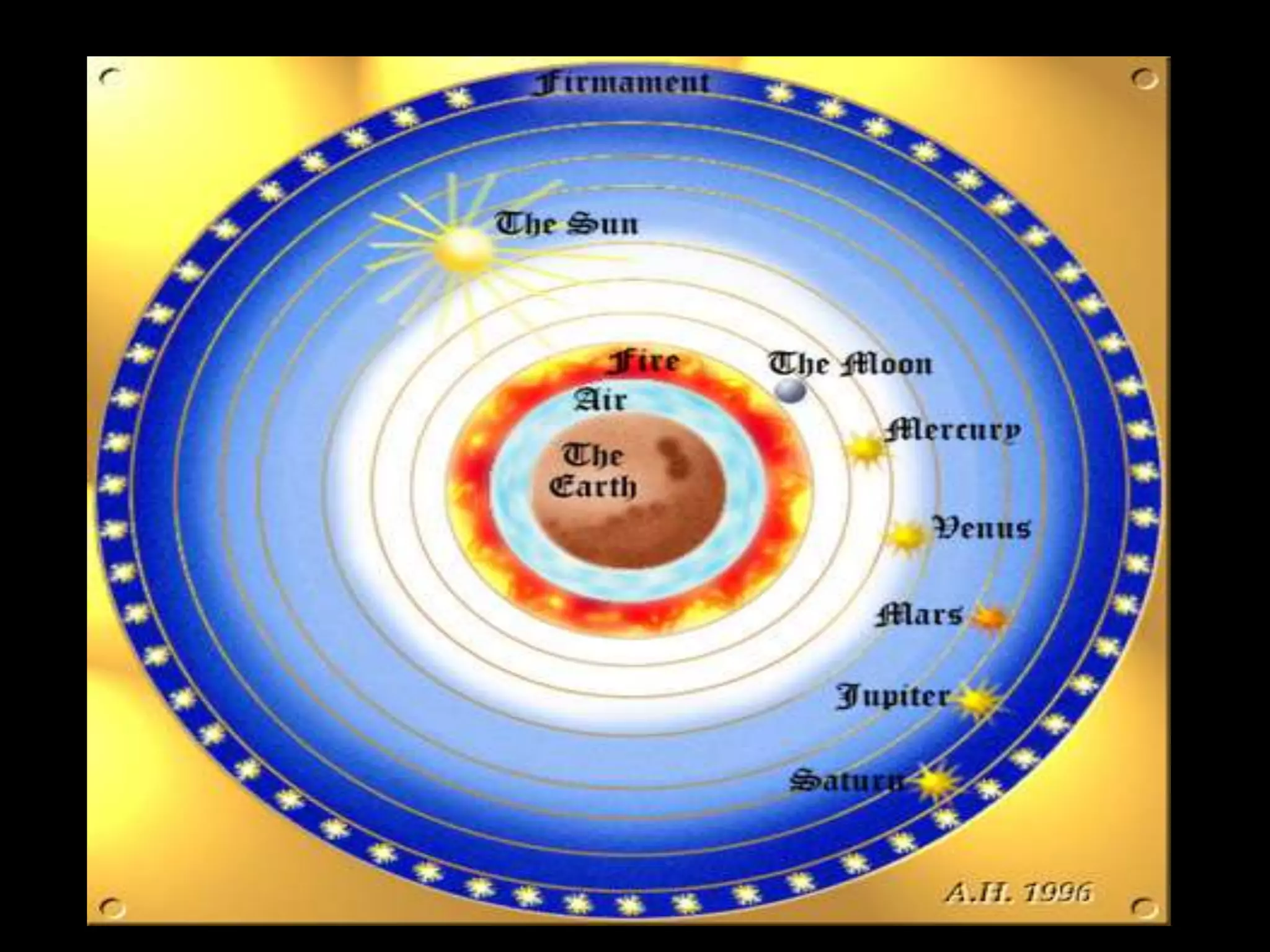
Aristotle and the Greek View: Geocentric ModelGeo- EarthCentric-  CenteredThe earth is a motionless sphere at the center of the Universe.  Explained the apparent motion of the sun, moon and stars.
PlanetsGreek astronomers observed that certain celestial objects do not follow a predictable path like the moon, sun, and stars.Called these objects Planets (Greek word planetes means wanderer)The observable motion of Planets is that they change speed and even loop back and forth relative to the stars.
Retrograde MotionMotion of planets in “backwards” or westward loops is known as Retrograde Motion.
Ptolemy (140 A.D.)A more complex model of the Universe/Solar System was needed to explain Retrograde Motion. Ptolemy suggests that planets orbit the Earth in a large circular orbits but also follow a small circular orbit around an imaginary point.  These small orbits were known as Epicycles
The Copernican Revolution:  Heliocentric ModelPtolemaic Model survived for 13 centuriesCopernicus suggested that the Earth is a planet and spins on its axis and orbits the Sun.Heliocentric-  Sun CenteredThis accounts for the apparent motion of the sun and stars.The realization that Earth is not at the center of the universe is now know as the Copernican Revolution.What about Retrograde motion of the planets?
Just like when you pass another car on the highway.
Galileo GalileiUsed the telescope to view objects in the sky (1609). Observations of celestial objects supported the Heliocentric Model of the solar system.
Galileo’s Observations The terrain of the Moon, Sunspots, the moons of JupiterPhases of Venus
Johannes KeplerA student of Tycho Brahe, Kepler used the  precise data of his mentor to develop three simple laws that describe the motion of planets.
Kepler’s Laws of Planetary MotionThe orbital paths of planets are elliptical with the Sun at one focus.An imaginary line connecting the Sun to any planet sweeps out equal areas of the ellipse in equal intervals of time.The square of a planet’s orbital period is proportional to the cube of its semi-major axis.
Kepler’s Laws certainly describe the motion of planets around the Sun but they tell us nothing about WHY planets orbit the Sun. What prevents the planets from flying off into space or from falling into the Sun?
Isaac NewtonDescribed the basic laws of motion in what is now known as Newtonian mechanics.  Newton’s 3 Laws of Motion. The Law of Universal Gravitation
Newton’s LawsInertia:  An object in motion stays in motion, an object at rest remains at rest, unless acted upon by a force. F = maTo every action there is an equal and opposite reaction.
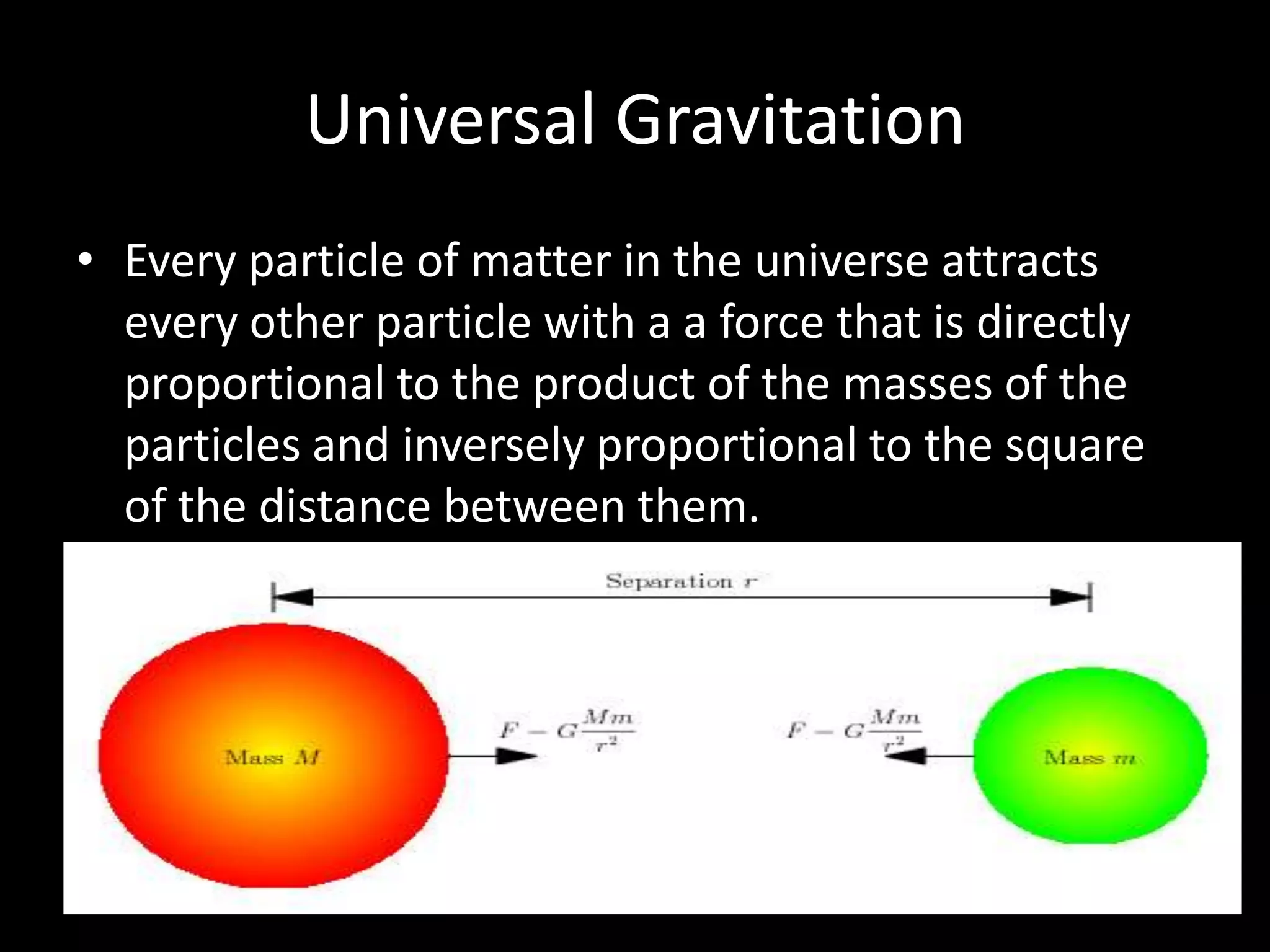
Universal GravitationEvery particle of matter in the universe attracts every other particle with a a force that is directly proportional to the product of the masses of the particles and inversely proportional to the square of the distance between them.
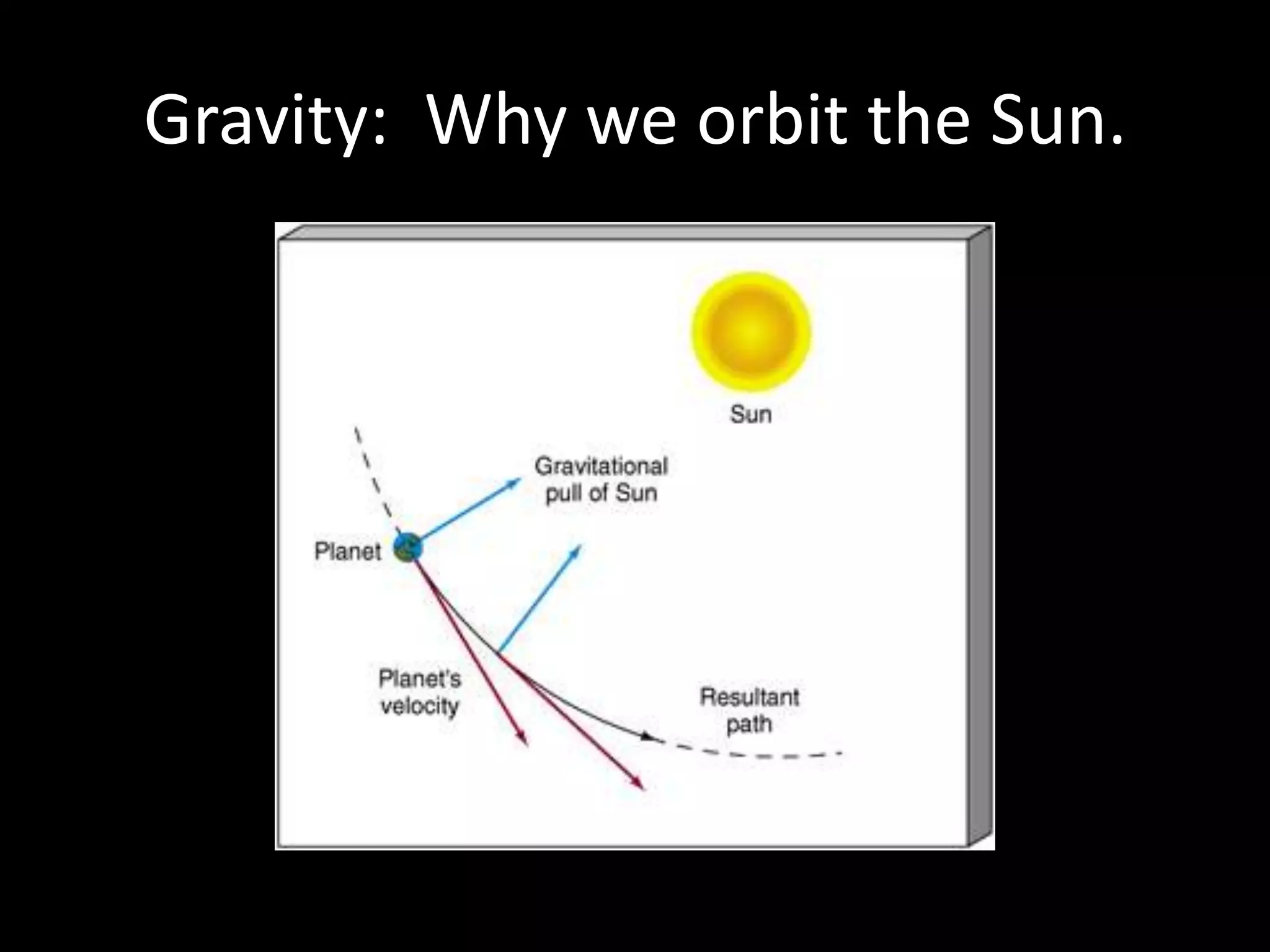
Gravity:  Why we orbit the Sun.
History Of Astronomy (Thru Newton)

History Of Astronomy (Thru Newton)

  • 1.
    History of AstronomyAncientCultures to Isaac Newton
  • 2.
    Early CivilizationsA practicalapproachPredicting seasonsNavigation
  • 3.
    Aristotle and theGreek View: Geocentric ModelGeo- EarthCentric- CenteredThe earth is a motionless sphere at the center of the Universe. Explained the apparent motion of the sun, moon and stars.
  • 5.
    PlanetsGreek astronomers observedthat certain celestial objects do not follow a predictable path like the moon, sun, and stars.Called these objects Planets (Greek word planetes means wanderer)The observable motion of Planets is that they change speed and even loop back and forth relative to the stars.
  • 6.
    Retrograde MotionMotion ofplanets in “backwards” or westward loops is known as Retrograde Motion.
  • 7.
    Ptolemy (140 A.D.)Amore complex model of the Universe/Solar System was needed to explain Retrograde Motion. Ptolemy suggests that planets orbit the Earth in a large circular orbits but also follow a small circular orbit around an imaginary point. These small orbits were known as Epicycles
  • 8.
    The Copernican Revolution: Heliocentric ModelPtolemaic Model survived for 13 centuriesCopernicus suggested that the Earth is a planet and spins on its axis and orbits the Sun.Heliocentric- Sun CenteredThis accounts for the apparent motion of the sun and stars.The realization that Earth is not at the center of the universe is now know as the Copernican Revolution.What about Retrograde motion of the planets?
  • 9.
    Just like whenyou pass another car on the highway.
  • 10.
    Galileo GalileiUsed thetelescope to view objects in the sky (1609). Observations of celestial objects supported the Heliocentric Model of the solar system.
  • 11.
    Galileo’s Observations Theterrain of the Moon, Sunspots, the moons of JupiterPhases of Venus
  • 12.
    Johannes KeplerA studentof Tycho Brahe, Kepler used the precise data of his mentor to develop three simple laws that describe the motion of planets.
  • 13.
    Kepler’s Laws ofPlanetary MotionThe orbital paths of planets are elliptical with the Sun at one focus.An imaginary line connecting the Sun to any planet sweeps out equal areas of the ellipse in equal intervals of time.The square of a planet’s orbital period is proportional to the cube of its semi-major axis.
  • 14.
    Kepler’s Laws certainlydescribe the motion of planets around the Sun but they tell us nothing about WHY planets orbit the Sun. What prevents the planets from flying off into space or from falling into the Sun?
  • 15.
    Isaac NewtonDescribed thebasic laws of motion in what is now known as Newtonian mechanics. Newton’s 3 Laws of Motion. The Law of Universal Gravitation
  • 16.
    Newton’s LawsInertia: An object in motion stays in motion, an object at rest remains at rest, unless acted upon by a force. F = maTo every action there is an equal and opposite reaction.
  • 17.
    Universal GravitationEvery particleof matter in the universe attracts every other particle with a a force that is directly proportional to the product of the masses of the particles and inversely proportional to the square of the distance between them.
  • 18.
    Gravity: Whywe orbit the Sun.