PATH FINDER
Presented By:
Group E
(2070-MSCS: Govinda, Sunena, Love Kumar,Yogendra)
Outline
•Introduction and Background
•Description
•Pathfinder Algorithms
•Examples
•Summary
•References
Introduction & Background
Proximity Data
-- Similarities
-- Relatedness
-- Association between entities
Methods of Proximity DataAnalysis
-- Multidimensional Scaling
--Hierarchical Clusters
GraphTheory
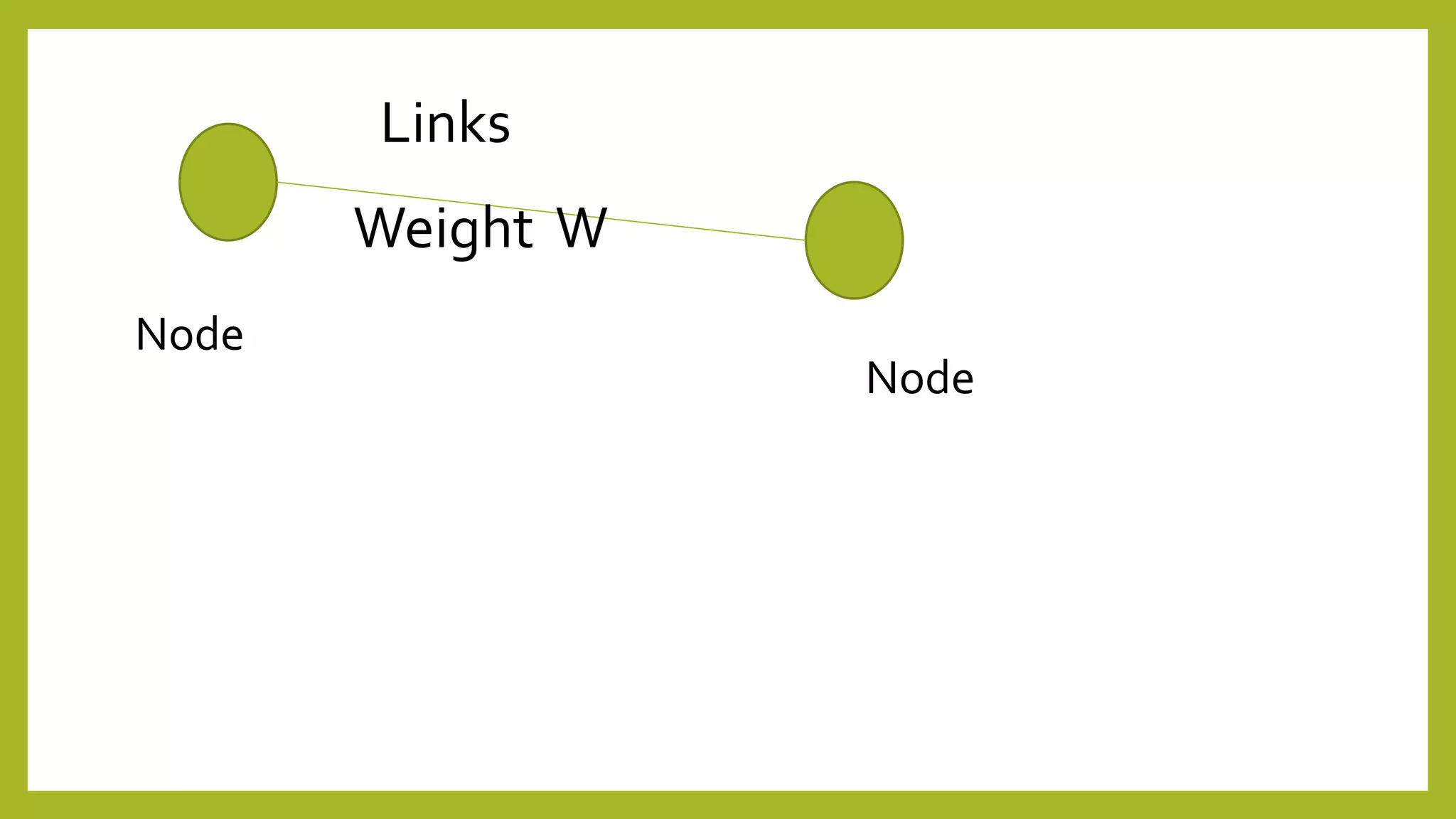
Nodes and Links
•Node==Finite set(1,2,…..n)
•Links==Subset of set of all node pairs
Node
Links
Node
Weight W
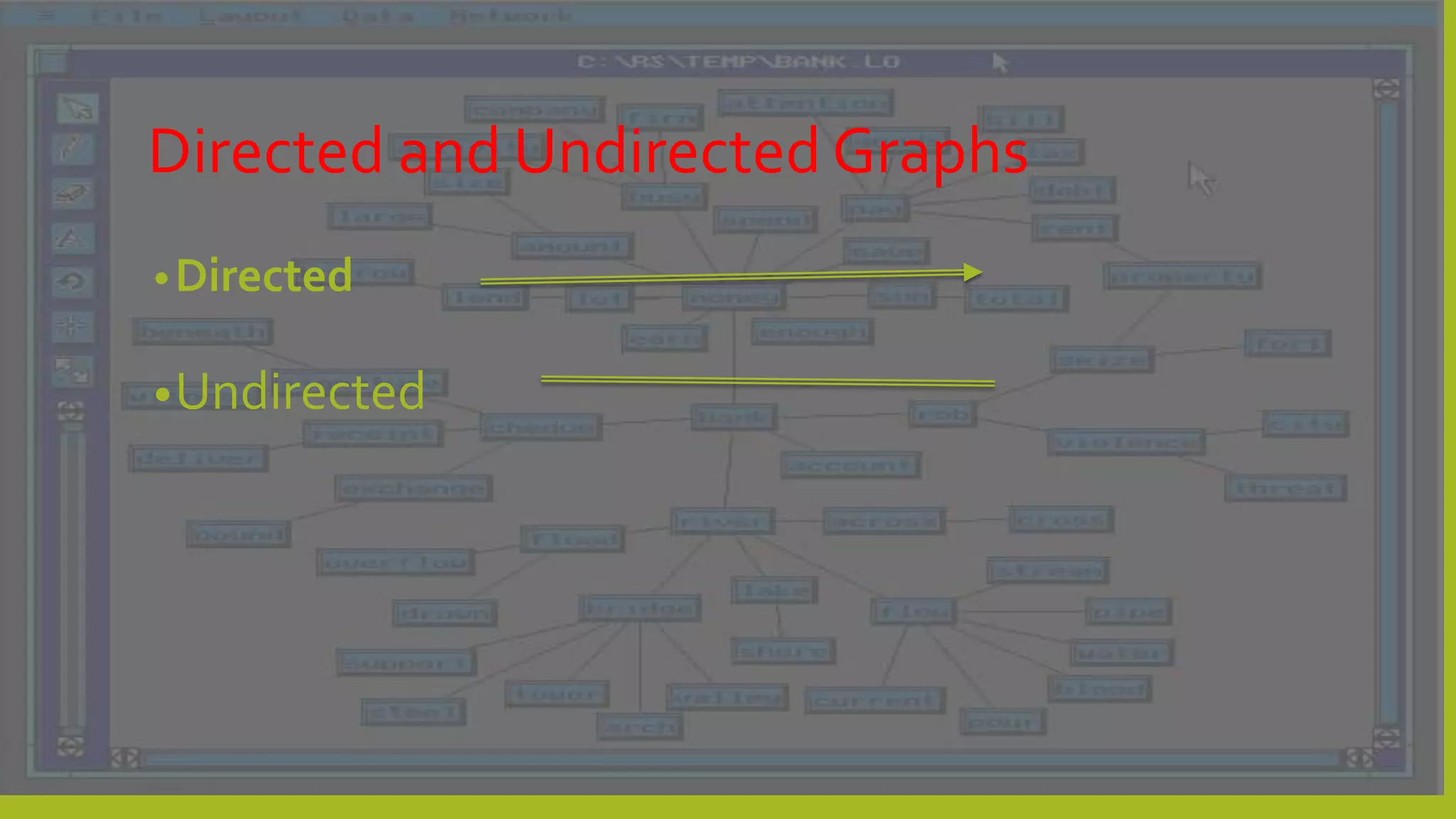
Directed and Undirected Graphs
•Directed
•Undirected
• Derived from proximities for pairs of entities
• Proximity ????
Similarities, Correlations, distances, conditional probabilities
or any other relationship among the entities
• Knowledge ElicitationTechnique developed around mid
1980s
Path Finder
Path finder Parameters
q parameter
-- n=Number of nodes or items
-- 2 to n-1
PFNet(q, r)
r parameter
-- Distance of path(Minkowski distance)
-- 1 to infinity
Path Finder
-- Pathfinder algorithm takes
proximity matrices and produces
networks in which nodes are concepts
and links are relations between them.
PFNet(q, r)
--The PFnet(n − 1, ∞) includes all of the links in any
minimum spanning tree
(q, r) no. of links
Example
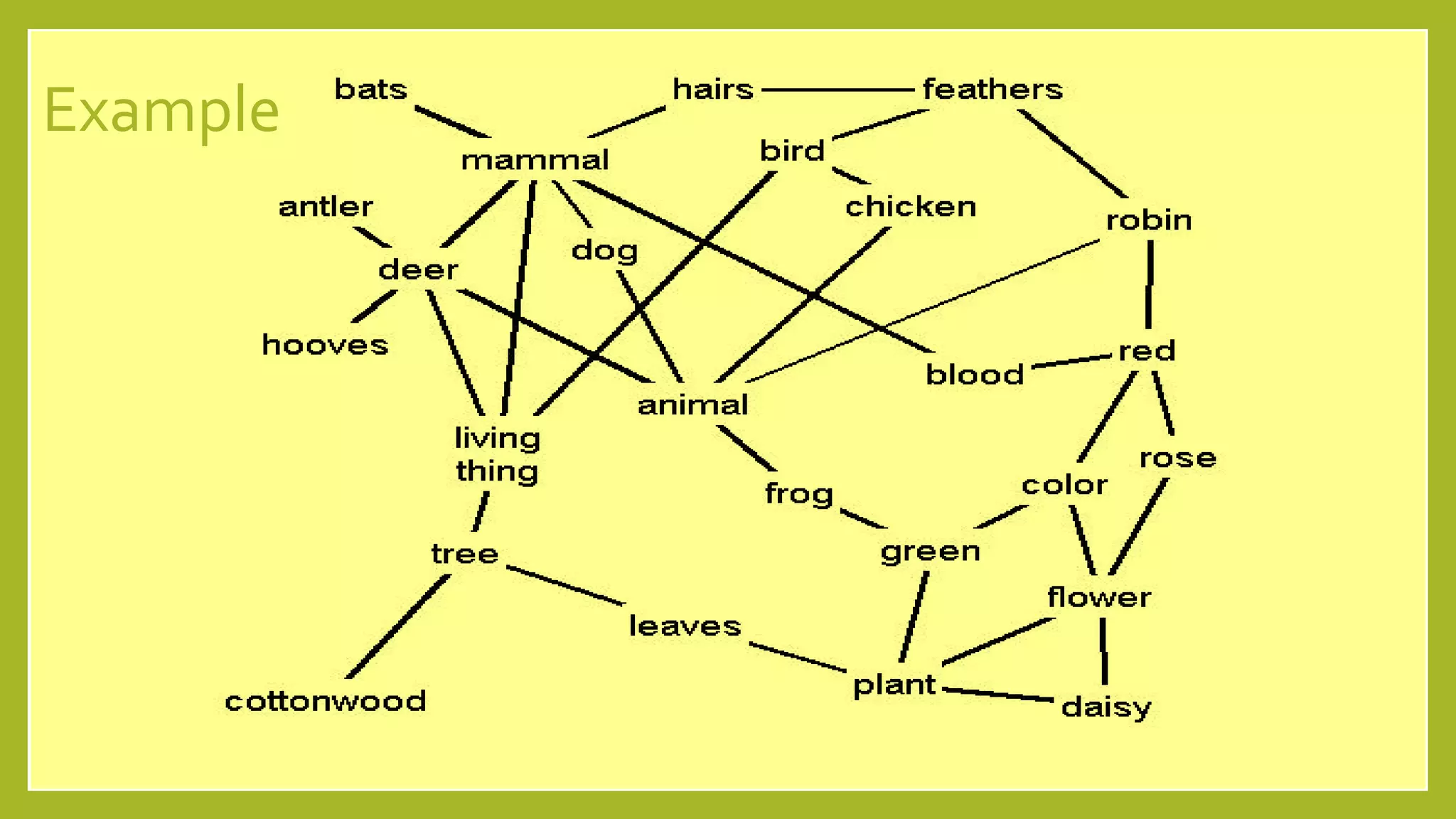
Example
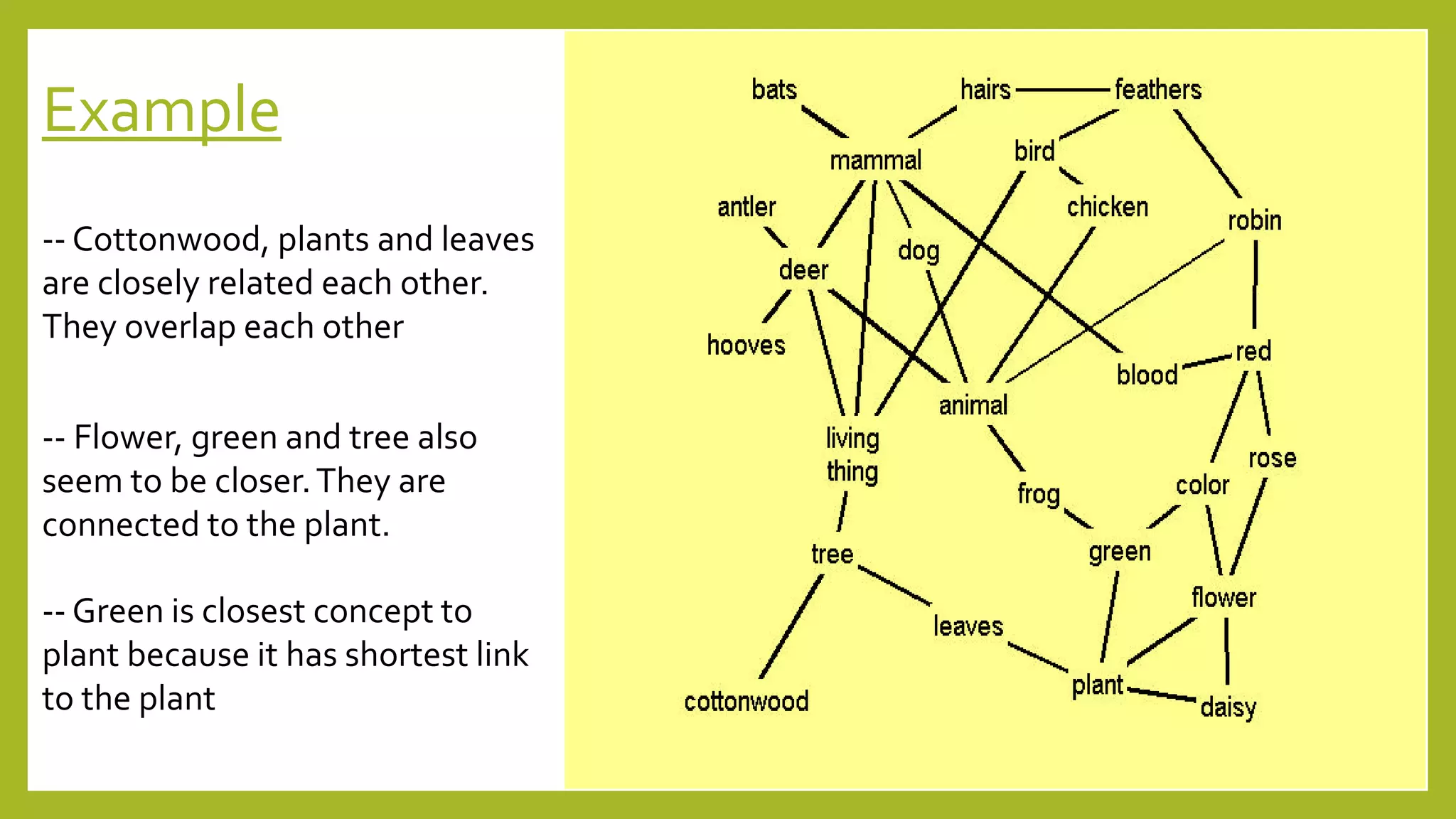
-- Cottonwood, plants and leaves
are closely related each other.
They overlap each other
-- Flower, green and tree also
seem to be closer.They are
connected to the plant.
-- Green is closest concept to
plant because it has shortest link
to the plant
Summary
• Pathfinder is graphic-theoretic technique that forms network from proximity
data.
• Concepts are represented by nodes.Their relationship is represented by link
between them.
• Can be used in knowledge acquisition, data visualization, citation patterns etc.
References:
1. http://en.wikipedia.org/wiki/Pathfinder_network
2. http://interlinkinc.net/Pathfinder.html
3. http://iv.slis.indiana.edu/sw/pfnet.html
4. Schvaneveldt, R.W., Durso, F.T., & Dearholt, D.W. (1989). Network
structures in proximity data. In G. Bower (Ed.),The psychology of learning
and motivation: Advances in research and theory,Vol. 24 (pp. 249–284).
NewYork: Academic Press

Path finder