WORD ASTHMA DAY 2015
ABU-SITTA HOSPITAL
Expanding Our Understanding of Asthma
Challenges in Treating a Heterogeneous
Disease
Asthma has always been susceptible to phenotypes
1- according to asthma trigger
2- according to severity
3- according to response to treatment
• Enhance interpretation of studies
• Promote appropriate comparisons among
studies
• Facilitate genetics research in which
phenotype is correlated with genotype
There is no one gene for asthma.
the following genes to be associated with asthma (IL13, IFNGR2, EDN1, and IL4R), atopy
(FLG, CHIA, IL18, TBXA2R, TLR10, IL4R, IFNGR2, LTA, and VDR), airway hyperresponsiveness
(TLR9, TBXA2R, VDR, and NOD2), and atopic asthma (TLR10, IFNGR2, STAT6, VDR, and C3).
Read More: http://www.atsjournals.org/doi/full/10.1513/pats.6.3.324a#.VUPoENLtmko
Define 9 phenotypes in 3 general
categories:
- Trigger-induced asthma
1) Allergic
2) Non-allergic
3) Aspirin-exacerbated respiratory
disease (AERD)
4) Infection
5) Exercise-induced
- Clinical presentation of asthma
6) Pre-asthma wheezing in infants
- Episodic (viral) wheeze
- Multi-trigger wheezing
7) Exacerbation-prone asthma
8) Asthma associated with apparent
irreversible airflow limitation
- Inflammatory markers of asthma
9) Eosinophilic and neutrophilic asthma
1) Allergic
2) Non-allergic
3) Aspirin-exacerbated respiratory
disease (AERD)
4) Infection
5) Exercise-induced
• the most common phenotype.
• Higher prevalence in children.
• Defined based on sensitization ± clinical
correlation.
sensitization cannot be demonstrated
Negative skin prick or RAST testing
Normal or low IgE
Onset: Late, adult
No personal or family history of allergy
More severe than allergic asthma
less responsive to steroids
Incidence: 10-33%
PROBABLE CRITERIA, WHEN
HISTORY OF ASPIRIN SENSITIVITY
IS ABSENT IN A SUBJECT WITH ASTHMA:
Chronic rhinosinusitis with nasal
polyps
• Adult onset (over age 20 years)
• Peripheral blood eosinophilia
1. Prevalence by history is variable (3-5%) but
may be present in up to 21% of adults and5% of children .
2. Aspirinsensitive asthma more in female
.3. Usual age of onset of symptoms is 30-34
years of age.
4. No known racial predisposition.
5. No known association with lower
socioeconomic status.
1. Familial cases reported but relatively
rare (5.5%).
2. Association with HLA-DQw2 and DPB1.
3. Genetic polymorphisms found in
leukotriene C4 synthase (LTC4S),prostaglandin E2
receptor genes.
1. Associated with more severe, refractory asthma, representing
A major risk factor for severe asthma in outpatients.
2. ASA may induce severe, lifethreatening asthma attacks.
3. Rhinorrhea and nasal congestion are usually the first symptoms
.of aspirinsensitive
4. asthma and are commonly poorly responsive to pharmacological
Treatment.
5. Symptoms manifest within 1-3 hours of ingestion of aspirin and
other NSAD. 1
Trigger-induced asthma
1) Allergic
2) Non-allergic
3) Aspirin-exacerbated respiratory
disease (AERD)
4) Infection
5) Exercise-induced
1- new onset of disease.
2- exacerbations of the disease.
3- Co-morbid condition (e.g. sinusitis).
4- persistence and/or severity of the disease
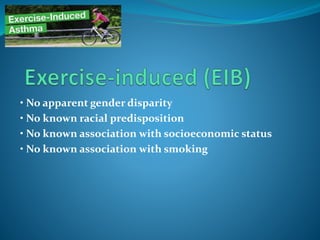
• No apparent gender disparity
• No known racial predisposition
• No known association with socioeconomic status
• No known association with smoking
EIB is generally thought to be due to evaporative
heat and water loss from the airway and various
inflammatory mediators and cells have been
Involved in its pathogenesis.
EIB occurs after the cessation of exercise,
usually within 3-5 minutes, with peak
bronchoconstriction occurring at 10-15 minutes.
Usually defined as ≥ 10% decrease in FEV1 after
exercise.
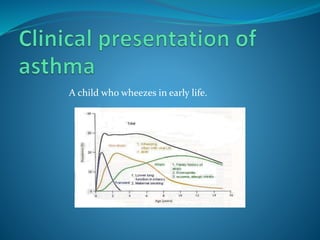
A child who wheezes in early life.
Pre-Asthma Wheezing
(Tucson Children’s Respiratory)
1- Never wheezed 51.5%
2- transient early wheezers 19.9 %
3- late-onset wheezers 15%
4- persistent wheezer s 13.7%
Relation to Severe Asthma
Factors for Severe Exacerbations
• Low FEV1
• African American Ethnicity
• History of Pneumonia
• Early Age of Onset
• NSAID Exacerbated Airway Disease
• Worsening Asthma Symptoms with
Menses
Evidence of both airway obstruction
(reduced FEV1/FVC ratio) and a reduced
FEV1 in a patient treated with both
anti-inflammatory agents
(glucocorticosteroids) and bronchodilators
(beta-agonists))
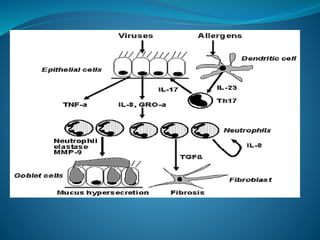
Eosinophilic asthma
• Eosinophilic inflammation associated
with poor asthma control, increased
bronchodilator response, lower lung
function and exacerbations in ICS
treated pts
• More common in aspirin-sensitive
asthma, in association with nasal polyps
and in later onset disease
>2% eosinophils in sputum
. Less atopy,Older , Later onset asthma
• Much less well described and defined than
eosinophilic asthma
• Seems to increase with increasing
severity/CS use
• “Definition”/neutrophil % cut-off unclear
and may depend on sputum processing
method
– Can be seen in association with eosinophil
phenotype
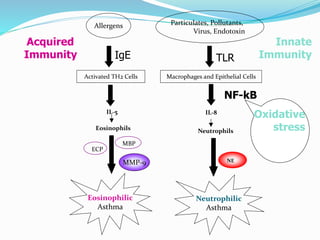
IL-5
Eosinophils
ECP
MBP
IL-8
Neutrophils
NE
Macrophages and Epithelial Cells
Allergens
Activated TH2 Cells
MMP-9
Eosinophilic
Asthma
Neutrophilic
Asthma
Particulates, Pollutants,
Virus, Endotoxin
Acquired
Immunity
Innate
ImmunityTLRIgE
NF-kB
Oxidative
stress
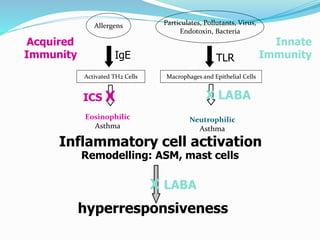
Macrophages and Epithelial Cells
Allergens
Activated TH2 Cells
Eosinophilic
Asthma
Neutrophilic
Asthma
Particulates, Pollutants, Virus,
Endotoxin, Bacteria
Acquired
Immunity
Innate
ImmunityTLRIgE
Inflammatory cell activation
hyperresponsiveness
ICS X X LABA
X LABA
Remodelling: ASM, mast cells
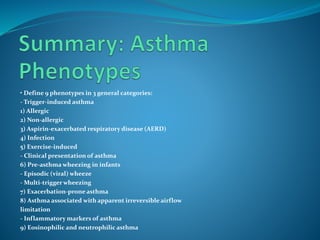
• Define 9 phenotypes in 3 general categories:
- Trigger-induced asthma
1) Allergic
2) Non-allergic
3) Aspirin-exacerbated respiratory disease (AERD)
4) Infection
5) Exercise-induced
- Clinical presentation of asthma
6) Pre-asthma wheezing in infants
- Episodic (viral) wheeze
- Multi-trigger wheezing
7) Exacerbation-prone asthma
8) Asthma associated with apparent irreversible airflow
limitation
- Inflammatory markers of asthma
9) Eosinophilic and neutrophilic asthma
-Asthma is not a single disease.
– A patient can have >1 phenotype
– Specific questions for future research to refine
definitions
Asthma phenotypes

Asthma phenotypes

  • 1.
    WORD ASTHMA DAY2015 ABU-SITTA HOSPITAL
  • 2.
    Expanding Our Understandingof Asthma Challenges in Treating a Heterogeneous Disease
  • 3.
    Asthma has alwaysbeen susceptible to phenotypes 1- according to asthma trigger 2- according to severity 3- according to response to treatment
  • 4.
    • Enhance interpretationof studies • Promote appropriate comparisons among studies • Facilitate genetics research in which phenotype is correlated with genotype
  • 5.
    There is noone gene for asthma. the following genes to be associated with asthma (IL13, IFNGR2, EDN1, and IL4R), atopy (FLG, CHIA, IL18, TBXA2R, TLR10, IL4R, IFNGR2, LTA, and VDR), airway hyperresponsiveness (TLR9, TBXA2R, VDR, and NOD2), and atopic asthma (TLR10, IFNGR2, STAT6, VDR, and C3). Read More: http://www.atsjournals.org/doi/full/10.1513/pats.6.3.324a#.VUPoENLtmko
  • 6.
    Define 9 phenotypesin 3 general categories: - Trigger-induced asthma 1) Allergic 2) Non-allergic 3) Aspirin-exacerbated respiratory disease (AERD) 4) Infection 5) Exercise-induced
  • 7.
    - Clinical presentationof asthma 6) Pre-asthma wheezing in infants - Episodic (viral) wheeze - Multi-trigger wheezing 7) Exacerbation-prone asthma
  • 8.
    8) Asthma associatedwith apparent irreversible airflow limitation - Inflammatory markers of asthma 9) Eosinophilic and neutrophilic asthma
  • 9.
    1) Allergic 2) Non-allergic 3)Aspirin-exacerbated respiratory disease (AERD) 4) Infection 5) Exercise-induced
  • 10.
    • the mostcommon phenotype. • Higher prevalence in children. • Defined based on sensitization ± clinical correlation.
  • 11.
    sensitization cannot bedemonstrated Negative skin prick or RAST testing Normal or low IgE Onset: Late, adult
  • 12.
    No personal orfamily history of allergy More severe than allergic asthma less responsive to steroids Incidence: 10-33%
  • 13.
    PROBABLE CRITERIA, WHEN HISTORYOF ASPIRIN SENSITIVITY IS ABSENT IN A SUBJECT WITH ASTHMA: Chronic rhinosinusitis with nasal polyps • Adult onset (over age 20 years) • Peripheral blood eosinophilia
  • 15.
    1. Prevalence byhistory is variable (3-5%) but may be present in up to 21% of adults and5% of children . 2. Aspirinsensitive asthma more in female .3. Usual age of onset of symptoms is 30-34 years of age. 4. No known racial predisposition. 5. No known association with lower socioeconomic status.
  • 16.
    1. Familial casesreported but relatively rare (5.5%). 2. Association with HLA-DQw2 and DPB1. 3. Genetic polymorphisms found in leukotriene C4 synthase (LTC4S),prostaglandin E2 receptor genes.
  • 17.
    1. Associated withmore severe, refractory asthma, representing A major risk factor for severe asthma in outpatients. 2. ASA may induce severe, lifethreatening asthma attacks. 3. Rhinorrhea and nasal congestion are usually the first symptoms .of aspirinsensitive 4. asthma and are commonly poorly responsive to pharmacological Treatment. 5. Symptoms manifest within 1-3 hours of ingestion of aspirin and other NSAD. 1
  • 18.
    Trigger-induced asthma 1) Allergic 2)Non-allergic 3) Aspirin-exacerbated respiratory disease (AERD) 4) Infection 5) Exercise-induced
  • 19.
    1- new onsetof disease. 2- exacerbations of the disease. 3- Co-morbid condition (e.g. sinusitis). 4- persistence and/or severity of the disease
  • 20.
    • No apparentgender disparity • No known racial predisposition • No known association with socioeconomic status • No known association with smoking
  • 21.
    EIB is generallythought to be due to evaporative heat and water loss from the airway and various inflammatory mediators and cells have been Involved in its pathogenesis. EIB occurs after the cessation of exercise, usually within 3-5 minutes, with peak bronchoconstriction occurring at 10-15 minutes. Usually defined as ≥ 10% decrease in FEV1 after exercise.
  • 22.
    A child whowheezes in early life.
  • 23.
    Pre-Asthma Wheezing (Tucson Children’sRespiratory) 1- Never wheezed 51.5% 2- transient early wheezers 19.9 % 3- late-onset wheezers 15% 4- persistent wheezer s 13.7%
  • 24.
    Relation to SevereAsthma Factors for Severe Exacerbations • Low FEV1 • African American Ethnicity • History of Pneumonia • Early Age of Onset • NSAID Exacerbated Airway Disease • Worsening Asthma Symptoms with Menses
  • 25.
    Evidence of bothairway obstruction (reduced FEV1/FVC ratio) and a reduced FEV1 in a patient treated with both anti-inflammatory agents (glucocorticosteroids) and bronchodilators (beta-agonists))
  • 26.
    Eosinophilic asthma • Eosinophilicinflammation associated with poor asthma control, increased bronchodilator response, lower lung function and exacerbations in ICS treated pts • More common in aspirin-sensitive asthma, in association with nasal polyps and in later onset disease >2% eosinophils in sputum
  • 27.
    . Less atopy,Older, Later onset asthma • Much less well described and defined than eosinophilic asthma • Seems to increase with increasing severity/CS use • “Definition”/neutrophil % cut-off unclear and may depend on sputum processing method – Can be seen in association with eosinophil phenotype
  • 29.
    IL-5 Eosinophils ECP MBP IL-8 Neutrophils NE Macrophages and EpithelialCells Allergens Activated TH2 Cells MMP-9 Eosinophilic Asthma Neutrophilic Asthma Particulates, Pollutants, Virus, Endotoxin Acquired Immunity Innate ImmunityTLRIgE NF-kB Oxidative stress
  • 30.
    Macrophages and EpithelialCells Allergens Activated TH2 Cells Eosinophilic Asthma Neutrophilic Asthma Particulates, Pollutants, Virus, Endotoxin, Bacteria Acquired Immunity Innate ImmunityTLRIgE Inflammatory cell activation hyperresponsiveness ICS X X LABA X LABA Remodelling: ASM, mast cells
  • 31.
    • Define 9phenotypes in 3 general categories: - Trigger-induced asthma 1) Allergic 2) Non-allergic 3) Aspirin-exacerbated respiratory disease (AERD) 4) Infection 5) Exercise-induced - Clinical presentation of asthma 6) Pre-asthma wheezing in infants - Episodic (viral) wheeze - Multi-trigger wheezing 7) Exacerbation-prone asthma 8) Asthma associated with apparent irreversible airflow limitation - Inflammatory markers of asthma 9) Eosinophilic and neutrophilic asthma
  • 32.
    -Asthma is nota single disease. – A patient can have >1 phenotype – Specific questions for future research to refine definitions