Bronchiectasis (non-CF):
A pulmonary and systemic disease
ROSMADI ISMAIL, MD
SEPT 2, 2022
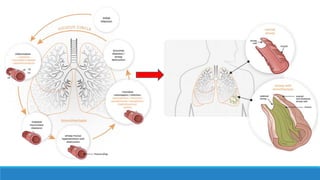
OUTLINE
 overview
 Clinical vignette
 Management of stable cases
 Management of exacerbation
 Future direction
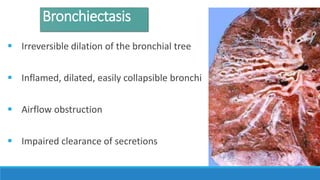
Bronchiectasis
 Irreversible dilation of the bronchial tree
 Inflamed, dilated, easily collapsible bronchi
 Airflow obstruction
 Impaired clearance of secretions
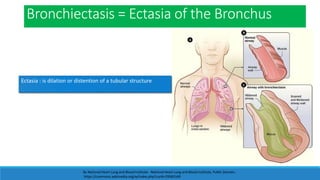
Bronchiectasis = Ectasia of the Bronchus
By National Heart Lung and Blood Institute - National Heart Lung and Blood Institute, Public Domain,
https://commons.wikimedia.org/w/index.php?curid=29583169
Ectasia : is dilation or distention of a tubular structure
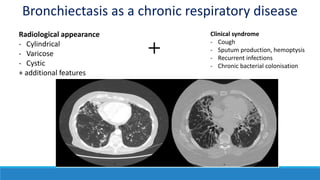
Radiological appearance
- Cylindrical
- Varicose
- Cystic
+ additional features
Clinical syndrome
- Cough
- Sputum production, hemoptysis
- Recurrent infections
- Chronic bacterial colonisation
Bronchiectasis as a chronic respiratory disease
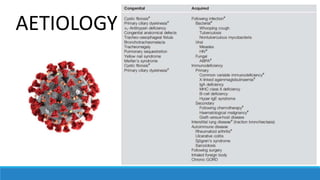
AETIOLOGY
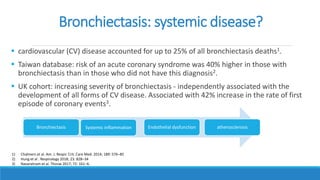
Bronchiectasis: systemic disease?
 cardiovascular (CV) disease accounted for up to 25% of all bronchiectasis deaths1.
 Taiwan database: risk of an acute coronary syndrome was 40% higher in those with
bronchiectasis than in those who did not have this diagnosis2.
 UK cohort: increasing severity of bronchiectasis - independently associated with the
development of all forms of CV disease. Associated with 42% increase in the rate of first
episode of coronary events3.
1) Chalmers et al. Am. J. Respir. Crit. Care Med. 2014; 189: 576–85
2) Hung et al . Respirology 2018; 23: 828–34
3) Navaratnam et al. Thorax 2017; 72: 161–6.
Bronchiectasis Systemic inflammation Endothelial dysfunction atherosclerosis
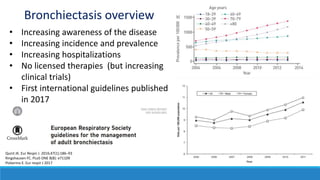
• Increasing awareness of the disease
• Increasing incidence and prevalence
• Increasing hospitalizations
• No licensed therapies (but increasing
clinical trials)
• First international guidelines published
in 2017
Bronchiectasis overview
Quint JK. Eur Respir J. 2016;47(1):186–93
Ringshausen FC. PLoS ONE 8(8): e71109
Polverino E. Eur respir J 2017
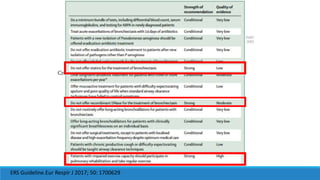
ERS Guideline.Eur Respir J 2017; 50: 1700629
European Respiratory Society guidelines on
bronchiectasis found no strong clinical evidence in
support of pharmacotherapy
Case 1: Diagnosis
 SN L, 35-year-old lady, Para 3
 Referred for newly diagnosed bronchiectasis ( Based on Hx and HRCT)
 Coughing x4 yrs, copious sputum
 mMRC : 1
 No previous hospitalization ( except for child birth)
 Non-smoker
 Work as SN
 No previous exacerbation
Hill et al. Thorax2019;74 (Suppl 1):1–69
British Thoracic Society Guideline 2019
BTS Guideline 2018/9
Hill et al. Thorax2019;74 (Suppl 1):1–69
Whom to investigate?
What radiology?
What tests?
Airways clearance
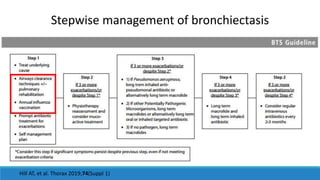
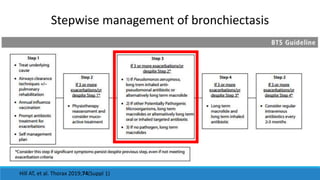
Stepwise Management
The Deteriorating Patient / exacerbation
Who should be followed up in secondary care
Monitoring
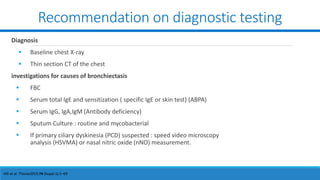
Recommendation on diagnostic testing
Diagnosis
 Baseline chest X-ray
 Thin section CT of the chest
investigations for causes of bronchiectasis
 FBC
 Serum total IgE and sensitization ( specific IgE or skin test) (ABPA)
 Serum IgG, IgA,IgM (Antibody deficiency)
 Sputum Culture : routine and mycobacterial
 If primary ciliary dyskinesia (PCD) suspected : speed video microscopy
analysis (HSVMA) or nasal nitric oxide (nNO) measurement.
Hill et al. Thorax2019;74 (Suppl 1):1–69
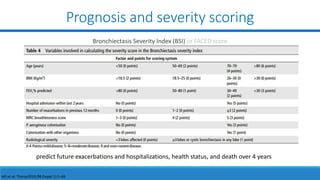
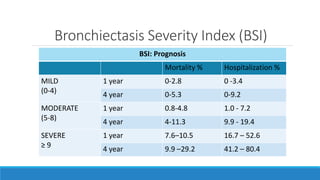
Prognosis and severity scoring
predict future exacerbations and hospitalizations, health status, and death over 4 years
Bronchiectasis Severity Index (BSI) or FACED score
Hill et al. Thorax2019;74 (Suppl 1):1–69
Bronchiectasis Severity Index (BSI)
BSI: Prognosis
Mortality % Hospitalization %
MILD
(0-4)
1 year 0-2.8 0 -3.4
4 year 0-5.3 0-9.2
MODERATE
(5-8)
1 year 0.8-4.8 1.0 - 7.2
4 year 4-11.3 9.9 - 19.4
SEVERE
≥ 9
1 year 7.6–10.5 16.7 – 52.6
4 year 9.9 –29.2 41.2 – 80.4
Case 1: SN L
BMI: 23. FBC: TWC; 6.2 (eosinophil : 9.9%[0.6]), Hb: 11, PLT: 318
RP/ LFT/ FBS: normal
Sputum MTB x2 : negative
Sputum Culture: no growth
RF/ ANCAs/ ANA: -ve
IgG, IgM, IgA: normal level. Serum Galactomannan: -ve
Spirometry 24/5/19:
FEV1: 2.31L (70% pred)
FVC: 2.87L (72% pred)
FEV1/FVC: 80%
BSI: 1 (MILD)
Complaint of copious sputum, through out the day, interfering her job as nurse.
Management for stable bronchiectasis
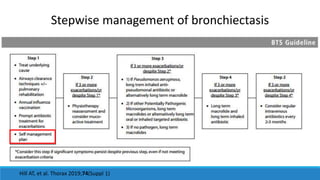
Hill AT, et al. Thorax 2019;74(Suppl 1)
Stepwise management of bronchiectasis
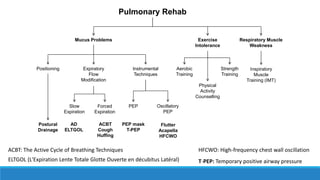
Pulmonary Rehab
Mucus Problems Exercise
Intolerance
Respiratory Muscle
Weakness
Expiratory
Flow
Modification
Slow
Expiration
Forced
Expiration
Instrumental
Techniques
PEP Oscillatory
PEP
Inspiratory
Muscle
Training (IMT)
Aerobic
Training
Strength
Training
AD
ELTGOL
ACBT
Cough
Huffing
Flutter
Acapella
HFCWO
PEP mask
T-PEP
Positioning
Postural
Drainage
Physical
Activity
Counselling
ELTGOL (L'Expiration Lente Totale Glotte Ouverte en décubitus Latéral)
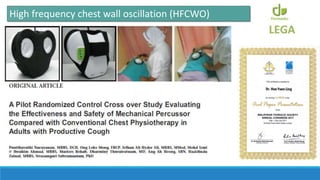
ACBT: The Active Cycle of Breathing Techniques HFCWO: High-frequency chest wall oscillation
T-PEP: Temporary positive airway pressure
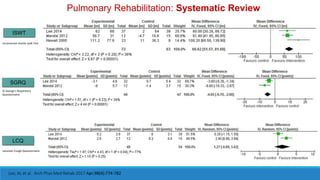
Pulmonary Rehabilitation: Systematic Review
Lee, AL et al. Arch Phys Med Rehab 2017 Apr;98(4):774-782
ISWT
SGRQ
LCQ
Leicester Cough Questionnaire
St George’s Respiratory
Questionnaire
incremental shuttle walk Test
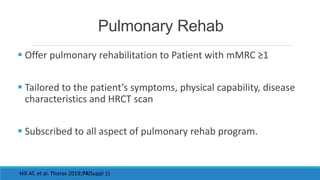
Pulmonary Rehab
 Offer pulmonary rehabilitation to Patient with mMRC ≥1
 Tailored to the patient’s symptoms, physical capability, disease
characteristics and HRCT scan
 Subscribed to all aspect of pulmonary rehab program.
Hill AT, et al. Thorax 2019;74(Suppl 1)
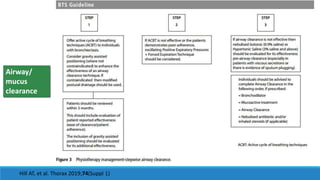
Airway/
mucus
clearance
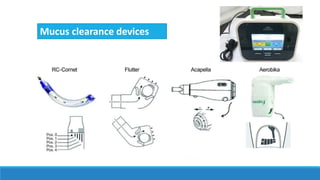
Mucus clearance devices
High frequency chest wall oscillation (HFCWO)
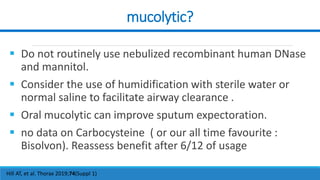
mucolytic?
Hill AT, et al. Thorax 2019;74(Suppl 1)
 Do not routinely use nebulized recombinant human DNase
and mannitol.
 Consider the use of humidification with sterile water or
normal saline to facilitate airway clearance .
 Oral mucolytic can improve sputum expectoration.
 no data on Carbocysteine ( or our all time favourite :
Bisolvon). Reassess benefit after 6/12 of usage
Hill AT, et al. Thorax 2019;74(Suppl 1)
Stepwise management of bronchiectasis
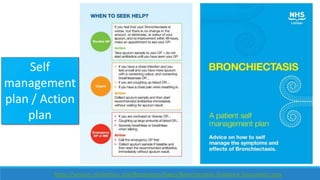
Self
management
plan / Action
plan
https://services.nhslothian.scot/Respiratory/Pages/Bronchiectasis-Guidance-Documents.aspx
Case 2: Exacerbator
 54 year old man, ex-smoker
 Bronchiectasis and COPD
 On LTOT
 > 5 exacerbation over the past 1 year ( hospital stay : 340
days over the past 1 year)
 mMRC : 4
Management for frequent exacerbator
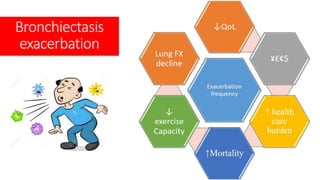
Bronchiectasis
exacerbation
Management of acute exacerbation
 No RCT evaluating the efficacy of antibiotics in exacerbations on
adults.
 Choices of antibiotic should be guided national antibiotic
guideline / hospital or community antibiogram.
 Prompt treatment of exacerbations.
 Use previous sputum bacteriology results.
 May start empirical antibiotics while waiting culture result.
Hill AT, et al. Thorax 2019;74(Suppl 1)
Stepwise management of bronchiectasis
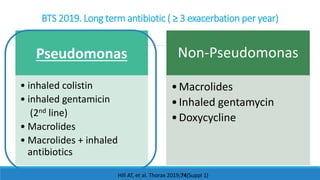
BTS 2019. Long term antibiotic ( ≥ 3 exacerbation per year)
Pseudomonas
• inhaled colistin
• inhaled gentamicin
(2nd line)
• Macrolides
• Macrolides + inhaled
antibiotics
Non-Pseudomonas
•Macrolides
•Inhaled gentamycin
•Doxycycline
Hill AT, et al. Thorax 2019;74(Suppl 1)
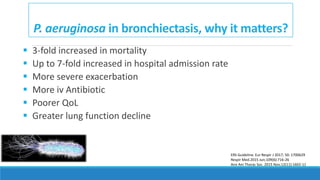
P. aeruginosa in bronchiectasis, why it matters?
 3-fold increased in mortality
 Up to 7-fold increased in hospital admission rate
 More severe exacerbation
 More iv Antibiotic
 Poorer QoL
 Greater lung function decline
ERS Guideline. Eur Respir J 2017; 50: 1700629
Respir Med.2015 Jun;109(6):716-26
Ann Am Thorac Soc. 2015 Nov;12(11):1602-11
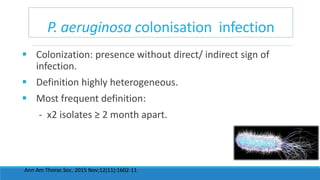
P. aeruginosa colonisation infection
 Colonization: presence without direct/ indirect sign of
infection.
 Definition highly heterogeneous.
 Most frequent definition:
- x2 isolates ≥ 2 month apart.
Ann Am Thorac Soc. 2015 Nov;12(11):1602-11
P. aeruginosa and bronchiectasis
 poor clinical outcomes associated with chronic P. aeruginosa
infection
 P. aeruginosa eradication positively influence important clinical
outcomes including exacerbation frequency
 eradication of organisms other than P. aeruginosa not proven
beneficial
ERS Guideline.Eur Respir J 2017; 50: 1700629
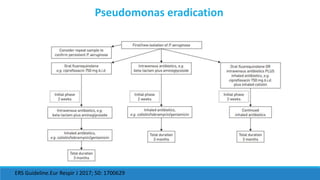
Pseudomonas eradication
ERS Guideline.Eur Respir J 2017; 50: 1700629
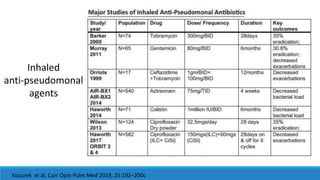
Kocurek et al. Curr Opin Pulm Med 2019, 25:192–200c
Inhaled
anti-pseudomonal
agents
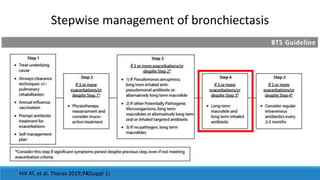
Hill AT, et al. Thorax 2019;74(Suppl 1)
Stepwise management of bronchiectasis
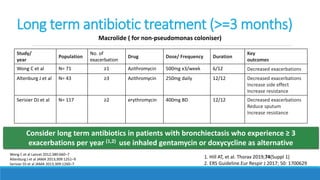
Long term antibiotic treatment (>=3 months)
Study/
year
Population
No. of
exacerbation
Drug Dose/ Frequency Duration
Key
outcomes
Wong C et al N= 71 ≥1 Azithromycin 500mg x3/week 6/12 Decreased exacerbations
Altenburg J et al N= 43 ≥3 Azithromycin 250mg daily 12/12 Decreased exacerbations
Increase side effect
Increase resistance
Serisier DJ et al N= 117 ≥2 erythromycin 400mg BD 12/12 Decreased exacerbations
Reduce sputum
Increase resistance
Wong C et al Lancet 2012;380:660–7
Altenburg J et al JAMA 2013;309:1251–9
Serisier DJ et al JAMA 2013;309:1260–7
Consider long term antibiotics in patients with bronchiectasis who experience ≥ 3
exacerbations per year (1,2) use inhaled gentamycin or doxycycline as alternative
1. Hill AT, et al. Thorax 2019;74(Suppl 1)
2. ERS Guideline.Eur Respir J 2017; 50: 1700629
Macrolide ( for non-pseudomonas coloniser)
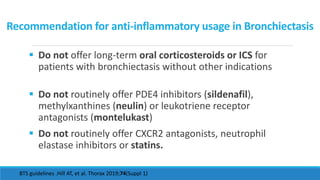
Recommendation for anti-inflammatory usage in Bronchiectasis
 Do not offer long-term oral corticosteroids or ICS for
patients with bronchiectasis without other indications
 Do not routinely offer PDE4 inhibitors (sildenafil),
methylxanthines (neulin) or leukotriene receptor
antagonists (montelukast)
 Do not routinely offer CXCR2 antagonists, neutrophil
elastase inhibitors or statins.
BTS guidelines .Hill AT, et al. Thorax 2019;74(Suppl 1)
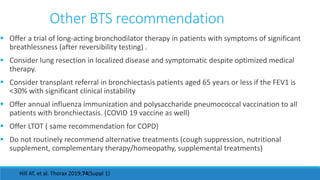
Other BTS recommendation
 Offer a trial of long-acting bronchodilator therapy in patients with symptoms of significant
breathlessness (after reversibility testing) .
 Consider lung resection in localized disease and symptomatic despite optimized medical
therapy.
 Consider transplant referral in bronchiectasis patients aged 65 years or less if the FEV1 is
<30% with significant clinical instability
 Offer annual influenza immunization and polysaccharide pneumococcal vaccination to all
patients with bronchiectasis. (COVID 19 vaccine as well)
 Offer LTOT ( same recommendation for COPD)
 Do not routinely recommend alternative treatments (cough suppression, nutritional
supplement, complementary therapy/homeopathy, supplemental treatments)
Hill AT, et al. Thorax 2019;74(Suppl 1)
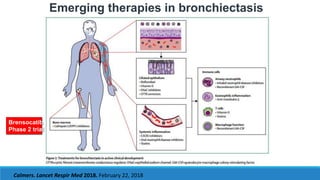
Emerging therapies in bronchiectasis
Calmers. Lancet Respir Med 2018. February 22, 2018
Brensocatib
Phase 2 trial
bronchiectasis a pulmonary and systemic disease 2022.pptx

bronchiectasis a pulmonary and systemic disease 2022.pptx

  • 1.
    Bronchiectasis (non-CF): A pulmonaryand systemic disease ROSMADI ISMAIL, MD SEPT 2, 2022
  • 2.
    OUTLINE  overview  Clinicalvignette  Management of stable cases  Management of exacerbation  Future direction
  • 3.
    Bronchiectasis  Irreversible dilationof the bronchial tree  Inflamed, dilated, easily collapsible bronchi  Airflow obstruction  Impaired clearance of secretions
  • 4.
    Bronchiectasis = Ectasiaof the Bronchus By National Heart Lung and Blood Institute - National Heart Lung and Blood Institute, Public Domain, https://commons.wikimedia.org/w/index.php?curid=29583169 Ectasia : is dilation or distention of a tubular structure
  • 6.
    Radiological appearance - Cylindrical -Varicose - Cystic + additional features Clinical syndrome - Cough - Sputum production, hemoptysis - Recurrent infections - Chronic bacterial colonisation Bronchiectasis as a chronic respiratory disease
  • 7.
  • 8.
    Bronchiectasis: systemic disease? cardiovascular (CV) disease accounted for up to 25% of all bronchiectasis deaths1.  Taiwan database: risk of an acute coronary syndrome was 40% higher in those with bronchiectasis than in those who did not have this diagnosis2.  UK cohort: increasing severity of bronchiectasis - independently associated with the development of all forms of CV disease. Associated with 42% increase in the rate of first episode of coronary events3. 1) Chalmers et al. Am. J. Respir. Crit. Care Med. 2014; 189: 576–85 2) Hung et al . Respirology 2018; 23: 828–34 3) Navaratnam et al. Thorax 2017; 72: 161–6. Bronchiectasis Systemic inflammation Endothelial dysfunction atherosclerosis
  • 9.
    • Increasing awarenessof the disease • Increasing incidence and prevalence • Increasing hospitalizations • No licensed therapies (but increasing clinical trials) • First international guidelines published in 2017 Bronchiectasis overview Quint JK. Eur Respir J. 2016;47(1):186–93 Ringshausen FC. PLoS ONE 8(8): e71109 Polverino E. Eur respir J 2017
  • 10.
    ERS Guideline.Eur RespirJ 2017; 50: 1700629
  • 11.
    European Respiratory Societyguidelines on bronchiectasis found no strong clinical evidence in support of pharmacotherapy
  • 12.
    Case 1: Diagnosis SN L, 35-year-old lady, Para 3  Referred for newly diagnosed bronchiectasis ( Based on Hx and HRCT)  Coughing x4 yrs, copious sputum  mMRC : 1  No previous hospitalization ( except for child birth)  Non-smoker  Work as SN  No previous exacerbation
  • 13.
    Hill et al.Thorax2019;74 (Suppl 1):1–69 British Thoracic Society Guideline 2019
  • 14.
    BTS Guideline 2018/9 Hillet al. Thorax2019;74 (Suppl 1):1–69 Whom to investigate? What radiology? What tests? Airways clearance Stepwise Management The Deteriorating Patient / exacerbation Who should be followed up in secondary care Monitoring
  • 15.
    Recommendation on diagnostictesting Diagnosis  Baseline chest X-ray  Thin section CT of the chest investigations for causes of bronchiectasis  FBC  Serum total IgE and sensitization ( specific IgE or skin test) (ABPA)  Serum IgG, IgA,IgM (Antibody deficiency)  Sputum Culture : routine and mycobacterial  If primary ciliary dyskinesia (PCD) suspected : speed video microscopy analysis (HSVMA) or nasal nitric oxide (nNO) measurement. Hill et al. Thorax2019;74 (Suppl 1):1–69
  • 16.
    Prognosis and severityscoring predict future exacerbations and hospitalizations, health status, and death over 4 years Bronchiectasis Severity Index (BSI) or FACED score Hill et al. Thorax2019;74 (Suppl 1):1–69
  • 17.
    Bronchiectasis Severity Index(BSI) BSI: Prognosis Mortality % Hospitalization % MILD (0-4) 1 year 0-2.8 0 -3.4 4 year 0-5.3 0-9.2 MODERATE (5-8) 1 year 0.8-4.8 1.0 - 7.2 4 year 4-11.3 9.9 - 19.4 SEVERE ≥ 9 1 year 7.6–10.5 16.7 – 52.6 4 year 9.9 –29.2 41.2 – 80.4
  • 18.
    Case 1: SNL BMI: 23. FBC: TWC; 6.2 (eosinophil : 9.9%[0.6]), Hb: 11, PLT: 318 RP/ LFT/ FBS: normal Sputum MTB x2 : negative Sputum Culture: no growth RF/ ANCAs/ ANA: -ve IgG, IgM, IgA: normal level. Serum Galactomannan: -ve Spirometry 24/5/19: FEV1: 2.31L (70% pred) FVC: 2.87L (72% pred) FEV1/FVC: 80% BSI: 1 (MILD) Complaint of copious sputum, through out the day, interfering her job as nurse.
  • 19.
    Management for stablebronchiectasis
  • 20.
    Hill AT, etal. Thorax 2019;74(Suppl 1) Stepwise management of bronchiectasis
  • 22.
    Pulmonary Rehab Mucus ProblemsExercise Intolerance Respiratory Muscle Weakness Expiratory Flow Modification Slow Expiration Forced Expiration Instrumental Techniques PEP Oscillatory PEP Inspiratory Muscle Training (IMT) Aerobic Training Strength Training AD ELTGOL ACBT Cough Huffing Flutter Acapella HFCWO PEP mask T-PEP Positioning Postural Drainage Physical Activity Counselling ELTGOL (L'Expiration Lente Totale Glotte Ouverte en décubitus Latéral) ACBT: The Active Cycle of Breathing Techniques HFCWO: High-frequency chest wall oscillation T-PEP: Temporary positive airway pressure
  • 23.
    Pulmonary Rehabilitation: SystematicReview Lee, AL et al. Arch Phys Med Rehab 2017 Apr;98(4):774-782 ISWT SGRQ LCQ Leicester Cough Questionnaire St George’s Respiratory Questionnaire incremental shuttle walk Test
  • 24.
    Pulmonary Rehab  Offerpulmonary rehabilitation to Patient with mMRC ≥1  Tailored to the patient’s symptoms, physical capability, disease characteristics and HRCT scan  Subscribed to all aspect of pulmonary rehab program. Hill AT, et al. Thorax 2019;74(Suppl 1)
  • 25.
    Hill AT, etal. Thorax 2019;74(Suppl 1) Airway/ mucus clearance
  • 26.
  • 27.
    High frequency chestwall oscillation (HFCWO)
  • 28.
    mucolytic? Hill AT, etal. Thorax 2019;74(Suppl 1)  Do not routinely use nebulized recombinant human DNase and mannitol.  Consider the use of humidification with sterile water or normal saline to facilitate airway clearance .  Oral mucolytic can improve sputum expectoration.  no data on Carbocysteine ( or our all time favourite : Bisolvon). Reassess benefit after 6/12 of usage
  • 29.
    Hill AT, etal. Thorax 2019;74(Suppl 1) Stepwise management of bronchiectasis
  • 30.
  • 31.
    Case 2: Exacerbator 54 year old man, ex-smoker  Bronchiectasis and COPD  On LTOT  > 5 exacerbation over the past 1 year ( hospital stay : 340 days over the past 1 year)  mMRC : 4
  • 32.
  • 33.
  • 34.
    Management of acuteexacerbation  No RCT evaluating the efficacy of antibiotics in exacerbations on adults.  Choices of antibiotic should be guided national antibiotic guideline / hospital or community antibiogram.  Prompt treatment of exacerbations.  Use previous sputum bacteriology results.  May start empirical antibiotics while waiting culture result. Hill AT, et al. Thorax 2019;74(Suppl 1)
  • 35.
    Hill AT, etal. Thorax 2019;74(Suppl 1) Stepwise management of bronchiectasis
  • 36.
    BTS 2019. Longterm antibiotic ( ≥ 3 exacerbation per year) Pseudomonas • inhaled colistin • inhaled gentamicin (2nd line) • Macrolides • Macrolides + inhaled antibiotics Non-Pseudomonas •Macrolides •Inhaled gentamycin •Doxycycline Hill AT, et al. Thorax 2019;74(Suppl 1)
  • 37.
    P. aeruginosa inbronchiectasis, why it matters?  3-fold increased in mortality  Up to 7-fold increased in hospital admission rate  More severe exacerbation  More iv Antibiotic  Poorer QoL  Greater lung function decline ERS Guideline. Eur Respir J 2017; 50: 1700629 Respir Med.2015 Jun;109(6):716-26 Ann Am Thorac Soc. 2015 Nov;12(11):1602-11
  • 38.
    P. aeruginosa colonisationinfection  Colonization: presence without direct/ indirect sign of infection.  Definition highly heterogeneous.  Most frequent definition: - x2 isolates ≥ 2 month apart. Ann Am Thorac Soc. 2015 Nov;12(11):1602-11
  • 39.
    P. aeruginosa andbronchiectasis  poor clinical outcomes associated with chronic P. aeruginosa infection  P. aeruginosa eradication positively influence important clinical outcomes including exacerbation frequency  eradication of organisms other than P. aeruginosa not proven beneficial ERS Guideline.Eur Respir J 2017; 50: 1700629
  • 40.
  • 41.
    Kocurek et al.Curr Opin Pulm Med 2019, 25:192–200c Inhaled anti-pseudomonal agents
  • 42.
    Hill AT, etal. Thorax 2019;74(Suppl 1) Stepwise management of bronchiectasis
  • 43.
    Long term antibiotictreatment (>=3 months) Study/ year Population No. of exacerbation Drug Dose/ Frequency Duration Key outcomes Wong C et al N= 71 ≥1 Azithromycin 500mg x3/week 6/12 Decreased exacerbations Altenburg J et al N= 43 ≥3 Azithromycin 250mg daily 12/12 Decreased exacerbations Increase side effect Increase resistance Serisier DJ et al N= 117 ≥2 erythromycin 400mg BD 12/12 Decreased exacerbations Reduce sputum Increase resistance Wong C et al Lancet 2012;380:660–7 Altenburg J et al JAMA 2013;309:1251–9 Serisier DJ et al JAMA 2013;309:1260–7 Consider long term antibiotics in patients with bronchiectasis who experience ≥ 3 exacerbations per year (1,2) use inhaled gentamycin or doxycycline as alternative 1. Hill AT, et al. Thorax 2019;74(Suppl 1) 2. ERS Guideline.Eur Respir J 2017; 50: 1700629 Macrolide ( for non-pseudomonas coloniser)
  • 44.
    Recommendation for anti-inflammatoryusage in Bronchiectasis  Do not offer long-term oral corticosteroids or ICS for patients with bronchiectasis without other indications  Do not routinely offer PDE4 inhibitors (sildenafil), methylxanthines (neulin) or leukotriene receptor antagonists (montelukast)  Do not routinely offer CXCR2 antagonists, neutrophil elastase inhibitors or statins. BTS guidelines .Hill AT, et al. Thorax 2019;74(Suppl 1)
  • 45.
    Other BTS recommendation Offer a trial of long-acting bronchodilator therapy in patients with symptoms of significant breathlessness (after reversibility testing) .  Consider lung resection in localized disease and symptomatic despite optimized medical therapy.  Consider transplant referral in bronchiectasis patients aged 65 years or less if the FEV1 is <30% with significant clinical instability  Offer annual influenza immunization and polysaccharide pneumococcal vaccination to all patients with bronchiectasis. (COVID 19 vaccine as well)  Offer LTOT ( same recommendation for COPD)  Do not routinely recommend alternative treatments (cough suppression, nutritional supplement, complementary therapy/homeopathy, supplemental treatments) Hill AT, et al. Thorax 2019;74(Suppl 1)
  • 46.
    Emerging therapies inbronchiectasis Calmers. Lancet Respir Med 2018. February 22, 2018 Brensocatib Phase 2 trial

Editor's Notes

  • #6 The first stage is an initial infective insult to the airways, triggers a mucociliary response. Micro-organisms trigger the release of toxins and an triggers inflammatory response, release of inflammatory mediators. This lead to changes in cilial beat frequency and mucous gland hypersecretion which compromise mucociliary clearance. airways susceptible to microbial colonization amplify inflammatory reaction many folds causing damage to bronchial wall. the self-perpetuating cycle of infection and inflammation, which promotes progressive airway damage and recurrent infections
  • #9 Chalmers cohort on Bronchiectasis severity index validation study.
  • #14 Provide more holistic approach on managing bronchiectasis
  • #15 There are 8 main comprehensive component in the guidelines, however I would be presenting only few key component as highlited above
  • #16 a baseline chest X-ray, which is a useful first-line test to exclude other pathologies, and a thin section CT of the chest, as the chest X-ray lacks both sensitivity and specificity in the diagnosis of bronchiectasis.
  • #17 Once we diagnosed and investigated the patient, almost similar with other common respiratory diseases such as asthma and COPD, we should stratify the disease severity. BSI predict future exacerbations and hospitalizations, health status, and death over 4 years
  • #21 Lets see how should manage her according to stepwise approach based on BTS guideline
  • #23 ELTGOL: slow expiration with the glottis opened in a lateral posture
  • #24 Figure 1. The effect of PR or ET vs no treatment on incremental shuttle walk distance immediately following 8 weeks of intervention. (higher=better) Figure 2. The effect of PR or ET vs no treatment on St George’s Respiratory Questionnaire (Total score) immediately following 8 weeks of intervention. (higher score= worse) Figure 3. The effect of PR or ET vs no treatment on Leicester Cough Questionnaire (Total score) immediately following 8 weeks of intervention. (more marks =better)
  • #26 Part of the pulmonary rehab is sputum clearance. Patients should be taught an airway clearance technique by a trained respiratory physiotherapist, to perform once or twice daily. As in our patient her main concerned was copious sputum production
  • #30 To empower our patient, they should be taught self manage plan and written action plan should be provided.
  • #31 Here are the example of written self management plan
  • #35 prompt treatment of exacerbations. and suitable patients should have antibiotics to keep at home
  • #38 Why pseudomonas
  • #41 Conditional recommendation, very low evidence.
  • #47 CXCR : CXC chemokine receptor