INTRODUCTION
 Definition : Hyperresponsiveness of the tracheobronchial tree to
extrinsic or intrinsic stimuli characterized by reversible airflow
obstruction
 Inflammation in the airways- more responsive wide range of triggers
 Narrowing of the airways usually reversible
 In chronic asthma there may be an element of irreversible airflow
obstruction
PREVALENCE
 Can present at any age, peak age of 3 years.
 In childhood, twice as many males as females are asthmatic,
Adulthood- the sex ratio equalized
 Most patients with asthma in affluent countries are atopic, with
allergic sensitization to the house dust mite Dermatophagoides
pteronyssinus
Prevalence contd…
 Adults with asthma- rarely become permanently asymptomatic
 Those with mild asthma rarely progress to more severe disease,
whereas
those with severe asthma usually have severe disease at the onset.
 Deaths from asthma are uncommon
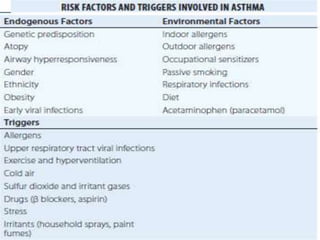
RISK FACTORS AND TRIGGERS
 Asthma is a heterogeneous disease with interplay between genetic
and environmental factors
 Risk factors that predispose to asthma have been identified
ATOPY
• Atopy is due to the genetically determined production of specific
IgE antibody, with many patients showing a family history of
allergic diseases
• Atopy is the major risk factor for asthma
• Nonatopic individuals have a very low risk of developing asthma.
• Patients with asthma commonly suffer from other atopic diseases,
particularly allergic rhinitis
GENETIC PREDISPOSITION :
Familial association of asthma
Severity of asthma is also genetically determined
INFECTIONS:
• Although viral infections (especially rhinovirus) are common
triggers of asthma exacerbations, it is uncertain whether they play
a role in etiology
• Atypical bacteria, such as Mycoplasma and Chlamydophila, have
been implicated
• Lower levels of infection may be a factor in affluent societies that
increase the risks of asthma. This “hygiene hypothesis”
DIET:
• Diets low in antioxidants such as vitamin C and vitamin A,
magnesium, selenium, and omega-3 polyunsaturated fats (fish oil)
or
high in sodium and omega-6 polyunsaturated fats are associated
with an increased risk of asthma.
• Vitamin D deficiency may also predispose
• Obesity is also an independent risk factor for asthma
AIR POLLUTION:
• Air pollutants, such as sulfur dioxide, ozone, and diesel
particulates, may trigger asthma symptoms
• Asthma is no more prevalent in cities with a high ambient level of
traffic pollution than in rural areas with low levels of pollution
• There is some evidence that maternal smoking is a risk factor for
asthma
ALLERGENS:
• Inhaled allergens are common triggers of asthma symptoms and
have also been implicated in allergic sensitization.
• The increase in house dust mites in centrally heated poorly
ventilated homes with fitted carpets has been implicated in the
increasing prevalence of asthma in affluent countries
• Domestic pets, particularly cats, have also been associated with
allergic sensitization
OCCUPATIONAL EXPOSURE:
• Occupational asthma is relatively common and may affect up to
10% of young adults.
• Over 300 sensitizing agents have been identified.
• Chemicals such as toluene diisocyanate and trimellitic anhydride,
may lead to sensitization independent of atopy.
OBESITY:
 Asthma occurs more frequently in obese people (body mass index
>30 kg/m2) and is often more difficult to control
INTRINSIC ASTHMA :
• Minority of asthmatic patients (approximately 10%) have negative
skin tests to common inhalant allergens and normal serum
concentrations of IgE.
• These patients, with nonatopic or intrinsic asthma, usually show
later onset of disease (adult-onset asthma), commonly have
concomitant nasal polyps, and may be aspirin-sensitive.
• They usually have more severe, persistent asthma.
• Little is understood about mechanism, but the immunopathology
in bronchial biopsies and sputum appears to be identical to that
found in atopic asthma
TRIGGERS
• Inhaled allergens activate mast cells with bound IgE directly
leading to the immediate release of bronchoconstrictor
mediators
• Most common allergens to trigger asthma are Dermatophagoides
species
• Other allergens, including grass pollen, ragweed, tree pollen, and
fungal spores, are seasonal
• Upper respiratory tract virus infections such as rhinovirus,
respiratory syncytial virus, and coronavirus
• Exercise Exercise is a common trigger of asthma, particularly in
children. The mechanism is linked to hyperventilation, which
results in increased osmolality in airway lining fluid and triggers
mast cell mediator release
• Physical factors Cold air and hyperventilation may trigger asthma
through the same mechanisms as exercise.
• Food and diet : There is little evidence that allergic reactions to
food lead to increased asthma symptoms, despite the belief of
many patients that their symptoms are triggered by particular
food constituents.
• Certain food additives may trigger asthma.
• Metabisulfite, which is used as a food preservative, may trigger
asthma through the release of sulfur dioxide gas in the stomach.
• Air pollution
• Occupational factors: Occupational asthma is characteristically
associated with symptoms at work with relief on weekends and
holidays
• Hormones Some women show premenstrual worsening of asthma,
which can occasionally be very severe
• Thyrotoxicosis and hypothyroidism can both worsen asthma
• Gastroesophageal reflux: might trigger reflex
bronchoconstriction, it rarely causes asthma symptoms
• Stress: Many asthmatics report worsening of symptoms with
stress.
• Psychological factors can induce bronchoconstriction through
cholinergic reflex pathways.
PATHOPHYSIOLOGY
• Specific chronic inflammation of the mucosa of the lower airways
• Pathology:
• Airway mucosa is infiltrated with activated eosinophils and T
lymphocytes, and there is activation of mucosal mast cells
• There are also structural changes in the airways (described as
remodeling)
• A characteristic finding is thickening of the basement membrane
due to subepithelial collagen deposition
• Another common finding in fatal asthma is occlusion of the
airway lumen by a mucous plug
• There is also vasodilation and increased numbers of blood vessels
(angiogenesis)
PHYSIOLOGY
• Limitation of airflow due to
1. Bronchoconstriction
2. Airway edema,
3. Vascular congestion, and
4. Luminal occlusion with exudate
• Reduction in forced expiratory volume in 1 second (FEV1)
• Early closure of peripheral airway – lung hyperinflation air
trapping- increased residual volume
• Airway Hyperresponsiveness : AHR is the characteristic
physiologic abnormality of asthma
CLINICAL FEATURES
• Wheezing, Dyspnea and coughing which are variable
• Symptoms may be worse at night, and patients typically awake in
the early morning hours.
 There is increased mucus production in some patients, with
typically tenacious mucus that is difficult to expectorate
 Prodromal symptoms may precede an attack, with itching under
the chin, discomfort between the scapulae, or inexplicable fear
(impending doom).
 Typical physical signs are inspiratory, and to a greater extent
expiratory, rhonchi throughout the chest, and there may be
hyperinflation
 Some patients may have a predominant nonproductive cough
(cough-variant asthma).
 THERE MAY BE NO ABNORMAL PHYSICAL FINDINGS WHEN
ASTHMA IS UNDER CONTROL.
DIAGNOSIS
 The diagnosis of asthma is usually done clinically but must be
confirmed by objective measurements of lung function.
 Lung Function Tests: Simple spirometry confirms airflow
limitation with a reduced FEV1, FEV1/FVC ratio, and PEF
 Hematologic Tests Blood tests are not usually helpful. Total
serum IgE and specific IgE to inhaled allergens
(radioallergosorbent test [RAST]) may be measured in some
patients.
 Imaging - Chest X-ray : is usually normal, may show hyperinflated
lungs in severe cases. In exacerbations, there may be
pneumothorax. Other findings are pneumonia or eosinophilic
infiltrates in patients with bronchopulmonary aspergillosis.
 Skin Tests : Skin prick tests to common inhalant allergens
Differential diagnosis :
 Eosinophilic pneumonias and systemic vasculitis, including
Churg- Strauss syndrome and polyarteritis nodosa, may be
associated with wheezing.
 Chronic obstructive pulmonary disease (COPD)
 Left ventricular failure
TREATMENT
BRONCHODILATOR THERAPIES :
 Bronchodilators act primarily on airway smooth muscle to reverse
the bronchoconstriction of asthma.
 This gives rapid relief of symptoms
 But has little or no effect on the underlying inflammatory process.
 There are three classes of bronchodilators in current use: β2-
adrenergic agonists, anticholinergics, and theophylline;
Of these, β2-agonists are by far the most effective.
CONTROLLER THERAPIES :
 Inhaled Corticosteroids
 Systemic Corticosteroids : Corticosteroids are used intravenously
(hydrocortisone or methylprednisolone) for the treatment of
acute severe asthma.
 A course of OCS (usually prednisone or prednisolone 30–45 mg
once daily for 5–10 days) is used to treat acute exacerbations of
asthma;
ACUTE SEVERE ASTHMA
 Exacerbations of asthma are feared by patients and may be life
threatening.
 One of the main aims of controller therapy is to prevent
exacerbations, ICS and combination inhalers are very effective.
 Clinical Features : Patients are aware of increasing chest tightness,
wheezing, and dyspnea that are often not or poorly relieved by
their usual reliever inhaler. In severe exacerbations, patients may
be so breathless that they are unable to complete sentences and
may become cyanotic.
 Examination usually shows increased ventilation, hyperinflation,
and tachycardia.
 Pulsus paradoxus may be present, but this is rarely a useful clinical
sign.
 There is a marked fall in spirometric values and PEF.
 Arterial blood gases on air show hypoxemia, and PCO2 is usually
low due to hyperventilation.
 A normal or rising PCO2 is an indication of impending respiratory
failure and requires immediate monitoring and therapy.
 A chest roentgenogram is not usually informative but may show
pneumonia or pneumothorax.
 A high concentration of oxygen should be given by face mask to
achieve oxygen saturation of >90%.
 The mainstay of treatment are high doses of SABA given either by
nebulizer or via a metered-dose inhaler with a spacer.
 In severely ill patients with impending respiratory failure, IV β2-
agonists may be given.
 A nebulized anticholinergic may be added if there is not a
satisfactory response to β2-agonists alone, as there are additive
effects.
 In patients who are refractory to inhaled therapies, a slow infusion
of aminophylline may be effective
 Prophylactic intubation may be indicated for impending
respiratory failure.

ASTHMA.ppt. .

  • 2.
    INTRODUCTION  Definition :Hyperresponsiveness of the tracheobronchial tree to extrinsic or intrinsic stimuli characterized by reversible airflow obstruction  Inflammation in the airways- more responsive wide range of triggers  Narrowing of the airways usually reversible  In chronic asthma there may be an element of irreversible airflow obstruction
  • 3.
    PREVALENCE  Can presentat any age, peak age of 3 years.  In childhood, twice as many males as females are asthmatic, Adulthood- the sex ratio equalized  Most patients with asthma in affluent countries are atopic, with allergic sensitization to the house dust mite Dermatophagoides pteronyssinus
  • 4.
    Prevalence contd…  Adultswith asthma- rarely become permanently asymptomatic  Those with mild asthma rarely progress to more severe disease, whereas those with severe asthma usually have severe disease at the onset.  Deaths from asthma are uncommon
  • 5.
    RISK FACTORS ANDTRIGGERS  Asthma is a heterogeneous disease with interplay between genetic and environmental factors  Risk factors that predispose to asthma have been identified
  • 7.
    ATOPY • Atopy isdue to the genetically determined production of specific IgE antibody, with many patients showing a family history of allergic diseases • Atopy is the major risk factor for asthma • Nonatopic individuals have a very low risk of developing asthma. • Patients with asthma commonly suffer from other atopic diseases, particularly allergic rhinitis
  • 8.
    GENETIC PREDISPOSITION : Familialassociation of asthma Severity of asthma is also genetically determined INFECTIONS: • Although viral infections (especially rhinovirus) are common triggers of asthma exacerbations, it is uncertain whether they play a role in etiology • Atypical bacteria, such as Mycoplasma and Chlamydophila, have been implicated • Lower levels of infection may be a factor in affluent societies that increase the risks of asthma. This “hygiene hypothesis”
  • 9.
    DIET: • Diets lowin antioxidants such as vitamin C and vitamin A, magnesium, selenium, and omega-3 polyunsaturated fats (fish oil) or high in sodium and omega-6 polyunsaturated fats are associated with an increased risk of asthma. • Vitamin D deficiency may also predispose • Obesity is also an independent risk factor for asthma
  • 10.
    AIR POLLUTION: • Airpollutants, such as sulfur dioxide, ozone, and diesel particulates, may trigger asthma symptoms • Asthma is no more prevalent in cities with a high ambient level of traffic pollution than in rural areas with low levels of pollution • There is some evidence that maternal smoking is a risk factor for asthma
  • 11.
    ALLERGENS: • Inhaled allergensare common triggers of asthma symptoms and have also been implicated in allergic sensitization. • The increase in house dust mites in centrally heated poorly ventilated homes with fitted carpets has been implicated in the increasing prevalence of asthma in affluent countries • Domestic pets, particularly cats, have also been associated with allergic sensitization
  • 12.
    OCCUPATIONAL EXPOSURE: • Occupationalasthma is relatively common and may affect up to 10% of young adults. • Over 300 sensitizing agents have been identified. • Chemicals such as toluene diisocyanate and trimellitic anhydride, may lead to sensitization independent of atopy.
  • 13.
    OBESITY:  Asthma occursmore frequently in obese people (body mass index >30 kg/m2) and is often more difficult to control
  • 14.
    INTRINSIC ASTHMA : •Minority of asthmatic patients (approximately 10%) have negative skin tests to common inhalant allergens and normal serum concentrations of IgE. • These patients, with nonatopic or intrinsic asthma, usually show later onset of disease (adult-onset asthma), commonly have concomitant nasal polyps, and may be aspirin-sensitive. • They usually have more severe, persistent asthma. • Little is understood about mechanism, but the immunopathology in bronchial biopsies and sputum appears to be identical to that found in atopic asthma
  • 15.
    TRIGGERS • Inhaled allergensactivate mast cells with bound IgE directly leading to the immediate release of bronchoconstrictor mediators • Most common allergens to trigger asthma are Dermatophagoides species • Other allergens, including grass pollen, ragweed, tree pollen, and fungal spores, are seasonal
  • 16.
    • Upper respiratorytract virus infections such as rhinovirus, respiratory syncytial virus, and coronavirus • Exercise Exercise is a common trigger of asthma, particularly in children. The mechanism is linked to hyperventilation, which results in increased osmolality in airway lining fluid and triggers mast cell mediator release • Physical factors Cold air and hyperventilation may trigger asthma through the same mechanisms as exercise.
  • 17.
    • Food anddiet : There is little evidence that allergic reactions to food lead to increased asthma symptoms, despite the belief of many patients that their symptoms are triggered by particular food constituents. • Certain food additives may trigger asthma. • Metabisulfite, which is used as a food preservative, may trigger asthma through the release of sulfur dioxide gas in the stomach.
  • 18.
    • Air pollution •Occupational factors: Occupational asthma is characteristically associated with symptoms at work with relief on weekends and holidays • Hormones Some women show premenstrual worsening of asthma, which can occasionally be very severe • Thyrotoxicosis and hypothyroidism can both worsen asthma
  • 19.
    • Gastroesophageal reflux:might trigger reflex bronchoconstriction, it rarely causes asthma symptoms • Stress: Many asthmatics report worsening of symptoms with stress. • Psychological factors can induce bronchoconstriction through cholinergic reflex pathways.
  • 20.
    PATHOPHYSIOLOGY • Specific chronicinflammation of the mucosa of the lower airways • Pathology: • Airway mucosa is infiltrated with activated eosinophils and T lymphocytes, and there is activation of mucosal mast cells • There are also structural changes in the airways (described as remodeling) • A characteristic finding is thickening of the basement membrane due to subepithelial collagen deposition • Another common finding in fatal asthma is occlusion of the airway lumen by a mucous plug • There is also vasodilation and increased numbers of blood vessels (angiogenesis)
  • 24.
    PHYSIOLOGY • Limitation ofairflow due to 1. Bronchoconstriction 2. Airway edema, 3. Vascular congestion, and 4. Luminal occlusion with exudate • Reduction in forced expiratory volume in 1 second (FEV1) • Early closure of peripheral airway – lung hyperinflation air trapping- increased residual volume
  • 25.
    • Airway Hyperresponsiveness: AHR is the characteristic physiologic abnormality of asthma
  • 26.
    CLINICAL FEATURES • Wheezing,Dyspnea and coughing which are variable • Symptoms may be worse at night, and patients typically awake in the early morning hours.  There is increased mucus production in some patients, with typically tenacious mucus that is difficult to expectorate
  • 27.
     Prodromal symptomsmay precede an attack, with itching under the chin, discomfort between the scapulae, or inexplicable fear (impending doom).  Typical physical signs are inspiratory, and to a greater extent expiratory, rhonchi throughout the chest, and there may be hyperinflation  Some patients may have a predominant nonproductive cough (cough-variant asthma).  THERE MAY BE NO ABNORMAL PHYSICAL FINDINGS WHEN ASTHMA IS UNDER CONTROL.
  • 28.
    DIAGNOSIS  The diagnosisof asthma is usually done clinically but must be confirmed by objective measurements of lung function.  Lung Function Tests: Simple spirometry confirms airflow limitation with a reduced FEV1, FEV1/FVC ratio, and PEF  Hematologic Tests Blood tests are not usually helpful. Total serum IgE and specific IgE to inhaled allergens (radioallergosorbent test [RAST]) may be measured in some patients.
  • 29.
     Imaging -Chest X-ray : is usually normal, may show hyperinflated lungs in severe cases. In exacerbations, there may be pneumothorax. Other findings are pneumonia or eosinophilic infiltrates in patients with bronchopulmonary aspergillosis.  Skin Tests : Skin prick tests to common inhalant allergens
  • 31.
    Differential diagnosis : Eosinophilic pneumonias and systemic vasculitis, including Churg- Strauss syndrome and polyarteritis nodosa, may be associated with wheezing.  Chronic obstructive pulmonary disease (COPD)  Left ventricular failure
  • 32.
  • 34.
    BRONCHODILATOR THERAPIES : Bronchodilators act primarily on airway smooth muscle to reverse the bronchoconstriction of asthma.  This gives rapid relief of symptoms  But has little or no effect on the underlying inflammatory process.  There are three classes of bronchodilators in current use: β2- adrenergic agonists, anticholinergics, and theophylline; Of these, β2-agonists are by far the most effective.
  • 35.
    CONTROLLER THERAPIES : Inhaled Corticosteroids  Systemic Corticosteroids : Corticosteroids are used intravenously (hydrocortisone or methylprednisolone) for the treatment of acute severe asthma.  A course of OCS (usually prednisone or prednisolone 30–45 mg once daily for 5–10 days) is used to treat acute exacerbations of asthma;
  • 37.
    ACUTE SEVERE ASTHMA Exacerbations of asthma are feared by patients and may be life threatening.  One of the main aims of controller therapy is to prevent exacerbations, ICS and combination inhalers are very effective.  Clinical Features : Patients are aware of increasing chest tightness, wheezing, and dyspnea that are often not or poorly relieved by their usual reliever inhaler. In severe exacerbations, patients may be so breathless that they are unable to complete sentences and may become cyanotic.  Examination usually shows increased ventilation, hyperinflation, and tachycardia.
  • 38.
     Pulsus paradoxusmay be present, but this is rarely a useful clinical sign.  There is a marked fall in spirometric values and PEF.  Arterial blood gases on air show hypoxemia, and PCO2 is usually low due to hyperventilation.  A normal or rising PCO2 is an indication of impending respiratory failure and requires immediate monitoring and therapy.  A chest roentgenogram is not usually informative but may show pneumonia or pneumothorax.
  • 39.
     A highconcentration of oxygen should be given by face mask to achieve oxygen saturation of >90%.  The mainstay of treatment are high doses of SABA given either by nebulizer or via a metered-dose inhaler with a spacer.  In severely ill patients with impending respiratory failure, IV β2- agonists may be given.  A nebulized anticholinergic may be added if there is not a satisfactory response to β2-agonists alone, as there are additive effects.
  • 40.
     In patientswho are refractory to inhaled therapies, a slow infusion of aminophylline may be effective  Prophylactic intubation may be indicated for impending respiratory failure.