Pilot Study: The main symptoms discriminating
asthmatics among secondary school students in
Tripoli.
Abisetta hospital doctors team
Introduced By
Dr .Heba Alshibanee
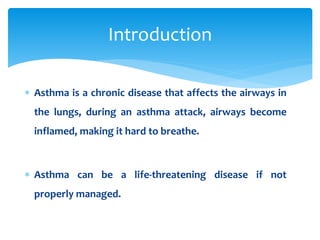
 Asthma affects approximately 300 million people
worldwide , making it one of the most common chronic
diseases in the word.
 It accounts for 250,000 deaths per year worldwide .
 National Annual statistic reports : No Data available.
Introduction
 Asthma is a chronic disease that affects the airways in
the lungs, during an asthma attack, airways become
inflamed, making it hard to breathe.
 Asthma can be a life-threatening disease if not
properly managed.
Introduction
 A disease consisting of a group of symptoms, including
wheeze, cough, shortness of breath, and chest
tightness.
 There is no single diagnostic test or symptom that
defines asthma.
 There is increasing demand for asthma to be diagnosed
as early as possible.
Introduction
To Know the distribution of main
symptoms related to asthma among
secondary school students regarding to
their genders.
Aim of study
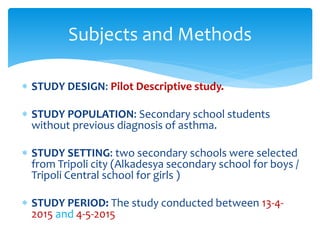
Subjects and Methods
 STUDY DESIGN: Pilot Descriptive study.
 STUDY POPULATION: Secondary school students
without previous diagnosis of asthma.
 STUDY SETTING: two secondary schools were selected
from Tripoli city (Alkadesya secondary school for boys /
Tripoli Central school for girls )
 STUDY PERIOD: The study conducted between 13-4-
2015 and 4-5-2015
Subjects and Methods
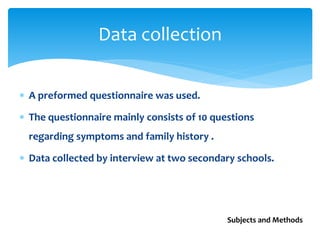
 A preformed questionnaire was used.
 The questionnaire mainly consists of 10 questions
regarding symptoms and family history .
 Data collected by interview at two secondary schools.
Data collection
Subjects and Methods
 The collected data analyzed by using SPSS software
version 16:-
- Descriptive Statistics: median, range and
percentages.
- Inferential Statistics: Chi Square Test
level of significant was 0.05
Statistical Analysis
Subjects and Methods
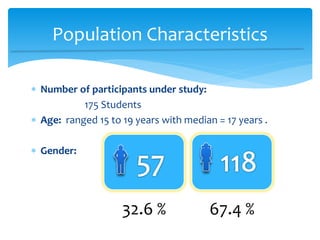
 Number of participants under study:
175 Students
 Age: ranged 15 to 19 years with median = 17 years .
 Gender:
Population Characteristics
32.6 % 67.4 %
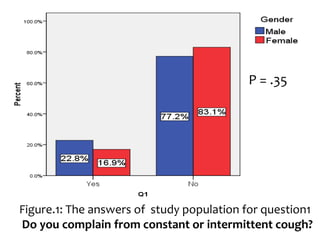
Figure.1: The answers of study population for question1
Do you complain from constant or intermittent cough?
P = .35
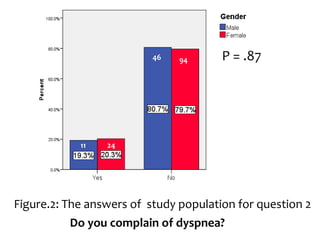
Do you complain of dyspnea?
Figure.2: The answers of study population for question 2
P = .87
11
46
24
94
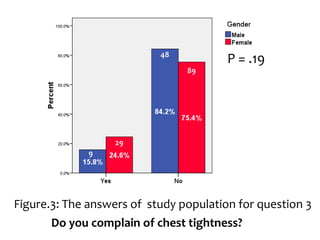
P = .19
9
48
29
89
Do you complain of chest tightness?
Figure.3: The answers of study population for question 3
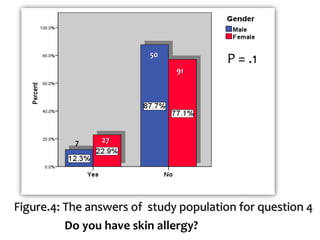
7 27
50
91
P = .1
Figure.4: The answers of study population for question 4
Do you have skin allergy?
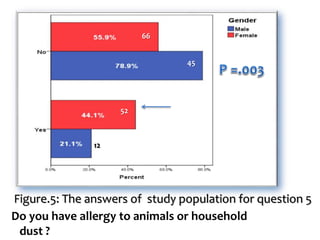
Figure.5: The answers of study population for question 5
Do you have allergy to animals or household
dust ?
12
52
45
66
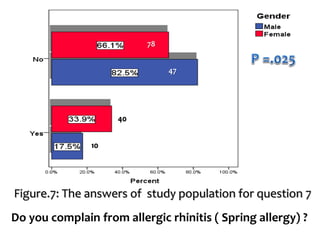
10
40
47
78
Figure.7: The answers of study population for question 7
Do you complain from allergic rhinitis ( Spring allergy) ?
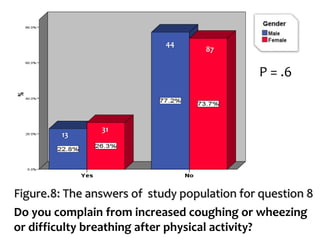
Figure.8: The answers of study population for question 8
Do you complain from increased coughing or wheezing
or difficulty breathing after physical activity?
P = .6
13
31
44
87
d
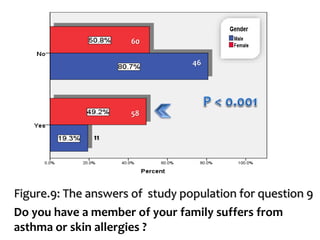
Figure.9: The answers of study population for question 9
Do you have a member of your family suffers from
asthma or skin allergies ?
11
58
46
60
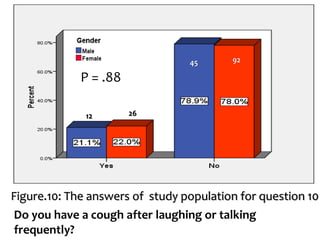
Figure.10: The answers of study population for question 10
Do you have a cough after laughing or talking
frequently?
12 26
45 92
P = .88
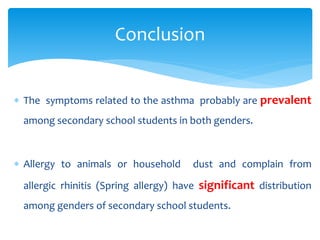
 The symptoms related to the asthma probably are prevalent
among secondary school students in both genders.
 Allergy to animals or household dust and complain from
allergic rhinitis (Spring allergy) have significant distribution
among genders of secondary school students.
Conclusion
 Family history related to asthma or skin allergy also
has significant difference regarding genders of
secondary school students.
 Asthma education for students and awareness
programs for students, school staff and parents are
needed with an urge for community participation
 Periodic health examination of the secondary school
students should be enhanced.
 More researches needed for drawing a definite
epidemiological features of asthma related illness in Libyan
community.
Recommendations
SPECIAL THANKS TO :
 Doctors team by the lead of Dr.Hassan
elmesrati.
 Dr.Tarek alezabi.

Pilot study abusetta hospital

  • 1.
    Pilot Study: Themain symptoms discriminating asthmatics among secondary school students in Tripoli. Abisetta hospital doctors team Introduced By Dr .Heba Alshibanee
  • 2.
     Asthma affectsapproximately 300 million people worldwide , making it one of the most common chronic diseases in the word.  It accounts for 250,000 deaths per year worldwide .  National Annual statistic reports : No Data available. Introduction
  • 3.
     Asthma isa chronic disease that affects the airways in the lungs, during an asthma attack, airways become inflamed, making it hard to breathe.  Asthma can be a life-threatening disease if not properly managed. Introduction
  • 4.
     A diseaseconsisting of a group of symptoms, including wheeze, cough, shortness of breath, and chest tightness.  There is no single diagnostic test or symptom that defines asthma.  There is increasing demand for asthma to be diagnosed as early as possible. Introduction
  • 5.
    To Know thedistribution of main symptoms related to asthma among secondary school students regarding to their genders. Aim of study
  • 6.
  • 7.
     STUDY DESIGN:Pilot Descriptive study.  STUDY POPULATION: Secondary school students without previous diagnosis of asthma.  STUDY SETTING: two secondary schools were selected from Tripoli city (Alkadesya secondary school for boys / Tripoli Central school for girls )  STUDY PERIOD: The study conducted between 13-4- 2015 and 4-5-2015 Subjects and Methods
  • 8.
     A preformedquestionnaire was used.  The questionnaire mainly consists of 10 questions regarding symptoms and family history .  Data collected by interview at two secondary schools. Data collection Subjects and Methods
  • 9.
     The collecteddata analyzed by using SPSS software version 16:- - Descriptive Statistics: median, range and percentages. - Inferential Statistics: Chi Square Test level of significant was 0.05 Statistical Analysis Subjects and Methods
  • 11.
     Number ofparticipants under study: 175 Students  Age: ranged 15 to 19 years with median = 17 years .  Gender: Population Characteristics 32.6 % 67.4 %
  • 12.
    Figure.1: The answersof study population for question1 Do you complain from constant or intermittent cough? P = .35
  • 13.
    Do you complainof dyspnea? Figure.2: The answers of study population for question 2 P = .87 11 46 24 94
  • 14.
    P = .19 9 48 29 89 Doyou complain of chest tightness? Figure.3: The answers of study population for question 3
  • 15.
    7 27 50 91 P =.1 Figure.4: The answers of study population for question 4 Do you have skin allergy?
  • 16.
    Figure.5: The answersof study population for question 5 Do you have allergy to animals or household dust ? 12 52 45 66
  • 17.
    10 40 47 78 Figure.7: The answersof study population for question 7 Do you complain from allergic rhinitis ( Spring allergy) ?
  • 18.
    Figure.8: The answersof study population for question 8 Do you complain from increased coughing or wheezing or difficulty breathing after physical activity? P = .6 13 31 44 87
  • 19.
    d Figure.9: The answersof study population for question 9 Do you have a member of your family suffers from asthma or skin allergies ? 11 58 46 60
  • 20.
    Figure.10: The answersof study population for question 10 Do you have a cough after laughing or talking frequently? 12 26 45 92 P = .88
  • 21.
     The symptomsrelated to the asthma probably are prevalent among secondary school students in both genders.  Allergy to animals or household dust and complain from allergic rhinitis (Spring allergy) have significant distribution among genders of secondary school students. Conclusion
  • 22.
     Family historyrelated to asthma or skin allergy also has significant difference regarding genders of secondary school students.
  • 23.
     Asthma educationfor students and awareness programs for students, school staff and parents are needed with an urge for community participation  Periodic health examination of the secondary school students should be enhanced.  More researches needed for drawing a definite epidemiological features of asthma related illness in Libyan community. Recommendations
  • 24.
    SPECIAL THANKS TO:  Doctors team by the lead of Dr.Hassan elmesrati.  Dr.Tarek alezabi.