ALLERGIC
BRONCHOPULMONARY
ASPERGILLOSIS (ABPA)
ANAS ZARMOUH (CONSULTANT IN GENERAL & RESPIRATORY
MEDICINE)
GLOBAL ASTHMA DAY - TRIPOLI
15 MAY 2018
OUTLINE
• Background
• Pathogenesis
• Aspergillus lung disease
• Diagnosis and work up
• CT appearances
• ABPA and SAFS
• Treatment and follow up
• Summary
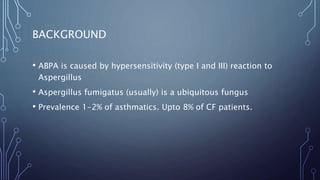
BACKGROUND
• ABPA is caused by hypersensitivity (type I and III) reaction to
Aspergillus
• Aspergillus fumigatus (usually) is a ubiquitous fungus
• Prevalence 1-2% of asthmatics. Upto 8% of CF patients.
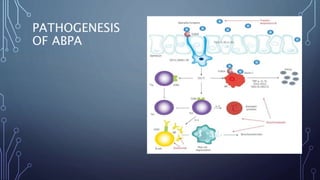
PATHOGENESIS
OF ABPA
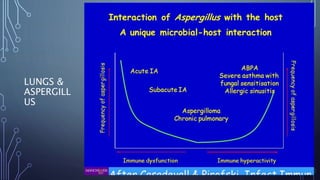
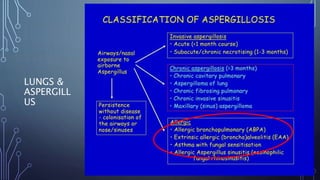
LUNGS &
ASPERGILL
US
LUNGS &
ASPERGILL
US
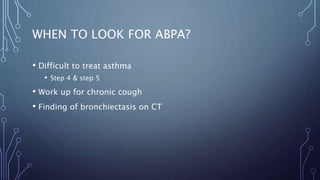
WHEN TO LOOK FOR ABPA?
• Difficult to treat asthma
• Step 4 & step 5
• Work up for chronic cough
• Finding of bronchiectasis on CT
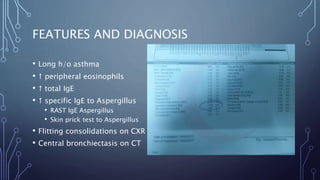
FEATURES AND DIAGNOSIS
• Long h/o asthma
•  peripheral eosinophils
•  total IgE
•  specific IgE to Aspergillus
• RAST IgE Aspergillus
• Skin prick test to Aspergillus
• Flitting consolidations on CXR
• Central bronchiectasis on CT
DIFFERENTIAL DIAGNOSIS
• Severe asthma with fungal
sensitization
• Churg-Strauss syndrome
• Eosinophilic pneumonitis
• Loeffler’s syndrome
(ascariasis)
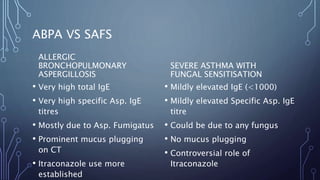
ABPA VS SAFS
ALLERGIC
BRONCHOPULMONARY
ASPERGILLOSIS
• Very high total IgE
• Very high specific Asp. IgE
titres
• Mostly due to Asp. Fumigatus
• Prominent mucus plugging
on CT
• Itraconazole use more
established
SEVERE ASTHMA WITH
FUNGAL SENSITISATION
• Mildly elevated IgE (<1000)
• Mildly elevated Specific Asp. IgE
titre
• Could be due to any fungus
• No mucus plugging
• Controversial role of
Itraconazole
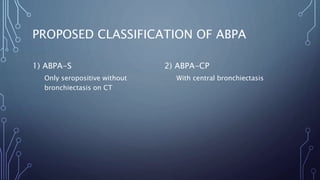
PROPOSED CLASSIFICATION OF ABPA
1) ABPA-S
Only seropositive without
bronchiectasis on CT
2) ABPA-CP
With central bronchiectasis
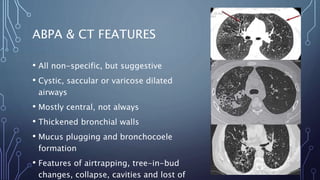
ABPA & CT FEATURES
• All non-specific, but suggestive
• Cystic, saccular or varicose dilated
airways
• Mostly central, not always
• Thickened bronchial walls
• Mucus plugging and bronchocoele
formation
• Features of airtrapping, tree-in-bud
changes, collapse, cavities and lost of
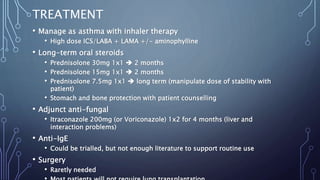
TREATMENT
• Manage as asthma with inhaler therapy
• High dose ICS/LABA + LAMA +/- aminophylline
• Long-term oral steroids
• Prednisolone 30mg 1x1  2 months
• Prednisolone 15mg 1x1  2 months
• Prednisolone 7.5mg 1x1  long term (manipulate dose of stability with
patient)
• Stomach and bone protection with patient counselling
• Adjunct anti-fungal
• Itraconazole 200mg (or Voriconazole) 1x2 for 4 months (liver and
interaction problems)
• Anti-IgE
• Could be trialled, but not enough literature to support routine use
• Surgery
• Raretly needed
FOLLOW UP AND PROGNOSIS
• All ABPA patient should be under routine follow up in the Chest
Clinic
• Total IgE check every 3 months
• Guides OCS tapering or predicts relapse
• Monitor spirometry, mMRC, sputum surveillance (pseudomonas
& NTM), DEXA scan, blood sugar.
• QOL and mortality: No data, but usually similar to patient with
severe asthma
SUMMARY
• Consider ABPA in chronic cough, severe asthma and
bronchiectasis
• CT is not diagnostic, but very useful
• All patients should be under routine follow up in chest clinics
• Treat exacerbations with longer courses of steroids and add
Itraconazole for steroid sparing effect
• Sputum surveillance and detection of Pseudomonas
colonization affects disease progression and prognosis
REFERENCES
• Murray_and_Nadel's_Textbook_of_Respiratory_Medicine v2011
4th edition.
• Oxford handbook of respiratory medicine 2005 1st edition
• Aspergillus & aspergillosis website (www.aspergillus.org.uk)
QUESTIONS!

3 abpa talk

  • 1.
    ALLERGIC BRONCHOPULMONARY ASPERGILLOSIS (ABPA) ANAS ZARMOUH(CONSULTANT IN GENERAL & RESPIRATORY MEDICINE) GLOBAL ASTHMA DAY - TRIPOLI 15 MAY 2018
  • 2.
    OUTLINE • Background • Pathogenesis •Aspergillus lung disease • Diagnosis and work up • CT appearances • ABPA and SAFS • Treatment and follow up • Summary
  • 3.
    BACKGROUND • ABPA iscaused by hypersensitivity (type I and III) reaction to Aspergillus • Aspergillus fumigatus (usually) is a ubiquitous fungus • Prevalence 1-2% of asthmatics. Upto 8% of CF patients.
  • 4.
  • 5.
  • 6.
  • 7.
    WHEN TO LOOKFOR ABPA? • Difficult to treat asthma • Step 4 & step 5 • Work up for chronic cough • Finding of bronchiectasis on CT
  • 8.
    FEATURES AND DIAGNOSIS •Long h/o asthma •  peripheral eosinophils •  total IgE •  specific IgE to Aspergillus • RAST IgE Aspergillus • Skin prick test to Aspergillus • Flitting consolidations on CXR • Central bronchiectasis on CT
  • 9.
    DIFFERENTIAL DIAGNOSIS • Severeasthma with fungal sensitization • Churg-Strauss syndrome • Eosinophilic pneumonitis • Loeffler’s syndrome (ascariasis)
  • 10.
    ABPA VS SAFS ALLERGIC BRONCHOPULMONARY ASPERGILLOSIS •Very high total IgE • Very high specific Asp. IgE titres • Mostly due to Asp. Fumigatus • Prominent mucus plugging on CT • Itraconazole use more established SEVERE ASTHMA WITH FUNGAL SENSITISATION • Mildly elevated IgE (<1000) • Mildly elevated Specific Asp. IgE titre • Could be due to any fungus • No mucus plugging • Controversial role of Itraconazole
  • 11.
    PROPOSED CLASSIFICATION OFABPA 1) ABPA-S Only seropositive without bronchiectasis on CT 2) ABPA-CP With central bronchiectasis
  • 12.
    ABPA & CTFEATURES • All non-specific, but suggestive • Cystic, saccular or varicose dilated airways • Mostly central, not always • Thickened bronchial walls • Mucus plugging and bronchocoele formation • Features of airtrapping, tree-in-bud changes, collapse, cavities and lost of
  • 13.
    TREATMENT • Manage asasthma with inhaler therapy • High dose ICS/LABA + LAMA +/- aminophylline • Long-term oral steroids • Prednisolone 30mg 1x1  2 months • Prednisolone 15mg 1x1  2 months • Prednisolone 7.5mg 1x1  long term (manipulate dose of stability with patient) • Stomach and bone protection with patient counselling • Adjunct anti-fungal • Itraconazole 200mg (or Voriconazole) 1x2 for 4 months (liver and interaction problems) • Anti-IgE • Could be trialled, but not enough literature to support routine use • Surgery • Raretly needed
  • 14.
    FOLLOW UP ANDPROGNOSIS • All ABPA patient should be under routine follow up in the Chest Clinic • Total IgE check every 3 months • Guides OCS tapering or predicts relapse • Monitor spirometry, mMRC, sputum surveillance (pseudomonas & NTM), DEXA scan, blood sugar. • QOL and mortality: No data, but usually similar to patient with severe asthma
  • 15.
    SUMMARY • Consider ABPAin chronic cough, severe asthma and bronchiectasis • CT is not diagnostic, but very useful • All patients should be under routine follow up in chest clinics • Treat exacerbations with longer courses of steroids and add Itraconazole for steroid sparing effect • Sputum surveillance and detection of Pseudomonas colonization affects disease progression and prognosis
  • 16.
    REFERENCES • Murray_and_Nadel's_Textbook_of_Respiratory_Medicine v2011 4thedition. • Oxford handbook of respiratory medicine 2005 1st edition • Aspergillus & aspergillosis website (www.aspergillus.org.uk)
  • 17.