SHORT NOTE ON ASSOCIATIVE MEMORY
Introduction
• A memory unit accessed by content is called associative
memory or content addressable memory(CAM) or associative
storage or associative array.
• Memory is capable of finding empty unused location to store
the word.
• To search particular data in memory, data is read from certain
address and compared if the match is not found content of the
next address is accessed and compared.
• This goes on until required data is found. The number of
access depend on the location of data and efficiency of
searching algorithm.
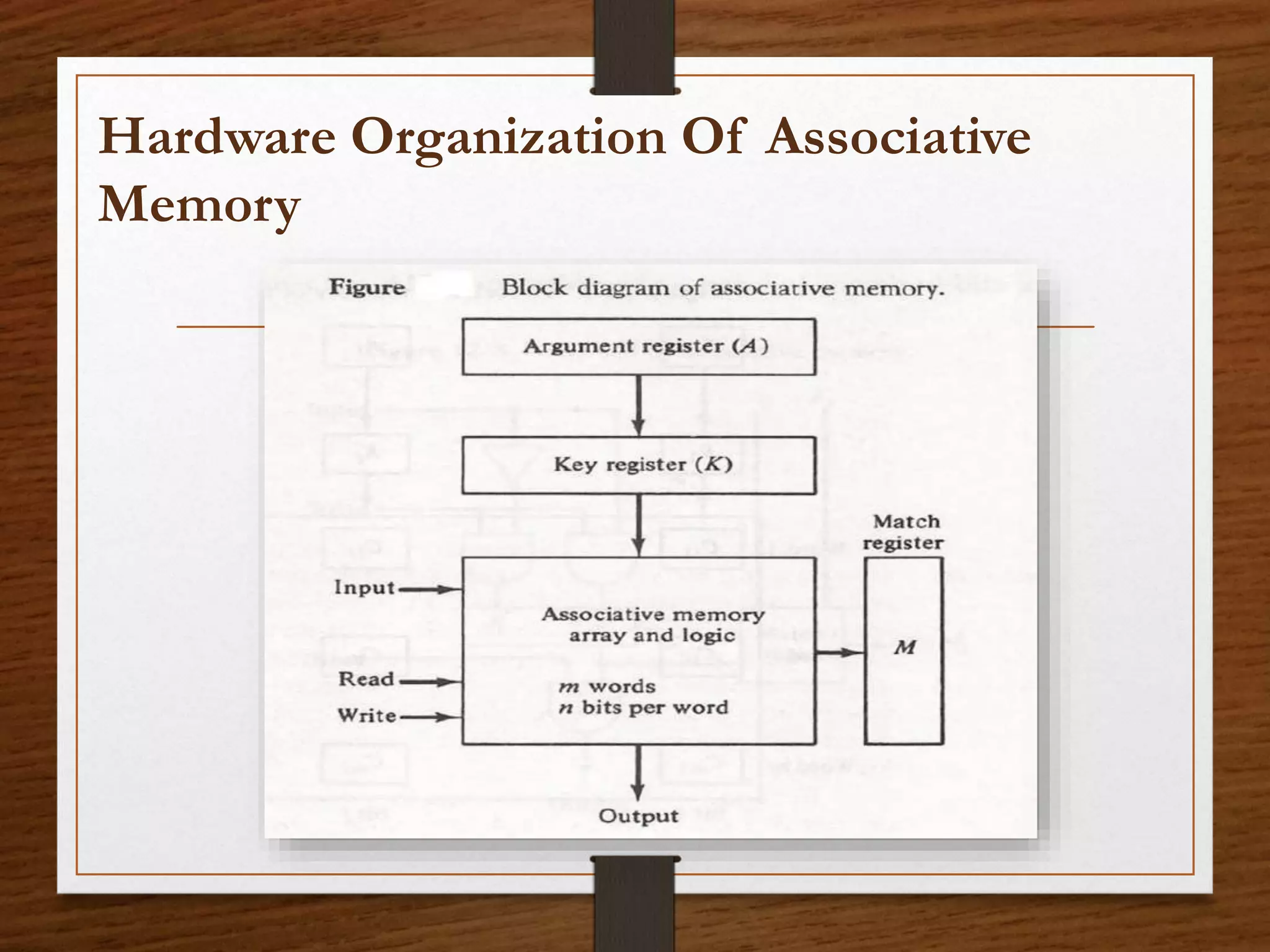
Hardware Organization Of Associative
Memory
Associative Memory is organized in such a way.
• Argument register(A) : It contains the word to be searched. It has
n bits(one for each bit of the word).
• Key Register(K) : This specifies which part of the argument word
needs to be compared with words in memory. If all bits in register
are 1, The entire word should be compared. Otherwise, only the
bits having k bit set to 1 will be compared.
• Associative memory array : It contains the words which are to be
compared with the argument word.
• Match Register(M): It has m bits, one bit corresponding to each
word in the memory array. After the matching process, the bits
corresponding to matching words in match register are set to 1.
Hardware Organization
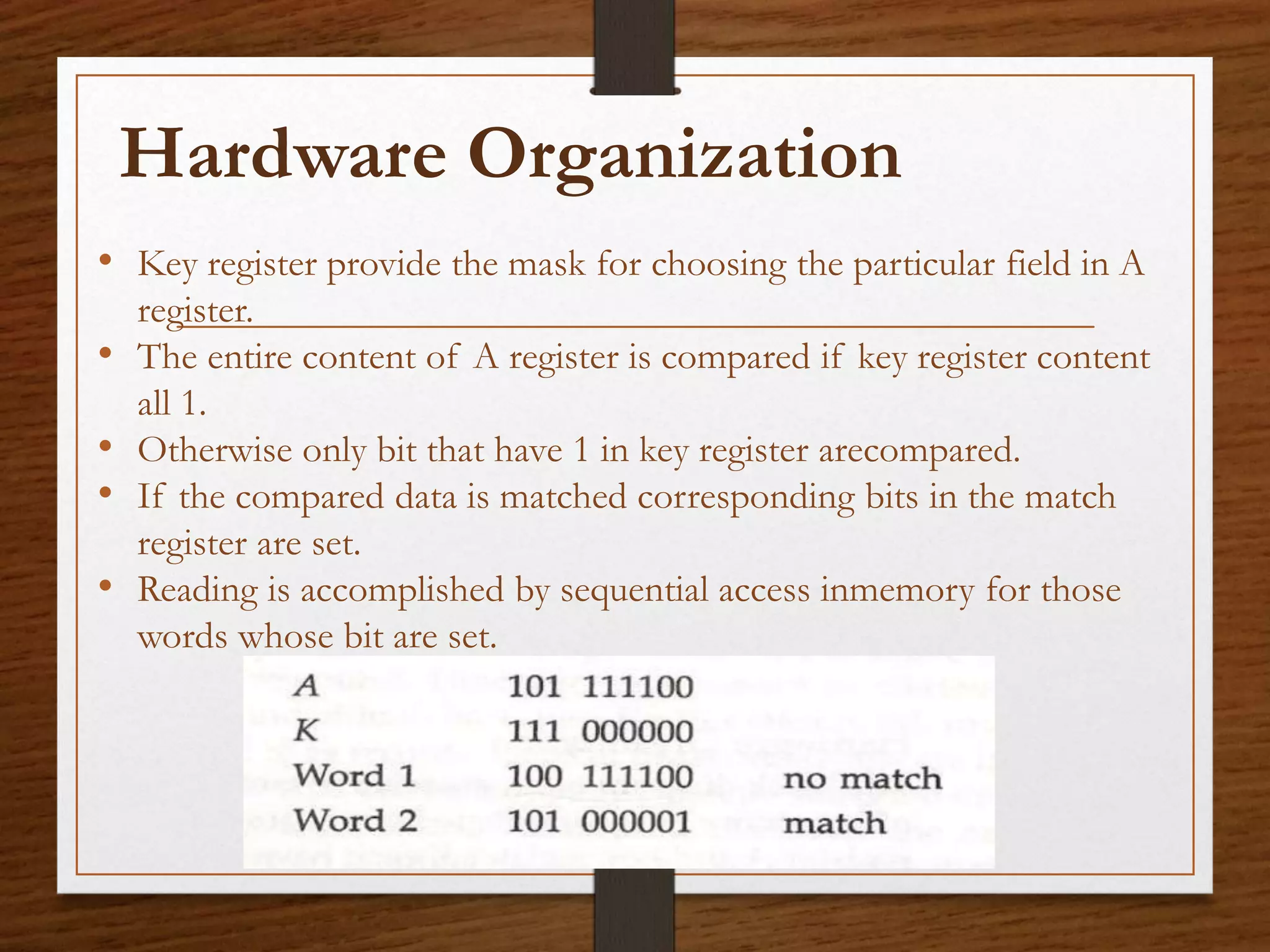
• Key register provide the mask for choosing the particular field in A
register.
• The entire content of A register is compared if key register content
all 1.
• Otherwise only bit that have 1 in key register arecompared.
• If the compared data is matched corresponding bits in the match
register are set.
• Reading is accomplished by sequential access inmemory for those
words whose bit are set.
Hardware Organization
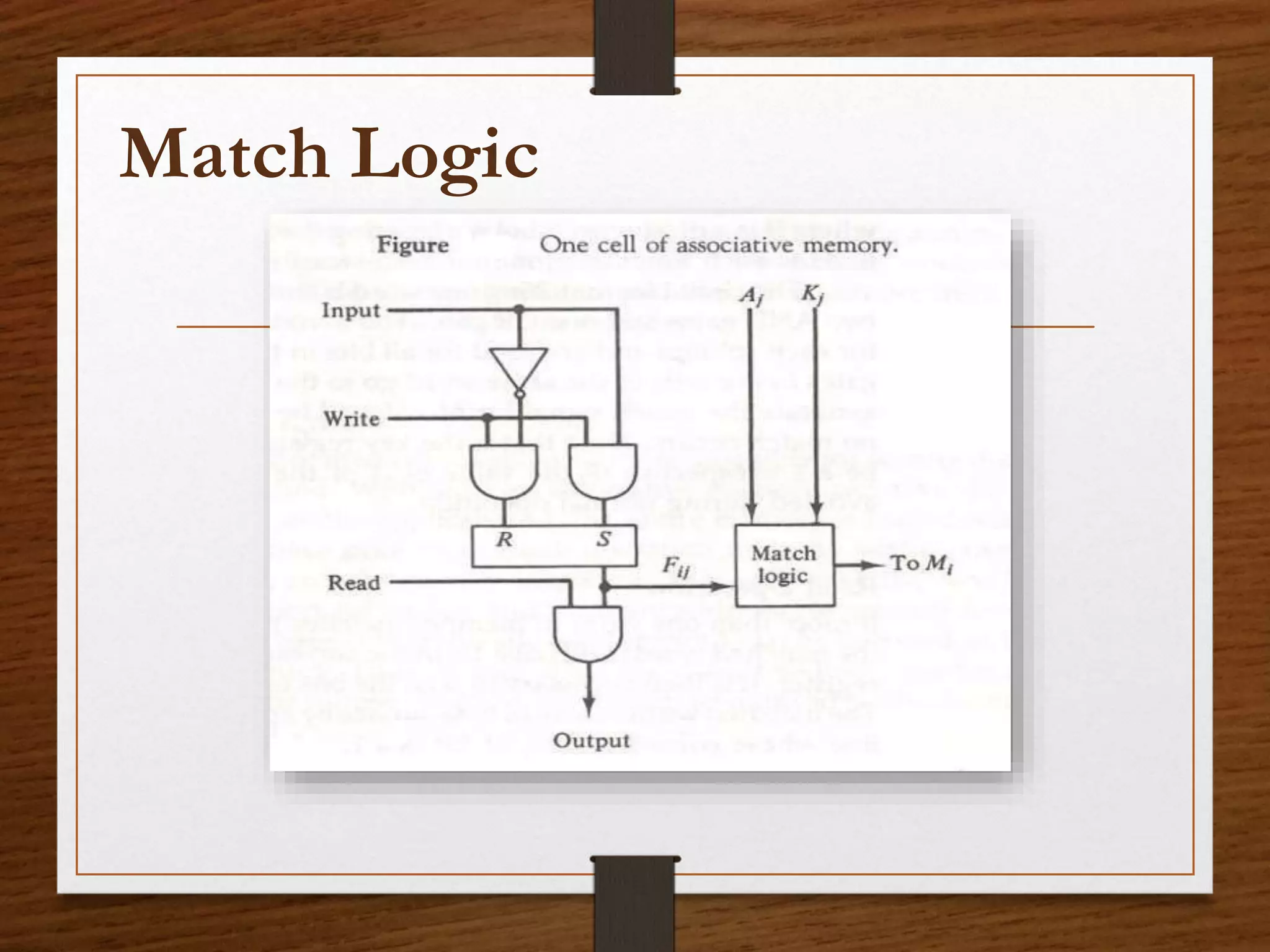
Match Logic
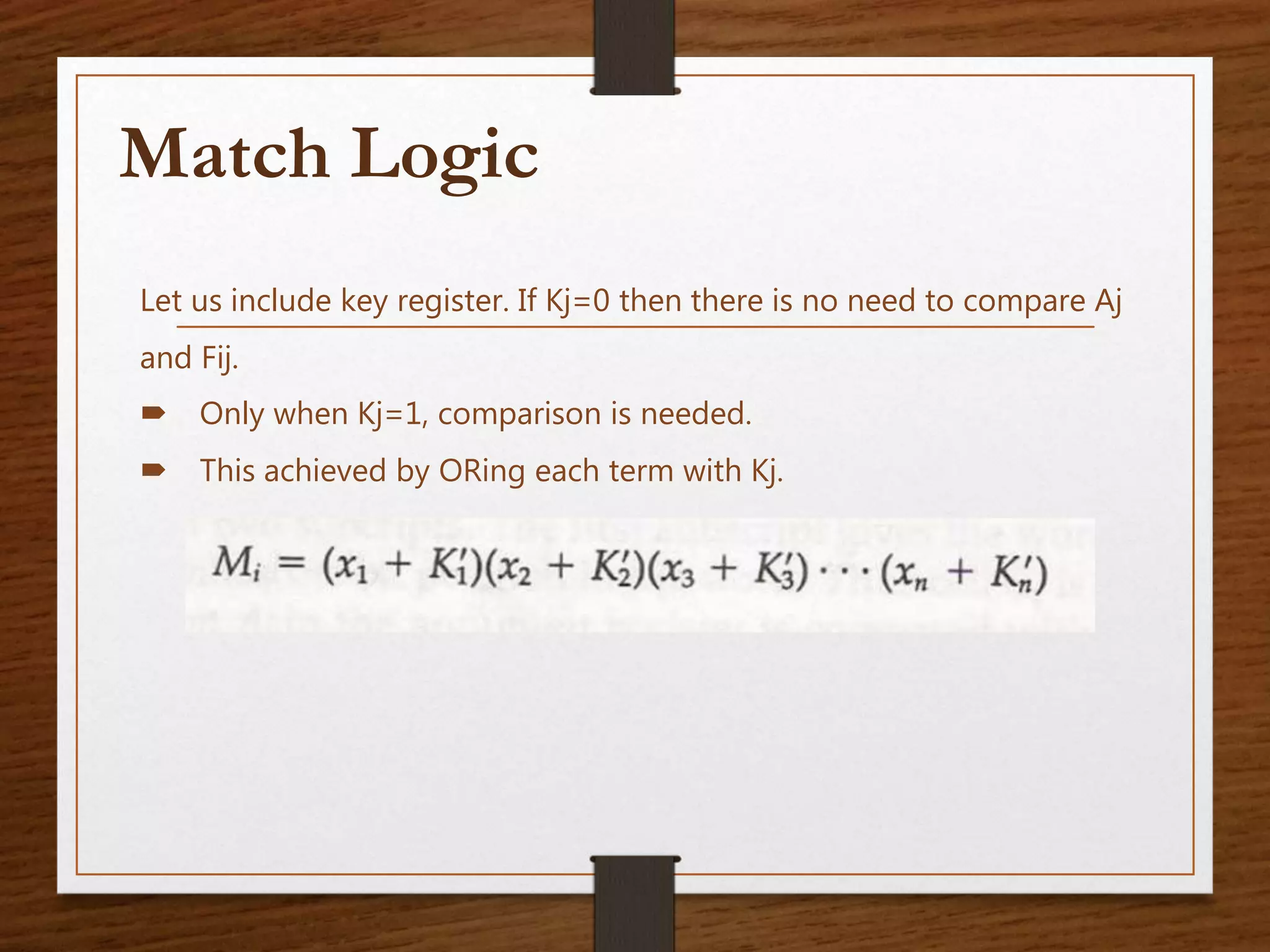
Let us include key register. If Kj=0 then there is no need to compare Aj
and Fij.
 Only when Kj=1, comparison is needed.
 This achieved by ORing each term with Kj.
Match Logic
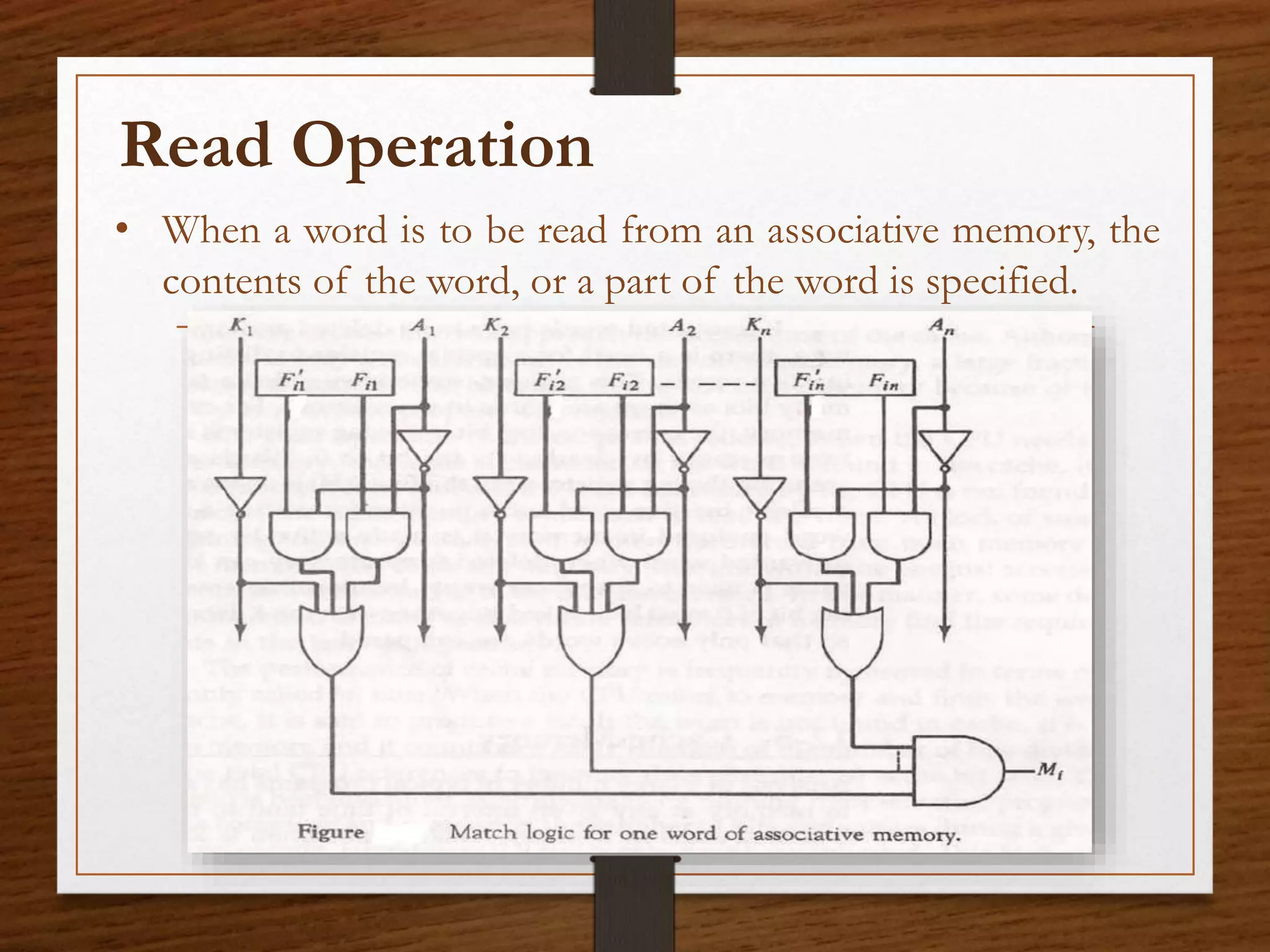
Read Operation
• When a word is to be read from an associative memory, the
contents of the word, or a part of the word is specified.
• If the entire memory is loaded with new information
at once prior to search operation then writing can be
done by addressing each location in sequence.
• Tag register contain as many bits as there are words
in memory.
• It contain 1 for active word and 0 for inactive word
• If the word is to be inserted, tag register is scanned
until 0 is found and word is written at that position
and bit is change to 1.
Write Operation
Advantages
This is suitable for parallel searches. It is also used
where search time needs to be short
Associative memory is often used to speed up
databases, in neural networks and in the page tables
used by the virtual memory of modern computers.
CAM-design challenge is to reduce power
consumption associated with the large amount of
parallel active circuitry, without sacrificing speed or
memory density
Disadvantages
 An associative memory is more expensive than a
random access memory because each cell must
have an extra storage capability as well as logic
circuits for matching its content with an external
argument.
 Usually associative memories are used in
applications where the search time is very critical
and must be very short.
THANK YOU…

Associative memory

  • 1.
    SHORT NOTE ONASSOCIATIVE MEMORY
  • 2.
    Introduction • A memoryunit accessed by content is called associative memory or content addressable memory(CAM) or associative storage or associative array. • Memory is capable of finding empty unused location to store the word. • To search particular data in memory, data is read from certain address and compared if the match is not found content of the next address is accessed and compared. • This goes on until required data is found. The number of access depend on the location of data and efficiency of searching algorithm.
  • 3.
    Hardware Organization OfAssociative Memory
  • 4.
    Associative Memory isorganized in such a way. • Argument register(A) : It contains the word to be searched. It has n bits(one for each bit of the word). • Key Register(K) : This specifies which part of the argument word needs to be compared with words in memory. If all bits in register are 1, The entire word should be compared. Otherwise, only the bits having k bit set to 1 will be compared. • Associative memory array : It contains the words which are to be compared with the argument word. • Match Register(M): It has m bits, one bit corresponding to each word in the memory array. After the matching process, the bits corresponding to matching words in match register are set to 1. Hardware Organization
  • 5.
    • Key registerprovide the mask for choosing the particular field in A register. • The entire content of A register is compared if key register content all 1. • Otherwise only bit that have 1 in key register arecompared. • If the compared data is matched corresponding bits in the match register are set. • Reading is accomplished by sequential access inmemory for those words whose bit are set. Hardware Organization
  • 6.
  • 7.
    Let us includekey register. If Kj=0 then there is no need to compare Aj and Fij.  Only when Kj=1, comparison is needed.  This achieved by ORing each term with Kj. Match Logic
  • 8.
    Read Operation • Whena word is to be read from an associative memory, the contents of the word, or a part of the word is specified.
  • 9.
    • If theentire memory is loaded with new information at once prior to search operation then writing can be done by addressing each location in sequence. • Tag register contain as many bits as there are words in memory. • It contain 1 for active word and 0 for inactive word • If the word is to be inserted, tag register is scanned until 0 is found and word is written at that position and bit is change to 1. Write Operation
  • 10.
    Advantages This is suitablefor parallel searches. It is also used where search time needs to be short Associative memory is often used to speed up databases, in neural networks and in the page tables used by the virtual memory of modern computers. CAM-design challenge is to reduce power consumption associated with the large amount of parallel active circuitry, without sacrificing speed or memory density
  • 11.
    Disadvantages  An associativememory is more expensive than a random access memory because each cell must have an extra storage capability as well as logic circuits for matching its content with an external argument.  Usually associative memories are used in applications where the search time is very critical and must be very short.
  • 12.