DISCOVER . LEARN . EMPOWER
MEMORY ORGANIZATION
University Institute of Engineering
DEPARTMENT OF COMPUTER SCIENCE
& ENGINEERING
Bachelor of Engineering (Computer Science & Engineering)
Subject Name: Computer Organization & Architecture
Subject Code: CST-252
Topics covered
• Memory hierarchy
• Cache Memory Associative Memory
• Cache memory with associative memory
• Virtual Memory:
1. Paging
2. Segmentation
2
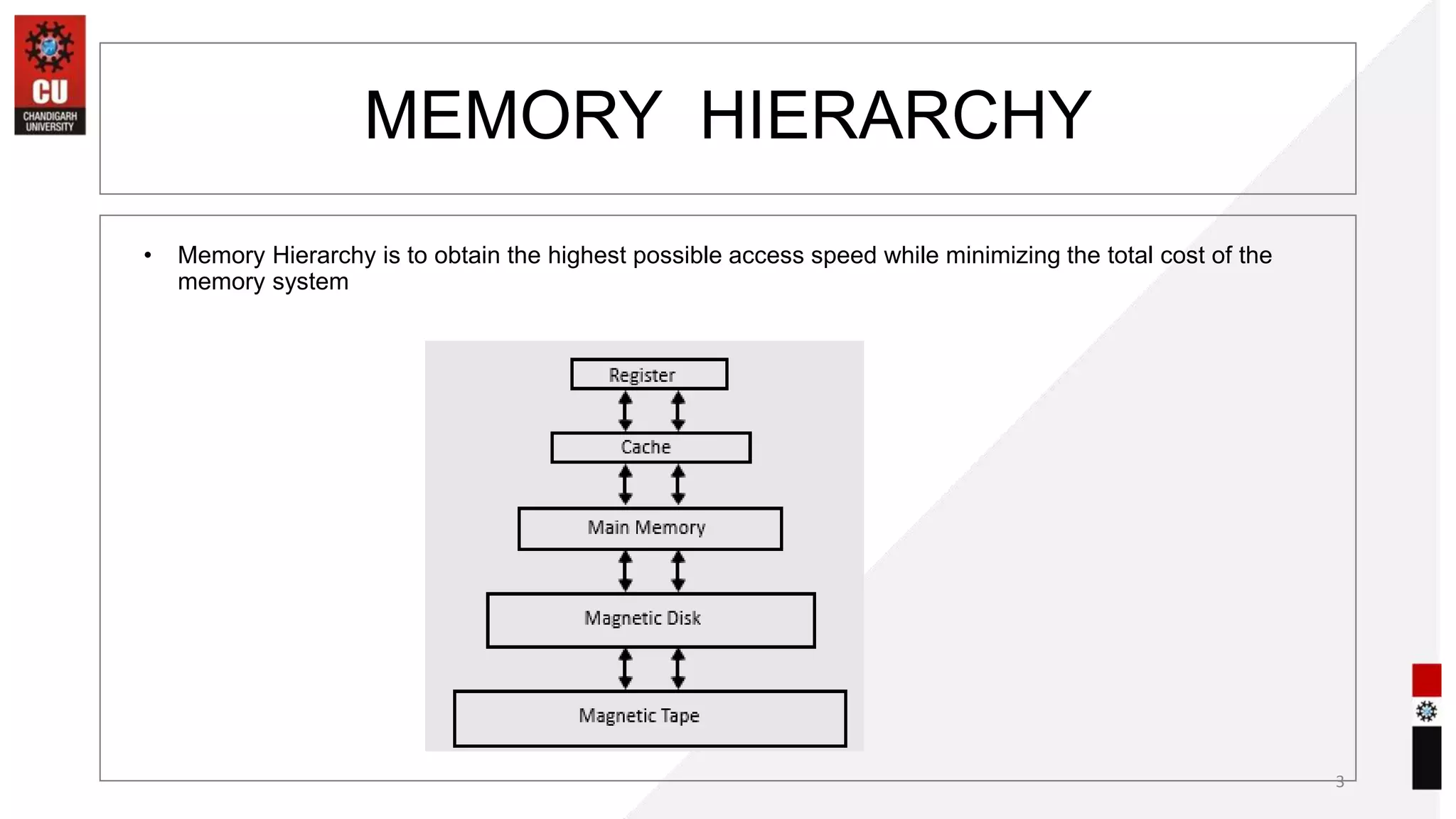
MEMORY HIERARCHY
3
• Memory Hierarchy is to obtain the highest possible access speed while minimizing the total cost of the
memory system
MAIN MEMORY
• Typical RAM chips
• Typical ROM chips
4
Chip select 1
Chip select 2
Read
Write
7-bit address
CS1
CS2
RD
WR
AD 7
128 x 8
RAM
8-bit data bus
CS1 CS2 RD WR
0 0 x x
0 1 x x
1 0 0 0
1 0 0 1
1 0 1 x
1 1 x x
Memory function
Inhibit
Inhibit
Inhibit
Write
Read
Inhibit
State of data bus
High-impedence
High-impedence
High-impedence
Input data to RAM
Output data from RAM
High-impedence
Chip select 1
Chip select 2
9-bit address
CS1
CS2
AD 9
512 x 8
ROM
8-bit data bus
• Address space assignment to each memory chip
• Example: 512 bytes RAM and 512 bytes ROM
• RAM and ROM chips are connected to a CPU through the data and address buses
• - The low-order lines in the address bus select the byte within the chips and other lines in the address bus
select a particular chip through its chip select inputs
5
MEMORY ADDRESS MAP
RAM 1
RAM 2
RAM 3
RAM 4
ROM
0000 - 007F
0080 - 00FF
0100 - 017F
0180 - 01FF
0200 - 03FF
Component
Hexa
address
0 0 0 x x x x x x x
0 0 1 x x x x x x x
0 1 0 x x x x x x x
0 1 1 x x x x x x x
1 x x x x x x x x x
10 9 8 7 6 5 4 3 2 1
Address bus
6
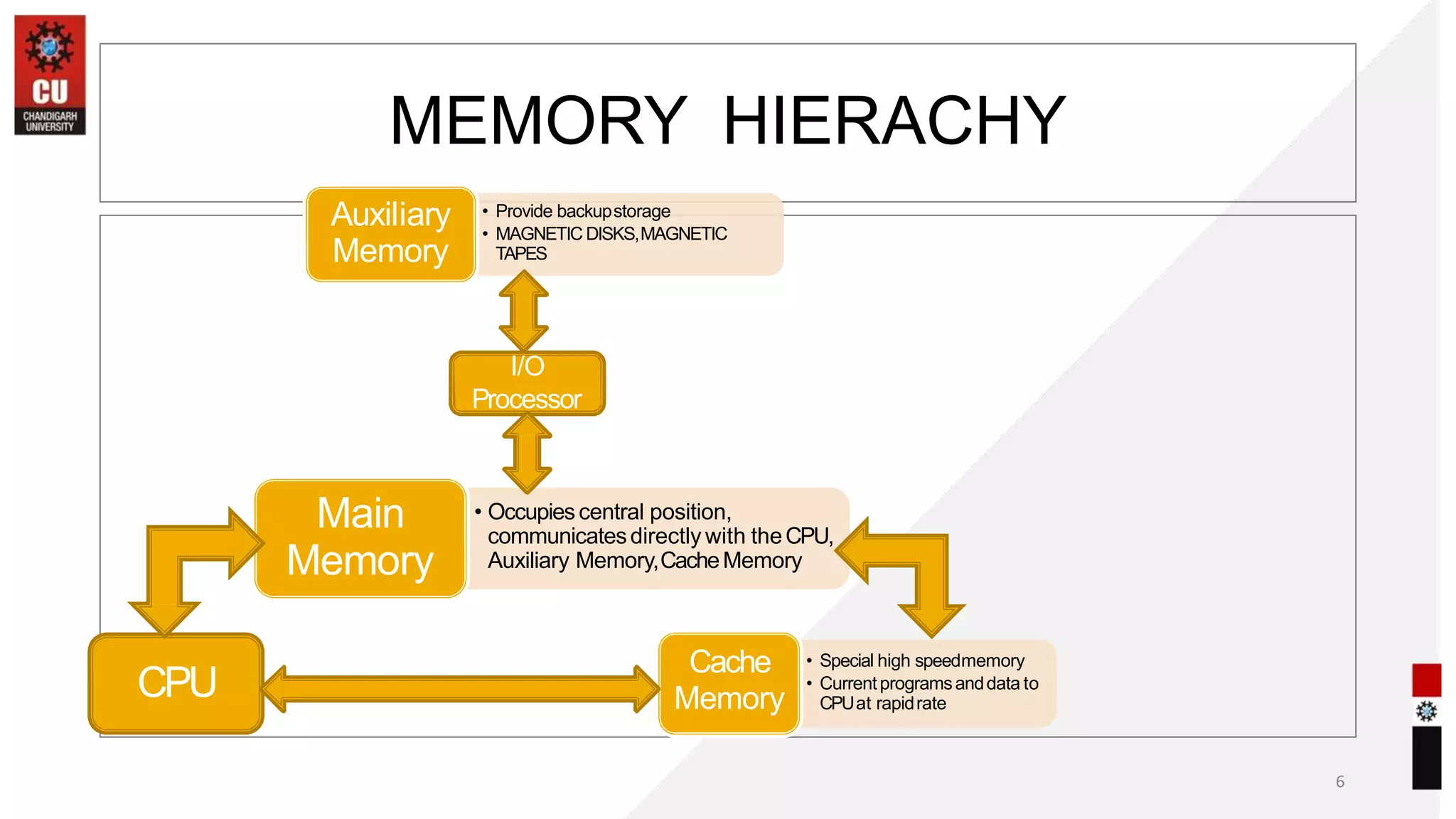
MEMORY HIERACHY
• Provide backupstorage
• MAGNETIC DISKS,MAGNETIC
TAPES
Auxiliary
Memory
• Occupiescentral position,
communicatesdirectly with theCPU,
Auxiliary Memory,CacheMemory
Main
Memory
CPU
• Special high speedmemory
• Currentprogramsanddata to
CPUat rapidrate
Cache
Memory
I/O
Processor
• CPU logic is usually faster than main memory access time, with the result that processing speed is limited
primarily by the speed of main memory.
• The cache is used for storing segments of programs currently being executed in the CPU and temporary data
frequently needed in the present calculations.
• The typical access time ratio between cache and main memory is about 1 to 7~10 .
• Auxiliary memory access time is usually 1000 times that of main memory.
• The memory hierarchy system consists of all storage devices employed in acomputer system from the slow by high-
capacity auxiliary memory to arelatively faster main memory,to anevensmallerandfastercachememory.
7
Contd..
• Amemoryunitaccessedbycontentsiscalled anassociativememory or content addressablememory(CAM).
• Thistype of memory isaccessed simultaneously andin parallel on the basisof data content rather than by specificaddress or
location.
Writeoperation:
•Whenaword iswritten ininanassociativememory, no addressisgiven
•Thememoryiscapableof finding anunusedlocation tostore the word.
Readoperation:
•When a word is to be read from an associative memory, the contents of the word, or a part of the word is specified.
•The memory locates all the words which match the specified content and marks them for reading.
8
ASSOCIATIVE MEMORY
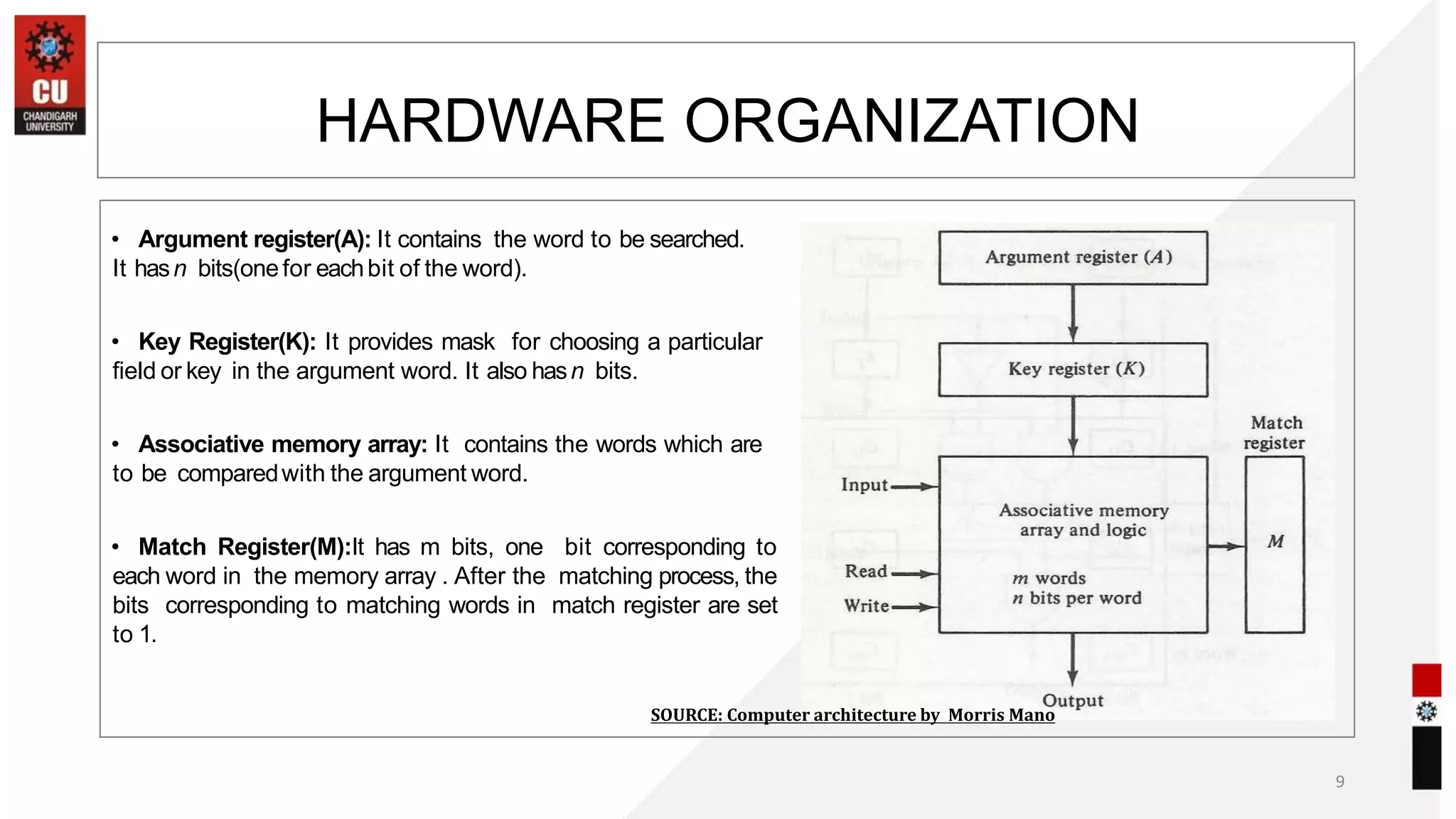
HARDWARE ORGANIZATION
• Argument register(A): It contains the word to be searched.
It hasn bits(onefor eachbit of the word).
• Key Register(K): It provides mask for choosing a particular
field or key in the argument word. It also hasn bits.
• Associative memory array: It contains the words which are
to be comparedwith the argument word.
• Match Register(M):It has m bits, one bit corresponding to
each word in the memory array . After the matching process, the
bits corresponding to matching words in match register are set
to 1.
9
SOURCE: Computer architecture by Morris Mano
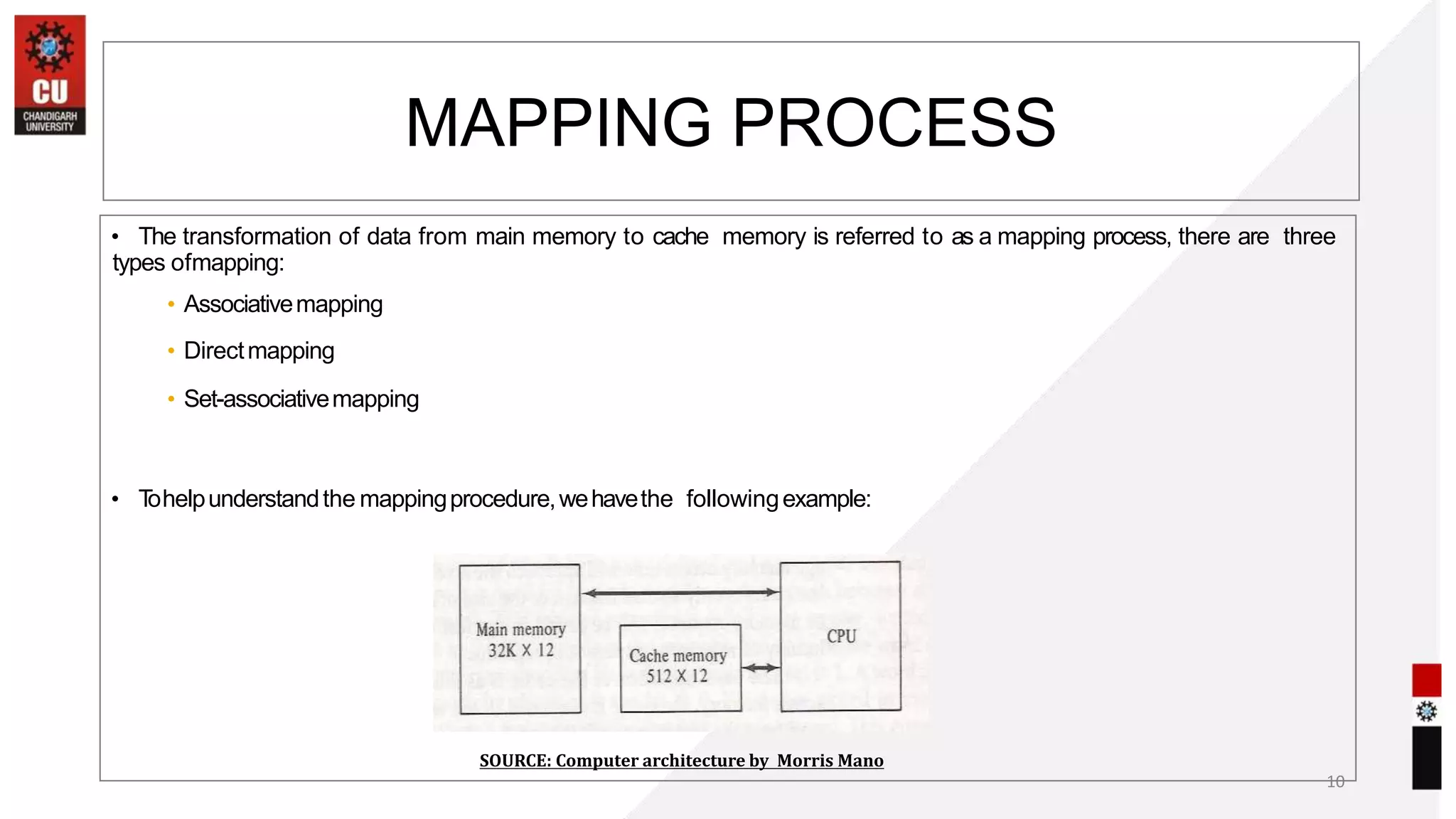
• The transformation of data from main memory to cache memory is referred to as a mapping process, there are three
types ofmapping:
• Associativemapping
• Directmapping
• Set-associativemapping
• T
ohelpunderstandthe mappingprocedure,wehavethe followingexample:
10
MAPPING PROCESS
SOURCE: Computer architecture by Morris Mano
ASSOCIATIVE MAPPING
11
SOURCE: Computer architecture by Morris Mano
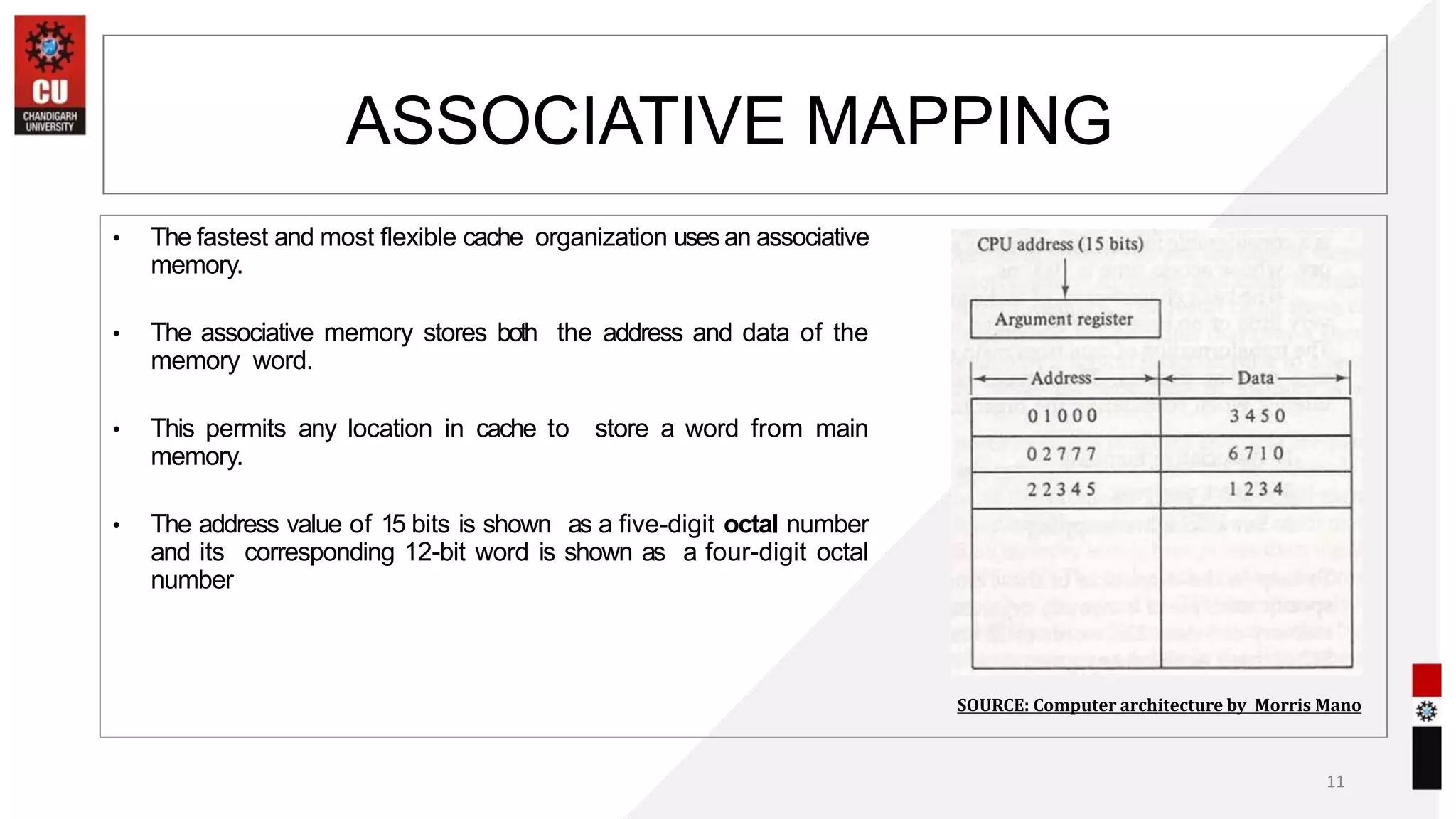
• The fastest and most flexible cache organization uses an associative
memory.
• The associative memory stores both the address and data of the
memory word.
• This permits any location in cache to store a word from main
memory.
• The address value of 15 bits is shown as a five-digit octal number
and its corresponding 12-bit word is shown as a four-digit octal
number
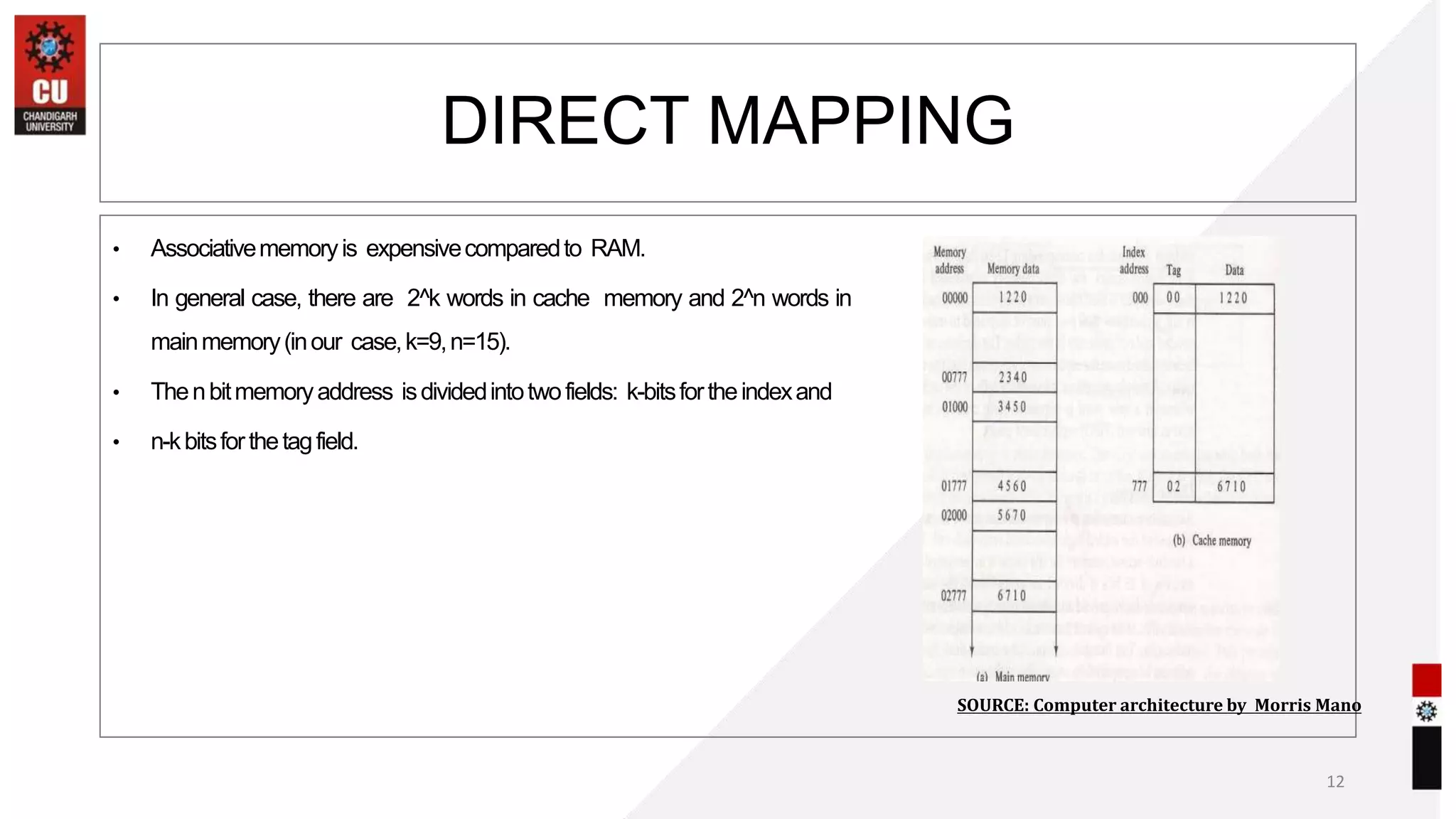
• Associativememoryis expensivecomparedto RAM.
• In general case, there are 2^k words in cache memory and 2^n words in
mainmemory(inour case,k=9,n=15).
• Thenbitmemoryaddress isdividedintotwofields: k-bitsfortheindexand
• n-kbitsforthetagfield.
12
DIRECT MAPPING
SOURCE: Computer architecture by Morris Mano
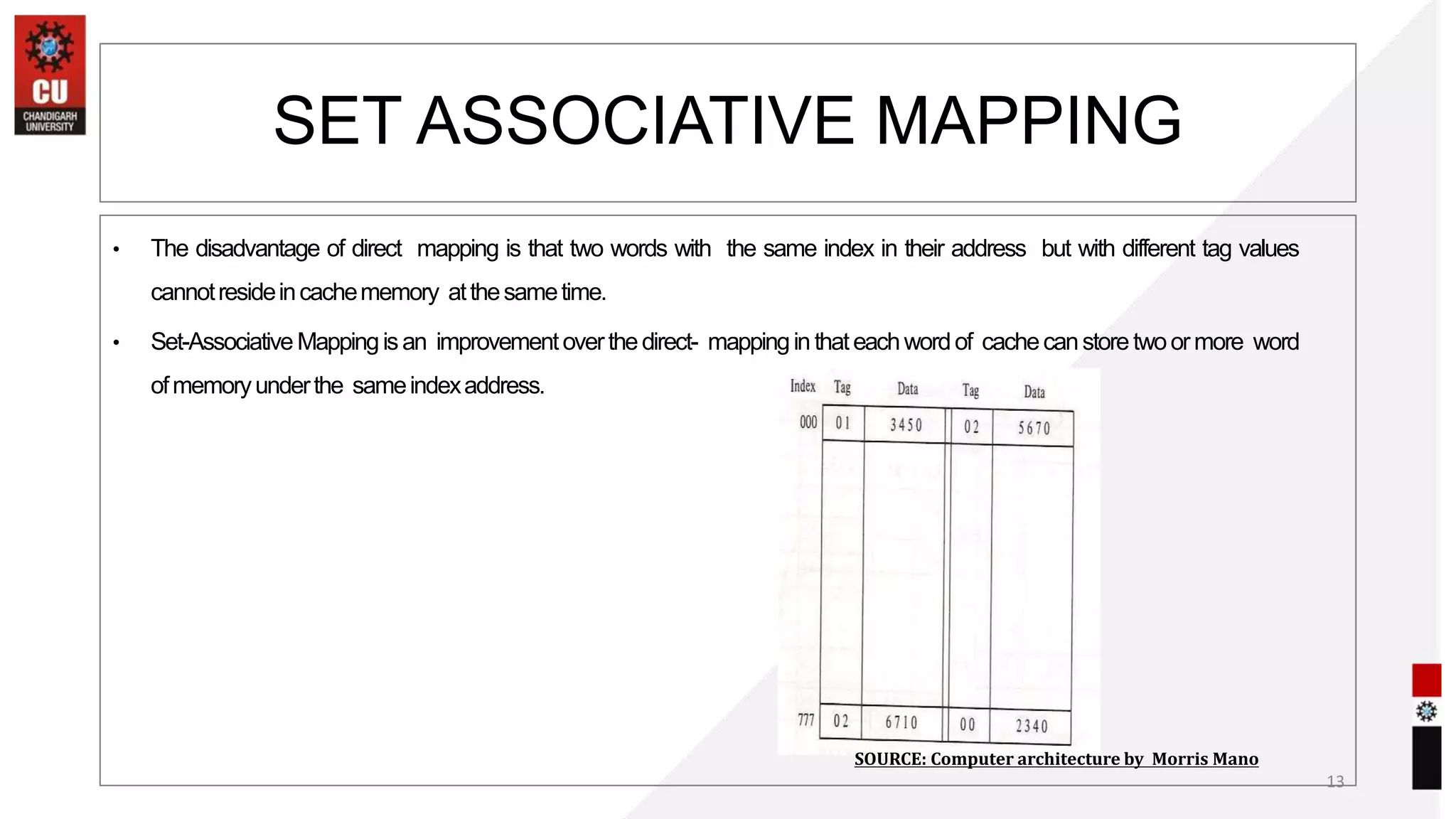
• The disadvantage of direct mapping is that two words with the same index in their address but with different tag values
cannotresideincachememory atthesametime.
• Set-Associative Mappingisan improvementoverthedirect- mappinginthateachwordof cachecanstoretwoormore word
ofmemoryunderthe sameindexaddress.
13
SET ASSOCIATIVE MAPPING
SOURCE: Computer architecture by Morris Mano
• Optimalreplacementalgorithm–findthe blockforreplacementthathasminimum chancetobereferencednexttime.
• Twoalgorithms:
I. FIFO:Selectstheitemwhichhasbeeninthesetthe longest.
II. LRU:Selectstheitemwhichhasbeenleastrecentlyused bytheCPU.
14
REPLACEMENT ALGORITHMS
• Virtualmemoryisacommonpartof operatingsystemondesktopcomputers.
• ThetermVirtualMemoryreferstosomething whichappearstobepresentbutactuallyis not.
• Thistechniqueallowsuserstousemore memoryforaprogramthantherealmemory ofacomputer.
15
VIRTUAL MEMORY
• Virtual Memoryisaimaginarymemory which weassumeor use,when we haveamaterial that exceedsourmemoryat that
time.
• Virtual Memory is temporary memory which is used along with the ram of the system.
16
NEED FOR VIRTUAL MEMORY
• Allows Processes whose aggregate memory requirement is greater than the amount of physical memory, as infrequently
usedpages canresideonthedisk.
• Virtualmemoryallowsspeedgainwhenonlya particularsegmentoftheprogramisrequired fortheexecutionoftheprogram.
• Thisconceptisveryhelpfulinimplementing multiprogrammingenvironment.
17
ADVANTAGES
• Applicationsrunratherslowerwhentheyare usingvirtualmemory.
• Ittakesmoretimetoswitchbetween applications.
• Reducessystemstability.
18
DISADVANTAGES
APPLICATIONS
• Computer organization and architecture course deals with instruction set architecture, micro architecture and
efficient implementation of micro architecture.
• Understanding the computer architecture concepts is essential for students interested in hardware, processor
design, compilers, and operating systems.
19
REFERENCES
Reference Books:
1. J.P. Hayes, “Computer Architecture and Organization”, Third Edition.
2. Mano, M., “Computer System Architecture”, Third Edition, Prentice Hall.
3. Stallings, W., “Computer Organization and Architecture”, Eighth Edition, Pearson Education.
Text Books:
1. Carpinelli J.D,” Computer systems organization &Architecture”, Fourth Edition, Addison Wesley.
2. Patterson and Hennessy, “Computer Architecture” , Fifth Edition Morgaon Kauffman.
Reference Website
1. https://www.geeksforgeeks.org/computer-organization-and-architecture-tutorials/
20
Assessment Pattern
• Element1(Assignment 1,2,3(Average)): 12 Marks
• Element2(Surprise Test): 9 Marks
• Element3(Tutorial/Optional): 9 Marks
• Element4(Quiz): 12 Marks
• MST1: 36 Marks
• MST2: 36 Marks
• Final Examination: 60 Marks
21
THANK YOU

Memory organization.pptx

  • 1.
    DISCOVER . LEARN. EMPOWER MEMORY ORGANIZATION University Institute of Engineering DEPARTMENT OF COMPUTER SCIENCE & ENGINEERING Bachelor of Engineering (Computer Science & Engineering) Subject Name: Computer Organization & Architecture Subject Code: CST-252
  • 2.
    Topics covered • Memoryhierarchy • Cache Memory Associative Memory • Cache memory with associative memory • Virtual Memory: 1. Paging 2. Segmentation 2
  • 3.
    MEMORY HIERARCHY 3 • MemoryHierarchy is to obtain the highest possible access speed while minimizing the total cost of the memory system
  • 4.
    MAIN MEMORY • TypicalRAM chips • Typical ROM chips 4 Chip select 1 Chip select 2 Read Write 7-bit address CS1 CS2 RD WR AD 7 128 x 8 RAM 8-bit data bus CS1 CS2 RD WR 0 0 x x 0 1 x x 1 0 0 0 1 0 0 1 1 0 1 x 1 1 x x Memory function Inhibit Inhibit Inhibit Write Read Inhibit State of data bus High-impedence High-impedence High-impedence Input data to RAM Output data from RAM High-impedence Chip select 1 Chip select 2 9-bit address CS1 CS2 AD 9 512 x 8 ROM 8-bit data bus
  • 5.
    • Address spaceassignment to each memory chip • Example: 512 bytes RAM and 512 bytes ROM • RAM and ROM chips are connected to a CPU through the data and address buses • - The low-order lines in the address bus select the byte within the chips and other lines in the address bus select a particular chip through its chip select inputs 5 MEMORY ADDRESS MAP RAM 1 RAM 2 RAM 3 RAM 4 ROM 0000 - 007F 0080 - 00FF 0100 - 017F 0180 - 01FF 0200 - 03FF Component Hexa address 0 0 0 x x x x x x x 0 0 1 x x x x x x x 0 1 0 x x x x x x x 0 1 1 x x x x x x x 1 x x x x x x x x x 10 9 8 7 6 5 4 3 2 1 Address bus
  • 6.
    6 MEMORY HIERACHY • Providebackupstorage • MAGNETIC DISKS,MAGNETIC TAPES Auxiliary Memory • Occupiescentral position, communicatesdirectly with theCPU, Auxiliary Memory,CacheMemory Main Memory CPU • Special high speedmemory • Currentprogramsanddata to CPUat rapidrate Cache Memory I/O Processor
  • 7.
    • CPU logicis usually faster than main memory access time, with the result that processing speed is limited primarily by the speed of main memory. • The cache is used for storing segments of programs currently being executed in the CPU and temporary data frequently needed in the present calculations. • The typical access time ratio between cache and main memory is about 1 to 7~10 . • Auxiliary memory access time is usually 1000 times that of main memory. • The memory hierarchy system consists of all storage devices employed in acomputer system from the slow by high- capacity auxiliary memory to arelatively faster main memory,to anevensmallerandfastercachememory. 7 Contd..
  • 8.
    • Amemoryunitaccessedbycontentsiscalled anassociativememoryor content addressablememory(CAM). • Thistype of memory isaccessed simultaneously andin parallel on the basisof data content rather than by specificaddress or location. Writeoperation: •Whenaword iswritten ininanassociativememory, no addressisgiven •Thememoryiscapableof finding anunusedlocation tostore the word. Readoperation: •When a word is to be read from an associative memory, the contents of the word, or a part of the word is specified. •The memory locates all the words which match the specified content and marks them for reading. 8 ASSOCIATIVE MEMORY
  • 9.
    HARDWARE ORGANIZATION • Argumentregister(A): It contains the word to be searched. It hasn bits(onefor eachbit of the word). • Key Register(K): It provides mask for choosing a particular field or key in the argument word. It also hasn bits. • Associative memory array: It contains the words which are to be comparedwith the argument word. • Match Register(M):It has m bits, one bit corresponding to each word in the memory array . After the matching process, the bits corresponding to matching words in match register are set to 1. 9 SOURCE: Computer architecture by Morris Mano
  • 10.
    • The transformationof data from main memory to cache memory is referred to as a mapping process, there are three types ofmapping: • Associativemapping • Directmapping • Set-associativemapping • T ohelpunderstandthe mappingprocedure,wehavethe followingexample: 10 MAPPING PROCESS SOURCE: Computer architecture by Morris Mano
  • 11.
    ASSOCIATIVE MAPPING 11 SOURCE: Computerarchitecture by Morris Mano • The fastest and most flexible cache organization uses an associative memory. • The associative memory stores both the address and data of the memory word. • This permits any location in cache to store a word from main memory. • The address value of 15 bits is shown as a five-digit octal number and its corresponding 12-bit word is shown as a four-digit octal number
  • 12.
    • Associativememoryis expensivecomparedtoRAM. • In general case, there are 2^k words in cache memory and 2^n words in mainmemory(inour case,k=9,n=15). • Thenbitmemoryaddress isdividedintotwofields: k-bitsfortheindexand • n-kbitsforthetagfield. 12 DIRECT MAPPING SOURCE: Computer architecture by Morris Mano
  • 13.
    • The disadvantageof direct mapping is that two words with the same index in their address but with different tag values cannotresideincachememory atthesametime. • Set-Associative Mappingisan improvementoverthedirect- mappinginthateachwordof cachecanstoretwoormore word ofmemoryunderthe sameindexaddress. 13 SET ASSOCIATIVE MAPPING SOURCE: Computer architecture by Morris Mano
  • 14.
    • Optimalreplacementalgorithm–findthe blockforreplacementthathasminimumchancetobereferencednexttime. • Twoalgorithms: I. FIFO:Selectstheitemwhichhasbeeninthesetthe longest. II. LRU:Selectstheitemwhichhasbeenleastrecentlyused bytheCPU. 14 REPLACEMENT ALGORITHMS
  • 15.
    • Virtualmemoryisacommonpartof operatingsystemondesktopcomputers. •ThetermVirtualMemoryreferstosomething whichappearstobepresentbutactuallyis not. • Thistechniqueallowsuserstousemore memoryforaprogramthantherealmemory ofacomputer. 15 VIRTUAL MEMORY
  • 16.
    • Virtual Memoryisaimaginarymemorywhich weassumeor use,when we haveamaterial that exceedsourmemoryat that time. • Virtual Memory is temporary memory which is used along with the ram of the system. 16 NEED FOR VIRTUAL MEMORY
  • 17.
    • Allows Processeswhose aggregate memory requirement is greater than the amount of physical memory, as infrequently usedpages canresideonthedisk. • Virtualmemoryallowsspeedgainwhenonlya particularsegmentoftheprogramisrequired fortheexecutionoftheprogram. • Thisconceptisveryhelpfulinimplementing multiprogrammingenvironment. 17 ADVANTAGES
  • 18.
    • Applicationsrunratherslowerwhentheyare usingvirtualmemory. •Ittakesmoretimetoswitchbetween applications. • Reducessystemstability. 18 DISADVANTAGES
  • 19.
    APPLICATIONS • Computer organizationand architecture course deals with instruction set architecture, micro architecture and efficient implementation of micro architecture. • Understanding the computer architecture concepts is essential for students interested in hardware, processor design, compilers, and operating systems. 19
  • 20.
    REFERENCES Reference Books: 1. J.P.Hayes, “Computer Architecture and Organization”, Third Edition. 2. Mano, M., “Computer System Architecture”, Third Edition, Prentice Hall. 3. Stallings, W., “Computer Organization and Architecture”, Eighth Edition, Pearson Education. Text Books: 1. Carpinelli J.D,” Computer systems organization &Architecture”, Fourth Edition, Addison Wesley. 2. Patterson and Hennessy, “Computer Architecture” , Fifth Edition Morgaon Kauffman. Reference Website 1. https://www.geeksforgeeks.org/computer-organization-and-architecture-tutorials/ 20
  • 21.
    Assessment Pattern • Element1(Assignment1,2,3(Average)): 12 Marks • Element2(Surprise Test): 9 Marks • Element3(Tutorial/Optional): 9 Marks • Element4(Quiz): 12 Marks • MST1: 36 Marks • MST2: 36 Marks • Final Examination: 60 Marks 21
  • 22.