Assistive Technology and Learning Guide for Parents and Teachers Assistive Technology (AT) Learning Disabilities (LD)- Middle School Divergent Learning Styles Current or Future Need  Academic Areas  Barriers  Learning Sciences and Technology (LST) Copyright 2005. James Vincent Puglia [Key Source: Driscoll, 2003]
Assistive Technology for LD Students Not just computer software Can be simple adjustment Definition:  Any item, equipment to improve the functional capabilities of children with learning disabilities.  (IDEA and Section 508) Assists in completing academic tasks
A  verage to above average intelligence D   iscrepancy- intellectual and academic achievement  A   ssistive technology is not intended to “fix” disability Adjust and compensate for weaknesses Example: problem solving math  Learning Disabilities
A  udtiory/listening  L  anguage P  erceptual  D  ivergent learning styles  R  etrieval I  nformation processing load (LST)  V  isual E  xternal and internal attention problems (LST) Learning Differences Different Learning Styles (ALP DRIVE)
Different Learning Modalities  Learning Disabled Students Differentiated Learning  Engaging, hands-on learning Sequenced and Structured Learning Knowledge- Construct Multiple Intelligences Assessments- varied forms Situated Cognition Kinesthetic
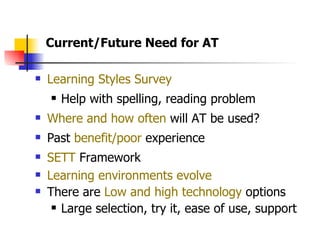
Learning Styles Survey   Help with spelling, reading problem Where and how often  will AT be used?  Past  benefit/poor  experience SETT  Framework Learning environments evolve There are  Low and high technology  options Large selection, try it, ease of use, support Current/Future Need for AT
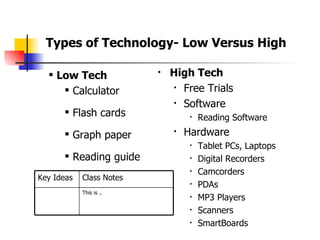
High Tech Free Trials  Software Reading Software Hardware  Tablet PCs, Laptops Digital Recorders Camcorders PDAs MP3 Players Scanners SmartBoards Types of Technology- Low Versus High Low Tech Calculator Flash cards Graph paper Reading guide This is .. Class Notes Key Ideas
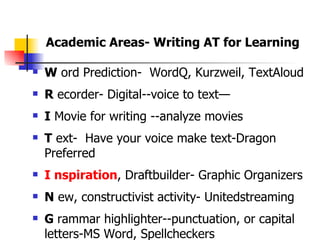
W  ord Prediction-  WordQ, Kurzweil, TextAloud R  ecorder- Digital--voice to text— I  Movie for writing --analyze movies T  ext-  Have your voice make text-Dragon Preferred  I  nspiration , Draftbuilder- Graphic Organizers N  ew, constructivist activity- Unitedstreaming  G  rammar highlighter--punctuation, or capital letters-MS Word, Spellcheckers Academic Areas- Writing AT for Learning
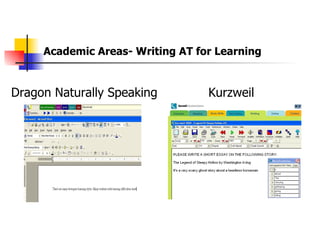
Academic Areas- Writing AT for Learning  Dragon Naturally Speaking Kurzweil
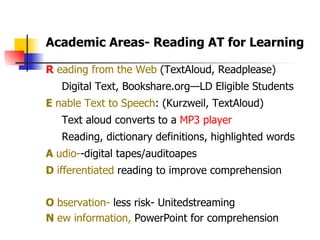
R  eading from the Web  (TextAloud, Readplease) Digital Text, Bookshare.org—LD Eligible Students  E  nable Text to Speech : (Kurzweil, TextAloud) Text aloud converts to a  MP3 player Reading, dictionary definitions, highlighted words A  udio- -digital tapes/auditoapes D  ifferentiated  reading to improve comprehension O  bservation-  less risk- Unitedstreaming N  ew information,  PowerPoint for comprehension  Academic Areas- Reading AT for Learning
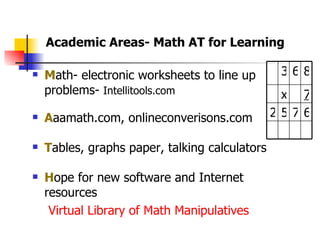
M ath- electronic worksheets to line up problems-  Intellitools.com A aamath.com, onlineconverisons.com T ables, graphs paper, talking calculators H ope for new software and Internet resources Virtual Library of Math Manipulatives Academic Areas- Math AT for Learning  6 7 5 2 7 x 8 6 3
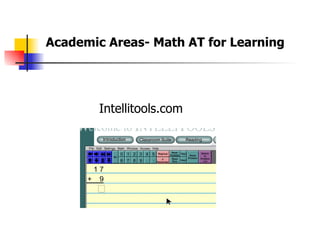
Academic Areas- Math AT for Learning  Intellitools.com
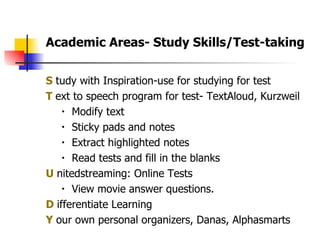
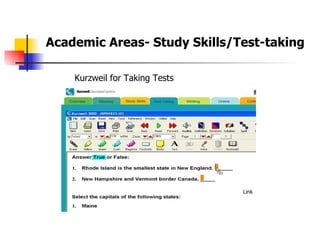
S  tudy with Inspiration-use for studying for test T  ext to speech program for test- TextAloud, Kurzweil  Modify text Sticky pads and notes Extract highlighted notes Read tests and fill in the blanks U  nitedstreaming: Online Tests View movie answer questions. D  ifferentiate Learning  Y  our own personal organizers, Danas, Alphasmarts Academic Areas- Study Skills/Test-taking
Academic Areas- Study Skills/Test-taking  Link Kurzweil for Taking Tests
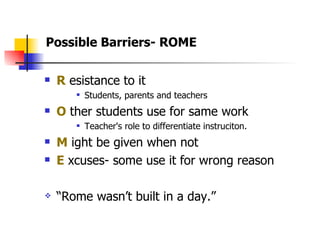
R  esistance to it Students, parents and teachers O  ther students use for same work Teacher's role to differentiate instruciton. M  ight be given when not  E  xcuses- some use it for wrong reason “ Rome wasn’t built in a day.”  Possible Barriers- ROME
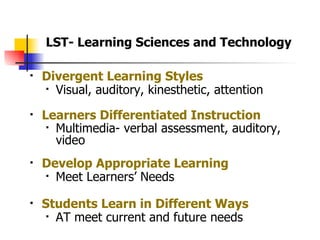
Divergent Learning Styles Visual, auditory, kinesthetic, attention Learners Differentiated Instruction Multimedia- verbal assessment, auditory, video   Develop Appropriate Learning Meet Learners’ Needs Students Learn in Different Ways AT meet current and future needs LST- Learning Sciences and Technology
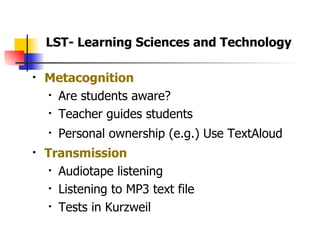
Metacognition Are students aware?  Teacher guides students  Personal ownership (e.g.) Use TextAloud Transmission Audiotape listening Listening to MP3 text file Tests in Kurzweil LST- Learning Sciences and Technology
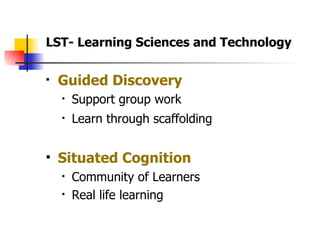
Guided Discovery Support group work  Learn through scaffolding  Situated Cognition  Community of Learners Real life learning  LST- Learning Sciences and Technology
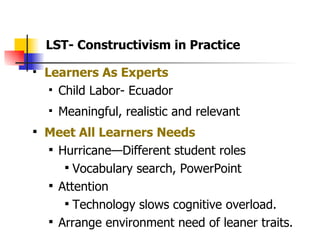
Learners As Experts   Child Labor- Ecuador Meaningful, realistic and relevant Meet All Learners Needs Hurricane—Different student roles Vocabulary search, PowerPoint Attention  Technology slows cognitive overload. Arrange environment need of leaner traits. LST- Constructivism in Practice
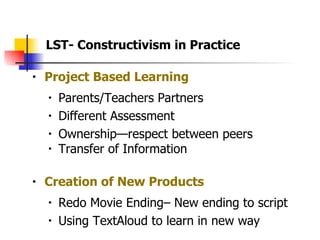
Project Based Learning Parents/Teachers Partners Different Assessment Ownership—respect between peers  Transfer of Information  Creation of New Products Redo Movie Ending– New ending to script Using TextAloud to learn in new way LST- Constructivism in Practice
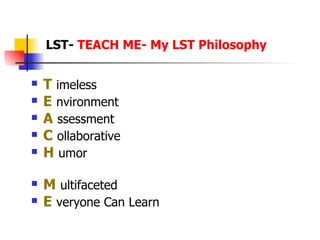
T   imeless E   nvironment A   ssessment C   ollaborative H   umor M   ultifaceted E   veryone Can Learn LST-  TEACH ME- My LST Philosophy
Links and References

Assistive Technology

  • 1.
    Assistive Technology andLearning Guide for Parents and Teachers Assistive Technology (AT) Learning Disabilities (LD)- Middle School Divergent Learning Styles Current or Future Need Academic Areas Barriers Learning Sciences and Technology (LST) Copyright 2005. James Vincent Puglia [Key Source: Driscoll, 2003]
  • 2.
    Assistive Technology forLD Students Not just computer software Can be simple adjustment Definition: Any item, equipment to improve the functional capabilities of children with learning disabilities. (IDEA and Section 508) Assists in completing academic tasks
  • 3.
    A verageto above average intelligence D iscrepancy- intellectual and academic achievement A ssistive technology is not intended to “fix” disability Adjust and compensate for weaknesses Example: problem solving math Learning Disabilities
  • 4.
    A udtiory/listening L anguage P erceptual D ivergent learning styles R etrieval I nformation processing load (LST) V isual E xternal and internal attention problems (LST) Learning Differences Different Learning Styles (ALP DRIVE)
  • 5.
    Different Learning Modalities Learning Disabled Students Differentiated Learning Engaging, hands-on learning Sequenced and Structured Learning Knowledge- Construct Multiple Intelligences Assessments- varied forms Situated Cognition Kinesthetic
  • 6.
    Learning Styles Survey Help with spelling, reading problem Where and how often will AT be used? Past benefit/poor experience SETT Framework Learning environments evolve There are Low and high technology options Large selection, try it, ease of use, support Current/Future Need for AT
  • 7.
    High Tech FreeTrials Software Reading Software Hardware Tablet PCs, Laptops Digital Recorders Camcorders PDAs MP3 Players Scanners SmartBoards Types of Technology- Low Versus High Low Tech Calculator Flash cards Graph paper Reading guide This is .. Class Notes Key Ideas
  • 8.
    W ordPrediction- WordQ, Kurzweil, TextAloud R ecorder- Digital--voice to text— I Movie for writing --analyze movies T ext- Have your voice make text-Dragon Preferred I nspiration , Draftbuilder- Graphic Organizers N ew, constructivist activity- Unitedstreaming G rammar highlighter--punctuation, or capital letters-MS Word, Spellcheckers Academic Areas- Writing AT for Learning
  • 9.
    Academic Areas- WritingAT for Learning Dragon Naturally Speaking Kurzweil
  • 10.
    R eadingfrom the Web (TextAloud, Readplease) Digital Text, Bookshare.org—LD Eligible Students E nable Text to Speech : (Kurzweil, TextAloud) Text aloud converts to a MP3 player Reading, dictionary definitions, highlighted words A udio- -digital tapes/auditoapes D ifferentiated reading to improve comprehension O bservation- less risk- Unitedstreaming N ew information, PowerPoint for comprehension Academic Areas- Reading AT for Learning
  • 11.
    M ath- electronicworksheets to line up problems- Intellitools.com A aamath.com, onlineconverisons.com T ables, graphs paper, talking calculators H ope for new software and Internet resources Virtual Library of Math Manipulatives Academic Areas- Math AT for Learning 6 7 5 2 7 x 8 6 3
  • 12.
    Academic Areas- MathAT for Learning Intellitools.com
  • 13.
    S tudywith Inspiration-use for studying for test T ext to speech program for test- TextAloud, Kurzweil Modify text Sticky pads and notes Extract highlighted notes Read tests and fill in the blanks U nitedstreaming: Online Tests View movie answer questions. D ifferentiate Learning Y our own personal organizers, Danas, Alphasmarts Academic Areas- Study Skills/Test-taking
  • 14.
    Academic Areas- StudySkills/Test-taking Link Kurzweil for Taking Tests
  • 15.
    R esistanceto it Students, parents and teachers O ther students use for same work Teacher's role to differentiate instruciton. M ight be given when not E xcuses- some use it for wrong reason “ Rome wasn’t built in a day.” Possible Barriers- ROME
  • 16.
    Divergent Learning StylesVisual, auditory, kinesthetic, attention Learners Differentiated Instruction Multimedia- verbal assessment, auditory, video Develop Appropriate Learning Meet Learners’ Needs Students Learn in Different Ways AT meet current and future needs LST- Learning Sciences and Technology
  • 17.
    Metacognition Are studentsaware? Teacher guides students Personal ownership (e.g.) Use TextAloud Transmission Audiotape listening Listening to MP3 text file Tests in Kurzweil LST- Learning Sciences and Technology
  • 18.
    Guided Discovery Supportgroup work Learn through scaffolding Situated Cognition Community of Learners Real life learning LST- Learning Sciences and Technology
  • 19.
    Learners As Experts Child Labor- Ecuador Meaningful, realistic and relevant Meet All Learners Needs Hurricane—Different student roles Vocabulary search, PowerPoint Attention Technology slows cognitive overload. Arrange environment need of leaner traits. LST- Constructivism in Practice
  • 20.
    Project Based LearningParents/Teachers Partners Different Assessment Ownership—respect between peers Transfer of Information Creation of New Products Redo Movie Ending– New ending to script Using TextAloud to learn in new way LST- Constructivism in Practice
  • 21.
    T imeless E nvironment A ssessment C ollaborative H umor M ultifaceted E veryone Can Learn LST- TEACH ME- My LST Philosophy
  • 22.