Assistive 
Technology 
Tuyet Nguyen 
October 5, 2014
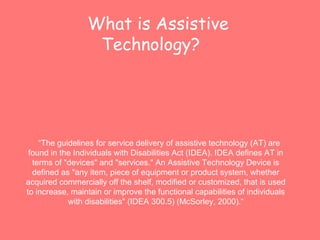
What is Assistive 
Technology? 
“The guidelines for service delivery of assistive technology (AT) are 
found in the Individuals with Disabilities Act (IDEA). IDEA defines AT in 
terms of "devices" and "services." An Assistive Technology Device is 
defined as "any item, piece of equipment or product system, whether 
acquired commercially off the shelf, modified or customized, that is used 
to increase, maintain or improve the functional capabilities of individuals 
with disabilities" (IDEA 300.5) (McSorley, 2000).“
Assistive Technology 
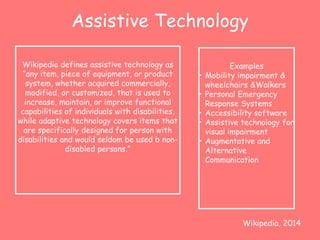
Wikipedia defines assistive technology as 
“any item, piece of equipment, or product 
system, whether acquired commercially, 
modified, or customized, that is used to 
increase, maintain, or improve functional 
capabilities of individuals with disabilities, 
while adaptive technology covers items that 
are specifically designed for person with 
disabilities and would seldom be used b non-disabled 
persons.” 
Examples 
• Mobility impairment & 
wheelchairs &Walkers 
• Personal Emergency 
Response Systems 
• Accessibility software 
• Assistive technology for 
visual impairment 
• Augmentative and 
Alternative 
Communication 
Wikipedia, 2014
How to Chose Assistive Technology (AT)? 
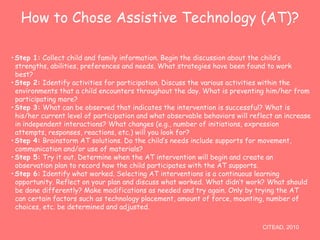
•Step 1: Collect child and family information. Begin the discussion about the child’s 
strengths, abilities, preferences and needs. What strategies have been found to work 
best? 
•Step 2: Identify activities for participation. Discuss the various activities within the 
environments that a child encounters throughout the day. What is preventing him/her from 
participating more? 
•Step 3: What can be observed that indicates the intervention is successful? What is 
his/her current level of participation and what observable behaviors will reflect an increase 
in independent interactions? What changes (e.g., number of initiations, expression 
attempts, responses, reactions, etc.) will you look for? 
•Step 4: Brainstorm AT solutions. Do the child’s needs include supports for movement, 
communication and/or use of materials? 
•Step 5: Try it out. Determine when the AT intervention will begin and create an 
observation plan to record how the child participates with the AT supports. 
•Step 6: Identify what worked. Selecting AT interventions is a continuous learning 
opportunity. Reflect on your plan and discuss what worked. What didn’t work? What should 
be done differently? Make modifications as needed and try again. Only by trying the AT 
can certain factors such as technology placement, amount of force, mounting, number of 
choices, etc. be determined and adjusted. 
CITEAD, 2010
High-Technology (high-tech) 
Devices that use complex multifunction 
technology. For example, computer or 
software. 
* tape recorders 
* talking calculators 
*speech recognition software 
Assistive Technology Industry Association
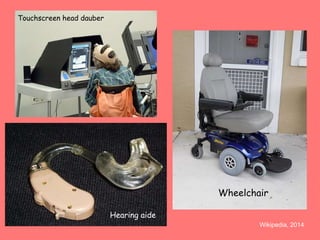
Wheelchair 
Hearing aide 
Touchscreen head dauber 
Wikipedia, 2014
NO-Technology (No-Tech) 
No-Tech devices are no technology related that can aide in the 
learning process. For example, a piece of foam glued onto the 
corners of book pages to make turning pages easy. 
pencil grips 
highlighting pens and tape 
calculators 
Low tech devices help organize students’ thoughts or work using 
flow charting. 
word processors 
dictionaries 
spell checkers 
Assistive Technology Industry Association
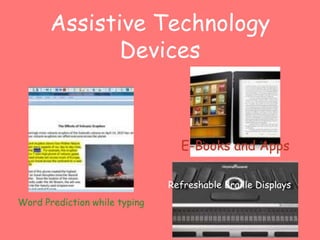
Assistive Technology 
Devices 
E-Books and Apps 
Word Prediction while typing 
Refreshable Braille Displays
AT Devices 
Computer/laptop, tablets, iPads, AAC devices 
FREE Built-In Accessibility Features in everyday technologies, Chrome Apps & 
Extensions, adjustable Furniture/ desks, adaptive keyboards and mice, adapted 
writing tools. 
Walking assistance, ramps, grab bars, environmental controls, eye gaze, switches, 
and so much more! 
Voice Recognition Software: Speech-to-text Software 
QR Codes and Bar Codes 
Refreshable Braille Displays 
Communication Boards and among other devices! 
Assistive Technology for Education, LLC, 2014 
Assisted Technology Industry Association
IDEA 
“Also described in IDEA, is an Assistive Technology 
Service. This is defined as "...any service that directly assists 
an individual with a disability in the selection, acquisition, or 
use of an assistive technology device" (IDEA 300.6). Studies 
have shown that assistive technology can significantly improve 
the educational, vocational, and social performance of 
individuals with disabilities. Federal law mandates that schools 
annually consider assistive technology accommodations in the 
Individual Education Program (IEP) of all eligible students” 
(McSorley, 2000).
Individualized Education 
Programs (IEPS) 
IEP are programs that helps kids with delayed skills or other disabilities 
Kids struggling in school may qualify for support services, allowing them to be taught in 
a special way, for reasons such as: 
• learning disabilities 
• attention deficit hyperactivity disorder (ADHD) 
• emotional disorders 
• cognitive challenges 
• autism 
• hearing impairment 
• visual impairment 
• speech or language impairment 
• developmental delay 
KidsHealth, 2014
Hearing Assistive Technology 
System (HATS) 
HATS are devices that helps communication be better with or 
without hearing aids or cochle implants to make hearing easier. 
Obstacles that affects or creates hearing problems are listed 
below: 
Distance between the listener and the sound source. 
Competing noise in the environment. 
Poor room acoustics/reverberation 
American Speech-Language-Hearing Association, 2014
Types of Learning 
Disabilities 
Reading disabilities 
Writing disabilities 
Dyslexia 
Math disabilities 
Attention and ADHD 
PBS, 2014
Attention and ADHD 
Attention and ADHD can affect a person’s 
attention and affects one’s success. 
Attention is important because it can leads 
to behavioral and social problems. 
PBS, 2014
What is Attention Deficit Hyperactivity 
Disorder (ADHD, ADD)? 
Attention deficit hyperactivity disorder (ADHD) is one of the most 
common childhood disorders and can continue through adolescence and 
adulthood. Symptoms include difficulty staying focused and paying 
attention, difficulty controlling behavior, and hyperactivity (over-activity). 
ADHD 3 Subtypes 
1. Predominantly hyperactive-impulsive 
2. Predominantly inattention 
3. Combined hyperactive-impulsive and inattentive 
National Institute of Mental Health. 2014
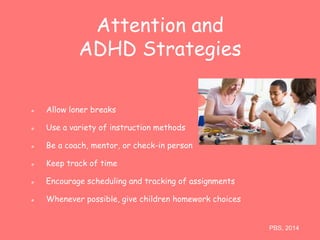
Attention and 
ADHD Strategies 
Allow loner breaks 
Use a variety of instruction methods 
Be a coach, mentor, or check-in person 
Keep track of time 
Encourage scheduling and tracking of assignments 
Whenever possible, give children homework choices 
PBS, 2014
Overview 
- Assistive Technology Service any service that directly 
assists an individual with a disability in the selection, 
acquisition, or use of an assistive technology device (IDEA 
300.6). 
- Assistive technology can significantly improve the 
educational, vocational, and social performance of individuals 
with disabilities. 
-Federal law mandates that schools annually consider 
assistive technology accommodations in the Individual 
Education Program (IEP) of all eligible students. 
(McSorley, 2000)
Reference 
2014. “Assistive Technology”. www.wikipedia.com. 
American Speech-Language-Hearing Association, 2014. “Hearing Assistive Technology”. 
Assistive Technology for Education, LLC. 2014. 
Assistive Technology Industry Association. http://www.atia.org/i4a/pages/index.cfm?pageid=3859. 
Accessed date, October 4, 2014. 
Berhrmann, Michael & Jerome, Marci Kindas. 2002. Assistive Technology for Students with Mild 
Disabilities 2002. Eric Digest. 
Georgia Project for Assistive Technology. Georgia Project for Assistive Technology. 
Individualized Education Program.1995. Kidshealth. What’s an IEP”. National Center For Technology 
Innovation and Implementing Technology in Education (CITED). 2010. 
McSorley, Jane & Wilbur, Judythe. 2000. Assistive Technology. 
National Institute of Mental Health. 2014. http://www.nimh.nih.gov/health/topics/attention- deficit-hyperactivity- 
disorder-adhd/index.shtml. Access date October 4, 2014. 
PBS Parents, 2014. “Types of Learning Disabilities”. http://www.pbs.org/parents/ 
educationlearning-disabilities/types/. Access date October 4, 2014.

Assistive technology nguyen

  • 1.
    Assistive Technology TuyetNguyen October 5, 2014
  • 2.
    What is Assistive Technology? “The guidelines for service delivery of assistive technology (AT) are found in the Individuals with Disabilities Act (IDEA). IDEA defines AT in terms of "devices" and "services." An Assistive Technology Device is defined as "any item, piece of equipment or product system, whether acquired commercially off the shelf, modified or customized, that is used to increase, maintain or improve the functional capabilities of individuals with disabilities" (IDEA 300.5) (McSorley, 2000).“
  • 3.
    Assistive Technology Wikipediadefines assistive technology as “any item, piece of equipment, or product system, whether acquired commercially, modified, or customized, that is used to increase, maintain, or improve functional capabilities of individuals with disabilities, while adaptive technology covers items that are specifically designed for person with disabilities and would seldom be used b non-disabled persons.” Examples • Mobility impairment & wheelchairs &Walkers • Personal Emergency Response Systems • Accessibility software • Assistive technology for visual impairment • Augmentative and Alternative Communication Wikipedia, 2014
  • 4.
    How to ChoseAssistive Technology (AT)? •Step 1: Collect child and family information. Begin the discussion about the child’s strengths, abilities, preferences and needs. What strategies have been found to work best? •Step 2: Identify activities for participation. Discuss the various activities within the environments that a child encounters throughout the day. What is preventing him/her from participating more? •Step 3: What can be observed that indicates the intervention is successful? What is his/her current level of participation and what observable behaviors will reflect an increase in independent interactions? What changes (e.g., number of initiations, expression attempts, responses, reactions, etc.) will you look for? •Step 4: Brainstorm AT solutions. Do the child’s needs include supports for movement, communication and/or use of materials? •Step 5: Try it out. Determine when the AT intervention will begin and create an observation plan to record how the child participates with the AT supports. •Step 6: Identify what worked. Selecting AT interventions is a continuous learning opportunity. Reflect on your plan and discuss what worked. What didn’t work? What should be done differently? Make modifications as needed and try again. Only by trying the AT can certain factors such as technology placement, amount of force, mounting, number of choices, etc. be determined and adjusted. CITEAD, 2010
  • 5.
    High-Technology (high-tech) Devicesthat use complex multifunction technology. For example, computer or software. * tape recorders * talking calculators *speech recognition software Assistive Technology Industry Association
  • 6.
    Wheelchair Hearing aide Touchscreen head dauber Wikipedia, 2014
  • 7.
    NO-Technology (No-Tech) No-Techdevices are no technology related that can aide in the learning process. For example, a piece of foam glued onto the corners of book pages to make turning pages easy. pencil grips highlighting pens and tape calculators Low tech devices help organize students’ thoughts or work using flow charting. word processors dictionaries spell checkers Assistive Technology Industry Association
  • 8.
    Assistive Technology Devices E-Books and Apps Word Prediction while typing Refreshable Braille Displays
  • 9.
    AT Devices Computer/laptop,tablets, iPads, AAC devices FREE Built-In Accessibility Features in everyday technologies, Chrome Apps & Extensions, adjustable Furniture/ desks, adaptive keyboards and mice, adapted writing tools. Walking assistance, ramps, grab bars, environmental controls, eye gaze, switches, and so much more! Voice Recognition Software: Speech-to-text Software QR Codes and Bar Codes Refreshable Braille Displays Communication Boards and among other devices! Assistive Technology for Education, LLC, 2014 Assisted Technology Industry Association
  • 10.
    IDEA “Also describedin IDEA, is an Assistive Technology Service. This is defined as "...any service that directly assists an individual with a disability in the selection, acquisition, or use of an assistive technology device" (IDEA 300.6). Studies have shown that assistive technology can significantly improve the educational, vocational, and social performance of individuals with disabilities. Federal law mandates that schools annually consider assistive technology accommodations in the Individual Education Program (IEP) of all eligible students” (McSorley, 2000).
  • 11.
    Individualized Education Programs(IEPS) IEP are programs that helps kids with delayed skills or other disabilities Kids struggling in school may qualify for support services, allowing them to be taught in a special way, for reasons such as: • learning disabilities • attention deficit hyperactivity disorder (ADHD) • emotional disorders • cognitive challenges • autism • hearing impairment • visual impairment • speech or language impairment • developmental delay KidsHealth, 2014
  • 12.
    Hearing Assistive Technology System (HATS) HATS are devices that helps communication be better with or without hearing aids or cochle implants to make hearing easier. Obstacles that affects or creates hearing problems are listed below: Distance between the listener and the sound source. Competing noise in the environment. Poor room acoustics/reverberation American Speech-Language-Hearing Association, 2014
  • 13.
    Types of Learning Disabilities Reading disabilities Writing disabilities Dyslexia Math disabilities Attention and ADHD PBS, 2014
  • 14.
    Attention and ADHD Attention and ADHD can affect a person’s attention and affects one’s success. Attention is important because it can leads to behavioral and social problems. PBS, 2014
  • 15.
    What is AttentionDeficit Hyperactivity Disorder (ADHD, ADD)? Attention deficit hyperactivity disorder (ADHD) is one of the most common childhood disorders and can continue through adolescence and adulthood. Symptoms include difficulty staying focused and paying attention, difficulty controlling behavior, and hyperactivity (over-activity). ADHD 3 Subtypes 1. Predominantly hyperactive-impulsive 2. Predominantly inattention 3. Combined hyperactive-impulsive and inattentive National Institute of Mental Health. 2014
  • 16.
    Attention and ADHDStrategies Allow loner breaks Use a variety of instruction methods Be a coach, mentor, or check-in person Keep track of time Encourage scheduling and tracking of assignments Whenever possible, give children homework choices PBS, 2014
  • 17.
    Overview - AssistiveTechnology Service any service that directly assists an individual with a disability in the selection, acquisition, or use of an assistive technology device (IDEA 300.6). - Assistive technology can significantly improve the educational, vocational, and social performance of individuals with disabilities. -Federal law mandates that schools annually consider assistive technology accommodations in the Individual Education Program (IEP) of all eligible students. (McSorley, 2000)
  • 18.
    Reference 2014. “AssistiveTechnology”. www.wikipedia.com. American Speech-Language-Hearing Association, 2014. “Hearing Assistive Technology”. Assistive Technology for Education, LLC. 2014. Assistive Technology Industry Association. http://www.atia.org/i4a/pages/index.cfm?pageid=3859. Accessed date, October 4, 2014. Berhrmann, Michael & Jerome, Marci Kindas. 2002. Assistive Technology for Students with Mild Disabilities 2002. Eric Digest. Georgia Project for Assistive Technology. Georgia Project for Assistive Technology. Individualized Education Program.1995. Kidshealth. What’s an IEP”. National Center For Technology Innovation and Implementing Technology in Education (CITED). 2010. McSorley, Jane & Wilbur, Judythe. 2000. Assistive Technology. National Institute of Mental Health. 2014. http://www.nimh.nih.gov/health/topics/attention- deficit-hyperactivity- disorder-adhd/index.shtml. Access date October 4, 2014. PBS Parents, 2014. “Types of Learning Disabilities”. http://www.pbs.org/parents/ educationlearning-disabilities/types/. Access date October 4, 2014.