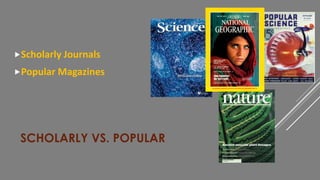
This document discusses determining the information needed for research. It begins by outlining the research process and distinguishing between primary and secondary sources. Primary sources are original documents, while secondary sources interpret and analyze primary sources. The document then describes various types of secondary sources like encyclopedias, dictionaries, and scholarly journals. It also explains how to access books and periodicals in print or digitally through the library catalog.





![W2 L1 The Research Process [Autosaved].pptx](https://cdn.slidesharecdn.com/ss_thumbnails/w2l1theresearchprocessautosaved-241202031529-1097ca97-thumbnail.jpg?width=640&height=640&fit=bounds)


