ASSISTIVE TECHNOLOGY
Supporting Students with Special Needs

Donnia M. Turner
ITEC 7530
Instruction Technology Foundations
WHAT IS ASSISTED TECHNOLOGY ?
Assistive Technology
 According to the Individuals with Disabilities Act

(IDEA), Assistive Technology (AT) is defined as
any item, piece of equipment, or product system
(whether acquired off the shelf, modified, or
customized) that is used to increase, maintain, or
improve the functional capabilities of a child with
a disability.
http://www.atp.ne.gov/techassist/def-legal.html
 Assistive technology devices and services were first

defined in federal law in the Individuals with
Disabilities Education Act of 1990 (Public Law 101-476)
which:
-is a law ensuring services to children with disabilities
throughout the nation. IDEA governs how states and
public agencies provide early intervention, special
education and related services to more than 6.5 million
eligible infants, toddlers, children and youth with
disabilities.
http://www.gpat.org/Georgia-Project-for-AssistiveTechnology/Pages/Assistive-Technology-Definition.aspx
www.idea.ed.gov
Assistive Technology continued
 The purpose of assistive technology is to bypass,

work around, or compensate for specific deficits,
rather than fixing them in order to help them
reach their full potential and live satisfying,
rewarding lives.

http://www.pluk.org/Pubs/ATguide4LD_419k.pdf
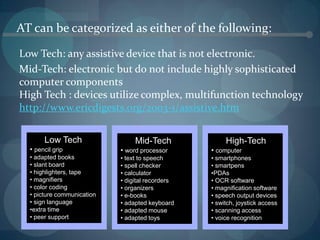
AT can be categorized as either of the following:
Low Tech: any assistive device that is not electronic.
Mid-Tech: electronic but do not include highly sophisticated
computer components
High Tech : devices utilize complex, multifunction technology
http://www.ericdigests.org/2003-1/assistive.htm
Low Tech
• pencil grip
• adapted books
• slant board
• highlighters, tape
• magnifiers
• color coding
• picture communication
• sign language
•extra time
• peer support

Mid-Tech

High-Tech

• word processor

• computer

• text to speech
• spell checker
• calculator
• digital recorders
• organizers
• e-books
• adapted keyboard
• adapted mouse
• adapted toys

• smartphones
• smartpens
•PDAs
• OCR software
• magnification software
• speech output devices
• switch, joystick access
• scanning access
• voice recognition
Why is AT Important?
By enabling people to perform tasks that they were
formerly unable to accomplish, or had great
difficulty accomplishing, the use of AT can:

•promote independence
• improve quality of life
• increase productivity
• enhance performance

• increase self esteem
http://en.wikipedia.org/wiki/Assistive_technology
Why is AT Important? continued
 Studies have shown that assistive technology can

support the developing child by significantly
improving the educational, vocational, and social
performance of students with special needs.
 However, their families and the professionals who

provide services to them may not be aware of these
tools or know how to use them.
(http://www.ldonline.org/article/8088)
SPECIAL NEEDS POPULATION
 The term “special needs" is broad and includes health,

mental health, developmental, and other kinds of
conditions and diagnoses. Some examples include: autism,
mental retardation, attention deficit-hyperactivity disorder
(ADHD), cerebral palsy, tics, learning disabilities, visual,
speech or language impairments.
 Also includes those children who are “at-risk” for
disabilities such as those who have a developmental delay.
The designation is useful for receiving needed services,
setting appropriate goals, and gaining understanding for a
child and their family.
 http://specialchildren.about.com/od/gettingadiagnosis/p/
whatare.htm
Special Needs can encompass the following:
 Behavioral Issues

 Developmental Issues
 Medical Issues
 Mental Health Issues
 Physical Disabilities
 Learning Issues

http://specialchildren.about.com/od/gettingadiagnosis/p/whatare.htm
FINDING A.T. SOLUTIONS
Individual Education Program
 An Individual Education Program (I.E.P) is

typically in place to serve students who have a
special need.
 The IEP is a legal document that is initiated by the
school that describes the goals sets for a child
during the school year, as well as any special
support needed to help achieve them.
http://kidshealth.org/parent/growth/learning/iep.html
Choosing Assistive Technology
When considering which assistive technology
devices/services, several factors must be
considered:
 Setting
 Physical needs of the student
 Task(s) to be accomplished by the student
 The device itself
http://www.ncld.org/students-disabilities/assistive-technologyeducation/choosing-assistive-technology
Identifying AT Solutions
 Step 1: Collect child and family information. Begin

the discussion about the child’s strengths, abilities,
preferences and needs. What strategies have been
found to work best?
 Step 2: Identify activities for participation. Discuss
the various activities within the environments that
a child encounters throughout the day. What is
preventing him/her from participating more?
 Step 3: What can be observed that indicates the

intervention is successful? What is his/her current
level of participation and what observable
behaviors will reflect an increase in independent
interactions? What changes (e.g., number of
initiations, expression attempts, responses,
reactions, etc.) will you look for?
 Step 4: Brainstorm AT solutions. Do the child’s

needs include supports for movement,
communication and/or use of materials? Start
with what is available in the environment (what
other children use) and consider adaptations to
those materials. A range of options that address
specific support areas should be considered.
 Step 5: Try it out. Determine when the AT

intervention will begin and create an observation
plan to record how the child participates with the
AT supports.
 Step 6: Identify what worked. Reflect on your plan
and discuss did and didn’t work. Make
modifications as needed and try again.
http://www.ldonline.org/article/8088
ASSISTIVE TECHNOLOGY
RESOURCES
 There are many types of learning difficulties

students may encounter such as: listening, math,
organization and memory, reading, and writing as
a result of their disability/special need. However,
there are several AT resources that can help.
Resources for
Listening/Hearing Difficulties
 Assistive listening devices (ALDs) help amplify the

sounds and can be used with a hearing aid or cochlear
implant.
http://www.nidcd.nih.gov/health/hearing/pages/assistive-devices.aspx

 Easy Listener and Hearing Helper- personal FM

systems that uses radio signals to transmit a speaker's
voice directly to the user's ear.
http://www.greatschools.org/special-education/assistive-technology/959-listeningtools.gs

 Text to Speech: Natural Reader is a free text to speech

reader.
http://www.naturalreaders.com/
Resources for
Math Difficulties
 MathPad and MathPad Plus- Allows students to

use the computer to work math problems
http://www.infouse.com/mathpad_public

 Math Talk -- user can voice own work and print work
 MaxAid and AbleData- talking calculator has the

ability to read aloud each number, symbol, or
operation key a user presses and also vocalizes the
answer to the problem.
http://www.greatschools.org/special-education/assistive-technology/949-math-tools.gs
Resources for
Organization/Memory Difficulties
 EcoSmart Pen – paper-based computer pen that

records and links audio to what a person writes
using the pen and special paper.
http://www.livescribe.com/en-us/solutions/learningdisabilities/

 Kidspiration and Draftbuilder - Graphic organizers

and outlining programs help users who have
trouble organizing and outlining information as
they begin a writing project.
http://www.readingrockets.org/article/33078
Resources for
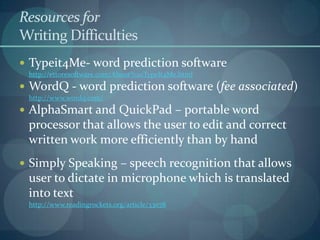
Writing Difficulties
 Typeit4Me- word prediction software
http://ettoresoftware.com/About%20TypeIt4Me.html

 WordQ - word prediction software (fee associated)
http://www.wordq.com/

 AlphaSmart and QuickPad – portable word

processor that allows the user to edit and correct
written work more efficiently than by hand
 Simply Speaking – speech recognition that allows

user to dictate in microphone which is translated
into text
http://www.readingrockets.org/article/33078
Resources for
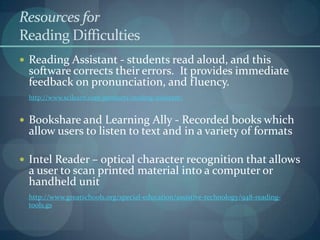
Reading Difficulties
 Reading Assistant - students read aloud, and this

software corrects their errors. It provides immediate
feedback on pronunciation, and fluency.
http://www.scilearn.com/products/reading-assistant/

 Bookshare and Learning Ally - Recorded books which

allow users to listen to text and in a variety of formats

 Intel Reader – optical character recognition that allows

a user to scan printed material into a computer or
handheld unit

http://www.greatschools.org/special-education/assistive-technology/948-readingtools.gs
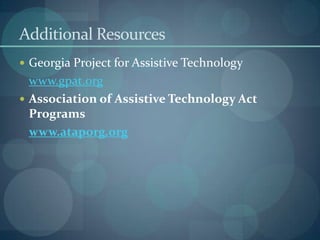
Additional Resources
 Georgia Project for Assistive Technology

www.gpat.org
 Association of Assistive Technology Act
Programs
www.ataporg.org

Donnia turner assistive technology

  • 1.
    ASSISTIVE TECHNOLOGY Supporting Studentswith Special Needs Donnia M. Turner ITEC 7530 Instruction Technology Foundations
  • 2.
    WHAT IS ASSISTEDTECHNOLOGY ?
  • 3.
    Assistive Technology  Accordingto the Individuals with Disabilities Act (IDEA), Assistive Technology (AT) is defined as any item, piece of equipment, or product system (whether acquired off the shelf, modified, or customized) that is used to increase, maintain, or improve the functional capabilities of a child with a disability. http://www.atp.ne.gov/techassist/def-legal.html
  • 4.
     Assistive technologydevices and services were first defined in federal law in the Individuals with Disabilities Education Act of 1990 (Public Law 101-476) which: -is a law ensuring services to children with disabilities throughout the nation. IDEA governs how states and public agencies provide early intervention, special education and related services to more than 6.5 million eligible infants, toddlers, children and youth with disabilities. http://www.gpat.org/Georgia-Project-for-AssistiveTechnology/Pages/Assistive-Technology-Definition.aspx www.idea.ed.gov
  • 5.
    Assistive Technology continued The purpose of assistive technology is to bypass, work around, or compensate for specific deficits, rather than fixing them in order to help them reach their full potential and live satisfying, rewarding lives. http://www.pluk.org/Pubs/ATguide4LD_419k.pdf
  • 6.
    AT can becategorized as either of the following: Low Tech: any assistive device that is not electronic. Mid-Tech: electronic but do not include highly sophisticated computer components High Tech : devices utilize complex, multifunction technology http://www.ericdigests.org/2003-1/assistive.htm Low Tech • pencil grip • adapted books • slant board • highlighters, tape • magnifiers • color coding • picture communication • sign language •extra time • peer support Mid-Tech High-Tech • word processor • computer • text to speech • spell checker • calculator • digital recorders • organizers • e-books • adapted keyboard • adapted mouse • adapted toys • smartphones • smartpens •PDAs • OCR software • magnification software • speech output devices • switch, joystick access • scanning access • voice recognition
  • 7.
    Why is ATImportant? By enabling people to perform tasks that they were formerly unable to accomplish, or had great difficulty accomplishing, the use of AT can: •promote independence • improve quality of life • increase productivity • enhance performance • increase self esteem http://en.wikipedia.org/wiki/Assistive_technology
  • 8.
    Why is ATImportant? continued  Studies have shown that assistive technology can support the developing child by significantly improving the educational, vocational, and social performance of students with special needs.  However, their families and the professionals who provide services to them may not be aware of these tools or know how to use them. (http://www.ldonline.org/article/8088)
  • 9.
  • 10.
     The term“special needs" is broad and includes health, mental health, developmental, and other kinds of conditions and diagnoses. Some examples include: autism, mental retardation, attention deficit-hyperactivity disorder (ADHD), cerebral palsy, tics, learning disabilities, visual, speech or language impairments.  Also includes those children who are “at-risk” for disabilities such as those who have a developmental delay. The designation is useful for receiving needed services, setting appropriate goals, and gaining understanding for a child and their family.  http://specialchildren.about.com/od/gettingadiagnosis/p/ whatare.htm
  • 11.
    Special Needs canencompass the following:  Behavioral Issues  Developmental Issues  Medical Issues  Mental Health Issues  Physical Disabilities  Learning Issues http://specialchildren.about.com/od/gettingadiagnosis/p/whatare.htm
  • 12.
  • 13.
    Individual Education Program An Individual Education Program (I.E.P) is typically in place to serve students who have a special need.  The IEP is a legal document that is initiated by the school that describes the goals sets for a child during the school year, as well as any special support needed to help achieve them. http://kidshealth.org/parent/growth/learning/iep.html
  • 14.
    Choosing Assistive Technology Whenconsidering which assistive technology devices/services, several factors must be considered:  Setting  Physical needs of the student  Task(s) to be accomplished by the student  The device itself http://www.ncld.org/students-disabilities/assistive-technologyeducation/choosing-assistive-technology
  • 15.
    Identifying AT Solutions Step 1: Collect child and family information. Begin the discussion about the child’s strengths, abilities, preferences and needs. What strategies have been found to work best?  Step 2: Identify activities for participation. Discuss the various activities within the environments that a child encounters throughout the day. What is preventing him/her from participating more?
  • 16.
     Step 3:What can be observed that indicates the intervention is successful? What is his/her current level of participation and what observable behaviors will reflect an increase in independent interactions? What changes (e.g., number of initiations, expression attempts, responses, reactions, etc.) will you look for?
  • 17.
     Step 4:Brainstorm AT solutions. Do the child’s needs include supports for movement, communication and/or use of materials? Start with what is available in the environment (what other children use) and consider adaptations to those materials. A range of options that address specific support areas should be considered.
  • 18.
     Step 5:Try it out. Determine when the AT intervention will begin and create an observation plan to record how the child participates with the AT supports.  Step 6: Identify what worked. Reflect on your plan and discuss did and didn’t work. Make modifications as needed and try again. http://www.ldonline.org/article/8088
  • 19.
  • 20.
     There aremany types of learning difficulties students may encounter such as: listening, math, organization and memory, reading, and writing as a result of their disability/special need. However, there are several AT resources that can help.
  • 21.
    Resources for Listening/Hearing Difficulties Assistive listening devices (ALDs) help amplify the sounds and can be used with a hearing aid or cochlear implant. http://www.nidcd.nih.gov/health/hearing/pages/assistive-devices.aspx  Easy Listener and Hearing Helper- personal FM systems that uses radio signals to transmit a speaker's voice directly to the user's ear. http://www.greatschools.org/special-education/assistive-technology/959-listeningtools.gs  Text to Speech: Natural Reader is a free text to speech reader. http://www.naturalreaders.com/
  • 22.
    Resources for Math Difficulties MathPad and MathPad Plus- Allows students to use the computer to work math problems http://www.infouse.com/mathpad_public  Math Talk -- user can voice own work and print work  MaxAid and AbleData- talking calculator has the ability to read aloud each number, symbol, or operation key a user presses and also vocalizes the answer to the problem. http://www.greatschools.org/special-education/assistive-technology/949-math-tools.gs
  • 23.
    Resources for Organization/Memory Difficulties EcoSmart Pen – paper-based computer pen that records and links audio to what a person writes using the pen and special paper. http://www.livescribe.com/en-us/solutions/learningdisabilities/  Kidspiration and Draftbuilder - Graphic organizers and outlining programs help users who have trouble organizing and outlining information as they begin a writing project. http://www.readingrockets.org/article/33078
  • 24.
    Resources for Writing Difficulties Typeit4Me- word prediction software http://ettoresoftware.com/About%20TypeIt4Me.html  WordQ - word prediction software (fee associated) http://www.wordq.com/  AlphaSmart and QuickPad – portable word processor that allows the user to edit and correct written work more efficiently than by hand  Simply Speaking – speech recognition that allows user to dictate in microphone which is translated into text http://www.readingrockets.org/article/33078
  • 25.
    Resources for Reading Difficulties Reading Assistant - students read aloud, and this software corrects their errors. It provides immediate feedback on pronunciation, and fluency. http://www.scilearn.com/products/reading-assistant/  Bookshare and Learning Ally - Recorded books which allow users to listen to text and in a variety of formats  Intel Reader – optical character recognition that allows a user to scan printed material into a computer or handheld unit http://www.greatschools.org/special-education/assistive-technology/948-readingtools.gs
  • 26.
    Additional Resources  GeorgiaProject for Assistive Technology www.gpat.org  Association of Assistive Technology Act Programs www.ataporg.org