ASSISTIVE 
TECHNOLOGIES 
Tiara Robinson 
Instructional Technology
Overview 
Working with a teaching a child that has special needs is an inevitable 
event in the field of education. As teachers we are introduced to a very 
wide range of disabilities and needs. Some of our students have 
emotional issues, many have special mental needs, as well as 
physical disabilities. Because every child is entitled to an education, 
and it is our job to make sure this happens, we must know to do this 
properly. In this presentation I will be focusing on ADHD, some mild 
learning disabilities, and assistive technologies and their use in the 
classroom. 
An Assistive Technology Device is defined as "any item, piece of 
equipment or product system, whether acquired commercially off the 
shelf, modified or customized, that is used to increase, maintain or 
improve the functional capabilities of individuals with disabilities (Ramp 
Up)“ These devices may be categorized as no technology, low 
technology, or high technology. Wheelchairs, amplifiers, and 
accessibility technology are just a few of the types of assistive devices 
that are available for and used by our students.
Auditory Processing Disability 
When a student has a APD they have the ability to hear, 
but not necessarily to listen and properly process. There 
are currently 5% of school-aged children who have this 
disorder. Their disability causes them to have difficulties 
receiving, sequencing, and applying information that they 
have heard. The behavior exhibited by children with this 
type of disability is often mistaken to be that of a child that 
has ADHD. Typically, these children have a hard time 
following directions, and are often fidgety or distracted 
during learning. While in school, our children are taught 
how to become “active listeners.” If a child has this order, 
and it is not handled properly they will struggle 
academically, and begin to develop language and speech 
delays.
Types of Auditory Processing Disabilities 
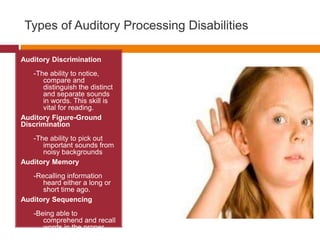
Auditory Discrimination 
-The ability to notice, 
compare and 
distinguish the distinct 
and separate sounds 
in words. This skill is 
vital for reading. 
Auditory Figure-Ground 
Discrimination 
-The ability to pick out 
important sounds from 
noisy backgrounds 
Auditory Memory 
-Recalling information 
heard either a long or 
short time ago. 
Auditory Sequencing 
-Being able to 
comprehend and recall 
words in the proper 
order.
Assistive Hearing Technologies for 
Students 
 One-to-one communicators 
 The speaker, regardless of who they are, uses a microphone 
when speaking to the student. The sound is transmitted directly 
to student’s earpiece, in which they are in control of the volume. 
 Personal FM systems 
 Similar to radio technology, the speaker uses a transmitter 
microphone that transmits to the student’s receiver. These 
systems can be used in school, church, theaters, etc. 
 Augmentative and alternative communication (AAC) devices 
 The use of technology such as picture boards or computer 
programs that synthesize speech from text, to help the child 
express themselves.. help people with communication disorders 
to express themselves. 
 Hearing loop systems 
 The use of electromagnetic energy to transmit sound. 
 Personal Amplifiers
ADHD 
 “I sit next to a window in math class, and I can’t filter 
out the noises coming from the playground. The 
noises make it hard for me to listen to the teacher.” - 
Martha, third grade 
The above statement, made by a child who was 
diagnosed as ADHD, makes it easy to see how it is 
sometimes difficult to decipher between ADHD and 
auditory processing disorder. 
ADHD is one of the most common neurodevelopmental 
disorders of childhood. It is usually first diagnosed in 
childhood and often lasts into adulthood. Children with 
ADHD may have trouble paying attention, controlling 
impulsive behaviors (may act without thinking about 
what the result will be), or be overly active. 
(www.CDC.gov)
ADHD at School 
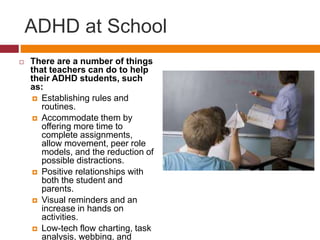
 There are a number of things 
that teachers can do to help 
their ADHD students, such 
as: 
 Establishing rules and 
routines. 
 Accommodate them by 
offering more time to 
complete assignments, 
allow movement, peer role 
models, and the reduction of 
possible distractions. 
 Positive relationships with 
both the student and 
parents. 
 Visual reminders and an 
increase in hands on 
activities. 
 Low-tech flow charting, task 
analysis, webbing, and
Mild Learning Disabilities 
Most students with mild 
intellectual disabilities appear 
very similar to others in school, 
except for the fact that they 
learn academic materials 
much more slowly than others 
They are typically low 
achieving, with poor social 
skills, and deficits in memory 
and motivation (education. 
com) These students make up 
nearly 60% of students who 
are currently receiving special 
services in school. 
 Slow rate of maturation 
 Delayed conceptual 
development 
 Difficulties converting ideas 
and feelings into words. 
 Limited attention span and 
retention abilities 
 Poor adaptive behaviors 
 Immature or inappropriate 
personal behavior 
 Low self-esteem and 
emotional disturbance. 
Characteristics:
How We Can Help… 
Resources: Application: 
 Word processing 
programs. 
 Word prediction software. 
 Communication and 
networking activities that 
allow for communication 
that goes beyond 
classroom walls. 
 Hyperlinks, which help 
students to make 
connections between 
resources. 
 Organization 
 Flow charting, webbing, 
outlining, etc. 
 Note taking 
 Microcassette voice 
recorders, notes typewritten 
by teacher, etc. 
 Writing assistance 
 Word processors that have 
tools such as spell/grammar 
checker and a thesaurus. 
 Access to reference materials 
 Cognitive assistance 
 Software with drills, practices, 
and simulations 
 Materials modification
Sources Cited 
 Behrmann, Michael M. (1995). Assistive Technology for Students with 
Mild Disabilities. Retrieved from 
https://www.teachervision.com/assistive- technology/teaching-methods/ 
3791.html 
 CDC. (2014). Facts about ADHD. Retrieved from 
http://www.cdc.gov/ncbddd/adhd/facts.html 
 Dendy, Zeigler Chris, ADDitude Editors. (2013). ADHD at School: 
Teachers Resources and Tips. Retrieved from 
http://www.additudemag.com/adhd/article/4039-5.html 
 Gurian, Anita Ph.D, Schwartz, Susan.(2013). About Learning 
Disabilities: What's an Auditory Processing Disorder. Retrieved from 
http://www.additudemag.com/adhd/article/921.html 
 Hasselbring, Ted S., Williams Glaser, Candyce H. Use of Computer 
Technology to Help Students with Special Needs.(2000). Retrieved 
from 
http://futureofchildren.org/publications/journals/article/index.xml?j 
our nalid=45&articleid=204&sectionid=1329 
 Hearing Assistive Technology. (2014). Retrieved from 
http://www.asha.org/public/hearing/treatment/assist_tech.htm
Sources Cont. 
 NCLD Editorial Team.(2012). Auditory Processing Disorders. Retrieved 
from http://www.ncld.org/types-learning-disabilities/adhd-related-issues/ 
auditory-processing-disorders/auditory-processing-disorders 
 Ramp Up to Access: Assistive Technolgy. (2000). Retrieved from 
http://uts.cc.utexas.edu/~wilbur/access/assistive.html 
 Rosenberg M.S., D.L., Westling, McLesky J.(2010). FAQ Sheet About 
Students with Mild Intellectual Disabilities. Retrieved from 
http://www.education.com/reference/article/faq-students-mild-intellecutal- 
disabilities/ 
 Special Education Support Service. Mild General Learning Disabilities. 
Retrieved from http://www.sess.ie/categories/general-learning-disabilities/ 
mild-general-learning-disabilities 
 The Nemours Foundation.(2014). Auditory Processing Disorder. Retrieved 
from 
http://kidshealth.org/parent/medical/ears/central_auditory.html 
 The NIDCD.(2011). Assistive Devices for People with Hearing, Voice, 
Speech, or Language Disorders. Retrieved from 
http://www.nidcd.nih.gov/health/hearing/pages/assistive-devices. 
aspx

Assistive Technologies for Students with Learning Disabilities and Special Needs

  • 1.
    ASSISTIVE TECHNOLOGIES TiaraRobinson Instructional Technology
  • 2.
    Overview Working witha teaching a child that has special needs is an inevitable event in the field of education. As teachers we are introduced to a very wide range of disabilities and needs. Some of our students have emotional issues, many have special mental needs, as well as physical disabilities. Because every child is entitled to an education, and it is our job to make sure this happens, we must know to do this properly. In this presentation I will be focusing on ADHD, some mild learning disabilities, and assistive technologies and their use in the classroom. An Assistive Technology Device is defined as "any item, piece of equipment or product system, whether acquired commercially off the shelf, modified or customized, that is used to increase, maintain or improve the functional capabilities of individuals with disabilities (Ramp Up)“ These devices may be categorized as no technology, low technology, or high technology. Wheelchairs, amplifiers, and accessibility technology are just a few of the types of assistive devices that are available for and used by our students.
  • 3.
    Auditory Processing Disability When a student has a APD they have the ability to hear, but not necessarily to listen and properly process. There are currently 5% of school-aged children who have this disorder. Their disability causes them to have difficulties receiving, sequencing, and applying information that they have heard. The behavior exhibited by children with this type of disability is often mistaken to be that of a child that has ADHD. Typically, these children have a hard time following directions, and are often fidgety or distracted during learning. While in school, our children are taught how to become “active listeners.” If a child has this order, and it is not handled properly they will struggle academically, and begin to develop language and speech delays.
  • 4.
    Types of AuditoryProcessing Disabilities Auditory Discrimination -The ability to notice, compare and distinguish the distinct and separate sounds in words. This skill is vital for reading. Auditory Figure-Ground Discrimination -The ability to pick out important sounds from noisy backgrounds Auditory Memory -Recalling information heard either a long or short time ago. Auditory Sequencing -Being able to comprehend and recall words in the proper order.
  • 5.
    Assistive Hearing Technologiesfor Students  One-to-one communicators  The speaker, regardless of who they are, uses a microphone when speaking to the student. The sound is transmitted directly to student’s earpiece, in which they are in control of the volume.  Personal FM systems  Similar to radio technology, the speaker uses a transmitter microphone that transmits to the student’s receiver. These systems can be used in school, church, theaters, etc.  Augmentative and alternative communication (AAC) devices  The use of technology such as picture boards or computer programs that synthesize speech from text, to help the child express themselves.. help people with communication disorders to express themselves.  Hearing loop systems  The use of electromagnetic energy to transmit sound.  Personal Amplifiers
  • 6.
    ADHD  “Isit next to a window in math class, and I can’t filter out the noises coming from the playground. The noises make it hard for me to listen to the teacher.” - Martha, third grade The above statement, made by a child who was diagnosed as ADHD, makes it easy to see how it is sometimes difficult to decipher between ADHD and auditory processing disorder. ADHD is one of the most common neurodevelopmental disorders of childhood. It is usually first diagnosed in childhood and often lasts into adulthood. Children with ADHD may have trouble paying attention, controlling impulsive behaviors (may act without thinking about what the result will be), or be overly active. (www.CDC.gov)
  • 7.
    ADHD at School  There are a number of things that teachers can do to help their ADHD students, such as:  Establishing rules and routines.  Accommodate them by offering more time to complete assignments, allow movement, peer role models, and the reduction of possible distractions.  Positive relationships with both the student and parents.  Visual reminders and an increase in hands on activities.  Low-tech flow charting, task analysis, webbing, and
  • 8.
    Mild Learning Disabilities Most students with mild intellectual disabilities appear very similar to others in school, except for the fact that they learn academic materials much more slowly than others They are typically low achieving, with poor social skills, and deficits in memory and motivation (education. com) These students make up nearly 60% of students who are currently receiving special services in school.  Slow rate of maturation  Delayed conceptual development  Difficulties converting ideas and feelings into words.  Limited attention span and retention abilities  Poor adaptive behaviors  Immature or inappropriate personal behavior  Low self-esteem and emotional disturbance. Characteristics:
  • 9.
    How We CanHelp… Resources: Application:  Word processing programs.  Word prediction software.  Communication and networking activities that allow for communication that goes beyond classroom walls.  Hyperlinks, which help students to make connections between resources.  Organization  Flow charting, webbing, outlining, etc.  Note taking  Microcassette voice recorders, notes typewritten by teacher, etc.  Writing assistance  Word processors that have tools such as spell/grammar checker and a thesaurus.  Access to reference materials  Cognitive assistance  Software with drills, practices, and simulations  Materials modification
  • 10.
    Sources Cited Behrmann, Michael M. (1995). Assistive Technology for Students with Mild Disabilities. Retrieved from https://www.teachervision.com/assistive- technology/teaching-methods/ 3791.html  CDC. (2014). Facts about ADHD. Retrieved from http://www.cdc.gov/ncbddd/adhd/facts.html  Dendy, Zeigler Chris, ADDitude Editors. (2013). ADHD at School: Teachers Resources and Tips. Retrieved from http://www.additudemag.com/adhd/article/4039-5.html  Gurian, Anita Ph.D, Schwartz, Susan.(2013). About Learning Disabilities: What's an Auditory Processing Disorder. Retrieved from http://www.additudemag.com/adhd/article/921.html  Hasselbring, Ted S., Williams Glaser, Candyce H. Use of Computer Technology to Help Students with Special Needs.(2000). Retrieved from http://futureofchildren.org/publications/journals/article/index.xml?j our nalid=45&articleid=204&sectionid=1329  Hearing Assistive Technology. (2014). Retrieved from http://www.asha.org/public/hearing/treatment/assist_tech.htm
  • 11.
    Sources Cont. NCLD Editorial Team.(2012). Auditory Processing Disorders. Retrieved from http://www.ncld.org/types-learning-disabilities/adhd-related-issues/ auditory-processing-disorders/auditory-processing-disorders  Ramp Up to Access: Assistive Technolgy. (2000). Retrieved from http://uts.cc.utexas.edu/~wilbur/access/assistive.html  Rosenberg M.S., D.L., Westling, McLesky J.(2010). FAQ Sheet About Students with Mild Intellectual Disabilities. Retrieved from http://www.education.com/reference/article/faq-students-mild-intellecutal- disabilities/  Special Education Support Service. Mild General Learning Disabilities. Retrieved from http://www.sess.ie/categories/general-learning-disabilities/ mild-general-learning-disabilities  The Nemours Foundation.(2014). Auditory Processing Disorder. Retrieved from http://kidshealth.org/parent/medical/ears/central_auditory.html  The NIDCD.(2011). Assistive Devices for People with Hearing, Voice, Speech, or Language Disorders. Retrieved from http://www.nidcd.nih.gov/health/hearing/pages/assistive-devices. aspx