Thingstobe
considered:
Definition
Types of AAC
Who Benefits?
Eligibility for AAC
Persons Involved
ALTERNATIVE AND AUGMENTATIVE COMMUNICATION
DEFINITION:
• various methods of communication that can help people
who are unable to use verbal speech to communicate
• benefit a wide range of individuals, from a beginning
communicator to a more sophisticated communicator who
generates his own messages
• includes all forms of communication (other than oral
speech) that are used to express thoughts, needs, wants,
and ideas
ALTERNATIVE AND AUGMENTATIVE COMMUNICATION
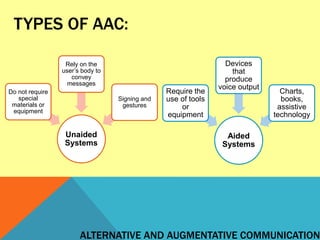
Unaided
Systems
Do not require
special
materials or
equipment
Rely on the
user’s body to
convey
messages
Signing and
gestures
Aided
Systems
Require the
use of tools
or
equipment
Devices
that
produce
voice output
Charts,
books,
assistive
technology
TYPES OF AAC:
ALTERNATIVE AND AUGMENTATIVE COMMUNICATION
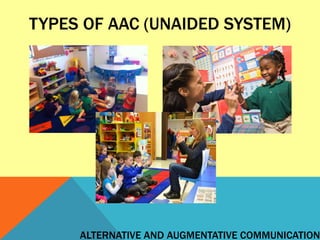
TYPES OF AAC (UNAIDED SYSTEM)
ALTERNATIVE AND AUGMENTATIVE COMMUNICATION
TYPES OF AAC (AIDED SYSTEM)
ALTERNATIVE AND AUGMENTATIVE COMMUNICATION
WHO BENEFITS?
• any person with disability that has
difficulty in communication
• family members and other significant
others
ALTERNATIVE AND AUGMENTATIVE COMMUNICATION
ELIGIBILITY:
The following factors need to be considered:
1. What are the individual's cognitive abilities?
2. What are the individual's physical abilities?
3. What is the most important vocabulary relevant to the
individual?
4. Is the individual motivated and interested in using AAC?
5. Always enlist the expert help of a speech language
pathologist, occupational therapist, or other AT professional.
ALTERNATIVE AND AUGMENTATIVE COMMUNICATION
speech-language pathologists
physical therapists
occupational therapists
educators
other professionals
1
3
2
4
5
Persons Involved
ALTERNATIVE AND AUGMENTATIVE COMMUNICATION

Alternative and Augmentative Communication Systems

  • 2.
    Thingstobe considered: Definition Types of AAC WhoBenefits? Eligibility for AAC Persons Involved ALTERNATIVE AND AUGMENTATIVE COMMUNICATION
  • 3.
    DEFINITION: • various methodsof communication that can help people who are unable to use verbal speech to communicate • benefit a wide range of individuals, from a beginning communicator to a more sophisticated communicator who generates his own messages • includes all forms of communication (other than oral speech) that are used to express thoughts, needs, wants, and ideas ALTERNATIVE AND AUGMENTATIVE COMMUNICATION
  • 4.
    Unaided Systems Do not require special materialsor equipment Rely on the user’s body to convey messages Signing and gestures Aided Systems Require the use of tools or equipment Devices that produce voice output Charts, books, assistive technology TYPES OF AAC: ALTERNATIVE AND AUGMENTATIVE COMMUNICATION
  • 5.
    TYPES OF AAC(UNAIDED SYSTEM) ALTERNATIVE AND AUGMENTATIVE COMMUNICATION
  • 6.
    TYPES OF AAC(AIDED SYSTEM) ALTERNATIVE AND AUGMENTATIVE COMMUNICATION
  • 7.
    WHO BENEFITS? • anyperson with disability that has difficulty in communication • family members and other significant others ALTERNATIVE AND AUGMENTATIVE COMMUNICATION
  • 8.
    ELIGIBILITY: The following factorsneed to be considered: 1. What are the individual's cognitive abilities? 2. What are the individual's physical abilities? 3. What is the most important vocabulary relevant to the individual? 4. Is the individual motivated and interested in using AAC? 5. Always enlist the expert help of a speech language pathologist, occupational therapist, or other AT professional. ALTERNATIVE AND AUGMENTATIVE COMMUNICATION
  • 9.
    speech-language pathologists physical therapists occupationaltherapists educators other professionals 1 3 2 4 5 Persons Involved ALTERNATIVE AND AUGMENTATIVE COMMUNICATION