
Saranya J S 
Natural Science 
Reg no: 13975022 
KUCTE Anchal
INTRODUCTION 
Internet enables people to learn in a network without meeting in physical environments. Blogs, Wikis, Twitter messages and other Web 2.0 media forms bring learners many new learning experiences. People are fond of learning with other people and make competitions. Learning networks make it possible for learners to learn together and to show their achievements. Certain monitoring tools are required to monitor the learning activities. However, it is challenging to measure the performance of learning or to tell who make better progresses in learning some soft skills. The reasons are that it is difficult to find those indicators. Web 2.0 media such as microblogging provides people informal learning and training possibility, if people subscribe to some professional microblogging hosts. For example, in Twitter followers and following build up two learning networks. Followers are those who follow the twitter messages of one person, while one is following the others and are followers of the others again. This represents the hub and authority relationships in Web. The e Twinning portal is considered as an informal dialogue to improve teaching. Consequently, informal assessment methods of learners' learning performance or achievements are required for informal learning and informal professional development. In some professional social networks, people's personal contacts number may show how well their social relationships are. For instance, contacts number is a label for the prominent in the professional social network site LinkedIn (linkedin.com). Research on information diffusion patterns in people's network may be employed for assess learners in learning networks. 
E-TWINNING 
The e-Twinning action is an initiative of the European Commission that aims to encourage European schools to collaborate using Information and Communication Technologies (ICT) by providing the necessary infrastructure (online tools, services, support). Therefore, teachers registered in the eTwinning action are enabled to form partnerships and develop collaborative, pedagogical school projects in any subject area with the sole requirements to employ ICT to develop their project and collaborate with teachers from other European
countries (at least two teachers from two different European countries are needed). The primary workspace for the eTwinning action, is the eTwinning Portal (www.etwinning.net) and it is available in twenty-five languages. Teachers registered in the eTwinning action, also called eTwinners, find each other, communicate, share resources and collaborate through the eTwinning platform. This growing and active community enforced the change in the motto of eTwinning from "School partnerships in Europe" to "The community for schools in Europe". 
HISTORY OF E-TWINNING 
The eTwinning action was launched in January 2005 as the main action of the European Commission’s eLearning Programme, eTwinning has been firmly integrated in Erasmus+, the European programme for Education, Training, Youth and Sport, since 2014. Its main objectives complied with the decision by the Barcelona European Council in March 2002 to promote school twinning as an opportunity for all students to learn and practice ICT skills and to promote awareness of the multicultural European model of society. More than 13 000 schools were involved in eTwinning within its first year. In fall 2008, over 50 000 teachers and 4 000 projects have been registered, while a new eTwinning platform was launched. In early 2009 the eTwinning motto has changed from School partnerships in Europe to the community for schools in Europe. In June 2009, the eTwinning community consisted of nearly 65 000 members. In 2011 nearly 30 000 projects have been registered, the total number of registered teachers has increased dramatically to 130 000, and the number of registered schools has been 90 000. The eTwinning Portal now has the involvement of nearly 230 277 members and over 5462 projects between two or more schools across Europe. 
THE E-TWINNING OPERATION 
The main concept behind eTwinning is that schools are paired with another school elsewhere in the Europe and they collaboratively develop a project, also known as e-Twinning project. The two schools then communicate using the Internet (for example, by e-mail or video conferencing) to collaborate, share and
learn from each other. e-Twinning encourages and develops ICT skills as the main activities inherently use information technology. Being twinned with a foreign school also encourages cross-cultural exchanges of knowledge, fosters students' intercultural awareness, and improves their communication skills. e-Twinning projects last for any length of time ranging from only a week, to months, up to creating permanent relationships between schools. Schools (both primary and secondary) within the European Union member states can participate in the eTwinning project, in addition to schools from Turkey, Norway and Iceland. In contrast with other European programmes, such as the Comenius programme, all communication is held via the internet and therefore there is no need for grants. Along the same lines, face-to-face meetings between partner schools are not required, though they are not prohibited and some schools organise face-to-face meetings. European school net has been granted the role of Central Support Service (CSS) at European level. e-Twinning is also supported by a network of National Support Services (NSS). 
PARTICIPATING COUNTRIES 
Member States of the European Union participate in the eTwinning action: Austria, Belgium, Bulgaria, Cyprus, Czech Republic, Denmark, Estonia, Finland, France, Germany, Greece, Hungary, Ireland, Italy, Latvia, Lithuania, Luxembourg, Malta, Poland, Portugal, Romania, Slovakia, Slovenia, Spain, Sweden, the Netherlands and the United Kingdom. Additionally, Croatia, Iceland, Norway, Switzerland and Turkey take part. 
E-TWINNING MEANS FOR INSTITUTIONAL AND PROFESSIONAL GROWTH 
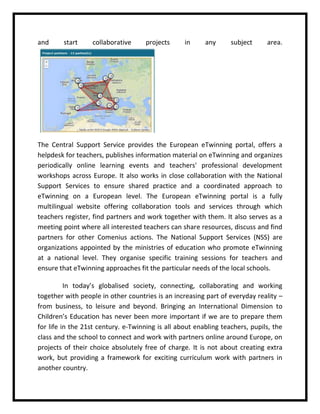
e-Twinning promotes school collaboration and school networking in Europe through the use of Information and Communication Technologies (ICT). It provides advice, ideas and tools to make it easy for schools to set up partnerships
and start collaborative projects in any subject area. 
The Central Support Service provides the European eTwinning portal, offers a helpdesk for teachers, publishes information material on eTwinning and organizes periodically online learning events and teachers' professional development workshops across Europe. It also works in close collaboration with the National Support Services to ensure shared practice and a coordinated approach to eTwinning on a European level. The European eTwinning portal is a fully multilingual website offering collaboration tools and services through which teachers register, find partners and work together with them. It also serves as a meeting point where all interested teachers can share resources, discuss and find partners for other Comenius actions. The National Support Services (NSS) are organizations appointed by the ministries of education who promote eTwinning at a national level. They organise specific training sessions for teachers and ensure that eTwinning approaches fit the particular needs of the local schools. 
In today’s globalised society, connecting, collaborating and working together with people in other countries is an increasing part of everyday reality – from business, to leisure and beyond. Bringing an International Dimension to Children’s Education has never been more important if we are to prepare them for life in the 21st century. e-Twinning is all about enabling teachers, pupils, the class and the school to connect and work with partners online around Europe, on projects of their choice absolutely free of charge. It is not about creating extra work, but providing a framework for exciting curriculum work with partners in another country.
e-Twinning offers a wide variety of Continues Profesional Development (CPD) opportunities, to which about 20,000 teachers participate every year. Training is both online and face-to-face, at national and European level, formal and non- formal. It promotes both Project Based learning and Inquiry Based learning approach to teaching by the means of eTwinning projects Teachers who are members in e-Twinning uses ICT in teaching process. 
Engagement of people online and in particular teachers is dependent on a number of different factors including cultural variables, time available, recognition granted and ICT skills. Above all, teachers need to feel safe online, be assured the community they are involved in is secure and that their opinions and contributions stay inside the walls of the community to which they belong. 
BENEFITS OF E-TWINNING 
 For pupils: 
 Increased motivation, as they have an audience for their work in a school in another country. 
 Enhanced key skills, including ICT use, communication and foreign language skills. 
 Greater cultural awareness through direct contact with peers in other countries. 
 For school staff: 
 Direct contact with education professionals in another European country. 
 An awareness of teaching and/or management approaches used in another country. 
 Sharing and celebration of your own professional expertise and experience. 
 Using eTwinning as a first step to international linking and gaining the International School Award.
CONCLUSION e-Twinning offers a platform for staff including teachers, head teachers, librarians, etc., working in a school in one of the European countries involved, to communicate, collaborate, develop projects, share and, in short, feel and be part of the most exciting learning community in Europe. eTwinning promotes school collaboration and school networking in Europe through the use of Information and Communication Technologies (ICT). The eTwinning action promotes school collaboration in Europe through the use of Information and Communication Technologies (ICT) by providing support, tools and services for schools. Schools, teachers of any subject area, headmasters, librarians and other educational staff get the benefits of e-twinning. REFERENCES 1. Crawley, C., Gilleran, A., Scimeca, S., Vuorikari, R. & Wastiau, P. (2009). Beyond School Projects - A report on eTwinning 2008-2009. Central Support Service for e-Twinning, European School net, Rue de Trèves 61, 1040 Brussels Belgium. 2. Konstantinidis, A. (2012). Implementing Learning-Oriented Assessment in an e-Twinning Online Course for Greek Teachers. MERLOT Journal of Online Learning and Teaching, 8(1), 45-62. 
3. Vuorikari, R. (2010). Teachers' professional development - An overview of current practice. Central Support Service for e-Twinning (CSS), December, 2010.

Online assignment saranya

  • 1.
    Saranya J S Natural Science Reg no: 13975022 KUCTE Anchal
  • 3.
    INTRODUCTION Internet enablespeople to learn in a network without meeting in physical environments. Blogs, Wikis, Twitter messages and other Web 2.0 media forms bring learners many new learning experiences. People are fond of learning with other people and make competitions. Learning networks make it possible for learners to learn together and to show their achievements. Certain monitoring tools are required to monitor the learning activities. However, it is challenging to measure the performance of learning or to tell who make better progresses in learning some soft skills. The reasons are that it is difficult to find those indicators. Web 2.0 media such as microblogging provides people informal learning and training possibility, if people subscribe to some professional microblogging hosts. For example, in Twitter followers and following build up two learning networks. Followers are those who follow the twitter messages of one person, while one is following the others and are followers of the others again. This represents the hub and authority relationships in Web. The e Twinning portal is considered as an informal dialogue to improve teaching. Consequently, informal assessment methods of learners' learning performance or achievements are required for informal learning and informal professional development. In some professional social networks, people's personal contacts number may show how well their social relationships are. For instance, contacts number is a label for the prominent in the professional social network site LinkedIn (linkedin.com). Research on information diffusion patterns in people's network may be employed for assess learners in learning networks. E-TWINNING The e-Twinning action is an initiative of the European Commission that aims to encourage European schools to collaborate using Information and Communication Technologies (ICT) by providing the necessary infrastructure (online tools, services, support). Therefore, teachers registered in the eTwinning action are enabled to form partnerships and develop collaborative, pedagogical school projects in any subject area with the sole requirements to employ ICT to develop their project and collaborate with teachers from other European
  • 4.
    countries (at leasttwo teachers from two different European countries are needed). The primary workspace for the eTwinning action, is the eTwinning Portal (www.etwinning.net) and it is available in twenty-five languages. Teachers registered in the eTwinning action, also called eTwinners, find each other, communicate, share resources and collaborate through the eTwinning platform. This growing and active community enforced the change in the motto of eTwinning from "School partnerships in Europe" to "The community for schools in Europe". HISTORY OF E-TWINNING The eTwinning action was launched in January 2005 as the main action of the European Commission’s eLearning Programme, eTwinning has been firmly integrated in Erasmus+, the European programme for Education, Training, Youth and Sport, since 2014. Its main objectives complied with the decision by the Barcelona European Council in March 2002 to promote school twinning as an opportunity for all students to learn and practice ICT skills and to promote awareness of the multicultural European model of society. More than 13 000 schools were involved in eTwinning within its first year. In fall 2008, over 50 000 teachers and 4 000 projects have been registered, while a new eTwinning platform was launched. In early 2009 the eTwinning motto has changed from School partnerships in Europe to the community for schools in Europe. In June 2009, the eTwinning community consisted of nearly 65 000 members. In 2011 nearly 30 000 projects have been registered, the total number of registered teachers has increased dramatically to 130 000, and the number of registered schools has been 90 000. The eTwinning Portal now has the involvement of nearly 230 277 members and over 5462 projects between two or more schools across Europe. THE E-TWINNING OPERATION The main concept behind eTwinning is that schools are paired with another school elsewhere in the Europe and they collaboratively develop a project, also known as e-Twinning project. The two schools then communicate using the Internet (for example, by e-mail or video conferencing) to collaborate, share and
  • 5.
    learn from eachother. e-Twinning encourages and develops ICT skills as the main activities inherently use information technology. Being twinned with a foreign school also encourages cross-cultural exchanges of knowledge, fosters students' intercultural awareness, and improves their communication skills. e-Twinning projects last for any length of time ranging from only a week, to months, up to creating permanent relationships between schools. Schools (both primary and secondary) within the European Union member states can participate in the eTwinning project, in addition to schools from Turkey, Norway and Iceland. In contrast with other European programmes, such as the Comenius programme, all communication is held via the internet and therefore there is no need for grants. Along the same lines, face-to-face meetings between partner schools are not required, though they are not prohibited and some schools organise face-to-face meetings. European school net has been granted the role of Central Support Service (CSS) at European level. e-Twinning is also supported by a network of National Support Services (NSS). PARTICIPATING COUNTRIES Member States of the European Union participate in the eTwinning action: Austria, Belgium, Bulgaria, Cyprus, Czech Republic, Denmark, Estonia, Finland, France, Germany, Greece, Hungary, Ireland, Italy, Latvia, Lithuania, Luxembourg, Malta, Poland, Portugal, Romania, Slovakia, Slovenia, Spain, Sweden, the Netherlands and the United Kingdom. Additionally, Croatia, Iceland, Norway, Switzerland and Turkey take part. E-TWINNING MEANS FOR INSTITUTIONAL AND PROFESSIONAL GROWTH e-Twinning promotes school collaboration and school networking in Europe through the use of Information and Communication Technologies (ICT). It provides advice, ideas and tools to make it easy for schools to set up partnerships
  • 6.
    and start collaborativeprojects in any subject area. The Central Support Service provides the European eTwinning portal, offers a helpdesk for teachers, publishes information material on eTwinning and organizes periodically online learning events and teachers' professional development workshops across Europe. It also works in close collaboration with the National Support Services to ensure shared practice and a coordinated approach to eTwinning on a European level. The European eTwinning portal is a fully multilingual website offering collaboration tools and services through which teachers register, find partners and work together with them. It also serves as a meeting point where all interested teachers can share resources, discuss and find partners for other Comenius actions. The National Support Services (NSS) are organizations appointed by the ministries of education who promote eTwinning at a national level. They organise specific training sessions for teachers and ensure that eTwinning approaches fit the particular needs of the local schools. In today’s globalised society, connecting, collaborating and working together with people in other countries is an increasing part of everyday reality – from business, to leisure and beyond. Bringing an International Dimension to Children’s Education has never been more important if we are to prepare them for life in the 21st century. e-Twinning is all about enabling teachers, pupils, the class and the school to connect and work with partners online around Europe, on projects of their choice absolutely free of charge. It is not about creating extra work, but providing a framework for exciting curriculum work with partners in another country.
  • 7.
    e-Twinning offers awide variety of Continues Profesional Development (CPD) opportunities, to which about 20,000 teachers participate every year. Training is both online and face-to-face, at national and European level, formal and non- formal. It promotes both Project Based learning and Inquiry Based learning approach to teaching by the means of eTwinning projects Teachers who are members in e-Twinning uses ICT in teaching process. Engagement of people online and in particular teachers is dependent on a number of different factors including cultural variables, time available, recognition granted and ICT skills. Above all, teachers need to feel safe online, be assured the community they are involved in is secure and that their opinions and contributions stay inside the walls of the community to which they belong. BENEFITS OF E-TWINNING  For pupils:  Increased motivation, as they have an audience for their work in a school in another country.  Enhanced key skills, including ICT use, communication and foreign language skills.  Greater cultural awareness through direct contact with peers in other countries.  For school staff:  Direct contact with education professionals in another European country.  An awareness of teaching and/or management approaches used in another country.  Sharing and celebration of your own professional expertise and experience.  Using eTwinning as a first step to international linking and gaining the International School Award.
  • 8.
    CONCLUSION e-Twinning offersa platform for staff including teachers, head teachers, librarians, etc., working in a school in one of the European countries involved, to communicate, collaborate, develop projects, share and, in short, feel and be part of the most exciting learning community in Europe. eTwinning promotes school collaboration and school networking in Europe through the use of Information and Communication Technologies (ICT). The eTwinning action promotes school collaboration in Europe through the use of Information and Communication Technologies (ICT) by providing support, tools and services for schools. Schools, teachers of any subject area, headmasters, librarians and other educational staff get the benefits of e-twinning. REFERENCES 1. Crawley, C., Gilleran, A., Scimeca, S., Vuorikari, R. & Wastiau, P. (2009). Beyond School Projects - A report on eTwinning 2008-2009. Central Support Service for e-Twinning, European School net, Rue de Trèves 61, 1040 Brussels Belgium. 2. Konstantinidis, A. (2012). Implementing Learning-Oriented Assessment in an e-Twinning Online Course for Greek Teachers. MERLOT Journal of Online Learning and Teaching, 8(1), 45-62. 3. Vuorikari, R. (2010). Teachers' professional development - An overview of current practice. Central Support Service for e-Twinning (CSS), December, 2010.