Meaningfully 
different brands 
Charles Foster 
MD Millward Brown MEA
2 
WE ARE 
THE WORLD’S 
LEADING EXPERT 
IN 
helping clients 
GROW 
great brands
Meaningfully 
different brands, 
properly amplified, 
create sustainable 
financial value 
growth.
4 
MillwardBrown Brand Philosophy
Brands 
Brands 
Brands 
Brands
What is 
a brand? 
A set of associations (ideas, 
memories and feelings) in 
the mind of a consumer
What makes a brand valuable? 
I N C R E A S I N G 
T H E L I K E L I H O O D 
that a consumer 
wi l l buy/consider 
I N C R E A S I N G 
H OW MU C H 
consumers 
wi l l pay 
Successful brands build associations that 
deliver these commercial benefits
8 
MEANINGFUL 
Consumers feel an 
affinity for the brand 
or think it meets their 
needs 
DIFFERENT 
Feels different from 
other brands or sets 
the trends for the 
category 
SALIENT 
Comes to mind 
quickly and readily 
when activated by 
ideas relating to 
category purchase
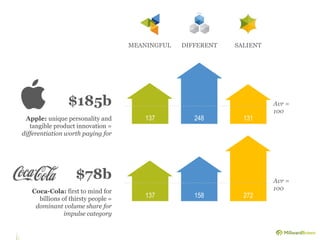
Apple: unique personality and 
tangible product innovation = 
differentiation worth paying for 
137 248 131 
137 158 272 
Avr = 
100 
$185b 
MEANINGFUL DIFFERENT SALIENT 
Avr = 
100 
$78b 
Coca-Cola: first to mind for 
billions of thirsty people = 
dominant volume share for 
impulse category
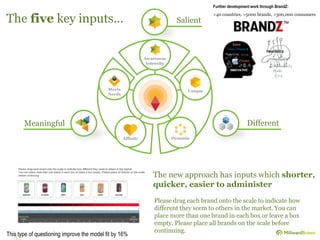
Salient 
The five key inputs… 
Meets 
Needs 
Meaningful Different 
Affinity 
Unique 
Dynamic 
Awareness 
Intensity 
The new approach has inputs which shorter, 
quicker, easier to administer 
Please drag each brand onto the scale to indicate how 
different they seem to others in the market. You can 
place more than one brand in each box or leave a box 
empty. Please place all brands on the scale before 
continuing. 
This type of questioning improve the model fit by 16% 
Further development work through BrandZ: 
>40 countries, >5000 brands, >300,000 consumers
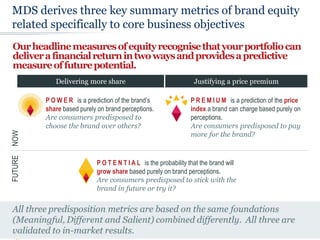
MDS derives three key summary metrics of brand equity 
related specifically to core business objectives 
Our headline measures of equity recognise that your portfolio can 
deliver a financial return in two ways and provides a predictive 
measure of future potential. 
11 
Delivering more share 
P OWE R is a prediction of the brand’s 
share based purely on brand perceptions. 
Are consumers predisposed to 
choose the brand over others? 
Justifying a price premium 
P R E M I U M is a prediction of the price 
index a brand can charge based purely on 
perceptions. 
Are consumers predisposed to pay 
more for the brand? 
P O T E N T I A L is the probability that the brand will 
grow share based purely on brand perceptions. 
Are consumers predisposed to stick with the 
brand in future or try it? 
FUTURE NOW
Meaningful, different and salient brands… 
Each of these metrics are created from measures of 
how meaningful, different and salient brands are. 
12 
… Have the POWER to 
capture significantly 
MORE VOLUME 
POWER 
… Can command a price 
PREMIUM PREMIUM 
… Have much greater 
POTENTIAL to gain 
value share in the future 
POTENTIAL
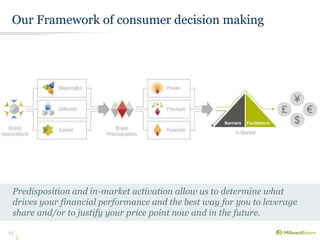
Our Framework of consumer decision making 
Predisposition and in-market activation allow us to determine what 
drives your financial performance and the best way for you to leverage 
share and/or to justify your price point now and in the future. 
13
Great 
metrics, 
need great 
14 
data 
capturing 
techniques
We are 90% electronic DC today, PAPI is going because…. 
15 
Busy consumers 
Less accessible 
Poorer quality data 
Slow study timelines 
BUT WHAT’S NEXT?
Mobile interviewing 
is the future; in fact it 
is already here 
16
Why consider mobile surveys? 
ACTUALLY THE REAL QUESTION SHOULD BE WHY NOT? 
17 
1.76 
BILLION 
37% 
GROWTH 
15% 
OF WEB 
smartphones users by the end of 2014 – overtaking 
laptops and PCs* 
in the number of global 3G subscribers in the past year** 
traffic comes via mobile – more than double last year; 
Mobile traffic share already over 50% in India and China*** 
*Source: e.Marketer Global report June 2014 **Source: InformaWCIS; 
***Source: StatCounter Global Stats, 9/12
Nearly 51% of web traffic in KSA comes from a 
mobile phone device and not from a desktop (49%) 
18
This is not surprising since KSA has the 3rd highest 
smart phone penetration in the world. 
53 
48 
47 
47 
44 
43 
42 
33 
25 
18 
15 
40 
Russia 
Mexico 
Thailand 
South Africa 
Argentina 
Philippines 
Japan 
Turkey 
Brazil 
Vietnam 
Indonesia 
India 
19 
81 
81 
76 
75 
72 
68 
65 
65 
62 
85 
UK 
Australia 
Spain 
Saudi Arabia 
Canada 
USA 
China 
Germany 
France 
Italy 
Source – Google Our Mobile Planet 2014.
20 
MOBILE SURVEYS GIVE YOU GREAT 
SHORT TERM ADVANTAGES 
 Consumers are connected to 
their mobile phones all the time 
and find it comfortable and 
engaging as a communication 
medium  better interview 
context 
 Pilot studies have shown that without 
interviewers (over)prompting, mobile 
data is more discriminating between 
brands and reflect market reality better 
 better data quality 
 Speed of data access and deliverables 
increases significantly.
21 
MOBILE SURVEYS WILL HELP YOU 
FUTURE PROOF YOUR INSIGHTS 
Door to door access will get increasingly difficult and expensive due to 
rising trend of gated communities where higher income respondents reside 
 better representativeness of the sample 
Can integrate exciting possibilities offered by the smartphone platform: 
multimedia, geo-location (GPS), passive behaviour monitoring (once the 
smartphone penetration is sufficiently high).
22 
Data quality 
is impressive 
on Mobile
23 
KEY INSIGHTS WE HAVE SEEN FROM THE DATA
ACCESS TO 
HIGHER 
INCOME 
HOUSEHOLDS 
MOBILE GIVES US BETTER ACCESS TO HIGHER INCOME HOUSEHOLDS (MORE 
VALUABLE 24 
CUSTOMERS) THAN TRADITIONAL DOOR-TO-DOOR INTERVIEWING CAN
25 
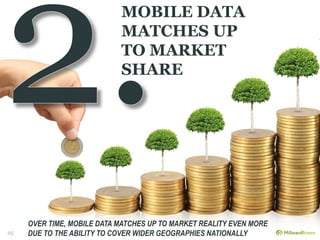
MOBILE DATA 
MATCHES UP 
TO MARKET 
SHARE 
OVER TIME, MOBILE DATA MATCHES UP TO MARKET REALITY EVEN MORE 
DUE TO THE ABILITY TO COVER WIDER GEOGRAPHIES NATIONALLY
26 
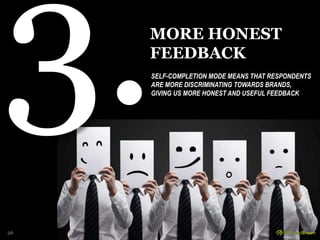
MORE HONEST 
FEEDBACK 
SELF-COMPLETION MODE MEANS THAT RESPONDENTS 
ARE MORE DISCRIMINATING TOWARDS BRANDS, 
GIVING US MORE HONEST AND USEFUL FEEDBACK
27 
NOT AN ISSUE CAPTURING 
OPEN ENDED RESPONSES
28 
SCREEN SIZE 
DOESN’T MATTER – 
RESPONSES ARE 
CONSISTENT
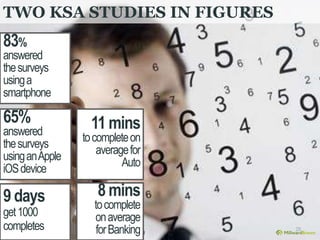
TWO KSA STUDIES IN FIGURES 
29 
8 mins 
to complete 
on average 
for Banking 
83% 
answered 
the surveys 
using a 
smartphone 
65% 
answered 
the surveys 
using an Apple 
iOSdevice 
11 mins 
to complete on 
average for 
Auto 
9 days 
get 1000 
completes
KSA STUDIES BY RESPONDENT LOCATION 
30
2 Brand Equity 
Studies 
completed via 
Mobile in KSA 
Cars example 
31
EQUITY OF LEADING CAR 
BRANDS 
32
33
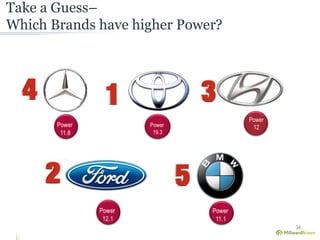
Take a Guess– 
Which Brands have higher Power? 
34 
Power 
12
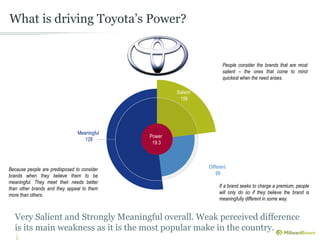
What is driving Toyota’s Power? 
Salient 
156 
Salient 
156 
Power 
19.3 
Salient 
156 
People consider the brands that are most 
salient – the ones that come to mind 
quickest when the need arises. 
Different 
88 
Power 
19.3 
Meaningful 
128 
Because people are predisposed to consider 
brands when they believe them to be 
meaningful. They meet their needs better 
than other brands and they appeal to them 
more than others. 
If a brand seeks to charge a premium, people 
will only do so if they believe the brand is 
meaningfully different in some way. 
Very Salient and Strongly Meaningful overall. Weak perceived difference 
is its main weakness as it is the most popular make in the country.
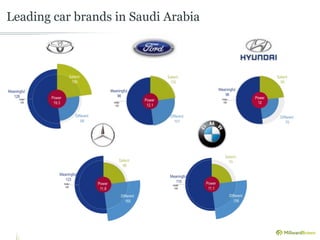
Leading car brands in Saudi Arabia 
Power 
12
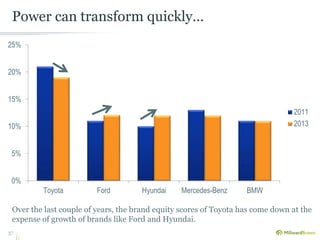
Power can transform quickly… 
25% 
20% 
15% 
10% 
5% 
0% 
Over the last couple of years, the brand equity scores of Toyota has come down at the 
expense of growth of brands like Ford and Hyundai. 
37 
Toyota Ford Hyundai Mercedes-Benz BMW 
2011 
2013
Changing demographics also impacting power shift: 
Younger Saudis lean towards Hyundai and BMW 
38 
POWER SCORES 
IN 2013 
TOTAL 
SAMPLE 
20-29 YRS 30-50 YRS 
Toyota 19.3% 
Ford 12.1% 
Hyundai 12% 
Mercedes-Benz 11.8% Average Average 
BMW 11.1% 
Chevrolet 9% 
Honda 9% 
Nissan 8% Average Average 
GMC 7% Average Average 
Base: (400) (236) (164) 
Lower than the average Higher than the average
What contributes to being 
Meaningful & Different in cars? 
39
What is driving Meaningful & Difference for cars in 
KSA? 
20.9% 
40 
Contribution to Meaningful Contribution to Difference 
3.1% 
0.4% 
- 12.4% 
17.0% 
16.3% 
26.6% 
24.2% 
Proud to drive 
Better to drive 
Stylish design 
Acceptable price 
Costs more 
Too cheap 
Doesn't meet needs 
- 1.3% 
- 15.6% 
29.9% 
1.7% 
14.0% 
16.7% 
Proud to drive 
Better to drive 
Stylish design 
Acceptable price 
Costs more 
Too cheap 
Doesn't meet needs 
Premium 
pricing 
Driving 
experience
Power differences across mid-range car brands 
Average 
Endorsement 
across category 
Toyota Ford Hyundai 
Better to drive than others in their 
class 33% 
More stylish and better designed 
than others in their class 34% 
Would be proud to use 34% 
Acceptable price 13% 
Does not meet my needs 22% 
Costs more than you're prepared 
to pay 12% 
-8% 
Too cheap 6% -1% 
1% 
-5% 
13% 
-4% 
1% 
41 
9% 
2% 
-10% 
-6% 
9% 
-15% 
-1% 
1% 
-2% 
-2% 
-3% 
4% 
-6% 
1%
Power differences across prestige brands 
Average 
Endorsement across 
category 
Mercedes Benz BMW 
Better to drive than others in 
their class 33% 
More stylish and better designed 
than others in their class 34% 
Would be proud to use 34% 
Acceptable price 13% 
Does not meet my needs 22% 
Costs more than you're prepared 
to pay 12% 
-10% 
-11% 
31% 
29% 
Too cheap 6% -1% 
22% 
13% 
-2% 
36% 
33% 
42 
-5% 
16% 
-13% 
38%
TO SUM UP…. 
43 
The MDS framework: 
- Helps you build meaningful brands & grown brand value 
- Holistic in approach, yet can diagnose in detail the barriers & 
facilitators to brand growth 
- Validated, forward looking and linked to brands’ financial 
performance. 
Digital data-collection is already a reality 
- Consumers are spending more time on digital devices 
- Gives us better access to different consumer profiles 
- Better quality data 
- Realistically shorter questionnaires are the future
Any Questions? 
Get in touch with Charles Foster 
charles.foster@millwardbrown.com

Meaningfully Different Brands

  • 1.
    Meaningfully different brands Charles Foster MD Millward Brown MEA
  • 2.
    2 WE ARE THE WORLD’S LEADING EXPERT IN helping clients GROW great brands
  • 3.
    Meaningfully different brands, properly amplified, create sustainable financial value growth.
  • 4.
  • 5.
  • 6.
    What is abrand? A set of associations (ideas, memories and feelings) in the mind of a consumer
  • 7.
    What makes abrand valuable? I N C R E A S I N G T H E L I K E L I H O O D that a consumer wi l l buy/consider I N C R E A S I N G H OW MU C H consumers wi l l pay Successful brands build associations that deliver these commercial benefits
  • 8.
    8 MEANINGFUL Consumersfeel an affinity for the brand or think it meets their needs DIFFERENT Feels different from other brands or sets the trends for the category SALIENT Comes to mind quickly and readily when activated by ideas relating to category purchase
  • 9.
    Apple: unique personalityand tangible product innovation = differentiation worth paying for 137 248 131 137 158 272 Avr = 100 $185b MEANINGFUL DIFFERENT SALIENT Avr = 100 $78b Coca-Cola: first to mind for billions of thirsty people = dominant volume share for impulse category
  • 10.
    Salient The fivekey inputs… Meets Needs Meaningful Different Affinity Unique Dynamic Awareness Intensity The new approach has inputs which shorter, quicker, easier to administer Please drag each brand onto the scale to indicate how different they seem to others in the market. You can place more than one brand in each box or leave a box empty. Please place all brands on the scale before continuing. This type of questioning improve the model fit by 16% Further development work through BrandZ: >40 countries, >5000 brands, >300,000 consumers
  • 11.
    MDS derives threekey summary metrics of brand equity related specifically to core business objectives Our headline measures of equity recognise that your portfolio can deliver a financial return in two ways and provides a predictive measure of future potential. 11 Delivering more share P OWE R is a prediction of the brand’s share based purely on brand perceptions. Are consumers predisposed to choose the brand over others? Justifying a price premium P R E M I U M is a prediction of the price index a brand can charge based purely on perceptions. Are consumers predisposed to pay more for the brand? P O T E N T I A L is the probability that the brand will grow share based purely on brand perceptions. Are consumers predisposed to stick with the brand in future or try it? FUTURE NOW
  • 12.
    Meaningful, different andsalient brands… Each of these metrics are created from measures of how meaningful, different and salient brands are. 12 … Have the POWER to capture significantly MORE VOLUME POWER … Can command a price PREMIUM PREMIUM … Have much greater POTENTIAL to gain value share in the future POTENTIAL
  • 13.
    Our Framework ofconsumer decision making Predisposition and in-market activation allow us to determine what drives your financial performance and the best way for you to leverage share and/or to justify your price point now and in the future. 13
  • 14.
    Great metrics, needgreat 14 data capturing techniques
  • 15.
    We are 90%electronic DC today, PAPI is going because…. 15 Busy consumers Less accessible Poorer quality data Slow study timelines BUT WHAT’S NEXT?
  • 16.
    Mobile interviewing isthe future; in fact it is already here 16
  • 17.
    Why consider mobilesurveys? ACTUALLY THE REAL QUESTION SHOULD BE WHY NOT? 17 1.76 BILLION 37% GROWTH 15% OF WEB smartphones users by the end of 2014 – overtaking laptops and PCs* in the number of global 3G subscribers in the past year** traffic comes via mobile – more than double last year; Mobile traffic share already over 50% in India and China*** *Source: e.Marketer Global report June 2014 **Source: InformaWCIS; ***Source: StatCounter Global Stats, 9/12
  • 18.
    Nearly 51% ofweb traffic in KSA comes from a mobile phone device and not from a desktop (49%) 18
  • 19.
    This is notsurprising since KSA has the 3rd highest smart phone penetration in the world. 53 48 47 47 44 43 42 33 25 18 15 40 Russia Mexico Thailand South Africa Argentina Philippines Japan Turkey Brazil Vietnam Indonesia India 19 81 81 76 75 72 68 65 65 62 85 UK Australia Spain Saudi Arabia Canada USA China Germany France Italy Source – Google Our Mobile Planet 2014.
  • 20.
    20 MOBILE SURVEYSGIVE YOU GREAT SHORT TERM ADVANTAGES  Consumers are connected to their mobile phones all the time and find it comfortable and engaging as a communication medium  better interview context  Pilot studies have shown that without interviewers (over)prompting, mobile data is more discriminating between brands and reflect market reality better  better data quality  Speed of data access and deliverables increases significantly.
  • 21.
    21 MOBILE SURVEYSWILL HELP YOU FUTURE PROOF YOUR INSIGHTS Door to door access will get increasingly difficult and expensive due to rising trend of gated communities where higher income respondents reside  better representativeness of the sample Can integrate exciting possibilities offered by the smartphone platform: multimedia, geo-location (GPS), passive behaviour monitoring (once the smartphone penetration is sufficiently high).
  • 22.
    22 Data quality is impressive on Mobile
  • 23.
    23 KEY INSIGHTSWE HAVE SEEN FROM THE DATA
  • 24.
    ACCESS TO HIGHER INCOME HOUSEHOLDS MOBILE GIVES US BETTER ACCESS TO HIGHER INCOME HOUSEHOLDS (MORE VALUABLE 24 CUSTOMERS) THAN TRADITIONAL DOOR-TO-DOOR INTERVIEWING CAN
  • 25.
    25 MOBILE DATA MATCHES UP TO MARKET SHARE OVER TIME, MOBILE DATA MATCHES UP TO MARKET REALITY EVEN MORE DUE TO THE ABILITY TO COVER WIDER GEOGRAPHIES NATIONALLY
  • 26.
    26 MORE HONEST FEEDBACK SELF-COMPLETION MODE MEANS THAT RESPONDENTS ARE MORE DISCRIMINATING TOWARDS BRANDS, GIVING US MORE HONEST AND USEFUL FEEDBACK
  • 27.
    27 NOT ANISSUE CAPTURING OPEN ENDED RESPONSES
  • 28.
    28 SCREEN SIZE DOESN’T MATTER – RESPONSES ARE CONSISTENT
  • 29.
    TWO KSA STUDIESIN FIGURES 29 8 mins to complete on average for Banking 83% answered the surveys using a smartphone 65% answered the surveys using an Apple iOSdevice 11 mins to complete on average for Auto 9 days get 1000 completes
  • 30.
    KSA STUDIES BYRESPONDENT LOCATION 30
  • 31.
    2 Brand Equity Studies completed via Mobile in KSA Cars example 31
  • 32.
    EQUITY OF LEADINGCAR BRANDS 32
  • 33.
  • 34.
    Take a Guess– Which Brands have higher Power? 34 Power 12
  • 35.
    What is drivingToyota’s Power? Salient 156 Salient 156 Power 19.3 Salient 156 People consider the brands that are most salient – the ones that come to mind quickest when the need arises. Different 88 Power 19.3 Meaningful 128 Because people are predisposed to consider brands when they believe them to be meaningful. They meet their needs better than other brands and they appeal to them more than others. If a brand seeks to charge a premium, people will only do so if they believe the brand is meaningfully different in some way. Very Salient and Strongly Meaningful overall. Weak perceived difference is its main weakness as it is the most popular make in the country.
  • 36.
    Leading car brandsin Saudi Arabia Power 12
  • 37.
    Power can transformquickly… 25% 20% 15% 10% 5% 0% Over the last couple of years, the brand equity scores of Toyota has come down at the expense of growth of brands like Ford and Hyundai. 37 Toyota Ford Hyundai Mercedes-Benz BMW 2011 2013
  • 38.
    Changing demographics alsoimpacting power shift: Younger Saudis lean towards Hyundai and BMW 38 POWER SCORES IN 2013 TOTAL SAMPLE 20-29 YRS 30-50 YRS Toyota 19.3% Ford 12.1% Hyundai 12% Mercedes-Benz 11.8% Average Average BMW 11.1% Chevrolet 9% Honda 9% Nissan 8% Average Average GMC 7% Average Average Base: (400) (236) (164) Lower than the average Higher than the average
  • 39.
    What contributes tobeing Meaningful & Different in cars? 39
  • 40.
    What is drivingMeaningful & Difference for cars in KSA? 20.9% 40 Contribution to Meaningful Contribution to Difference 3.1% 0.4% - 12.4% 17.0% 16.3% 26.6% 24.2% Proud to drive Better to drive Stylish design Acceptable price Costs more Too cheap Doesn't meet needs - 1.3% - 15.6% 29.9% 1.7% 14.0% 16.7% Proud to drive Better to drive Stylish design Acceptable price Costs more Too cheap Doesn't meet needs Premium pricing Driving experience
  • 41.
    Power differences acrossmid-range car brands Average Endorsement across category Toyota Ford Hyundai Better to drive than others in their class 33% More stylish and better designed than others in their class 34% Would be proud to use 34% Acceptable price 13% Does not meet my needs 22% Costs more than you're prepared to pay 12% -8% Too cheap 6% -1% 1% -5% 13% -4% 1% 41 9% 2% -10% -6% 9% -15% -1% 1% -2% -2% -3% 4% -6% 1%
  • 42.
    Power differences acrossprestige brands Average Endorsement across category Mercedes Benz BMW Better to drive than others in their class 33% More stylish and better designed than others in their class 34% Would be proud to use 34% Acceptable price 13% Does not meet my needs 22% Costs more than you're prepared to pay 12% -10% -11% 31% 29% Too cheap 6% -1% 22% 13% -2% 36% 33% 42 -5% 16% -13% 38%
  • 43.
    TO SUM UP…. 43 The MDS framework: - Helps you build meaningful brands & grown brand value - Holistic in approach, yet can diagnose in detail the barriers & facilitators to brand growth - Validated, forward looking and linked to brands’ financial performance. Digital data-collection is already a reality - Consumers are spending more time on digital devices - Gives us better access to different consumer profiles - Better quality data - Realistically shorter questionnaires are the future
  • 44.
    Any Questions? Getin touch with Charles Foster charles.foster@millwardbrown.com

Editor's Notes

  • #5 But first of all I would like to introduce you to our brand philosophy and what we know about brands…
  • #7 So as we know brands aren’t very tangible…the product or the service we sell is, but not the brand and it is all made up in consumers minds…so how de we equate that to financial value
  • #8 A brands value lies in whether people will buy the service above all others and whether they will be willing to pay more…and the associations that a brand builds needs to deliver on these two elements to ensure commercial benefits
  • #9 What do all strong brands have in common in terms of their assocations…they are meaningful in consumers minds both on an emotional and rational level, the are unique in some way setting them apart from the competition and they come readily to mind when consumers consider the category
  • #10 As an example…2 very strong brands…and how they perform on driving MDS…firstly you will notice that they over index on all 3 areas…which means strong brands need all 3, but the headline strength can be different…
  • #13 There are three “flavors” of predisposition that we measure in our research. Each one relates to a different behavioural outcome but ,importantly, each one of these measures is created based on different combinations of the three basic ingredients: meaning, difference and salience. Power, the ability to command volume sales, depends on meaning and salience more than difference. Premium, the ability to command a price premium, depends on meaning and difference far more than salience. Marketing strategies and tactics that only focus on creating salience potentially undermine a brand’s ability to command a price premium. Potential, the likelihood that the brand will gain future value share, is similarly reliant on meaning and difference, less so salience.
  • #14 Successful brands are meaningful, different and salient. The ideal balance for a specific brand is a function of both the category and the primary mode of financial return—sales volume or premium pricing. There are three types of consumer predisposition to brands. We have a measure for each one: Consumers are predisposed to choose the brand over others. This will drive brand volume, so Power predicts volume share based entirely on perceptions, absent of activation factors. We report Power as a percentage share because we want to reflect the relationship it has with Volume Share. Consumers are predisposed to pay more for the brand. This will allow the brand to charge more, so Premium predicts the price index your brand can command, based purely on perceptions, absent of activation factors. We report the Premium score as an index because we want to reflect the relationship it has with in-market Price Index Consumers are predisposed to stick with the brand in the future, or try it. This will prime the brand for future value share growth and is predicted by Potential, similar to what Voltage2.0 did, but improved. We express Potential as a % representing probability of growth. All three predisposition metrics are based on the same foundations (Meaningful, Different and Salient) combined differently. All three (Power, Premium and Potential) are validated to in-market results. Predisposition and in-market barriers and facilitators allow us to determine what drives your financial performance and the best way for you to leverage volume share and/or to justify your price point now and in the future.
  • #20 World where smartphone are common-place , but still some big and important where smart-phone consumers are still a niche; but still represent a large number of people. Our survey covers only smart-phone usage as we wanted a homogenous and comparable sample across markets, and with decreasing costs of devices and data, smartphone penetration will be growing considerably in low-penetration markets, so in some markets these results are more future-facing
  • #37 Difference for Auto is interesting. In KSA, Difference seems to be driven by status and premium (I might read ‘costs more than prepared to pay’ in the more positive sense of premium)...and from a product perspective, more than drive quality it is design (sort of linked to status and  premium – design can be a head turner).  While Mercedes has a higher Power score compared to BMW, BMW is stronger on design and  amongst Youth. The reason why Power is similar for Ford and Hyundai is because on the biggest component driving POWER (MEANINGFUL), their scores are actually quite similar. Where the gap between the two is the biggest is Difference but that only accounts for ~25% contribution. Refer to the angle of each slice of the pie. So Ford and Hyundai are close on what matters more to drive volume share (MEANINGFUL).
  • #38 Further, if we look at Power over time, we do see BMW holding while Mercedes weakens; pointing to BMW arguably having longer term strengths compared to Mercedes…
  • #41 The drive experience is immensely important to the general car consumers if they are to be relevant (or meaningful). When it comes to establishing a sense of difference though, the sense of design and premium pricing contributes more.