Three
Questions
You Need to Ask
About Your
Brand
-An Indian Context
While developing a brand,
the following questions need
to be kept in mind...
Have we
established a
frame?
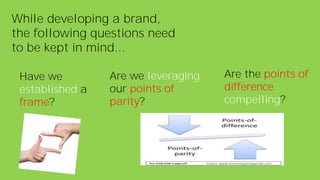
Are we leveraging
our points of
parity?
Are the points of
difference
compelling?
Have we
established
a frame?
Brand positioning starts with
establishing a frame of reference,
which signals consumers the goal
they can expect to achieve by
using a brand. It also involves
selecting the target group that
the brand will appeal to
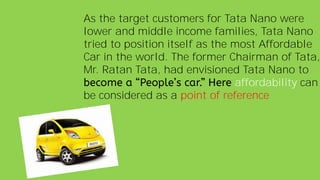
As the target customers for Tata Nano were
lower and middle income families, Tata Nano
tried to position itself as the most Affordable
Car in the world. The former Chairman of Tata,
Mr. Ratan Tata, had envisioned Tata Nano to
affordability can
be considered as a point of reference
Also, it needs to be kept in mind that the frame of
reference need to be altered according to
competition from other brands, market factors,
customer perceptions etc.
For example, Tata Nano Poor
repositioned Smart City Car
focusing on the youth.
Are we
leveraging our
points of parity?
Consumers might consider a
brand truly legitimate only
if it met certain points of
parity.
While launching a new brand, the
brand needs to satisfy certain basic
requirements that will make it a
legitimate player in that segment
For example, A bank will truly be
perceived so only if, it provides savings
plans, safe deposits etc.
While extending a brand also it is
important we keep in mind its points of parity…
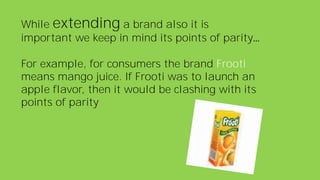
For example, for consumers the brand Frooti
means mango juice. If Frooti was to launch an
apple flavor, then it would be clashing with its
points of parity
Established brands also need to reassess
their points of parity from time to time, because
attributes that were differentiators once can
become minimum requirements
In 2002, when ICICI bank launched its mobile
ATM it was a highly innovative point of
providing the same service and this point of
differentiation was lost
Are the
points of
difference
compelling?
We can conclude
that a point of
difference is
compelling if it is
both desirable and
deliverable
Desirable
(Consumer perspective)
Deliverable
(Company perspective)
The point of
difference needs to
be relevant and
believable
The point of difference
needs to be feasible,
profitable and
defensible(difficult to
be attacked)
Putting it
all
together...
It is also necessary that
the frame of reference,
points of parity and
points of difference are
internally consistent at
any point in time and
over time
Do not give attributes that contradict each other...
For example, a brand cannot be positioned as both
inexpensive & highest quality as in the case of Tata
Nano. Since the car was priced at a very low amount,
the consumers do not expect it to be of the highest
quality
Making it
last...
As a brand ages the challenge
is to make it stay up-to-date
trends.
This can be
achieved in
several
ways...
#1If the brand is rich, then
that same position can be
sustained over a long time
#2Relating brand to
consumer needs
#3Emphasising over a particular
point of difference of the brand that
is important to consumers
And remember...
None of these variables which
we have discussed so far are
static...
The most savviest brand
managers are also the most
vigilant!!!
Recap
Three things which we need to keep in mind while
positioning our brand are...
Have
established
a frame of
reference
Are we
leveraging
our points of
parity
Are the
points of
difference
compelling
It is also important to make these factors last
together without contradicting each other
Finally be vigilant and dynamic!!!
Credits
http://i2.auto-service.de
http://jerrytieben.nl
http://www.segmentationstudyguide.com
http://efoodmart.in
http://www.veronicadearly.com
http://www.florainn.com
http://www.martymccolgan.com
https://s-media-cache-ak0.pinimg.com
https://www.google.co.in/search?q=vigilant+marketing
Disclaimer
Created by Arjun S, MEC Kochi, during an
internship by Prof. Sameer Mathur, IIM Lucknow.
www.IIMInternship.com

Three questions you need to ask about your brand-An Indian Context

  • 1.
    Three Questions You Need toAsk About Your Brand -An Indian Context
  • 2.
    While developing abrand, the following questions need to be kept in mind... Have we established a frame? Are we leveraging our points of parity? Are the points of difference compelling?
  • 3.
    Have we established a frame? Brandpositioning starts with establishing a frame of reference, which signals consumers the goal they can expect to achieve by using a brand. It also involves selecting the target group that the brand will appeal to
  • 4.
    As the targetcustomers for Tata Nano were lower and middle income families, Tata Nano tried to position itself as the most Affordable Car in the world. The former Chairman of Tata, Mr. Ratan Tata, had envisioned Tata Nano to affordability can be considered as a point of reference
  • 5.
    Also, it needsto be kept in mind that the frame of reference need to be altered according to competition from other brands, market factors, customer perceptions etc. For example, Tata Nano Poor repositioned Smart City Car focusing on the youth.
  • 6.
    Are we leveraging our pointsof parity? Consumers might consider a brand truly legitimate only if it met certain points of parity.
  • 7.
    While launching anew brand, the brand needs to satisfy certain basic requirements that will make it a legitimate player in that segment For example, A bank will truly be perceived so only if, it provides savings plans, safe deposits etc.
  • 8.
    While extending abrand also it is important we keep in mind its points of parity… For example, for consumers the brand Frooti means mango juice. If Frooti was to launch an apple flavor, then it would be clashing with its points of parity
  • 9.
    Established brands alsoneed to reassess their points of parity from time to time, because attributes that were differentiators once can become minimum requirements
  • 10.
    In 2002, whenICICI bank launched its mobile ATM it was a highly innovative point of providing the same service and this point of differentiation was lost
  • 11.
    Are the points of difference compelling? Wecan conclude that a point of difference is compelling if it is both desirable and deliverable
  • 12.
    Desirable (Consumer perspective) Deliverable (Company perspective) Thepoint of difference needs to be relevant and believable The point of difference needs to be feasible, profitable and defensible(difficult to be attacked)
  • 13.
    Putting it all together... It isalso necessary that the frame of reference, points of parity and points of difference are internally consistent at any point in time and over time
  • 14.
    Do not giveattributes that contradict each other... For example, a brand cannot be positioned as both inexpensive & highest quality as in the case of Tata Nano. Since the car was priced at a very low amount, the consumers do not expect it to be of the highest quality
  • 15.
    Making it last... As abrand ages the challenge is to make it stay up-to-date trends. This can be achieved in several ways...
  • 16.
    #1If the brandis rich, then that same position can be sustained over a long time #2Relating brand to consumer needs #3Emphasising over a particular point of difference of the brand that is important to consumers
  • 17.
    And remember... None ofthese variables which we have discussed so far are static... The most savviest brand managers are also the most vigilant!!!
  • 18.
    Recap Three things whichwe need to keep in mind while positioning our brand are... Have established a frame of reference Are we leveraging our points of parity Are the points of difference compelling It is also important to make these factors last together without contradicting each other Finally be vigilant and dynamic!!!
  • 19.
  • 20.
    Disclaimer Created by ArjunS, MEC Kochi, during an internship by Prof. Sameer Mathur, IIM Lucknow. www.IIMInternship.com