

The Balance Sheet
Dileep Panoli
dileeppanoli@gmail.com
Purpose of the Balance Sheet
 Traditionally the oldest statement
 Theoretically represents financial position,
including net worth.
Format
 Follows the balance sheet equation
 Three main elements- Assets, Liabilities and
Equity
 In the USA, Assets and Liabilities are
classified as “current” or “non-current”, in
decreasing order of presumed liquidity.
Time Frame
 The balance sheet reflects conditions at a
point in time, usually, the fiscal year-end.
Core Issues
– Recognition (e.g., should I recognize this as an
asset?)
– Valuation (If so, for how much?)
– Classification (What should I call it?)
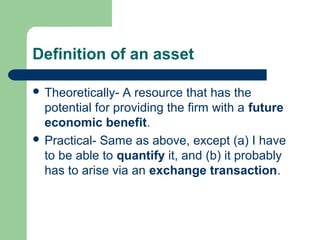
Definition of an asset
 Theoretically- A resource that has the
potential for providing the firm with a future
economic benefit.
 Practical- Same as above, except (a) I have
to be able to quantify it, and (b) it probably
has to arise via an exchange transaction.
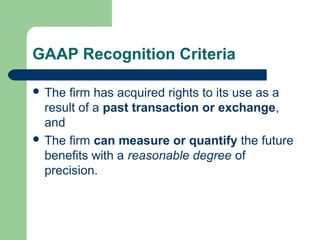
GAAP Recognition Criteria
 The firm has acquired rights to its use as a
result of a past transaction or exchange,
and
 The firm can measure or quantify the future
benefits with a reasonable degree of
precision.
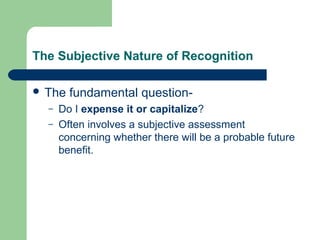
The Subjective Nature of Recognition
 The fundamental question-
– Do I expense it or capitalize?
– Often involves a subjective assessment
concerning whether there will be a probable future
benefit.
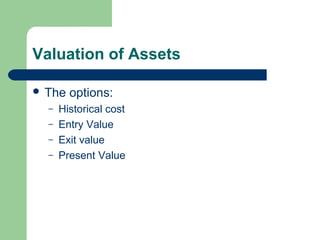
Valuation of Assets
 The options:
– Historical cost
– Entry Value
– Exit value
– Present Value
Valuation-
Why not Current Value?
 Entry Value (replacement cost)-
– How do you reliably estimate second-hand
values?
 Exit value (realizable value)-
– Same problem
 Present value (of future cash flows)-
– How do you estimate future cash flows and
associated risks?
Balance Sheet Issues
 The problem of mis-specification.
 Adding apples, oranges and tomatoes. What
does the sum mean?
 The question of timing and the impact on
relevancy.
 The bottom line: The Statement of
Financial Position is NOT a statement of
financial position.
The Issue of “Allocation”
 Property Plant and Equipment-
– Includes Building, Machinery, Equipment
– Valuation: Historical Cost
– Costs capitalized: everything necessary to get
assets ready to operate
– Recorded net of depreciation and/or depletion
Methods of Depreciation
 Straight Line
 Units of Production
 Accelerated Methods
– Declining Balance
– Sum of Years Digits
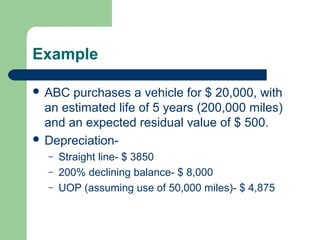
Example
 ABC purchases a vehicle for $ 20,000, with
an estimated life of 5 years (200,000 miles)
and an expected residual value of $ 500.
 Depreciation-
– Straight line- $ 3850
– 200% declining balance- $ 8,000
– UOP (assuming use of 50,000 miles)- $ 4,875
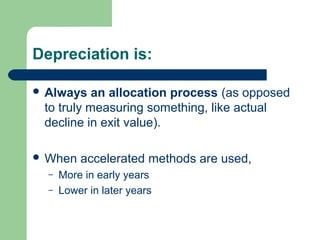
Depreciation is:
 Always an allocation process (as opposed
to truly measuring something, like actual
decline in exit value).
 When accelerated methods are used,
– More in early years
– Lower in later years
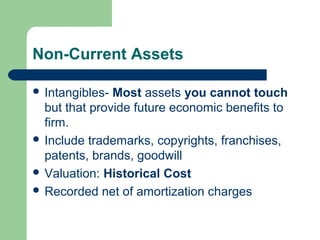
Non-Current Assets
 Intangibles- Most assets you cannot touch
but that provide future economic benefits to
firm.
 Include trademarks, copyrights, franchises,
patents, brands, goodwill
 Valuation: Historical Cost
 Recorded net of amortization charges
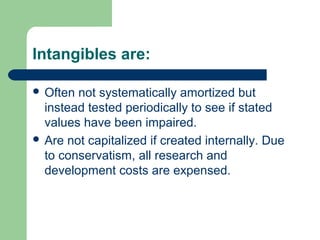
Intangibles are:
 Often not systematically amortized but
instead tested periodically to see if stated
values have been impaired.
 Are not capitalized if created internally. Due
to conservatism, all research and
development costs are expensed.
 Intangible assets are the newest, and
arguably most important, asset class today.
From these, much wealth is being created.
Unfortunately:
 We have little idea how to measure and
recognize the value of these assets.
Summary of Key Points-Assets
 Three issues decide how assets will be
reported- recognition, valuation, and
classification.
 Recognition is mainly a question of
capitalization vs expensing. The main issue
is whether any future economic benefit
accrues to the firm.
Summary of Key Points-Assets
 The Balance sheet has historically been a
“parking lot” for historical costs that will be
expensed sometime in the future.
 Increasingly, more and more assets are
being stated at current value.
 Today, asset valuations on the balance
sheet collectively reflect a mix of values and
costs.
Summary of Key Points-Assets
 Many assets are adjusted after initial
recognition. Adjustments can be:
– Allocations- Systematic reductions that don’t
really measure anything. (e.g., depreciation)
– Measurements- attempts to adjust values based
on changes in exit value that have occurred. (e.g.,
impairment tests of goodwill)
Liabilities
 What are they?
– Theoretically: probable future sacrifices of
economic benefits
– GAAP definition: probable future sacrifices of
economic benefits arising from present
obligations ….to transfer assets or to provide
services ….in the future as a result of past
transactions or events
Liabilities
 What are they?
– Practically (Recognition criteria):
 Probable future sacrifices of resources
 Can be measured (quantified)
 Generally, can’t be avoided.
 Arise through a past transaction or exchange.
Liabilities
 Classification:
– Current
 Listed in order of probable liquidation dates
 Types: accounts payable, wages payable, dividends,
payable, collections received in advance of delivering
goods and services
 Valuation- Usually at historical value.
Liabilities
 Classification
– Non-current
 Types: Deferred taxes, bonds, long-term loans
 Valuation: Historical exchange value, with adjustments
for amortization of premiums and discounts.
Liabilities
 The problem of what “probable” means-
– Potential liabilities are known as “contingent
liabilities. Some future event must occur for them
to happen. (e.g., a judgment by a court of law)
– Contingent liabilities are not usually reported
in the balance sheet. Instead they are disclosed in
the footnotes.
– The exception is when they can be quantified and
are “probably” going to cost the firm future
resources to resolve.
Key points-Liabilities
 Financial reporting liabilities reflect probable
economic sacrifices of future resources.
 Reported liabilities arise through exchange
transactions.
 Not all legal, or even economic, liabilities are
reported in the balance sheet.
 Liabilities are not reported at market value, but
instead historical value, with adjustments.
Shareholder’s Equity
 Two types:
– Contributed capital
– Retained Earnings
Types of Stock
 Common
 Preferred
– Preference over common shareholders with
respect to dividends, if declared, and at liquidation
– Usually have no voting rights.
– Debatable whether preferred shares are really
equity.
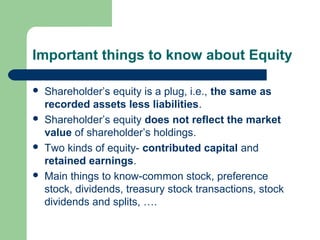
Important things to know about Equity
 Shareholder’s equity is a plug, i.e., the same as
recorded assets less liabilities.
 Shareholder’s equity does not reflect the market
value of shareholder’s holdings.
 Two kinds of equity- contributed capital and
retained earnings.
 Main things to know-common stock, preference
stock, dividends, treasury stock transactions, stock
dividends and splits, ….
Income Statement
Accrual Accounting-Purpose
Revenue Recognition under
GAAP
Expense Recognition under
GAAP
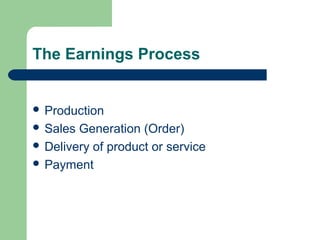
The Earnings Process
 Production
 Sales Generation (Order)
 Delivery of product or service
 Payment
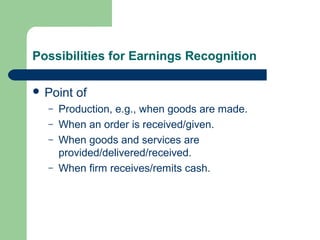
Possibilities for Earnings Recognition
 Point of
– Production, e.g., when goods are made.
– When an order is received/given.
– When goods and services are
provided/delivered/received.
– When firm receives/remits cash.
Cash Basis Accounting
 Is a simple reporting of cash receipts and
disbursements.
 Can be manipulated
 Can be misleading about non-cash
expenses/revenues.
 On the other hand, involves the verifiable flow of a
measurable commodity.
 May not explicitly map to economic profitability.
Profitability-What is it?
 Theoretically: any change in corporate
wealth.
 Practically: earned revenues less costs
incurred to produce those revenues
 The problem: “Earned revenues” and “costs
incurred” are abstract ideas. Measurement of
these will necessarily vary across different
economic agents.
The Problem:
 When has a firm “earned” revenues?
 When has a firm “incurred” costs to produce
those revenues?
Accrual Accounting
 Is a set of rules/traditions (GAAP) designed to
– recognize revenue when “earned” as defined by the
revenue realization principle.
– Recognize “expenses” when they are incurred, as defined
by GAAP.
NOTE: Cash inflows (outflows) associated with revenues
(expenses) may occur before, during, or after accrual-
based recognition occurs.
Revenues
 When are revenues usually recognized?
– Generally when sales are completed by
“delivery”, in the legal sense, to customers.
Revenues
 But is this really when revenues are
“earned”?
Some Alternatives to
Revenue Recognition at the Time of sale
 When production is complete (e.g., gold
miners).
 After sales orders are received and during
production (e.g., Boeing).
 When cash is fully received (e.g., credit
collectors).
 As cash is gradually received (e.g., real
estate).
Costs/Expenses
 The Ideal: Mapping (Matching) all costs incurred to
revenues produced and recognized.
 The problem:
– Many costs have no clear relation to revenues.
– As with revenues, its not always clear if a cost has been
incurred.
– Sometimes, it can even be unclear if a cost even exists, or if
it does, whether it detracts from revenue or actually
increases it (e.g., goodwill).
Costs-Types
 Costs directly traceable to specific revenue
transactions (e.g., costs to buy/produce inventory).
 Costs associated with, and/or systematically
allocable to time periods in which revenue is
recognized (e.g., rent expense).
 Costs for which no measurable future benefit can
be discerned (e.g., R&D).
Cost-Types
 Costs in financial reports are expensed
through one of two paths:
– Product costs: costs associated with producing
or acquiring goods to be resold.
– Period Costs: everything else.
Cost-Types
 From an analysis viewpoint, costs can also
be viewed according to their relation to the
production function:
– Fixed: Cost level doesn’t change across a range
of volume of goods and services produced.
– Variable: Systematic variance of cost levels with
production.
 Income, or earnings, is equal to revenues
less expenses.
 But does earnings actually reflect the change
in wealth that a firm experiences from one
period to the next?
Income- Fictitious or “Real”?
 Considerations:
– Accounting Income is determined by GAAP.
Different rules = different reported profits
– Dividends are paid with cash. A firm can have
lots of reported “income” and no cash, and
vice versa.
Goals
 The goal of financial reporting, and GAAP,
are to:
– Report (changes in) financial position.
– Report on the profitability of firms.
– In the real world, these goals often conflict.
Income Characteristics
 Permanent versus transient
 Controllable versus uncontrollable
 Operational versus non-operational
Income Statement Classification
 Income From continuing operations
– Single step format
– Multiple step format
 Income from discontinuing operations
 Extraordinary gains and losses
 Cumulative effect of changes in accounting
principles
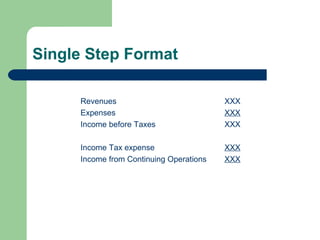
Single Step Format
Revenues XXX
Expenses XXX
Income before Taxes XXX
Income Tax expense XXX
Income from Continuing Operations XXX
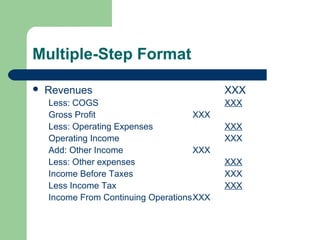
Multiple-Step Format
 Revenues XXX
Less: COGS XXX
Gross Profit XXX
Less: Operating Expenses XXX
Operating Income XXX
Add: Other Income XXX
Less: Other expenses XXX
Income Before Taxes XXX
Less Income Tax XXX
Income From Continuing OperationsXXX
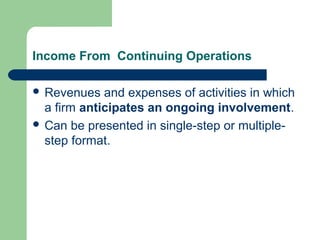
Income From Continuing Operations
 Revenues and expenses of activities in which
a firm anticipates an ongoing involvement.
 Can be presented in single-step or multiple-
step format.
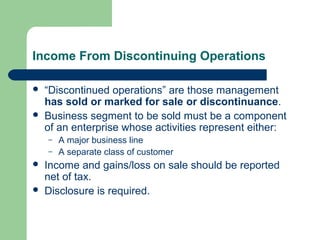
Income From Discontinuing Operations
 “Discontinued operations” are those management
has sold or marked for sale or discontinuance.
 Business segment to be sold must be a component
of an enterprise whose activities represent either:
– A major business line
– A separate class of customer
 Income and gains/loss on sale should be reported
net of tax.
 Disclosure is required.
Extraordinary Gains and Losses
 These are arising from events that are both unusual
and infrequent (non-recurring) in nature.
 Reported net of tax.
 Disclosure is required.
 Examples:
– Loss due to earthquake.
– Expropriation: takeover of property by a government.
– Prohibition under a new law.
Cumulative Effect of Changes in Accounting
Principles
 Reflects all income effects in previous years
resultant from a change in method, e.g.,
change from accelerated to straight-line
depreciation.
 Does not capture changes in estimate or
in basis (e.g., improvements made to a fixed
asset).
 Reported net of tax.
Pro-Forma Earnings
 Future expected earnings reported in annual reports.
 Based on assumptions concerning growth rate and
margins.
 Very popular in bull markets (e.g., 1999)-can be
used to justify high market valuations.
 Unpopular in bear markets (i.e., when continued
growth no longer seems so certain)
Accounting Myths:
 “Conservative” accounting is “good”
accounting.
 Accounting based on “Professional
Judgement” is bad accounting.
A Specific example of the
“fictitiousness” of accounting: Income
Taxes
 Income tax is measured using IRS rules. As
with book income, these rules have, at their
core, a concept of “earnings”, but reflect a
number of other considerations as well,
including the power of taxpayers to avoid
taxation.
 If accounting income is different from IRS-
based tax income, on what basis should the
expense be based?
Income Taxes
 The problem: Some of these differences are
timing differences and some are permanent.
 If they are timing differences, there will be tax
implications, on a cash basis, occurring in
future periods that were spawned by
revenue/cost streams being recognized now.
Income Taxes
– The question: Is the expense a function of simply
what you pay to the IRS each year, irrespective of
how the amount is determined? Or:
– To the extent possible, is the expense best
determined as a function of the book income that
precipitated it?
Income Taxes-Balance sheet effects
 To the extent that a relatively greater
expense is recognized under IRS rules (e.g.,
depreciation), a tax liability is created.
 To the extent that relatively less expense is
recognized under IRS rules, a tax asset is
created.
Income Taxes
 BUT: What if these tax assets and liabilities
never reverse? They can’t be sold, and in
fact, have no “real” existence.
 This happens with many firms whose growth
rates cause tax assets and liabilities to never
reverse.
 What then are tax assets and liabilities?
Statement of Cash Flows
 Broken into 3 categories: Operating,
Investing and Financing
 Newest of the three statements
Statement of Cash Flows
 Operating cash flows can be computed using
the direct or indirect method.
 Almost everybody uses the indirect method.
 Indirect method requires:
– Add-backs for non-cash charges
– Adjustments for operating accrual accounts.
Statement of Cash Flows
 Corporate Life Cycle is an important context
to consider when interpreting the meaning of
reported cash flows.
 The relation between earnings and cash
flows, and changes in this relation, can
provide useful analytical information.

The balance-sheet-purpose-of-the-balance-sheet1407

  • 1.
    The Balance Sheet DileepPanoli dileeppanoli@gmail.com
  • 2.
    Purpose of theBalance Sheet  Traditionally the oldest statement  Theoretically represents financial position, including net worth.
  • 3.
    Format  Follows thebalance sheet equation  Three main elements- Assets, Liabilities and Equity  In the USA, Assets and Liabilities are classified as “current” or “non-current”, in decreasing order of presumed liquidity.
  • 4.
    Time Frame  Thebalance sheet reflects conditions at a point in time, usually, the fiscal year-end.
  • 5.
    Core Issues – Recognition(e.g., should I recognize this as an asset?) – Valuation (If so, for how much?) – Classification (What should I call it?)
  • 6.
    Definition of anasset  Theoretically- A resource that has the potential for providing the firm with a future economic benefit.  Practical- Same as above, except (a) I have to be able to quantify it, and (b) it probably has to arise via an exchange transaction.
  • 7.
    GAAP Recognition Criteria The firm has acquired rights to its use as a result of a past transaction or exchange, and  The firm can measure or quantify the future benefits with a reasonable degree of precision.
  • 8.
    The Subjective Natureof Recognition  The fundamental question- – Do I expense it or capitalize? – Often involves a subjective assessment concerning whether there will be a probable future benefit.
  • 9.
    Valuation of Assets The options: – Historical cost – Entry Value – Exit value – Present Value
  • 10.
    Valuation- Why not CurrentValue?  Entry Value (replacement cost)- – How do you reliably estimate second-hand values?  Exit value (realizable value)- – Same problem  Present value (of future cash flows)- – How do you estimate future cash flows and associated risks?
  • 11.
    Balance Sheet Issues The problem of mis-specification.  Adding apples, oranges and tomatoes. What does the sum mean?  The question of timing and the impact on relevancy.  The bottom line: The Statement of Financial Position is NOT a statement of financial position.
  • 12.
    The Issue of“Allocation”  Property Plant and Equipment- – Includes Building, Machinery, Equipment – Valuation: Historical Cost – Costs capitalized: everything necessary to get assets ready to operate – Recorded net of depreciation and/or depletion
  • 13.
    Methods of Depreciation Straight Line  Units of Production  Accelerated Methods – Declining Balance – Sum of Years Digits
  • 14.
    Example  ABC purchasesa vehicle for $ 20,000, with an estimated life of 5 years (200,000 miles) and an expected residual value of $ 500.  Depreciation- – Straight line- $ 3850 – 200% declining balance- $ 8,000 – UOP (assuming use of 50,000 miles)- $ 4,875
  • 15.
    Depreciation is:  Alwaysan allocation process (as opposed to truly measuring something, like actual decline in exit value).  When accelerated methods are used, – More in early years – Lower in later years
  • 16.
    Non-Current Assets  Intangibles-Most assets you cannot touch but that provide future economic benefits to firm.  Include trademarks, copyrights, franchises, patents, brands, goodwill  Valuation: Historical Cost  Recorded net of amortization charges
  • 17.
    Intangibles are:  Oftennot systematically amortized but instead tested periodically to see if stated values have been impaired.  Are not capitalized if created internally. Due to conservatism, all research and development costs are expensed.
  • 18.
     Intangible assetsare the newest, and arguably most important, asset class today. From these, much wealth is being created. Unfortunately:  We have little idea how to measure and recognize the value of these assets.
  • 19.
    Summary of KeyPoints-Assets  Three issues decide how assets will be reported- recognition, valuation, and classification.  Recognition is mainly a question of capitalization vs expensing. The main issue is whether any future economic benefit accrues to the firm.
  • 20.
    Summary of KeyPoints-Assets  The Balance sheet has historically been a “parking lot” for historical costs that will be expensed sometime in the future.  Increasingly, more and more assets are being stated at current value.  Today, asset valuations on the balance sheet collectively reflect a mix of values and costs.
  • 21.
    Summary of KeyPoints-Assets  Many assets are adjusted after initial recognition. Adjustments can be: – Allocations- Systematic reductions that don’t really measure anything. (e.g., depreciation) – Measurements- attempts to adjust values based on changes in exit value that have occurred. (e.g., impairment tests of goodwill)
  • 22.
    Liabilities  What arethey? – Theoretically: probable future sacrifices of economic benefits – GAAP definition: probable future sacrifices of economic benefits arising from present obligations ….to transfer assets or to provide services ….in the future as a result of past transactions or events
  • 23.
    Liabilities  What arethey? – Practically (Recognition criteria):  Probable future sacrifices of resources  Can be measured (quantified)  Generally, can’t be avoided.  Arise through a past transaction or exchange.
  • 24.
    Liabilities  Classification: – Current Listed in order of probable liquidation dates  Types: accounts payable, wages payable, dividends, payable, collections received in advance of delivering goods and services  Valuation- Usually at historical value.
  • 25.
    Liabilities  Classification – Non-current Types: Deferred taxes, bonds, long-term loans  Valuation: Historical exchange value, with adjustments for amortization of premiums and discounts.
  • 26.
    Liabilities  The problemof what “probable” means- – Potential liabilities are known as “contingent liabilities. Some future event must occur for them to happen. (e.g., a judgment by a court of law) – Contingent liabilities are not usually reported in the balance sheet. Instead they are disclosed in the footnotes. – The exception is when they can be quantified and are “probably” going to cost the firm future resources to resolve.
  • 27.
    Key points-Liabilities  Financialreporting liabilities reflect probable economic sacrifices of future resources.  Reported liabilities arise through exchange transactions.  Not all legal, or even economic, liabilities are reported in the balance sheet.  Liabilities are not reported at market value, but instead historical value, with adjustments.
  • 28.
    Shareholder’s Equity  Twotypes: – Contributed capital – Retained Earnings
  • 29.
    Types of Stock Common  Preferred – Preference over common shareholders with respect to dividends, if declared, and at liquidation – Usually have no voting rights. – Debatable whether preferred shares are really equity.
  • 30.
    Important things toknow about Equity  Shareholder’s equity is a plug, i.e., the same as recorded assets less liabilities.  Shareholder’s equity does not reflect the market value of shareholder’s holdings.  Two kinds of equity- contributed capital and retained earnings.  Main things to know-common stock, preference stock, dividends, treasury stock transactions, stock dividends and splits, ….
  • 31.
    Income Statement Accrual Accounting-Purpose RevenueRecognition under GAAP Expense Recognition under GAAP
  • 32.
    The Earnings Process Production  Sales Generation (Order)  Delivery of product or service  Payment
  • 33.
    Possibilities for EarningsRecognition  Point of – Production, e.g., when goods are made. – When an order is received/given. – When goods and services are provided/delivered/received. – When firm receives/remits cash.
  • 34.
    Cash Basis Accounting Is a simple reporting of cash receipts and disbursements.  Can be manipulated  Can be misleading about non-cash expenses/revenues.  On the other hand, involves the verifiable flow of a measurable commodity.  May not explicitly map to economic profitability.
  • 35.
    Profitability-What is it? Theoretically: any change in corporate wealth.  Practically: earned revenues less costs incurred to produce those revenues  The problem: “Earned revenues” and “costs incurred” are abstract ideas. Measurement of these will necessarily vary across different economic agents.
  • 36.
    The Problem:  Whenhas a firm “earned” revenues?  When has a firm “incurred” costs to produce those revenues?
  • 37.
    Accrual Accounting  Isa set of rules/traditions (GAAP) designed to – recognize revenue when “earned” as defined by the revenue realization principle. – Recognize “expenses” when they are incurred, as defined by GAAP. NOTE: Cash inflows (outflows) associated with revenues (expenses) may occur before, during, or after accrual- based recognition occurs.
  • 38.
    Revenues  When arerevenues usually recognized? – Generally when sales are completed by “delivery”, in the legal sense, to customers.
  • 39.
    Revenues  But isthis really when revenues are “earned”?
  • 40.
    Some Alternatives to RevenueRecognition at the Time of sale  When production is complete (e.g., gold miners).  After sales orders are received and during production (e.g., Boeing).  When cash is fully received (e.g., credit collectors).  As cash is gradually received (e.g., real estate).
  • 41.
    Costs/Expenses  The Ideal:Mapping (Matching) all costs incurred to revenues produced and recognized.  The problem: – Many costs have no clear relation to revenues. – As with revenues, its not always clear if a cost has been incurred. – Sometimes, it can even be unclear if a cost even exists, or if it does, whether it detracts from revenue or actually increases it (e.g., goodwill).
  • 42.
    Costs-Types  Costs directlytraceable to specific revenue transactions (e.g., costs to buy/produce inventory).  Costs associated with, and/or systematically allocable to time periods in which revenue is recognized (e.g., rent expense).  Costs for which no measurable future benefit can be discerned (e.g., R&D).
  • 43.
    Cost-Types  Costs infinancial reports are expensed through one of two paths: – Product costs: costs associated with producing or acquiring goods to be resold. – Period Costs: everything else.
  • 44.
    Cost-Types  From ananalysis viewpoint, costs can also be viewed according to their relation to the production function: – Fixed: Cost level doesn’t change across a range of volume of goods and services produced. – Variable: Systematic variance of cost levels with production.
  • 45.
     Income, orearnings, is equal to revenues less expenses.  But does earnings actually reflect the change in wealth that a firm experiences from one period to the next?
  • 46.
    Income- Fictitious or“Real”?  Considerations: – Accounting Income is determined by GAAP. Different rules = different reported profits – Dividends are paid with cash. A firm can have lots of reported “income” and no cash, and vice versa.
  • 47.
    Goals  The goalof financial reporting, and GAAP, are to: – Report (changes in) financial position. – Report on the profitability of firms. – In the real world, these goals often conflict.
  • 48.
    Income Characteristics  Permanentversus transient  Controllable versus uncontrollable  Operational versus non-operational
  • 49.
    Income Statement Classification Income From continuing operations – Single step format – Multiple step format  Income from discontinuing operations  Extraordinary gains and losses  Cumulative effect of changes in accounting principles
  • 50.
    Single Step Format RevenuesXXX Expenses XXX Income before Taxes XXX Income Tax expense XXX Income from Continuing Operations XXX
  • 51.
    Multiple-Step Format  RevenuesXXX Less: COGS XXX Gross Profit XXX Less: Operating Expenses XXX Operating Income XXX Add: Other Income XXX Less: Other expenses XXX Income Before Taxes XXX Less Income Tax XXX Income From Continuing OperationsXXX
  • 52.
    Income From ContinuingOperations  Revenues and expenses of activities in which a firm anticipates an ongoing involvement.  Can be presented in single-step or multiple- step format.
  • 53.
    Income From DiscontinuingOperations  “Discontinued operations” are those management has sold or marked for sale or discontinuance.  Business segment to be sold must be a component of an enterprise whose activities represent either: – A major business line – A separate class of customer  Income and gains/loss on sale should be reported net of tax.  Disclosure is required.
  • 54.
    Extraordinary Gains andLosses  These are arising from events that are both unusual and infrequent (non-recurring) in nature.  Reported net of tax.  Disclosure is required.  Examples: – Loss due to earthquake. – Expropriation: takeover of property by a government. – Prohibition under a new law.
  • 55.
    Cumulative Effect ofChanges in Accounting Principles  Reflects all income effects in previous years resultant from a change in method, e.g., change from accelerated to straight-line depreciation.  Does not capture changes in estimate or in basis (e.g., improvements made to a fixed asset).  Reported net of tax.
  • 56.
    Pro-Forma Earnings  Futureexpected earnings reported in annual reports.  Based on assumptions concerning growth rate and margins.  Very popular in bull markets (e.g., 1999)-can be used to justify high market valuations.  Unpopular in bear markets (i.e., when continued growth no longer seems so certain)
  • 57.
    Accounting Myths:  “Conservative”accounting is “good” accounting.  Accounting based on “Professional Judgement” is bad accounting.
  • 58.
    A Specific exampleof the “fictitiousness” of accounting: Income Taxes  Income tax is measured using IRS rules. As with book income, these rules have, at their core, a concept of “earnings”, but reflect a number of other considerations as well, including the power of taxpayers to avoid taxation.  If accounting income is different from IRS- based tax income, on what basis should the expense be based?
  • 59.
    Income Taxes  Theproblem: Some of these differences are timing differences and some are permanent.  If they are timing differences, there will be tax implications, on a cash basis, occurring in future periods that were spawned by revenue/cost streams being recognized now.
  • 60.
    Income Taxes – Thequestion: Is the expense a function of simply what you pay to the IRS each year, irrespective of how the amount is determined? Or: – To the extent possible, is the expense best determined as a function of the book income that precipitated it?
  • 61.
    Income Taxes-Balance sheeteffects  To the extent that a relatively greater expense is recognized under IRS rules (e.g., depreciation), a tax liability is created.  To the extent that relatively less expense is recognized under IRS rules, a tax asset is created.
  • 62.
    Income Taxes  BUT:What if these tax assets and liabilities never reverse? They can’t be sold, and in fact, have no “real” existence.  This happens with many firms whose growth rates cause tax assets and liabilities to never reverse.  What then are tax assets and liabilities?
  • 63.
    Statement of CashFlows  Broken into 3 categories: Operating, Investing and Financing  Newest of the three statements
  • 64.
    Statement of CashFlows  Operating cash flows can be computed using the direct or indirect method.  Almost everybody uses the indirect method.  Indirect method requires: – Add-backs for non-cash charges – Adjustments for operating accrual accounts.
  • 65.
    Statement of CashFlows  Corporate Life Cycle is an important context to consider when interpreting the meaning of reported cash flows.  The relation between earnings and cash flows, and changes in this relation, can provide useful analytical information.