
ASSET INTEGRITY MANAGEMENT SYSTEM
JAKARTA, 26 – 27 NOPEMBER 2020
CREATED BY RAMBOE
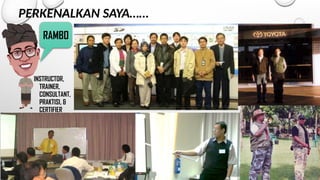
PERKENALKAN SAYA……
INSTRUCTOR,
TRAINER,
CONSULTANT,
PRAKTISI, &
CERTIFIER
RAMBO
Pendukung Perjalanan

 
 

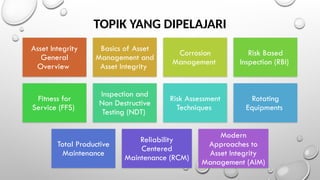
TUJUAN
• Pahami bagaimana Anda dapat mengoptimalkan sistem dan strategi Manajemen
Integritas Aset di Organisasi Anda.
• Cari tahu bagaimana mengelola desain aset holistik dengan bantuan sistem AIM dan
kode desain.
• Temukan cara menggunakan Pemeriksaan Berbasis Risiko untuk mengidentifikasi
ancaman lebih cepat dan menghemat biaya operasional.
• Menerapkan pendekatan teknis untuk manajemen integritas aset untuk mendapatkan
hasil operasional yang EFEKTIF dan memperpanjang siklus hidup fasilitas.
• MENGAdaptasi strategi manajemen integritas aset yang efektif yang akan membantu
meningkatkan produktivitas dan mengatasi tantangan.
TOPIK YANG DIPELAJARI
Asset Integrity
General
Overview
Basics of Asset
Management and
Asset Integrity
Corrosion
Management
Risk Based
Inspection (RBI)
Fitness for
Service (FFS)
Inspection and
Non Destructive
Testing (NDT)
Risk Assessment
Techniques
Rotating
Equipments
Total Productive
Maintenance
Reliability
Centered
Maintenance (RCM)
Modern
Approaches to
Asset Integrity
Management (AIM)
ASSET INTEGRITY GENERAL OVERVIEW
MODUL - 1
ASSET INTEGRITY
Integritas Aset Dapat Didefinisikan
Sebagai Kemampuan Aset Untuk
Menjalankan Fungsi Yang Diperlukan
Secara Efektif Dan Efisien Dalam
Siklus Hidupnya Yang Melindungi
Kesehatan, Keselamatan, Dan
Lingkungan ”.
SASARAN ASSET INTEGRITY
• Keamanan dan keandalan operasi aset dengan peningkatan ketersediaan aset.
• Identifikasi ancaman dan dampaknya terhadap integritas aset
• Proses dan prosedur sistematis untuk mengatasi ancaman dan mengurangi dampaknya terhadap
integritas
• Perpanjangan hidup ASET
• Pemotongan biaya OPERASIONAL.
• Perencanaan SHUT-DOWN.
• Perbaikan perencanaan / jadwal / HAL UNTUK MENDAPATKAN KEMBALI.
• perbaikan Desain
• Citra merek (BRAND IMAGE)
• Manajemen Stakeholder
BASICS OF ASSET MANAGEMENT AND ASSET
INTEGRITY
MODUL - 2
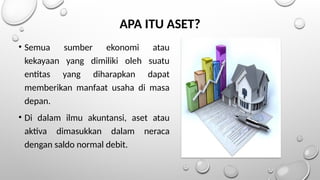
APA ITU ASET?
• Semua sumber ekonomi atau
kekayaan yang dimiliki oleh suatu
entitas yang diharapkan dapat
memberikan manfaat usaha di masa
depan.
• Di dalam ilmu akuntansi, aset atau
aktiva dimasukkan dalam neraca
dengan saldo normal debit.
ASSET MANAGEMENT
Suatu proses perencanaan,
pengadaan, pengelolaan dan
perwatan hingga penghpsan suatu
sumber daya yang dimiliki oleh
individu / organisasi secara efektif
dan efisien dalam rangka mencapai
tujuan.
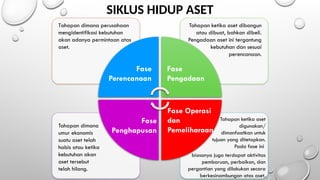
SIKLUS HIDUP ASET
Tahapan dimana perusahaan
mengidentifikasi kebutuhan
akan adanya permintaan atas
aset.
Tahapan ketika aset dibangun
atau dibuat, bahkan dibeli.
Pengadaan aset ini tergantung
kebutuhan dan sesuai
perencanaan.
Tahapan ketika aset
digunakan/
dimanfaatkan untuk
tujuan yang ditetapkan.
Pada fase ini
biasanya juga terdapat aktivitas
pembaruan, perbaikan, dan
pergantian yang dilakukan secara
berkesinambungan atas aset.
Tahapan dimana
umur ekonomis
suatu aset telah
habis atau ketika
kebutuhan akan
aset tersebut
telah hilang.
Fase
Perencanaan
Fase
Pengadaan
Fase
Penghapusan
Fase Operasi
dan
Pemeliharaan
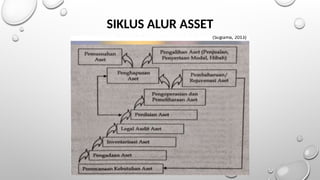
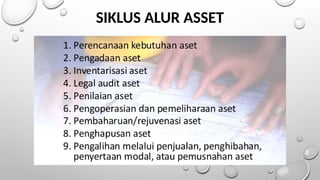
SIKLUS ALUR ASSET
SIKLUS ALUR ASSET
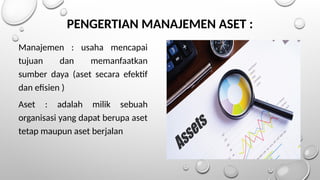
PENGERTIAN MANAJEMEN ASET :
Manajemen : usaha mencapai
tujuan dan memanfaatkan
sumber daya (aset secara efektif
dan efisien )
Aset : adalah milik sebuah
organisasi yang dapat berupa aset
tetap maupun aset berjalan
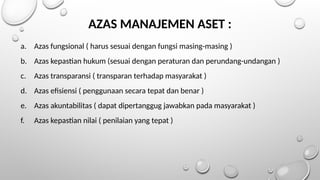
AZAS MANAJEMEN ASET :
a. Azas fungsional ( harus sesuai dengan fungsi masing-masing )
b. Azas kepastian hukum (sesuai dengan peraturan dan perundang-undangan )
c. Azas transparansi ( transparan terhadap masyarakat )
d. Azas efisiensi ( penggunaan secara tepat dan benar )
e. Azas akuntabilitas ( dapat dipertanggug jawabkan pada masyarakat )
f. Azas kepastian nilai ( penilaian yang tepat )
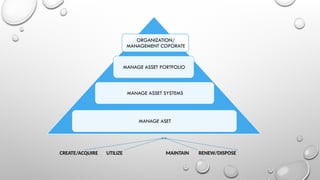
CREATE/ACQUIRE UTILIZE MAINTAIN RENEW/DISPOSE
ORGANIZATION/
MANAGEMENT COPORATE
MANAGE ASSET PORTFOLIO
MANAGE ASSET SYSTEMS
MANAGE ASET
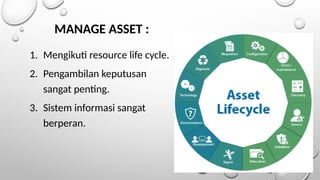
MANAGE ASSET :
1. Mengikuti resource life cycle.
2. Pengambilan keputusan
sangat penting.
3. Sistem informasi sangat
berperan.
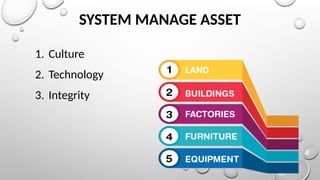
SYSTEM MANAGE ASSET
1. Culture
2. Technology
3. Integrity
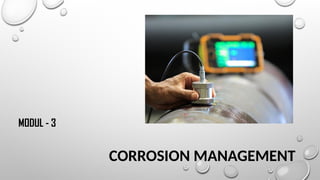
CORROSION MANAGEMENT
MODUL - 3
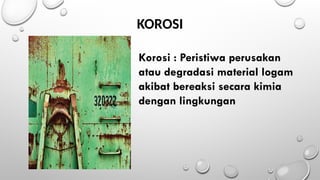
KOROSI
Korosi : Peristiwa perusakan
atau degradasi material logam
akibat bereaksi secara kimia
dengan lingkungan
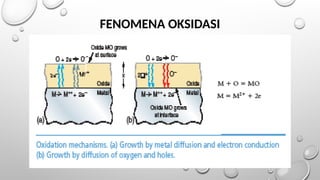
FENOMENA OKSIDASI
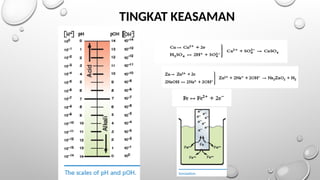
TINGKAT KEASAMAN
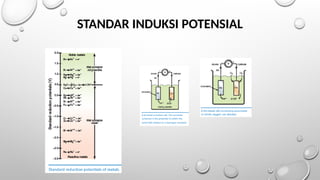
STANDAR INDUKSI POTENSIAL
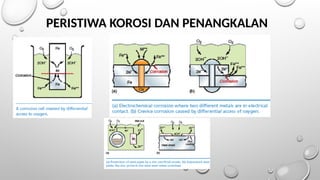
PERISTIWA KOROSI DAN PENANGKALAN
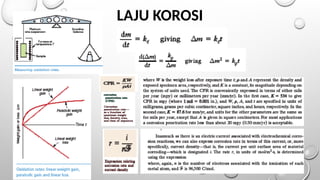
LAJU KOROSI
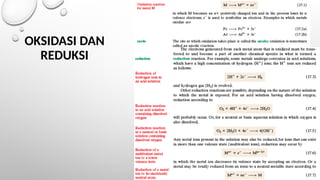
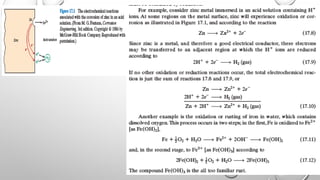
OKSIDASI DAN
REDUKSI
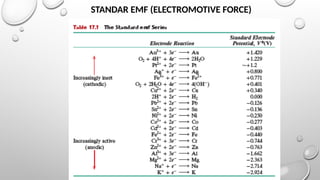
STANDAR EMF (ELECTROMOTIVE FORCE)
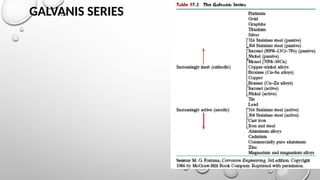
GALVANIS SERIES
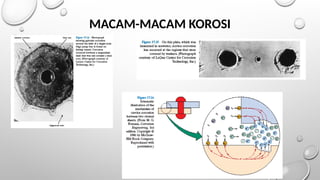
MACAM-MACAM KOROSI
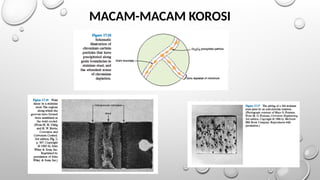
MACAM-MACAM KOROSI
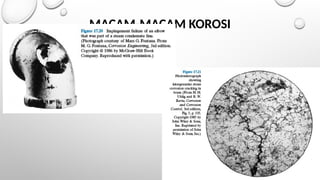
MACAM-MACAM KOROSI
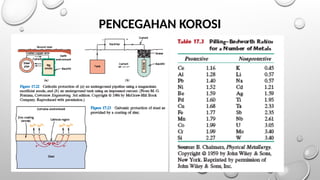
PENCEGAHAN KOROSI
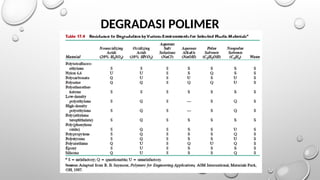
DEGRADASI POLIMER
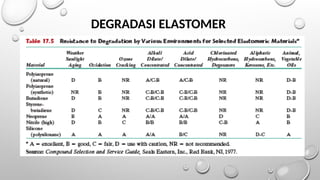
DEGRADASI ELASTOMER
RISK BASED INSPECTION (RBI)
MODUL - 4
WHAT IS RISK-BASED INSPECTION (RBI)?
• A risk assessment and management process that is focused on loss of containment of
pressurized equipment in processing facilities due to material deterioration. These risks are
managed primarily through equipment inspection.
• The risk-based inspection is a systematic and integrated use of expertise from the different
disciplines that impact plant integrity. These include design, materials selection, operating
parameters and scenarios, and understanding of the current and future degradation mechanisms
and risks involved.
• Risk-based methodologies enable the assessment of the likelihood and potential consequences
of equipment failures. Risk-Based Inspection (RBI) provides companies the opportunity to
prioritize their equipment for inspection; optimize inspection methods, frequencies, and
resources; and develop specific equipment inspection plans the extent of inspection, and the
most suitable type of Non-Destructive Examination (NDE)
WHAT IS RISK-BASED INSPECTION (RBI)
• RBI is most often used in engineering industries and is predominant in the oi l and
gas, petrochemical industries. Assessed risk level are used to develop a prioritised
inspection plan. It is related to (or sometimes a part of) Risk Based Asset
Management (RBAM), Risk Based Integrity Management (RBIM) and Risk Based
Management(RBM).Generally, RBI is part of Risk and Reliability Management (RRM).
Inspections typically employ nondestructive testing (NDT).
• Risk-Based Inspection (RBI) is a methodology that, as opposed to condition-based
inspection involves quantitative assessment of the Probability of failure (PoF) and the
Consequence of failure (CoF) associated with each equipment item, piping circuits
included, in a particular process unit.
WHAT IS RISK-BASED INSPECTION (RBI)
• RBI is a risk assessment and management tool that addresses an area not completely
addressed in other organizational risk management efforts such as Process Hazards
Analyses (PHA) or reliability centered maintenance (RCM).
• RBI produces Inspection and Maintenance Plans for equipment that identifies the
actions that should be implemented to provide reliable and safe operation.
• The RBI effort can provide input into an organization’s annual planning and budgeting
that define the staffing and funds required to maintain equipment operation at
acceptable levels of performance and risk.
• Risk-Based Inspection is Proactive – It Utilizes the Information Available to Manage
Risk
PURPOSE OF RISK-BASED INSPECTION
• Screen operating units within a plant to identify
areas of high risk.
• Estimate a risk value associated with the operation
of each piece of equipment
• Prioritize the equipment based on the measured
risk
• Design an appropriate inspection program
• Systematically manage the risk of equipment
failures. *
KEY ELEMENTS OF A RBI PROGRAM
• Key elements that should exist in any RBI program are:
• Management systems for maintaining documentation, personnel
qualifications, data requirements and analysis updates.
• Documented method for probability of failure determination.
• Documented method for consequence of failure determination.
• Documented methodology for managing risk through inspection and
other mitigation activities.
EQUIPMENT COVERED IN RBI
The following types of pressurized equipment and associated components/internals
are covered by this document:
• Pressure vessels—all pressure containing components.
• Process piping—pipe and piping components.
• Storage tanks—atmospheric and pressurized.
• Rotating equipment—pressure containing components.
• Boilers and heaters—pressurized components.
• Heat exchangers (shells, heads, channels and bundles).
• Pressure relief devices.
EQUIPMENT NOT COVERED IN RBI
The following non-pressurized equipment is not covered by this document:
• Instrument and control systems.
• Electrical systems.
• Structural systems.
• Machinery components (except pump and compressor casings).
RISK ANALYSIS
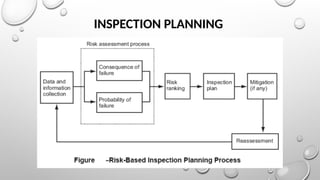
A risk assessment involves first establishing the current and anticipated
condition of the equipment, by asking the following questions:
• What material degradations have been experienced or could be
experienced?
• What are the likelihood (probabilities) of these degradations occurring?
• What are the consequences of these degradations?
• The next step is to determine the risk of operating equipment as the
combination of two separate terms:
• Risk = Likelihood or Probability of Failure x Consequence of Failure
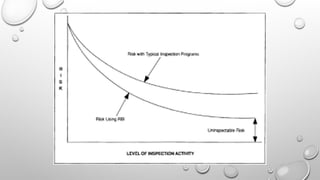
INSPECTION PLANNING
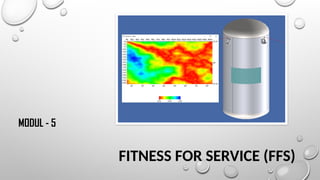
FITNESS FOR SERVICE (FFS)
MODUL - 5
BACKGROUND
• In 1990 a joint industry project was organized by materials properties council (MPC)
concentrated the program on the development of technology for FFS and the
culmination of this progran was the development of API RP 579.
• Sponsor’s pf yhe API RP 579 were EXXON, SHELL, BP, MOBIL, CHEVRON, ARCO, &
AMOCO.
• In 2000 API published API RP 579 for FFS Assessment to evaluate flaws or damage in
the in-service equipment.
• Primarily it was intended to refining & petrochemical assets.
• In 2007 API joined force with the ASME to produce an updated document with the
desigation API-759-1/ASME FFS-1.
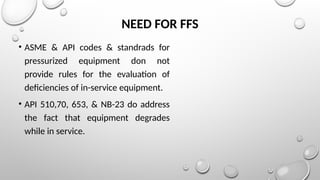
NEED FOR FFS
• ASME & API codes & standrads for
pressurized equipment don not
provide rules for the evaluation of
deficiencies of in-service equipment.
• API 510,70, 653, & NB-23 do address
the fact that equipment degrades
while in service.
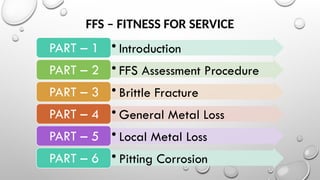
FFS – FITNESS FOR SERVICE
• Introduction
PART – 1
• FFS Assessment Procedure
PART – 2
• Brittle Fracture
PART – 3
• General Metal Loss
PART – 4
• Local Metal Loss
PART – 5
• Pitting Corrosion
PART – 6
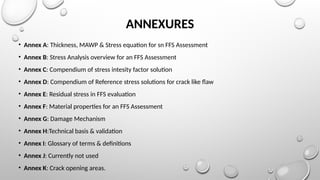
ANNEXURES
• Annex A: Thickness, MAWP & Stress equation for sn FFS Assessment
• Annex B: Stress Analysis overview for an FFS Assessment
• Annex C: Compendium of stress intesity factor solution
• Annex D: Compendium of Reference stress solutions for crack like flaw
• Annex E: Residual stress in FFS evaluation
• Annex F: Material properties for an FFS Assessment
• Annex G: Damage Mechanism
• Annex H:Technical basis & validation
• Annex I: Glossary of terms & definitions
• Annex J: Currently not used
• Annex K: Crack opening areas.
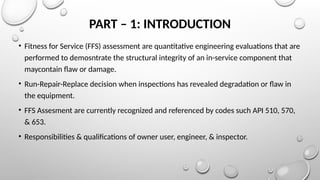
PART – 1: INTRODUCTION
• Fitness for Service (FFS) assessment are quantitative engineering evaluations that are
performed to demosntrate the structural integrity of an in-service component that
maycontain flaw or damage.
• Run-Repair-Replace decision when inspections has revealed degradation or flaw in
the equipment.
• FFS Assesment are currently recognized and referenced by codes such API 510, 570,
& 653.
• Responsibilities & qualifications of owner user, engineer, & inspector.
PART – 1: INTRODUCTION
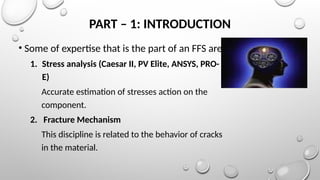
• Some of expertise that is the part of an FFS are
1. Stress analysis (Caesar II, PV Elite, ANSYS, PRO-
E)
Accurate estimation of stresses action on the
component.
2. Fracture Mechanism
This discipline is related to the behavior of cracks
in the material.
PART – 1: INTRODUCTION
3. Metallurgy/Material Engineering
Understanding of thr performance of varios materials subjected to spesific
environment, pressure, temperature, and stress level.
4. NDE
Detection and sizing of the flaw.
5. Plant Operations
Process conditions & startup/shutdown inputs to FFS Assessment
6. Corrosion
Degradation mechanism input to FFS Assessment.
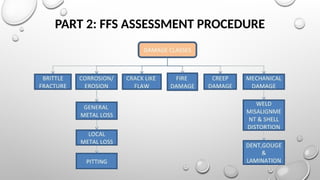
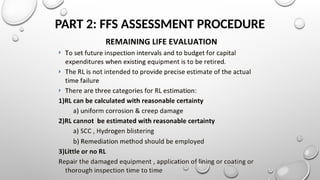
PART 2: FFS ASSESSMENT PROCEDURE
There are 8 steps in the FFS Assessment procedure:
1. Identification of flaw and damage mechanism.
2. Applicability and limitations.
3. Data requirements.
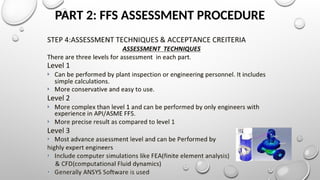
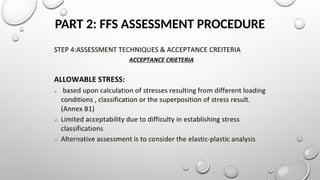
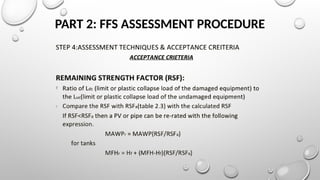
4. Assessment techniques & Acceptance criteria.
5. Remaining life evaluation.
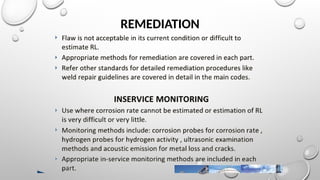
6. Remediation.
7. In-service monitoring.
8. Documetation.
PART 2: FFS ASSESSMENT PROCEDURE
REMEDIATION
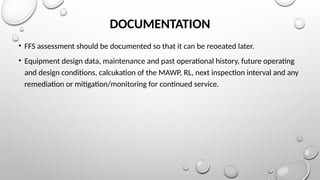
DOCUMENTATION
• FFS assessment should be documented so that it can be reoeated later.
• Equipment design data, maintenance and past operational history, future operating
and design conditions, calcukation of the MAWP, RL, next inspection interval and any
remediation or mitigation/monitoring for continued service.
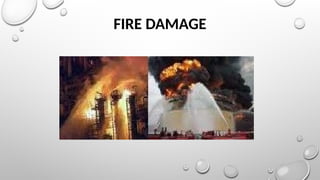
FIRE DAMAGE
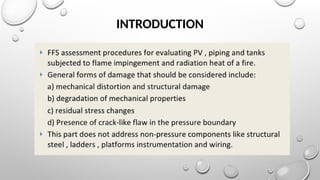
INTRODUCTION
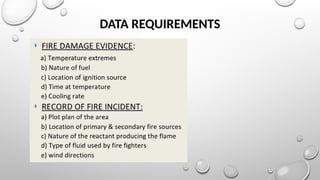
DATA REQUIREMENTS
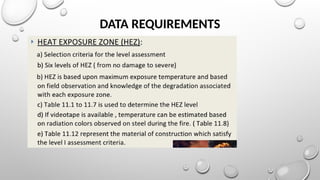
DATA REQUIREMENTS
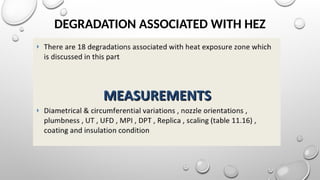
DEGRADATION ASSOCIATED WITH HEZ
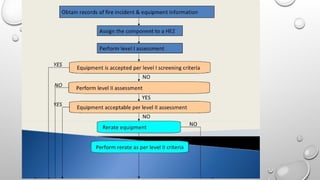
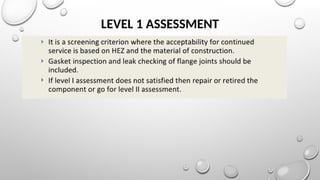
LEVEL 1 ASSESSMENT
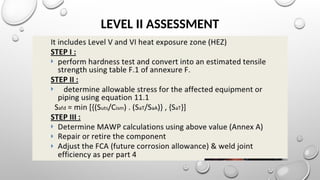
LEVEL II ASSESSMENT
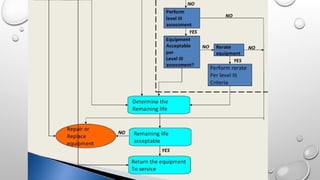
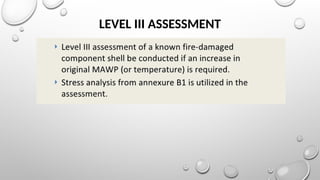
LEVEL III ASSESSMENT
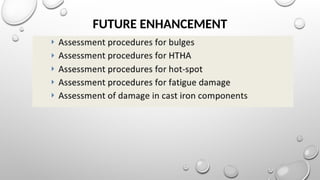
FUTURE ENHANCEMENT
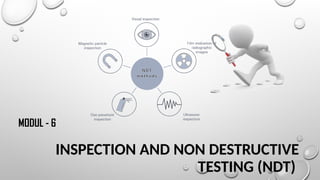
INSPECTION AND NON DESTRUCTIVE
TESTING (NDT)
MODUL - 6
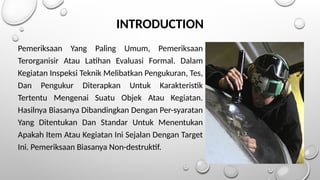
Pemeriksaan Yang Paling Umum, Pemeriksaan
Terorganisir Atau Latihan Evaluasi Formal. Dalam
Kegiatan Inspeksi Teknik Melibatkan Pengukuran, Tes,
Dan Pengukur Diterapkan Untuk Karakteristik
Tertentu Mengenai Suatu Objek Atau Kegiatan.
Hasilnya Biasanya Dibandingkan Dengan Per-syaratan
Yang Ditentukan Dan Standar Untuk Menentukan
Apakah Item Atau Kegiatan Ini Sejalan Dengan Target
Ini. Pemeriksaan Biasanya Non-destruktif.
INTRODUCTION
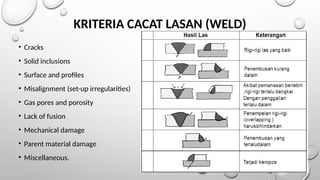
• Cracks
• Solid inclusions
• Surface and profiles
• Misalignment (set-up irregularities)
• Gas pores and porosity
• Lack of fusion
• Mechanical damage
• Parent material damage
• Miscellaneous.
KRITERIA CACAT LASAN (WELD)
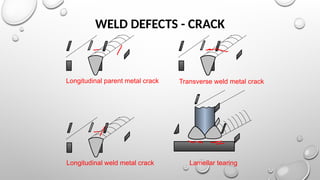
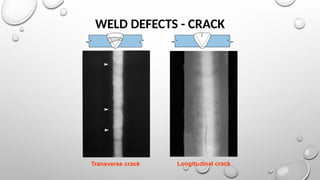
WELD DEFECTS - CRACK
Longitudinal parent metal crack Transverse weld metal crack
Longitudinal weld metal crack Lamellar tearing
WELD DEFECTS - CRACK
Transverse crack Longitudinal crack
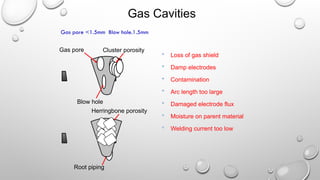
Gas Cavities
Root piping
Cluster porosity
Gas pore
Blow hole
Herringbone porosity
 Loss of gas shield
 Damp electrodes
 Contamination
 Arc length too large
 Damaged electrode flux
 Moisture on parent material
 Welding current too low
Gas pore <1.5mm Blow hole.1.5mm
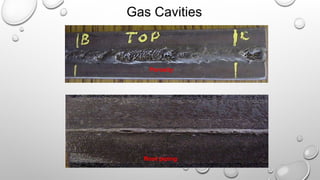
Gas Cavities
Root piping
Porosity
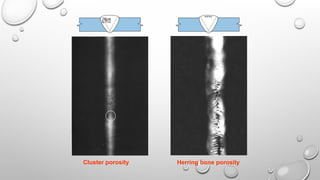
Cluster porosity Herring bone porosity
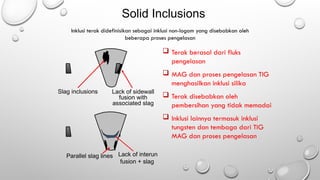
Solid Inclusions
 Terak berasal dari fluks
pengelasan
 MAG dan proses pengelasan TIG
menghasilkan inklusi silika
 Terak disebabkan oleh
pembersihan yang tidak memadai
 Inklusi lainnya termasuk inklusi
tungsten dan tembaga dari TIG
MAG dan proses pengelasan
Inklusi terak didefinisikan sebagai inklusi non-logam yang disebabkan oleh
beberapa proses pengelasan
Slag inclusions
Parallel slag lines Lack of interun
fusion + slag
Lack of sidewall
fusion with
associated slag
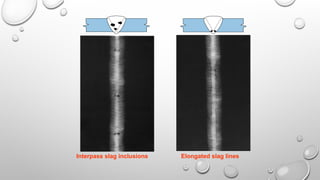
Elongated slag lines
Interpass slag inclusions
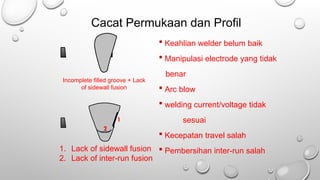
Cacat Permukaan dan Profil
Incomplete filled groove + Lack
of sidewall fusion
1
2
1. Lack of sidewall fusion
2. Lack of inter-run fusion
 Keahlian welder belum baik
 Manipulasi electrode yang tidak
benar
 Arc blow
 welding current/voltage tidak
sesuai
 Kecepatan travel salah
 Pembersihan inter-run salah
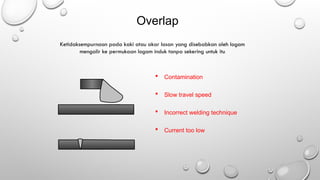
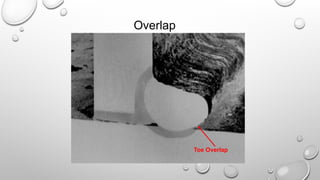
Overlap
Ketidaksempurnaan pada kaki atau akar lasan yang disebabkan oleh logam
mengalir ke permukaan logam induk tanpa sekering untuk itu
 Contamination
 Slow travel speed
 Incorrect welding technique
 Current too low
Overlap
Toe Overlap
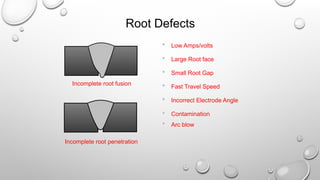
Root Defects
Incomplete root fusion
Incomplete root penetration
 Low Amps/volts
 Large Root face
 Small Root Gap
 Fast Travel Speed
 Incorrect Electrode Angle
 Contamination
 Arc blow
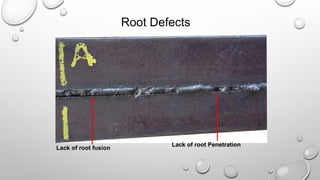
Root Defects
Lack of root fusion
Lack of root Penetration
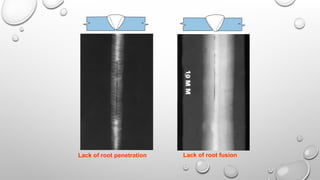
Lack of root penetration Lack of root fusion
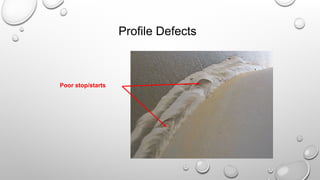
Profile Defects
Poor stop/starts
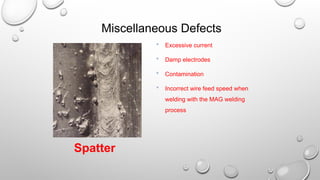
Spatter
 Excessive current
 Damp electrodes
 Contamination
 Incorrect wire feed speed when
welding with the MAG welding
process
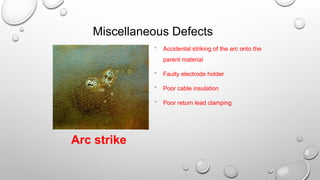
Miscellaneous Defects
 Accidental striking of the arc onto the
parent material
 Faulty electrode holder
 Poor cable insulation
 Poor return lead clamping
Arc strike
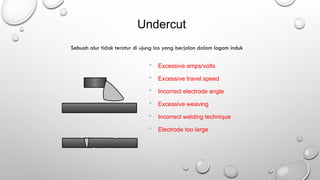
Undercut
Sebuah alur tidak teratur di ujung las yang berjalan dalam logam induk
 Excessive amps/volts
 Excessive travel speed
 Incorrect electrode angle
 Excessive weaving
 Incorrect welding technique
 Electrode too large
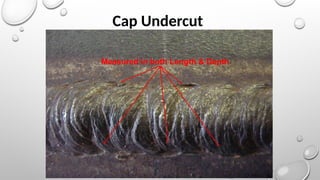
Cap Undercut
Measured in both Length & Depth
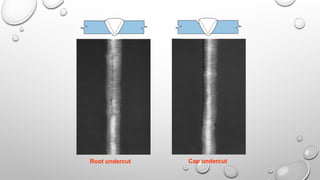
Cap undercut
Root undercut
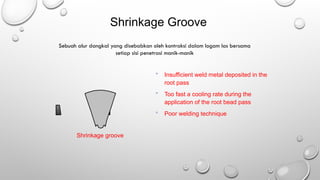
Shrinkage groove
Shrinkage Groove
 Insufficient weld metal deposited in the
root pass
 Too fast a cooling rate during the
application of the root bead pass
 Poor welding technique
Sebuah alur dangkal yang disebabkan oleh kontraksi dalam logam las bersama
setiap sisi penetrasi manik-manik
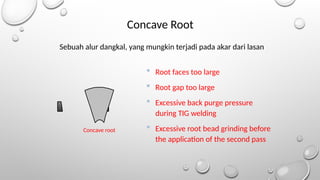
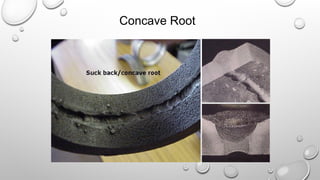
Concave root
Concave Root
 Root faces too large
 Root gap too large
 Excessive back purge pressure
during TIG welding
 Excessive root bead grinding before
the application of the second pass
Sebuah alur dangkal, yang mungkin terjadi pada akar dari lasan
Concave Root
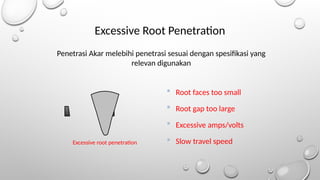
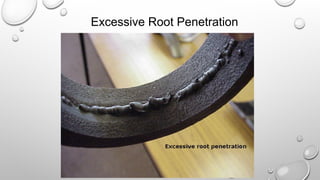
Excessive root penetration
Excessive Root Penetration
 Root faces too small
 Root gap too large
 Excessive amps/volts
 Slow travel speed
Penetrasi Akar melebihi penetrasi sesuai dengan spesifikasi yang
relevan digunakan
Excessive Root Penetration
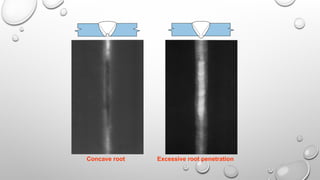
Concave root Excessive root penetration
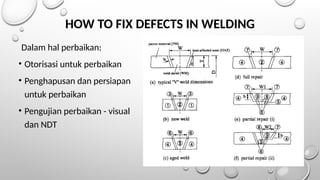
Dalam hal perbaikan:
• Otorisasi untuk perbaikan
• Penghapusan dan persiapan
untuk perbaikan
• Pengujian perbaikan - visual
dan NDT
HOW TO FIX DEFECTS IN WELDING
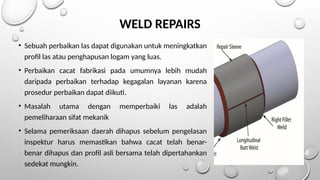
WELD REPAIRS
• Sebuah perbaikan las dapat digunakan untuk meningkatkan
profil las atau penghapusan logam yang luas.
• Perbaikan cacat fabrikasi pada umumnya lebih mudah
daripada perbaikan terhadap kegagalan layanan karena
prosedur perbaikan dapat diikuti.
• Masalah utama dengan memperbaiki las adalah
pemeliharaan sifat mekanik
• Selama pemeriksaan daerah dihapus sebelum pengelasan
inspektur harus memastikan bahwa cacat telah benar-
benar dihapus dan profil asli bersama telah dipertahankan
sedekat mungkin.
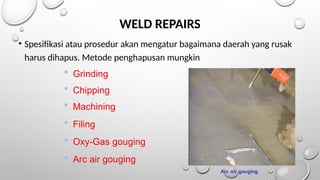
WELD REPAIRS
• Spesifikasi atau prosedur akan mengatur bagaimana daerah yang rusak
harus dihapus. Metode penghapusan mungkin
 Grinding
 Chipping
 Machining
 Filing
 Oxy-Gas gouging
 Arc air gouging
Arc air gouging
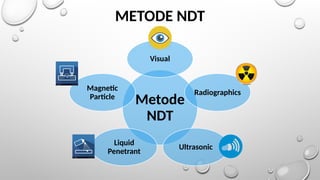
METODE NDT
Metode
NDT
Visual
Radiographics
Ultrasonic
Liquid
Penetrant
Magnetic
Particle
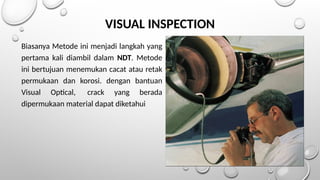
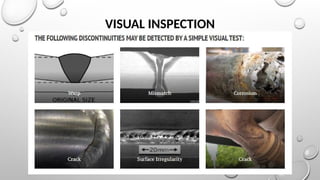
Biasanya Metode ini menjadi langkah yang
pertama kali diambil dalam NDT. Metode
ini bertujuan menemukan cacat atau retak
permukaan dan korosi. dengan bantuan
Visual Optical, crack yang berada
dipermukaan material dapat diketahui
VISUAL INSPECTION
VISUAL INSPECTION
VISUAL TEST SPECIFICATIONS
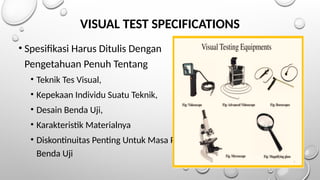
• Spesifikasi Harus Ditulis Dengan
Pengetahuan Penuh Tentang
• Teknik Tes Visual,
• Kepekaan Individu Suatu Teknik,
• Desain Benda Uji,
• Karakteristik Materialnya
• Diskontinuitas Penting Untuk Masa Pakai
Benda Uji
PERSONNEL REQUIREMENTS
• Untuk pengujian visual yang kompeten dari suatu objek, seseorang harus memiliki
pengetahuan yang baik dan pengalaman industri terkait tentang proses manufaktur
yang digunakan untuk membuat item pengujian, riwayat layanannya, dan mode
kegagalan potensinya.
• American Society for Nondestructive Testing (ASNT) telah menjadi pemimpin dunia
dalam kualifikasi dan sertifikasi personel penguji tak rusak sejak 1960-an.
• 4 dokumen utama untuk kualifikasi dan sertifikasi personel NDT:
• Rekomendasi Praktik No. SNT-TC-1A, Kualifikasi Personel, dan Sertifikasi dalam Pengujian
Nondestruktif
• ANSI / ASNT CP-189, Standar Kualifikasi dan Sertifikasi Personil NDT
• ANSI / ASNT CP-105, Garis Besar Topik Standar ASNT untuk Kualifikasi Personil Penguji Nondestruktif
• Program Sertifikasi Sentral ASNT (ACCP),
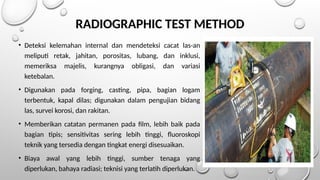
RADIOGRAPHIC TEST METHOD
• Deteksi kelemahan internal dan mendeteksi cacat las-an
meliputi retak, jahitan, porositas, lubang, dan inklusi,
memeriksa majelis, kurangnya obligasi, dan variasi
ketebalan.
• Digunakan pada forging, casting, pipa, bagian logam
terbentuk, kapal dilas; digunakan dalam pengujian bidang
las, survei korosi, dan rakitan.
• Memberikan catatan permanen pada film, lebih baik pada
bagian tipis; sensitivitas sering lebih tinggi, fluoroskopi
teknik yang tersedia dengan tingkat energi disesuaikan.
• Biaya awal yang lebih tinggi, sumber tenaga yang
diperlukan, bahaya radiasi; teknisi yang terlatih diperlukan.
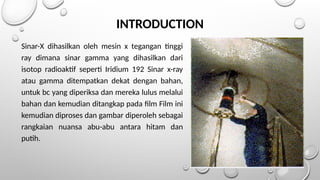
INTRODUCTION
Sinar-X dihasilkan oleh mesin x tegangan tinggi
ray dimana sinar gamma yang dihasilkan dari
isotop radioaktif seperti Iridium 192 Sinar x-ray
atau gamma ditempatkan dekat dengan bahan,
untuk bc yang diperiksa dan mereka lulus melalui
bahan dan kemudian ditangkap pada film Film ini
kemudian diproses dan gambar diperoleh sebagai
rangkaian nuansa abu-abu antara hitam dan
putih.
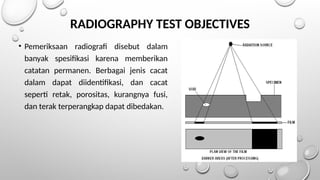
RADIOGRAPHY TEST OBJECTIVES
• Pemeriksaan radiografi disebut dalam
banyak spesifikasi karena memberikan
catatan permanen. Berbagai jenis cacat
dalam dapat diidentifikasi, dan cacat
seperti retak, porositas, kurangnya fusi,
dan terak terperangkap dapat dibedakan.
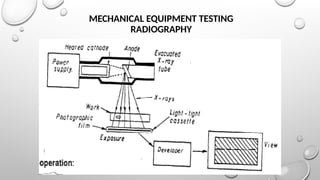
MECHANICAL EQUIPMENT TESTING
RADIOGRAPHY
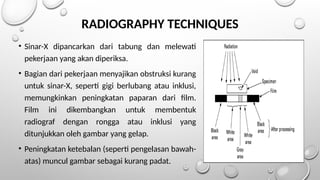
RADIOGRAPHY TECHNIQUES
• Sinar-X dipancarkan dari tabung dan melewati
pekerjaan yang akan diperiksa.
• Bagian dari pekerjaan menyajikan obstruksi kurang
untuk sinar-X, seperti gigi berlubang atau inklusi,
memungkinkan peningkatan paparan dari film.
Film ini dikembangkan untuk membentuk
radiograf dengan rongga atau inklusi yang
ditunjukkan oleh gambar yang gelap.
• Peningkatan ketebalan (seperti pengelasan bawah-
atas) muncul gambar sebagai kurang padat.
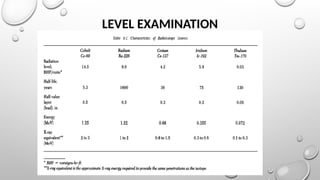
LEVEL EXAMINATION
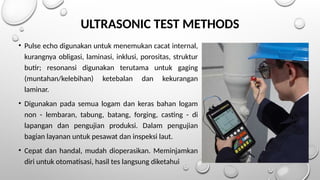
ULTRASONIC TEST METHODS
• Pulse echo digunakan untuk menemukan cacat internal,
kurangnya obligasi, laminasi, inklusi, porositas, struktur
butir; resonansi digunakan terutama untuk gaging
(muntahan/kelebihan) ketebalan dan kekurangan
laminar.
• Digunakan pada semua logam dan keras bahan logam
non - lembaran, tabung, batang, forging, casting - di
lapangan dan pengujian produksi. Dalam pengujian
bagian layanan untuk pesawat dan inspeksi laut.
• Cepat dan handal, mudah dioperasikan. Meminjamkan
diri untuk otomatisasi, hasil tes langsung diketahui
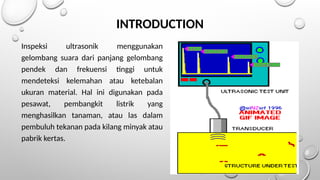
Inspeksi ultrasonik menggunakan
gelombang suara dari panjang gelombang
pendek dan frekuensi tinggi untuk
mendeteksi kelemahan atau ketebalan
ukuran material. Hal ini digunakan pada
pesawat, pembangkit listrik yang
menghasilkan tanaman, atau las dalam
pembuluh tekanan pada kilang minyak atau
pabrik kertas.
INTRODUCTION
HOW IT WORKS
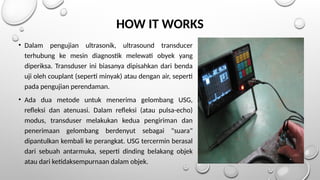
• Dalam pengujian ultrasonik, ultrasound transducer
terhubung ke mesin diagnostik melewati obyek yang
diperiksa. Transduser ini biasanya dipisahkan dari benda
uji oleh couplant (seperti minyak) atau dengan air, seperti
pada pengujian perendaman.
• Ada dua metode untuk menerima gelombang USG,
refleksi dan atenuasi. Dalam refleksi (atau pulsa-echo)
modus, transduser melakukan kedua pengiriman dan
penerimaan gelombang berdenyut sebagai "suara"
dipantulkan kembali ke perangkat. USG tercermin berasal
dari sebuah antarmuka, seperti dinding belakang objek
atau dari ketidaksempurnaan dalam objek.
HOW IT WORKS
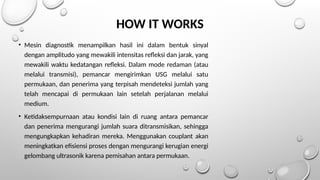
• Mesin diagnostik menampilkan hasil ini dalam bentuk sinyal
dengan amplitudo yang mewakili intensitas refleksi dan jarak, yang
mewakili waktu kedatangan refleksi. Dalam mode redaman (atau
melalui transmisi), pemancar mengirimkan USG melalui satu
permukaan, dan penerima yang terpisah mendeteksi jumlah yang
telah mencapai di permukaan lain setelah perjalanan melalui
medium.
• Ketidaksempurnaan atau kondisi lain di ruang antara pemancar
dan penerima mengurangi jumlah suara ditransmisikan, sehingga
mengungkapkan kehadiran mereka. Menggunakan couplant akan
meningkatkan efisiensi proses dengan mengurangi kerugian energi
gelombang ultrasonik karena pemisahan antara permukaan.
MEASUREMENT METHOD
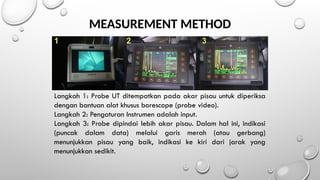
Langkah 1: Probe UT ditempatkan pada akar pisau untuk diperiksa
dengan bantuan alat khusus borescope (probe video).
Langkah 2: Pengaturan Instrumen adalah input.
Langkah 3: Probe dipindai lebih akar pisau. Dalam hal ini, indikasi
(puncak dalam data) melalui garis merah (atau gerbang)
menunjukkan pisau yang baik, indikasi ke kiri dari jarak yang
menunjukkan sedikit.
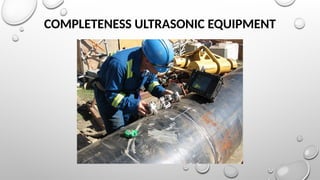
COMPLETENESS ULTRASONIC EQUIPMENT
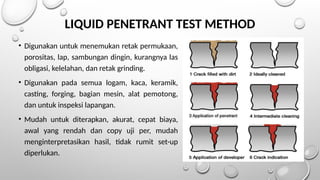
LIQUID PENETRANT TEST METHOD
• Digunakan untuk menemukan retak permukaan,
porositas, lap, sambungan dingin, kurangnya las
obligasi, kelelahan, dan retak grinding.
• Digunakan pada semua logam, kaca, keramik,
casting, forging, bagian mesin, alat pemotong,
dan untuk inspeksi lapangan.
• Mudah untuk diterapkan, akurat, cepat biaya,
awal yang rendah dan copy uji per, mudah
menginterpretasikan hasil, tidak rumit set-up
diperlukan.
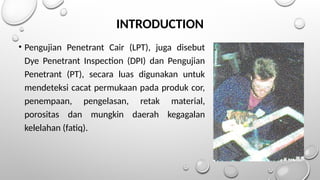
INTRODUCTION
• Pengujian Penetrant Cair (LPT), juga disebut
Dye Penetrant Inspection (DPI) dan Pengujian
Penetrant (PT), secara luas digunakan untuk
mendeteksi cacat permukaan pada produk cor,
penempaan, pengelasan, retak material,
porositas dan mungkin daerah kegagalan
kelelahan (fatiq).
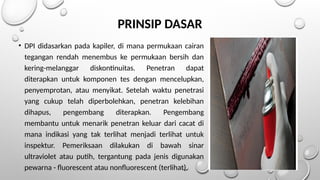
PRINSIP DASAR
• DPI didasarkan pada kapiler, di mana permukaan cairan
tegangan rendah menembus ke permukaan bersih dan
kering-melanggar diskontinuitas. Penetran dapat
diterapkan untuk komponen tes dengan mencelupkan,
penyemprotan, atau menyikat. Setelah waktu penetrasi
yang cukup telah diperbolehkan, penetran kelebihan
dihapus, pengembang diterapkan. Pengembang
membantu untuk menarik penetran keluar dari cacat di
mana indikasi yang tak terlihat menjadi terlihat untuk
inspektur. Pemeriksaan dilakukan di bawah sinar
ultraviolet atau putih, tergantung pada jenis digunakan
pewarna - fluorescent atau nonfluorescent (terlihat).
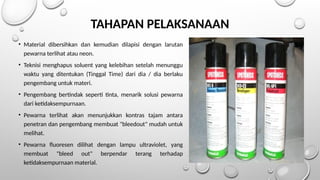
TAHAPAN PELAKSANAAN
• Material dibersihkan dan kemudian dilapisi dengan larutan
pewarna terlihat atau neon.
• Teknisi menghapus soluent yang kelebihan setelah menunggu
waktu yang ditentukan (Tinggal Time) dari dia / dia berlaku
pengembang untuk materi.
• Pengembang bertindak seperti tinta, menarik solusi pewarna
dari ketidaksempurnaan.
• Pewarna terlihat akan menunjukkan kontras tajam antara
penetran dan pengembang membuat "bleedout" mudah untuk
melihat.
• Pewarna fluoresen dilihat dengan lampu ultraviolet, yang
membuat "bleed out" berpendar terang terhadap
ketidaksempurnaan material.
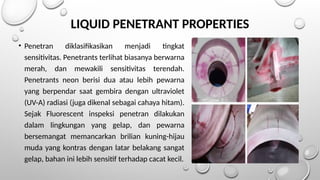
• Penetran diklasifikasikan menjadi tingkat
sensitivitas. Penetrants terlihat biasanya berwarna
merah, dan mewakili sensitivitas terendah.
Penetrants neon berisi dua atau lebih pewarna
yang berpendar saat gembira dengan ultraviolet
(UV-A) radiasi (juga dikenal sebagai cahaya hitam).
Sejak Fluorescent inspeksi penetran dilakukan
dalam lingkungan yang gelap, dan pewarna
bersemangat memancarkan brilian kuning-hijau
muda yang kontras dengan latar belakang sangat
gelap, bahan ini lebih sensitif terhadap cacat kecil.
LIQUID PENETRANT PROPERTIES
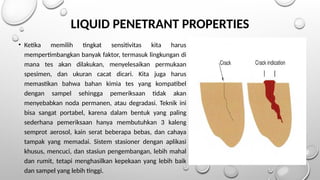
• Ketika memilih tingkat sensitivitas kita harus
mempertimbangkan banyak faktor, termasuk lingkungan di
mana tes akan dilakukan, menyelesaikan permukaan
spesimen, dan ukuran cacat dicari. Kita juga harus
memastikan bahwa bahan kimia tes yang kompatibel
dengan sampel sehingga pemeriksaan tidak akan
menyebabkan noda permanen, atau degradasi. Teknik ini
bisa sangat portabel, karena dalam bentuk yang paling
sederhana pemeriksaan hanya membutuhkan 3 kaleng
semprot aerosol, kain serat beberapa bebas, dan cahaya
tampak yang memadai. Sistem stasioner dengan aplikasi
khusus, mencuci, dan stasiun pengembangan, lebih mahal
dan rumit, tetapi menghasilkan kepekaan yang lebih baik
dan sampel yang lebih tinggi.
LIQUID PENETRANT PROPERTIES
PEMBERSIHAN AWAL
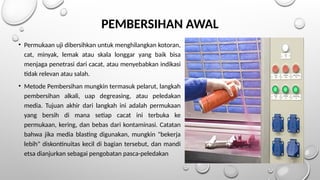
• Permukaan uji dibersihkan untuk menghilangkan kotoran,
cat, minyak, lemak atau skala longgar yang baik bisa
menjaga penetrasi dari cacat, atau menyebabkan indikasi
tidak relevan atau salah.
• Metode Pembersihan mungkin termasuk pelarut, langkah
pembersihan alkali, uap degreasing, atau peledakan
media. Tujuan akhir dari langkah ini adalah permukaan
yang bersih di mana setiap cacat ini terbuka ke
permukaan, kering, dan bebas dari kontaminasi. Catatan
bahwa jika media blasting digunakan, mungkin "bekerja
lebih" diskontinuitas kecil di bagian tersebut, dan mandi
etsa dianjurkan sebagai pengobatan pasca-peledakan
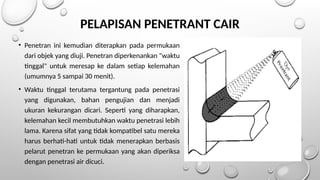
• Penetran ini kemudian diterapkan pada permukaan
dari objek yang diuji. Penetran diperkenankan "waktu
tinggal" untuk meresap ke dalam setiap kelemahan
(umumnya 5 sampai 30 menit).
• Waktu tinggal terutama tergantung pada penetrasi
yang digunakan, bahan pengujian dan menjadi
ukuran kekurangan dicari. Seperti yang diharapkan,
kelemahan kecil membutuhkan waktu penetrasi lebih
lama. Karena sifat yang tidak kompatibel satu mereka
harus berhati-hati untuk tidak menerapkan berbasis
pelarut penetran ke permukaan yang akan diperiksa
dengan penetrasi air dicuci.
PELAPISAN PENETRANT CAIR
PEMBERSIHAN KELEBIHAN PENETRANT CAIR
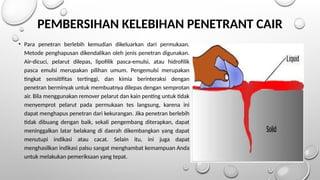
• Para penetran berlebih kemudian dikeluarkan dari permukaan.
Metode penghapusan dikendalikan oleh jenis penetran digunakan.
Air-dicuci, pelarut dilepas, lipofilik pasca-emulsi, atau hidrofilik
pasca emulsi merupakan pilihan umum. Pengemulsi merupakan
tingkat sensitifitas tertinggi, dan kimia berinteraksi dengan
penetran berminyak untuk membuatnya dilepas dengan semprotan
air. Bila menggunakan remover pelarut dan kain penting untuk tidak
menyemprot pelarut pada permukaan tes langsung, karena ini
dapat menghapus penetran dari kekurangan. Jika penetran berlebih
tidak dibuang dengan baik, sekali pengembang diterapkan, dapat
meninggalkan latar belakang di daerah dikembangkan yang dapat
menutupi indikasi atau cacat. Selain itu, ini juga dapat
menghasilkan indikasi palsu sangat menghambat kemampuan Anda
untuk melakukan pemeriksaan yang tepat.
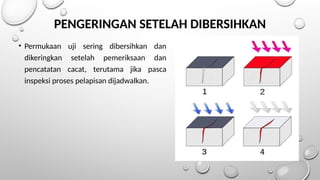
• Permukaan uji sering dibersihkan dan
dikeringkan setelah pemeriksaan dan
pencatatan cacat, terutama jika pasca
inspeksi proses pelapisan dijadwalkan.
PENGERINGAN SETELAH DIBERSIHKAN
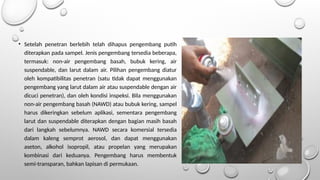
• Setelah penetran berlebih telah dihapus pengembang putih
diterapkan pada sampel. Jenis pengembang tersedia beberapa,
termasuk: non-air pengembang basah, bubuk kering, air
suspendable, dan larut dalam air. Pilihan pengembang diatur
oleh kompatibilitas penetran (satu tidak dapat menggunakan
pengembang yang larut dalam air atau suspendable dengan air
dicuci penetran), dan oleh kondisi inspeksi. Bila menggunakan
non-air pengembang basah (NAWD) atau bubuk kering, sampel
harus dikeringkan sebelum aplikasi, sementara pengembang
larut dan suspendable diterapkan dengan bagian masih basah
dari langkah sebelumnya. NAWD secara komersial tersedia
dalam kaleng semprot aerosol, dan dapat menggunakan
aseton, alkohol isopropil, atau propelan yang merupakan
kombinasi dari keduanya. Pengembang harus membentuk
semi-transparan, bahkan lapisan di permukaan.
• Pengembang menarik penetran dari cacat keluar
ke permukaan untuk membentuk indikasi yang
terlihat, umumnya dikenal sebagai berdarah-out.
Setiap daerah yang berdarah-out dapat
menunjukkan lokasi, orientasi dan jenis
kemungkinan cacat di permukaan. Menafsirkan
hasil dan karakterisasi cacat dari indikasi yang
ditemukan mungkin membutuhkan beberapa
pelatihan dan / atau pengalaman [ukuran indikasi
bukan ukuran sebenarnya dari cacat]
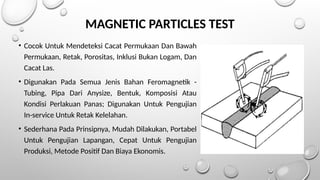
• Cocok Untuk Mendeteksi Cacat Permukaan Dan Bawah
Permukaan, Retak, Porositas, Inklusi Bukan Logam, Dan
Cacat Las.
• Digunakan Pada Semua Jenis Bahan Feromagnetik -
Tubing, Pipa Dari Anysize, Bentuk, Komposisi Atau
Kondisi Perlakuan Panas; Digunakan Untuk Pengujian
In-service Untuk Retak Kelelahan.
• Sederhana Pada Prinsipnya, Mudah Dilakukan, Portabel
Untuk Pengujian Lapangan, Cepat Untuk Pengujian
Produksi, Metode Positif Dan Biaya Ekonomis.
MAGNETIC PARTICLES TEST
MAGNETIC PARTICLE INSPECTION
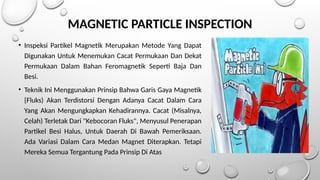
• Inspeksi Partikel Magnetik Merupakan Metode Yang Dapat
Digunakan Untuk Menemukan Cacat Permukaan Dan Dekat
Permukaan Dalam Bahan Feromagnetik Seperti Baja Dan
Besi.
• Teknik Ini Menggunakan Prinsip Bahwa Garis Gaya Magnetik
{Fluks) Akan Terdistorsi Dengan Adanya Cacat Dalam Cara
Yang Akan Mengungkapkan Kehadirannya. Cacat (Misalnya,
Celah) Terletak Dari "Kebocoran Fluks", Menyusul Penerapan
Partikel Besi Halus, Untuk Daerah Di Bawah Pemeriksaan.
Ada Variasi Dalam Cara Medan Magnet Diterapkan. Tetapi
Mereka Semua Tergantung Pada Prinsip Di Atas
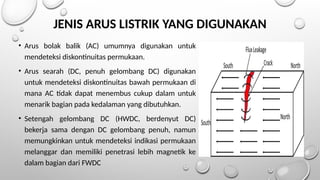
• Arus bolak balik (AC) umumnya digunakan untuk
mendeteksi diskontinuitas permukaan.
• Arus searah (DC, penuh gelombang DC) digunakan
untuk mendeteksi diskontinuitas bawah permukaan di
mana AC tidak dapat menembus cukup dalam untuk
menarik bagian pada kedalaman yang dibutuhkan.
• Setengah gelombang DC (HWDC, berdenyut DC)
bekerja sama dengan DC gelombang penuh, namun
memungkinkan untuk mendeteksi indikasi permukaan
melanggar dan memiliki penetrasi lebih magnetik ke
dalam bagian dari FWDC
JENIS ARUS LISTRIK YANG DIGUNAKAN
MAGNETIC PARTICLE TEST STEPS
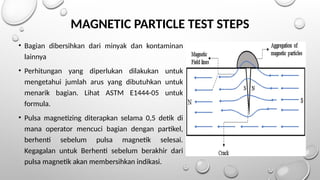
• Bagian dibersihkan dari minyak dan kontaminan
lainnya
• Perhitungan yang diperlukan dilakukan untuk
mengetahui jumlah arus yang dibutuhkan untuk
menarik bagian. Lihat ASTM E1444-05 untuk
formula.
• Pulsa magnetizing diterapkan selama 0,5 detik di
mana operator mencuci bagian dengan partikel,
berhenti sebelum pulsa magnetik selesai.
Kegagalan untuk Berhenti sebelum berakhir dari
pulsa magnetik akan membersihkan indikasi.
MAGNETIC PARTICLE TEST STEPS
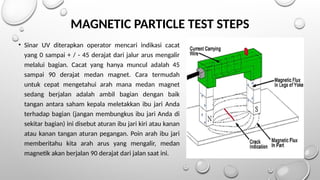
• Sinar UV diterapkan operator mencari indikasi cacat
yang 0 sampai + / - 45 derajat dari jalur arus mengalir
melalui bagian. Cacat yang hanya muncul adalah 45
sampai 90 derajat medan magnet. Cara termudah
untuk cepat mengetahui arah mana medan magnet
sedang berjalan adalah ambil bagian dengan baik
tangan antara saham kepala meletakkan ibu jari Anda
terhadap bagian (jangan membungkus ibu jari Anda di
sekitar bagian) ini disebut aturan ibu jari kiri atau kanan
atau kanan tangan aturan pegangan. Poin arah ibu jari
memberitahu kita arah arus yang mengalir, medan
magnetik akan berjalan 90 derajat dari jalan saat ini.
MAGNETIC PARTICLE TEST STEPS
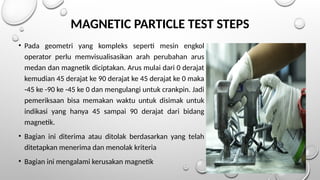
• Pada geometri yang kompleks seperti mesin engkol
operator perlu memvisualisasikan arah perubahan arus
medan dan magnetik diciptakan. Arus mulai dari 0 derajat
kemudian 45 derajat ke 90 derajat ke 45 derajat ke 0 maka
-45 ke -90 ke -45 ke 0 dan mengulangi untuk crankpin. Jadi
pemeriksaan bisa memakan waktu untuk disimak untuk
indikasi yang hanya 45 sampai 90 derajat dari bidang
magnetik.
• Bagian ini diterima atau ditolak berdasarkan yang telah
ditetapkan menerima dan menolak kriteria
• Bagian ini mengalami kerusakan magnetik
MAGNETIC PARTICLE TEST STEPS
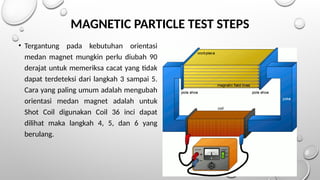
• Tergantung pada kebutuhan orientasi
medan magnet mungkin perlu diubah 90
derajat untuk memeriksa cacat yang tidak
dapat terdeteksi dari langkah 3 sampai 5.
Cara yang paling umum adalah mengubah
orientasi medan magnet adalah untuk
Shot Coil digunakan Coil 36 inci dapat
dilihat maka langkah 4, 5, dan 6 yang
berulang.
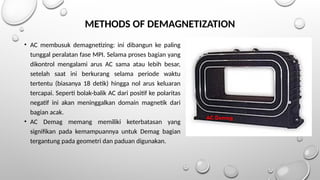
METHODS OF DEMAGNETIZATION
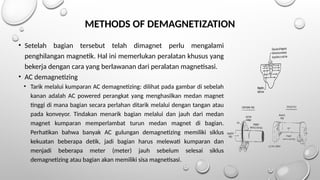
• Setelah bagian tersebut telah dimagnet perlu mengalami
penghilangan magnetik. Hal ini memerlukan peralatan khusus yang
bekerja dengan cara yang berlawanan dari peralatan magnetisasi.
• AC demagnetizing
• Tarik melalui kumparan AC demagnetizing: dilihat pada gambar di sebelah
kanan adalah AC powered perangkat yang menghasilkan medan magnet
tinggi di mana bagian secara perlahan ditarik melalui dengan tangan atau
pada konveyor. Tindakan menarik bagian melalui dan jauh dari medan
magnet kumparan memperlambat turun medan magnet di bagian.
Perhatikan bahwa banyak AC gulungan demagnetizing memiliki siklus
kekuatan beberapa detik, jadi bagian harus melewati kumparan dan
menjadi beberapa meter (meter) jauh sebelum selesai siklus
demagnetizing atau bagian akan memiliki sisa magnetisasi.
METHODS OF DEMAGNETIZATION
• AC membusuk demagnetizing: ini dibangun ke paling
tunggal peralatan fase MPI. Selama proses bagian yang
dikontrol mengalami arus AC sama atau lebih besar,
setelah saat ini berkurang selama periode waktu
tertentu (biasanya 18 detik) hingga nol arus keluaran
tercapai. Seperti bolak-balik AC dari positif ke polaritas
negatif ini akan meninggalkan domain magnetik dari
bagian acak.
• AC Demag memang memiliki keterbatasan yang
signifikan pada kemampuannya untuk Demag bagian
tergantung pada geometri dan paduan digunakan.
AC Demag
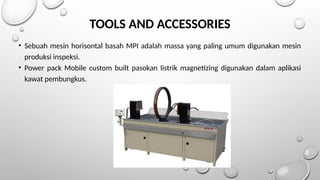
TOOLS AND ACCESSORIES
• Sebuah mesin horisontal basah MPI adalah massa yang paling umum digunakan mesin
produksi inspeksi.
• Power pack Mobile custom built pasokan listrik magnetizing digunakan dalam aplikasi
kawat pembungkus.
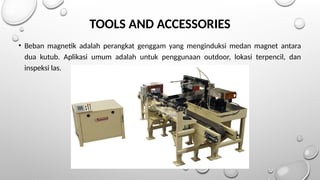
TOOLS AND ACCESSORIES
• Beban magnetik adalah perangkat genggam yang menginduksi medan magnet antara
dua kutub. Aplikasi umum adalah untuk penggunaan outdoor, lokasi terpencil, dan
inspeksi las.
LEVEL CERTIFICATION FOR NDT
• Level 1 adalah teknisi memenuhi syarat untuk melakukan kalibrasi hanya spesifik dan tes di bawah
pengawasan yang ketat dan arah oleh personil tingkat yang lebih tinggi. Mereka hanya bisa
melaporkan hasil tes. Biasanya mereka bekerja mengikuti instruksi kerja khusus untuk prosedur
pengujian dan kriteria penolakan.
• Tingkat 2 adalah insinyur atau teknisi berpengalaman yang mampu mengatur dan kalibrasi peralatan
pengujian, melakukan pemeriksaan sesuai dengan kode dan standar (bukan mengikuti instruksi kerja)
dan menyusun instruksi kerja untuk Level 1 teknisi. Mereka juga berwenang melaporkan, menafsirkan,
mengevaluasi dan mendokumentasikan hasil pengujian. Mereka juga dapat mengawasi dan melatih
Level 1 teknisi. Selain menguji metode, mereka harus terbiasa dengan kode yang berlaku dan standar
dan memiliki pengetahuan tentang pembuatan dan layanan produk diuji.
• Tingkat 3 biasanya insinyur atau teknisi khusus yang sangat berpengalaman. Mereka dapat
membangun teknik NDT dan prosedur dan menginterpretasikan kode dan standar.
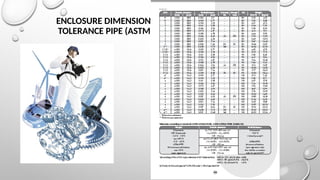
ENCLOSURE DIMENSIONS
TOLERANCE PIPE (ASTM)
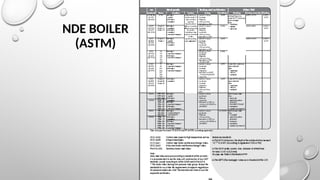
NDE BOILER
(ASTM)
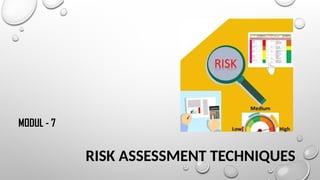
RISK ASSESSMENT TECHNIQUES
MODUL - 7
LEGAL BACKGROUND
Management Regulations (1999) are the umbrella regulations
Require employer to:
• Identify hazards
• Assess risks
• Eliminate or control exposure to risks
• Write it down if significant
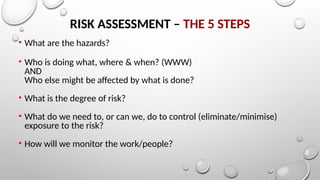
RISK ASSESSMENT – THE 5 STEPS
• What are the hazards?
• Who is doing what, where & when? (WWW)
AND
Who else might be affected by what is done?
• What is the degree of risk?
• What do we need to, or can we, do to control (eliminate/minimise)
exposure to the risk?
• How will we monitor the work/people?
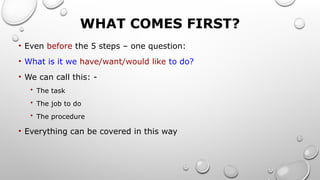
WHAT COMES FIRST?
• Even before the 5 steps – one question:
• What is it we have/want/would like to do?
• We can call this: -
• The task
• The job to do
• The procedure
• Everything can be covered in this way
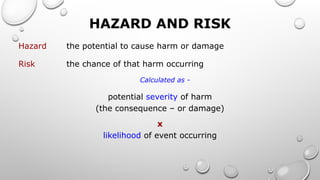
HAZARD AND RISK
Hazard the potential to cause harm or damage
Risk the chance of that harm occurring
Calculated as -
potential severity of harm
(the consequence – or damage)
x
likelihood of event occurring
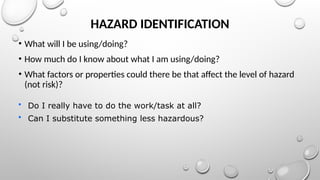
HAZARD IDENTIFICATION
• What will I be using/doing?
• How much do I know about what I am using/doing?
• What factors or properties could there be that affect the level of hazard
(not risk)?
• Do I really have to do the work/task at all?
• Can I substitute something less hazardous?
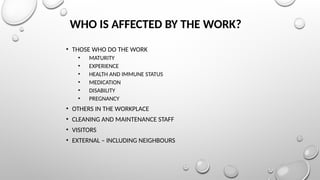
WHO IS AFFECTED BY THE WORK?
• THOSE WHO DO THE WORK
• MATURITY
• EXPERIENCE
• HEALTH AND IMMUNE STATUS
• MEDICATION
• DISABILITY
• PREGNANCY
• OTHERS IN THE WORKPLACE
• CLEANING AND MAINTENANCE STAFF
• VISITORS
• EXTERNAL – INCLUDING NEIGHBOURS
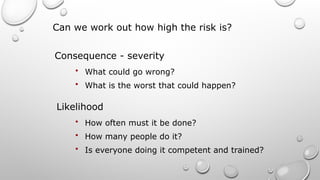
Can we work out how high the risk is?
• What could go wrong?
• What is the worst that could happen?
Consequence - severity
Likelihood
• How often must it be done?
• How many people do it?
• Is everyone doing it competent and trained?
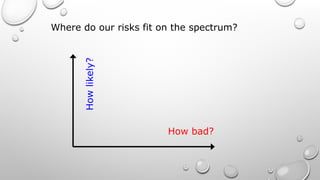
Where do our risks fit on the spectrum?
How
likely?
How bad?
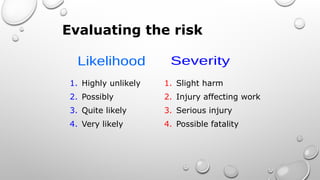
Evaluating the risk
1. Highly unlikely
2. Possibly
3. Quite likely
4. Very likely
1. Slight harm
2. Injury affecting work
3. Serious injury
4. Possible fatality
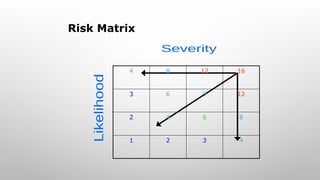
Risk Matrix
4 8 12 16
3 6 9 12
2 4 6 8
1 2 3 4
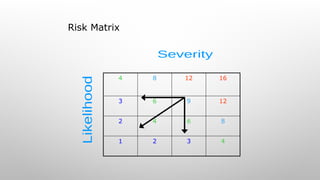
Risk Matrix
4 8 12 16
3 6 9 12
2 4 6 8
1 2 3 4
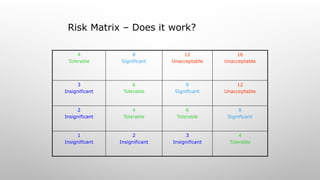
Risk Matrix – Does it work?
4
Tolerable
8
Significant
12
Unacceptable
16
Unacceptable
3
Insignificant
6
Tolerable
9
Significant
12
Unacceptable
2
Insignificant
4
Tolerable
6
Tolerable
8
Significant
1
Insignificant
2
Insignificant
3
Insignificant
4
Tolerable
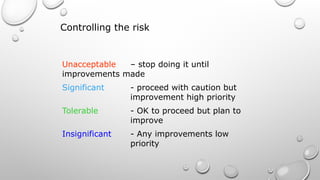
Controlling the risk
Unacceptable – stop doing it until
improvements made
Significant - proceed with caution but
improvement high priority
Tolerable - OK to proceed but plan to
improve
Insignificant - Any improvements low
priority
Controlling the risk
• Decide measures to be taken
• Implement them according to priority
• Confirm measures appropriate and work
MONITORING AND REVIEW
Monitoring
• ‘Live’ nature of assessments
• Possible modification to procedures
Review
• Identifies changes to procedures
• Possible modification to assessment
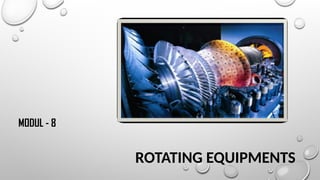
ROTATING EQUIPMENTS
MODUL - 8
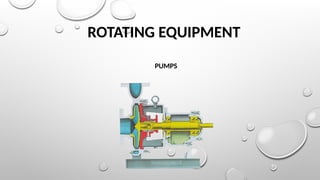
ROTATING EQUIPMENT
PUMPS
ROTATING EQUIPMENT
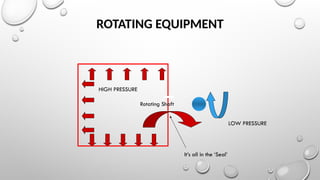
HIGH PRESSURE
It’s all in the ‘Seal’
LOW PRESSURE
Rotating Shaft
ROTATING EQUIPMENT
• PUMPS
• COMPRESSORS
• AGITATORS
• FANS / BLOWERS
• TURBINES
• VACUUM PUMPS
• VALVES
TYPE OF SEALS
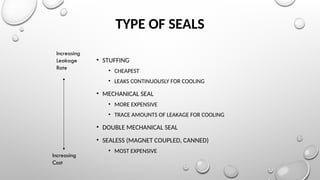
• STUFFING
• CHEAPEST
• LEAKS CONTINUOUSLY FOR COOLING
• MECHANICAL SEAL
• MORE EXPENSIVE
• TRACE AMOUNTS OF LEAKAGE FOR COOLING
• DOUBLE MECHANICAL SEAL
• SEALESS (MAGNET COUPLED, CANNED)
• MOST EXPENSIVE
Increasing
Cost
Increasing
Leakage
Rate
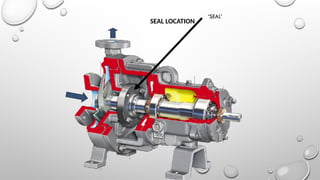
‘SEAL’
SEAL LOCATION
ROTATING EQUIPMENT
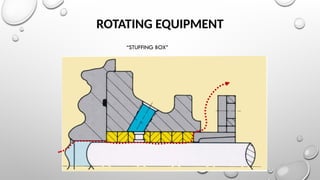
“STUFFING BOX”
ROTATING EQUIPMENT
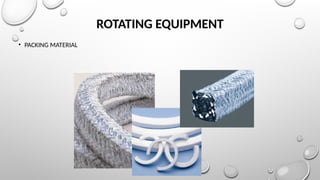
• PACKING MATERIAL
ROTATING EQUIPMENT
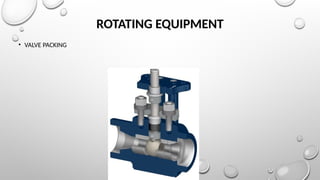
• VALVE PACKING
ROTATING EQUIPMENT
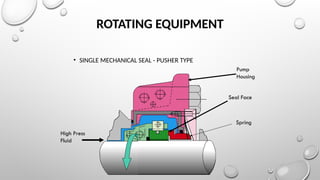
• SINGLE MECHANICAL SEAL - PUSHER TYPE
High Press
Fluid
Shaft
Seal Face
Pump
Housing
Spring
ROTATING EQUIPMENT
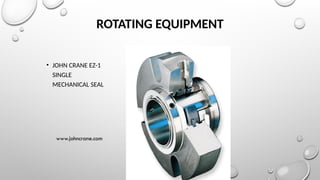
• JOHN CRANE EZ-1
SINGLE
MECHANICAL SEAL
www.johncrane.com
ROTATING EQUIPMENT
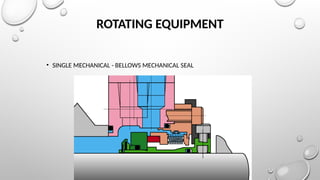
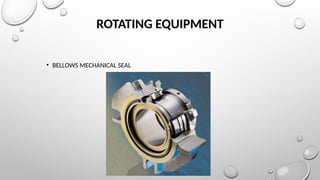
• SINGLE MECHANICAL - BELLOWS MECHANICAL SEAL
ROTATING EQUIPMENT
• BELLOWS MECHANICAL SEAL
ROTATING EQUIPMENT
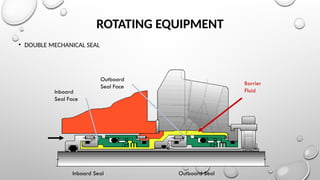
• DOUBLE MECHANICAL SEAL
Inboard Seal Outboard Seal
Barrier
Fluid
Inboard
Seal Face
Outboard
Seal Face
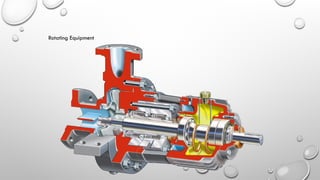
Rotating Equipment
ROTATING EQUIPMENT
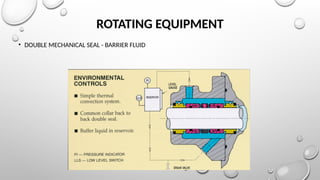
• DOUBLE MECHANICAL SEAL - BARRIER FLUID
ROTATING EQUIPMENT
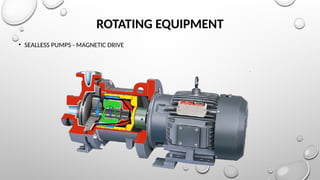
• SEALLESS PUMPS - MAGNETIC DRIVE
ROTATING EQUIPMENT
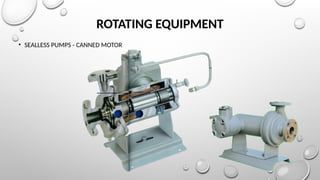
• SEALLESS PUMPS - CANNED MOTOR
ROTATING EQUIPMENT
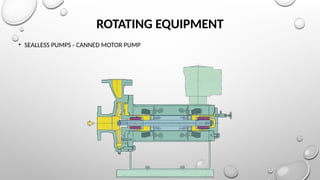
• SEALLESS PUMPS - CANNED MOTOR PUMP
ROTATING EQUIPMENT
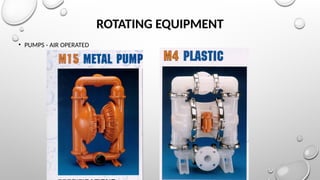
• PUMPS - AIR OPERATED
ROTATING EQUIPMENT
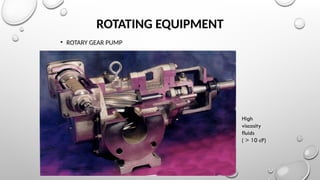
• ROTARY GEAR PUMP
High
viscosity
fluids
( > 10 cP)
ROTATING EQUIPMENT
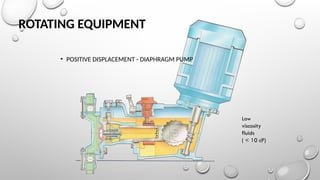
• POSITIVE DISPLACEMENT - DIAPHRAGM PUMP
Low
viscosity
fluids
( < 10 cP)
ROTATING EQUIPMENT
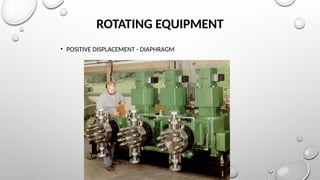
• POSITIVE DISPLACEMENT - DIAPHRAGM
ROTATING EQUIPMENT
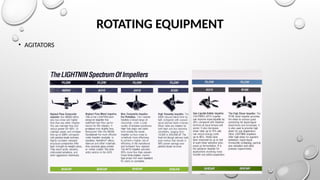
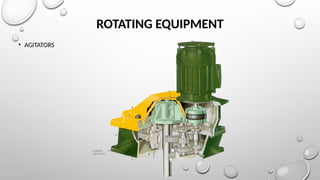
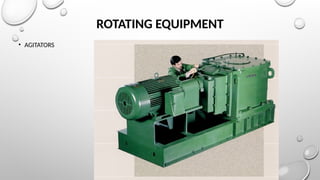
• AGITATORS
ROTATING EQUIPMENT
• AGITATORS
ROTATING EQUIPMENT
• AGITATORS
ROTATING EQUIPMENT
• AGITATORS
PUMP SIZING FOR CHEE 470
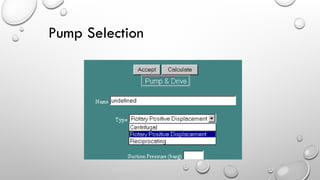
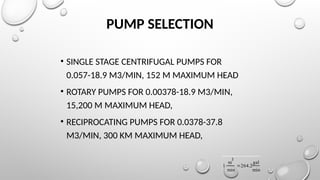
Pump Selection
PUMP SELECTION
• SINGLE STAGE CENTRIFUGAL PUMPS FOR
0.057-18.9 M3/MIN, 152 M MAXIMUM HEAD
• ROTARY PUMPS FOR 0.00378-18.9 M3/MIN,
15,200 M MAXIMUM HEAD,
• RECIPROCATING PUMPS FOR 0.0378-37.8
M3/MIN, 300 KM MAXIMUM HEAD,
1
m
3
min
 264.2
gal
min

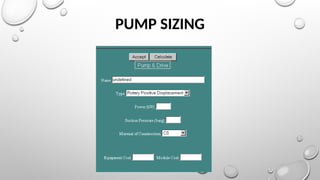
PUMP SIZING
%
50
)
(
)
(
Power
fluid
Hydraulic
Efficiency
Motor
Efficiency
Hydraulic
Power
fluid
Hydraulic
Power
Shaft



1714
)
(
)
(
)
(
psi
pressure
al
Differenti
USGPM
Flow
Volumetric
Power
fluid
Hydraulic


Grav
Spec
ft
Head
psi
pressure
al
Differenti 

 43352
.
0
)
(
)
(
(HP)
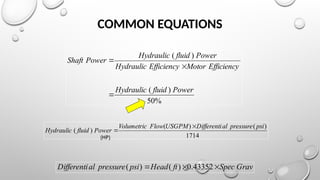
COMMON EQUATIONS
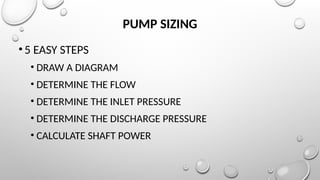
PUMP SIZING
•5 EASY STEPS
• DRAW A DIAGRAM
• DETERMINE THE FLOW
• DETERMINE THE INLET PRESSURE
• DETERMINE THE DISCHARGE PRESSURE
• CALCULATE SHAFT POWER
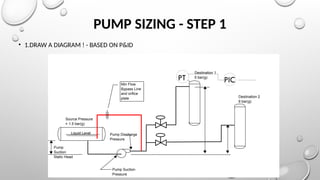
PUMP SIZING - STEP 1
• 1.DRAW A DIAGRAM ! - BASED ON P&ID
Source Pressure
= 1.5 bar(g)
Destination 1
5 bar(g)

Liquid Level
Pump Suction
Pressure
Pump Discharge
Pressure
Pump
Suction
Static Head
Destination 2
9 bar(g)
Min Flow
Bypass Line
and orifice
plate
PIC
PT
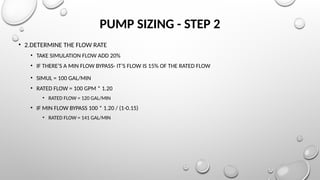
PUMP SIZING - STEP 2
• 2.DETERMINE THE FLOW RATE
• TAKE SIMULATION FLOW ADD 20%
• IF THERE’S A MIN FLOW BYPASS- IT’S FLOW IS 15% OF THE RATED FLOW
• SIMUL = 100 GAL/MIN
• RATED FLOW = 100 GPM * 1.20
• RATED FLOW = 120 GAL/MIN
• IF MIN FLOW BYPASS 100 * 1.20 / (1-0.15)
• RATED FLOW = 141 GAL/MIN
PUMP SIZING - STEP 3
• 3. Determine Pump Inlet Pressure
• Use Pressure from Simulation
• Assume elevation changes offset piping pressure drops
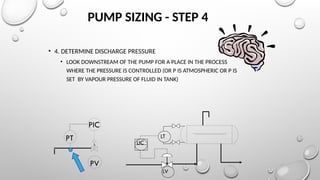
PUMP SIZING - STEP 4
• 4. DETERMINE DISCHARGE PRESSURE
• LOOK DOWNSTREAM OF THE PUMP FOR A PLACE IN THE PROCESS
WHERE THE PRESSURE IS CONTROLLED (OR P IS ATMOSPHERIC OR P IS
SET BY VAPOUR PRESSURE OF FLUID IN TANK)
PIC
PT
PV
LT
LV
LIC
PUMP SIZING - STEP 4
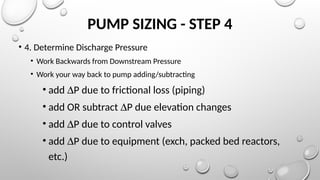
• 4. Determine Discharge Pressure
• Work Backwards from Downstream Pressure
• Work your way back to pump adding/subtracting
• add DP due to frictional loss (piping)
• add OR subtract DP due elevation changes
• add DP due to control valves
• add DP due to equipment (exch, packed bed reactors,
etc.)
PUMP SIZING - STEP 4
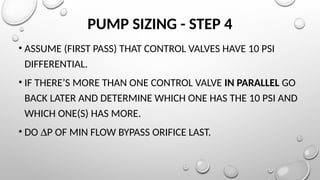
• ASSUME (FIRST PASS) THAT CONTROL VALVES HAVE 10 PSI
DIFFERENTIAL.
• IF THERE’S MORE THAN ONE CONTROL VALVE IN PARALLEL GO
BACK LATER AND DETERMINE WHICH ONE HAS THE 10 PSI AND
WHICH ONE(S) HAS MORE.
• DO DP OF MIN FLOW BYPASS ORIFICE LAST.
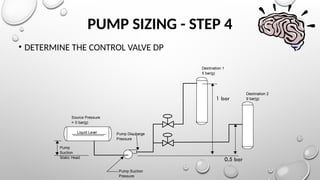
PUMP SIZING - STEP 4
• DETERMINE THE CONTROL VALVE DP
Source Pressure
= 0 bar(g)
Destination 1
5 bar(g)
Liquid Level
Pump Suction
Pressure
Pump Discharge
Pressure
Pump
Suction
Static Head
Destination 2
9 bar(g)
1 bar
0.5 bar
PUMP SIZING - STEP 4
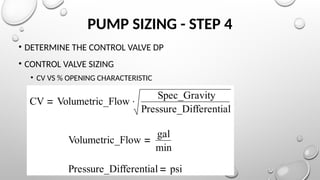
• DETERMINE THE CONTROL VALVE DP
• CONTROL VALVE SIZING
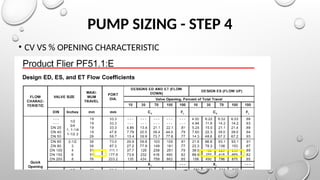
• CV VS % OPENING CHARACTERISTIC
CV Volumetric_Flow
Spec_Gravity
Pressure_Differential

Volumetric_Flow
gal
min
Pressure_Differential psi
PUMP SIZING - STEP 4
• CV VS % OPENING CHARACTERISTIC
PUMP SIZING - STEP 4
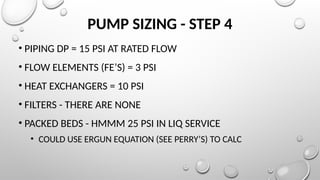
• PIPING DP = 15 PSI AT RATED FLOW
• FLOW ELEMENTS (FE’S) = 3 PSI
• HEAT EXCHANGERS = 10 PSI
• FILTERS - THERE ARE NONE
• PACKED BEDS - HMMM 25 PSI IN LIQ SERVICE
• COULD USE ERGUN EQUATION (SEE PERRY’S) TO CALC
PUMP SIZING - STEP 5
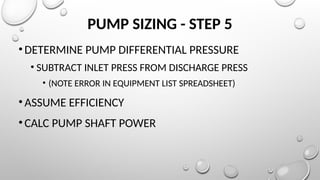
•DETERMINE PUMP DIFFERENTIAL PRESSURE
• SUBTRACT INLET PRESS FROM DISCHARGE PRESS
• (NOTE ERROR IN EQUIPMENT LIST SPREADSHEET)
•ASSUME EFFICIENCY
•CALC PUMP SHAFT POWER
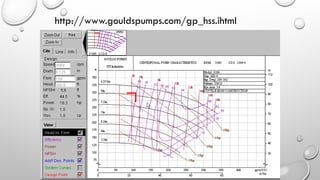
http://www.gouldspumps.com/gp_hss.ihtml
GOULDS PUMP SIZING
• 3600 OR 1800 RPM
• START WITH MODEL 3196 (STANDARD CHEMICAL SERVICE)
• LOOK FOR THE PUMP WITH THE HIGHEST EFFICIENCY
http://www.gouldspumps.com/gp_hss.ihtml
WORKSHOP
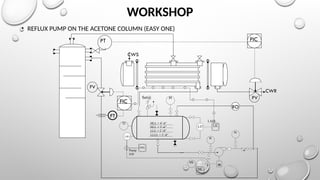
• REFLUX PUMP ON THE ACETONE COLUMN (EASY ONE)
NLL = 3’-6”
LLL = 2’-0”
HLL = 4’-6”
LLLL = 2’-0”
LIT
LSLL
I Pump
S/D
LIC
TI
PI
LAHL
LALL
Set@
M
I
HS
HS
PI
PI
RO
FV
FT
FIC
PV
PT PIC
CWS
CWR
WORKSHOP
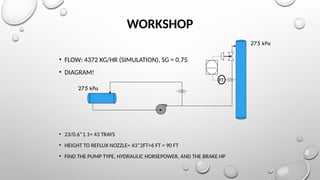
• FLOW: 4372 KG/HR (SIMULATION), SG = 0.75
• DIAGRAM!
• 23/0.6*1.1= 43 TRAYS
• HEIGHT TO REFLUX NOZZLE= 43*2FT+6 FT = 90 FT
• FIND THE PUMP TYPE, HYDRAULIC HORSEPOWER, AND THE BRAKE HP
FT
275 kPa
275 kPa
QUESTIONS
• NPSH
• COMPRESSION RATIO
• DRIVER TYPES
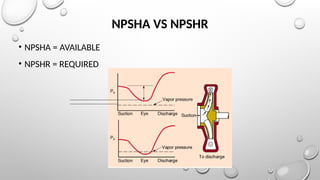
NPSHA VS NPSHR
• NPSHA = AVAILABLE
• NPSHR = REQUIRED
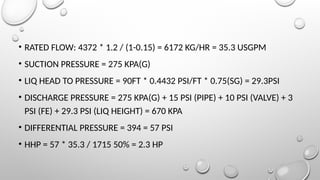
• RATED FLOW: 4372 * 1.2 / (1-0.15) = 6172 KG/HR = 35.3 USGPM
• SUCTION PRESSURE = 275 KPA(G)
• LIQ HEAD TO PRESSURE = 90FT * 0.4432 PSI/FT * 0.75(SG) = 29.3PSI
• DISCHARGE PRESSURE = 275 KPA(G) + 15 PSI (PIPE) + 10 PSI (VALVE) + 3
PSI (FE) + 29.3 PSI (LIQ HEIGHT) = 670 KPA
• DIFFERENTIAL PRESSURE = 394 = 57 PSI
• HHP = 57 * 35.3 / 1715 50% = 2.3 HP
TOTAL PRODUCTIVE MAINTENANCE
MODUL - 9
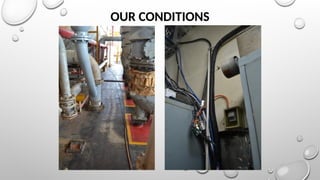
OUR CONDITIONS
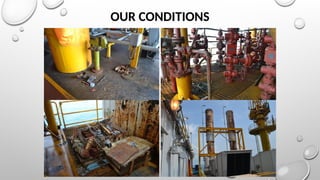
OUR CONDITIONS
What Does TPM Look
Like?
TPM IMPLEMENTED?
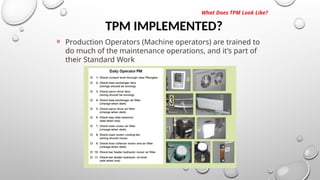
What Does TPM Look Like?
» Production Operators (Machine operators) are trained to
do much of the maintenance operations, and it’s part of
their Standard Work
Production Operators Roles
• Cleaning all equipment, machine, and
facilities every day.
• Oiling at moving parts, gear, chain, bearing,
and others machine/equipments/facilities
that need an oil or grease.
• Checking the abnormalities of
machine/equipment/instrument/facilities
by simple check, such as check a gauge,
standard value or not, etc?
• Doing a small repair.
TPM Implemented?
What Does TPM Look Like?
Maintenance/Technician
• Doing a big repair for the un
predictive one.
• Doing a weekly or monthly
maintenance to all equipments/
machine/facilities .
• Evaluate Production operator
check sheet and history of small
repair.
• Doing a yearly maintenance to all
equipment/machine/ facilities.
• Etc.
TPM Implemented?
What Does TPM Look Like?
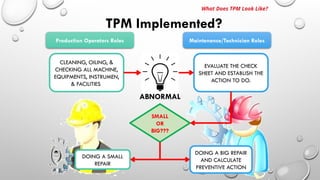
Production Operators Roles Maintenance/Technician Roles
CLEANING, OILING, &
CHECKING ALL MACHINE,
EQUIPMENTS, INSTRUMEN,
& FACILITIES
ABNORMAL
EVALUATE THE CHECK
SHEET AND ESTABLISH THE
ACTION TO DO.
DOING A SMALL
REPAIR
DOING A BIG REPAIR
AND CALCULATE
PREVENTIVE ACTION
SMALL
OR
BIG???
TPM IMPLEMENTED?
What Does TPM Look Like?
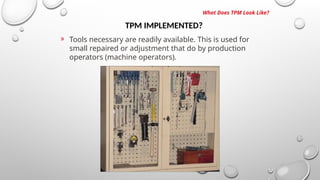
» Tools necessary are readily available. This is used for
small repaired or adjustment that do by production
operators (machine operators).
TPM IMPLEMENTED?
What Does TPM Look Like?
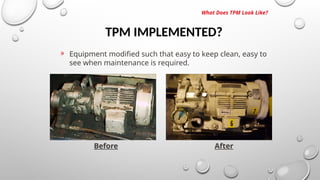
» Equipment modified such that easy to keep clean, easy to
see when maintenance is required.
Before After
TPM IMPLEMENTED?
What Does TPM Look Like?
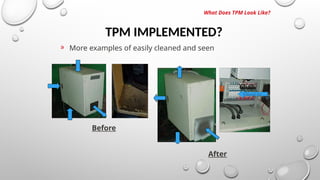
» More examples of easily cleaned and seen
Before
After
Filtered Air
TPM IMPLEMENTED?
What Does TPM Look Like?
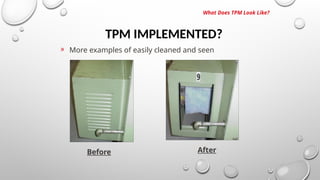
» More examples of easily cleaned and seen
Before After
TPM IMPLEMENTED?
What Does TPM Look Like?
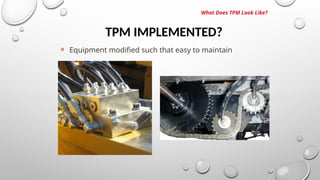
» Equipment modified such that easy to maintain
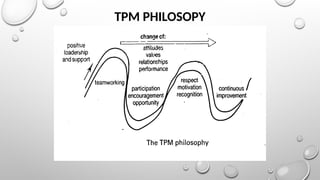
TPM PHILOSOPY
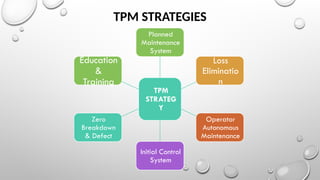
TPM STRATEGIES
TPM
STRATEG
Y
Planned
Maintenance
System
Loss
Eliminatio
n
Operator
Autonomous
Maintenance
Initial Control
System
Zero
Breakdown
& Defect
Education
&
Training
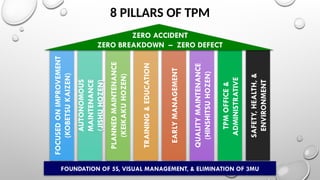
8 PILLARS OF TPM
FOCUSED
ON
IMPROVEMENT
(KOBETSU
KAIZEN)
AUTONOMOUS
MAINTENANCE
(JISHU
HOZEN)
PLANNED
MAINTENANCE
(KEIKAKU
HOZEN)
TRAINING
&
EDUCATION
EARLY
MANAGEMENT
QUALITY
MAINTENANCE
(HINSHITSU
HOZEN)
TPM
OFFICE
&
ADMINISTRATIVE
SAFETY,
HEALTH,
&
ENVIRONMENT
FOUNDATION OF 5S, VISUAL MANAGEMENT, & ELIMINATION OF 3MU
ZERO ACCIDENT
ZERO BREAKDOWN – ZERO DEFECT
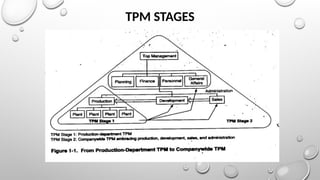
TPM STAGES
WHAT ARE THE BENEFITS FOR YOU?
•Safe Work Environment
•Job Security
•Improved Quality
•Increased Productivity/Efficiency.
•Improved Skills
What Can Be Expected?
Productivity/Efficiency:
uValue added improvement 1.5 to 2 times.
u40% reduction in breakdowns.
uOverall equipment efficiency up 1.5 to 2 times.
Quality:
uReduction in Work-In-Process (WIP) defects.
uReduction in Parts Per Million (PPM).
Cost:
uRecovery Costs reduced by 30%.
uCost caused breakdown reduced by 30%.
What Can Be Expected?
Safety & Morale:
uZero accidents.
u5 -- 10 suggestions per employee.
Education:
uSkill upgrading of employees.
Delivery:
uReduced finished goods inventory by 50%.
u100% on-time delivery.
uReduced premium freight by 60%.
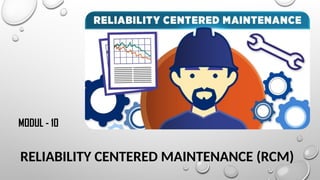
RELIABILITY CENTERED MAINTENANCE (RCM)
MODUL - 10
EVOLUTION OF MAINTENANCE
• At the very beginning, Maintenance was an appendix to Operations / Production: It
existed only to fix failures, when they happened. These were the days of absolute
CORRECTIVE MAINTENANCE.
• As times went by, it was detected that many failures have an almost regular pattern,
failing after an average period. Therefore, one could choose regular intervals to fix
the equipment BEFORE the failure: PREVENTIVE MAINTENANCE Also know as TIME
BASED MAINTENANCE.
EVOLUTION OF MAINTENANCE
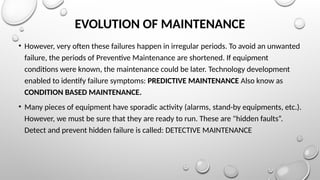
• However, very often these failures happen in irregular periods. To avoid an unwanted
failure, the periods of Preventive Maintenance are shortened. If equipment
conditions were known, the maintenance could be later. Technology development
enabled to identify failure symptoms: PREDICTIVE MAINTENANCE Also know as
CONDITION BASED MAINTENANCE.
• Many pieces of equipment have sporadic activity (alarms, stand-by equipments, etc.).
However, we must be sure that they are ready to run. These are "hidden faults“.
Detect and prevent hidden failure is called: DETECTIVE MAINTENANCE
EVOLUTION OF MAINTENANCE
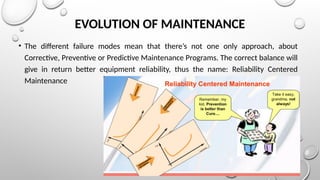
• The different failure modes mean that there’s not one only approach, about
Corrective, Preventive or Predictive Maintenance Programs. The correct balance will
give in return better equipment reliability, thus the name: Reliability Centered
Maintenance
RELIABILITY CENTERED MAINTENANCE (RCM)
John Moubray 1949-2004
After graduating as a mechanical engineer in 1971, John Moubray
worked for two years as a maintenance planner in a packaging plant and
for one year as a commercial field engineer for a major oil company. In
1974, he joined a large multi-disciplinary management consulting
company. He worked for this company for twelve years, specializing in
the development and implementation of manual and computerized
maintenance management systems for a wide variety of clients in the
mining, manufacturing and electric utility sectors.He began working on
RCM in 1981, and since 1986 was full time dedicated to RCM, founding
Aladon LCC, which he led until his premature death in
2004. John Moubray is today considered a synonym of RCM.
RELIABILITY CENTERED MAINTENANCE (RCM)
ITS ORIGINS
• What about a failure rate of 0.00006/event?
• Quite good, no?
• This was the average failure rate in commercial flights
takeoffs, in the 50’s. Two thirds of them caused by equipment
failures. Today, this would mean 2 accidents per day, with
planes with more than 100 passengers!!! That’s why
Reliability Centered Maintenance has begun in the
Aeronautical Engineering. Pretty soon, Nuclear activities,
Military, Oil & Gas industries also began to use RCM concepts
and implement them in their facilities.
RELIABILITY CENTERED MAINTENANCE (RCM)
RELIABILITY AND AVAILABILITY
Reliability
• Reliability is a broad term that focuses on the ability of a product to perform its intended
function. Mathematically speaking, reliability can be defined as the probability that an item
will continue to perform its intended function without failure for a specified period of time
under stated conditions.
• Reliability is a performance expectation. It’s usually defined at design.
Availability
• Depends upon Operation uptime and Operating cycle.
• Availability is a performance result. Equipment history will tell us the availability.
Bibliography: Kardec, Alan y Nascif, Julio - Manutenção- Função Estratégica, Editora Qualitymark
RELIABILITY CENTERED MAINTENANCE (RCM)
RELIABILITY AND AVAILABILITY
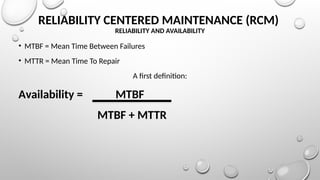
• MTBF = Mean Time Between Failures
• MTTR = Mean Time To Repair
A first definition:
Availability = MTBF
MTBF + MTTR
RELIABILITY CENTERED MAINTENANCE (RCM)
AVAILABILITY DEFINITIONS
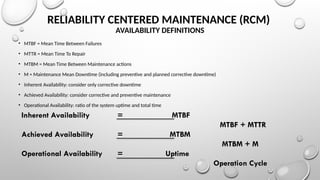
• MTBF = Mean Time Between Failures
• MTTR = Mean Time To Repair
• MTBM = Mean Time Between Maintenance actions
• M = Maintenance Mean Downtime (including preventive and planned corrective downtime)
• Inherent Availability: consider only corrective downtime
• Achieved Availability: consider corrective and preventive maintenance
• Operational Availability: ratio of the system uptime and total time
Inherent Availability = MTBF
MTBF + MTTR
Achieved Availability = MTBM
MTBM + M
Operational Availability = Uptime
Operation Cycle
RELIABILITY CENTERED MAINTENANCE (RCM)
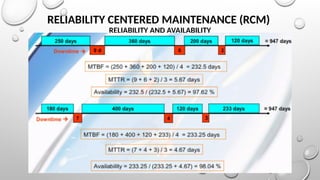
RELIABILITY AND AVAILABILITY
RELIABILITY CENTERED MAINTENANCE (RCM)
RELIABILITY AND AVAILABILITY
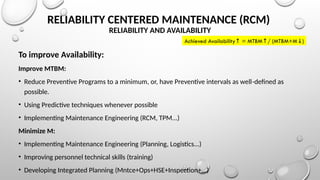
To improve Availability:
Improve MTBM:
• Reduce Preventive Programs to a minimum, or, have Preventive intervals as well-defined as
possible.
• Using Predictive techniques whenever possible
• Implementing Maintenance Engineering (RCM, TPM...)
Minimize M:
• Implementing Maintenance Engineering (Planning, Logistics...)
• Improving personnel technical skills (training)
• Developing Integrated Planning (Mntce+Ops+HSE+Inspection+...)
Achieved Availability = MTBM / (MTBM+M )
↑ ↑ ↓
RELIABILITY CENTERED MAINTENANCE (RCM)
IMPROVING PRODUCTIVITY
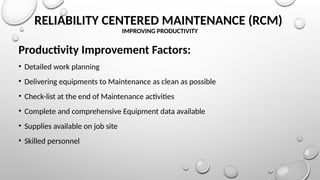
Productivity Improvement Factors:
• Detailed work planning
• Delivering equipments to Maintenance as clean as possible
• Check-list at the end of Maintenance activities
• Complete and comprehensive Equipment data available
• Supplies available on job site
• Skilled personnel
RELIABILITY CENTERED MAINTENANCE (RCM)
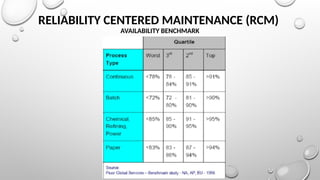
AVAILABILITY BENCHMARK
RELIABILITY CENTERED MAINTENANCE (RCM)
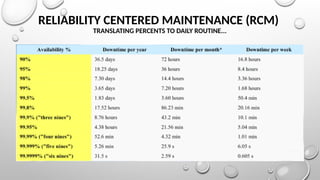
TRANSLATING PERCENTS TO DAILY ROUTINE...
RELIABILITY CENTERED MAINTENANCE (RCM)
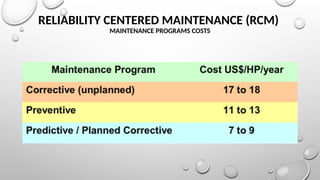
MAINTENANCE PROGRAMS COSTS
RELIABILITY CENTERED MAINTENANCE (RCM)
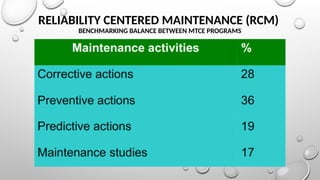
BENCHMARKING BALANCE BETWEEN MTCE PROGRAMS
RELIABILITY CENTERED MAINTENANCE (RCM)
DEFINITIONS
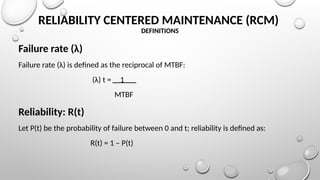
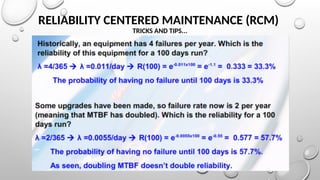
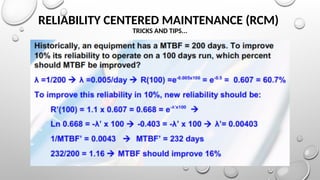
Failure rate (λ)
Failure rate (λ) is defined as the reciprocal of MTBF:
(λ) t = 1
MTBF
Reliability: R(t)
Let P(t) be the probability of failure between 0 and t; reliability is defined as:
R(t) = 1 – P(t)
RELIABILITY CENTERED MAINTENANCE (RCM)
SOME MATH...
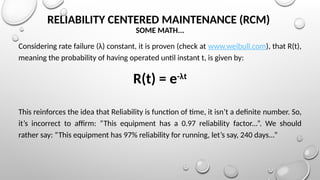
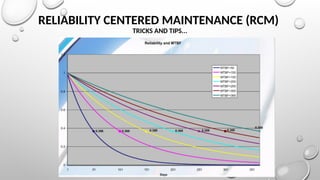
Considering rate failure (λ) constant, it is proven (check at www.weibull.com), that R(t),
meaning the probability of having operated until instant t, is given by:
R(t) = e-λt
This reinforces the idea that Reliability is function of time, it isn’t a definite number. So,
it’s incorrect to affirm: “This equipment has a 0.97 reliability factor...”. We should
rather say: “This equipment has 97% reliability for running, let’s say, 240 days...”
RELIABILITY CENTERED MAINTENANCE (RCM)
TRICKS AND TIPS...
RELIABILITY CENTERED MAINTENANCE (RCM)
TRICKS AND TIPS...
RELIABILITY CENTERED MAINTENANCE (RCM)
TRICKS AND TIPS...
RELIABILITY CENTERED MAINTENANCE (RCM)
TRICKS AND TIPS...
RELIABILITY CENTERED MAINTENANCE (RCM)
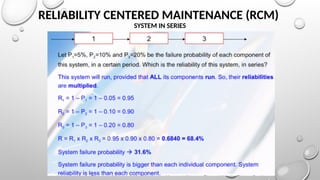
SYSTEM IN SERIES
RELIABILITY CENTERED MAINTENANCE (RCM)
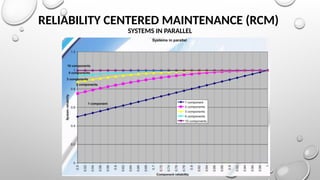
SYSTEM IN PARALLEL
RELIABILITY CENTERED MAINTENANCE (RCM)
MIXED SYSTEMS
RELIABILITY CENTERED MAINTENANCE (RCM)
REDUNDANCY
RELIABILITY CENTERED MAINTENANCE (RCM)
REDUNDANCY
RELIABILITY CENTERED MAINTENANCE (RCM)
SYSTEMS IN PARALLEL
RELIABILITY CENTERED MAINTENANCE (RCM)
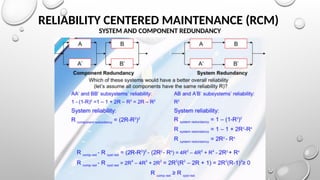
SYSTEM AND COMPONENT REDUNDANCY
RELIABILITY CENTERED MAINTENANCE (RCM)
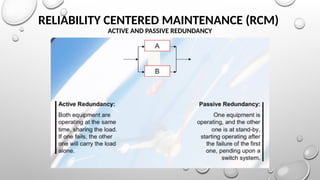
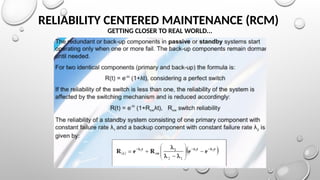
ACTIVE AND PASSIVE REDUNDANCY
RELIABILITY CENTERED MAINTENANCE (RCM)
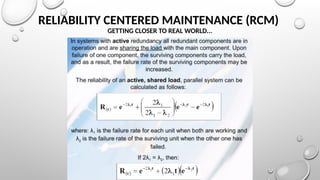
GETTING CLOSER TO REAL WORLD...
RELIABILITY CENTERED MAINTENANCE (RCM)
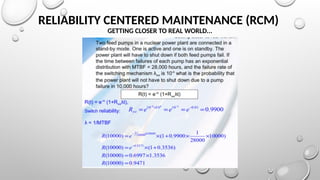
GETTING CLOSER TO REAL WORLD...
RELIABILITY CENTERED MAINTENANCE (RCM)
GETTING CLOSER TO REAL WORLD...
RELIABILITY CENTERED MAINTENANCE (RCM)
GETTING CLOSER TO REAL WORLD...
RELIABILITY CENTERED MAINTENANCE (RCM)
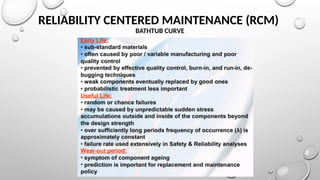
BATHTUB CURVE
RELIABILITY CENTERED MAINTENANCE (RCM)
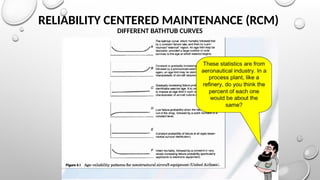
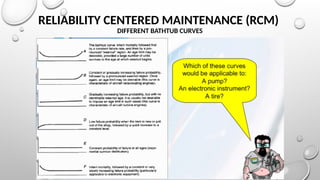
DIFFERENT BATHTUB CURVES
RELIABILITY CENTERED MAINTENANCE (RCM)
DIFFERENT BATHTUB CURVES
RELIABILITY CENTERED MAINTENANCE (RCM)
FAILURE MODES
• Common sense tells that the best way to optimize the availability of plants is to implement some
Preventive maintenance.
• Preventive maintenance means fixing or replacing some pieces of equipments and/or components
in fixed intervals. Useful lifespan of equipments may be calculated with Failure Statistical Analysis,
enabling Maintenance Department to implement Preventive Programs.
• This is true for some simple pieces of equipment and components, which may have a prevailing
failure mode. Many components in contact with process fluids have a regular lifespan, as well as
cyclic equipment, due to fatigue and corrosion.
• But, for many pieces of equipment there’s no connection between reliability and time.
Furthermore, as seen in Reliability curves, defining the optimum interval for Preventive
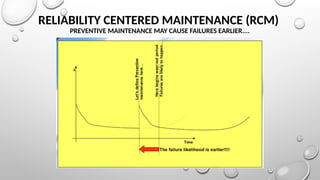
maintenance may be a hard task. Besides, fixing or even replacing the equipment may bring you
back to Infant Mortality period...
RELIABILITY CENTERED MAINTENANCE (RCM)
PREVENTIVE MAINTENANCE MAY CAUSE FAILURES EARLIER....
RELIABILITY CENTERED MAINTENANCE (RCM)
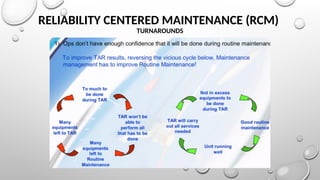
TURNAROUNDS
Turnarounds are often seen by Operations as an unique opportunity to have all problems solved,
all equipment fixed…
Meanwhile, for Maintenance, a Turnaround is a huge event, time & resources & costs consuming,
in which ONLY should be done whatever CANNOT be done on the run, during normal operation.
Frequently, Maintenance is asked to perform General Maintenance in ALL rotating equipment of a
Unit, during its Turnaround. Matter of fact, if these equipment have spares, this General
Maintenance should be done out of the TAR.
Why do Operations want everything to be done during the TAR?
1. Because Ops don’t have enough confidence that it will be done during routine maintenance.
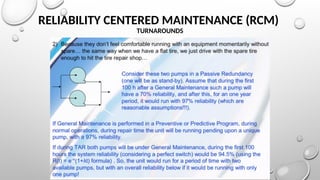
2. Because they don’t feel comfortable running with an equipment momentarily without spare…
the same way when we have a flat tire, we just drive with the spare tire enough to hit the tire
repair shop…
RELIABILITY CENTERED MAINTENANCE (RCM)
TURNAROUNDS
RELIABILITY CENTERED MAINTENANCE (RCM)
TURNAROUNDS
RELIABILITY CENTERED MAINTENANCE (RCM)
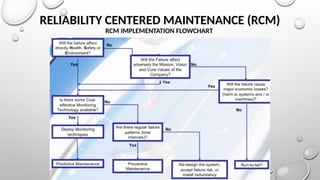
RCM IMPLEMENTATION FLOWCHART
RELIABILITY CENTERED MAINTENANCE (RCM)
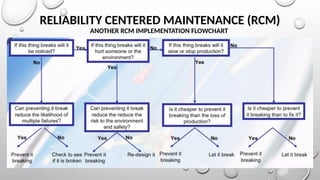
ANOTHER RCM IMPLEMENTATION FLOWCHART
Bila ada Pertanyaan:
Email:
rachmatbr@gmailcom
HP/WA:
+6287885442700

ASSET INTEGRITY MANAGEMENT SYSTEM-BOOK.pptx

  • 1.
    ASSET INTEGRITY MANAGEMENTSYSTEM JAKARTA, 26 – 27 NOPEMBER 2020 CREATED BY RAMBOE
  • 2.
  • 3.
  • 4.
    TUJUAN • Pahami bagaimanaAnda dapat mengoptimalkan sistem dan strategi Manajemen Integritas Aset di Organisasi Anda. • Cari tahu bagaimana mengelola desain aset holistik dengan bantuan sistem AIM dan kode desain. • Temukan cara menggunakan Pemeriksaan Berbasis Risiko untuk mengidentifikasi ancaman lebih cepat dan menghemat biaya operasional. • Menerapkan pendekatan teknis untuk manajemen integritas aset untuk mendapatkan hasil operasional yang EFEKTIF dan memperpanjang siklus hidup fasilitas. • MENGAdaptasi strategi manajemen integritas aset yang efektif yang akan membantu meningkatkan produktivitas dan mengatasi tantangan.
  • 5.
    TOPIK YANG DIPELAJARI AssetIntegrity General Overview Basics of Asset Management and Asset Integrity Corrosion Management Risk Based Inspection (RBI) Fitness for Service (FFS) Inspection and Non Destructive Testing (NDT) Risk Assessment Techniques Rotating Equipments Total Productive Maintenance Reliability Centered Maintenance (RCM) Modern Approaches to Asset Integrity Management (AIM)
  • 6.
    ASSET INTEGRITY GENERALOVERVIEW MODUL - 1
  • 7.
    ASSET INTEGRITY Integritas AsetDapat Didefinisikan Sebagai Kemampuan Aset Untuk Menjalankan Fungsi Yang Diperlukan Secara Efektif Dan Efisien Dalam Siklus Hidupnya Yang Melindungi Kesehatan, Keselamatan, Dan Lingkungan ”.
  • 8.
    SASARAN ASSET INTEGRITY •Keamanan dan keandalan operasi aset dengan peningkatan ketersediaan aset. • Identifikasi ancaman dan dampaknya terhadap integritas aset • Proses dan prosedur sistematis untuk mengatasi ancaman dan mengurangi dampaknya terhadap integritas • Perpanjangan hidup ASET • Pemotongan biaya OPERASIONAL. • Perencanaan SHUT-DOWN. • Perbaikan perencanaan / jadwal / HAL UNTUK MENDAPATKAN KEMBALI. • perbaikan Desain • Citra merek (BRAND IMAGE) • Manajemen Stakeholder
  • 9.
    BASICS OF ASSETMANAGEMENT AND ASSET INTEGRITY MODUL - 2
  • 10.
    APA ITU ASET? •Semua sumber ekonomi atau kekayaan yang dimiliki oleh suatu entitas yang diharapkan dapat memberikan manfaat usaha di masa depan. • Di dalam ilmu akuntansi, aset atau aktiva dimasukkan dalam neraca dengan saldo normal debit.
  • 11.
    ASSET MANAGEMENT Suatu prosesperencanaan, pengadaan, pengelolaan dan perwatan hingga penghpsan suatu sumber daya yang dimiliki oleh individu / organisasi secara efektif dan efisien dalam rangka mencapai tujuan.
  • 12.
    SIKLUS HIDUP ASET Tahapandimana perusahaan mengidentifikasi kebutuhan akan adanya permintaan atas aset. Tahapan ketika aset dibangun atau dibuat, bahkan dibeli. Pengadaan aset ini tergantung kebutuhan dan sesuai perencanaan. Tahapan ketika aset digunakan/ dimanfaatkan untuk tujuan yang ditetapkan. Pada fase ini biasanya juga terdapat aktivitas pembaruan, perbaikan, dan pergantian yang dilakukan secara berkesinambungan atas aset. Tahapan dimana umur ekonomis suatu aset telah habis atau ketika kebutuhan akan aset tersebut telah hilang. Fase Perencanaan Fase Pengadaan Fase Penghapusan Fase Operasi dan Pemeliharaan
  • 13.
  • 14.
  • 15.
    PENGERTIAN MANAJEMEN ASET: Manajemen : usaha mencapai tujuan dan memanfaatkan sumber daya (aset secara efektif dan efisien ) Aset : adalah milik sebuah organisasi yang dapat berupa aset tetap maupun aset berjalan
  • 16.
    AZAS MANAJEMEN ASET: a. Azas fungsional ( harus sesuai dengan fungsi masing-masing ) b. Azas kepastian hukum (sesuai dengan peraturan dan perundang-undangan ) c. Azas transparansi ( transparan terhadap masyarakat ) d. Azas efisiensi ( penggunaan secara tepat dan benar ) e. Azas akuntabilitas ( dapat dipertanggug jawabkan pada masyarakat ) f. Azas kepastian nilai ( penilaian yang tepat )
  • 17.
    CREATE/ACQUIRE UTILIZE MAINTAINRENEW/DISPOSE ORGANIZATION/ MANAGEMENT COPORATE MANAGE ASSET PORTFOLIO MANAGE ASSET SYSTEMS MANAGE ASET
  • 18.
    MANAGE ASSET : 1.Mengikuti resource life cycle. 2. Pengambilan keputusan sangat penting. 3. Sistem informasi sangat berperan.
  • 19.
    SYSTEM MANAGE ASSET 1.Culture 2. Technology 3. Integrity
  • 20.
  • 21.
    KOROSI Korosi : Peristiwaperusakan atau degradasi material logam akibat bereaksi secara kimia dengan lingkungan
  • 22.
  • 23.
  • 24.
  • 25.
  • 26.
  • 27.
  • 29.
  • 30.
  • 31.
  • 32.
  • 33.
  • 34.
  • 35.
  • 36.
  • 37.
    RISK BASED INSPECTION(RBI) MODUL - 4
  • 38.
    WHAT IS RISK-BASEDINSPECTION (RBI)? • A risk assessment and management process that is focused on loss of containment of pressurized equipment in processing facilities due to material deterioration. These risks are managed primarily through equipment inspection. • The risk-based inspection is a systematic and integrated use of expertise from the different disciplines that impact plant integrity. These include design, materials selection, operating parameters and scenarios, and understanding of the current and future degradation mechanisms and risks involved. • Risk-based methodologies enable the assessment of the likelihood and potential consequences of equipment failures. Risk-Based Inspection (RBI) provides companies the opportunity to prioritize their equipment for inspection; optimize inspection methods, frequencies, and resources; and develop specific equipment inspection plans the extent of inspection, and the most suitable type of Non-Destructive Examination (NDE)
  • 39.
    WHAT IS RISK-BASEDINSPECTION (RBI) • RBI is most often used in engineering industries and is predominant in the oi l and gas, petrochemical industries. Assessed risk level are used to develop a prioritised inspection plan. It is related to (or sometimes a part of) Risk Based Asset Management (RBAM), Risk Based Integrity Management (RBIM) and Risk Based Management(RBM).Generally, RBI is part of Risk and Reliability Management (RRM). Inspections typically employ nondestructive testing (NDT). • Risk-Based Inspection (RBI) is a methodology that, as opposed to condition-based inspection involves quantitative assessment of the Probability of failure (PoF) and the Consequence of failure (CoF) associated with each equipment item, piping circuits included, in a particular process unit.
  • 40.
    WHAT IS RISK-BASEDINSPECTION (RBI) • RBI is a risk assessment and management tool that addresses an area not completely addressed in other organizational risk management efforts such as Process Hazards Analyses (PHA) or reliability centered maintenance (RCM). • RBI produces Inspection and Maintenance Plans for equipment that identifies the actions that should be implemented to provide reliable and safe operation. • The RBI effort can provide input into an organization’s annual planning and budgeting that define the staffing and funds required to maintain equipment operation at acceptable levels of performance and risk. • Risk-Based Inspection is Proactive – It Utilizes the Information Available to Manage Risk
  • 41.
    PURPOSE OF RISK-BASEDINSPECTION • Screen operating units within a plant to identify areas of high risk. • Estimate a risk value associated with the operation of each piece of equipment • Prioritize the equipment based on the measured risk • Design an appropriate inspection program • Systematically manage the risk of equipment failures. *
  • 42.
    KEY ELEMENTS OFA RBI PROGRAM • Key elements that should exist in any RBI program are: • Management systems for maintaining documentation, personnel qualifications, data requirements and analysis updates. • Documented method for probability of failure determination. • Documented method for consequence of failure determination. • Documented methodology for managing risk through inspection and other mitigation activities.
  • 43.
    EQUIPMENT COVERED INRBI The following types of pressurized equipment and associated components/internals are covered by this document: • Pressure vessels—all pressure containing components. • Process piping—pipe and piping components. • Storage tanks—atmospheric and pressurized. • Rotating equipment—pressure containing components. • Boilers and heaters—pressurized components. • Heat exchangers (shells, heads, channels and bundles). • Pressure relief devices.
  • 44.
    EQUIPMENT NOT COVEREDIN RBI The following non-pressurized equipment is not covered by this document: • Instrument and control systems. • Electrical systems. • Structural systems. • Machinery components (except pump and compressor casings).
  • 45.
    RISK ANALYSIS A riskassessment involves first establishing the current and anticipated condition of the equipment, by asking the following questions: • What material degradations have been experienced or could be experienced? • What are the likelihood (probabilities) of these degradations occurring? • What are the consequences of these degradations? • The next step is to determine the risk of operating equipment as the combination of two separate terms: • Risk = Likelihood or Probability of Failure x Consequence of Failure
  • 46.
  • 48.
    FITNESS FOR SERVICE(FFS) MODUL - 5
  • 49.
    BACKGROUND • In 1990a joint industry project was organized by materials properties council (MPC) concentrated the program on the development of technology for FFS and the culmination of this progran was the development of API RP 579. • Sponsor’s pf yhe API RP 579 were EXXON, SHELL, BP, MOBIL, CHEVRON, ARCO, & AMOCO. • In 2000 API published API RP 579 for FFS Assessment to evaluate flaws or damage in the in-service equipment. • Primarily it was intended to refining & petrochemical assets. • In 2007 API joined force with the ASME to produce an updated document with the desigation API-759-1/ASME FFS-1.
  • 50.
    NEED FOR FFS •ASME & API codes & standrads for pressurized equipment don not provide rules for the evaluation of deficiencies of in-service equipment. • API 510,70, 653, & NB-23 do address the fact that equipment degrades while in service.
  • 51.
    FFS – FITNESSFOR SERVICE • Introduction PART – 1 • FFS Assessment Procedure PART – 2 • Brittle Fracture PART – 3 • General Metal Loss PART – 4 • Local Metal Loss PART – 5 • Pitting Corrosion PART – 6
  • 52.
    ANNEXURES • Annex A:Thickness, MAWP & Stress equation for sn FFS Assessment • Annex B: Stress Analysis overview for an FFS Assessment • Annex C: Compendium of stress intesity factor solution • Annex D: Compendium of Reference stress solutions for crack like flaw • Annex E: Residual stress in FFS evaluation • Annex F: Material properties for an FFS Assessment • Annex G: Damage Mechanism • Annex H:Technical basis & validation • Annex I: Glossary of terms & definitions • Annex J: Currently not used • Annex K: Crack opening areas.
  • 53.
    PART – 1:INTRODUCTION • Fitness for Service (FFS) assessment are quantitative engineering evaluations that are performed to demosntrate the structural integrity of an in-service component that maycontain flaw or damage. • Run-Repair-Replace decision when inspections has revealed degradation or flaw in the equipment. • FFS Assesment are currently recognized and referenced by codes such API 510, 570, & 653. • Responsibilities & qualifications of owner user, engineer, & inspector.
  • 54.
    PART – 1:INTRODUCTION • Some of expertise that is the part of an FFS are 1. Stress analysis (Caesar II, PV Elite, ANSYS, PRO- E) Accurate estimation of stresses action on the component. 2. Fracture Mechanism This discipline is related to the behavior of cracks in the material.
  • 55.
    PART – 1:INTRODUCTION 3. Metallurgy/Material Engineering Understanding of thr performance of varios materials subjected to spesific environment, pressure, temperature, and stress level. 4. NDE Detection and sizing of the flaw. 5. Plant Operations Process conditions & startup/shutdown inputs to FFS Assessment 6. Corrosion Degradation mechanism input to FFS Assessment.
  • 56.
    PART 2: FFSASSESSMENT PROCEDURE There are 8 steps in the FFS Assessment procedure: 1. Identification of flaw and damage mechanism. 2. Applicability and limitations. 3. Data requirements. 4. Assessment techniques & Acceptance criteria. 5. Remaining life evaluation. 6. Remediation. 7. In-service monitoring. 8. Documetation.
  • 57.
    PART 2: FFSASSESSMENT PROCEDURE
  • 58.
    PART 2: FFSASSESSMENT PROCEDURE
  • 59.
    PART 2: FFSASSESSMENT PROCEDURE
  • 60.
    PART 2: FFSASSESSMENT PROCEDURE
  • 61.
    PART 2: FFSASSESSMENT PROCEDURE
  • 62.
    PART 2: FFSASSESSMENT PROCEDURE
  • 63.
  • 64.
    DOCUMENTATION • FFS assessmentshould be documented so that it can be reoeated later. • Equipment design data, maintenance and past operational history, future operating and design conditions, calcukation of the MAWP, RL, next inspection interval and any remediation or mitigation/monitoring for continued service.
  • 65.
  • 66.
  • 67.
  • 68.
  • 69.
  • 73.
  • 74.
  • 75.
  • 76.
  • 77.
    INSPECTION AND NONDESTRUCTIVE TESTING (NDT) MODUL - 6
  • 78.
    Pemeriksaan Yang PalingUmum, Pemeriksaan Terorganisir Atau Latihan Evaluasi Formal. Dalam Kegiatan Inspeksi Teknik Melibatkan Pengukuran, Tes, Dan Pengukur Diterapkan Untuk Karakteristik Tertentu Mengenai Suatu Objek Atau Kegiatan. Hasilnya Biasanya Dibandingkan Dengan Per-syaratan Yang Ditentukan Dan Standar Untuk Menentukan Apakah Item Atau Kegiatan Ini Sejalan Dengan Target Ini. Pemeriksaan Biasanya Non-destruktif. INTRODUCTION
  • 80.
    • Cracks • Solidinclusions • Surface and profiles • Misalignment (set-up irregularities) • Gas pores and porosity • Lack of fusion • Mechanical damage • Parent material damage • Miscellaneous. KRITERIA CACAT LASAN (WELD)
  • 81.
    WELD DEFECTS -CRACK Longitudinal parent metal crack Transverse weld metal crack Longitudinal weld metal crack Lamellar tearing
  • 82.
    WELD DEFECTS -CRACK Transverse crack Longitudinal crack
  • 83.
    Gas Cavities Root piping Clusterporosity Gas pore Blow hole Herringbone porosity  Loss of gas shield  Damp electrodes  Contamination  Arc length too large  Damaged electrode flux  Moisture on parent material  Welding current too low Gas pore <1.5mm Blow hole.1.5mm
  • 84.
  • 85.
  • 86.
    Solid Inclusions  Terakberasal dari fluks pengelasan  MAG dan proses pengelasan TIG menghasilkan inklusi silika  Terak disebabkan oleh pembersihan yang tidak memadai  Inklusi lainnya termasuk inklusi tungsten dan tembaga dari TIG MAG dan proses pengelasan Inklusi terak didefinisikan sebagai inklusi non-logam yang disebabkan oleh beberapa proses pengelasan Slag inclusions Parallel slag lines Lack of interun fusion + slag Lack of sidewall fusion with associated slag
  • 87.
  • 88.
    Cacat Permukaan danProfil Incomplete filled groove + Lack of sidewall fusion 1 2 1. Lack of sidewall fusion 2. Lack of inter-run fusion  Keahlian welder belum baik  Manipulasi electrode yang tidak benar  Arc blow  welding current/voltage tidak sesuai  Kecepatan travel salah  Pembersihan inter-run salah
  • 89.
    Overlap Ketidaksempurnaan pada kakiatau akar lasan yang disebabkan oleh logam mengalir ke permukaan logam induk tanpa sekering untuk itu  Contamination  Slow travel speed  Incorrect welding technique  Current too low
  • 90.
  • 91.
    Root Defects Incomplete rootfusion Incomplete root penetration  Low Amps/volts  Large Root face  Small Root Gap  Fast Travel Speed  Incorrect Electrode Angle  Contamination  Arc blow
  • 92.
    Root Defects Lack ofroot fusion Lack of root Penetration
  • 93.
    Lack of rootpenetration Lack of root fusion
  • 94.
  • 95.
    Spatter  Excessive current Damp electrodes  Contamination  Incorrect wire feed speed when welding with the MAG welding process Miscellaneous Defects
  • 96.
    Miscellaneous Defects  Accidentalstriking of the arc onto the parent material  Faulty electrode holder  Poor cable insulation  Poor return lead clamping Arc strike
  • 97.
    Undercut Sebuah alur tidakteratur di ujung las yang berjalan dalam logam induk  Excessive amps/volts  Excessive travel speed  Incorrect electrode angle  Excessive weaving  Incorrect welding technique  Electrode too large
  • 98.
    Cap Undercut Measured inboth Length & Depth
  • 99.
  • 100.
    Shrinkage groove Shrinkage Groove Insufficient weld metal deposited in the root pass  Too fast a cooling rate during the application of the root bead pass  Poor welding technique Sebuah alur dangkal yang disebabkan oleh kontraksi dalam logam las bersama setiap sisi penetrasi manik-manik
  • 101.
    Concave root Concave Root Root faces too large  Root gap too large  Excessive back purge pressure during TIG welding  Excessive root bead grinding before the application of the second pass Sebuah alur dangkal, yang mungkin terjadi pada akar dari lasan
  • 102.
  • 103.
    Excessive root penetration ExcessiveRoot Penetration  Root faces too small  Root gap too large  Excessive amps/volts  Slow travel speed Penetrasi Akar melebihi penetrasi sesuai dengan spesifikasi yang relevan digunakan
  • 104.
  • 105.
    Concave root Excessiveroot penetration
  • 106.
    Dalam hal perbaikan: •Otorisasi untuk perbaikan • Penghapusan dan persiapan untuk perbaikan • Pengujian perbaikan - visual dan NDT HOW TO FIX DEFECTS IN WELDING
  • 107.
    WELD REPAIRS • Sebuahperbaikan las dapat digunakan untuk meningkatkan profil las atau penghapusan logam yang luas. • Perbaikan cacat fabrikasi pada umumnya lebih mudah daripada perbaikan terhadap kegagalan layanan karena prosedur perbaikan dapat diikuti. • Masalah utama dengan memperbaiki las adalah pemeliharaan sifat mekanik • Selama pemeriksaan daerah dihapus sebelum pengelasan inspektur harus memastikan bahwa cacat telah benar- benar dihapus dan profil asli bersama telah dipertahankan sedekat mungkin.
  • 108.
    WELD REPAIRS • Spesifikasiatau prosedur akan mengatur bagaimana daerah yang rusak harus dihapus. Metode penghapusan mungkin  Grinding  Chipping  Machining  Filing  Oxy-Gas gouging  Arc air gouging Arc air gouging
  • 109.
  • 110.
    Biasanya Metode inimenjadi langkah yang pertama kali diambil dalam NDT. Metode ini bertujuan menemukan cacat atau retak permukaan dan korosi. dengan bantuan Visual Optical, crack yang berada dipermukaan material dapat diketahui VISUAL INSPECTION
  • 111.
  • 112.
    VISUAL TEST SPECIFICATIONS •Spesifikasi Harus Ditulis Dengan Pengetahuan Penuh Tentang • Teknik Tes Visual, • Kepekaan Individu Suatu Teknik, • Desain Benda Uji, • Karakteristik Materialnya • Diskontinuitas Penting Untuk Masa Pakai Benda Uji
  • 113.
    PERSONNEL REQUIREMENTS • Untukpengujian visual yang kompeten dari suatu objek, seseorang harus memiliki pengetahuan yang baik dan pengalaman industri terkait tentang proses manufaktur yang digunakan untuk membuat item pengujian, riwayat layanannya, dan mode kegagalan potensinya. • American Society for Nondestructive Testing (ASNT) telah menjadi pemimpin dunia dalam kualifikasi dan sertifikasi personel penguji tak rusak sejak 1960-an. • 4 dokumen utama untuk kualifikasi dan sertifikasi personel NDT: • Rekomendasi Praktik No. SNT-TC-1A, Kualifikasi Personel, dan Sertifikasi dalam Pengujian Nondestruktif • ANSI / ASNT CP-189, Standar Kualifikasi dan Sertifikasi Personil NDT • ANSI / ASNT CP-105, Garis Besar Topik Standar ASNT untuk Kualifikasi Personil Penguji Nondestruktif • Program Sertifikasi Sentral ASNT (ACCP),
  • 114.
    RADIOGRAPHIC TEST METHOD •Deteksi kelemahan internal dan mendeteksi cacat las-an meliputi retak, jahitan, porositas, lubang, dan inklusi, memeriksa majelis, kurangnya obligasi, dan variasi ketebalan. • Digunakan pada forging, casting, pipa, bagian logam terbentuk, kapal dilas; digunakan dalam pengujian bidang las, survei korosi, dan rakitan. • Memberikan catatan permanen pada film, lebih baik pada bagian tipis; sensitivitas sering lebih tinggi, fluoroskopi teknik yang tersedia dengan tingkat energi disesuaikan. • Biaya awal yang lebih tinggi, sumber tenaga yang diperlukan, bahaya radiasi; teknisi yang terlatih diperlukan.
  • 115.
    INTRODUCTION Sinar-X dihasilkan olehmesin x tegangan tinggi ray dimana sinar gamma yang dihasilkan dari isotop radioaktif seperti Iridium 192 Sinar x-ray atau gamma ditempatkan dekat dengan bahan, untuk bc yang diperiksa dan mereka lulus melalui bahan dan kemudian ditangkap pada film Film ini kemudian diproses dan gambar diperoleh sebagai rangkaian nuansa abu-abu antara hitam dan putih.
  • 116.
    RADIOGRAPHY TEST OBJECTIVES •Pemeriksaan radiografi disebut dalam banyak spesifikasi karena memberikan catatan permanen. Berbagai jenis cacat dalam dapat diidentifikasi, dan cacat seperti retak, porositas, kurangnya fusi, dan terak terperangkap dapat dibedakan.
  • 117.
  • 118.
    RADIOGRAPHY TECHNIQUES • Sinar-Xdipancarkan dari tabung dan melewati pekerjaan yang akan diperiksa. • Bagian dari pekerjaan menyajikan obstruksi kurang untuk sinar-X, seperti gigi berlubang atau inklusi, memungkinkan peningkatan paparan dari film. Film ini dikembangkan untuk membentuk radiograf dengan rongga atau inklusi yang ditunjukkan oleh gambar yang gelap. • Peningkatan ketebalan (seperti pengelasan bawah- atas) muncul gambar sebagai kurang padat.
  • 119.
  • 120.
    ULTRASONIC TEST METHODS •Pulse echo digunakan untuk menemukan cacat internal, kurangnya obligasi, laminasi, inklusi, porositas, struktur butir; resonansi digunakan terutama untuk gaging (muntahan/kelebihan) ketebalan dan kekurangan laminar. • Digunakan pada semua logam dan keras bahan logam non - lembaran, tabung, batang, forging, casting - di lapangan dan pengujian produksi. Dalam pengujian bagian layanan untuk pesawat dan inspeksi laut. • Cepat dan handal, mudah dioperasikan. Meminjamkan diri untuk otomatisasi, hasil tes langsung diketahui
  • 121.
    Inspeksi ultrasonik menggunakan gelombangsuara dari panjang gelombang pendek dan frekuensi tinggi untuk mendeteksi kelemahan atau ketebalan ukuran material. Hal ini digunakan pada pesawat, pembangkit listrik yang menghasilkan tanaman, atau las dalam pembuluh tekanan pada kilang minyak atau pabrik kertas. INTRODUCTION
  • 122.
    HOW IT WORKS •Dalam pengujian ultrasonik, ultrasound transducer terhubung ke mesin diagnostik melewati obyek yang diperiksa. Transduser ini biasanya dipisahkan dari benda uji oleh couplant (seperti minyak) atau dengan air, seperti pada pengujian perendaman. • Ada dua metode untuk menerima gelombang USG, refleksi dan atenuasi. Dalam refleksi (atau pulsa-echo) modus, transduser melakukan kedua pengiriman dan penerimaan gelombang berdenyut sebagai "suara" dipantulkan kembali ke perangkat. USG tercermin berasal dari sebuah antarmuka, seperti dinding belakang objek atau dari ketidaksempurnaan dalam objek.
  • 123.
    HOW IT WORKS •Mesin diagnostik menampilkan hasil ini dalam bentuk sinyal dengan amplitudo yang mewakili intensitas refleksi dan jarak, yang mewakili waktu kedatangan refleksi. Dalam mode redaman (atau melalui transmisi), pemancar mengirimkan USG melalui satu permukaan, dan penerima yang terpisah mendeteksi jumlah yang telah mencapai di permukaan lain setelah perjalanan melalui medium. • Ketidaksempurnaan atau kondisi lain di ruang antara pemancar dan penerima mengurangi jumlah suara ditransmisikan, sehingga mengungkapkan kehadiran mereka. Menggunakan couplant akan meningkatkan efisiensi proses dengan mengurangi kerugian energi gelombang ultrasonik karena pemisahan antara permukaan.
  • 124.
    MEASUREMENT METHOD Langkah 1:Probe UT ditempatkan pada akar pisau untuk diperiksa dengan bantuan alat khusus borescope (probe video). Langkah 2: Pengaturan Instrumen adalah input. Langkah 3: Probe dipindai lebih akar pisau. Dalam hal ini, indikasi (puncak dalam data) melalui garis merah (atau gerbang) menunjukkan pisau yang baik, indikasi ke kiri dari jarak yang menunjukkan sedikit.
  • 125.
  • 126.
    LIQUID PENETRANT TESTMETHOD • Digunakan untuk menemukan retak permukaan, porositas, lap, sambungan dingin, kurangnya las obligasi, kelelahan, dan retak grinding. • Digunakan pada semua logam, kaca, keramik, casting, forging, bagian mesin, alat pemotong, dan untuk inspeksi lapangan. • Mudah untuk diterapkan, akurat, cepat biaya, awal yang rendah dan copy uji per, mudah menginterpretasikan hasil, tidak rumit set-up diperlukan.
  • 127.
    INTRODUCTION • Pengujian PenetrantCair (LPT), juga disebut Dye Penetrant Inspection (DPI) dan Pengujian Penetrant (PT), secara luas digunakan untuk mendeteksi cacat permukaan pada produk cor, penempaan, pengelasan, retak material, porositas dan mungkin daerah kegagalan kelelahan (fatiq).
  • 128.
    PRINSIP DASAR • DPIdidasarkan pada kapiler, di mana permukaan cairan tegangan rendah menembus ke permukaan bersih dan kering-melanggar diskontinuitas. Penetran dapat diterapkan untuk komponen tes dengan mencelupkan, penyemprotan, atau menyikat. Setelah waktu penetrasi yang cukup telah diperbolehkan, penetran kelebihan dihapus, pengembang diterapkan. Pengembang membantu untuk menarik penetran keluar dari cacat di mana indikasi yang tak terlihat menjadi terlihat untuk inspektur. Pemeriksaan dilakukan di bawah sinar ultraviolet atau putih, tergantung pada jenis digunakan pewarna - fluorescent atau nonfluorescent (terlihat).
  • 129.
    TAHAPAN PELAKSANAAN • Materialdibersihkan dan kemudian dilapisi dengan larutan pewarna terlihat atau neon. • Teknisi menghapus soluent yang kelebihan setelah menunggu waktu yang ditentukan (Tinggal Time) dari dia / dia berlaku pengembang untuk materi. • Pengembang bertindak seperti tinta, menarik solusi pewarna dari ketidaksempurnaan. • Pewarna terlihat akan menunjukkan kontras tajam antara penetran dan pengembang membuat "bleedout" mudah untuk melihat. • Pewarna fluoresen dilihat dengan lampu ultraviolet, yang membuat "bleed out" berpendar terang terhadap ketidaksempurnaan material.
  • 130.
    • Penetran diklasifikasikanmenjadi tingkat sensitivitas. Penetrants terlihat biasanya berwarna merah, dan mewakili sensitivitas terendah. Penetrants neon berisi dua atau lebih pewarna yang berpendar saat gembira dengan ultraviolet (UV-A) radiasi (juga dikenal sebagai cahaya hitam). Sejak Fluorescent inspeksi penetran dilakukan dalam lingkungan yang gelap, dan pewarna bersemangat memancarkan brilian kuning-hijau muda yang kontras dengan latar belakang sangat gelap, bahan ini lebih sensitif terhadap cacat kecil. LIQUID PENETRANT PROPERTIES
  • 131.
    • Ketika memilihtingkat sensitivitas kita harus mempertimbangkan banyak faktor, termasuk lingkungan di mana tes akan dilakukan, menyelesaikan permukaan spesimen, dan ukuran cacat dicari. Kita juga harus memastikan bahwa bahan kimia tes yang kompatibel dengan sampel sehingga pemeriksaan tidak akan menyebabkan noda permanen, atau degradasi. Teknik ini bisa sangat portabel, karena dalam bentuk yang paling sederhana pemeriksaan hanya membutuhkan 3 kaleng semprot aerosol, kain serat beberapa bebas, dan cahaya tampak yang memadai. Sistem stasioner dengan aplikasi khusus, mencuci, dan stasiun pengembangan, lebih mahal dan rumit, tetapi menghasilkan kepekaan yang lebih baik dan sampel yang lebih tinggi. LIQUID PENETRANT PROPERTIES
  • 132.
    PEMBERSIHAN AWAL • Permukaanuji dibersihkan untuk menghilangkan kotoran, cat, minyak, lemak atau skala longgar yang baik bisa menjaga penetrasi dari cacat, atau menyebabkan indikasi tidak relevan atau salah. • Metode Pembersihan mungkin termasuk pelarut, langkah pembersihan alkali, uap degreasing, atau peledakan media. Tujuan akhir dari langkah ini adalah permukaan yang bersih di mana setiap cacat ini terbuka ke permukaan, kering, dan bebas dari kontaminasi. Catatan bahwa jika media blasting digunakan, mungkin "bekerja lebih" diskontinuitas kecil di bagian tersebut, dan mandi etsa dianjurkan sebagai pengobatan pasca-peledakan
  • 133.
    • Penetran inikemudian diterapkan pada permukaan dari objek yang diuji. Penetran diperkenankan "waktu tinggal" untuk meresap ke dalam setiap kelemahan (umumnya 5 sampai 30 menit). • Waktu tinggal terutama tergantung pada penetrasi yang digunakan, bahan pengujian dan menjadi ukuran kekurangan dicari. Seperti yang diharapkan, kelemahan kecil membutuhkan waktu penetrasi lebih lama. Karena sifat yang tidak kompatibel satu mereka harus berhati-hati untuk tidak menerapkan berbasis pelarut penetran ke permukaan yang akan diperiksa dengan penetrasi air dicuci. PELAPISAN PENETRANT CAIR
  • 134.
    PEMBERSIHAN KELEBIHAN PENETRANTCAIR • Para penetran berlebih kemudian dikeluarkan dari permukaan. Metode penghapusan dikendalikan oleh jenis penetran digunakan. Air-dicuci, pelarut dilepas, lipofilik pasca-emulsi, atau hidrofilik pasca emulsi merupakan pilihan umum. Pengemulsi merupakan tingkat sensitifitas tertinggi, dan kimia berinteraksi dengan penetran berminyak untuk membuatnya dilepas dengan semprotan air. Bila menggunakan remover pelarut dan kain penting untuk tidak menyemprot pelarut pada permukaan tes langsung, karena ini dapat menghapus penetran dari kekurangan. Jika penetran berlebih tidak dibuang dengan baik, sekali pengembang diterapkan, dapat meninggalkan latar belakang di daerah dikembangkan yang dapat menutupi indikasi atau cacat. Selain itu, ini juga dapat menghasilkan indikasi palsu sangat menghambat kemampuan Anda untuk melakukan pemeriksaan yang tepat.
  • 135.
    • Permukaan ujisering dibersihkan dan dikeringkan setelah pemeriksaan dan pencatatan cacat, terutama jika pasca inspeksi proses pelapisan dijadwalkan. PENGERINGAN SETELAH DIBERSIHKAN
  • 136.
    • Setelah penetranberlebih telah dihapus pengembang putih diterapkan pada sampel. Jenis pengembang tersedia beberapa, termasuk: non-air pengembang basah, bubuk kering, air suspendable, dan larut dalam air. Pilihan pengembang diatur oleh kompatibilitas penetran (satu tidak dapat menggunakan pengembang yang larut dalam air atau suspendable dengan air dicuci penetran), dan oleh kondisi inspeksi. Bila menggunakan non-air pengembang basah (NAWD) atau bubuk kering, sampel harus dikeringkan sebelum aplikasi, sementara pengembang larut dan suspendable diterapkan dengan bagian masih basah dari langkah sebelumnya. NAWD secara komersial tersedia dalam kaleng semprot aerosol, dan dapat menggunakan aseton, alkohol isopropil, atau propelan yang merupakan kombinasi dari keduanya. Pengembang harus membentuk semi-transparan, bahkan lapisan di permukaan.
  • 137.
    • Pengembang menarikpenetran dari cacat keluar ke permukaan untuk membentuk indikasi yang terlihat, umumnya dikenal sebagai berdarah-out. Setiap daerah yang berdarah-out dapat menunjukkan lokasi, orientasi dan jenis kemungkinan cacat di permukaan. Menafsirkan hasil dan karakterisasi cacat dari indikasi yang ditemukan mungkin membutuhkan beberapa pelatihan dan / atau pengalaman [ukuran indikasi bukan ukuran sebenarnya dari cacat]
  • 138.
    • Cocok UntukMendeteksi Cacat Permukaan Dan Bawah Permukaan, Retak, Porositas, Inklusi Bukan Logam, Dan Cacat Las. • Digunakan Pada Semua Jenis Bahan Feromagnetik - Tubing, Pipa Dari Anysize, Bentuk, Komposisi Atau Kondisi Perlakuan Panas; Digunakan Untuk Pengujian In-service Untuk Retak Kelelahan. • Sederhana Pada Prinsipnya, Mudah Dilakukan, Portabel Untuk Pengujian Lapangan, Cepat Untuk Pengujian Produksi, Metode Positif Dan Biaya Ekonomis. MAGNETIC PARTICLES TEST
  • 139.
    MAGNETIC PARTICLE INSPECTION •Inspeksi Partikel Magnetik Merupakan Metode Yang Dapat Digunakan Untuk Menemukan Cacat Permukaan Dan Dekat Permukaan Dalam Bahan Feromagnetik Seperti Baja Dan Besi. • Teknik Ini Menggunakan Prinsip Bahwa Garis Gaya Magnetik {Fluks) Akan Terdistorsi Dengan Adanya Cacat Dalam Cara Yang Akan Mengungkapkan Kehadirannya. Cacat (Misalnya, Celah) Terletak Dari "Kebocoran Fluks", Menyusul Penerapan Partikel Besi Halus, Untuk Daerah Di Bawah Pemeriksaan. Ada Variasi Dalam Cara Medan Magnet Diterapkan. Tetapi Mereka Semua Tergantung Pada Prinsip Di Atas
  • 140.
    • Arus bolakbalik (AC) umumnya digunakan untuk mendeteksi diskontinuitas permukaan. • Arus searah (DC, penuh gelombang DC) digunakan untuk mendeteksi diskontinuitas bawah permukaan di mana AC tidak dapat menembus cukup dalam untuk menarik bagian pada kedalaman yang dibutuhkan. • Setengah gelombang DC (HWDC, berdenyut DC) bekerja sama dengan DC gelombang penuh, namun memungkinkan untuk mendeteksi indikasi permukaan melanggar dan memiliki penetrasi lebih magnetik ke dalam bagian dari FWDC JENIS ARUS LISTRIK YANG DIGUNAKAN
  • 141.
    MAGNETIC PARTICLE TESTSTEPS • Bagian dibersihkan dari minyak dan kontaminan lainnya • Perhitungan yang diperlukan dilakukan untuk mengetahui jumlah arus yang dibutuhkan untuk menarik bagian. Lihat ASTM E1444-05 untuk formula. • Pulsa magnetizing diterapkan selama 0,5 detik di mana operator mencuci bagian dengan partikel, berhenti sebelum pulsa magnetik selesai. Kegagalan untuk Berhenti sebelum berakhir dari pulsa magnetik akan membersihkan indikasi.
  • 142.
    MAGNETIC PARTICLE TESTSTEPS • Sinar UV diterapkan operator mencari indikasi cacat yang 0 sampai + / - 45 derajat dari jalur arus mengalir melalui bagian. Cacat yang hanya muncul adalah 45 sampai 90 derajat medan magnet. Cara termudah untuk cepat mengetahui arah mana medan magnet sedang berjalan adalah ambil bagian dengan baik tangan antara saham kepala meletakkan ibu jari Anda terhadap bagian (jangan membungkus ibu jari Anda di sekitar bagian) ini disebut aturan ibu jari kiri atau kanan atau kanan tangan aturan pegangan. Poin arah ibu jari memberitahu kita arah arus yang mengalir, medan magnetik akan berjalan 90 derajat dari jalan saat ini.
  • 143.
    MAGNETIC PARTICLE TESTSTEPS • Pada geometri yang kompleks seperti mesin engkol operator perlu memvisualisasikan arah perubahan arus medan dan magnetik diciptakan. Arus mulai dari 0 derajat kemudian 45 derajat ke 90 derajat ke 45 derajat ke 0 maka -45 ke -90 ke -45 ke 0 dan mengulangi untuk crankpin. Jadi pemeriksaan bisa memakan waktu untuk disimak untuk indikasi yang hanya 45 sampai 90 derajat dari bidang magnetik. • Bagian ini diterima atau ditolak berdasarkan yang telah ditetapkan menerima dan menolak kriteria • Bagian ini mengalami kerusakan magnetik
  • 144.
    MAGNETIC PARTICLE TESTSTEPS • Tergantung pada kebutuhan orientasi medan magnet mungkin perlu diubah 90 derajat untuk memeriksa cacat yang tidak dapat terdeteksi dari langkah 3 sampai 5. Cara yang paling umum adalah mengubah orientasi medan magnet adalah untuk Shot Coil digunakan Coil 36 inci dapat dilihat maka langkah 4, 5, dan 6 yang berulang.
  • 145.
    METHODS OF DEMAGNETIZATION •Setelah bagian tersebut telah dimagnet perlu mengalami penghilangan magnetik. Hal ini memerlukan peralatan khusus yang bekerja dengan cara yang berlawanan dari peralatan magnetisasi. • AC demagnetizing • Tarik melalui kumparan AC demagnetizing: dilihat pada gambar di sebelah kanan adalah AC powered perangkat yang menghasilkan medan magnet tinggi di mana bagian secara perlahan ditarik melalui dengan tangan atau pada konveyor. Tindakan menarik bagian melalui dan jauh dari medan magnet kumparan memperlambat turun medan magnet di bagian. Perhatikan bahwa banyak AC gulungan demagnetizing memiliki siklus kekuatan beberapa detik, jadi bagian harus melewati kumparan dan menjadi beberapa meter (meter) jauh sebelum selesai siklus demagnetizing atau bagian akan memiliki sisa magnetisasi.
  • 146.
    METHODS OF DEMAGNETIZATION •AC membusuk demagnetizing: ini dibangun ke paling tunggal peralatan fase MPI. Selama proses bagian yang dikontrol mengalami arus AC sama atau lebih besar, setelah saat ini berkurang selama periode waktu tertentu (biasanya 18 detik) hingga nol arus keluaran tercapai. Seperti bolak-balik AC dari positif ke polaritas negatif ini akan meninggalkan domain magnetik dari bagian acak. • AC Demag memang memiliki keterbatasan yang signifikan pada kemampuannya untuk Demag bagian tergantung pada geometri dan paduan digunakan. AC Demag
  • 147.
    TOOLS AND ACCESSORIES •Sebuah mesin horisontal basah MPI adalah massa yang paling umum digunakan mesin produksi inspeksi. • Power pack Mobile custom built pasokan listrik magnetizing digunakan dalam aplikasi kawat pembungkus.
  • 148.
    TOOLS AND ACCESSORIES •Beban magnetik adalah perangkat genggam yang menginduksi medan magnet antara dua kutub. Aplikasi umum adalah untuk penggunaan outdoor, lokasi terpencil, dan inspeksi las.
  • 149.
    LEVEL CERTIFICATION FORNDT • Level 1 adalah teknisi memenuhi syarat untuk melakukan kalibrasi hanya spesifik dan tes di bawah pengawasan yang ketat dan arah oleh personil tingkat yang lebih tinggi. Mereka hanya bisa melaporkan hasil tes. Biasanya mereka bekerja mengikuti instruksi kerja khusus untuk prosedur pengujian dan kriteria penolakan. • Tingkat 2 adalah insinyur atau teknisi berpengalaman yang mampu mengatur dan kalibrasi peralatan pengujian, melakukan pemeriksaan sesuai dengan kode dan standar (bukan mengikuti instruksi kerja) dan menyusun instruksi kerja untuk Level 1 teknisi. Mereka juga berwenang melaporkan, menafsirkan, mengevaluasi dan mendokumentasikan hasil pengujian. Mereka juga dapat mengawasi dan melatih Level 1 teknisi. Selain menguji metode, mereka harus terbiasa dengan kode yang berlaku dan standar dan memiliki pengetahuan tentang pembuatan dan layanan produk diuji. • Tingkat 3 biasanya insinyur atau teknisi khusus yang sangat berpengalaman. Mereka dapat membangun teknik NDT dan prosedur dan menginterpretasikan kode dan standar.
  • 150.
  • 151.
  • 152.
  • 153.
    LEGAL BACKGROUND Management Regulations(1999) are the umbrella regulations Require employer to: • Identify hazards • Assess risks • Eliminate or control exposure to risks • Write it down if significant
  • 154.
    RISK ASSESSMENT –THE 5 STEPS • What are the hazards? • Who is doing what, where & when? (WWW) AND Who else might be affected by what is done? • What is the degree of risk? • What do we need to, or can we, do to control (eliminate/minimise) exposure to the risk? • How will we monitor the work/people?
  • 155.
    WHAT COMES FIRST? •Even before the 5 steps – one question: • What is it we have/want/would like to do? • We can call this: - • The task • The job to do • The procedure • Everything can be covered in this way
  • 156.
    HAZARD AND RISK Hazardthe potential to cause harm or damage Risk the chance of that harm occurring Calculated as - potential severity of harm (the consequence – or damage) x likelihood of event occurring
  • 157.
    HAZARD IDENTIFICATION • Whatwill I be using/doing? • How much do I know about what I am using/doing? • What factors or properties could there be that affect the level of hazard (not risk)? • Do I really have to do the work/task at all? • Can I substitute something less hazardous?
  • 158.
    WHO IS AFFECTEDBY THE WORK? • THOSE WHO DO THE WORK • MATURITY • EXPERIENCE • HEALTH AND IMMUNE STATUS • MEDICATION • DISABILITY • PREGNANCY • OTHERS IN THE WORKPLACE • CLEANING AND MAINTENANCE STAFF • VISITORS • EXTERNAL – INCLUDING NEIGHBOURS
  • 159.
    Can we workout how high the risk is? • What could go wrong? • What is the worst that could happen? Consequence - severity Likelihood • How often must it be done? • How many people do it? • Is everyone doing it competent and trained?
  • 160.
    Where do ourrisks fit on the spectrum? How likely? How bad?
  • 161.
    Evaluating the risk 1.Highly unlikely 2. Possibly 3. Quite likely 4. Very likely 1. Slight harm 2. Injury affecting work 3. Serious injury 4. Possible fatality
  • 162.
    Risk Matrix 4 812 16 3 6 9 12 2 4 6 8 1 2 3 4
  • 163.
    Risk Matrix 4 812 16 3 6 9 12 2 4 6 8 1 2 3 4
  • 164.
    Risk Matrix –Does it work? 4 Tolerable 8 Significant 12 Unacceptable 16 Unacceptable 3 Insignificant 6 Tolerable 9 Significant 12 Unacceptable 2 Insignificant 4 Tolerable 6 Tolerable 8 Significant 1 Insignificant 2 Insignificant 3 Insignificant 4 Tolerable
  • 165.
    Controlling the risk Unacceptable– stop doing it until improvements made Significant - proceed with caution but improvement high priority Tolerable - OK to proceed but plan to improve Insignificant - Any improvements low priority
  • 166.
    Controlling the risk •Decide measures to be taken • Implement them according to priority • Confirm measures appropriate and work
  • 167.
    MONITORING AND REVIEW Monitoring •‘Live’ nature of assessments • Possible modification to procedures Review • Identifies changes to procedures • Possible modification to assessment
  • 168.
  • 169.
  • 170.
    ROTATING EQUIPMENT HIGH PRESSURE It’sall in the ‘Seal’ LOW PRESSURE Rotating Shaft
  • 171.
    ROTATING EQUIPMENT • PUMPS •COMPRESSORS • AGITATORS • FANS / BLOWERS • TURBINES • VACUUM PUMPS • VALVES
  • 172.
    TYPE OF SEALS •STUFFING • CHEAPEST • LEAKS CONTINUOUSLY FOR COOLING • MECHANICAL SEAL • MORE EXPENSIVE • TRACE AMOUNTS OF LEAKAGE FOR COOLING • DOUBLE MECHANICAL SEAL • SEALESS (MAGNET COUPLED, CANNED) • MOST EXPENSIVE Increasing Cost Increasing Leakage Rate
  • 173.
  • 174.
  • 175.
  • 176.
  • 177.
    ROTATING EQUIPMENT • SINGLEMECHANICAL SEAL - PUSHER TYPE High Press Fluid Shaft Seal Face Pump Housing Spring
  • 178.
    ROTATING EQUIPMENT • JOHNCRANE EZ-1 SINGLE MECHANICAL SEAL www.johncrane.com
  • 179.
    ROTATING EQUIPMENT • SINGLEMECHANICAL - BELLOWS MECHANICAL SEAL
  • 180.
  • 181.
    ROTATING EQUIPMENT • DOUBLEMECHANICAL SEAL Inboard Seal Outboard Seal Barrier Fluid Inboard Seal Face Outboard Seal Face
  • 182.
  • 183.
    ROTATING EQUIPMENT • DOUBLEMECHANICAL SEAL - BARRIER FLUID
  • 184.
    ROTATING EQUIPMENT • SEALLESSPUMPS - MAGNETIC DRIVE
  • 185.
    ROTATING EQUIPMENT • SEALLESSPUMPS - CANNED MOTOR
  • 186.
    ROTATING EQUIPMENT • SEALLESSPUMPS - CANNED MOTOR PUMP
  • 187.
  • 188.
    ROTATING EQUIPMENT • ROTARYGEAR PUMP High viscosity fluids ( > 10 cP)
  • 189.
    ROTATING EQUIPMENT • POSITIVEDISPLACEMENT - DIAPHRAGM PUMP Low viscosity fluids ( < 10 cP)
  • 190.
    ROTATING EQUIPMENT • POSITIVEDISPLACEMENT - DIAPHRAGM
  • 191.
  • 192.
  • 193.
  • 194.
  • 195.
  • 196.
  • 197.
    PUMP SELECTION • SINGLESTAGE CENTRIFUGAL PUMPS FOR 0.057-18.9 M3/MIN, 152 M MAXIMUM HEAD • ROTARY PUMPS FOR 0.00378-18.9 M3/MIN, 15,200 M MAXIMUM HEAD, • RECIPROCATING PUMPS FOR 0.0378-37.8 M3/MIN, 300 KM MAXIMUM HEAD, 1 m 3 min  264.2 gal min 
  • 198.
  • 199.
  • 200.
    PUMP SIZING •5 EASYSTEPS • DRAW A DIAGRAM • DETERMINE THE FLOW • DETERMINE THE INLET PRESSURE • DETERMINE THE DISCHARGE PRESSURE • CALCULATE SHAFT POWER
  • 201.
    PUMP SIZING -STEP 1 • 1.DRAW A DIAGRAM ! - BASED ON P&ID Source Pressure = 1.5 bar(g) Destination 1 5 bar(g) Liquid Level Pump Suction Pressure Pump Discharge Pressure Pump Suction Static Head Destination 2 9 bar(g) Min Flow Bypass Line and orifice plate PIC PT
  • 202.
    PUMP SIZING -STEP 2 • 2.DETERMINE THE FLOW RATE • TAKE SIMULATION FLOW ADD 20% • IF THERE’S A MIN FLOW BYPASS- IT’S FLOW IS 15% OF THE RATED FLOW • SIMUL = 100 GAL/MIN • RATED FLOW = 100 GPM * 1.20 • RATED FLOW = 120 GAL/MIN • IF MIN FLOW BYPASS 100 * 1.20 / (1-0.15) • RATED FLOW = 141 GAL/MIN
  • 203.
    PUMP SIZING -STEP 3 • 3. Determine Pump Inlet Pressure • Use Pressure from Simulation • Assume elevation changes offset piping pressure drops
  • 204.
    PUMP SIZING -STEP 4 • 4. DETERMINE DISCHARGE PRESSURE • LOOK DOWNSTREAM OF THE PUMP FOR A PLACE IN THE PROCESS WHERE THE PRESSURE IS CONTROLLED (OR P IS ATMOSPHERIC OR P IS SET BY VAPOUR PRESSURE OF FLUID IN TANK) PIC PT PV LT LV LIC
  • 205.
    PUMP SIZING -STEP 4 • 4. Determine Discharge Pressure • Work Backwards from Downstream Pressure • Work your way back to pump adding/subtracting • add DP due to frictional loss (piping) • add OR subtract DP due elevation changes • add DP due to control valves • add DP due to equipment (exch, packed bed reactors, etc.)
  • 206.
    PUMP SIZING -STEP 4 • ASSUME (FIRST PASS) THAT CONTROL VALVES HAVE 10 PSI DIFFERENTIAL. • IF THERE’S MORE THAN ONE CONTROL VALVE IN PARALLEL GO BACK LATER AND DETERMINE WHICH ONE HAS THE 10 PSI AND WHICH ONE(S) HAS MORE. • DO DP OF MIN FLOW BYPASS ORIFICE LAST.
  • 207.
    PUMP SIZING -STEP 4 • DETERMINE THE CONTROL VALVE DP Source Pressure = 0 bar(g) Destination 1 5 bar(g) Liquid Level Pump Suction Pressure Pump Discharge Pressure Pump Suction Static Head Destination 2 9 bar(g) 1 bar 0.5 bar
  • 208.
    PUMP SIZING -STEP 4 • DETERMINE THE CONTROL VALVE DP • CONTROL VALVE SIZING • CV VS % OPENING CHARACTERISTIC CV Volumetric_Flow Spec_Gravity Pressure_Differential  Volumetric_Flow gal min Pressure_Differential psi
  • 209.
    PUMP SIZING -STEP 4 • CV VS % OPENING CHARACTERISTIC
  • 210.
    PUMP SIZING -STEP 4 • PIPING DP = 15 PSI AT RATED FLOW • FLOW ELEMENTS (FE’S) = 3 PSI • HEAT EXCHANGERS = 10 PSI • FILTERS - THERE ARE NONE • PACKED BEDS - HMMM 25 PSI IN LIQ SERVICE • COULD USE ERGUN EQUATION (SEE PERRY’S) TO CALC
  • 211.
    PUMP SIZING -STEP 5 •DETERMINE PUMP DIFFERENTIAL PRESSURE • SUBTRACT INLET PRESS FROM DISCHARGE PRESS • (NOTE ERROR IN EQUIPMENT LIST SPREADSHEET) •ASSUME EFFICIENCY •CALC PUMP SHAFT POWER
  • 212.
  • 213.
    GOULDS PUMP SIZING •3600 OR 1800 RPM • START WITH MODEL 3196 (STANDARD CHEMICAL SERVICE) • LOOK FOR THE PUMP WITH THE HIGHEST EFFICIENCY http://www.gouldspumps.com/gp_hss.ihtml
  • 214.
    WORKSHOP • REFLUX PUMPON THE ACETONE COLUMN (EASY ONE) NLL = 3’-6” LLL = 2’-0” HLL = 4’-6” LLLL = 2’-0” LIT LSLL I Pump S/D LIC TI PI LAHL LALL Set@ M I HS HS PI PI RO FV FT FIC PV PT PIC CWS CWR
  • 215.
    WORKSHOP • FLOW: 4372KG/HR (SIMULATION), SG = 0.75 • DIAGRAM! • 23/0.6*1.1= 43 TRAYS • HEIGHT TO REFLUX NOZZLE= 43*2FT+6 FT = 90 FT • FIND THE PUMP TYPE, HYDRAULIC HORSEPOWER, AND THE BRAKE HP FT 275 kPa 275 kPa
  • 216.
    QUESTIONS • NPSH • COMPRESSIONRATIO • DRIVER TYPES
  • 217.
    NPSHA VS NPSHR •NPSHA = AVAILABLE • NPSHR = REQUIRED
  • 218.
    • RATED FLOW:4372 * 1.2 / (1-0.15) = 6172 KG/HR = 35.3 USGPM • SUCTION PRESSURE = 275 KPA(G) • LIQ HEAD TO PRESSURE = 90FT * 0.4432 PSI/FT * 0.75(SG) = 29.3PSI • DISCHARGE PRESSURE = 275 KPA(G) + 15 PSI (PIPE) + 10 PSI (VALVE) + 3 PSI (FE) + 29.3 PSI (LIQ HEIGHT) = 670 KPA • DIFFERENTIAL PRESSURE = 394 = 57 PSI • HHP = 57 * 35.3 / 1715 50% = 2.3 HP
  • 219.
  • 220.
  • 221.
  • 222.
    What Does TPMLook Like?
  • 223.
    TPM IMPLEMENTED? What DoesTPM Look Like? » Production Operators (Machine operators) are trained to do much of the maintenance operations, and it’s part of their Standard Work
  • 224.
    Production Operators Roles •Cleaning all equipment, machine, and facilities every day. • Oiling at moving parts, gear, chain, bearing, and others machine/equipments/facilities that need an oil or grease. • Checking the abnormalities of machine/equipment/instrument/facilities by simple check, such as check a gauge, standard value or not, etc? • Doing a small repair. TPM Implemented? What Does TPM Look Like? Maintenance/Technician • Doing a big repair for the un predictive one. • Doing a weekly or monthly maintenance to all equipments/ machine/facilities . • Evaluate Production operator check sheet and history of small repair. • Doing a yearly maintenance to all equipment/machine/ facilities. • Etc.
  • 225.
    TPM Implemented? What DoesTPM Look Like? Production Operators Roles Maintenance/Technician Roles CLEANING, OILING, & CHECKING ALL MACHINE, EQUIPMENTS, INSTRUMEN, & FACILITIES ABNORMAL EVALUATE THE CHECK SHEET AND ESTABLISH THE ACTION TO DO. DOING A SMALL REPAIR DOING A BIG REPAIR AND CALCULATE PREVENTIVE ACTION SMALL OR BIG???
  • 226.
    TPM IMPLEMENTED? What DoesTPM Look Like? » Tools necessary are readily available. This is used for small repaired or adjustment that do by production operators (machine operators).
  • 227.
    TPM IMPLEMENTED? What DoesTPM Look Like? » Equipment modified such that easy to keep clean, easy to see when maintenance is required. Before After
  • 228.
    TPM IMPLEMENTED? What DoesTPM Look Like? » More examples of easily cleaned and seen Before After Filtered Air
  • 229.
    TPM IMPLEMENTED? What DoesTPM Look Like? » More examples of easily cleaned and seen Before After
  • 230.
    TPM IMPLEMENTED? What DoesTPM Look Like? » Equipment modified such that easy to maintain
  • 232.
  • 233.
  • 234.
    8 PILLARS OFTPM FOCUSED ON IMPROVEMENT (KOBETSU KAIZEN) AUTONOMOUS MAINTENANCE (JISHU HOZEN) PLANNED MAINTENANCE (KEIKAKU HOZEN) TRAINING & EDUCATION EARLY MANAGEMENT QUALITY MAINTENANCE (HINSHITSU HOZEN) TPM OFFICE & ADMINISTRATIVE SAFETY, HEALTH, & ENVIRONMENT FOUNDATION OF 5S, VISUAL MANAGEMENT, & ELIMINATION OF 3MU ZERO ACCIDENT ZERO BREAKDOWN – ZERO DEFECT
  • 235.
  • 236.
    WHAT ARE THEBENEFITS FOR YOU? •Safe Work Environment •Job Security •Improved Quality •Increased Productivity/Efficiency. •Improved Skills
  • 237.
    What Can BeExpected? Productivity/Efficiency: uValue added improvement 1.5 to 2 times. u40% reduction in breakdowns. uOverall equipment efficiency up 1.5 to 2 times. Quality: uReduction in Work-In-Process (WIP) defects. uReduction in Parts Per Million (PPM). Cost: uRecovery Costs reduced by 30%. uCost caused breakdown reduced by 30%.
  • 238.
    What Can BeExpected? Safety & Morale: uZero accidents. u5 -- 10 suggestions per employee. Education: uSkill upgrading of employees. Delivery: uReduced finished goods inventory by 50%. u100% on-time delivery. uReduced premium freight by 60%.
  • 239.
  • 240.
    EVOLUTION OF MAINTENANCE •At the very beginning, Maintenance was an appendix to Operations / Production: It existed only to fix failures, when they happened. These were the days of absolute CORRECTIVE MAINTENANCE. • As times went by, it was detected that many failures have an almost regular pattern, failing after an average period. Therefore, one could choose regular intervals to fix the equipment BEFORE the failure: PREVENTIVE MAINTENANCE Also know as TIME BASED MAINTENANCE.
  • 241.
    EVOLUTION OF MAINTENANCE •However, very often these failures happen in irregular periods. To avoid an unwanted failure, the periods of Preventive Maintenance are shortened. If equipment conditions were known, the maintenance could be later. Technology development enabled to identify failure symptoms: PREDICTIVE MAINTENANCE Also know as CONDITION BASED MAINTENANCE. • Many pieces of equipment have sporadic activity (alarms, stand-by equipments, etc.). However, we must be sure that they are ready to run. These are "hidden faults“. Detect and prevent hidden failure is called: DETECTIVE MAINTENANCE
  • 242.
    EVOLUTION OF MAINTENANCE •The different failure modes mean that there’s not one only approach, about Corrective, Preventive or Predictive Maintenance Programs. The correct balance will give in return better equipment reliability, thus the name: Reliability Centered Maintenance
  • 243.
    RELIABILITY CENTERED MAINTENANCE(RCM) John Moubray 1949-2004 After graduating as a mechanical engineer in 1971, John Moubray worked for two years as a maintenance planner in a packaging plant and for one year as a commercial field engineer for a major oil company. In 1974, he joined a large multi-disciplinary management consulting company. He worked for this company for twelve years, specializing in the development and implementation of manual and computerized maintenance management systems for a wide variety of clients in the mining, manufacturing and electric utility sectors.He began working on RCM in 1981, and since 1986 was full time dedicated to RCM, founding Aladon LCC, which he led until his premature death in 2004. John Moubray is today considered a synonym of RCM.
  • 244.
    RELIABILITY CENTERED MAINTENANCE(RCM) ITS ORIGINS • What about a failure rate of 0.00006/event? • Quite good, no? • This was the average failure rate in commercial flights takeoffs, in the 50’s. Two thirds of them caused by equipment failures. Today, this would mean 2 accidents per day, with planes with more than 100 passengers!!! That’s why Reliability Centered Maintenance has begun in the Aeronautical Engineering. Pretty soon, Nuclear activities, Military, Oil & Gas industries also began to use RCM concepts and implement them in their facilities.
  • 245.
    RELIABILITY CENTERED MAINTENANCE(RCM) RELIABILITY AND AVAILABILITY Reliability • Reliability is a broad term that focuses on the ability of a product to perform its intended function. Mathematically speaking, reliability can be defined as the probability that an item will continue to perform its intended function without failure for a specified period of time under stated conditions. • Reliability is a performance expectation. It’s usually defined at design. Availability • Depends upon Operation uptime and Operating cycle. • Availability is a performance result. Equipment history will tell us the availability. Bibliography: Kardec, Alan y Nascif, Julio - Manutenção- Função Estratégica, Editora Qualitymark
  • 246.
    RELIABILITY CENTERED MAINTENANCE(RCM) RELIABILITY AND AVAILABILITY • MTBF = Mean Time Between Failures • MTTR = Mean Time To Repair A first definition: Availability = MTBF MTBF + MTTR
  • 247.
    RELIABILITY CENTERED MAINTENANCE(RCM) AVAILABILITY DEFINITIONS • MTBF = Mean Time Between Failures • MTTR = Mean Time To Repair • MTBM = Mean Time Between Maintenance actions • M = Maintenance Mean Downtime (including preventive and planned corrective downtime) • Inherent Availability: consider only corrective downtime • Achieved Availability: consider corrective and preventive maintenance • Operational Availability: ratio of the system uptime and total time Inherent Availability = MTBF MTBF + MTTR Achieved Availability = MTBM MTBM + M Operational Availability = Uptime Operation Cycle
  • 248.
    RELIABILITY CENTERED MAINTENANCE(RCM) RELIABILITY AND AVAILABILITY
  • 249.
    RELIABILITY CENTERED MAINTENANCE(RCM) RELIABILITY AND AVAILABILITY To improve Availability: Improve MTBM: • Reduce Preventive Programs to a minimum, or, have Preventive intervals as well-defined as possible. • Using Predictive techniques whenever possible • Implementing Maintenance Engineering (RCM, TPM...) Minimize M: • Implementing Maintenance Engineering (Planning, Logistics...) • Improving personnel technical skills (training) • Developing Integrated Planning (Mntce+Ops+HSE+Inspection+...) Achieved Availability = MTBM / (MTBM+M ) ↑ ↑ ↓
  • 250.
    RELIABILITY CENTERED MAINTENANCE(RCM) IMPROVING PRODUCTIVITY Productivity Improvement Factors: • Detailed work planning • Delivering equipments to Maintenance as clean as possible • Check-list at the end of Maintenance activities • Complete and comprehensive Equipment data available • Supplies available on job site • Skilled personnel
  • 251.
    RELIABILITY CENTERED MAINTENANCE(RCM) AVAILABILITY BENCHMARK
  • 252.
    RELIABILITY CENTERED MAINTENANCE(RCM) TRANSLATING PERCENTS TO DAILY ROUTINE...
  • 253.
    RELIABILITY CENTERED MAINTENANCE(RCM) MAINTENANCE PROGRAMS COSTS
  • 254.
    RELIABILITY CENTERED MAINTENANCE(RCM) BENCHMARKING BALANCE BETWEEN MTCE PROGRAMS
  • 255.
    RELIABILITY CENTERED MAINTENANCE(RCM) DEFINITIONS Failure rate (λ) Failure rate (λ) is defined as the reciprocal of MTBF: (λ) t = 1 MTBF Reliability: R(t) Let P(t) be the probability of failure between 0 and t; reliability is defined as: R(t) = 1 – P(t)
  • 256.
    RELIABILITY CENTERED MAINTENANCE(RCM) SOME MATH... Considering rate failure (λ) constant, it is proven (check at www.weibull.com), that R(t), meaning the probability of having operated until instant t, is given by: R(t) = e-λt This reinforces the idea that Reliability is function of time, it isn’t a definite number. So, it’s incorrect to affirm: “This equipment has a 0.97 reliability factor...”. We should rather say: “This equipment has 97% reliability for running, let’s say, 240 days...”
  • 257.
    RELIABILITY CENTERED MAINTENANCE(RCM) TRICKS AND TIPS...
  • 258.
    RELIABILITY CENTERED MAINTENANCE(RCM) TRICKS AND TIPS...
  • 259.
    RELIABILITY CENTERED MAINTENANCE(RCM) TRICKS AND TIPS...
  • 260.
    RELIABILITY CENTERED MAINTENANCE(RCM) TRICKS AND TIPS...
  • 261.
    RELIABILITY CENTERED MAINTENANCE(RCM) SYSTEM IN SERIES
  • 262.
    RELIABILITY CENTERED MAINTENANCE(RCM) SYSTEM IN PARALLEL
  • 263.
  • 264.
  • 265.
  • 266.
    RELIABILITY CENTERED MAINTENANCE(RCM) SYSTEMS IN PARALLEL
  • 267.
    RELIABILITY CENTERED MAINTENANCE(RCM) SYSTEM AND COMPONENT REDUNDANCY
  • 268.
    RELIABILITY CENTERED MAINTENANCE(RCM) ACTIVE AND PASSIVE REDUNDANCY
  • 269.
    RELIABILITY CENTERED MAINTENANCE(RCM) GETTING CLOSER TO REAL WORLD...
  • 270.
    RELIABILITY CENTERED MAINTENANCE(RCM) GETTING CLOSER TO REAL WORLD...
  • 271.
    RELIABILITY CENTERED MAINTENANCE(RCM) GETTING CLOSER TO REAL WORLD...
  • 272.
    RELIABILITY CENTERED MAINTENANCE(RCM) GETTING CLOSER TO REAL WORLD...
  • 273.
  • 274.
    RELIABILITY CENTERED MAINTENANCE(RCM) DIFFERENT BATHTUB CURVES
  • 275.
    RELIABILITY CENTERED MAINTENANCE(RCM) DIFFERENT BATHTUB CURVES
  • 276.
    RELIABILITY CENTERED MAINTENANCE(RCM) FAILURE MODES • Common sense tells that the best way to optimize the availability of plants is to implement some Preventive maintenance. • Preventive maintenance means fixing or replacing some pieces of equipments and/or components in fixed intervals. Useful lifespan of equipments may be calculated with Failure Statistical Analysis, enabling Maintenance Department to implement Preventive Programs. • This is true for some simple pieces of equipment and components, which may have a prevailing failure mode. Many components in contact with process fluids have a regular lifespan, as well as cyclic equipment, due to fatigue and corrosion. • But, for many pieces of equipment there’s no connection between reliability and time. Furthermore, as seen in Reliability curves, defining the optimum interval for Preventive maintenance may be a hard task. Besides, fixing or even replacing the equipment may bring you back to Infant Mortality period...
  • 277.
    RELIABILITY CENTERED MAINTENANCE(RCM) PREVENTIVE MAINTENANCE MAY CAUSE FAILURES EARLIER....
  • 278.
    RELIABILITY CENTERED MAINTENANCE(RCM) TURNAROUNDS Turnarounds are often seen by Operations as an unique opportunity to have all problems solved, all equipment fixed… Meanwhile, for Maintenance, a Turnaround is a huge event, time & resources & costs consuming, in which ONLY should be done whatever CANNOT be done on the run, during normal operation. Frequently, Maintenance is asked to perform General Maintenance in ALL rotating equipment of a Unit, during its Turnaround. Matter of fact, if these equipment have spares, this General Maintenance should be done out of the TAR. Why do Operations want everything to be done during the TAR? 1. Because Ops don’t have enough confidence that it will be done during routine maintenance. 2. Because they don’t feel comfortable running with an equipment momentarily without spare… the same way when we have a flat tire, we just drive with the spare tire enough to hit the tire repair shop…
  • 279.
  • 280.
  • 281.
    RELIABILITY CENTERED MAINTENANCE(RCM) RCM IMPLEMENTATION FLOWCHART
  • 282.
    RELIABILITY CENTERED MAINTENANCE(RCM) ANOTHER RCM IMPLEMENTATION FLOWCHART
  • 283.

Editor's Notes

  • #4 Understand how you can optimize the Asset Integrity Management systems and strategies in your Organization. Find out how to manage holistic asset designs with the assistance of AIM systems and design codes. Discover how to use Risk Based Inspection to identify threats faster and save operational cost. Implement a technical approach to asset integrity management to obtain positive operational results and extended the life – cycle of the facility. Adapt effective asset integrity managements strategies that will help increase productivity and over challenges.
  • #5 Asset Integrity General Overview Basics of Asset Management and Asset Integrity Corrosion Management Risk Based Inspection (RBI) Fitness for Service (FFS) Inspection and Non Destructive Testing (NDT) Risk Assessment Techniques Rotating Equipments Total Productive Maintenance Reliability Centered Maintenance (RCM) Modern Approaches to Asset Integrity Management (AIM) Asset Integrity General Overview Introduction Definitions General organization of an Asset Integrity Management System Standardization and codes Basics of Asset Management and Asset Integrity Asset Management versus Asset Integrity Defining Asset Criticality Risk Assessment Techniques Life Cycle Costing design considerations, process safety management (PSM) mechanical integrity risk based inspection (RBI) Corrosion Management Corrosion Basics Main corrosion factors Type of corrosion in Oil & Gas Industry Corrosion Management Standardization and codes Risk Based Inspection (RBI) RBI concepts Implementation Standardization and codes Fitness for Service (FFS) FFS concepts Implementation Standardization and codes Inspection and Non Destructive Testing (NDT) Inspection and NDT implementation Main NDT Methods Personnel Qualification Standardization and codes Risk Assessment Techniques FMECA, Fault tree, Hazop, what if analysis etc. Rotating Equipments Condition monitoring for rotating equipments and risk analysis. PM optimization.Alarms, trips and safe shut down of system. Total Productive Maintenance Impact of TPM on asset integrity, Different pillars of TPM and its effect on asset integrity Reliability Centered Maintenance (RCM) Principles of RCM The Seven Key Elements of RCM Reliability Analysis Summary Proven Tools that support AIM Root Cause Analysis (RCA) Failure Mode and Effect Analysis (FMEA) Modern Approaches to Asset Integrity Management (AIM) Lessons Learned from Case Studies Around the World.
  • #57 STEP – 1: IDENTIFICATION OF DAMAGE MECHANISM & FLAW STEP – 2: APPLICABILITY & LIMITATIONS STEP – 3: DATA REQUIREMENTS
  • #59 STEP – 4: ASSESSMENT TECHNIQUES & ACCEPTANCE CRITERIA
  • #153 This provides the legal background to the duty to make risk assessments (and could be the only slide about the law). Opportunity to introduce the thought that if you start from the ‘top’ on a task by task basis, before applying specific regulations for certain assessments (e.g. manual handling), rather than using the Management regulations to ‘plug the gaps’, then key areas that do not fit neatly into specific slots will not be missed. Key example – Slips, trips and falls
  • #154 You may wish to hand out the HSE ‘five steps’ leaflet to delegates. Whether you do or not, this slide turns the steps into questions. The steps are introduced first and in this way, to ensure that delegates learn first that risk assessment is a logical exercise with a meaningful outcome. Where to start the process and clarifying definitions are dealt with in the following slides. Not too long need be spent on each step as long as people remember What hazards? Who is possibly exposed? How big is the risk? What can we do about it? How do we check it is working (including compliance)?
  • #155 Aim: to get people to start with the question ‘What am I trying to do/achieve?’ before they start looking at the hazards. Can go on to propose splitting up the task into steps if necessary.
  • #156 Important to agree definitions. The definitions used in this slide have been used in the MRC over time, are sound, and are in line with HSE definitions. It may be opportune to point out that if delegates are involved in corporate business risk management, the definitions are not the same – which is in some ways unfortunate. Very important to stress that these are health and safety definitions. Useful, to call for examples: e.g. a car (Stationary car usually not a hazard – but what about parking on a hill? Moving car a hazard; risk of injury to driver, to other drivers, pedestrians. Each of these potential sets of people carries its own risks of injury. To be meaningful, risk has to connected to a task, e.g., crossing the road, driving on a journey and considering self, pedestrians and other vehicles. Whose risk is it?)
  • #157 Identifying hazards. This introduces concept of ‘competence’ in the second question. Discussion can be around ‘who does the assessment?’ and ‘who is responsible for it?’. Main answer should be that person doing the work should do assessment (shouldn’t be doing it if they do not know what they are doing) with team leader/PI/functional manager retaining overall responsibility). This also introduces link to hierarchy of control (two blue bullets) but mainly dwells on the duty to ask the two last questions.
  • #158 Key issue: No such thing as a ‘normal’ person. However many risk assessments can be properly made that apply to the majority of people. Even so, individual characteristics do affect the level of risk, on the ‘severity’ or ‘consequence’ spectrum. Each should be discussed briefly. When considering disability, emphasise ‘inclusivity’ and the MRC aim of enabling as many people with disabilities to work in as many areas as possible. Duty to adjust. In all groups (e.g. cleaners as well as own employees) communication is important so language skills can be important.
  • #159 This is the first of a series of slides looking at Step 3: evaluation of risk. In the series of slides we look at: The 2 parameters of consequence and likelihood Translating the two factors into a graph with ‘risk’ assessed as the area under the graph (simple product) Understanding the limits we have on controlling ‘severity’ in some situations and ‘likelihood’ in others Translating a graph into a numerical matrix Adding words to the matrix that determine actions Defining those actions
  • #160 Most of this series of slides should be viewed as a slideshow while reading these notes to enhance the points made. Here we introduce ‘How likely’ on the ‘y’ axis, explaining that likelihood could in some circumstances relate to ‘how many times it is done’ but also can relate to the human factors set out in previous slides (Experience, etc.) ‘How bad’ places severity on the ‘x’ axis, with the explanation that this could range from a slight injury to possible fatality.
  • #161 MRC operates using a 4 x 4 matrix, so we are introducing an example model of a 4 x 4. In our model we are dividing the ‘y’ and ‘x’ axes each into 4 distinct steps. It can be emphasised that matrices vary in the number or options and the wording also varies, but our model ranges from something that is very unlikely to happen to near certainty and from slight harm to possible fatality. Delegates should be encouraged to keep the printed slides as reference during these slides.
  • #162 View the slide presentation first. Matrix created by multiplying the 2 axes values. Highest number at top right equals highest risk. Arrow flying in from top right indicates direction we would ideally like our risk to go once controls applied Arrow from right is to demonstrate that we cannot always control how many times a task is performed, or the number of people performing it, so we will focus on reducing the potential severity, or consequences Arrow from top indicates that sometimes we cannot change the potential severity of an event, so we reduce the chances of it happening (or the likelihood). An example would be the need to fly by aeroplane. We can reduce the chance of a plane crashing through good construction, maintenance and training, since we cannot influence the outcome to any significant extent.
  • #163 Once again run through this first. The main point is that in our workplace we rarely if at all work with hazards where the risks are toward the top tight of the matrix. Using the printed overheads for reference we can suggest that our range is usually from value ‘9’ downwards, which translates as an outcome of ‘quite likely there is a serious injury’. An example could be the risk of injuring a back sufficiently to be away from work for more than 3 days through attempting to lift or move heavy objects. In case the question arises, the point can be made that the very nature of using probabilities means that a person can do a task badly several times without apparent injury and then get injured on the next occasion without warning. Sometimes previous statistics can be a help and the risk properly calculated, but on other occasions we have to use our skills, knowledge and experience to anticipate problems.
  • #164 We can now make an attempt to add meaningful words to our matrix. We can try these words and see if they work. Thus we are saying that 10 or over is unacceptable. This includes ‘very likely serious injury’ and ‘quite likely possible fatality’ the category seems sensible 7-9 is significant. This includes ‘very likely injury affecting work’ through to ‘possibly a possible fatality’ Again this works. 4-6 is tolerable. This might include ‘very likely risk of slight harm’, via a ‘possible injury affecting work’ through to a ‘very unlikely risk of possible fatality’. Again this works, with all others rated at 1-3 regarded as insignificant.
  • #165 But the ‘acceptance level’ is only worthwhile if it is connected to an action plan. In this slide we place actions against each category from the matrix. Each establishment can make their own judgement on acceptance of risk which may be related to the skills, knowledge and experience of individuals for a wide range of tasks (can refer back to first example slide). Important that all assessors are aware of local standards.
  • #166 Aspects of controlling risk – introduced as ‘What can we do to remove or reduce risk?’ are discussed in Presentation 2. This slide just sets the scene on what needs to be done as Step 4.
  • #167 Step 5 is the need to monitor the risk assessment in action. Can take the opportunity to differentiate between monitoring and reviewing, with the message that they are really two arms of the same process – to ensure risk assessments remain live. Regular monitoring of a risk assessment may lead to changes being made to procedures (changing the risk control) Regular review of procedures may lead to changes made to assessments (and sometimes back to the procedures again).
  • #177 In a mechanical seal, the primary seal is achieved by two very flat, lapped faces which create a difficult leakage path perpendicular to the shaft. Rubbing contact these two flat mating surfaces miniises leakage. As in all seals, one face is held stationary in a housing and the other face is fixed to, and rotates with, the shaft. One of the faces is usually a non-galling material such as carbon-graphite. The other is usually a relatively hard material The faces in a typical mechanical seal are lubricated with a boundary layer of gas or liquid between the faces. In designing seals for the desired leakage, seal life and energy consumption, the designer must consider how the faces are to be lubricated and select from a number of modes of seal face lubrication. These depend on the operating conditions and the product to be sealed.
  • #234 3MU = MUDA (WASTE), MURA (UNBALANCED), MURI (DIFFICULT TO DO)
  • #236 Briefly discuss benefits.
  • #237 Through TPM we expect improvements in the following areas: -Productivity -Quality -Cost
  • #238 We also expect improvements in these areas: -Delivery -Safety & Morale -Education