Process Troubleshooting
By: Nasir Hussain
Process Operations Enigneer
PARCO Oil Refinery
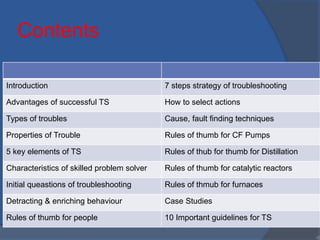
Contents
•2
Introduction 7 steps strategy of troubleshooting
Advantages of successful TS How to select actions
Types of troubles Cause, fault finding techniques
Properties of Trouble Rules of thumb for CF Pumps
5 key elements of TS Rules of thub for thumb for Distillation
Characteristics of skilled problem solver Rules of thumb for catalytic reactors
Initial queastions of troubleshooting Rules of thmub for furnaces
Detracting & enriching behaviour Case Studies
Rules of thumb for people 10 Important guidelines for TS
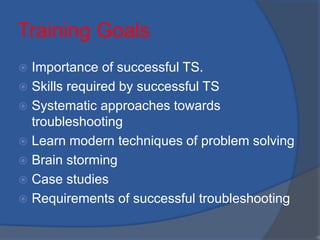
Training Goals
 Importance of successful TS.
 Skills required by successful TS
 Systematic approaches towards
troubleshooting
 Learn modern techniques of problem solving
 Brain storming
 Case studies
 Requirements of successful troubleshooting
•3
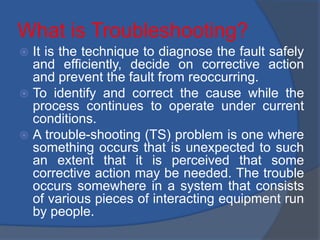
What is Troubleshooting?
 It is the technique to diagnose the fault safely
and efficiently, decide on corrective action
and prevent the fault from reoccurring.
 To identify and correct the cause while the
process continues to operate under current
conditions.
 A trouble-shooting (TS) problem is one where
something occurs that is unexpected to such
an extent that it is perceived that some
corrective action may be needed. The trouble
occurs somewhere in a system that consists
of various pieces of interacting equipment run
by people.
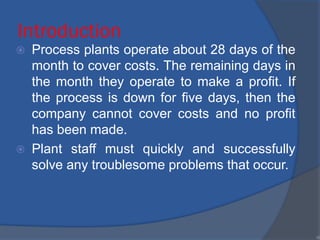
Introduction
 Process plants operate about 28 days of the
month to cover costs. The remaining days in
the month they operate to make a profit. If
the process is down for five days, then the
company cannot cover costs and no profit
has been made.
 Plant staff must quickly and successfully
solve any troublesome problems that occur.
•5
Introduction
 Sometimes the problems occur during
startup; sometimes, just after a
maintenance turn-around; and
sometimes unexpectedly during usual
operation.
 It is the backbone of process industry
the whole profit of and industry depends
on the successful troubleshooting.
 Experience can play a vital role, but only
if used correctly.
•6
Introduction
 Don't assume that same problem
exhibits same set of sypmtoms every
time or ones with the same set of
symptoms have the same root cause.
 Research shows that 5 % problems are
new for the experienced troubleshooter,
so they also need trainings and
refreshing sessions.
Introduction
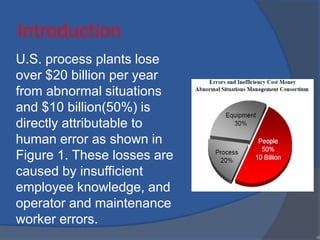
U.S. process plants lose
over $20 billion per year
from abnormal situations
and $10 billion(50%) is
directly attributable to
human error as shown in
Figure 1. These losses are
caused by insufficient
employee knowledge, and
operator and maintenance
worker errors.
•8
Why do we need successful TS?
 Aging and large facilities
 Increased complexity and automation
 Traditional trainings
 Less trained staff
 Weak education background
 Market competition
 Least profit margins
•9
Advantages of Successful TS
 Safe unit operation
 Profitable business
 Brainstorming skills
 Sharping problem solving
 Practical solutions
 Career growth
 Systematic approach development
•10
Safety and troubleshooting
Safety and troubleshooting both have strong
relations with each other.
In short successful troubleshooting guarantee
safety of employees, facility, environment and
community.
•11
Types of Troubles
1. Known means, those troubles which have
established SOPS like power failure,
steam failure etc.
2. Unknown, which may arise any time but
with different symptoms & without any
established SOPS.
3. Problems during startups & shutdowns
4. Problems during commissioning
5. Change” when significant changes and
maintenance carried out.
Categories of Troubles
1. Equipment Specific: Specific equipment
have specific types of troubles e.g
distillation tower, centrifugal pumps,
compressors, catalytic reactors etc.
2. Process Specific: Problems which are
related to process chemistry, specific fluids
or specific products, like Diesel, Naphtha,
Ammonia, Urea etc.
Properties of Troubles
1.Trouble-shooting situations present symptoms.
The symptoms may suggest faults on the plant or
they might be caused by trouble upstream or
downstream. The symptoms may be false and
misleading because they result from faulty
instruments or incorrect sampling. The symptoms
might not reflect the real problem.
2. The time constraints relate to safety and to
economics. Is the symptom indicative of a potential
explosion or leak of toxic gas? Should we initiate
immediate shutdown and emergency procedures?
•14
Properties of Troubles contd.
3. The process configuration constrains a trouble
shooter. The process is fabricated in a given way. The
valves, lines and instruments are in fixed locations.
We may want to measure or sample, but no easy way
is available. We have to work within the existing
process system.
4. Sometimes the cause of the problem is people.
Someone may not have followed the expected
procedure and was unwilling to admit error. Someone
may have opened the bypass valve in the belief that
“the process operates better that way
•15
Five Key Elements Common to
the TS Process
1) Skill in problem solving (Data handling,
decision making, hypothesis synthesis, etc.
2) Knowledge about a range of process
equipment.
3) Knowledge about the properties, safety
and unique characteristics of the specific
chemicals and process conditions where
the trouble occurs.
4) System thinking
5) People skills
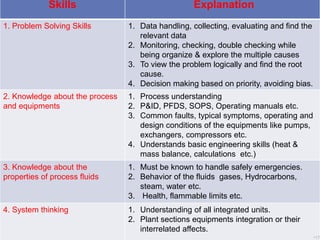
Skills Explanation
1. Problem Solving Skills 1. Data handling, collecting, evaluating and find the
relevant data
2. Monitoring, checking, double checking while
being organize & explore the multiple causes
3. To view the problem logically and find the root
cause.
4. Decision making based on priority, avoiding bias.
2. Knowledge about the process
and equipments
1. Process understanding
2. P&ID, PFDS, SOPS, Operating manuals etc.
3. Common faults, typical symptoms, operating and
design conditions of the equipments like pumps,
exchangers, compressors etc.
4. Understands basic engineering skills (heat &
mass balance, calculations etc.)
3. Knowledge about the
properties of process fluids
1. Must be known to handle safely emergencies.
2. Behavior of the fluids gases, Hydrocarbons,
steam, water etc.
3. Health, flammable limits etc.
4. System thinking 1. Understanding of all integrated units.
2. Plant sections equipments integration or their
interrelated affects.
•17
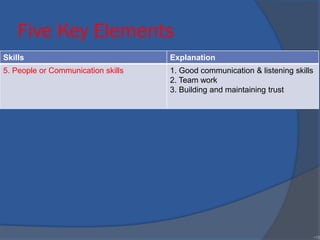
Five Key Elements
Skills Explanation
5. People or Communication skills 1. Good communication & listening skills
2. Team work
3. Building and maintaining trust
•18
Characteristics of skilled problem
solvers
1. Be able to describe thought processes as
solve problems.
2. Must have five key skills as described.
3. Be organized and systematic. An evidence-
based strategy for solving problems.
4. Focus on accuracy instead of speed.
5. Spend time where it benefits you the most.
6. Doesn't panic in situation of emergency.
•19
Characteristics of skilled problem
solvers, contd.
6. Explore the “real” problem by creating a rich
perspective of the problem. Ask many what if
questions. Identify the real problem, by asking a
series of Why?
7. Be flexible and not biased.
8. Keep at least five hypotheses active. Do not
quickly close on one hypothesis. Issues related
to “decision making” are next.
•20
Characteristics of skilled
problem solvers
9. Monitor and reflect. Mentally keep track of
the problem-solving process and monitor
about once per minute. Typical monitoring
thoughts are “Have I finished this stage?
What have I discovered so far? Why am I
doing this: if I calculate this, what will this tell
me? What do I do next? What seems to be
the problem? Is this the real problem? Should
I recheck the criteria?
•21
Characteristics of skilled problem
solvers, contd.
10. Be an effective decision maker. Make
decisions based on criteria that are explicit
and measurable. Reject options that do not meet
the must criteria. Use a rating system to score
the want criteria.
11. Manage time & stress well.
14. Understand your strengths, limitations and
preferred style.
15. Don’t be entrapped in the biased hypothesis.
16. Don’t work by deciding results first.
•22
Characteristics of skilled
problem solvers
17. Be social and have strong communication,
interpersonal skills.
18. Prioritize test procedures; use the simple,
inexpensive ones first before exploring the high-
cost option.
19. Do not guess. Use a systematic TS process.
Find the root cause; do not correct the
symptoms.
•23
Use of Computaional Techniques
 The modern day widespread availability of
desktop and laptop computers, along with
process engineering programs, allows the
chemical engineer to quickly simulate
fractionation or flash calculations.
 In addition, the wide- spread availability of
component databases and equations of
state/equilibrium algorithms enhances the ability
of the computers to do such calculations.
Because of the expansion of the technology, it
may seem that manual calcula- tions are now
obsolete.
Use of Computaional Techniques
 However, there is still a place for manual
calculations. While the computer simulation
programs are very precise, they also depend
on accurate input data and good convergence
routines. In addition, they are generally best
suited for design rather than problem solving.
 Examples are efficiency calculations of
process equipments, feed ratios calculations,
material and energy balances, energy and
utility factors calculations etc.
Review
 What is Troubleshooting?
 Advantages of Troubleshooting skills?
 Types of troubles in process plants?
 Categories of troubles
 Key elements of troubleshooting?
 Characteristics of STS.
 Use of computational techniques
•26
Initial Questions of Troubleshooting
1. What specification is not being met (top,
bottom, side, etc.)? This gives us an idea of
where to look first.
2. Is it a capacity problem? If I’ve just increased
rates again, I may be at the limit of my
internals. (What does my original design
indicate?)
3. Has it occurred before’? If so, what was the
solution then? This may get me back to the
problem faster.
•27
Initial Questions of Troubleshooting
 When was the problem first noticed?
This may elim- inate the need to look at
a large amount of data.
 Have there been any upset conditions?
 Have the laboratory and sampling
conditions have been changed or
persons have been changed?
 Have there been any changes in the
upstream/downstream equipment and
operations.
•28
Laboratory Analysis
 Laboratory analysis must also be
suspected although laboratory personnel
are generally highly motivated, well-trained
conscientious people.
 Laboratory analysis is usually very
accurate-after the sample gets to the lab.
Watch out for changes in sample taking
locations and sampling techniques.
Observe the sampling, then check the
analytical procedure and technique.
•29
Laboratory Analysis
 A good deal of company money and a
lot of time can be spent chasing a
perceived operating problem because of
an improperly calibrated instrument,
 Have the laboratory rerun standard
samples. If necessary have samples
sent out for analysis by an external
laboratory.
•30
Important Note
“The solution to the process problem
isn't found by sitting behind your desk,
but by going into plant & carrying out
tests and evaluating data.”
General Rules of Thumb and
Typical Causes
Gans et al. (1983) suggests that big failures
usually have simple causes, such as a
compressor that will not start. On the other hand,
small failures (or deviations from the norm) often
are caused by complex causes, such as the
product does not quite meet specifications
because of a buildup of contaminants.
•32
Meaning of Rule of Thumb
A broadly accurate guide or principle,
based on practice rather than theory.
Example,
“A useful rule of thumb is that about ten
hours will be needed to analyse each hour
of recorded data"
•33
Common Faults for First Time
Startup
a. 75%Mechanical/electrical failures leaks,
broken agitators, plugged lines, frozen
lines, air leaks in seals.
b. 20%Faulty design or poor fabrication
unexpected corrosion, overloaded
motors, excessive pressure drop in
heat exchangers, flooded towers.
c. 5% Faulty/inadequate initial data often
chosen to be the scapegoat by
inexperienced trouble shooters.
•34
Frequency of failures based on
type of equipment:
 17% heat exchangers.
 16% rotating equipment: pumps,
compressors, mixers.
 14% vessels.
 12% towers.
 10% piping. 8% tanks.
 8% reactors.
 7% furnaces.
•35
Important Note
Problem solving is a social
process
•36
Rules of Thumb for People
 Become aware of your own uniqueness and
personal style, and how you might differ from
the style of others.
 Honor the seven fundamental rights of
individuals, RIGHTS. R, to be Respected; I,
Inform or to have an opinion and express it; G,
have Goals and needs; H, have feelings and
express them; T, trouble and make mistakes
and be forgiven; S, select your response to
others expectations and claim these rights and
honor these in others.
•37
Rules of Thumb for People
 Avoid the four behaviors that destroy
relationships: Contempt, Criticism,
Defensiveness and Withdrawal/ stonewalling.
 Trust is the glue that holds relationships
together. Three elements of trust are
benevolence, integrity and competence.
 Build trust by benevolence through loyalty to
others, especially when they are not present
and by not doing anything that would
embarrass or hurt them.
•38
Rules of Thumb for People
 Destroy trust by the reverse of the Builders of
trust listed above, and by selectively
listening, reading and using material out of
context; not accepting the experience of
others as being valid; making changes that
affect others without consultation; blind-siding
by playing the broken record until you’ve
even tually worn them out or subtly make
changes in the context/issues/wording
gradually so that they are unaware of what is
happening until it is too late.
•39
Rules of Thumb for People
 To improve and grow we need feedback
about performance. Give feedback to
others to encourage and help them; not
for you to get your kicks and put them
down. Focus on five strengths for every
two areas to improve on.
 Be skilled at responding assertively.
•40
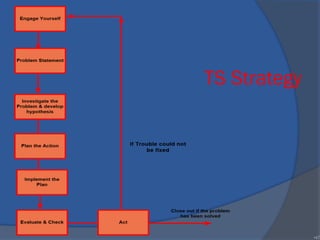
7 Steps Strategy of Troubleshooting
1. Engage yourself
2. Define the problem
3. Explore the problem (Root cause
finding)
4. Plan a solution
5. Do it, carry out the plan.
6. Evaluate and check
7. Act
Engage Yourself or Hook up
 Listen carefully, don’t be panic.
 Motivation, confidence.
 Stress management.
 Yes I want to and I can solve this
problem.
 Decide to go to the location either,
control room, DCS or any other location.
•42
Advantages of Systematic
Approach
 It ensures consistency, as everyone understands
the approach to be used.
 By using data, it helps eliminate bias and
preconceptions, leading to greater objectivity.
 It helps to remove divisions and encourages
collaborative working.
 It eliminates the confusion caused when people use
different problem solving techniques on the same
issue.
 It makes the decision making process easier.
 It provides a justifiable solution.
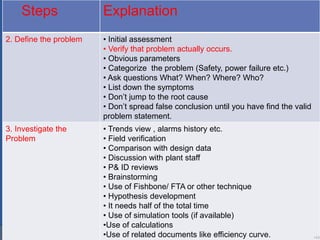
Steps Explanation
2. Define the problem • Initial assessment
• Verify that problem actually occurs.
• Obvious parameters
• Categorize the problem (Safety, power failure etc.)
• Ask questions What? When? Where? Who?
• List down the symptoms
• Don’t jump to the root cause
• Don’t spread false conclusion until you have find the valid
problem statement.
3. Investigate the
Problem
• Trends view , alarms history etc.
• Field verification
• Comparison with design data
• Discussion with plant staff
• P& ID reviews
• Brainstorming
• Use of Fishbone/ FTA or other technique
• Hypothesis development
• It needs half of the total time
• Use of simulation tools (if available)
•Use of calculations
•Use of related documents like efficiency curve. •44
•45
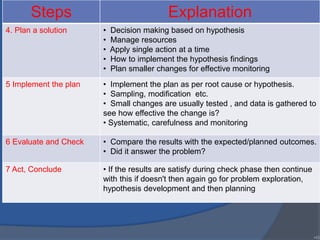
Steps Explanation
4. Plan a solution • Decision making based on hypothesis
• Manage resources
• Apply single action at a time
• How to implement the hypothesis findings
• Plan smaller changes for effective monitoring
5 Implement the plan • Implement the plan as per root cause or hypothesis.
• Sampling, modification etc.
• Small changes are usually tested , and data is gathered to
see how effective the change is?
• Systematic, carefulness and monitoring
6 Evaluate and Check • Compare the results with the expected/planned outcomes.
• Did it answer the problem?
7 Act, Conclude • If the results are satisfy during check phase then continue
with this if doesn't then again go for problem exploration,
hypothesis development and then planning
•Department of Mechanical Engineering, Yuan Ze University
•46
TS Strategy
•47
How to Select an Action
 Safety first! . Keep it simple. Pertinent, easy-to-
gather information should be gathered first.
 The results should provide the accuracy needed.
 Safety and time are critical.
 Select actions that will prove or disprove
hypotheses.
 There is an expense associated with any action or
lack of action.
 Stopping production to “inspect” or “change
equipment” is usually very costly.
•48
How to Select an Action
 Wait for the results from the first action before
we recycle back to the Explore stage and
relook at our hypotheses.
 Prioritize test procedures; use the simple,
inexpensive ones first before exploring the
high-cost option.
•49
Review
 What is the strategy of TS Skills ?
 Advantages of TS strategy ?
•50
TS/Root Cause Analysis Techniques
1. Fishbone Diagram
2. Fault Tree Analysis
3. Mind mapping
4. 5 Whys
5. What if Analysis
•51
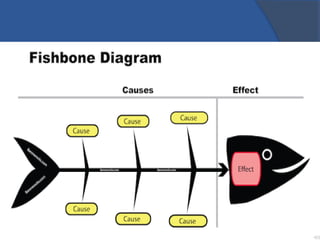
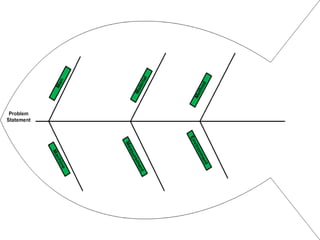
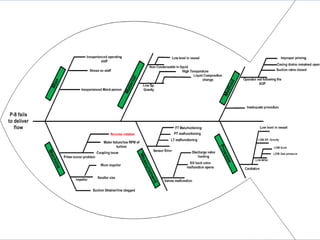
Fishbone Diagram
 Also called Ishikawa or cause and effect
diagram developed in 1968.
 It is used to find root cause, defect or
deficiency in the system, problem
solving and quality defects identification.
 Being used in manufacturing, service,
engineering, marketing etc. industries.
•52
•53
•54
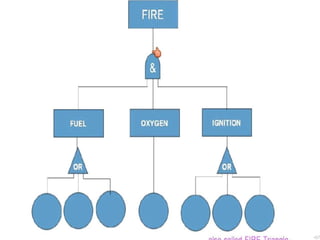
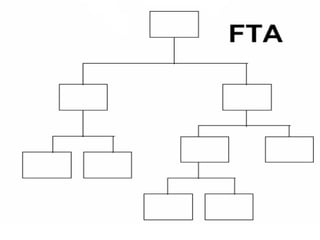
Fault Tree Analysis
 It was originally developed in 1962 at
Bell Laboratories by H.A Watson in US
Air force.
 Mainly used in safety engineering,
reliability engineering, aero space,
nuclear power, chemical and process
etc.
 It is used for find cause of failure, root
cause, defects in the system .
•55
Advantages of FTA
 Display relationships clearly and logically
 Show all causes simultaneously
 Facilitate brainstorming
 Stimulate problem solving
 Easy to draw
 Create visual record of a system
•56
•57
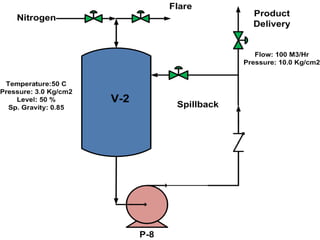
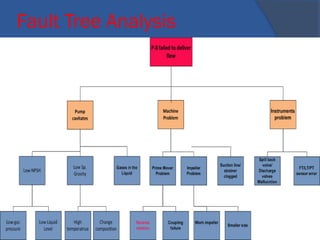
A product pump of was taken in service after
complete overhauling but the pump was not
delivering the required flow. Develop the FSB &
FTA to find the root cause of the problem.
•58
Case Study:
•59
•60
•61
Fault Tree Analysis
•62
5 Whys
The 5 Whys technique was developed and fine-
tuned within the Toyota Motor Corporation as a
critical component of its problem-solving training.
Taiichi Ohno, the architect of the Toyota
Production System in the 1950s, describes the
method in his book Toyota Production System:
Beyond Large-Scale Production as “the basis of
Toyota’s scientific approach . . . by repeating why
five times, the nature of the problem as well as its
solution becomes clear.”
•63
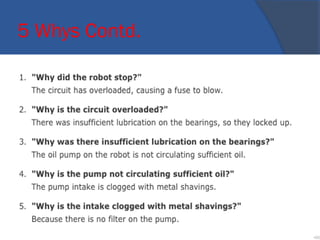
5 Whys Contd.
Ohno encouraged his team to dig into each
problem that arose until they found the root
cause. “Observe the production floor without
preconceptions,” he would advise. “Ask ‘why’
five times about every matter.”
Here’s an example Toyota offers of a potential
5 Whys that might be used at one of their
plants.
•64
•65
5 Whys Contd.
•66
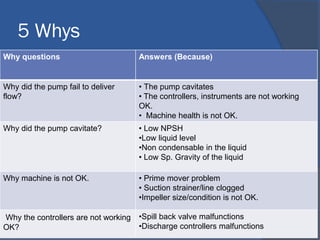
5 Whys
Why questions Answers (Because)
Why did the pump fail to deliver
flow?
• The pump cavitates
• The controllers, instruments are not working
OK.
• Machine health is not OK.
Why did the pump cavitate? • Low NPSH
•Low liquid level
•Non condensable in the liquid
• Low Sp. Gravity of the liquid
Why machine is not OK. • Prime mover problem
• Suction strainer/line clogged
•Impeller size/condition is not OK.
Why the controllers are not working
OK?
•Spill back valve malfunctions
•Discharge controllers malfunctions
•68
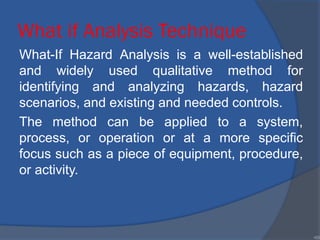
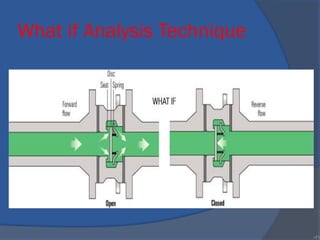
What if Analysis Technique
What-If Hazard Analysis is a well-established
and widely used qualitative method for
identifying and analyzing hazards, hazard
scenarios, and existing and needed controls.
The method can be applied to a system,
process, or operation or at a more specific
focus such as a piece of equipment, procedure,
or activity.
•69
Applications of What if Analysis
 Although originally developed for chemical and
petrochemical process hazard studies, the
What-If Hazard Analysis and its variations have
become widely used in many other industries
including energy, manufacturing, high-tech,
food processing, transportation, and healthcare
to mention a few.
•70
What if Analysis Technique
•71
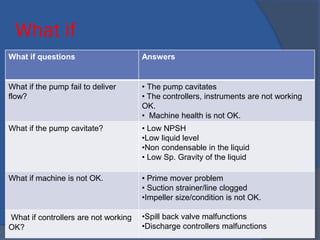
What if
What if questions Answers
What if the pump fail to deliver
flow?
• The pump cavitates
• The controllers, instruments are not working
OK.
• Machine health is not OK.
What if the pump cavitate? • Low NPSH
•Low liquid level
•Non condensable in the liquid
• Low Sp. Gravity of the liquid
What if machine is not OK. • Prime mover problem
• Suction strainer/line clogged
•Impeller size/condition is not OK.
What if controllers are not working
OK?
•Spill back valve malfunctions
•Discharge controllers malfunctions
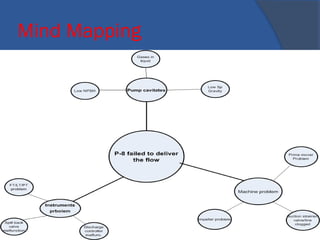
Mind Mapping
A mind map is a diagram used to visually
organize information. A mind map is
hierarchical and shows relationships among
pieces of the whole.[1] It is often created
around a single concept, drawn as an image
in the center of a blank page, to which
associated representations of ideas such as
images, words and parts of words are added.
Major ideas are connected directly to the
central concept, and other ideas branch out
from those major ideas.
•73
•74
Mind Mapping
•75
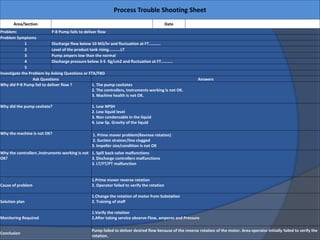
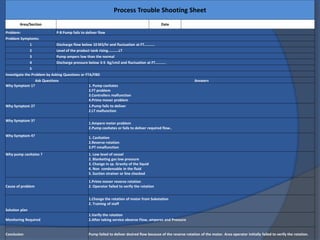
Process Trouble Shooting Sheet
Area/Section Date
Problem: P-8 Pump fails to deliver flow
Problem Symptoms
1 Discharge flow below 10 M3/hr and fluctuation at FT………..
2 Level of the product tank rising………..LT
3 Pump ampers low than the normal
4 Discharge pressure below 3-5 Kg/cm2 and fluctuation at FT………..
5
Investigate the Problem by Asking Questions or FTA/FBD
Ask Questions Answers
Why did P-8 Pump fail to deliver flow ? 1. The pump cavitates
2. The controllers, instruments working is not OK.
3. Machine health is not OK.
Why did the pump cavitate? 1. Low NPSH
2. Low liquid level
3. Non condensable in the liquid
4. Low Sp. Gravity of the liquid
Why the machine is not OK? 1. Prime mover problem(Revrese rotation)
2. Suction strainer/line clogged
3. Impeller size/condition is not OK
Why the controllers ,Instruments working is not
OK?
1. Spill back valve malfunctions
3. Discharge controllers malfunctions
3. LT/FT/PT malfunction
Cause of problem
1.Prime mover reverse rotation
2. Operator failed to verify the rotation
Solution plan
1.Change the rotation of motor from Substation
2. Training of staff
Monitoring Required
1.Varify the rotation
2.After taking service observe Flow, amperes and Pressure
Conclusion
Pump failed to deliver desired flow because of the reverse rotation of the motor. Area operator initially failed to verify the
rotation.
Process Trouble Shooting Sheet
Area/Section Date
Problem: P-8 Pump fails to deliver flow
Problem Symptoms:
1 Discharge flow below 10 M3/hr and fluctuation at FT………..
2 Level of the product tank rising………..LT
3 Pump ampers low than the normal
4 Discharge pressure below 3-5 Kg/cm2 and fluctuation at FT………..
5
Investigate the Problem by Asking Questions or FTA/FBD
Ask Questions Answers
Why Symptom 1? 1. Pump cavitates
2.FT problem
3.Controllers malfunction
4.Prime mover problem
Why Symptom 2? 1.Pump fails to deliver
2.LT malfunction
Why Symptom 3?
1.Ampere meter problem
2.Pump cavitates or fails to deliver required flow..
Why Symptom 4? 1. Cavitation
2.Reverse rotation
3.PT nmalfunction
Why pump cavitates ? 1. Low level of vessel
2. Blanketing gas low pressure
3. Change in sp. Gravity of the liquid
4. Non condensable in the fluid
5. Suction strainer or line chocked
Cause of problem
1.Prime mover reverse rotation
2. Operator failed to verify the rotation
Solution plan
1.Change the rotation of motor from Substation
2. Training of staff
Monitoring Required
1.Varify the rotation
2.After taking service obverse Flow, amperes and Pressure
Conclusion Pump failed to deliver desired flow because of the reverse rotation of the motor. Area operator initially failed to verify the rotation.
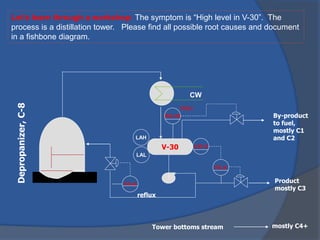
V-30
CW
Depropanizer,C-8
By-product
to fuel,
mostly C1
and C2
Product
mostly C3
Tower bottoms stream mostly C4+
reflux
FC-4
FC-4
LIC-3
PC-10
Let’s learn through a workshop: The symptom is “High level in V-30”. The
process is a distillation tower. Please find all possible root causes and document
in a fishbone diagram.
LAH
LAL
PAH
High
level in
V-30
???
???
???
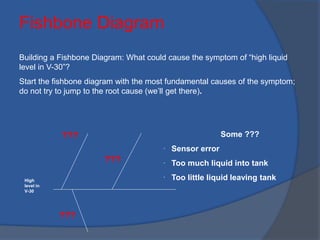
Building a Fishbone Diagram: What could cause the symptom of “high liquid
level in V-30”?
Start the fishbone diagram with the most fundamental causes of the symptom;
do not try to jump to the root cause (we’ll get there).
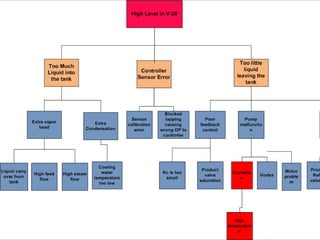
Fishbone Diagram
Some ???
 Sensor error
 Too much liquid into tank
 Too little liquid leaving tank
High
level in
V-30
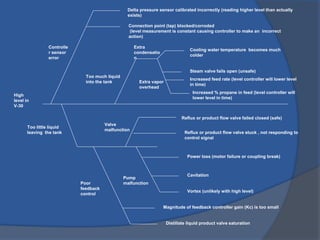
Controlle
r sensor
error
Delta pressure sensor calibrated incorrectly (reading higher level than actually
exists)
Connection point (tap) blocked/corroded
(level measurement is constant causing controller to make an incorrect
action)
Too much liquid
into the tank
Steam valve fails open (unsafe)
Too little liquid
leaving the tank
Poor
feedback
control
Magnitude of feedback controller gain (Kc) is too small
Valve
malfunction
Reflux or product flow valve failed closed (safe)
Pump
malfunction
Vortex (unlikely with high level)
Cavitation
Power loss (motor failure or coupling break)
Increased feed rate (level controller will lower level
in time)
Increased % propane in feed (level controller will
lower level in time)
Distillate liquid product valve saturation
Reflux or product flow valve stuck , not responding to
control signal
Extra vapor
overhead
Extra
condensatio
n
Cooling water temperature becomes much
colder
•Department of Mechanical Engineering, Yuan Ze University
•81
Review
 What are FBD, FTA, 5Whys, What if,
Mind mapping techniques?
 Which one is easy to use?
1. Rules of thumb for
Centrifugal Pumps TS
•83
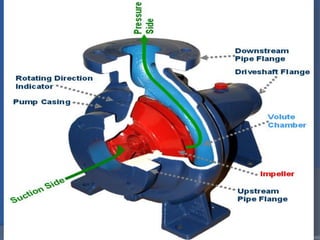
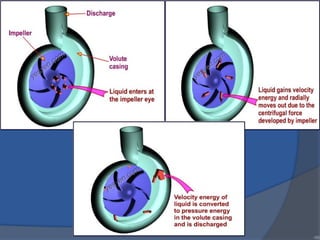
What are Centrifugal Pumps?
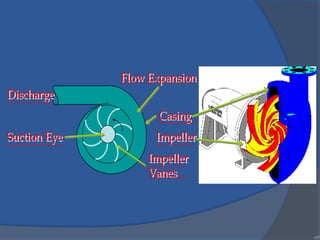
Centrifugal pumps are used to transport fluids by
the conversion of rotational kinetic energy to the
hydrodynamic energy of the fluid flow. The
rotational energy typically comes from an engine
or electric motor. The fluid enters the pump
impeller along or near to the rotating axis and is
accelerated by the impeller, flowing radially
outward into a diffuser or volute chamber
(casing), from where it exits.
•84
•85
•86
•87
Important Terms
 Vapor pressure is the pressure absolute
at which a liquid, at a given temperature,
starts to boil or flash to a gas.
 Cavitaion: When a liquid boils in the
suction line or suction nozzle of a pump,
it is said to be “flashing” or “cavitating”
(forming cavities of gas in the liquid).
This occurs when the pressure acting on
the liquid is below the vapor pressure of
the liquid.
•88
Important Terms
 Net Positive Suction Head is the difference
between suction pressure and vapor
pressure. In pump design and application
jargon, NPSHA is the net positive suction
head available to the pump, and NPSHR is
the net positive suction head required by
the pump.
 NPSHA = PB – VP ± Gr + hv
•89
Minimum Flow
Most pumps need minimum flow protection to
protect pump’s horsepower turns into heat, which
can vaporize them against shutoff. At shutoff,
practically all of a the liquid and damage the pump.
Such minimum flow protection is particularly
important for boiler feed- water pumps that handle
water near its boiling point and are multistaged for
high head. The minimum flow is a relatively
constant flow going from dis- charge to suction. In
the case of boiler feedwater pumps, the minimum
flow is preferably piped back to the deaerator.
•90
Flow rate with which liquid is moved or
pushed by the pump to the desired point in
the process. It is commonly measured in
either gallons per minute (gpm) or cubic
meters per hour (m3/hr). The capacity
depends on a number of factors like process
liquid characteristics i.e. density, viscosity,
Size of the pump and its inlet and outlet
sections, Impeller size ,RPM, Size and shape
of cavities between the vanes,
•91
Capacity
Centrifugal Pumps TS Rules
of Thumb
Symptoms Control measures
No liquid
delivery
instrument error/not primed/ cavitation/supply tank
empty
Liquid
flowrate low
instrument error/ cavitation/ non-condensibles in
liquid/ inlet strainer clogged.
Intermittent
operation
[cavitation]*/ not primed/ non-condensibles in
liquid
Discharge
pressure low
instrument error/ noncondensibles in liquid/ speed
too low/ wrong direction of rotation
Power
demand
excessive
Speed too high/ density liquid high/ required
system head lower than expected/ viscosity high
•92
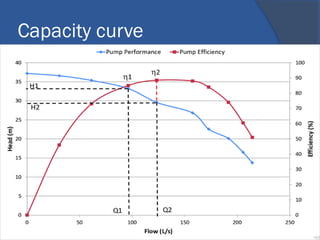
Capacity curve
•93
Distillation
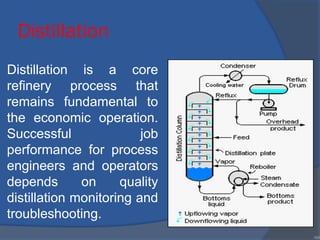
Distillation is a core
refinery process that
remains fundamental to
the economic operation.
Successful job
performance for process
engineers and operators
depends on quality
distillation monitoring and
troubleshooting.
•94
Distillation
Distillation is simply the separation of
molecules (or components) based on
their relative volatility. Distillation
separates components based on their
relative boiling points. Since chemicals
or components such as gasoline, jet, and
diesel boil at different temperatures
distillation columns can separate mixed
feed streams into distinct product
streams.
•95
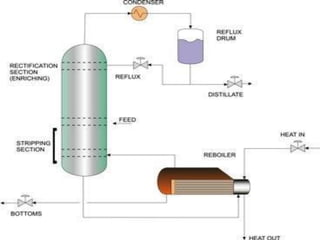
Sections of Distillation Tower
 Stripping Section: Below feed point
 Rectifying Section: Above feed point
 Volatility: Ease of evaporation of any
liquid, lighter components with low BP
have more volatility than heavier.
•96
•97
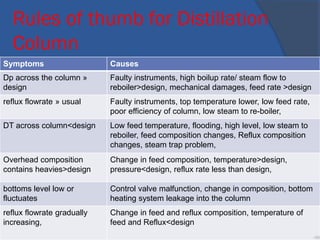
Rules of thumb for Distillation
Column
Symptoms Causes
Dp across the column »
design
Faulty instruments, high boilup rate/ steam flow to
reboiler>design, mechanical damages, feed rate >design
reflux flowrate » usual Faulty instruments, top temperature lower, low feed rate,
poor efficiency of column, low steam to re-boiler,
DT across column<design Low feed temperature, flooding, high level, low steam to
reboiler, feed composition changes, Reflux composition
changes, steam trap problem,
Overhead composition
contains heavies>design
Change in feed composition, temperature>design,
pressure<design, reflux rate less than design,
bottoms level low or
fluctuates
Control valve malfunction, change in composition, bottom
heating system leakage into the column
reflux flowrate gradually
increasing,
Change in feed and reflux composition, temperature of
feed and Reflux<design
•98
Rules of thumb for Distillation
Column
Symptoms Causes
bottoms pressure>design High level in column, instrument faults, low
boiling rate of liquid
DT across column<design Feed and reflux composition change,
leakage from feed and product
exchangers, steam to reboiler stops or
restricted
Dp across the column<design instrument fault/ [low boilup rate], dry
trays/ low feedrate/ feed temperature too
high.
Feed flowrate<design instrument fault/ pump problems, filter
plugged/ column pressure>design/ feed
location higher than design.
Temperature of feed>design instrument fault/ preheater fouled/ feed
flowrate low/ heating medium
temperature<design
Temperature of bottoms<design instrument fault/ [low boilup]* loss of•99
Rules of thumb for Distillation
Column
Symptoms Causes
Temperature of
bottoms>design
Instrument fault/ [column pressure>design]*/ high boilup/
overhead condenser vent plugged/ insufficient condensing
Temperature at
top>design
Instrument fault/ bottom temperature>design/ reflux too low/
distillate feed forward too high/ column pressure high/ [flooding
Temperature at
top>design and
overhead composition
contaminated with too
many heavies”
vapor bypassing caused by excessive vapor velocities (high
boilup) or not enough liquid on tray or packing, or downcomers
not sealed, or sieve holes corroded larger than design and tray
weeps/ reflux too low/ feed contains excessive heavies
Temperature at
top<design
instrument fault/ control temperature too low/ [low boilup]
•100
Rules of thumb for Distillation
Column
All temperatures falling
simultaneously
low boilup pressure rising
Overhead off spec Poor tray or packing efficiency/ [maldistribution]*/ not
enough trays or packing/ loss of efficiency/ high
concentration of non-condensibles/ missing tray/ collapsed
tray/ liquid entrainment/ liquid bypass and weeping/ liquid
or gas maldistribution
Overhead contaminated
with heavies and excessive
reflux rate and high boilup
rate
inadequate gas-liquid contact/ insufficient liquid
disengagement from vapor/ presence of non-condensibles
in feed. “Overhead and bottoms off spec and decreases
across column in both DT and Dp
Overhead and bottoms off
spec
Bypass open on reflux control valve, poor stripping, low
flow of stripping agent
Overhead and bottoms off
spec, decrease in DT
across column and
Poor tray or packing efficiency/ [maldistribution]*/ not
enough trays or packing/ loss of efficiency/ high
concentration of non-condensibles/ missing tray/ collapsed•101
E-1
Stripping Steam
F:5 T/Hr, P:3.5, T:155 C
Stripper Feed
T:160
Unchanged
Stripper Feed
Current: T: 170
Previous: 190
Stripper Feed
Current: T: 168
Previous: 188
Reflux:
Current:3, Prev.: 6
Current: T: 130, Press. 2
Prev. 135, 2
Current: 36
Prev: 45
Level: 60%
Current: 155
Previous: 170
Current: F: 10
Prev: 2
V-1
V-2
Feed Composition:
Diesel, Naphtha, C1~C4.
Cooling Water
Rules of Thumb for Control
System
•103
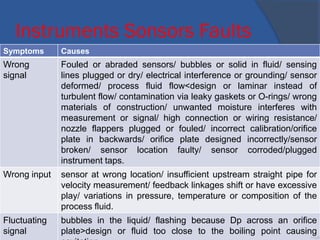
Instruments Sonsors Faults
Symptoms Causes
Wrong
signal
Fouled or abraded sensors/ bubbles or solid in fluid/ sensing
lines plugged or dry/ electrical interference or grounding/ sensor
deformed/ process fluid flow<design or laminar instead of
turbulent flow/ contamination via leaky gaskets or O-rings/ wrong
materials of construction/ unwanted moisture interferes with
measurement or signal/ high connection or wiring resistance/
nozzle flappers plugged or fouled/ incorrect calibration/orifice
plate in backwards/ orifice plate designed incorrectly/sensor
broken/ sensor location faulty/ sensor corroded/plugged
instrument taps.
Wrong input sensor at wrong location/ insufficient upstream straight pipe for
velocity measurement/ feedback linkages shift or have excessive
play/ variations in pressure, temperature or composition of the
process fluid.
Fluctuating
signal
bubbles in the liquid/ flashing because Dp across an orifice
plate>design or fluid too close to the boiling point causing
•104
Control Valve Faults
Symptoms Causes
Leaks Erosion/ corrosion/ gaskets, packing or bolts at temperatures, pressures
and fluids that differ from design
Can’t control
low flowrate
miscalibration/ buildup of rust, scale, dirt/[faulty design]*.
Can’t stop
flow
miscalibration/ damaged seat or plug
Excessive
flow
miscalibration/ damaged seat or plug
Slow
response
Restricted air to actuator/ dirty air filters. “Noise”: cavitation/
compressible flow
Poor valve
action
Dirt in instrument air/ sticky valve stem/ packing gland too tight/ faulty
valve positioner
Cycling Stiction. [Faulty design]*: valve stem at design flowrate is not at
midrange. [Stiction]* is the sticking and friction related to valve
movement and measured as the difference between the driving values
needed to overcome static friction upscale and downscale. Likely cause
•105
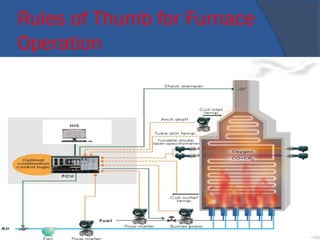
Rules of Thumb for Furnace
Operation
•106
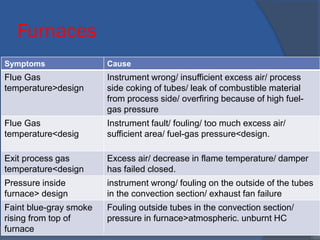
Furnaces
Symptoms Cause
Flue Gas
temperature>design
Instrument wrong/ insufficient excess air/ process
side coking of tubes/ leak of combustible material
from process side/ overfiring because of high fuel-
gas pressure
Flue Gas
temperature<desig
Instrument fault/ fouling/ too much excess air/
sufficient area/ fuel-gas pressure<design.
Exit process gas
temperature<design
Excess air/ decrease in flame temperature/ damper
has failed closed.
Pressure inside
furnace> design
instrument wrong/ fouling on the outside of the tubes
in the convection section/ exhaust fan failure
Faint blue-gray smoke
rising from top of
furnace
Fouling outside tubes in the convection section/
pressure in furnace>atmospheric. unburnt HC
•107
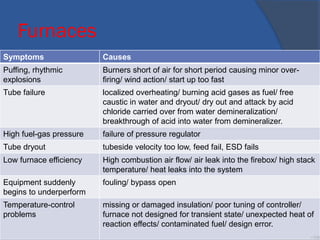
Furnaces
Symptoms Causes
Puffing, rhythmic
explosions
Burners short of air for short period causing minor over-
firing/ wind action/ start up too fast
Tube failure localized overheating/ burning acid gases as fuel/ free
caustic in water and dryout/ dry out and attack by acid
chloride carried over from water demineralization/
breakthrough of acid into water from demineralizer.
High fuel-gas pressure failure of pressure regulator
Tube dryout tubeside velocity too low, feed fail, ESD fails
Low furnace efficiency High combustion air flow/ air leak into the firebox/ high stack
temperature/ heat leaks into the system
Equipment suddenly
begins to underperform
fouling/ bypass open
Temperature-control
problems
missing or damaged insulation/ poor tuning of controller/
furnace not designed for transient state/ unexpected heat of
reaction effects/ contaminated fuel/ design error.
•108
Case Study
Stack Temperature >design
•109
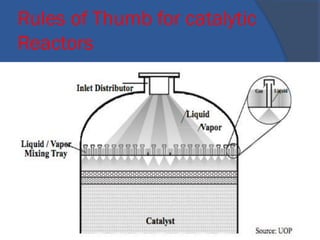
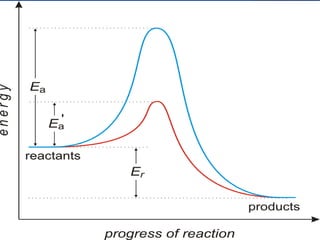
Rules of Thumb for catalytic
Reactors
•110
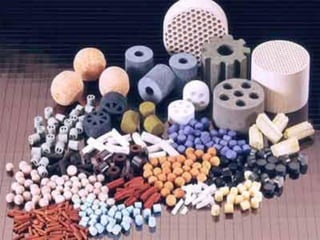
Catalysis
Catalysis is process containing change in the
rate of a chemical reaction due to the use of
catalyst. A catalyst is a substance, or a
mixture of substances, which increases the
rate of chemical reaction by providing an
alternative, quicker reaction path, without
modifying the thermodynamic factors. The catalyst
remains, in general, unaltered at the end of the
catalytic process. industries.
•111
•112
•Department of Mechanical Engineering, Yuan Ze University
•113
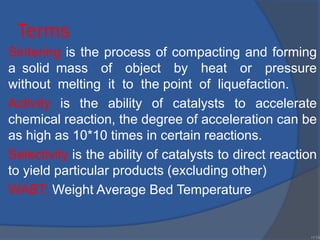
Terms
Sintering is the process of compacting and forming
a solid mass of object by heat or pressure
without melting it to the point of liquefaction.
Activity is the ability of catalysts to accelerate
chemical reaction, the degree of acceleration can be
as high as 10*10 times in certain reactions.
Selectivity is the ability of catalysts to direct reaction
to yield particular products (excluding other)
WABT: Weight Average Bed Temperature
•114
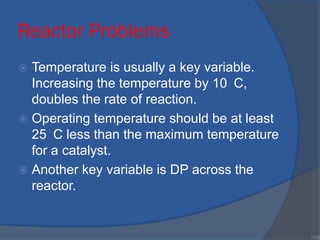
Reactor Problems
 Temperature is usually a key variable.
Increasing the temperature by 10 C,
doubles the rate of reaction.
 Operating temperature should be at least
25 C less than the maximum temperature
for a catalyst.
 Another key variable is DP across the
reactor.
•115
Rules of Thumb for catalytic
ReactorsSymptoms Causes
DP
higher>design
catalyst degradation/ instrument error/ high gas flow/ sudden coking/
problem left in from construction or revamp, internal damage
Rapid decline in
conversion
unfavorable shift in equilibrium at operating temperature, for
exothermic reactions/ [sintering]*/ [agglomeration], poisons in feed,
temperature runaway
Gradual decline
in conversion
Sample error/ analysis error/ temperature sensor error/ [catalyst
activity lost]*/ [maldistribution]*/ [unacceptable temperature profiles]*/
[inadequate heat transfer]*/ wrong locations of feed, discharge or
recycle lines/ faulty design of feed and discharge ports/ wrong
internal baffles and internals/ faulty bed-voidage profiles
Temperature
runaways
Change in feed composition, furnace controlled firing, uncontrolled
reactions. feed temperature too high/ [temperature hot spot]*/ cooling
water too hot, failure of cooling media
Local high
temperature/hot
spot
[misdistribution of gas flow]*/ instrument error/ extraneous feed
component that reacts exothermically
•116
Catalytic Reactors
Local low temperature
within the bed
[maldistribution of gas flow]*/ instrument error/ extraneous
feed component that reacts endothermically
Exit gas temperature too
high
instrument error/ control-system malfunction/ fouled reactor
coolant tubes.
Temperature varies axially
across bed
[maldistribution}
Symptom: Soon after startup, temperature of tubewall near top>usual and increasing
and perhaps Dp increase and less conversion than expected or operating
temperatures>usual to obtain expected conversion
Cause: inadequate catalyst regeneration/ contamination in feed; for steam reforming
sulfur concentration>specifications/ wrong feed composition; for steam reforming:
steam/CH4<7 to 10
•117
Startup after Catalyst
Replacement/Regeneration
Symptoms Causes
conversions<standard Reduction faulty, bad batch of catalyst/
preconditioning of catalyst faulty/ temperature and
pressures incorrectly set/ instrument error for
pressure or temperature
poor selectivity bad batch of catalyst/ preconditioning of catalyst
faulty/ temperature and pressures incorrectly set/
instrument error for pressure or temperature
Dp<expected and
conversion<standard
maldistribution and axial variation in temperature/
larger size catalyst.
conversion<standard and Dp
increasing
maldistribution and axial temperatures different]*/
feed precursors present for polymerization or coking
Dp for this batch of
catalyst>previous batch
catalyst fines produced during loading/ poor loading
conversion<specifications per
unit mass of catalyst and more
side reactions
maldistribution/ faulty inlet distributor/ faulty exit
distributor
•118
Startup after Catalyst
Replacement/Regeneration
increased side reactions and
conversion<specification
Catalyst loading not the same in all tubes.
Active species volatized [regeneration faulty]*/ faulty catalyst design for typical
reaction temperature/ [hot spots]*.
Agglomeration of packing or
catalyst particles
[temperature hot spots
Carbon buildup inadequate regeneration]*/ [excessive carbon formed]*.
[Catalyst selectivity changes]*: [poisoned catalyst]*/
feed contaminants/ change in feed/ change in
temperature settings
Catalyst activity lost carbon buildup]*/[regeneration faulty]*/ [sintered
catalyst]*/ excessive regeneration temperature/
[poisoned catalyst]*/ [loss of surface area]*/
[agglomeration]*/ [active species volatized
Excessive carbon formed operating intensity above usual/ feed changes/
temperature hot spots. •119
Rules of Thumb for reactors
Symptoms Causes
Dust or corrosive
products from
upstream processes
in-line filters not working or not installed/ dust in the atmosphere
brought in with air/ air filters not working or not installed.
Loss of surface area [sintered catalyst]*/ [carbon buildup]*/ [agglomeration
Maldistribution faulty flow-distributor design/ plugging of flow distributors with fine
solids, sticky byproducts or trace polymers/ [sintered catalyst
particles]*/ [agglomeration of packing or catalyst particles]*/ fluid
feed velocity too high/ faulty loading of catalyst bed/ incorrect flow
collector at outlet.
Poisoned catalyst Poisons in feed/ flowrate of “counterpoison” insufficient/ poison
formed from unwanted reactions.
Reactor instability Control fault/ poor controller tuning/ wrong type of control/
insufficient heat transfer area/ feed temperature exceeds
threshold/ coolant temperature exceeds threshold/ coolant
flowrate<threshold/ tube diameter too large
•120
Case Study
•121
High Differential pressure of Diesel
Hydroteator reactor
Case Study
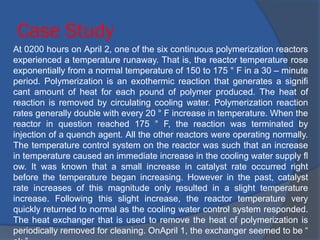
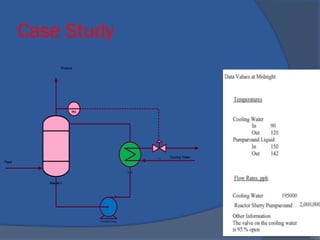
At 0200 hours on April 2, one of the six continuous polymerization reactors
experienced a temperature runaway. That is, the reactor temperature rose
exponentially from a normal temperature of 150 to 175 ° F in a 30 – minute
period. Polymerization is an exothermic reaction that generates a signifi
cant amount of heat for each pound of polymer produced. The heat of
reaction is removed by circulating cooling water. Polymerization reaction
rates generally double with every 20 ° F increase in temperature. When the
reactor in question reached 175 ° F, the reaction was terminated by
injection of a quench agent. All the other reactors were operating normally.
The temperature control system on the reactor was such that an increase
in temperature caused an immediate increase in the cooling water supply fl
ow. It was known that a small increase in catalyst rate occurred right
before the temperature began increasing. However in the past, catalyst
rate increases of this magnitude only resulted in a slight temperature
increase. Following this slight increase, the reactor temperature very
quickly returned to normal as the cooling water control system responded.
The heat exchanger that is used to remove the heat of polymerization is
periodically removed for cleaning. OnApril 1, the exchanger seemed to be “
Case Study
•123
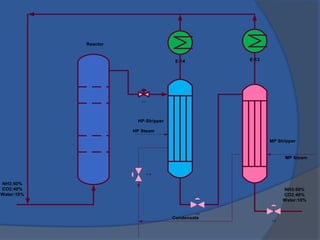
NH3:50%
CO2:40%
Water:10%
E-13E-14
NH3:50%
CO2:40%
Water:10%
Reactor
HP-Stripper
MP Stripper
V-7
MP Steam
Condensate
HP Steam
V-8
V-9
V-10
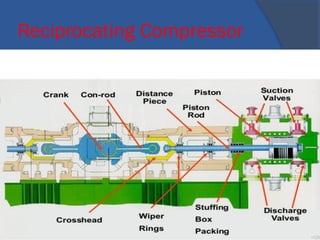
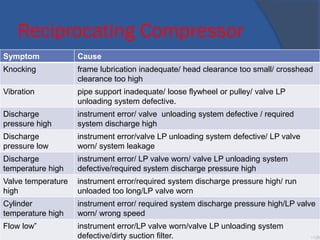
Reciprocating Compressor
•125
Reciprocating Compressor
Symptom Cause
Knocking frame lubrication inadequate/ head clearance too small/ crosshead
clearance too high
Vibration pipe support inadequate/ loose flywheel or pulley/ valve LP
unloading system defective.
Discharge
pressure high
instrument error/ valve unloading system defective / required
system discharge high
Discharge
pressure low
instrument error/valve LP unloading system defective/ LP valve
worn/ system leakage
Discharge
temperature high
instrument error/ LP valve worn/ valve LP unloading system
defective/required system discharge pressure high
Valve temperature
high
instrument error/required system discharge pressure high/ run
unloaded too long/LP valve worn
Cylinder
temperature high
instrument error/ required system discharge pressure high/LP valve
worn/ wrong speed
Flow low” instrument error/LP valve worn/valve LP unloading system
defective/dirty suction filter. •126
10 ImportantTroubleshooting
Guidelines
Ruth Sands, former CE author and mass
transfer consultant at DuPont Engineering
Research & Technology, gave troubleshooting
tips in the AIChE Spring meeting in Chicago,
2011.
The general most likely causes for failure differ
depending upon whether this is the startup of a
new process or startup after a shutdown and
maintenance or fault that develops for an on-
going, operating process.
•127
10 Important Guidelines
1. Safety first: Assess the SHE issues and implement
a temporary solution to give time for
troubleshooting. Rushing can lead to safety
hazards.
2. Good troubleshooters understand the basics well.
Use calculations, models, experiments and so on
to check your theories.
3. Know what to expect before you start. What
temperature, pressure, flow profile should you
expect? And, last, but not least, “Don’t ever be
afraid to do a simple material and energy balance.
It will tell you a million things.”
•128
10 Important Guidelines
Contd.
4. Do not overlook the obvious. However,
correcting obvious problems does not
necessarily solve the whole issue. Be patient.
5. Good troubleshooters have a willingness to
accept the data rather than their own theories
6. Think of ways to challenge the mental
model. Is the process at steady state?
Visualize what is happening.
•129
7.Testing should begin with the easiest to
prove or disprove and not be based on how
likely the theory is. Do all practical tests
before making a permanent change.
8.Believe your instruments, unless you have a
good reason not to. Don’t start by
questioning your instruments. What
scenario could cause these data to be true?
Instruments report information as they see
it.
•130
10 Important Guidelines Contd.
9.Use people as sources of information.
Listen to all sources. Use a learning
attitude. Implying that someone screwed up
is a sure way to get no cooperation.
10.Learn through examples. Incident
investigations give ideas for modes of
failure. A person that learns from others’
failures is wise.
•131
10 Important Guidelines Contd.
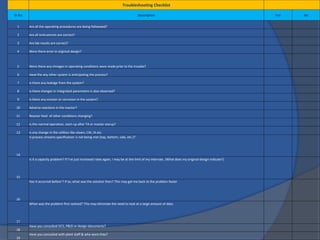
Troubleshooting Checklist
Sr No Description Yes No
1 Are all the operating procedures are being folloewed?
2 Are all isntruemnts are correct?
3 Are lab results are correct?
4 Were there error in orgincal design?
5 Were there any chnages in operating conditions were made prior to the trouble?
6 Have the any other system is anticipating the process?
7 Is there any leakage from the system?
8 Is there changes in integrated parameters is also observed?
9 Is there any erosion or corrosion in the system?
10 Adverse reactions in the reactor?
11 Reactor feed of other conditions changing?
12 Is this normal operation, start-up after TA or master starup?
13 Is any change in the utilities like steam, CW, IA etc.
14
Is process streams specification is not being met (top, bottom, side, etc.)?
15
Is it a capacity problem? If I’ve just increased rates again, I may be at the limit of my internals. (What does my original design indicate?)
16
Has it occurred before’? If so, what was the solution then? This may get me back to the problem faster.
17
When was the problem first noticed? This may eliminate the need to look at a large amount of data.
18
Have you consulted DCS, P&ID or design documents?
19
Have you consulted with plant staff & who were they?
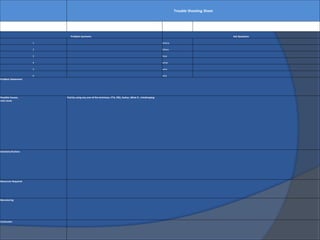
Trouble Shooting Sheet
Area/Section Date
Problem Symtoms Ask Questions
1 where
2 When
3 how
4 what
5 who
6 why
Problem Statement:
Possible Causes,
root cause
Find by using any one of the techniues, FTA, FBD, 5whys, What if , mindmaping
Solutions/Actions
Resources Required
Monotoring
Conlcusion
The End
•134

Process Troubleshooting

  • 1.
    Process Troubleshooting By: NasirHussain Process Operations Enigneer PARCO Oil Refinery
  • 2.
    Contents •2 Introduction 7 stepsstrategy of troubleshooting Advantages of successful TS How to select actions Types of troubles Cause, fault finding techniques Properties of Trouble Rules of thumb for CF Pumps 5 key elements of TS Rules of thub for thumb for Distillation Characteristics of skilled problem solver Rules of thumb for catalytic reactors Initial queastions of troubleshooting Rules of thmub for furnaces Detracting & enriching behaviour Case Studies Rules of thumb for people 10 Important guidelines for TS
  • 3.
    Training Goals  Importanceof successful TS.  Skills required by successful TS  Systematic approaches towards troubleshooting  Learn modern techniques of problem solving  Brain storming  Case studies  Requirements of successful troubleshooting •3
  • 4.
    What is Troubleshooting? It is the technique to diagnose the fault safely and efficiently, decide on corrective action and prevent the fault from reoccurring.  To identify and correct the cause while the process continues to operate under current conditions.  A trouble-shooting (TS) problem is one where something occurs that is unexpected to such an extent that it is perceived that some corrective action may be needed. The trouble occurs somewhere in a system that consists of various pieces of interacting equipment run by people.
  • 5.
    Introduction  Process plantsoperate about 28 days of the month to cover costs. The remaining days in the month they operate to make a profit. If the process is down for five days, then the company cannot cover costs and no profit has been made.  Plant staff must quickly and successfully solve any troublesome problems that occur. •5
  • 6.
    Introduction  Sometimes theproblems occur during startup; sometimes, just after a maintenance turn-around; and sometimes unexpectedly during usual operation.  It is the backbone of process industry the whole profit of and industry depends on the successful troubleshooting.  Experience can play a vital role, but only if used correctly. •6
  • 7.
    Introduction  Don't assumethat same problem exhibits same set of sypmtoms every time or ones with the same set of symptoms have the same root cause.  Research shows that 5 % problems are new for the experienced troubleshooter, so they also need trainings and refreshing sessions.
  • 8.
    Introduction U.S. process plantslose over $20 billion per year from abnormal situations and $10 billion(50%) is directly attributable to human error as shown in Figure 1. These losses are caused by insufficient employee knowledge, and operator and maintenance worker errors. •8
  • 9.
    Why do weneed successful TS?  Aging and large facilities  Increased complexity and automation  Traditional trainings  Less trained staff  Weak education background  Market competition  Least profit margins •9
  • 10.
    Advantages of SuccessfulTS  Safe unit operation  Profitable business  Brainstorming skills  Sharping problem solving  Practical solutions  Career growth  Systematic approach development •10
  • 11.
    Safety and troubleshooting Safetyand troubleshooting both have strong relations with each other. In short successful troubleshooting guarantee safety of employees, facility, environment and community. •11
  • 12.
    Types of Troubles 1.Known means, those troubles which have established SOPS like power failure, steam failure etc. 2. Unknown, which may arise any time but with different symptoms & without any established SOPS. 3. Problems during startups & shutdowns 4. Problems during commissioning 5. Change” when significant changes and maintenance carried out.
  • 13.
    Categories of Troubles 1.Equipment Specific: Specific equipment have specific types of troubles e.g distillation tower, centrifugal pumps, compressors, catalytic reactors etc. 2. Process Specific: Problems which are related to process chemistry, specific fluids or specific products, like Diesel, Naphtha, Ammonia, Urea etc.
  • 14.
    Properties of Troubles 1.Trouble-shootingsituations present symptoms. The symptoms may suggest faults on the plant or they might be caused by trouble upstream or downstream. The symptoms may be false and misleading because they result from faulty instruments or incorrect sampling. The symptoms might not reflect the real problem. 2. The time constraints relate to safety and to economics. Is the symptom indicative of a potential explosion or leak of toxic gas? Should we initiate immediate shutdown and emergency procedures? •14
  • 15.
    Properties of Troublescontd. 3. The process configuration constrains a trouble shooter. The process is fabricated in a given way. The valves, lines and instruments are in fixed locations. We may want to measure or sample, but no easy way is available. We have to work within the existing process system. 4. Sometimes the cause of the problem is people. Someone may not have followed the expected procedure and was unwilling to admit error. Someone may have opened the bypass valve in the belief that “the process operates better that way •15
  • 16.
    Five Key ElementsCommon to the TS Process 1) Skill in problem solving (Data handling, decision making, hypothesis synthesis, etc. 2) Knowledge about a range of process equipment. 3) Knowledge about the properties, safety and unique characteristics of the specific chemicals and process conditions where the trouble occurs. 4) System thinking 5) People skills
  • 17.
    Skills Explanation 1. ProblemSolving Skills 1. Data handling, collecting, evaluating and find the relevant data 2. Monitoring, checking, double checking while being organize & explore the multiple causes 3. To view the problem logically and find the root cause. 4. Decision making based on priority, avoiding bias. 2. Knowledge about the process and equipments 1. Process understanding 2. P&ID, PFDS, SOPS, Operating manuals etc. 3. Common faults, typical symptoms, operating and design conditions of the equipments like pumps, exchangers, compressors etc. 4. Understands basic engineering skills (heat & mass balance, calculations etc.) 3. Knowledge about the properties of process fluids 1. Must be known to handle safely emergencies. 2. Behavior of the fluids gases, Hydrocarbons, steam, water etc. 3. Health, flammable limits etc. 4. System thinking 1. Understanding of all integrated units. 2. Plant sections equipments integration or their interrelated affects. •17
  • 18.
    Five Key Elements SkillsExplanation 5. People or Communication skills 1. Good communication & listening skills 2. Team work 3. Building and maintaining trust •18
  • 19.
    Characteristics of skilledproblem solvers 1. Be able to describe thought processes as solve problems. 2. Must have five key skills as described. 3. Be organized and systematic. An evidence- based strategy for solving problems. 4. Focus on accuracy instead of speed. 5. Spend time where it benefits you the most. 6. Doesn't panic in situation of emergency. •19
  • 20.
    Characteristics of skilledproblem solvers, contd. 6. Explore the “real” problem by creating a rich perspective of the problem. Ask many what if questions. Identify the real problem, by asking a series of Why? 7. Be flexible and not biased. 8. Keep at least five hypotheses active. Do not quickly close on one hypothesis. Issues related to “decision making” are next. •20
  • 21.
    Characteristics of skilled problemsolvers 9. Monitor and reflect. Mentally keep track of the problem-solving process and monitor about once per minute. Typical monitoring thoughts are “Have I finished this stage? What have I discovered so far? Why am I doing this: if I calculate this, what will this tell me? What do I do next? What seems to be the problem? Is this the real problem? Should I recheck the criteria? •21
  • 22.
    Characteristics of skilledproblem solvers, contd. 10. Be an effective decision maker. Make decisions based on criteria that are explicit and measurable. Reject options that do not meet the must criteria. Use a rating system to score the want criteria. 11. Manage time & stress well. 14. Understand your strengths, limitations and preferred style. 15. Don’t be entrapped in the biased hypothesis. 16. Don’t work by deciding results first. •22
  • 23.
    Characteristics of skilled problemsolvers 17. Be social and have strong communication, interpersonal skills. 18. Prioritize test procedures; use the simple, inexpensive ones first before exploring the high- cost option. 19. Do not guess. Use a systematic TS process. Find the root cause; do not correct the symptoms. •23
  • 24.
    Use of ComputaionalTechniques  The modern day widespread availability of desktop and laptop computers, along with process engineering programs, allows the chemical engineer to quickly simulate fractionation or flash calculations.  In addition, the wide- spread availability of component databases and equations of state/equilibrium algorithms enhances the ability of the computers to do such calculations. Because of the expansion of the technology, it may seem that manual calcula- tions are now obsolete.
  • 25.
    Use of ComputaionalTechniques  However, there is still a place for manual calculations. While the computer simulation programs are very precise, they also depend on accurate input data and good convergence routines. In addition, they are generally best suited for design rather than problem solving.  Examples are efficiency calculations of process equipments, feed ratios calculations, material and energy balances, energy and utility factors calculations etc.
  • 26.
    Review  What isTroubleshooting?  Advantages of Troubleshooting skills?  Types of troubles in process plants?  Categories of troubles  Key elements of troubleshooting?  Characteristics of STS.  Use of computational techniques •26
  • 27.
    Initial Questions ofTroubleshooting 1. What specification is not being met (top, bottom, side, etc.)? This gives us an idea of where to look first. 2. Is it a capacity problem? If I’ve just increased rates again, I may be at the limit of my internals. (What does my original design indicate?) 3. Has it occurred before’? If so, what was the solution then? This may get me back to the problem faster. •27
  • 28.
    Initial Questions ofTroubleshooting  When was the problem first noticed? This may elim- inate the need to look at a large amount of data.  Have there been any upset conditions?  Have the laboratory and sampling conditions have been changed or persons have been changed?  Have there been any changes in the upstream/downstream equipment and operations. •28
  • 29.
    Laboratory Analysis  Laboratoryanalysis must also be suspected although laboratory personnel are generally highly motivated, well-trained conscientious people.  Laboratory analysis is usually very accurate-after the sample gets to the lab. Watch out for changes in sample taking locations and sampling techniques. Observe the sampling, then check the analytical procedure and technique. •29
  • 30.
    Laboratory Analysis  Agood deal of company money and a lot of time can be spent chasing a perceived operating problem because of an improperly calibrated instrument,  Have the laboratory rerun standard samples. If necessary have samples sent out for analysis by an external laboratory. •30
  • 31.
    Important Note “The solutionto the process problem isn't found by sitting behind your desk, but by going into plant & carrying out tests and evaluating data.”
  • 32.
    General Rules ofThumb and Typical Causes Gans et al. (1983) suggests that big failures usually have simple causes, such as a compressor that will not start. On the other hand, small failures (or deviations from the norm) often are caused by complex causes, such as the product does not quite meet specifications because of a buildup of contaminants. •32
  • 33.
    Meaning of Ruleof Thumb A broadly accurate guide or principle, based on practice rather than theory. Example, “A useful rule of thumb is that about ten hours will be needed to analyse each hour of recorded data" •33
  • 34.
    Common Faults forFirst Time Startup a. 75%Mechanical/electrical failures leaks, broken agitators, plugged lines, frozen lines, air leaks in seals. b. 20%Faulty design or poor fabrication unexpected corrosion, overloaded motors, excessive pressure drop in heat exchangers, flooded towers. c. 5% Faulty/inadequate initial data often chosen to be the scapegoat by inexperienced trouble shooters. •34
  • 35.
    Frequency of failuresbased on type of equipment:  17% heat exchangers.  16% rotating equipment: pumps, compressors, mixers.  14% vessels.  12% towers.  10% piping. 8% tanks.  8% reactors.  7% furnaces. •35
  • 36.
    Important Note Problem solvingis a social process •36
  • 37.
    Rules of Thumbfor People  Become aware of your own uniqueness and personal style, and how you might differ from the style of others.  Honor the seven fundamental rights of individuals, RIGHTS. R, to be Respected; I, Inform or to have an opinion and express it; G, have Goals and needs; H, have feelings and express them; T, trouble and make mistakes and be forgiven; S, select your response to others expectations and claim these rights and honor these in others. •37
  • 38.
    Rules of Thumbfor People  Avoid the four behaviors that destroy relationships: Contempt, Criticism, Defensiveness and Withdrawal/ stonewalling.  Trust is the glue that holds relationships together. Three elements of trust are benevolence, integrity and competence.  Build trust by benevolence through loyalty to others, especially when they are not present and by not doing anything that would embarrass or hurt them. •38
  • 39.
    Rules of Thumbfor People  Destroy trust by the reverse of the Builders of trust listed above, and by selectively listening, reading and using material out of context; not accepting the experience of others as being valid; making changes that affect others without consultation; blind-siding by playing the broken record until you’ve even tually worn them out or subtly make changes in the context/issues/wording gradually so that they are unaware of what is happening until it is too late. •39
  • 40.
    Rules of Thumbfor People  To improve and grow we need feedback about performance. Give feedback to others to encourage and help them; not for you to get your kicks and put them down. Focus on five strengths for every two areas to improve on.  Be skilled at responding assertively. •40
  • 41.
    7 Steps Strategyof Troubleshooting 1. Engage yourself 2. Define the problem 3. Explore the problem (Root cause finding) 4. Plan a solution 5. Do it, carry out the plan. 6. Evaluate and check 7. Act
  • 42.
    Engage Yourself orHook up  Listen carefully, don’t be panic.  Motivation, confidence.  Stress management.  Yes I want to and I can solve this problem.  Decide to go to the location either, control room, DCS or any other location. •42
  • 43.
    Advantages of Systematic Approach It ensures consistency, as everyone understands the approach to be used.  By using data, it helps eliminate bias and preconceptions, leading to greater objectivity.  It helps to remove divisions and encourages collaborative working.  It eliminates the confusion caused when people use different problem solving techniques on the same issue.  It makes the decision making process easier.  It provides a justifiable solution.
  • 44.
    Steps Explanation 2. Definethe problem • Initial assessment • Verify that problem actually occurs. • Obvious parameters • Categorize the problem (Safety, power failure etc.) • Ask questions What? When? Where? Who? • List down the symptoms • Don’t jump to the root cause • Don’t spread false conclusion until you have find the valid problem statement. 3. Investigate the Problem • Trends view , alarms history etc. • Field verification • Comparison with design data • Discussion with plant staff • P& ID reviews • Brainstorming • Use of Fishbone/ FTA or other technique • Hypothesis development • It needs half of the total time • Use of simulation tools (if available) •Use of calculations •Use of related documents like efficiency curve. •44
  • 45.
    •45 Steps Explanation 4. Plana solution • Decision making based on hypothesis • Manage resources • Apply single action at a time • How to implement the hypothesis findings • Plan smaller changes for effective monitoring 5 Implement the plan • Implement the plan as per root cause or hypothesis. • Sampling, modification etc. • Small changes are usually tested , and data is gathered to see how effective the change is? • Systematic, carefulness and monitoring 6 Evaluate and Check • Compare the results with the expected/planned outcomes. • Did it answer the problem? 7 Act, Conclude • If the results are satisfy during check phase then continue with this if doesn't then again go for problem exploration, hypothesis development and then planning
  • 46.
    •Department of MechanicalEngineering, Yuan Ze University •46
  • 47.
  • 48.
    How to Selectan Action  Safety first! . Keep it simple. Pertinent, easy-to- gather information should be gathered first.  The results should provide the accuracy needed.  Safety and time are critical.  Select actions that will prove or disprove hypotheses.  There is an expense associated with any action or lack of action.  Stopping production to “inspect” or “change equipment” is usually very costly. •48
  • 49.
    How to Selectan Action  Wait for the results from the first action before we recycle back to the Explore stage and relook at our hypotheses.  Prioritize test procedures; use the simple, inexpensive ones first before exploring the high-cost option. •49
  • 50.
    Review  What isthe strategy of TS Skills ?  Advantages of TS strategy ? •50
  • 51.
    TS/Root Cause AnalysisTechniques 1. Fishbone Diagram 2. Fault Tree Analysis 3. Mind mapping 4. 5 Whys 5. What if Analysis •51
  • 52.
    Fishbone Diagram  Alsocalled Ishikawa or cause and effect diagram developed in 1968.  It is used to find root cause, defect or deficiency in the system, problem solving and quality defects identification.  Being used in manufacturing, service, engineering, marketing etc. industries. •52
  • 53.
  • 54.
  • 55.
    Fault Tree Analysis It was originally developed in 1962 at Bell Laboratories by H.A Watson in US Air force.  Mainly used in safety engineering, reliability engineering, aero space, nuclear power, chemical and process etc.  It is used for find cause of failure, root cause, defects in the system . •55
  • 56.
    Advantages of FTA Display relationships clearly and logically  Show all causes simultaneously  Facilitate brainstorming  Stimulate problem solving  Easy to draw  Create visual record of a system •56
  • 57.
  • 58.
    A product pumpof was taken in service after complete overhauling but the pump was not delivering the required flow. Develop the FSB & FTA to find the root cause of the problem. •58 Case Study:
  • 59.
  • 60.
  • 61.
  • 62.
  • 63.
    5 Whys The 5Whys technique was developed and fine- tuned within the Toyota Motor Corporation as a critical component of its problem-solving training. Taiichi Ohno, the architect of the Toyota Production System in the 1950s, describes the method in his book Toyota Production System: Beyond Large-Scale Production as “the basis of Toyota’s scientific approach . . . by repeating why five times, the nature of the problem as well as its solution becomes clear.” •63
  • 64.
    5 Whys Contd. Ohnoencouraged his team to dig into each problem that arose until they found the root cause. “Observe the production floor without preconceptions,” he would advise. “Ask ‘why’ five times about every matter.” Here’s an example Toyota offers of a potential 5 Whys that might be used at one of their plants. •64
  • 65.
  • 66.
  • 67.
    5 Whys Why questionsAnswers (Because) Why did the pump fail to deliver flow? • The pump cavitates • The controllers, instruments are not working OK. • Machine health is not OK. Why did the pump cavitate? • Low NPSH •Low liquid level •Non condensable in the liquid • Low Sp. Gravity of the liquid Why machine is not OK. • Prime mover problem • Suction strainer/line clogged •Impeller size/condition is not OK. Why the controllers are not working OK? •Spill back valve malfunctions •Discharge controllers malfunctions
  • 68.
  • 69.
    What if AnalysisTechnique What-If Hazard Analysis is a well-established and widely used qualitative method for identifying and analyzing hazards, hazard scenarios, and existing and needed controls. The method can be applied to a system, process, or operation or at a more specific focus such as a piece of equipment, procedure, or activity. •69
  • 70.
    Applications of Whatif Analysis  Although originally developed for chemical and petrochemical process hazard studies, the What-If Hazard Analysis and its variations have become widely used in many other industries including energy, manufacturing, high-tech, food processing, transportation, and healthcare to mention a few. •70
  • 71.
    What if AnalysisTechnique •71
  • 72.
    What if What ifquestions Answers What if the pump fail to deliver flow? • The pump cavitates • The controllers, instruments are not working OK. • Machine health is not OK. What if the pump cavitate? • Low NPSH •Low liquid level •Non condensable in the liquid • Low Sp. Gravity of the liquid What if machine is not OK. • Prime mover problem • Suction strainer/line clogged •Impeller size/condition is not OK. What if controllers are not working OK? •Spill back valve malfunctions •Discharge controllers malfunctions
  • 73.
    Mind Mapping A mindmap is a diagram used to visually organize information. A mind map is hierarchical and shows relationships among pieces of the whole.[1] It is often created around a single concept, drawn as an image in the center of a blank page, to which associated representations of ideas such as images, words and parts of words are added. Major ideas are connected directly to the central concept, and other ideas branch out from those major ideas. •73
  • 74.
  • 75.
  • 76.
    Process Trouble ShootingSheet Area/Section Date Problem: P-8 Pump fails to deliver flow Problem Symptoms 1 Discharge flow below 10 M3/hr and fluctuation at FT……….. 2 Level of the product tank rising………..LT 3 Pump ampers low than the normal 4 Discharge pressure below 3-5 Kg/cm2 and fluctuation at FT……….. 5 Investigate the Problem by Asking Questions or FTA/FBD Ask Questions Answers Why did P-8 Pump fail to deliver flow ? 1. The pump cavitates 2. The controllers, instruments working is not OK. 3. Machine health is not OK. Why did the pump cavitate? 1. Low NPSH 2. Low liquid level 3. Non condensable in the liquid 4. Low Sp. Gravity of the liquid Why the machine is not OK? 1. Prime mover problem(Revrese rotation) 2. Suction strainer/line clogged 3. Impeller size/condition is not OK Why the controllers ,Instruments working is not OK? 1. Spill back valve malfunctions 3. Discharge controllers malfunctions 3. LT/FT/PT malfunction Cause of problem 1.Prime mover reverse rotation 2. Operator failed to verify the rotation Solution plan 1.Change the rotation of motor from Substation 2. Training of staff Monitoring Required 1.Varify the rotation 2.After taking service observe Flow, amperes and Pressure Conclusion Pump failed to deliver desired flow because of the reverse rotation of the motor. Area operator initially failed to verify the rotation.
  • 77.
    Process Trouble ShootingSheet Area/Section Date Problem: P-8 Pump fails to deliver flow Problem Symptoms: 1 Discharge flow below 10 M3/hr and fluctuation at FT……….. 2 Level of the product tank rising………..LT 3 Pump ampers low than the normal 4 Discharge pressure below 3-5 Kg/cm2 and fluctuation at FT……….. 5 Investigate the Problem by Asking Questions or FTA/FBD Ask Questions Answers Why Symptom 1? 1. Pump cavitates 2.FT problem 3.Controllers malfunction 4.Prime mover problem Why Symptom 2? 1.Pump fails to deliver 2.LT malfunction Why Symptom 3? 1.Ampere meter problem 2.Pump cavitates or fails to deliver required flow.. Why Symptom 4? 1. Cavitation 2.Reverse rotation 3.PT nmalfunction Why pump cavitates ? 1. Low level of vessel 2. Blanketing gas low pressure 3. Change in sp. Gravity of the liquid 4. Non condensable in the fluid 5. Suction strainer or line chocked Cause of problem 1.Prime mover reverse rotation 2. Operator failed to verify the rotation Solution plan 1.Change the rotation of motor from Substation 2. Training of staff Monitoring Required 1.Varify the rotation 2.After taking service obverse Flow, amperes and Pressure Conclusion Pump failed to deliver desired flow because of the reverse rotation of the motor. Area operator initially failed to verify the rotation.
  • 78.
    V-30 CW Depropanizer,C-8 By-product to fuel, mostly C1 andC2 Product mostly C3 Tower bottoms stream mostly C4+ reflux FC-4 FC-4 LIC-3 PC-10 Let’s learn through a workshop: The symptom is “High level in V-30”. The process is a distillation tower. Please find all possible root causes and document in a fishbone diagram. LAH LAL PAH
  • 79.
    High level in V-30 ??? ??? ??? Building aFishbone Diagram: What could cause the symptom of “high liquid level in V-30”? Start the fishbone diagram with the most fundamental causes of the symptom; do not try to jump to the root cause (we’ll get there). Fishbone Diagram Some ???  Sensor error  Too much liquid into tank  Too little liquid leaving tank
  • 80.
    High level in V-30 Controlle r sensor error Deltapressure sensor calibrated incorrectly (reading higher level than actually exists) Connection point (tap) blocked/corroded (level measurement is constant causing controller to make an incorrect action) Too much liquid into the tank Steam valve fails open (unsafe) Too little liquid leaving the tank Poor feedback control Magnitude of feedback controller gain (Kc) is too small Valve malfunction Reflux or product flow valve failed closed (safe) Pump malfunction Vortex (unlikely with high level) Cavitation Power loss (motor failure or coupling break) Increased feed rate (level controller will lower level in time) Increased % propane in feed (level controller will lower level in time) Distillate liquid product valve saturation Reflux or product flow valve stuck , not responding to control signal Extra vapor overhead Extra condensatio n Cooling water temperature becomes much colder
  • 81.
    •Department of MechanicalEngineering, Yuan Ze University •81
  • 82.
    Review  What areFBD, FTA, 5Whys, What if, Mind mapping techniques?  Which one is easy to use?
  • 83.
    1. Rules ofthumb for Centrifugal Pumps TS •83
  • 84.
    What are CentrifugalPumps? Centrifugal pumps are used to transport fluids by the conversion of rotational kinetic energy to the hydrodynamic energy of the fluid flow. The rotational energy typically comes from an engine or electric motor. The fluid enters the pump impeller along or near to the rotating axis and is accelerated by the impeller, flowing radially outward into a diffuser or volute chamber (casing), from where it exits. •84
  • 85.
  • 86.
  • 87.
  • 88.
    Important Terms  Vaporpressure is the pressure absolute at which a liquid, at a given temperature, starts to boil or flash to a gas.  Cavitaion: When a liquid boils in the suction line or suction nozzle of a pump, it is said to be “flashing” or “cavitating” (forming cavities of gas in the liquid). This occurs when the pressure acting on the liquid is below the vapor pressure of the liquid. •88
  • 89.
    Important Terms  NetPositive Suction Head is the difference between suction pressure and vapor pressure. In pump design and application jargon, NPSHA is the net positive suction head available to the pump, and NPSHR is the net positive suction head required by the pump.  NPSHA = PB – VP ± Gr + hv •89
  • 90.
    Minimum Flow Most pumpsneed minimum flow protection to protect pump’s horsepower turns into heat, which can vaporize them against shutoff. At shutoff, practically all of a the liquid and damage the pump. Such minimum flow protection is particularly important for boiler feed- water pumps that handle water near its boiling point and are multistaged for high head. The minimum flow is a relatively constant flow going from dis- charge to suction. In the case of boiler feedwater pumps, the minimum flow is preferably piped back to the deaerator. •90
  • 91.
    Flow rate withwhich liquid is moved or pushed by the pump to the desired point in the process. It is commonly measured in either gallons per minute (gpm) or cubic meters per hour (m3/hr). The capacity depends on a number of factors like process liquid characteristics i.e. density, viscosity, Size of the pump and its inlet and outlet sections, Impeller size ,RPM, Size and shape of cavities between the vanes, •91 Capacity
  • 92.
    Centrifugal Pumps TSRules of Thumb Symptoms Control measures No liquid delivery instrument error/not primed/ cavitation/supply tank empty Liquid flowrate low instrument error/ cavitation/ non-condensibles in liquid/ inlet strainer clogged. Intermittent operation [cavitation]*/ not primed/ non-condensibles in liquid Discharge pressure low instrument error/ noncondensibles in liquid/ speed too low/ wrong direction of rotation Power demand excessive Speed too high/ density liquid high/ required system head lower than expected/ viscosity high •92
  • 93.
  • 94.
    Distillation Distillation is acore refinery process that remains fundamental to the economic operation. Successful job performance for process engineers and operators depends on quality distillation monitoring and troubleshooting. •94
  • 95.
    Distillation Distillation is simplythe separation of molecules (or components) based on their relative volatility. Distillation separates components based on their relative boiling points. Since chemicals or components such as gasoline, jet, and diesel boil at different temperatures distillation columns can separate mixed feed streams into distinct product streams. •95
  • 96.
    Sections of DistillationTower  Stripping Section: Below feed point  Rectifying Section: Above feed point  Volatility: Ease of evaporation of any liquid, lighter components with low BP have more volatility than heavier. •96
  • 97.
  • 98.
    Rules of thumbfor Distillation Column Symptoms Causes Dp across the column » design Faulty instruments, high boilup rate/ steam flow to reboiler>design, mechanical damages, feed rate >design reflux flowrate » usual Faulty instruments, top temperature lower, low feed rate, poor efficiency of column, low steam to re-boiler, DT across column<design Low feed temperature, flooding, high level, low steam to reboiler, feed composition changes, Reflux composition changes, steam trap problem, Overhead composition contains heavies>design Change in feed composition, temperature>design, pressure<design, reflux rate less than design, bottoms level low or fluctuates Control valve malfunction, change in composition, bottom heating system leakage into the column reflux flowrate gradually increasing, Change in feed and reflux composition, temperature of feed and Reflux<design •98
  • 99.
    Rules of thumbfor Distillation Column Symptoms Causes bottoms pressure>design High level in column, instrument faults, low boiling rate of liquid DT across column<design Feed and reflux composition change, leakage from feed and product exchangers, steam to reboiler stops or restricted Dp across the column<design instrument fault/ [low boilup rate], dry trays/ low feedrate/ feed temperature too high. Feed flowrate<design instrument fault/ pump problems, filter plugged/ column pressure>design/ feed location higher than design. Temperature of feed>design instrument fault/ preheater fouled/ feed flowrate low/ heating medium temperature<design Temperature of bottoms<design instrument fault/ [low boilup]* loss of•99
  • 100.
    Rules of thumbfor Distillation Column Symptoms Causes Temperature of bottoms>design Instrument fault/ [column pressure>design]*/ high boilup/ overhead condenser vent plugged/ insufficient condensing Temperature at top>design Instrument fault/ bottom temperature>design/ reflux too low/ distillate feed forward too high/ column pressure high/ [flooding Temperature at top>design and overhead composition contaminated with too many heavies” vapor bypassing caused by excessive vapor velocities (high boilup) or not enough liquid on tray or packing, or downcomers not sealed, or sieve holes corroded larger than design and tray weeps/ reflux too low/ feed contains excessive heavies Temperature at top<design instrument fault/ control temperature too low/ [low boilup] •100
  • 101.
    Rules of thumbfor Distillation Column All temperatures falling simultaneously low boilup pressure rising Overhead off spec Poor tray or packing efficiency/ [maldistribution]*/ not enough trays or packing/ loss of efficiency/ high concentration of non-condensibles/ missing tray/ collapsed tray/ liquid entrainment/ liquid bypass and weeping/ liquid or gas maldistribution Overhead contaminated with heavies and excessive reflux rate and high boilup rate inadequate gas-liquid contact/ insufficient liquid disengagement from vapor/ presence of non-condensibles in feed. “Overhead and bottoms off spec and decreases across column in both DT and Dp Overhead and bottoms off spec Bypass open on reflux control valve, poor stripping, low flow of stripping agent Overhead and bottoms off spec, decrease in DT across column and Poor tray or packing efficiency/ [maldistribution]*/ not enough trays or packing/ loss of efficiency/ high concentration of non-condensibles/ missing tray/ collapsed•101
  • 102.
    E-1 Stripping Steam F:5 T/Hr,P:3.5, T:155 C Stripper Feed T:160 Unchanged Stripper Feed Current: T: 170 Previous: 190 Stripper Feed Current: T: 168 Previous: 188 Reflux: Current:3, Prev.: 6 Current: T: 130, Press. 2 Prev. 135, 2 Current: 36 Prev: 45 Level: 60% Current: 155 Previous: 170 Current: F: 10 Prev: 2 V-1 V-2 Feed Composition: Diesel, Naphtha, C1~C4. Cooling Water
  • 103.
    Rules of Thumbfor Control System •103
  • 104.
    Instruments Sonsors Faults SymptomsCauses Wrong signal Fouled or abraded sensors/ bubbles or solid in fluid/ sensing lines plugged or dry/ electrical interference or grounding/ sensor deformed/ process fluid flow<design or laminar instead of turbulent flow/ contamination via leaky gaskets or O-rings/ wrong materials of construction/ unwanted moisture interferes with measurement or signal/ high connection or wiring resistance/ nozzle flappers plugged or fouled/ incorrect calibration/orifice plate in backwards/ orifice plate designed incorrectly/sensor broken/ sensor location faulty/ sensor corroded/plugged instrument taps. Wrong input sensor at wrong location/ insufficient upstream straight pipe for velocity measurement/ feedback linkages shift or have excessive play/ variations in pressure, temperature or composition of the process fluid. Fluctuating signal bubbles in the liquid/ flashing because Dp across an orifice plate>design or fluid too close to the boiling point causing •104
  • 105.
    Control Valve Faults SymptomsCauses Leaks Erosion/ corrosion/ gaskets, packing or bolts at temperatures, pressures and fluids that differ from design Can’t control low flowrate miscalibration/ buildup of rust, scale, dirt/[faulty design]*. Can’t stop flow miscalibration/ damaged seat or plug Excessive flow miscalibration/ damaged seat or plug Slow response Restricted air to actuator/ dirty air filters. “Noise”: cavitation/ compressible flow Poor valve action Dirt in instrument air/ sticky valve stem/ packing gland too tight/ faulty valve positioner Cycling Stiction. [Faulty design]*: valve stem at design flowrate is not at midrange. [Stiction]* is the sticking and friction related to valve movement and measured as the difference between the driving values needed to overcome static friction upscale and downscale. Likely cause •105
  • 106.
    Rules of Thumbfor Furnace Operation •106
  • 107.
    Furnaces Symptoms Cause Flue Gas temperature>design Instrumentwrong/ insufficient excess air/ process side coking of tubes/ leak of combustible material from process side/ overfiring because of high fuel- gas pressure Flue Gas temperature<desig Instrument fault/ fouling/ too much excess air/ sufficient area/ fuel-gas pressure<design. Exit process gas temperature<design Excess air/ decrease in flame temperature/ damper has failed closed. Pressure inside furnace> design instrument wrong/ fouling on the outside of the tubes in the convection section/ exhaust fan failure Faint blue-gray smoke rising from top of furnace Fouling outside tubes in the convection section/ pressure in furnace>atmospheric. unburnt HC •107
  • 108.
    Furnaces Symptoms Causes Puffing, rhythmic explosions Burnersshort of air for short period causing minor over- firing/ wind action/ start up too fast Tube failure localized overheating/ burning acid gases as fuel/ free caustic in water and dryout/ dry out and attack by acid chloride carried over from water demineralization/ breakthrough of acid into water from demineralizer. High fuel-gas pressure failure of pressure regulator Tube dryout tubeside velocity too low, feed fail, ESD fails Low furnace efficiency High combustion air flow/ air leak into the firebox/ high stack temperature/ heat leaks into the system Equipment suddenly begins to underperform fouling/ bypass open Temperature-control problems missing or damaged insulation/ poor tuning of controller/ furnace not designed for transient state/ unexpected heat of reaction effects/ contaminated fuel/ design error. •108
  • 109.
  • 110.
    Rules of Thumbfor catalytic Reactors •110
  • 111.
    Catalysis Catalysis is processcontaining change in the rate of a chemical reaction due to the use of catalyst. A catalyst is a substance, or a mixture of substances, which increases the rate of chemical reaction by providing an alternative, quicker reaction path, without modifying the thermodynamic factors. The catalyst remains, in general, unaltered at the end of the catalytic process. industries. •111
  • 112.
  • 113.
    •Department of MechanicalEngineering, Yuan Ze University •113
  • 114.
    Terms Sintering is theprocess of compacting and forming a solid mass of object by heat or pressure without melting it to the point of liquefaction. Activity is the ability of catalysts to accelerate chemical reaction, the degree of acceleration can be as high as 10*10 times in certain reactions. Selectivity is the ability of catalysts to direct reaction to yield particular products (excluding other) WABT: Weight Average Bed Temperature •114
  • 115.
    Reactor Problems  Temperatureis usually a key variable. Increasing the temperature by 10 C, doubles the rate of reaction.  Operating temperature should be at least 25 C less than the maximum temperature for a catalyst.  Another key variable is DP across the reactor. •115
  • 116.
    Rules of Thumbfor catalytic ReactorsSymptoms Causes DP higher>design catalyst degradation/ instrument error/ high gas flow/ sudden coking/ problem left in from construction or revamp, internal damage Rapid decline in conversion unfavorable shift in equilibrium at operating temperature, for exothermic reactions/ [sintering]*/ [agglomeration], poisons in feed, temperature runaway Gradual decline in conversion Sample error/ analysis error/ temperature sensor error/ [catalyst activity lost]*/ [maldistribution]*/ [unacceptable temperature profiles]*/ [inadequate heat transfer]*/ wrong locations of feed, discharge or recycle lines/ faulty design of feed and discharge ports/ wrong internal baffles and internals/ faulty bed-voidage profiles Temperature runaways Change in feed composition, furnace controlled firing, uncontrolled reactions. feed temperature too high/ [temperature hot spot]*/ cooling water too hot, failure of cooling media Local high temperature/hot spot [misdistribution of gas flow]*/ instrument error/ extraneous feed component that reacts exothermically •116
  • 117.
    Catalytic Reactors Local lowtemperature within the bed [maldistribution of gas flow]*/ instrument error/ extraneous feed component that reacts endothermically Exit gas temperature too high instrument error/ control-system malfunction/ fouled reactor coolant tubes. Temperature varies axially across bed [maldistribution} Symptom: Soon after startup, temperature of tubewall near top>usual and increasing and perhaps Dp increase and less conversion than expected or operating temperatures>usual to obtain expected conversion Cause: inadequate catalyst regeneration/ contamination in feed; for steam reforming sulfur concentration>specifications/ wrong feed composition; for steam reforming: steam/CH4<7 to 10 •117
  • 118.
    Startup after Catalyst Replacement/Regeneration SymptomsCauses conversions<standard Reduction faulty, bad batch of catalyst/ preconditioning of catalyst faulty/ temperature and pressures incorrectly set/ instrument error for pressure or temperature poor selectivity bad batch of catalyst/ preconditioning of catalyst faulty/ temperature and pressures incorrectly set/ instrument error for pressure or temperature Dp<expected and conversion<standard maldistribution and axial variation in temperature/ larger size catalyst. conversion<standard and Dp increasing maldistribution and axial temperatures different]*/ feed precursors present for polymerization or coking Dp for this batch of catalyst>previous batch catalyst fines produced during loading/ poor loading conversion<specifications per unit mass of catalyst and more side reactions maldistribution/ faulty inlet distributor/ faulty exit distributor •118
  • 119.
    Startup after Catalyst Replacement/Regeneration increasedside reactions and conversion<specification Catalyst loading not the same in all tubes. Active species volatized [regeneration faulty]*/ faulty catalyst design for typical reaction temperature/ [hot spots]*. Agglomeration of packing or catalyst particles [temperature hot spots Carbon buildup inadequate regeneration]*/ [excessive carbon formed]*. [Catalyst selectivity changes]*: [poisoned catalyst]*/ feed contaminants/ change in feed/ change in temperature settings Catalyst activity lost carbon buildup]*/[regeneration faulty]*/ [sintered catalyst]*/ excessive regeneration temperature/ [poisoned catalyst]*/ [loss of surface area]*/ [agglomeration]*/ [active species volatized Excessive carbon formed operating intensity above usual/ feed changes/ temperature hot spots. •119
  • 120.
    Rules of Thumbfor reactors Symptoms Causes Dust or corrosive products from upstream processes in-line filters not working or not installed/ dust in the atmosphere brought in with air/ air filters not working or not installed. Loss of surface area [sintered catalyst]*/ [carbon buildup]*/ [agglomeration Maldistribution faulty flow-distributor design/ plugging of flow distributors with fine solids, sticky byproducts or trace polymers/ [sintered catalyst particles]*/ [agglomeration of packing or catalyst particles]*/ fluid feed velocity too high/ faulty loading of catalyst bed/ incorrect flow collector at outlet. Poisoned catalyst Poisons in feed/ flowrate of “counterpoison” insufficient/ poison formed from unwanted reactions. Reactor instability Control fault/ poor controller tuning/ wrong type of control/ insufficient heat transfer area/ feed temperature exceeds threshold/ coolant temperature exceeds threshold/ coolant flowrate<threshold/ tube diameter too large •120
  • 121.
    Case Study •121 High Differentialpressure of Diesel Hydroteator reactor
  • 122.
    Case Study At 0200hours on April 2, one of the six continuous polymerization reactors experienced a temperature runaway. That is, the reactor temperature rose exponentially from a normal temperature of 150 to 175 ° F in a 30 – minute period. Polymerization is an exothermic reaction that generates a signifi cant amount of heat for each pound of polymer produced. The heat of reaction is removed by circulating cooling water. Polymerization reaction rates generally double with every 20 ° F increase in temperature. When the reactor in question reached 175 ° F, the reaction was terminated by injection of a quench agent. All the other reactors were operating normally. The temperature control system on the reactor was such that an increase in temperature caused an immediate increase in the cooling water supply fl ow. It was known that a small increase in catalyst rate occurred right before the temperature began increasing. However in the past, catalyst rate increases of this magnitude only resulted in a slight temperature increase. Following this slight increase, the reactor temperature very quickly returned to normal as the cooling water control system responded. The heat exchanger that is used to remove the heat of polymerization is periodically removed for cleaning. OnApril 1, the exchanger seemed to be “
  • 123.
  • 124.
  • 125.
  • 126.
    Reciprocating Compressor Symptom Cause Knockingframe lubrication inadequate/ head clearance too small/ crosshead clearance too high Vibration pipe support inadequate/ loose flywheel or pulley/ valve LP unloading system defective. Discharge pressure high instrument error/ valve unloading system defective / required system discharge high Discharge pressure low instrument error/valve LP unloading system defective/ LP valve worn/ system leakage Discharge temperature high instrument error/ LP valve worn/ valve LP unloading system defective/required system discharge pressure high Valve temperature high instrument error/required system discharge pressure high/ run unloaded too long/LP valve worn Cylinder temperature high instrument error/ required system discharge pressure high/LP valve worn/ wrong speed Flow low” instrument error/LP valve worn/valve LP unloading system defective/dirty suction filter. •126
  • 127.
    10 ImportantTroubleshooting Guidelines Ruth Sands,former CE author and mass transfer consultant at DuPont Engineering Research & Technology, gave troubleshooting tips in the AIChE Spring meeting in Chicago, 2011. The general most likely causes for failure differ depending upon whether this is the startup of a new process or startup after a shutdown and maintenance or fault that develops for an on- going, operating process. •127
  • 128.
    10 Important Guidelines 1.Safety first: Assess the SHE issues and implement a temporary solution to give time for troubleshooting. Rushing can lead to safety hazards. 2. Good troubleshooters understand the basics well. Use calculations, models, experiments and so on to check your theories. 3. Know what to expect before you start. What temperature, pressure, flow profile should you expect? And, last, but not least, “Don’t ever be afraid to do a simple material and energy balance. It will tell you a million things.” •128
  • 129.
    10 Important Guidelines Contd. 4.Do not overlook the obvious. However, correcting obvious problems does not necessarily solve the whole issue. Be patient. 5. Good troubleshooters have a willingness to accept the data rather than their own theories 6. Think of ways to challenge the mental model. Is the process at steady state? Visualize what is happening. •129
  • 130.
    7.Testing should beginwith the easiest to prove or disprove and not be based on how likely the theory is. Do all practical tests before making a permanent change. 8.Believe your instruments, unless you have a good reason not to. Don’t start by questioning your instruments. What scenario could cause these data to be true? Instruments report information as they see it. •130 10 Important Guidelines Contd.
  • 131.
    9.Use people assources of information. Listen to all sources. Use a learning attitude. Implying that someone screwed up is a sure way to get no cooperation. 10.Learn through examples. Incident investigations give ideas for modes of failure. A person that learns from others’ failures is wise. •131 10 Important Guidelines Contd.
  • 132.
    Troubleshooting Checklist Sr NoDescription Yes No 1 Are all the operating procedures are being folloewed? 2 Are all isntruemnts are correct? 3 Are lab results are correct? 4 Were there error in orgincal design? 5 Were there any chnages in operating conditions were made prior to the trouble? 6 Have the any other system is anticipating the process? 7 Is there any leakage from the system? 8 Is there changes in integrated parameters is also observed? 9 Is there any erosion or corrosion in the system? 10 Adverse reactions in the reactor? 11 Reactor feed of other conditions changing? 12 Is this normal operation, start-up after TA or master starup? 13 Is any change in the utilities like steam, CW, IA etc. 14 Is process streams specification is not being met (top, bottom, side, etc.)? 15 Is it a capacity problem? If I’ve just increased rates again, I may be at the limit of my internals. (What does my original design indicate?) 16 Has it occurred before’? If so, what was the solution then? This may get me back to the problem faster. 17 When was the problem first noticed? This may eliminate the need to look at a large amount of data. 18 Have you consulted DCS, P&ID or design documents? 19 Have you consulted with plant staff & who were they?
  • 133.
    Trouble Shooting Sheet Area/SectionDate Problem Symtoms Ask Questions 1 where 2 When 3 how 4 what 5 who 6 why Problem Statement: Possible Causes, root cause Find by using any one of the techniues, FTA, FBD, 5whys, What if , mindmaping Solutions/Actions Resources Required Monotoring Conlcusion
  • 134.