Assessment For LearningMichelle RathorManchester LA Advanced Skills Teacher – EnglishFunctional Skills Champion for Manchester Authority
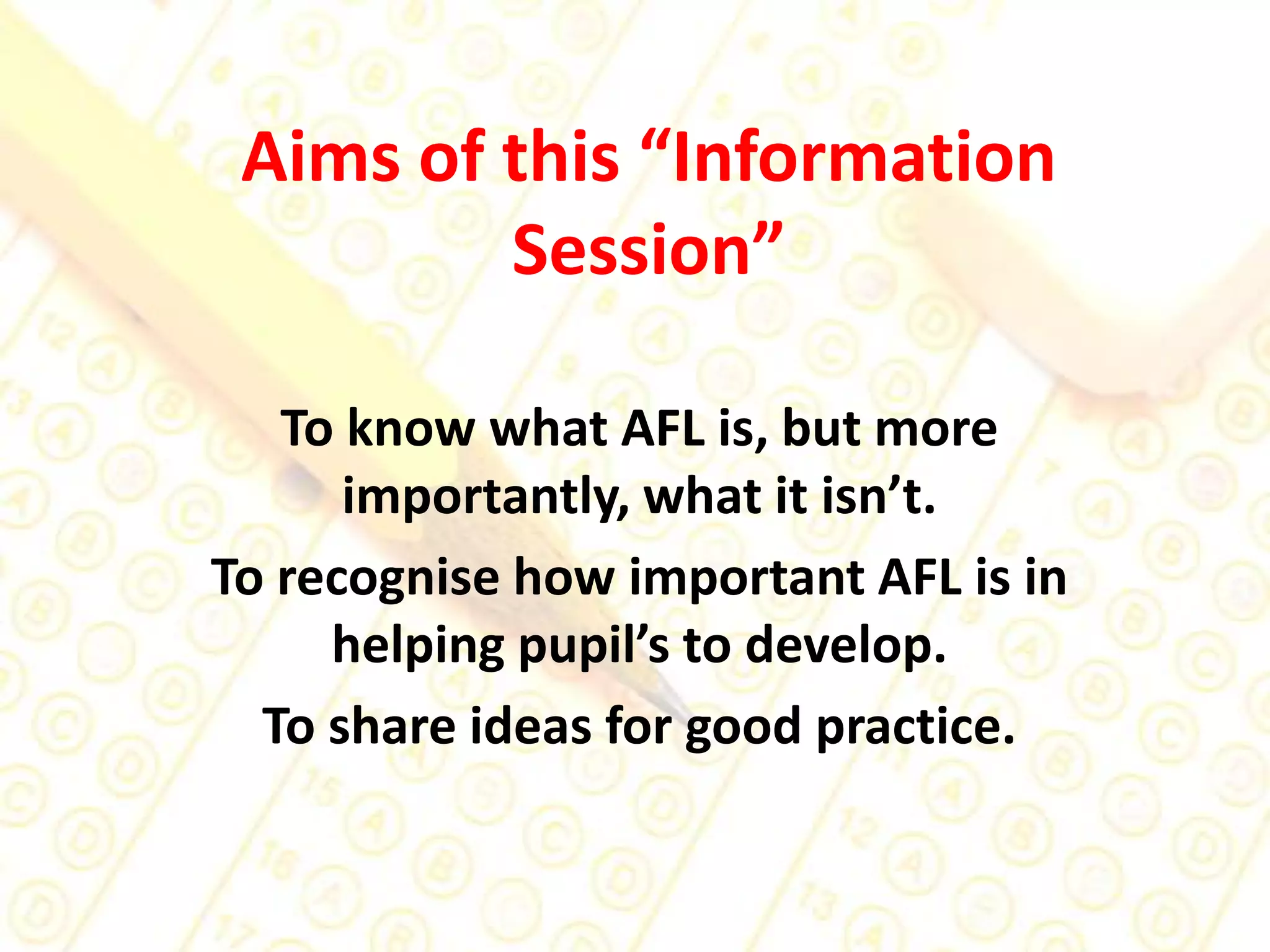
Objectives of this “Information Session” To know what AFL is but, more importantly, what it isn’t.To recognise how important AFL is in helping pupils to develop.To share ideas for good practice.How will you know that you have reached these objectives today?
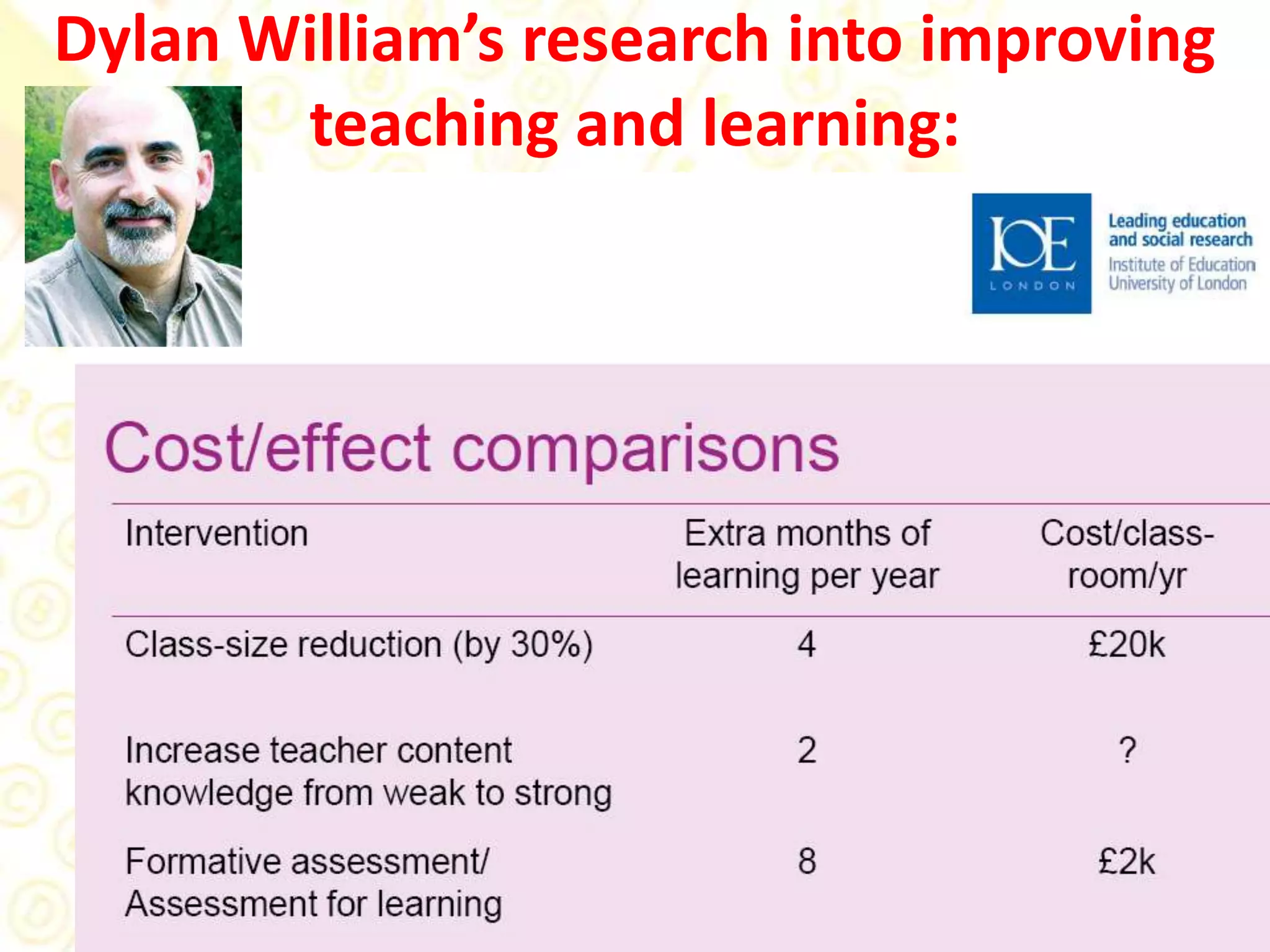
Dylan William’s research into improving teaching and learning:
Talk to the person next to you and be prepared to come back with an answer to this question: What is Assessment for learning?This is our starting point!
The QCDA definition:Assessment for learning involves using assessment in the classroom to raise pupils’ achievement. It is based on the idea that pupils will improve most if they understand the aim of their learning, where they are in relation to this aim and how they can achieve the aim (or close the gap in their knowledge). http://www.qcda.gov.uk/4334.aspx
The Ofsted Question….When Ofsted arrive, what will they look for, to JUDGE that learning is taking place?
When OFSTED arrive, Learning is judged by:Pupils’ intellectual physical and creative effortProductivity and pace of learningPupils’ interest, concentration and independencePupils’ own knowledge of their learningHow pupils with SEN learnHow pupils with EAL learn
According to Ofsted, when good learning is happening you should expect to see pupils:	 Interested and enthusiastic – enjoying the work
	 Engaged
	 Working hard and being challenged to think
	 Being able to explain what they are doing, why they are doing it, what they are going to do next and, above all, how well they are doing. You must be able to answer the question – What have the pupils learned in this lesson that they didn’t know before? Afl is at the core of this.
Talk to the person next to you and be prepared to come back with an answer to this question: What does Assessment For Learning look like in the classroom?
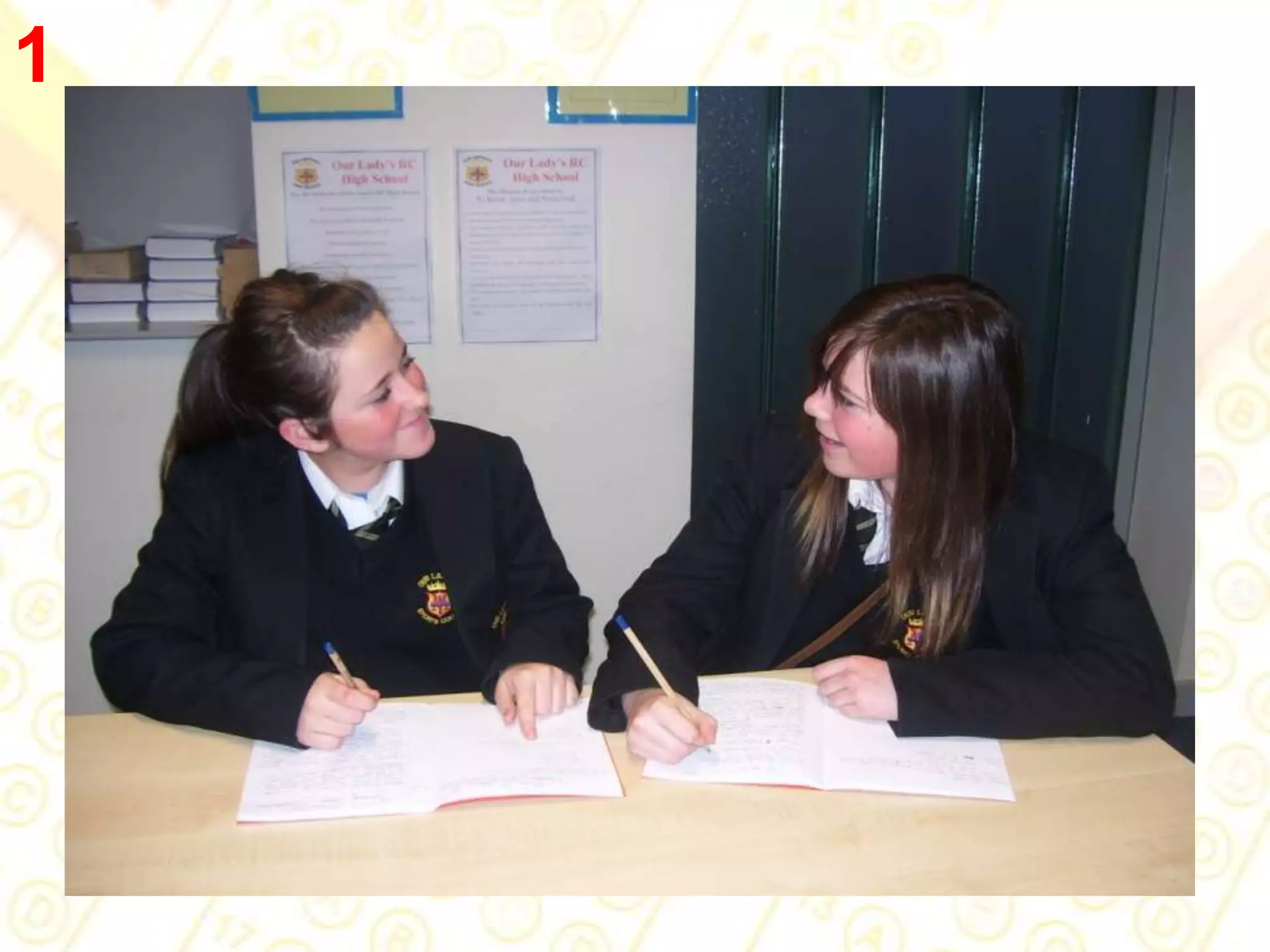
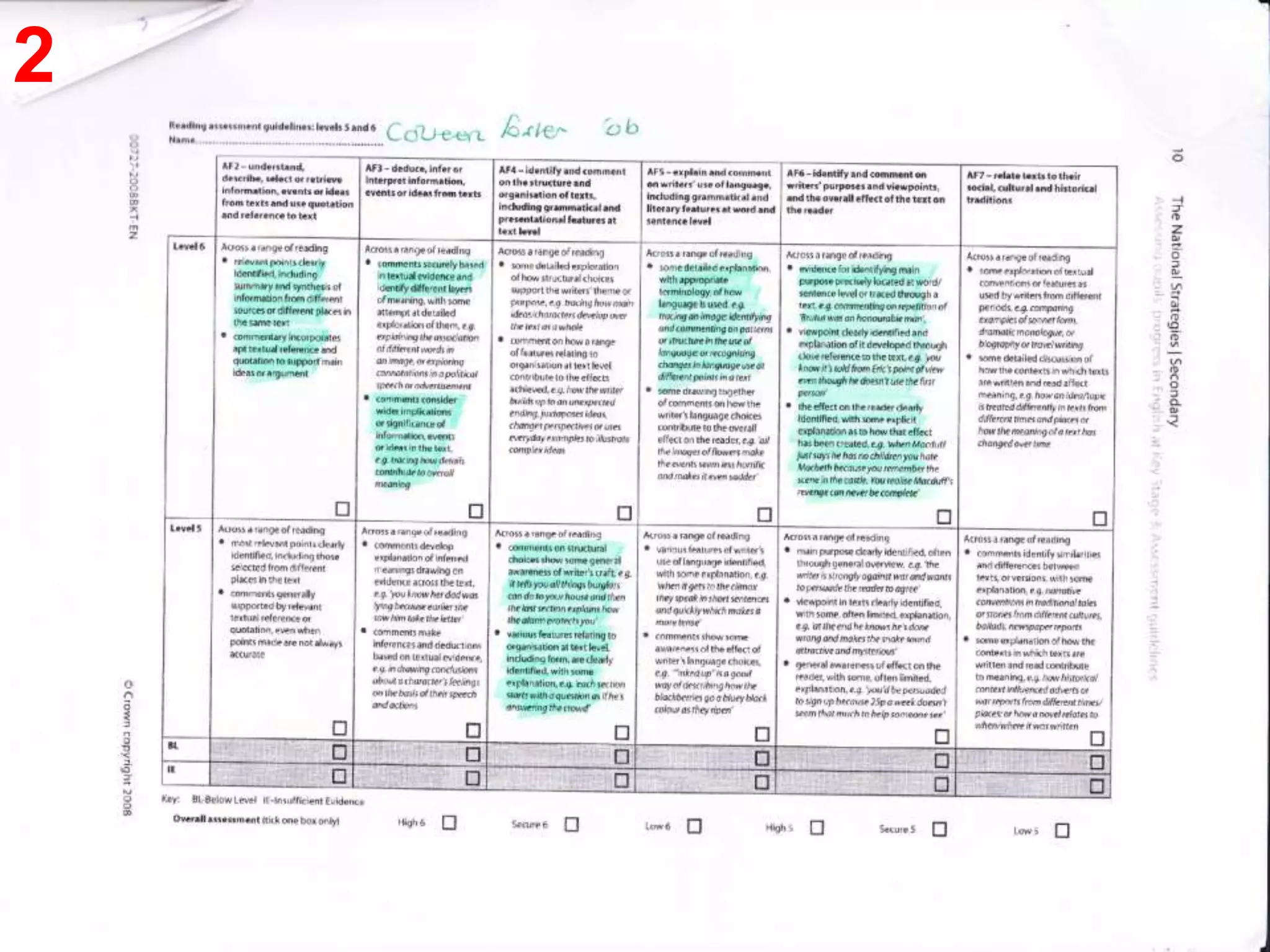
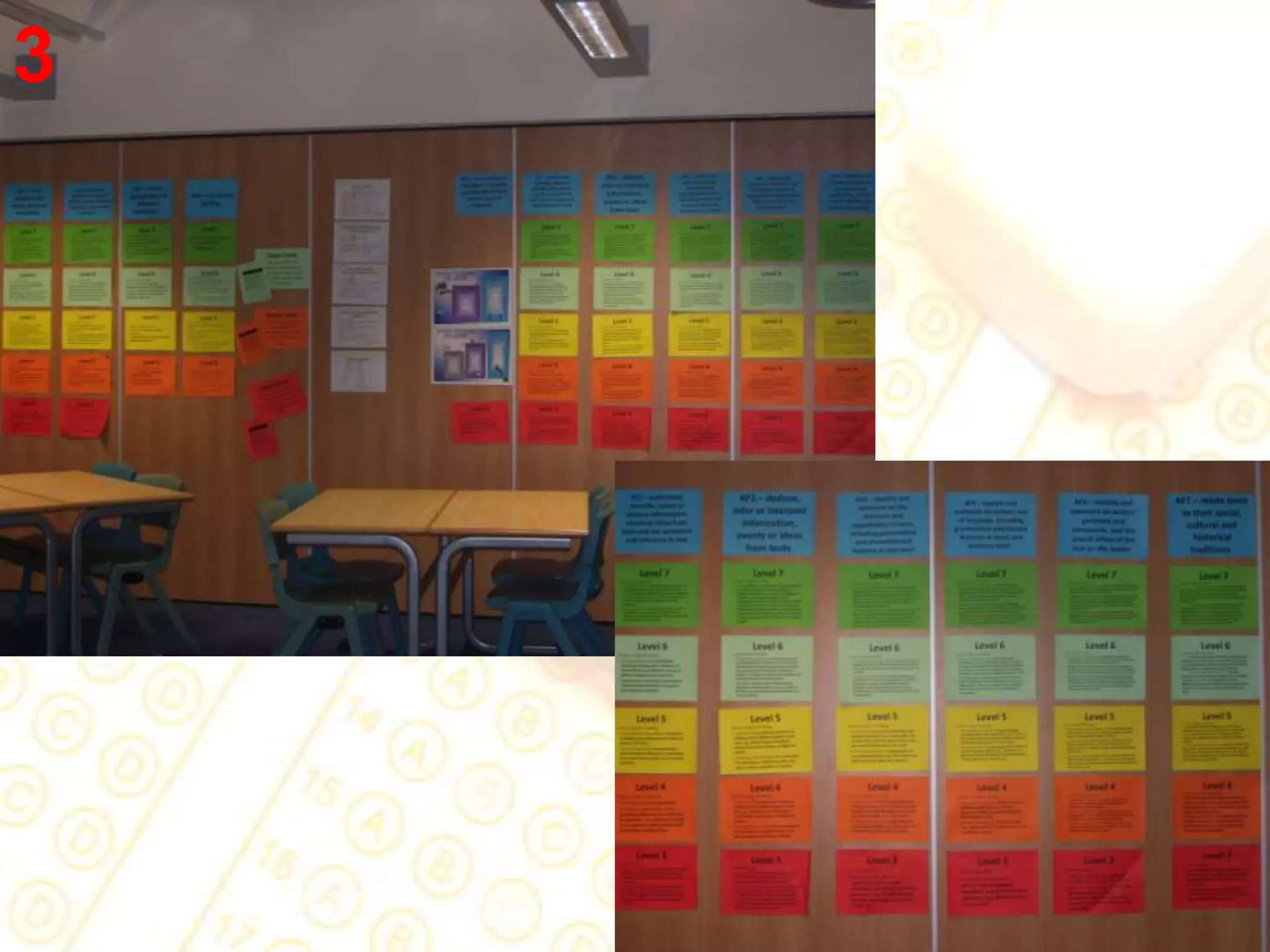
Write 1-10 on a piece of paperAs you look at the following images, I’d like you to consider what part of AFL strategy you are seeing here.
1
2
3
4
5
6
7
8
9
10
I’d like you to hold on to those answers for now:An AFL activity:Draw a picture of the school that you want to work in when you are qualifiedYou have 3 minutes
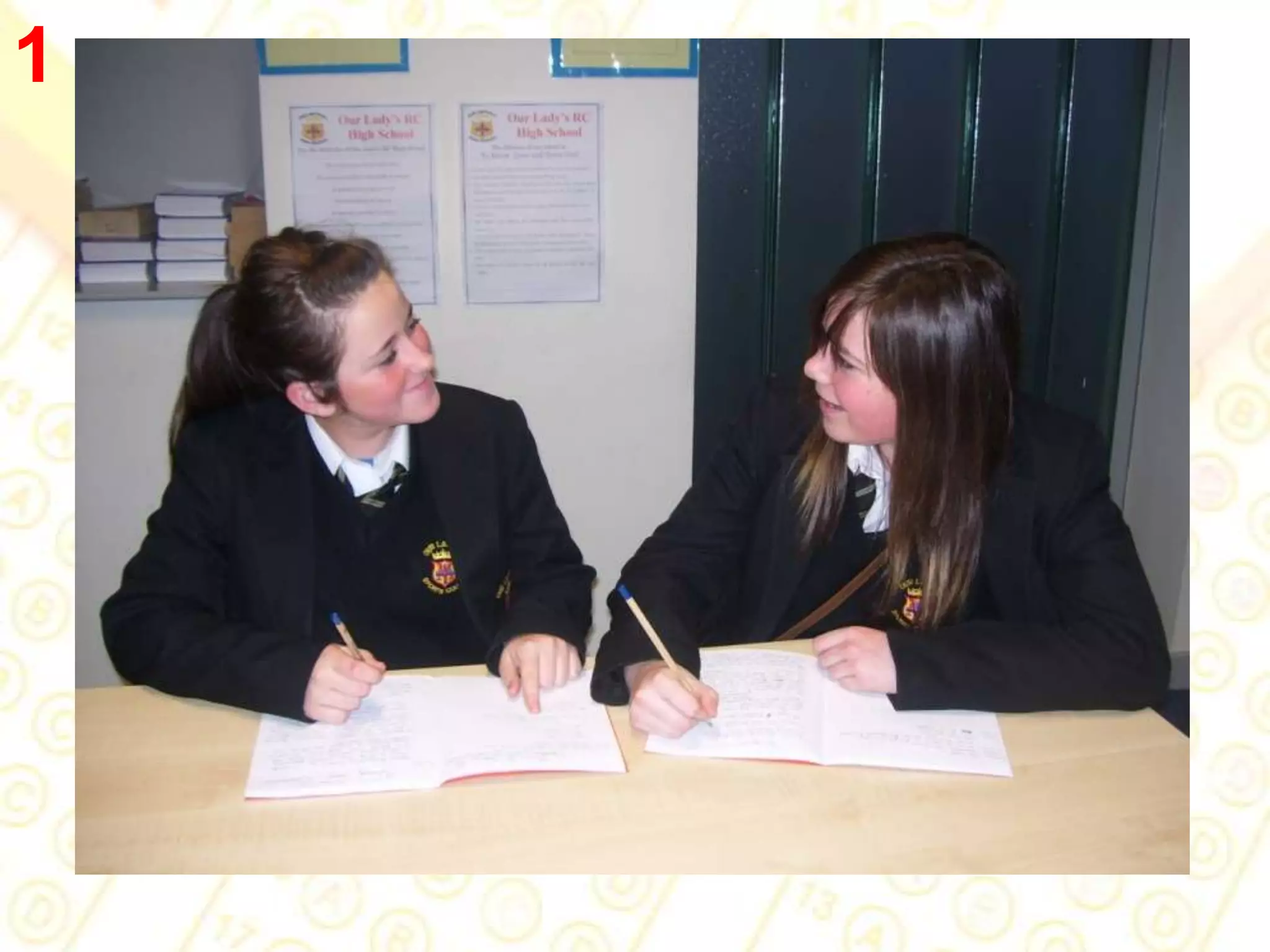
1
Peer markingThis is an essential tool in AFL;Swap pictures with a partnerLook at the picture and give it a mark out of 10.Give it back to your partner and tell them what score you have given them.Who scored over 5?How do you know?
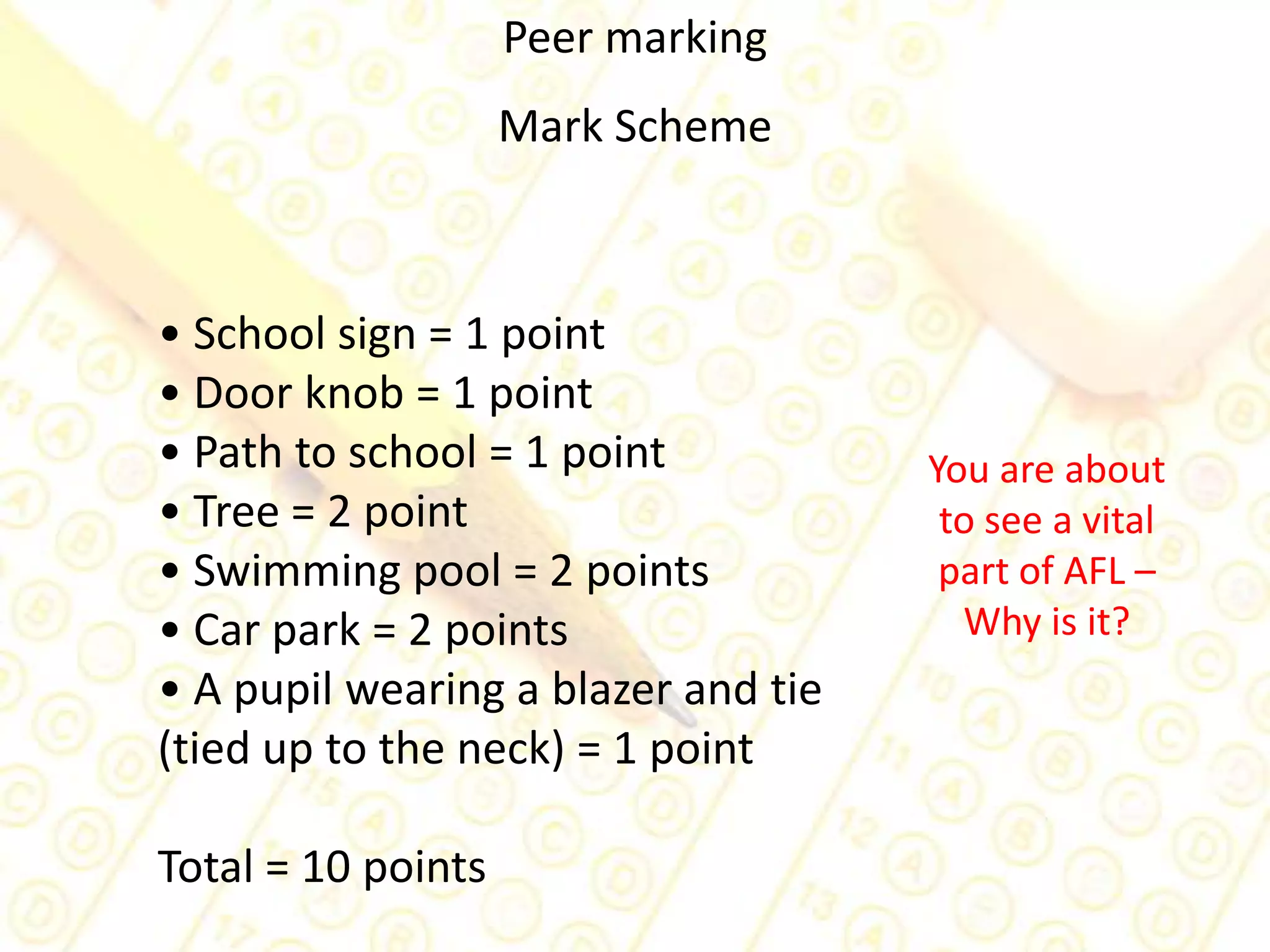
Peer markingMark Scheme• School sign = 1 point• Door knob = 1 point• Path to school = 1 point• Tree = 2 point• Swimming pool = 2 points• Car park = 2 points• A pupil wearing a blazer and tie (tied up to the neck) = 1 pointTotal = 10 pointsYou are about to see a vital part of AFL – Why is it?
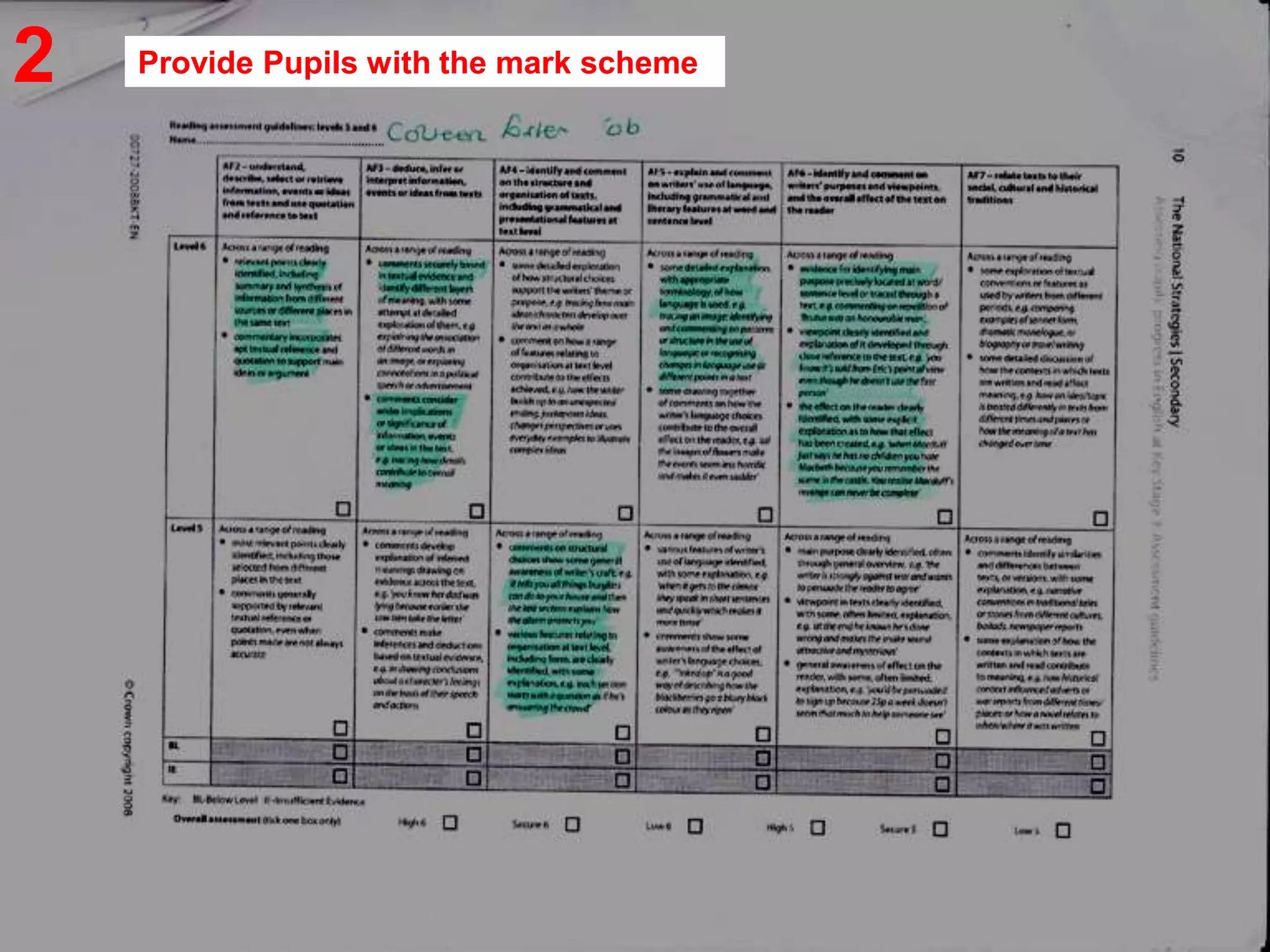
2Provide Pupils with the mark scheme
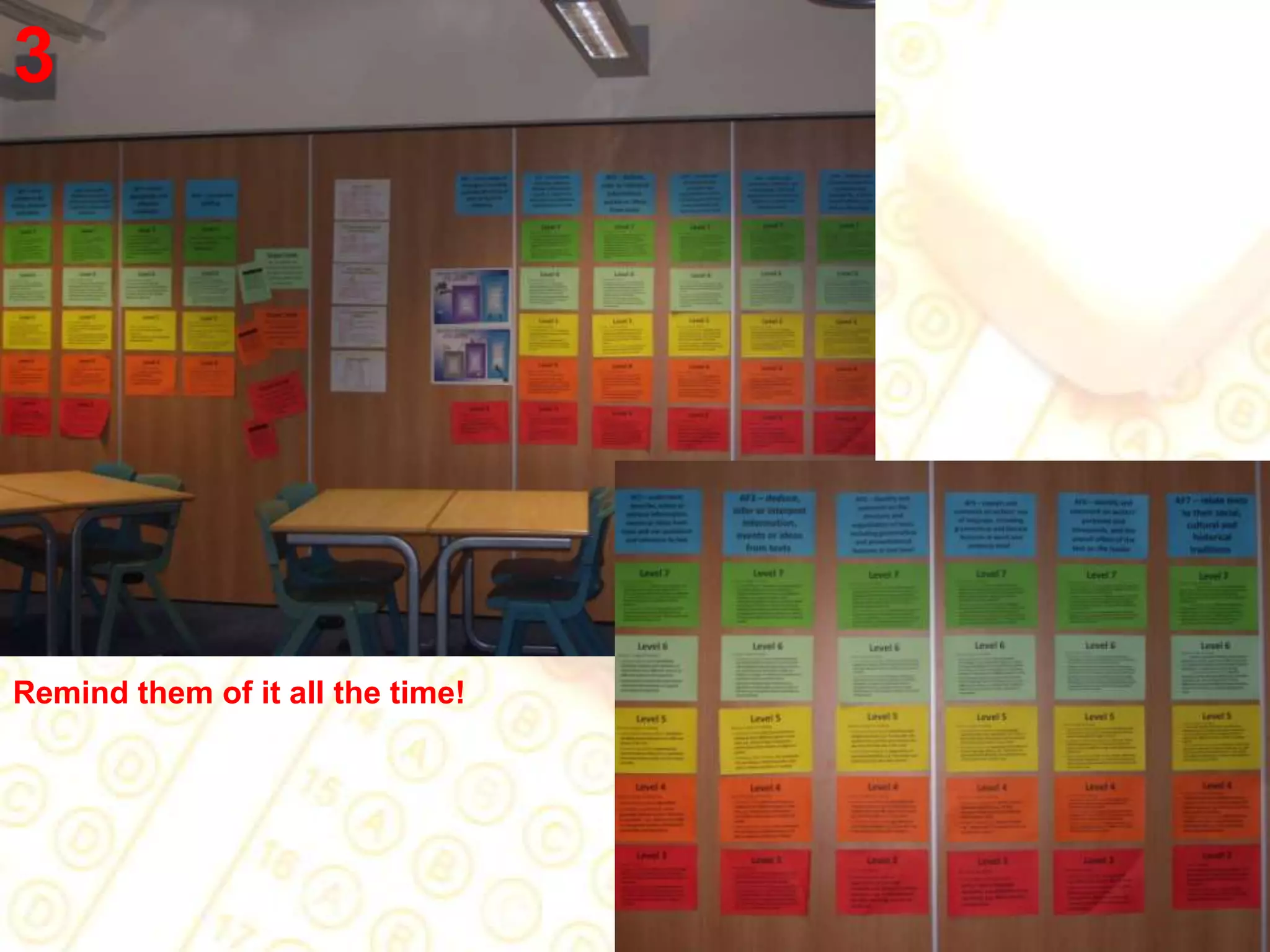
3Remind them of it all the time!
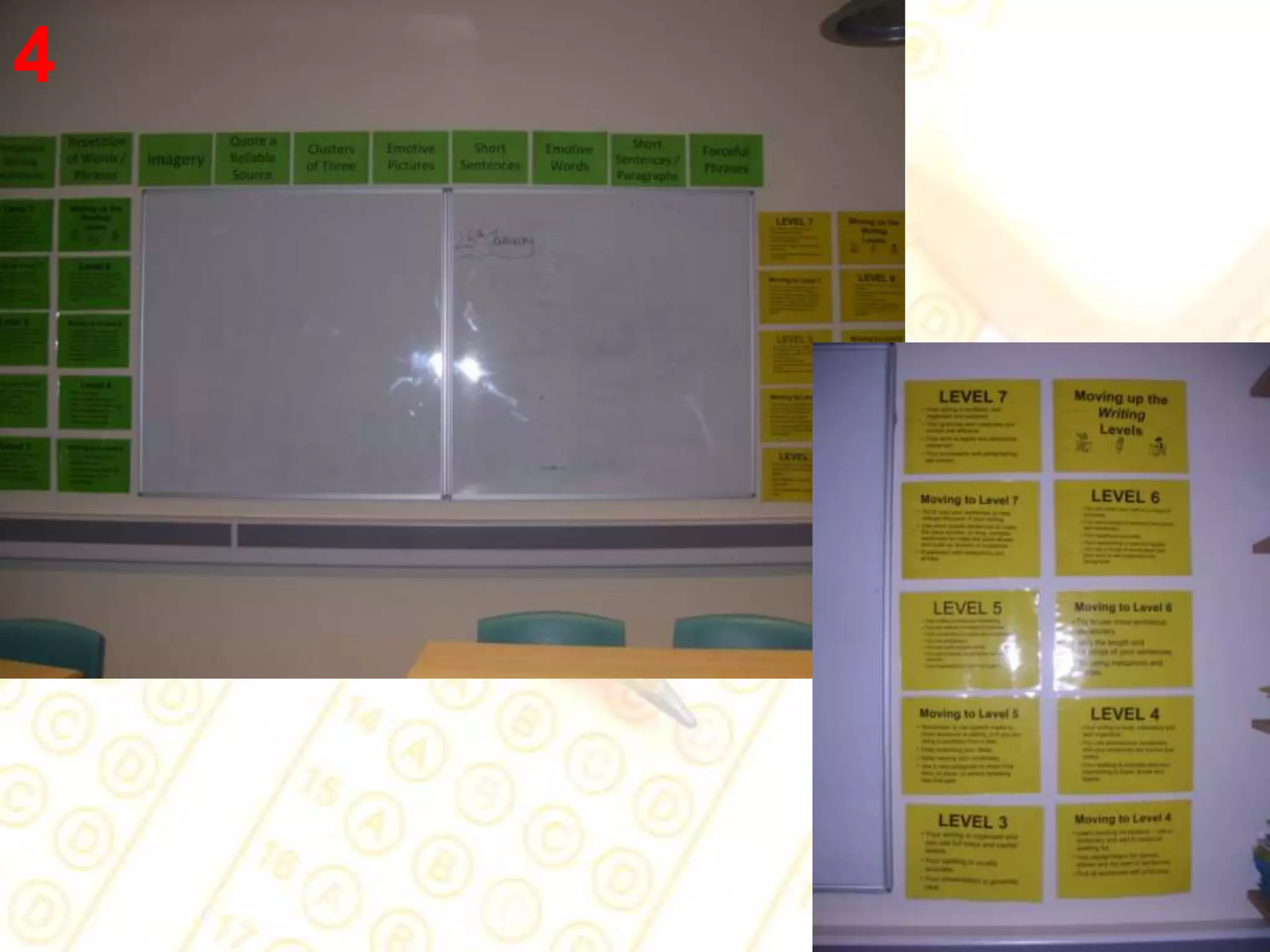
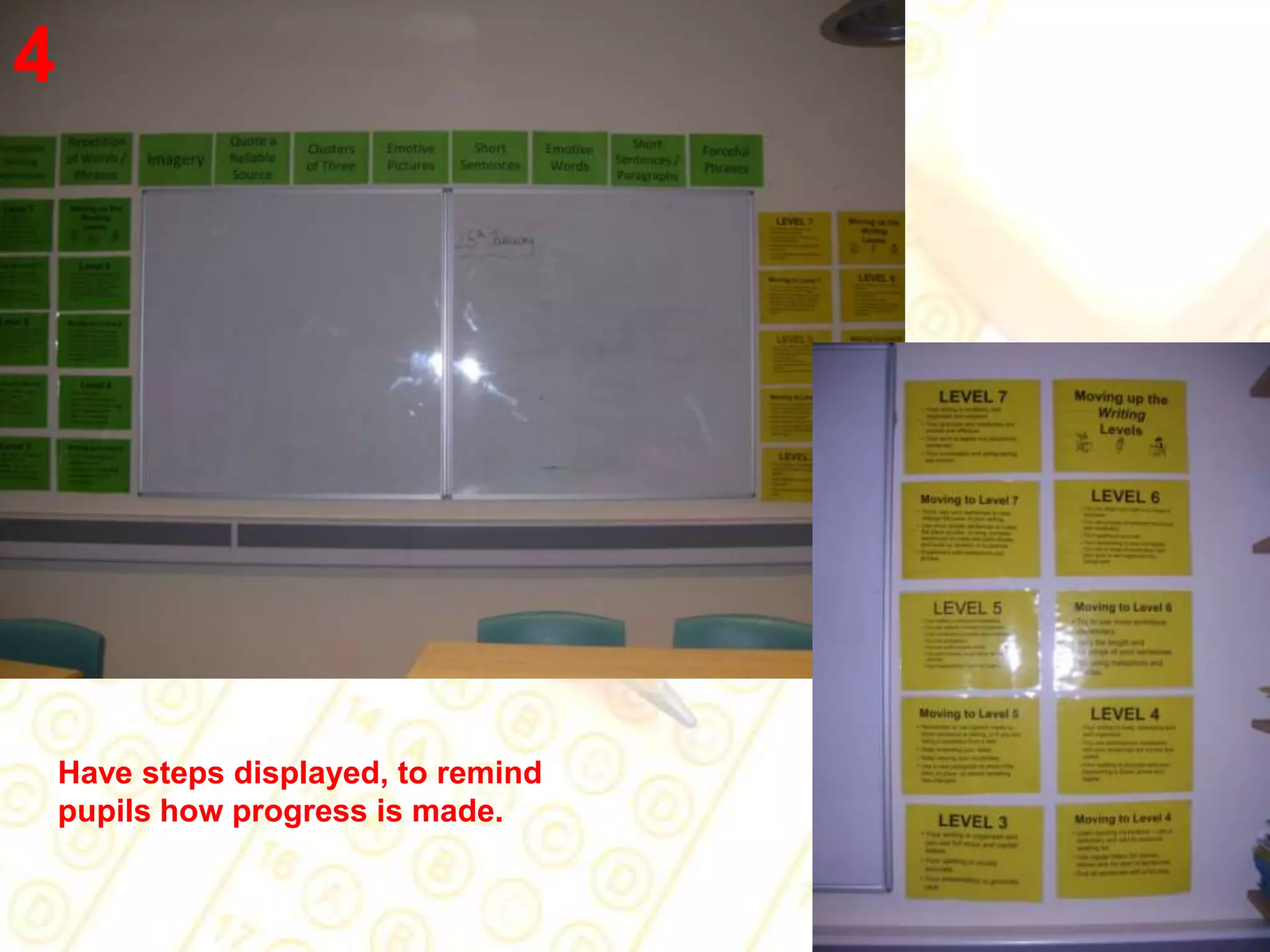
4Have steps displayed, to remind pupils how progress is made.
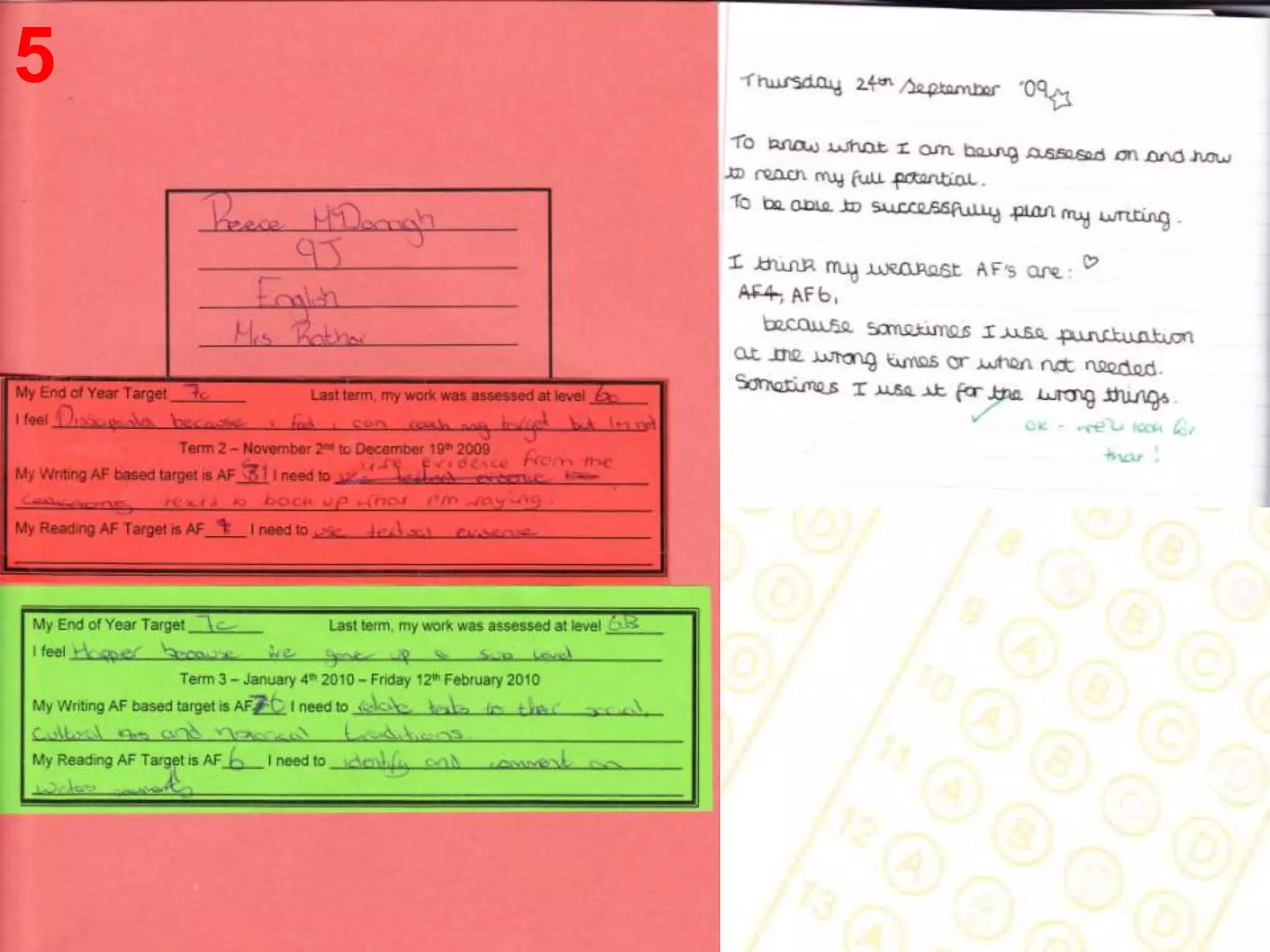
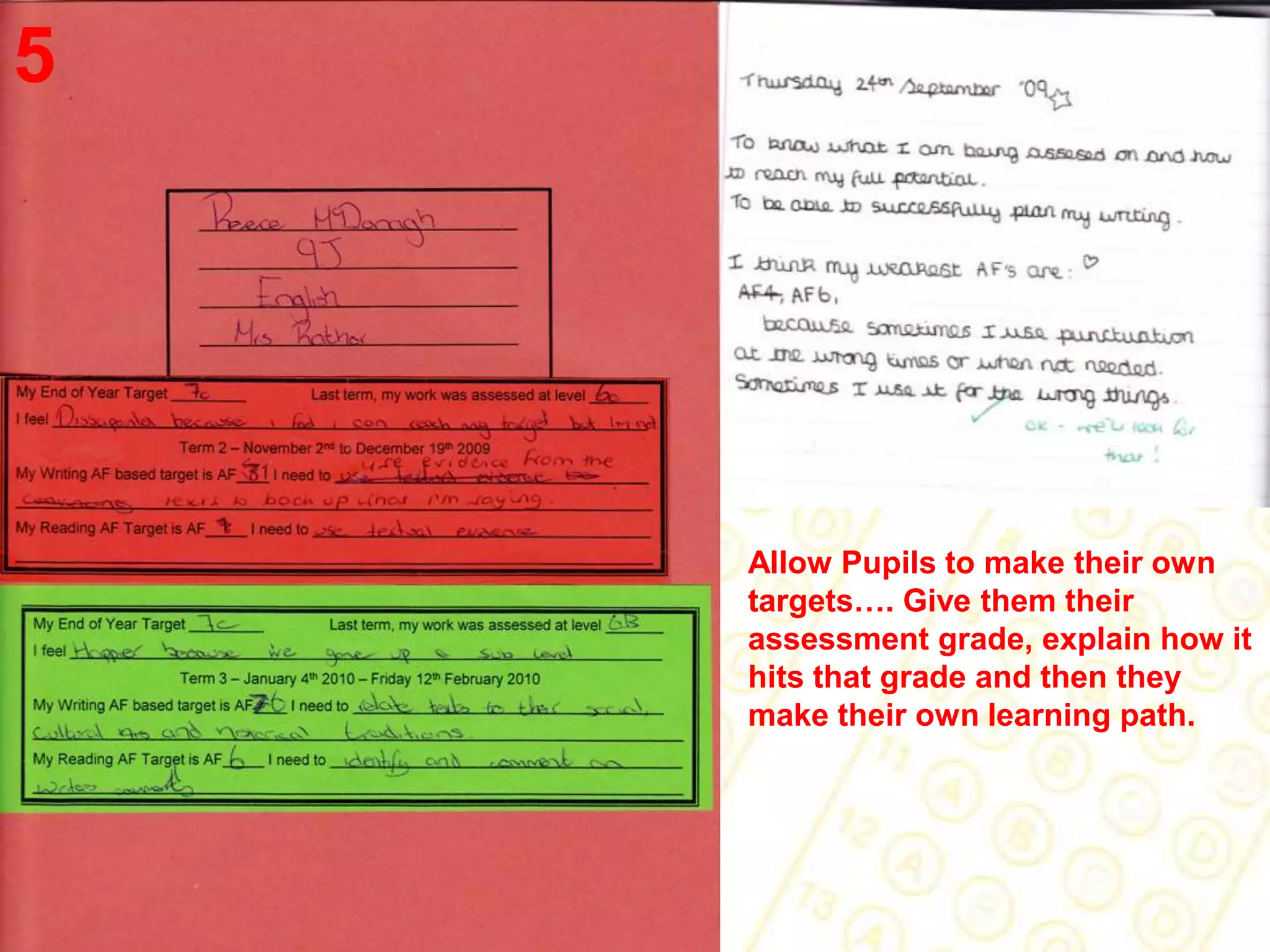
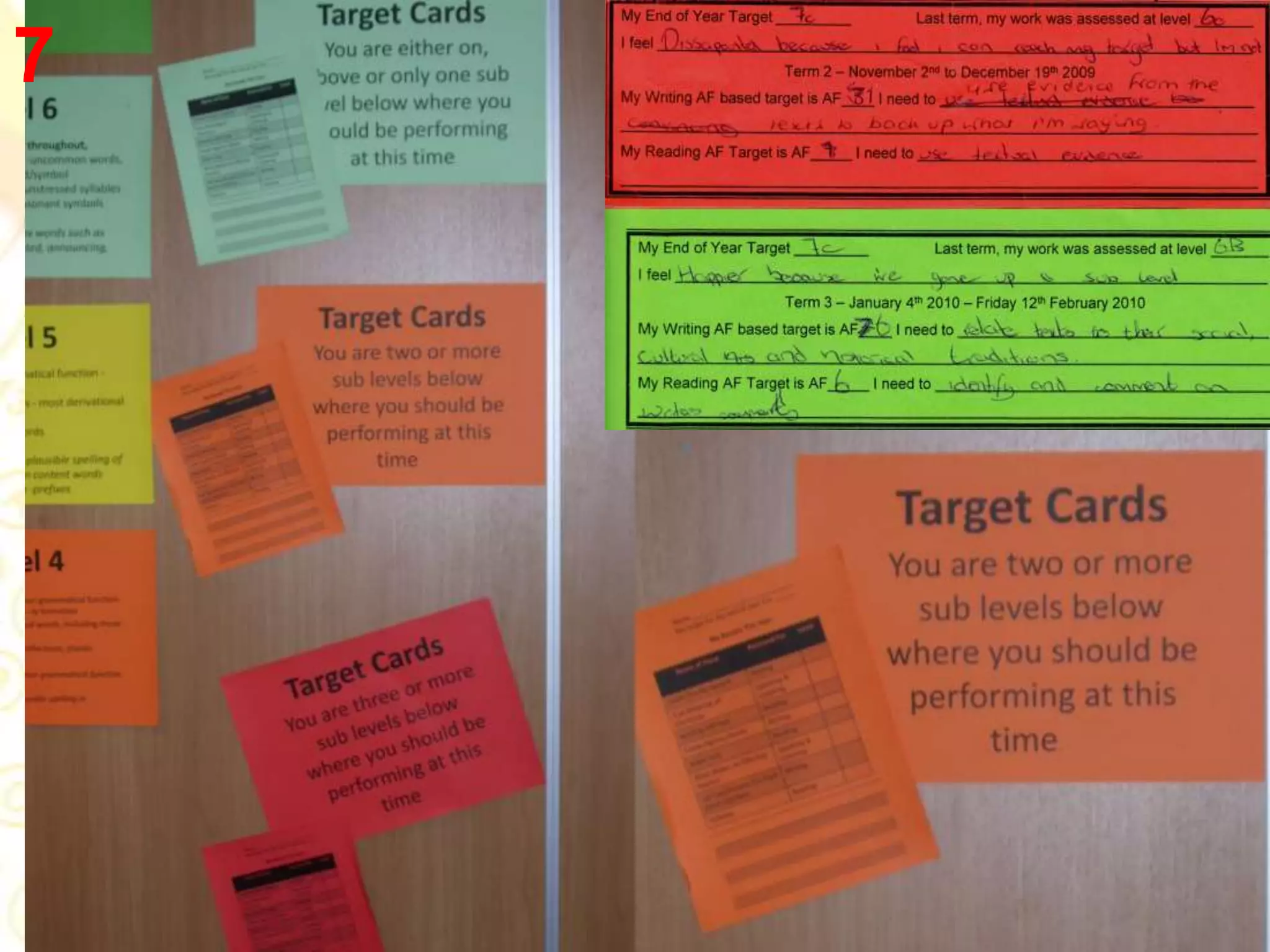
5Allow Pupils to make their own targets…. Give them their assessment grade, explain how it hits that grade and then they make their own learning path.
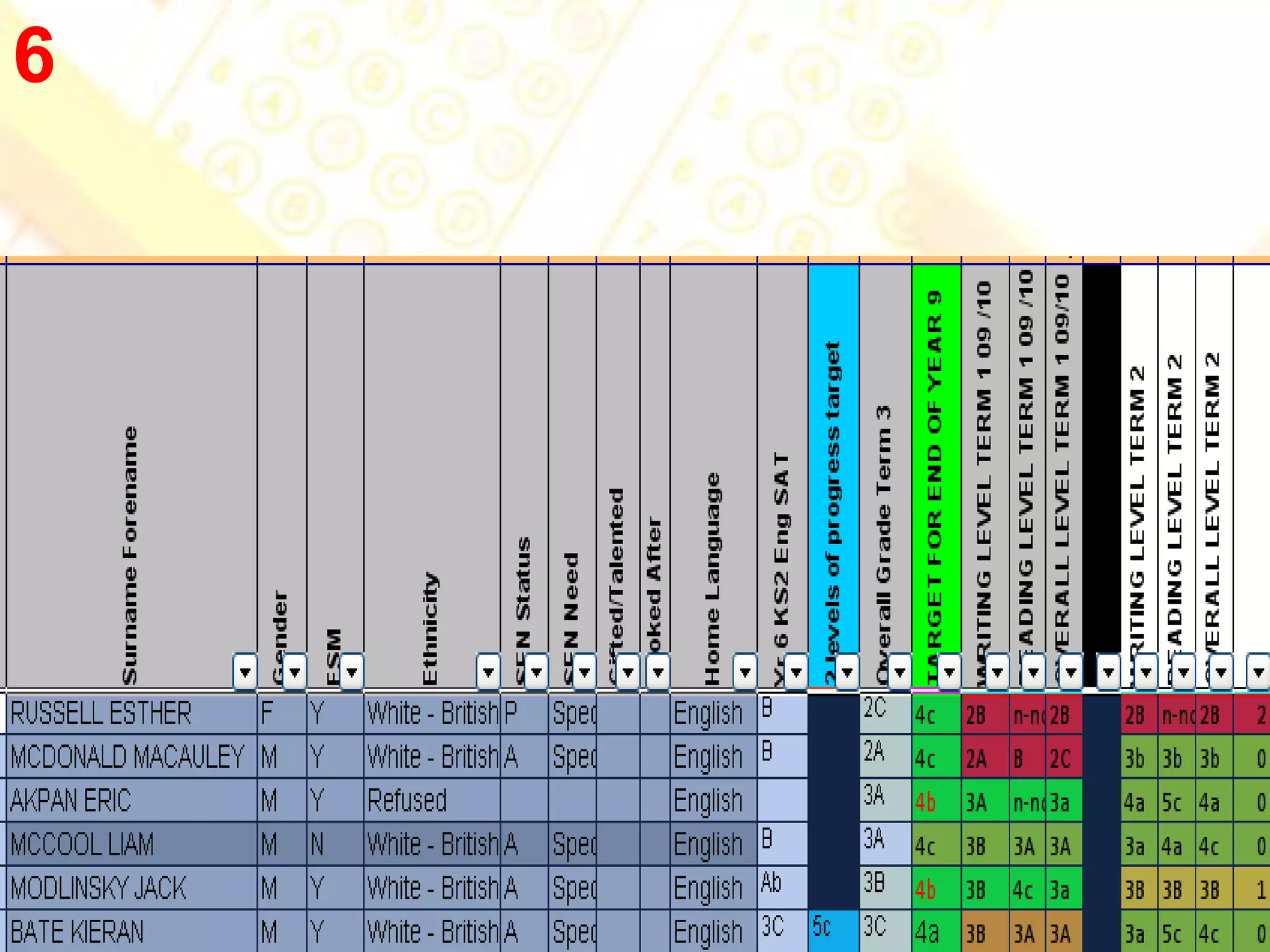
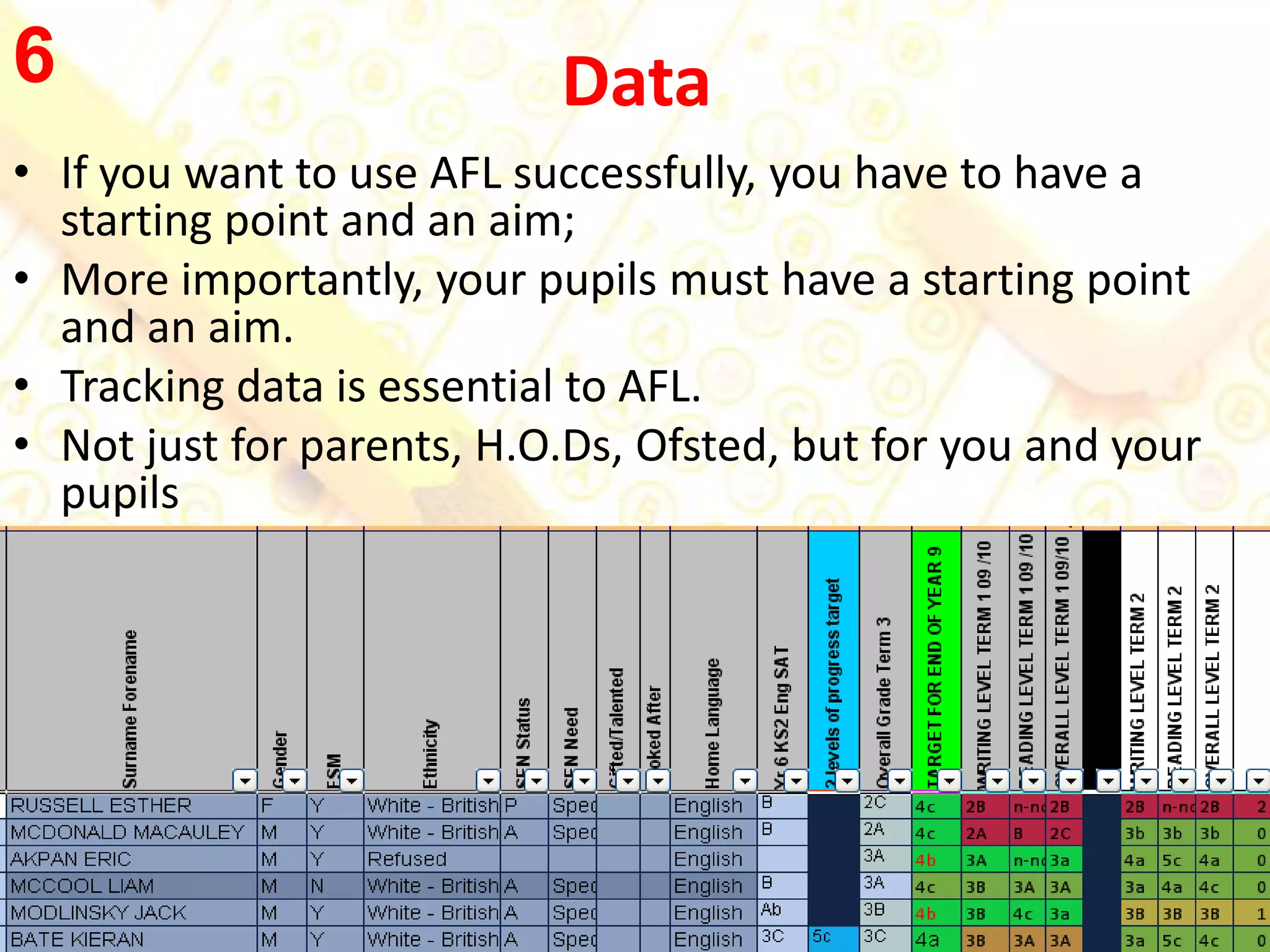
Data6If you want to use AFL successfully, you have to have a starting point and an aim;More importantly, your pupils must have a starting point and an aim.Tracking data is essential to AFL.Not just for parents, H.O.Ds, Ofsted, but for you and your pupils
7
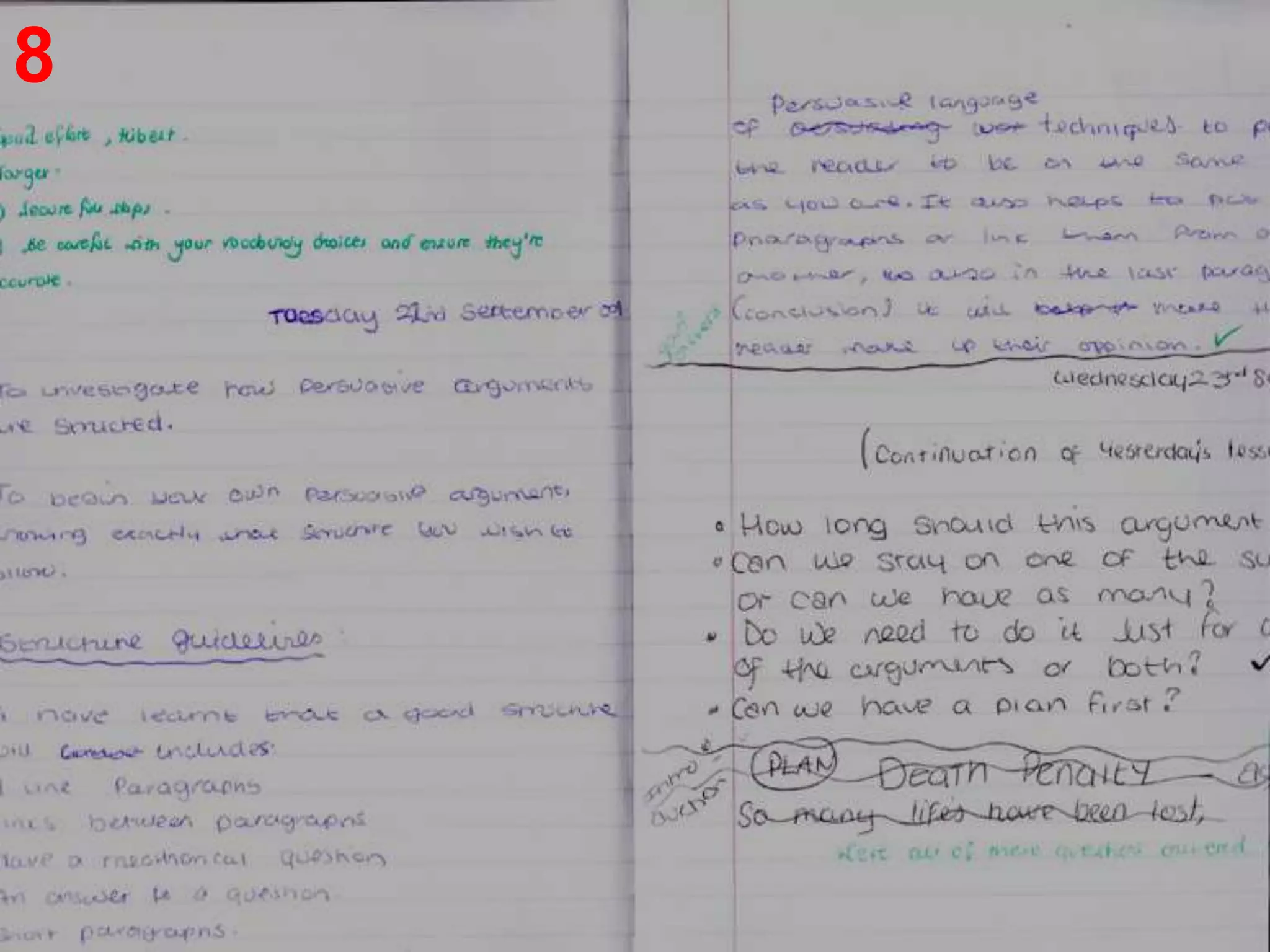
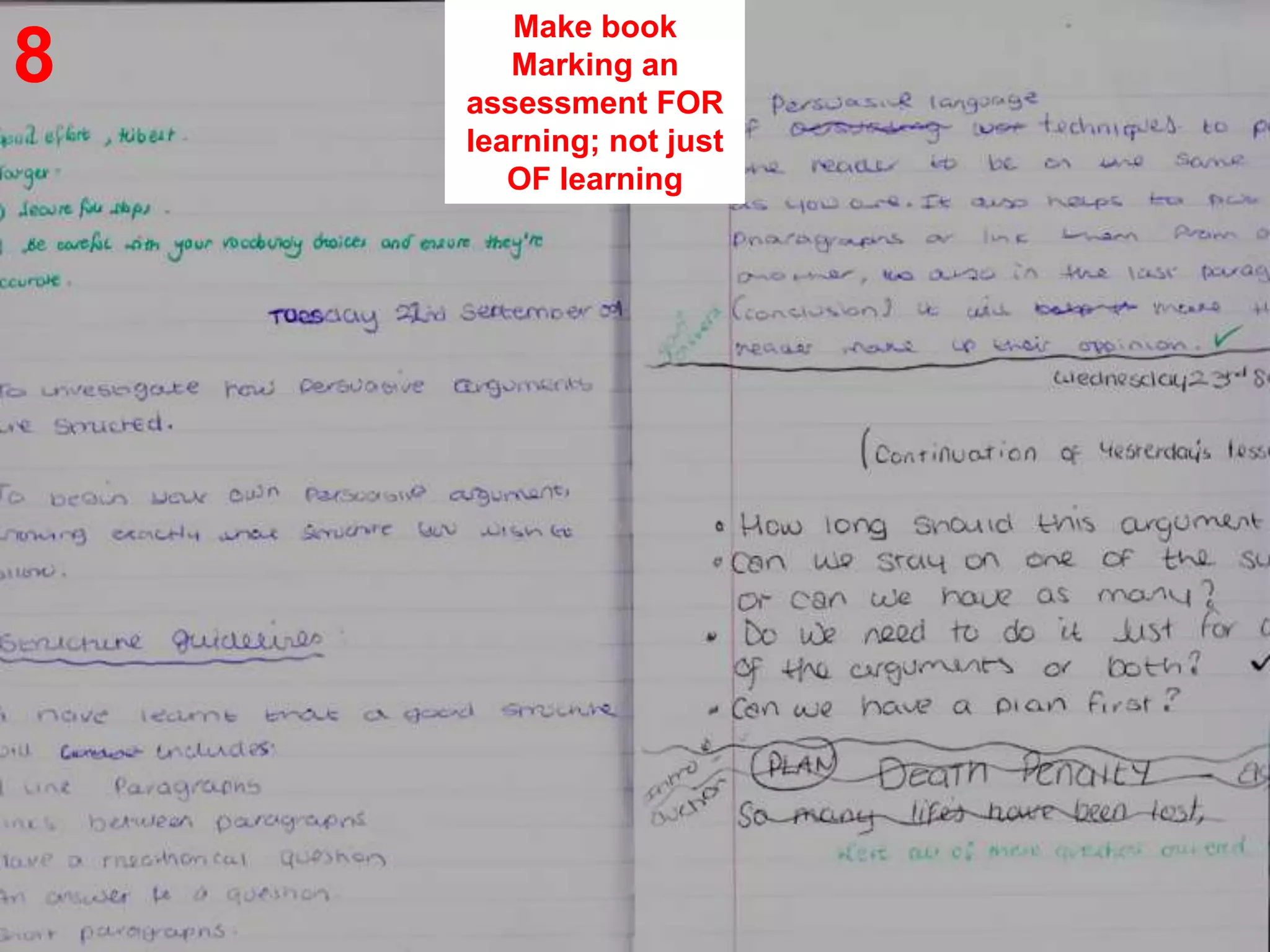
8Make book Marking an assessment FOR learning; not just OF learning
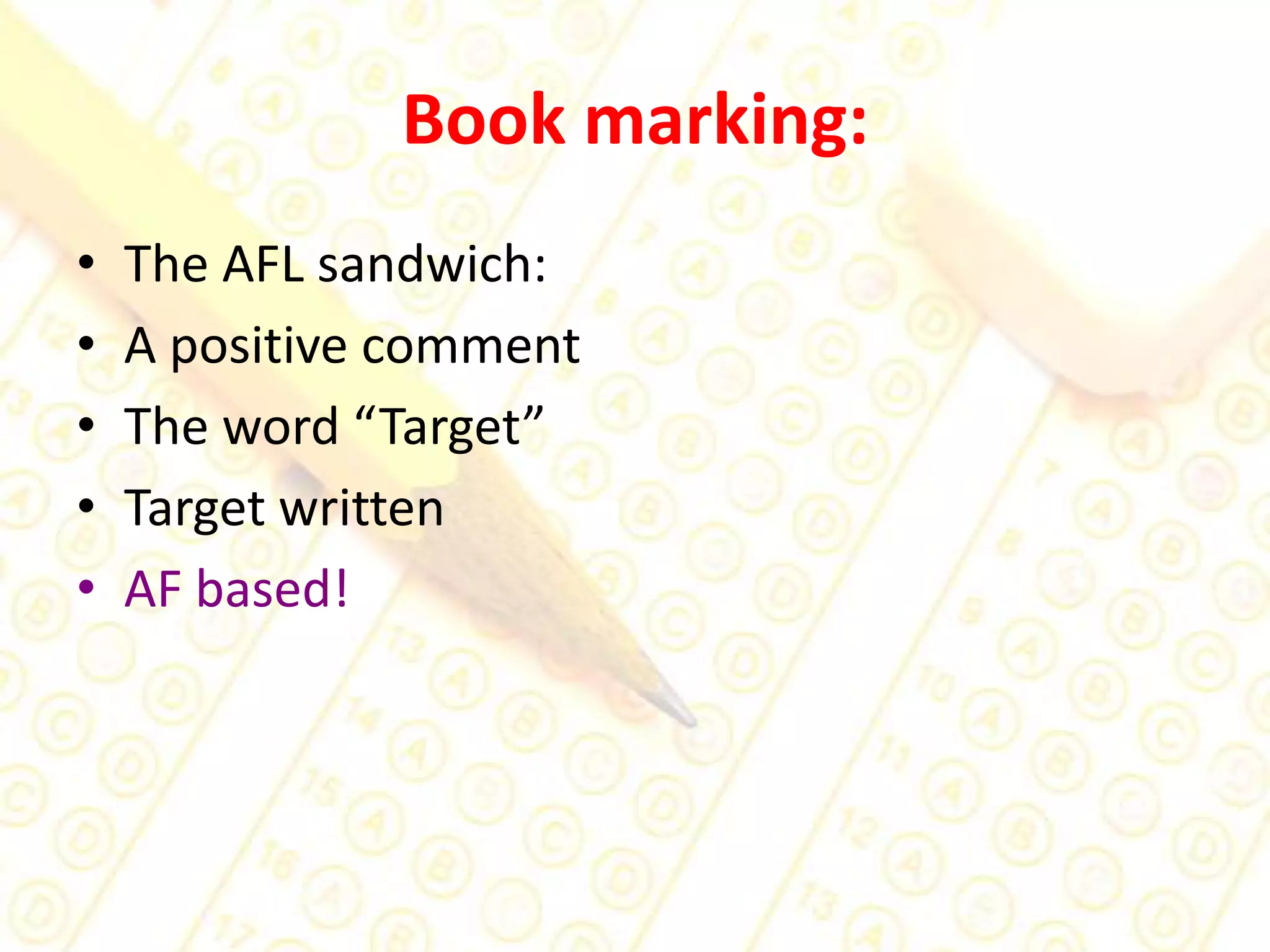
Book marking:The AFL sandwich:A positive commentThe word “Target”Target writtenAF based!
9Review Learning at Regular Intervals…. Mini Plenaries!
Why do teachers need to write learning / lesson objectives in their planning and in their room?By making clear your learning objectives, you are: Describing to the students what you value and expect them to be able do
 Specifying the desired outcomes that can be tested (developing an assessment strategy)
Assessing the student’s performance / understanding and, for you, if the lesson is effective (improving your own evaluation & ongoing delivery)Lesson Objectives:They get pupils into the habit of knowing what they are learning and how it fits into their own day to day lives – the big picture!You should train pupils to regularly refer to them throughout the lesson – what progress are they making?
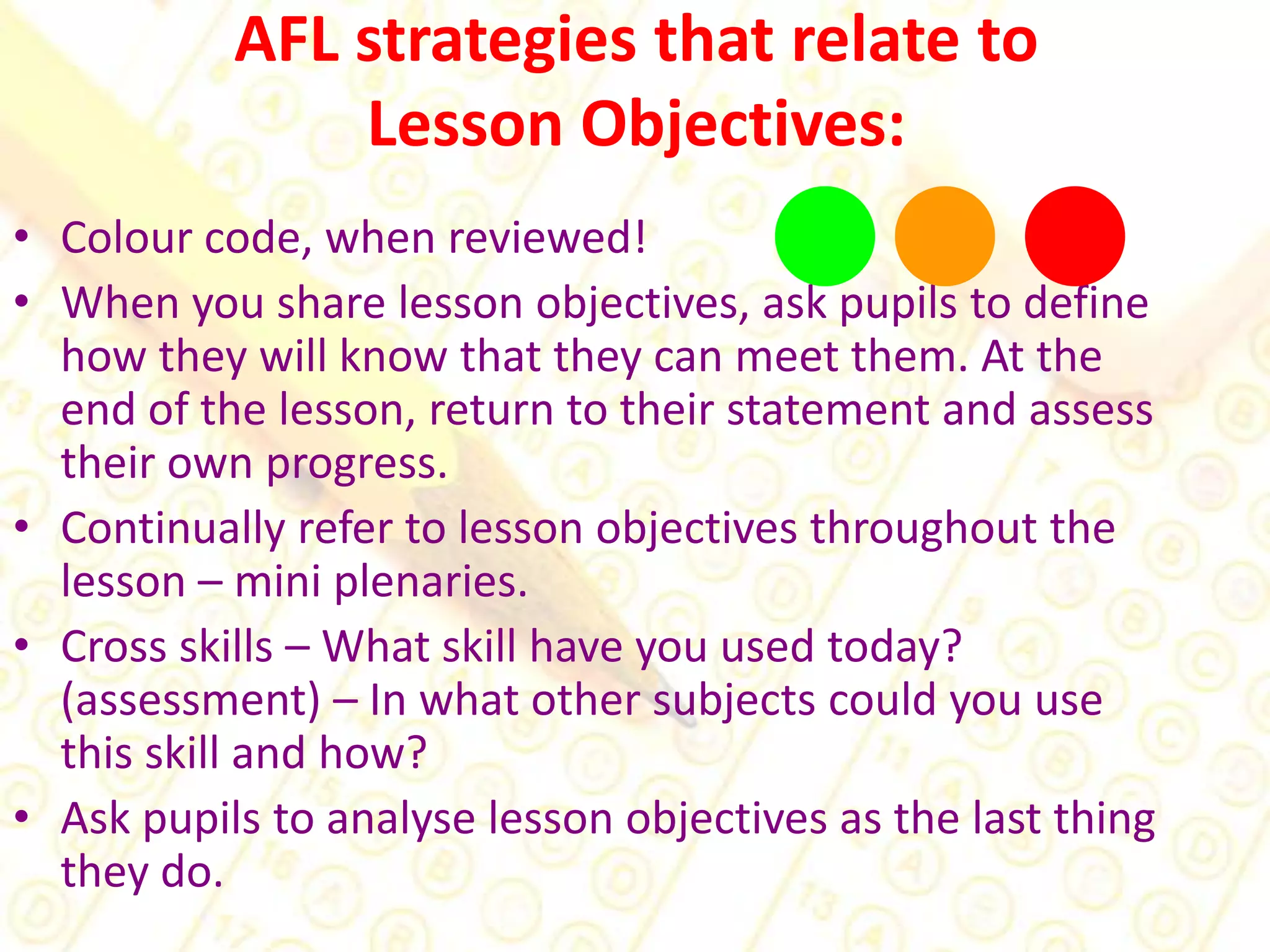
AFL strategies that relate to Lesson Objectives:Colour code, when reviewed!When you share lesson objectives, ask pupils to define how they will know that they can meet them. At the end of the lesson, return to their statement and assess their own progress.Continually refer to lesson objectives throughout the lesson – mini plenaries.Cross skills – What skill have you used today?  (assessment) – In what other subjects could you use this skill and how?Ask pupils to analyse lesson objectives as the last thing they do.
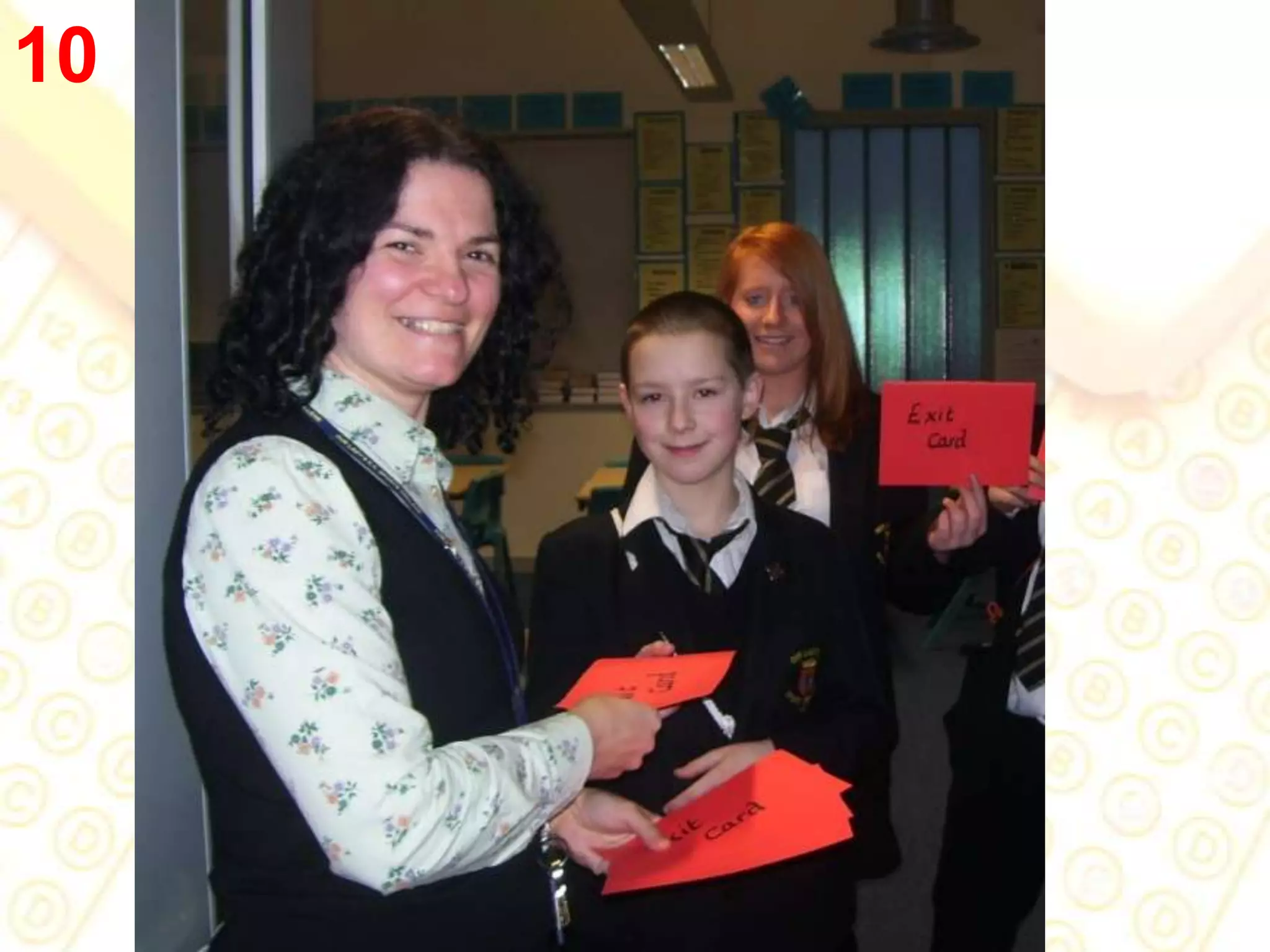
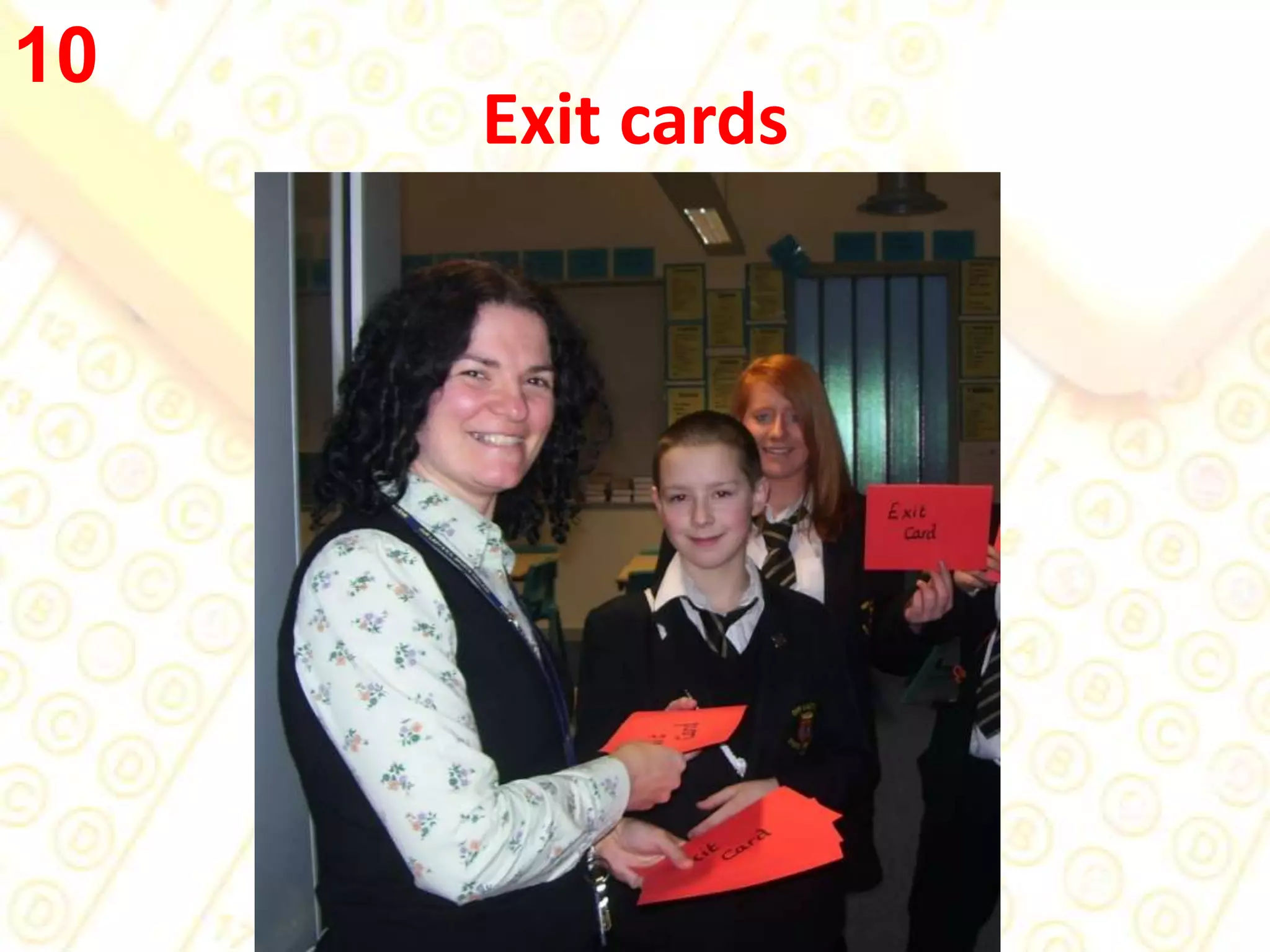
Exit cards10
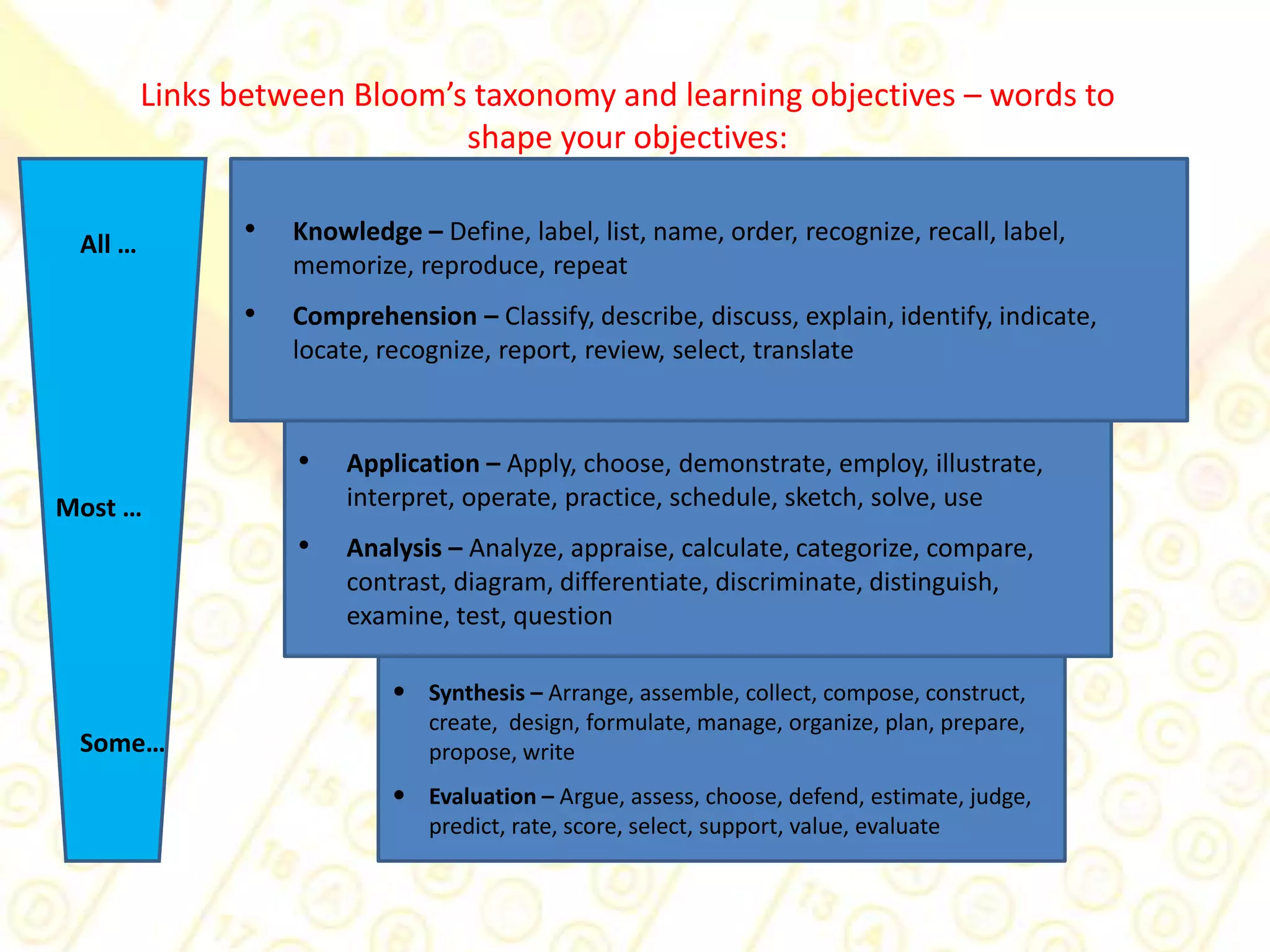
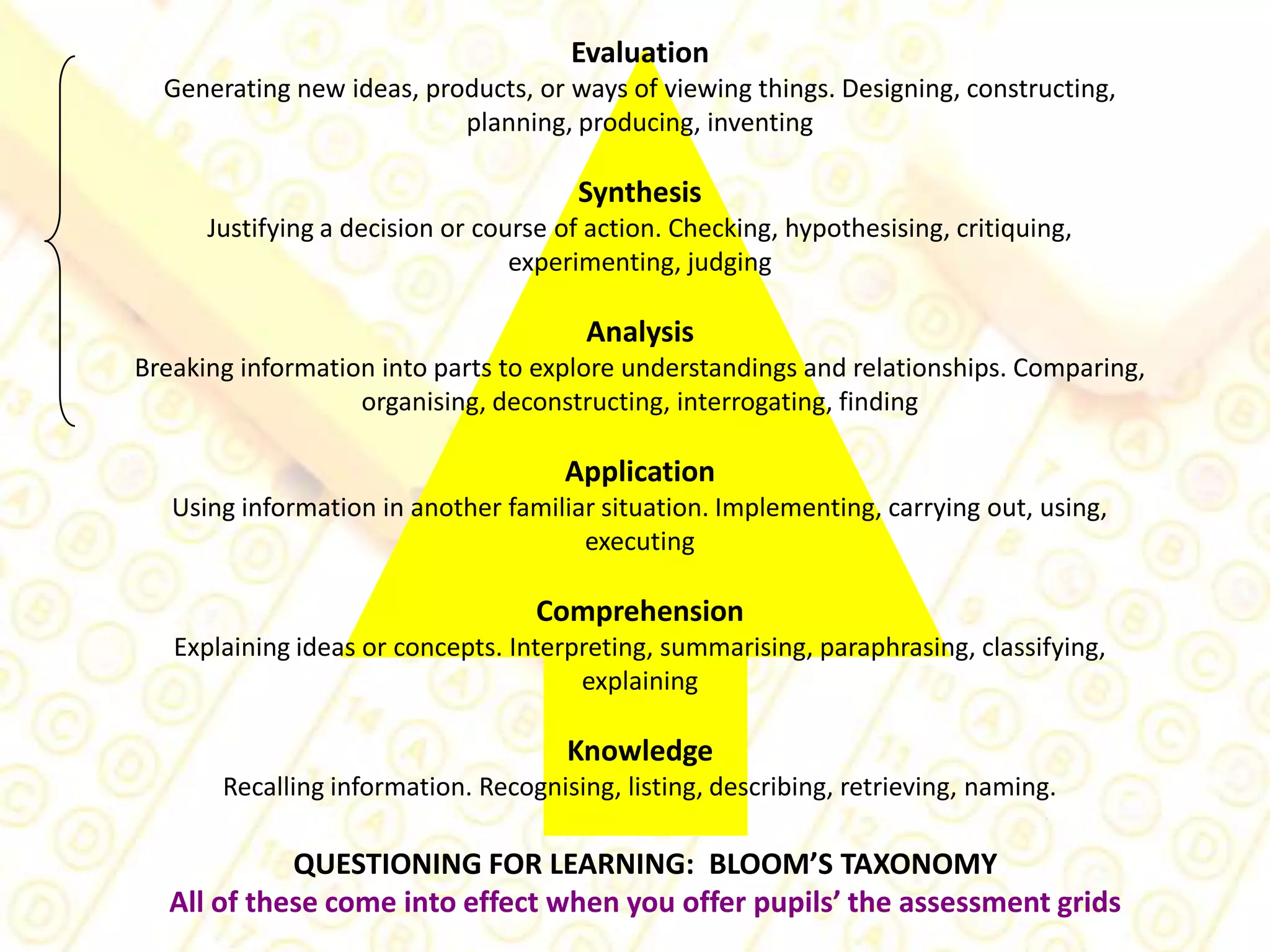
Links between Bloom’s taxonomy and learning objectives – words to shape your objectives:Knowledge – Define, label, list, name, order, recognize, recall, label, memorize, reproduce, repeat
Comprehension – Classify, describe, discuss, explain, identify, indicate, locate, recognize, report, review, select, translateAll …Application – Apply, choose, demonstrate, employ, illustrate, interpret, operate, practice, schedule, sketch, solve, use
Analysis – Analyze, appraise, calculate, categorize, compare, contrast, diagram, differentiate, discriminate, distinguish, examine, test, questionMost …Synthesis – Arrange, assemble, collect, compose, construct, create,  design, formulate, manage, organize, plan, prepare, propose, write
Evaluation – Argue, assess, choose, defend, estimate, judge, predict, rate, score, select, support, value, evaluateSome…

Assessment For Learning Presentation

  • 1.
    Assessment For LearningMichelleRathorManchester LA Advanced Skills Teacher – EnglishFunctional Skills Champion for Manchester Authority
  • 2.
    Objectives of this“Information Session” To know what AFL is but, more importantly, what it isn’t.To recognise how important AFL is in helping pupils to develop.To share ideas for good practice.How will you know that you have reached these objectives today?
  • 3.
    Dylan William’s researchinto improving teaching and learning:
  • 4.
    Talk to theperson next to you and be prepared to come back with an answer to this question: What is Assessment for learning?This is our starting point!
  • 5.
    The QCDA definition:Assessmentfor learning involves using assessment in the classroom to raise pupils’ achievement. It is based on the idea that pupils will improve most if they understand the aim of their learning, where they are in relation to this aim and how they can achieve the aim (or close the gap in their knowledge). http://www.qcda.gov.uk/4334.aspx
  • 6.
    The Ofsted Question….WhenOfsted arrive, what will they look for, to JUDGE that learning is taking place?
  • 7.
    When OFSTED arrive,Learning is judged by:Pupils’ intellectual physical and creative effortProductivity and pace of learningPupils’ interest, concentration and independencePupils’ own knowledge of their learningHow pupils with SEN learnHow pupils with EAL learn
  • 8.
    According to Ofsted,when good learning is happening you should expect to see pupils: Interested and enthusiastic – enjoying the work
  • 9.
  • 10.
    Working hardand being challenged to think
  • 11.
    Being ableto explain what they are doing, why they are doing it, what they are going to do next and, above all, how well they are doing. You must be able to answer the question – What have the pupils learned in this lesson that they didn’t know before? Afl is at the core of this.
  • 12.
    Talk to theperson next to you and be prepared to come back with an answer to this question: What does Assessment For Learning look like in the classroom?
  • 13.
    Write 1-10 ona piece of paperAs you look at the following images, I’d like you to consider what part of AFL strategy you are seeing here.
  • 14.
  • 15.
  • 16.
  • 17.
  • 18.
  • 19.
  • 20.
  • 21.
  • 22.
  • 23.
  • 24.
    I’d like youto hold on to those answers for now:An AFL activity:Draw a picture of the school that you want to work in when you are qualifiedYou have 3 minutes
  • 25.
  • 26.
    Peer markingThis isan essential tool in AFL;Swap pictures with a partnerLook at the picture and give it a mark out of 10.Give it back to your partner and tell them what score you have given them.Who scored over 5?How do you know?
  • 27.
    Peer markingMark Scheme•School sign = 1 point• Door knob = 1 point• Path to school = 1 point• Tree = 2 point• Swimming pool = 2 points• Car park = 2 points• A pupil wearing a blazer and tie (tied up to the neck) = 1 pointTotal = 10 pointsYou are about to see a vital part of AFL – Why is it?
  • 28.
    2Provide Pupils withthe mark scheme
  • 29.
    3Remind them ofit all the time!
  • 30.
    4Have steps displayed,to remind pupils how progress is made.
  • 31.
    5Allow Pupils tomake their own targets…. Give them their assessment grade, explain how it hits that grade and then they make their own learning path.
  • 32.
    Data6If you wantto use AFL successfully, you have to have a starting point and an aim;More importantly, your pupils must have a starting point and an aim.Tracking data is essential to AFL.Not just for parents, H.O.Ds, Ofsted, but for you and your pupils
  • 33.
  • 34.
    8Make book Markingan assessment FOR learning; not just OF learning
  • 35.
    Book marking:The AFLsandwich:A positive commentThe word “Target”Target writtenAF based!
  • 36.
    9Review Learning atRegular Intervals…. Mini Plenaries!
  • 37.
    Why do teachersneed to write learning / lesson objectives in their planning and in their room?By making clear your learning objectives, you are: Describing to the students what you value and expect them to be able do
  • 38.
    Specifying thedesired outcomes that can be tested (developing an assessment strategy)
  • 39.
    Assessing the student’sperformance / understanding and, for you, if the lesson is effective (improving your own evaluation & ongoing delivery)Lesson Objectives:They get pupils into the habit of knowing what they are learning and how it fits into their own day to day lives – the big picture!You should train pupils to regularly refer to them throughout the lesson – what progress are they making?
  • 40.
    AFL strategies thatrelate to Lesson Objectives:Colour code, when reviewed!When you share lesson objectives, ask pupils to define how they will know that they can meet them. At the end of the lesson, return to their statement and assess their own progress.Continually refer to lesson objectives throughout the lesson – mini plenaries.Cross skills – What skill have you used today? (assessment) – In what other subjects could you use this skill and how?Ask pupils to analyse lesson objectives as the last thing they do.
  • 41.
  • 42.
    Links between Bloom’staxonomy and learning objectives – words to shape your objectives:Knowledge – Define, label, list, name, order, recognize, recall, label, memorize, reproduce, repeat
  • 43.
    Comprehension – Classify,describe, discuss, explain, identify, indicate, locate, recognize, report, review, select, translateAll …Application – Apply, choose, demonstrate, employ, illustrate, interpret, operate, practice, schedule, sketch, solve, use
  • 44.
    Analysis – Analyze,appraise, calculate, categorize, compare, contrast, diagram, differentiate, discriminate, distinguish, examine, test, questionMost …Synthesis – Arrange, assemble, collect, compose, construct, create, design, formulate, manage, organize, plan, prepare, propose, write
  • 45.
    Evaluation – Argue,assess, choose, defend, estimate, judge, predict, rate, score, select, support, value, evaluateSome…
  • 46.
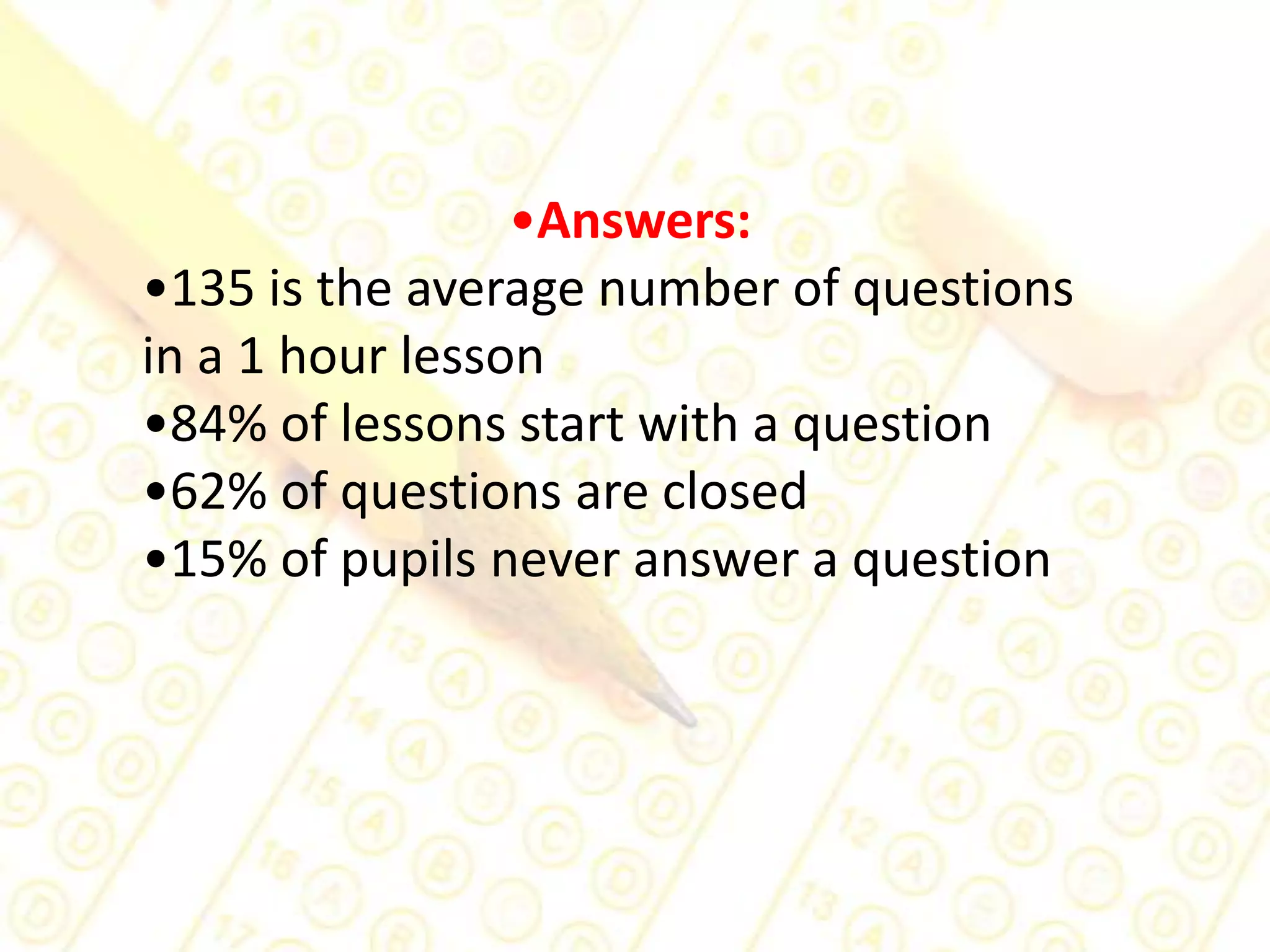
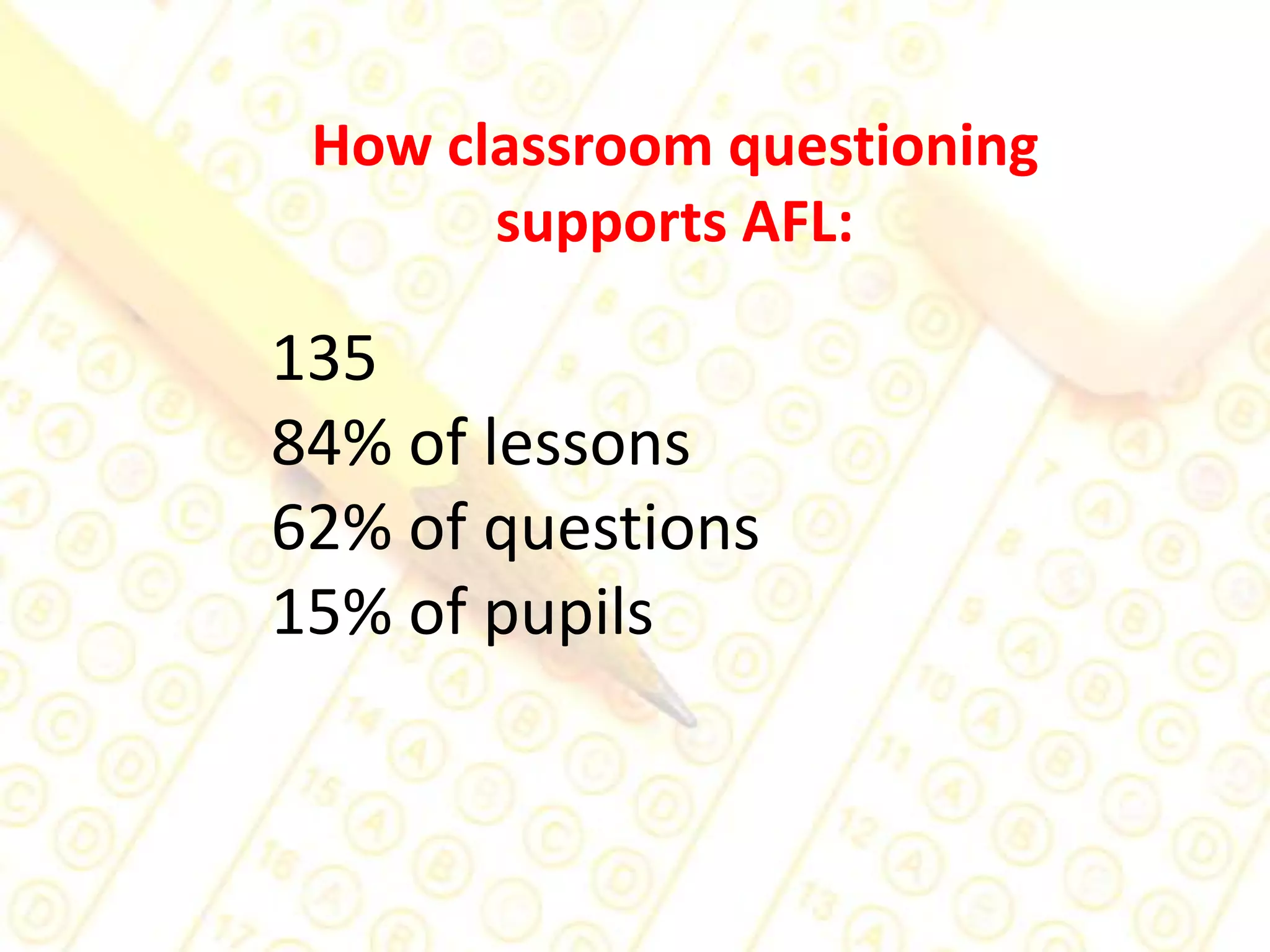
    How classroom questioningsupports AFL:13584% of lessons62% of questions15% of pupils
  • 47.
  • 48.
    135 is theaverage number of questions in a 1 hour lesson
  • 49.
    84% of lessonsstart with a question
  • 50.
  • 51.
    15% of pupilsnever answer a questionPersonalised Questioning to support your lessons’ AFL• Hands down: teacher selects pupil(s) to answer• Wait time: all pupils have the opportunity to think before answering• Pupils encouraged to consult in their group/with a partner in order to formulate an answer• Teacher involves a number of pupils in the answer to a single question, creating the opportunity for discussion, eg “What do you think?” “Do you agree with that answer?”• Use of wrong answers to develop understanding• Appropriateness of questions; fit for purpose• Quality of questions – good question stems, eg “Why does…?” “What if…?” “How would you..?” “Could you explain….?• Opportunities for pupils to formulate questions
  • 52.
    Personalised QuestioningTips forasking questions• Extend thinking time after you have asked a question and after a first response• Adopt a rule of ‘No hands up’• Avoid the temptation to prompt, provide the answer or move on to someone else• Ask questions randomly and return to the same pupils on two or three occasions• If pupils cannot answer a question, leave it with them and say you will come back to them after they have thought about it. Don’t forget to go back!• Ask pupils to work in pairs on your questions (KAGAN) – discussion encourages collaboration and clarification of thought
  • 53.
    EvaluationGenerating new ideas,products, or ways of viewing things. Designing, constructing, planning, producing, inventingSynthesisJustifying a decision or course of action. Checking, hypothesising, critiquing, experimenting, judgingAnalysisBreaking information into parts to explore understandings and relationships. Comparing, organising, deconstructing, interrogating, findingApplicationUsing information in another familiar situation. Implementing, carrying out, using, executingComprehensionExplaining ideas or concepts. Interpreting, summarising, paraphrasing, classifying, explainingKnowledgeRecalling information. Recognising, listing, describing, retrieving, naming.QUESTIONING FOR LEARNING: BLOOM’S TAXONOMYAll of these come into effect when you offer pupils’ the assessment grids
  • 54.
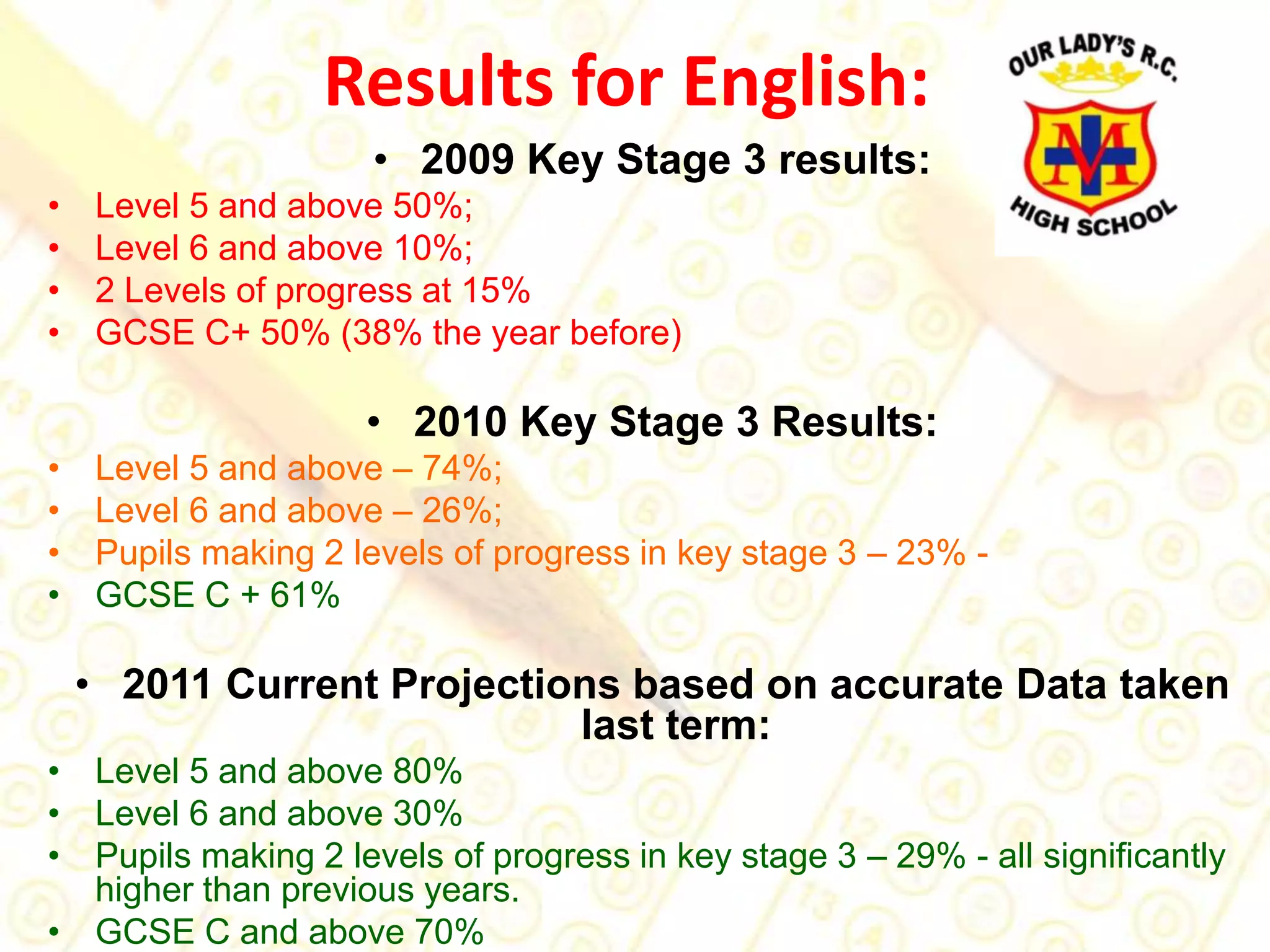
    Results for English:2009Key Stage 3 results:Level 5 and above 50%; Level 6 and above 10%; 2 Levels of progress at 15%GCSE C+ 50% (38% the year before)2010 Key Stage 3 Results:Level 5 and above – 74%; Level 6 and above – 26%; Pupils making 2 levels of progress in key stage 3 – 23% - GCSE C + 61%2011 Current Projections based on accurate Data taken last term:Level 5 and above 80%Level 6 and above 30%Pupils making 2 levels of progress in key stage 3 – 29% - all significantly higher than previous years.GCSE C and above 70%
  • 55.
    Aims of this“Information Session” To know what AFL is, but more importantly, what it isn’t.To recognise how important AFL is in helping pupil’s to develop.To share ideas for good practice.

Editor's Notes

  • #24 Once everyone has finished drawing their school, get them to pass their drawing to some one else for marking – then display. Clearly, nearly all teachers will score very low marks. However, give the mark scheme to one colleague in advance so that he/she scores 10 out of 10 – the conclusions here are obvious; when we know what to do and how we are going to be assessed we are far more likely to succeed!In the discussion draw out from teachers that this is at the heart of Afl.
  • #25 Once everyone has finished drawing their school, get them to pass their drawing to some one else for marking – then display. Clearly, nearly all teachers will score very low marks. However, give the mark scheme to one colleague in advance so that he/she scores 10 out of 10 – the conclusions here are obvious; when we know what to do and how we are going to be assessed we are far more likely to succeed!In the discussion draw out from teachers that this is at the heart of Afl.
  • #40 The relevance of this slide is to focus on questioning, a crucial skill of the teacher.Here are the answers – what are the questions? Answers:135 is the average number of questions in a 1 hour lesson0.97 seconds is the average wait time84% of lessons start with a question62% of questions are closed15% of pupils never answer a question
  • #41 The relevance of this slide is to focus on questioning, a crucial skill of the teacher.Here are the answers – what are the questions? Answers:135 is the average number of questions in a 1 hour lesson0.97 seconds is the average wait time84% of lessons start with a question62% of questions are closed15% of pupils never answer a question
  • #44 Talk through this: how to use questioning to develop challenge and develop thinking skills. Bloom’s taxonomy is also used to plan differentiated learning objectives – the importance here is to ensure that teachers develop an understanding of personalised questioning, through differentiated challenge.