Writing at Masters levelPGCE SecondaryHetal Patelh.patel@mmu.ac.uk
Aims of this session… 	Understand what critical thinking is and how it applies to your work	General information on structuring your assignment
Everyday Critical Encounters Not accepting things at face value - just because something's in print, it doesn't mean it’s true
 Use your own experience and values to help you think critically. Absence of critical thinkingBelievingalltelevision adverts and everything thatpoliticianssay etc.How do you know this? Why?Theory &PracticeBased on past experience and information presented in newspapersBecause they lieReasoning/ justificationEvidence
Being ‘critical’ at universitySame thinking processLearn not to take academic texts at face valueRead more than one source to gain a rounded critical perspectiveRemember that the author is ‘selling’ you their argument
Five Steps to Critical AnalysisCritical ThinkingStep 5Does it add up?Is the proof valid?Step 4Step 3Where’s the proof?Who is making the claim?Step 2What is the main point of the text?Step 1Adapted from Cottrell (2003)
ExerciseHow critical a reader and self critical a writer are you already?Please complete short ‘tick box’ exercise in hand out. How can you improve on your weak areas?(Wallace and Wray, 2006)
(Cottrell, 2003:232)
FundamentalWhat do I think I know about X?Connecting How does X relate to Y or Z?HypothesisIf X relates to Y or/and Z then A.CriticalIn evaluating X, Y, Z and A what is my 	argument?Adapted from Jones (2009: 8)
FundamentalWhat difficulties do pupils with English as an additional language (EAL) face in a classroom setting?Connecting What methods are used to reduce these difficulties?HypothesisWhat are the implications of using these methods in a classroom setting?CriticalEvaluate the methods used to reduce the difficulties that pupils with EAL face in the classroom setting.  Adapted from Jones (2009: 8)
Critical reading – assess the extent to which adequate justification has been provided for the claims made. This depends on the author’s argument and on your own knowledge, experience & understandingCritical writing – convince your tutor of your argument by adequate reasons and evidence.
RememberYou will not be able to include EVERYTHING in your assignmentChoose which points you think are importantFocus on QUALITY and not quantity
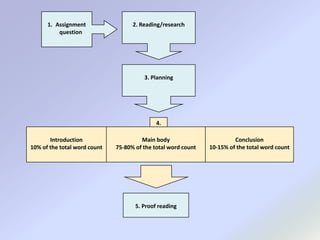
Assignment question2. Reading/research3. Planning4.Introduction10% of the total word countMain body75-80% of the total word countConclusion10-15% of the total word count5. Proof reading
Answering the questionAvoid deviating – answer must relate to the questionAnswer all parts of the question – divide the word count between the sectionsAssignment question2. Reading/research3. PlanningAssignment questionBreak it down - look for key words1. Academic key words:http://www.uefap.com/writing/writfram.htm2. Identify the topic/s and the focus4.Introduction10% of the total word countMain body75-80% of the total word countConclusion10-15% of the total word count5. Proof reading
Assignment question2. Reading/research3. PlanningReading around the subject areaDevelop your arguments Need evidence to back up your points.4.Introduction10% of the total word countMain body75-80% of the total word countConclusion10-15% of the total word count5. Proof reading
Assignment question2. Reading/research3. PlanningYour argument should follow a logical orderWhat information should you keep in and what should you to leave out4.Introduction10% of the total word countMain body75-80% of the total word countConclusion10-15% of the total word count5. Proof reading
General structure
Assignment question2. Reading/research3. PlanningGeneral background information on the assignmentContents of your essay?What are the main points?What order have they been addressed?4.Introduction10% of the total word countMain body75-80% of the total word countConclusion10-15% of the total word count5. Proof reading
Assignment question2. Reading/research3. PlanningDevelop your argument and put forward your line of reasoning. Structure your argument!Each paragraph should cover one theme4.Introduction10% of the total word countMain body75-80% of the total word countConclusion10-15% of the total word count5. Proof reading
Assignment question2. Reading/research3. PlanningDraw together the main pointsDo NOT introduce new material4.Introduction10% of the total word countMain body75-80% of the total word countConclusion10-15% of the total word count5. Proof reading
Assignment question2. Reading/research3. Planning4.Introduction10% of the total word countMain body75-80% of the total word countConclusion10-15% of the total word count5. Proof reading
Top tipsMake sure you leave enoughtime to complete your assignmentDon’t leave your reference list until the end – do it as you do your research/ writing
Help with referencing and plagiarism:http://www.youtube.com/user/mmudegreeskills
ANY QUESTIONS?
ReferencesCottrell, S. (2003) The Study Skills Handbook. 2nd ed. Basingstoke: Palgrave MacmillanJones, S. (2009) Critical learning for social work student. Exeter: Learning MattersWarren, M. and Wray, A. (2006) Critical reading and writing for postgraduates. London: SAGE Publications Ltd.
M Level Writing

M Level Writing

  • 1.
    Writing at MasterslevelPGCE SecondaryHetal Patelh.patel@mmu.ac.uk
  • 2.
    Aims of thissession… Understand what critical thinking is and how it applies to your work General information on structuring your assignment
  • 3.
    Everyday Critical EncountersNot accepting things at face value - just because something's in print, it doesn't mean it’s true
  • 4.
    Use yourown experience and values to help you think critically. Absence of critical thinkingBelievingalltelevision adverts and everything thatpoliticianssay etc.How do you know this? Why?Theory &PracticeBased on past experience and information presented in newspapersBecause they lieReasoning/ justificationEvidence
  • 5.
    Being ‘critical’ atuniversitySame thinking processLearn not to take academic texts at face valueRead more than one source to gain a rounded critical perspectiveRemember that the author is ‘selling’ you their argument
  • 6.
    Five Steps toCritical AnalysisCritical ThinkingStep 5Does it add up?Is the proof valid?Step 4Step 3Where’s the proof?Who is making the claim?Step 2What is the main point of the text?Step 1Adapted from Cottrell (2003)
  • 7.
    ExerciseHow critical areader and self critical a writer are you already?Please complete short ‘tick box’ exercise in hand out. How can you improve on your weak areas?(Wallace and Wray, 2006)
  • 8.
  • 9.
    FundamentalWhat do Ithink I know about X?Connecting How does X relate to Y or Z?HypothesisIf X relates to Y or/and Z then A.CriticalIn evaluating X, Y, Z and A what is my argument?Adapted from Jones (2009: 8)
  • 10.
    FundamentalWhat difficulties dopupils with English as an additional language (EAL) face in a classroom setting?Connecting What methods are used to reduce these difficulties?HypothesisWhat are the implications of using these methods in a classroom setting?CriticalEvaluate the methods used to reduce the difficulties that pupils with EAL face in the classroom setting. Adapted from Jones (2009: 8)
  • 11.
    Critical reading –assess the extent to which adequate justification has been provided for the claims made. This depends on the author’s argument and on your own knowledge, experience & understandingCritical writing – convince your tutor of your argument by adequate reasons and evidence.
  • 12.
    RememberYou will notbe able to include EVERYTHING in your assignmentChoose which points you think are importantFocus on QUALITY and not quantity
  • 13.
    Assignment question2. Reading/research3.Planning4.Introduction10% of the total word countMain body75-80% of the total word countConclusion10-15% of the total word count5. Proof reading
  • 14.
    Answering the questionAvoiddeviating – answer must relate to the questionAnswer all parts of the question – divide the word count between the sectionsAssignment question2. Reading/research3. PlanningAssignment questionBreak it down - look for key words1. Academic key words:http://www.uefap.com/writing/writfram.htm2. Identify the topic/s and the focus4.Introduction10% of the total word countMain body75-80% of the total word countConclusion10-15% of the total word count5. Proof reading
  • 15.
    Assignment question2. Reading/research3.PlanningReading around the subject areaDevelop your arguments Need evidence to back up your points.4.Introduction10% of the total word countMain body75-80% of the total word countConclusion10-15% of the total word count5. Proof reading
  • 16.
    Assignment question2. Reading/research3.PlanningYour argument should follow a logical orderWhat information should you keep in and what should you to leave out4.Introduction10% of the total word countMain body75-80% of the total word countConclusion10-15% of the total word count5. Proof reading
  • 17.
  • 18.
    Assignment question2. Reading/research3.PlanningGeneral background information on the assignmentContents of your essay?What are the main points?What order have they been addressed?4.Introduction10% of the total word countMain body75-80% of the total word countConclusion10-15% of the total word count5. Proof reading
  • 19.
    Assignment question2. Reading/research3.PlanningDevelop your argument and put forward your line of reasoning. Structure your argument!Each paragraph should cover one theme4.Introduction10% of the total word countMain body75-80% of the total word countConclusion10-15% of the total word count5. Proof reading
  • 20.
    Assignment question2. Reading/research3.PlanningDraw together the main pointsDo NOT introduce new material4.Introduction10% of the total word countMain body75-80% of the total word countConclusion10-15% of the total word count5. Proof reading
  • 21.
    Assignment question2. Reading/research3.Planning4.Introduction10% of the total word countMain body75-80% of the total word countConclusion10-15% of the total word count5. Proof reading
  • 22.
    Top tipsMake sureyou leave enoughtime to complete your assignmentDon’t leave your reference list until the end – do it as you do your research/ writing
  • 23.
    Help with referencingand plagiarism:http://www.youtube.com/user/mmudegreeskills
  • 24.
  • 25.
    ReferencesCottrell, S. (2003)The Study Skills Handbook. 2nd ed. Basingstoke: Palgrave MacmillanJones, S. (2009) Critical learning for social work student. Exeter: Learning MattersWarren, M. and Wray, A. (2006) Critical reading and writing for postgraduates. London: SAGE Publications Ltd.

Editor's Notes

  • #8 You need to critically read all the sources that you use. These questions will help with assignment activity 2. You may not include the answers in your written summary and reflection.
  • #10 For all three of your tasks and the essay, you’ll need to ensure that you don’t just describe what happened but that you reflect and critically evaluate.