WELCOME TO THE
PROFESSIONAL DEVELOPMENT DAY 2
UsingAssessmenttoSupportTeaching
andLearningintheClassroom
Sharing the Learning Intentions
Compare different modes of Assessment and describe how
they can be applied in your teaching

Describe how you can develop Questioning skills in
Assessment for Learning in your classes

Describe the benefits of Peer and Self Assessment and how
they can be applied in your class

l... 
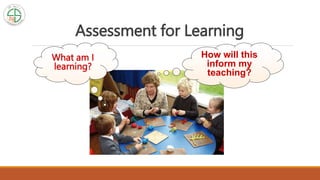
Assessment for Learning
What am I
learning?
How will this
inform my
teaching?
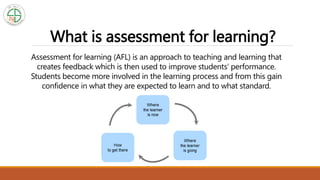
What is assessment for learning?
Assessment for learning (AFL) is an approach to teaching and learning that
creates feedback which is then used to improve students’ performance.
Students become more involved in the learning process and from this gain
confidence in what they are expected to learn and to what standard.
Assessment is the process of gathering information
about children’s learning
Purpose of
Learning
Schemes of assessment should:
Provide information about what students know and what they can do
Enhance the quality of learning
Measure progress made by students
Certify achievement
Motivate
Supply information for teachers, students and parents that enables them to
direct future strategies for teaching and learning
Allow and encourage students to become reflective and independent learners
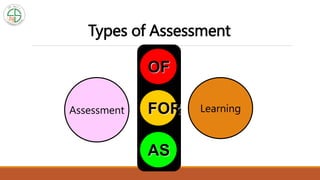
Types of Assessment
Assessment Learning
FOR
OF
AS
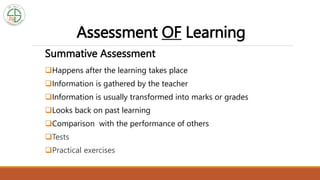
Assessment OF Learning
Summative Assessment
Happens after the learning takes place
Information is gathered by the teacher
Information is usually transformed into marks or grades
Looks back on past learning
Comparison with the performance of others
Tests
Practical exercises
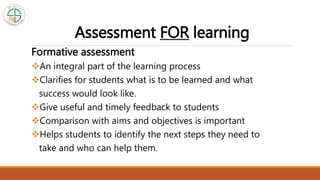
Assessment FOR learning
Formative assessment
An integral part of the learning process
Clarifies for students what is to be learned and what
success would look like.
Give useful and timely feedback to students
Comparison with aims and objectives is important
Helps students to identify the next steps they need to
take and who can help them.
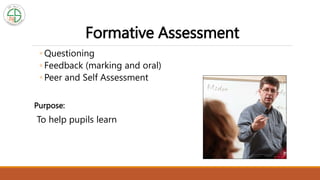
Formative Assessment
◦ Questioning
◦ Feedback (marking and oral)
◦ Peer and Self Assessment
Purpose:
To help pupils learn
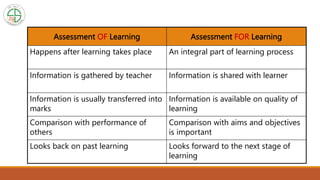
Assessment OF Learning Assessment FOR Learning
Happens after learning takes place An integral part of learning process
Information is gathered by teacher Information is shared with learner
Information is usually transferred into
marks
Information is available on quality of
learning
Comparison with performance of
others
Comparison with aims and objectives
is important
Looks back on past learning Looks forward to the next stage of
learning
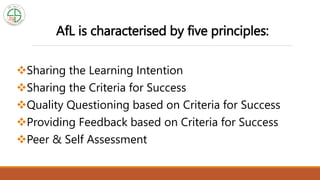
AfL is characterised by five principles:
Sharing the Learning Intention
Sharing the Criteria for Success
Quality Questioning based on Criteria for Success
Providing Feedback based on Criteria for Success
Peer & Self Assessment
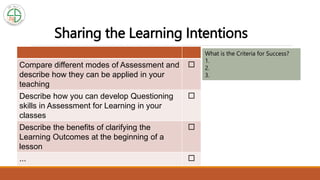
Sharing the Learning Intentions
Compare different modes of Assessment and
describe how they can be applied in your
teaching

Describe how you can develop Questioning
skills in Assessment for Learning in your
classes

Describe the benefits of clarifying the
Learning Outcomes at the beginning of a
lesson

... 
What is the Criteria for Success?
1.
2.
3.
How well can you draw?
As a student sitting the first exam, your
task is to draw a house and give it a
name
You have 60 seconds
Best of luck
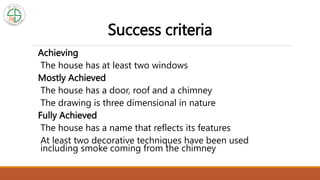
Success criteria
Achieving
The house has at least two windows
Mostly Achieved
The house has a door, roof and a chimney
The drawing is three dimensional in nature
Fully Achieved
The house has a name that reflects its features
At least two decorative techniques have been used
including smoke coming from the chimney
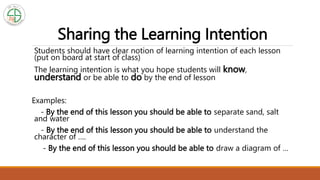
Sharing the Learning Intention
Students should have clear notion of learning intention of each lesson
(put on board at start of class)
The learning intention is what you hope students will know,
understand or be able to do by the end of lesson
Examples:
- By the end of this lesson you should be able to separate sand, salt
and water
- By the end of this lesson you should be able to understand the
character of ….
- By the end of this lesson you should be able to draw a diagram of …
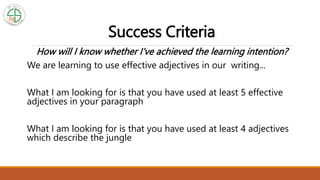
Success Criteria
How will I know whether I've achieved the learning intention?
We are learning to use effective adjectives in our writing...
What I am looking for is that you have used at least 5 effective
adjectives in your paragraph
What I am looking for is that you have used at least 4 adjectives
which describe the jungle
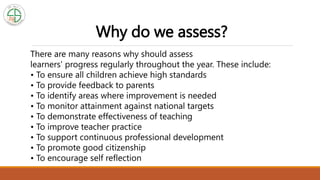
Why do we assess?
There are many reasons why should assess
learners' progress regularly throughout the year. These include:
• To ensure all children achieve high standards
• To provide feedback to parents
• To identify areas where improvement is needed
• To monitor attainment against national targets
• To demonstrate effectiveness of teaching
• To improve teacher practice
• To support continuous professional development
• To promote good citizenship
• To encourage self reflection
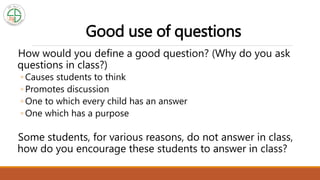
Good use of questions
How would you define a good question? (Why do you ask
questions in class?)
◦ Causes students to think
◦ Promotes discussion
◦ One to which every child has an answer
◦ One which has a purpose
Some students, for various reasons, do not answer in class,
how do you encourage these students to answer in class?
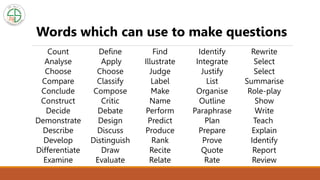
Count Define Find Identify Rewrite
Analyse Apply Illustrate Integrate Select
Choose Choose Judge Justify Select
Compare Classify Label List Summarise
Conclude Compose Make Organise Role-play
Construct Critic Name Outline Show
Decide Debate Perform Paraphrase Write
Demonstrate Design Predict Plan Teach
Describe Discuss Produce Prepare Explain
Develop Distinguish Rank Prove Identify
Differentiate Draw Recite Quote Report
Examine Evaluate Relate Rate Review
Words which can use to make questions
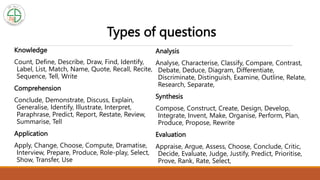
Knowledge
Count, Define, Describe, Draw, Find, Identify,
Label, List, Match, Name, Quote, Recall, Recite,
Sequence, Tell, Write
Comprehension
Conclude, Demonstrate, Discuss, Explain,
Generalise, Identify, Illustrate, Interpret,
Paraphrase, Predict, Report, Restate, Review,
Summarise, Tell
Application
Apply, Change, Choose, Compute, Dramatise,
Interview, Prepare, Produce, Role-play, Select,
Show, Transfer, Use
Analysis
Analyse, Characterise, Classify, Compare, Contrast,
Debate, Deduce, Diagram, Differentiate,
Discriminate, Distinguish, Examine, Outline, Relate,
Research, Separate,
Synthesis
Compose, Construct, Create, Design, Develop,
Integrate, Invent, Make, Organise, Perform, Plan,
Produce, Propose, Rewrite
Evaluation
Appraise, Argue, Assess, Choose, Conclude, Critic,
Decide, Evaluate, Judge, Justify, Predict, Prioritise,
Prove, Rank, Rate, Select,
Types of questions
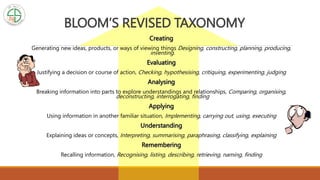
BLOOM’S REVISED TAXONOMY
Creating
Generating new ideas, products, or ways of viewing things Designing, constructing, planning, producing,
inventing.
Evaluating
Justifying a decision or course of action, Checking, hypothesising, critiquing, experimenting, judging
Analysing
Breaking information into parts to explore understandings and relationships, Comparing, organising,
deconstructing, interrogating, finding
Applying
Using information in another familiar situation, Implementing, carrying out, using, executing
Understanding
Explaining ideas or concepts, Interpreting, summarising, paraphrasing, classifying, explaining
Remembering
Recalling information, Recognising, listing, describing, retrieving, naming, finding
Assessment for learning in practice
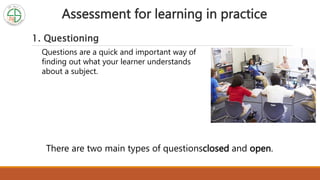
1. Questioning
Questions are a quick and important way of
finding out what your learner understands
about a subject.
There are two main types of questionsclosed and open.
Assessment for learning in practice
1. Questioning
A closed question requires a short answer, such as remembering a fact.
The answer is usually right or wrong.
For example, a Geography teacher might ask:
‘What is the capital of Peru?’
One way to help increase ‘wait time’, and to ensure the whole class is actively engaged, is
to ask your learners to write down the answer to a closed question on a piece of paper,
mini whiteboard or tablet, and hold it up. This immediately gives you feedback about
who understands, who does not, and therefore what the next steps in the learning might
be.
Assessment for learning in practice
1. Questioning
Open questions need longer answers, and often require the learner to
provide an opinion.
E.g. A Physics teacher might ask: ‘What will happen to the flow of
water through a hose pipe if a smaller nozzle is fitted to it? Explain how
this relates to the study of voltage, current and resistance in a simple
electric circuit.’
AfL – questioning
type of questions...
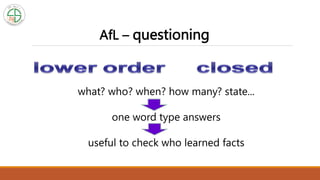
AfL – questioning
what? who? when? how many? state...
one word type answers
useful to check who learned facts
AfL – questioning
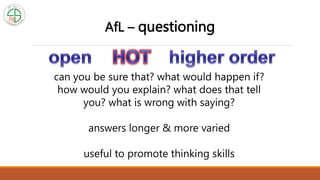
can you be sure that? what would happen if?
how would you explain? what does that tell
you? what is wrong with saying?
answers longer & more varied
useful to promote thinking skills
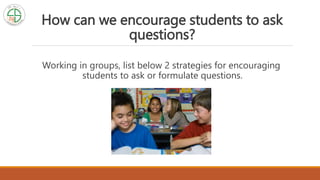
How can we encourage students to ask
questions?
Working in groups, list below 2 strategies for encouraging
students to ask or formulate questions.
Use of Questions
When looking at questioning in the classroom we should
consider:
◦ Wait time
◦ Variety of questioning
◦ Developing key questions (for key stages of the lesson)
◦ Quality of questions (why does..? Could you explain..?)
◦ Well thought out questions
◦ Involving more than one student in the answer
◦ No Hands Up
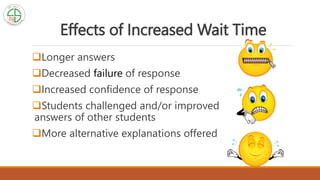
Effects of Increased Wait Time
Longer answers
Decreased failure of response
Increased confidence of response
Students challenged and/or improved
answers of other students
More alternative explanations offered
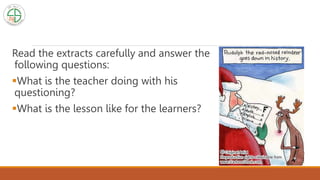
Read the extracts carefully and answer the
following questions:
What is the teacher doing with his
questioning?
What is the lesson like for the learners?
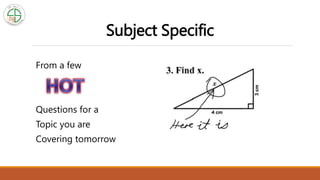
Subject Specific
From a few
Questions for a
Topic you are
Covering tomorrow
Classroom Strategies:
Ask Better Questions
◦ Ask fewer questions.
◦ Variety of questions
◦ Sequence questions.
◦ Prepare key questions
◦ Developing key questions (for key
stages of the lesson)
◦ Quality of questions (why does..?
Could you explain..?)
◦ Well thought out questions
oInvolve more than one student
in the answer
oInvolve the whole class.
oThink, pair, share, square.
oWait-time (1 and 2)
oTry no hands up.
oTraffic lights
Question Stems
How can we be sure that ...?
What is the same and what is different about …?
Is it ever/always true/false that …?
Why do ____, ____ and ____ all give the same answer?
How do you ….?
How would you explain …?
What does that tell us about …?
What is wrong with …?
Why is _____ true?
ACTIVITY - pick a topic you are going to
teach. Can you formulate questions using
the stems. What sort of answers might you
expect and how would you deal with that?
What are the question techniques using in your
own classroom?
Reflection
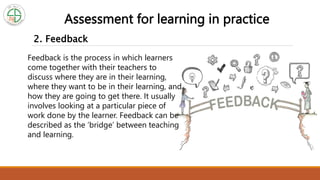
2. Feedback
Assessment for learning in practice
Feedback is the process in which learners
come together with their teachers to
discuss where they are in their learning,
where they want to be in their learning, and
how they are going to get there. It usually
involves looking at a particular piece of
work done by the learner. Feedback can be
described as the ‘bridge’ between teaching
and learning.
Feedback through marking
How clear is the feedback we give the students?
◦ ‘you must try harder’
◦ ‘develop these ideas further’
◦ ‘good work keep it up’
◦ ‘more detailed needed here’
How does the student interpret the feedback?
◦ ‘a tick means he probably likes it’
◦ ‘there is a lot of writing at end this means it is bad’
◦ ‘this is one of my best because my hand writing is neat, I
checked my spellings and I put in the date’
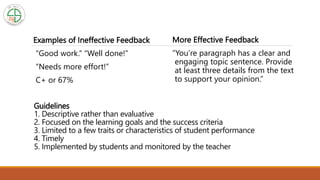
Guidelines
1. Descriptive rather than evaluative
2. Focused on the learning goals and the success criteria
3. Limited to a few traits or characteristics of student performance
4. Timely
5. Implemented by students and monitored by the teacher
Examples of Ineffective Feedback
“Good work.” “Well done!”
“Needs more effort!”
C+ or 67%
More Effective Feedback
“You’re paragraph has a clear and
engaging topic sentence. Provide
at least three details from the text
to support your opinion.”
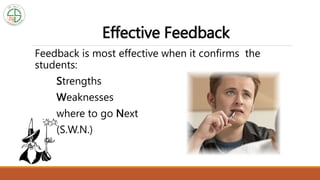
Effective Feedback
Feedback is most effective when it confirms the
students:
Strengths
Weaknesses
where to go Next
(S.W.N.)
Feedback and Motivation
Timing of feedback is crucial
Minimal intervention promotes better learning
Feedback should focus on what needs to be done to
improve, rather than on how well the student has done
Feedback should be designed to lead students to
believe ability is incremental, not fixed.
Think about a time when you gave feedback to a
learner that could be described as more ego-
specific than task specific. What might you have
done differently?
Reflection
3. Peer assessment or peer feedback
Assessment for learning in practice
Peer feedback, or peer assessment, is the process by which learners
assess each other’s work and give each other feedback. This feedback is
based on an understanding of what makes a successful piece of work.
The teacher is vital to this process, as teachers know their learners and
can help them to develop their critical and reflective thinking skills.
Giving learners independence is a great way for them to take
responsibility for their own learning. Peer feedback also helps learners to
develop their social skills and to use higher-level skills such as thinking
critically and analytically.
4. Self-
assessment
Assessment for learning in practice
In self-assessment a learner evaluates their own work, and
thinks about their own learning. This helps them to make
sense of what the teacher says, relate it to previous learning
and use this for new learning. Ultimately, self-assessment
enables learners to set their own learning goals and be
responsible for their own learning.
"Students need to learn for themselves how
they move up to the next level."
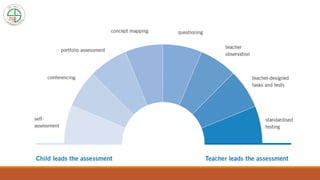
Self assessment
Traffic lights system
Mark own work using marking scheme
Use checking sheets
Graphic Organisers
Flash Cards
Self Assessment
Children looking at their own work in a reflective way -
metacognition
Whole class, group , individual
Criteria must be agreed beforehand by the teacher
Fosters independence and motivation and positive classroom
climate
Can be shared with other parties
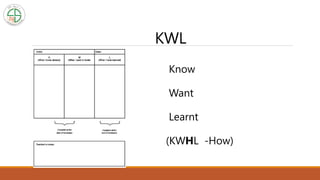
KWL
Know
Want
Learnt
(KWHL -How)
REFLECTION
Reflect YOURSELF about
todays PD session topic
Assessment to support teaching ad learning in the classroom

Assessment to support teaching ad learning in the classroom

  • 1.
    WELCOME TO THE PROFESSIONALDEVELOPMENT DAY 2 UsingAssessmenttoSupportTeaching andLearningintheClassroom
  • 2.
    Sharing the LearningIntentions Compare different modes of Assessment and describe how they can be applied in your teaching  Describe how you can develop Questioning skills in Assessment for Learning in your classes  Describe the benefits of Peer and Self Assessment and how they can be applied in your class  l... 
  • 4.
    Assessment for Learning Whatam I learning? How will this inform my teaching?
  • 5.
    What is assessmentfor learning? Assessment for learning (AFL) is an approach to teaching and learning that creates feedback which is then used to improve students’ performance. Students become more involved in the learning process and from this gain confidence in what they are expected to learn and to what standard.
  • 6.
    Assessment is theprocess of gathering information about children’s learning Purpose of Learning
  • 7.
    Schemes of assessmentshould: Provide information about what students know and what they can do Enhance the quality of learning Measure progress made by students Certify achievement Motivate Supply information for teachers, students and parents that enables them to direct future strategies for teaching and learning Allow and encourage students to become reflective and independent learners
  • 8.
  • 9.
    Assessment OF Learning SummativeAssessment Happens after the learning takes place Information is gathered by the teacher Information is usually transformed into marks or grades Looks back on past learning Comparison with the performance of others Tests Practical exercises
  • 10.
    Assessment FOR learning Formativeassessment An integral part of the learning process Clarifies for students what is to be learned and what success would look like. Give useful and timely feedback to students Comparison with aims and objectives is important Helps students to identify the next steps they need to take and who can help them.
  • 11.
    Formative Assessment ◦ Questioning ◦Feedback (marking and oral) ◦ Peer and Self Assessment Purpose: To help pupils learn
  • 13.
    Assessment OF LearningAssessment FOR Learning Happens after learning takes place An integral part of learning process Information is gathered by teacher Information is shared with learner Information is usually transferred into marks Information is available on quality of learning Comparison with performance of others Comparison with aims and objectives is important Looks back on past learning Looks forward to the next stage of learning
  • 15.
    AfL is characterisedby five principles: Sharing the Learning Intention Sharing the Criteria for Success Quality Questioning based on Criteria for Success Providing Feedback based on Criteria for Success Peer & Self Assessment
  • 16.
    Sharing the LearningIntentions Compare different modes of Assessment and describe how they can be applied in your teaching  Describe how you can develop Questioning skills in Assessment for Learning in your classes  Describe the benefits of clarifying the Learning Outcomes at the beginning of a lesson  ...  What is the Criteria for Success? 1. 2. 3.
  • 17.
    How well canyou draw? As a student sitting the first exam, your task is to draw a house and give it a name You have 60 seconds Best of luck
  • 18.
    Success criteria Achieving The househas at least two windows Mostly Achieved The house has a door, roof and a chimney The drawing is three dimensional in nature Fully Achieved The house has a name that reflects its features At least two decorative techniques have been used including smoke coming from the chimney
  • 19.
    Sharing the LearningIntention Students should have clear notion of learning intention of each lesson (put on board at start of class) The learning intention is what you hope students will know, understand or be able to do by the end of lesson Examples: - By the end of this lesson you should be able to separate sand, salt and water - By the end of this lesson you should be able to understand the character of …. - By the end of this lesson you should be able to draw a diagram of …
  • 20.
    Success Criteria How willI know whether I've achieved the learning intention? We are learning to use effective adjectives in our writing... What I am looking for is that you have used at least 5 effective adjectives in your paragraph What I am looking for is that you have used at least 4 adjectives which describe the jungle
  • 21.
    Why do weassess? There are many reasons why should assess learners' progress regularly throughout the year. These include: • To ensure all children achieve high standards • To provide feedback to parents • To identify areas where improvement is needed • To monitor attainment against national targets • To demonstrate effectiveness of teaching • To improve teacher practice • To support continuous professional development • To promote good citizenship • To encourage self reflection
  • 22.
    Good use ofquestions How would you define a good question? (Why do you ask questions in class?) ◦ Causes students to think ◦ Promotes discussion ◦ One to which every child has an answer ◦ One which has a purpose Some students, for various reasons, do not answer in class, how do you encourage these students to answer in class?
  • 23.
    Count Define FindIdentify Rewrite Analyse Apply Illustrate Integrate Select Choose Choose Judge Justify Select Compare Classify Label List Summarise Conclude Compose Make Organise Role-play Construct Critic Name Outline Show Decide Debate Perform Paraphrase Write Demonstrate Design Predict Plan Teach Describe Discuss Produce Prepare Explain Develop Distinguish Rank Prove Identify Differentiate Draw Recite Quote Report Examine Evaluate Relate Rate Review Words which can use to make questions
  • 24.
    Knowledge Count, Define, Describe,Draw, Find, Identify, Label, List, Match, Name, Quote, Recall, Recite, Sequence, Tell, Write Comprehension Conclude, Demonstrate, Discuss, Explain, Generalise, Identify, Illustrate, Interpret, Paraphrase, Predict, Report, Restate, Review, Summarise, Tell Application Apply, Change, Choose, Compute, Dramatise, Interview, Prepare, Produce, Role-play, Select, Show, Transfer, Use Analysis Analyse, Characterise, Classify, Compare, Contrast, Debate, Deduce, Diagram, Differentiate, Discriminate, Distinguish, Examine, Outline, Relate, Research, Separate, Synthesis Compose, Construct, Create, Design, Develop, Integrate, Invent, Make, Organise, Perform, Plan, Produce, Propose, Rewrite Evaluation Appraise, Argue, Assess, Choose, Conclude, Critic, Decide, Evaluate, Judge, Justify, Predict, Prioritise, Prove, Rank, Rate, Select, Types of questions
  • 25.
    BLOOM’S REVISED TAXONOMY Creating Generatingnew ideas, products, or ways of viewing things Designing, constructing, planning, producing, inventing. Evaluating Justifying a decision or course of action, Checking, hypothesising, critiquing, experimenting, judging Analysing Breaking information into parts to explore understandings and relationships, Comparing, organising, deconstructing, interrogating, finding Applying Using information in another familiar situation, Implementing, carrying out, using, executing Understanding Explaining ideas or concepts, Interpreting, summarising, paraphrasing, classifying, explaining Remembering Recalling information, Recognising, listing, describing, retrieving, naming, finding
  • 26.
    Assessment for learningin practice 1. Questioning Questions are a quick and important way of finding out what your learner understands about a subject. There are two main types of questionsclosed and open.
  • 27.
    Assessment for learningin practice 1. Questioning A closed question requires a short answer, such as remembering a fact. The answer is usually right or wrong. For example, a Geography teacher might ask: ‘What is the capital of Peru?’ One way to help increase ‘wait time’, and to ensure the whole class is actively engaged, is to ask your learners to write down the answer to a closed question on a piece of paper, mini whiteboard or tablet, and hold it up. This immediately gives you feedback about who understands, who does not, and therefore what the next steps in the learning might be.
  • 28.
    Assessment for learningin practice 1. Questioning Open questions need longer answers, and often require the learner to provide an opinion. E.g. A Physics teacher might ask: ‘What will happen to the flow of water through a hose pipe if a smaller nozzle is fitted to it? Explain how this relates to the study of voltage, current and resistance in a simple electric circuit.’
  • 29.
    AfL – questioning typeof questions...
  • 30.
    AfL – questioning what?who? when? how many? state... one word type answers useful to check who learned facts
  • 31.
    AfL – questioning canyou be sure that? what would happen if? how would you explain? what does that tell you? what is wrong with saying? answers longer & more varied useful to promote thinking skills
  • 32.
    How can weencourage students to ask questions? Working in groups, list below 2 strategies for encouraging students to ask or formulate questions.
  • 33.
    Use of Questions Whenlooking at questioning in the classroom we should consider: ◦ Wait time ◦ Variety of questioning ◦ Developing key questions (for key stages of the lesson) ◦ Quality of questions (why does..? Could you explain..?) ◦ Well thought out questions ◦ Involving more than one student in the answer ◦ No Hands Up
  • 34.
    Effects of IncreasedWait Time Longer answers Decreased failure of response Increased confidence of response Students challenged and/or improved answers of other students More alternative explanations offered
  • 35.
    Read the extractscarefully and answer the following questions: What is the teacher doing with his questioning? What is the lesson like for the learners?
  • 36.
    Subject Specific From afew Questions for a Topic you are Covering tomorrow
  • 37.
    Classroom Strategies: Ask BetterQuestions ◦ Ask fewer questions. ◦ Variety of questions ◦ Sequence questions. ◦ Prepare key questions ◦ Developing key questions (for key stages of the lesson) ◦ Quality of questions (why does..? Could you explain..?) ◦ Well thought out questions oInvolve more than one student in the answer oInvolve the whole class. oThink, pair, share, square. oWait-time (1 and 2) oTry no hands up. oTraffic lights
  • 38.
    Question Stems How canwe be sure that ...? What is the same and what is different about …? Is it ever/always true/false that …? Why do ____, ____ and ____ all give the same answer? How do you ….? How would you explain …? What does that tell us about …? What is wrong with …? Why is _____ true?
  • 39.
    ACTIVITY - picka topic you are going to teach. Can you formulate questions using the stems. What sort of answers might you expect and how would you deal with that?
  • 40.
    What are thequestion techniques using in your own classroom? Reflection
  • 41.
    2. Feedback Assessment forlearning in practice Feedback is the process in which learners come together with their teachers to discuss where they are in their learning, where they want to be in their learning, and how they are going to get there. It usually involves looking at a particular piece of work done by the learner. Feedback can be described as the ‘bridge’ between teaching and learning.
  • 42.
    Feedback through marking Howclear is the feedback we give the students? ◦ ‘you must try harder’ ◦ ‘develop these ideas further’ ◦ ‘good work keep it up’ ◦ ‘more detailed needed here’ How does the student interpret the feedback? ◦ ‘a tick means he probably likes it’ ◦ ‘there is a lot of writing at end this means it is bad’ ◦ ‘this is one of my best because my hand writing is neat, I checked my spellings and I put in the date’
  • 43.
    Guidelines 1. Descriptive ratherthan evaluative 2. Focused on the learning goals and the success criteria 3. Limited to a few traits or characteristics of student performance 4. Timely 5. Implemented by students and monitored by the teacher Examples of Ineffective Feedback “Good work.” “Well done!” “Needs more effort!” C+ or 67% More Effective Feedback “You’re paragraph has a clear and engaging topic sentence. Provide at least three details from the text to support your opinion.”
  • 44.
    Effective Feedback Feedback ismost effective when it confirms the students: Strengths Weaknesses where to go Next (S.W.N.)
  • 45.
    Feedback and Motivation Timingof feedback is crucial Minimal intervention promotes better learning Feedback should focus on what needs to be done to improve, rather than on how well the student has done Feedback should be designed to lead students to believe ability is incremental, not fixed.
  • 46.
    Think about atime when you gave feedback to a learner that could be described as more ego- specific than task specific. What might you have done differently? Reflection
  • 47.
    3. Peer assessmentor peer feedback Assessment for learning in practice Peer feedback, or peer assessment, is the process by which learners assess each other’s work and give each other feedback. This feedback is based on an understanding of what makes a successful piece of work. The teacher is vital to this process, as teachers know their learners and can help them to develop their critical and reflective thinking skills. Giving learners independence is a great way for them to take responsibility for their own learning. Peer feedback also helps learners to develop their social skills and to use higher-level skills such as thinking critically and analytically.
  • 48.
    4. Self- assessment Assessment forlearning in practice In self-assessment a learner evaluates their own work, and thinks about their own learning. This helps them to make sense of what the teacher says, relate it to previous learning and use this for new learning. Ultimately, self-assessment enables learners to set their own learning goals and be responsible for their own learning. "Students need to learn for themselves how they move up to the next level."
  • 49.
    Self assessment Traffic lightssystem Mark own work using marking scheme Use checking sheets Graphic Organisers Flash Cards
  • 50.
    Self Assessment Children lookingat their own work in a reflective way - metacognition Whole class, group , individual Criteria must be agreed beforehand by the teacher Fosters independence and motivation and positive classroom climate Can be shared with other parties
  • 51.
  • 52.

Editor's Notes

  • #4 I just want to point out this slide at this stage but I will come back to it later.. In terms of AfL… Where am I ? Where do I need to be? How do I get there ? 3 Step Interview or KWL Chart
  • #7 Assessment in education is about gathering, interpreting and using information about the processes and outcomes of learning. Certification: acknowledge that the student has learned (worked), understand (points NB for leaving cert not grades) (& what the teacher has thought) (Good @ this) Differentiate students: into different levels of ability/ achievement/ material learned (Good @ this) Learning: How much have students learned, what have they learned (from what was thought) (Good @ this but not using it well) Diagnosis: find where there are gaps/difficulties in understanding, Check how students understand procedures etc (Poor @ this) Feedback: Confirm that students have worked/not, understand material/not, identify problems (Good @ giving out not at clarifying problems)
  • #11 Sets up the objectives for the class/lesson/topic What we want out of this learning/course/lesson, what a good answer would be Timely feedback; time to change approach, diagnose problems and plan how to address them Clarify the learning gap, give direction where we are going with this topic/lesson etc.
  • #16 What are the objectives of this lesson/topic, what are you going to teach? What are you looking for in this lesson/topic, what is looked for in the exam? What are the key points/concepts/etc Method: a variety of types of questions, different order questions Feedback with direction Teaching students how to assess themselves, what to look for, set their own objectives
  • #20 Remembers doing theorems: QED at the end= sequential learners not given an overview first Setting objectives for lesson; may not meet them/may exceed them – give overview of what you are going to do (Reaffirm, Reaffirm, Reaffirm) Learning intentions are expressed in terms of knowledge, understanding and skills, and link directly with the relevant curriculum objectives. What do I want students to know? What do I want students to understand? What do I want students to be able to do? Learning intentions that focus on knowledge Thinking about the different kinds of knowledge, and being specific about the kind of knowledge that is required in a particular situation, will help teachers design their learning intentions. They consider, for instance, knowledge about a particular topic (know about different types of energy) knowledge of how something is done, of the steps involved in producing something (know how to construct a pie graph) Learning intentions that focus on skills Learning intentions that focus on skills always start with the words 'to be able to' followed by a verb. For example, to be able to write a recount to be able to solve a problem using more than one strategy to be able to work as part of a team Often learning intentions that focus on skills will also imply the acquisition of certain knowledge or understandings. For instance, to be able to write a recount, students must have a knowledge of the structures and features of a recount. Learning intentions that focus on understanding Understanding builds on knowledge and requires some kind of processing. For instance, a student might be able to list the causes of an historical event - thereby showing knowledge of them - but understanding requires analysis and, perhaps, interpretation. Understanding, then, is of a higher cognitive order than knowledge and, in designing learning intentions, teachers ensure that students are exposed to learning which makes those higher demands as well as demands of a lesser nature. understand the causes of an historical event understand the effects of diet on health understand how persuasive language can position the reader to agree with the author understand how the internet can be used for research purposes
  • #21 You’ve done your fortnightly plan so you know what you’re going to teach so tell the children. So you’re not only telling the children what you want them to do in the lesson (the tasks) but also what you hope they will be learning Children are more likely to engage in the task and achieve the learning intention if when stated, it is then followed by an invitation to create the success criteria – i.e. how will we know we’ve achieved this? The purpose of the success criteria – or what we’re looking for – is to make sure the children know what is in the teachers mind as the criteria for judging their work. Very often the children know what they have to do but do not know how the teacher is going to judge their performance. Can be lists of ingredients/ series of steps Brainstorm to achieve success criteria/ give samples – can simply be one statement or a list of success criteria e.g. the “how will we know” needs to state exactly what the children and teacher will want to see. In a learning intention of “using effective adjectives” three alternatives re, success criteria might be What you’re looking for is that you have used at least five effective adjectives in your paragraph; What you’re looking for is that you have used at least four adjectives just before a noun; What you’re looking for is that you used at least four adjectives which describe the jungle. Success criteria need to be brief and succinct, a summary of what has been discussed so far. Need to be visually displayed – 90% of what the brain remembers is derive from visual images – so once the sc are displayed children often look up while they are working to check that they are on task. Shirley says when she works with adults now, she only gives tasks if they are accompanied by a learning intention and success criteria – adult learners need the same visual prompts. You can believe you understand a task presented to you at the time, but once you are engaged in the actual activity, it is easy to loose track of the whole point of the exercise.
  • #23 What is a good question… Causes pupils to think Promotes Discussion One to which every pupil has an answer Has Purpose/ is leading somewhere NB: Create a classroom environment where all students feel safe to take risks and make mistakes
  • #33 Strategies to encourage participation by greatest number of students Pair work Group work “no hands up” approach Invite students to speak by name Create an atmosphere that allows for speculation and/or error Listen and use positive language Allow students to write before they speak
  • #34 When looking at questioning in the classroom we should consider: Wait time (0.6 seconds) Variety of questioning (Redirection, probing, Controversy, Debating) Developing key questions (for key stages of the lesson) Exercise Page 5 Quality of questions (Why does..? Could you explain..?) (Blooms Taxonomy) Well thought out questions Involving more than one student in the answer
  • #35 This is what we found for all 36 of our teachers. more varied answers longer answers better answers more students answering more questions discussion
  • #36 How can we encourage students to ask questions? Use a Question Box Ask for questions for a Class Quiz on a topic Prepare questions for Who wants to be a Millionaire? – simple questions to begin, then on to more difficult Groups form questions Bring a visual image of a topic into class - other students ask questions about it Student presentations on a topic of their choice DVD – students devise questions after the viewing
  • #38 The first thing we can do is to ask better questions by planning more carefully and taking more care when framing our questions. We each need to consider: What do I want my pupils to learn? How will they learn it? How will I find out if they have learnt it? We then must make sure that our questions reinforce the focus for learning and draw out pupils’ understanding of the learning. To start, we should ask fewer questions. Many of the questions we ask pupils are not meant to be answered; they are really instructions (‘Would everyone line up, please?), rhetorical questions (‘Do you think I didn’t see that?’), or answered by the teacher. The first step in asking more effective questions is to ask only the questions that you really want pupils to answer. We should also use more ‘open’ questions. Different types of questions serve different purposes. Some seek facts only and others encourage and extend pupils’ understanding. Where recall is required and you want to find out what your pupils know, closed questions are appropriate. However, when you want to know what they understand, use more open-ended questions (eg Why do you think… Could you tell me more about… or even ‘closed’ questions with more than one possible answer, such as ‘What colour is the sky?’) These will extend learning and aid reflection. You can also think about reframing questions to encourage more thoughtful answers (eg, rather than ask ‘What is 7+8?’, ask ‘How many ways can we make 15?’). Alternatively, to encourage pupils to take risks, you could use ‘Have a go’ questions (perhaps deliberately difficult or open-ended) where pupils do not have to find the right answer but are rewarded for exploring options and sharing possible solutions. Sequencing your questions is also useful. Single, stand-alone questions rarely achieve the kind of outcomes we are aiming for, and a barrage of closed questions can sometimes ‘close down’ the learning. The best questions look ahead and help move the lesson forward. By carefully planning the sequence of questions, you can expand the learning, encourage pupils to the desired outcome/answer and help them on their learning journey. For example, your questions could move from narrow to broad (specific to general) or from broad to narrow (general to specific). Preparing 3-4 ‘key questions’ before a lesson or activity can help you to introduce the lesson and its learning intentions, structure the lesson, make links within the lesson and keep everyone on task. They can be displayed on prompt cards or in the form of a mind map. NCCA mention preparing 1 or 2 HOT questions Wait-time 1 – refers to the amount of time the teacher allows to elapse after he / she has posed a question and before the student begins to speak Wait-time 2 – refers to the amount of time a teacher waits after a student has stopped speaking before saying anything
  • #39 ACTIVITY - pick a topic you are going to teach. Can you formulate questions using the stems. What sort of answers might you expect and how would you deal with that?
  • #43 ‘you must try harder’ to get what? ‘develop these ideas further’ How? ‘good work keep it up’ What is good work? ‘more detailed needed here’ What detail? ‘a tick means he probably likes it’ – I have a lot of writing, spellings are correct, I have every bit of information that is required ‘there is a lot of writing at end this means it is bad’ ‘this is one of my best because my hand writing is neat, I checked my spellings and I put in the date’
  • #46 Feedback tells students where they are, says what’s good about what they’ve done and do to improve their work i.e. how to ‘close the gap’. Managerial feedback dominates – presentation, handwriting, spelling, quantity….. Grades and marks show students where they are at not where they can go……. Ideally feedback should cause thinking, focus on the task not the person. Allow time for students to act on feedback. It s only formative and useful when it is used.
  • #48 According to the literature, peer and self assessment have several advantages over teacher assessed work. They: Require students to take responsibility for their own work (take the initiative) Encourage learning through discussion (students required to justify ideas) Increase motivation and interest Make students think Develop collaboration skills Mark own work in small groups using text-books Group marking of questions; Compare answers and decide which is the best answer 1 + 1 = Students in groups given a problem or similar exercise and asked to present findings to class – peers asked to identify one learning point and make one suggestion to improve
  • #51 Self-assessment is an essential part of AfL. It enables the child to take greater responsibility for his/her own learning. Children are involved in self-assessment when they look at their own work in a reflective way, identify aspects of it that are good and that could be improved, and then set personal learning targets for themselves. Self-assessment involves metacognition—the process of being aware of and reflecting on one’s own learning. Whole class discussions, group situations or one-to-one conferencing are all platforms for self-assessment. Self-assessment can be used by children of all ability levels and in all areas of learning. In age-appropriate ways, it can be used throughout the primary school and across subjects. Classroom climate Makes children more independent and motivated. Developing self confidence and feeling more secure about not always being right Shared The results of the child’s self-assessment (for example, learning logs, portfolios, pieces of writing) can be shared with his/her parents during parent/teacher meetings. This can give parents more information about the child’s learning from the child’s own perspective.