
Pramesti Ariyani (0204511044)
Devi Hermasari (0204511048)
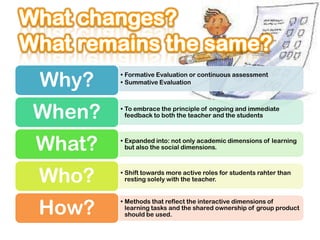
Why?    • Formative Evaluation or continuous assessment
        • Summative Evaluation


When?   • To embrace the principle of ongoing and immediate
          feedback to both the teacher and the students


What?   • Expanded into: not only academic dimensions of learning
          but also the social dimensions.


Who?    • Shift towards more active roles for students rahter than
          resting solely with the teacher.


How?
        • Methods that reflect the interactive dimensions of
          learning tasks and the shared ownership of group product
          should be used.
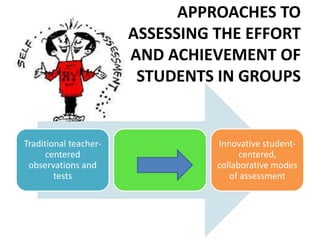
APPROACHES TO
                       ASSESSING THE EFFORT
                       AND ACHIEVEMENT OF
                        STUDENTS IN GROUPS


Traditional teacher-             Innovative student-
      centered                         centered,
 observations and                collaborative modes
        tests                       of assessment
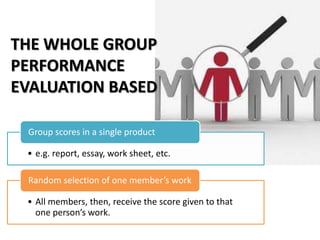
THE WHOLE GROUP
PERFORMANCE
EVALUATION BASED

 Group scores in a single product

 • e.g. report, essay, work sheet, etc.

 Random selection of one member’s work

 • All members, then, receive the score given to that
   one person’s work.
Can a single shared
group grade be fair?
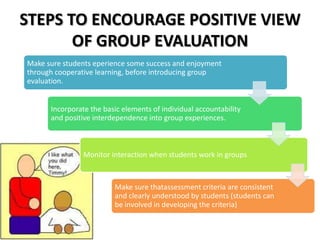
STEPS TO ENCOURAGE POSITIVE VIEW
       OF GROUP EVALUATION
Make sure students eperience some success and enjoyment
through cooperative learning, before introducing group
evaluation.


      Incorporate the basic elements of individual accountability
      and positive interdependence into group experiences.


                Monitor interaction when students work in groups


                         Make sure thatassessment criteria are consistent
                         and clearly understood by students (students can
                         be involved in developing the criteria)
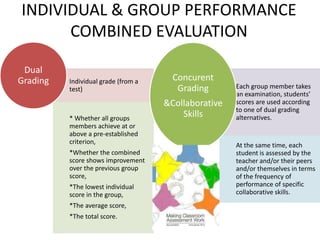
INDIVIDUAL & GROUP PERFORMANCE
      COMBINED EVALUATION

 Dual
Grading   Individual grade (from a     Concurent
          test)                         Grading       Each group member takes
                                                      an examination, students’
                                     &Collaborative   scores are used according
                                                      to one of dual grading
          * Whether all groups
                                         Skills       alternatives.
          members achieve at or
          above a pre-established
          criterion,                                  At the same time, each
          *Whether the combined                       student is assessed by the
          score shows improvement                     teacher and/or their peers
          over the previous group                     and/or themselves in terms
          score,                                      of the frequency of
          *The lowest individual                      performance of specific
          score in the group,                         collaborative skills.
          *The average score,
          *The total score.
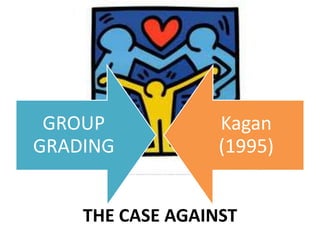
GROUP            Kagan
GRADING           (1995)


    THE CASE AGAINST
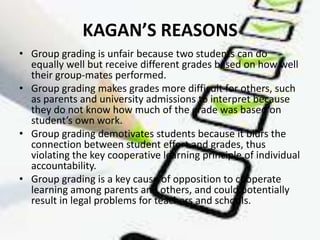
KAGAN’S REASONS
• Group grading is unfair because two students can do
  equally well but receive different grades based on how well
  their group-mates performed.
• Group grading makes grades more difficult for others, such
  as parents and university admissions to interpret because
  they do not know how much of the grade was based on
  student’s own work.
• Group grading demotivates students because it blurs the
  connection between student effort and grades, thus
  violating the key cooperative learning principle of individual
  accountability.
• Group grading is a key cause of opposition to cooperate
  learning among parents and others, and could potentially
  result in legal problems for teachers and schools.
KAGAN’S RECOMENDED
            ALTERNATIVES
• Use content that is motivating by itself so that
  grades will not be needed as a motivation tool.
• Provide written feedback, apart from grades, on
  the work of individual students and of groups.
• Have students establish goals for themselves and,
  with the help of teachers and peers, assess their
  own progress toward htose goals.
• Use non-grade reward, such as recognition in
  class newsletters and notes from teachers.
• Give separate grades on the use of collaborative
  skills.
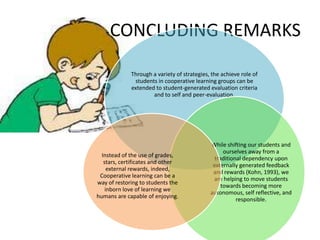
CONCLUDING REMARKS

             Through a variety of strategies, the achieve role of
              students in cooperative learning groups can be
             extended to student-generated evaluation criteria
                     and to self and peer-evaluation.


                                             While shifting our students and
                                                   ourselves away from a
  Instead of the use of grades,
                                               traditional dependency upon
   stars, certificates and other
                                              externally generated feedback
     external rewards, indeed,
                                              and rewards (Kohn, 1993), we
 Cooperative learning can be a
                                              are helping to move students
way of restoring to students the
                                                  towards becoming more
    inborn love of learning we
                                             autonomous, self reflective, and
humans are capable of enjoying.
                                                        responsible.

Assessing Students in Cooperative Learning

  • 1.
    Pramesti Ariyani (0204511044) DeviHermasari (0204511048)
  • 2.
    Why? • Formative Evaluation or continuous assessment • Summative Evaluation When? • To embrace the principle of ongoing and immediate feedback to both the teacher and the students What? • Expanded into: not only academic dimensions of learning but also the social dimensions. Who? • Shift towards more active roles for students rahter than resting solely with the teacher. How? • Methods that reflect the interactive dimensions of learning tasks and the shared ownership of group product should be used.
  • 3.
    APPROACHES TO ASSESSING THE EFFORT AND ACHIEVEMENT OF STUDENTS IN GROUPS Traditional teacher- Innovative student- centered centered, observations and collaborative modes tests of assessment
  • 4.
    THE WHOLE GROUP PERFORMANCE EVALUATIONBASED Group scores in a single product • e.g. report, essay, work sheet, etc. Random selection of one member’s work • All members, then, receive the score given to that one person’s work.
  • 5.
    Can a singleshared group grade be fair?
  • 6.
    STEPS TO ENCOURAGEPOSITIVE VIEW OF GROUP EVALUATION Make sure students eperience some success and enjoyment through cooperative learning, before introducing group evaluation. Incorporate the basic elements of individual accountability and positive interdependence into group experiences. Monitor interaction when students work in groups Make sure thatassessment criteria are consistent and clearly understood by students (students can be involved in developing the criteria)
  • 7.
    INDIVIDUAL & GROUPPERFORMANCE COMBINED EVALUATION Dual Grading Individual grade (from a Concurent test) Grading Each group member takes an examination, students’ &Collaborative scores are used according to one of dual grading * Whether all groups Skills alternatives. members achieve at or above a pre-established criterion, At the same time, each *Whether the combined student is assessed by the score shows improvement teacher and/or their peers over the previous group and/or themselves in terms score, of the frequency of *The lowest individual performance of specific score in the group, collaborative skills. *The average score, *The total score.
  • 8.
    GROUP Kagan GRADING (1995) THE CASE AGAINST
  • 9.
    KAGAN’S REASONS • Groupgrading is unfair because two students can do equally well but receive different grades based on how well their group-mates performed. • Group grading makes grades more difficult for others, such as parents and university admissions to interpret because they do not know how much of the grade was based on student’s own work. • Group grading demotivates students because it blurs the connection between student effort and grades, thus violating the key cooperative learning principle of individual accountability. • Group grading is a key cause of opposition to cooperate learning among parents and others, and could potentially result in legal problems for teachers and schools.
  • 10.
    KAGAN’S RECOMENDED ALTERNATIVES • Use content that is motivating by itself so that grades will not be needed as a motivation tool. • Provide written feedback, apart from grades, on the work of individual students and of groups. • Have students establish goals for themselves and, with the help of teachers and peers, assess their own progress toward htose goals. • Use non-grade reward, such as recognition in class newsletters and notes from teachers. • Give separate grades on the use of collaborative skills.
  • 11.
    CONCLUDING REMARKS Through a variety of strategies, the achieve role of students in cooperative learning groups can be extended to student-generated evaluation criteria and to self and peer-evaluation. While shifting our students and ourselves away from a Instead of the use of grades, traditional dependency upon stars, certificates and other externally generated feedback external rewards, indeed, and rewards (Kohn, 1993), we Cooperative learning can be a are helping to move students way of restoring to students the towards becoming more inborn love of learning we autonomous, self reflective, and humans are capable of enjoying. responsible.