

In this kind of essay, we not only give information but also present
an argument with the PROS (supporting ideas) and CONS
(opposing ideas) of an argumentative issue. We should clearly
take our stand and write as if we are trying to persuade an
opposing audience to adopt new beliefs or behavior. The
primary objective is to persuade people to change beliefs that
many of them do not want to change.
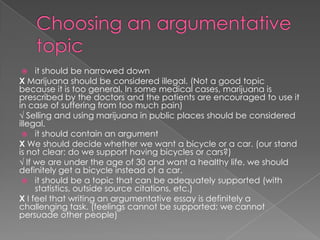
it should be narrowed down
X Marijuana should be considered illegal. (Not a good topic
because it is too general. In some medical cases, marijuana is
prescribed by the doctors and the patients are encouraged to use it
in case of suffering from too much pain)
√ Selling and using marijuana in public places should be considered
illegal.
 it should contain an argument
X We should decide whether we want a bicycle or a car. (our stand
is not clear: do we support having bicycles or cars?)
√ If we are under the age of 30 and want a healthy life, we should
definitely get a bicycle instead of a car.
 it should be a topic that can be adequately supported (with
statistics, outside source citations, etc.)
X I feel that writing an argumentative essay is definitely a
challenging task. (feelings cannot be supported; we cannot
persuade other people)

If you believe that you can find enough
evidence to support your idea and
refute others effectively, you can choose
challenging topics as well. You can
enjoy writing about such topics:
Topic: Stress is good for the human body.


All argumentative topics
have PROs and CONs. Before starting
writing, it is imperative to make a list of
these ideas and choose the most suitable
ones among them for supporting and
refuting.
There are three types of organization:
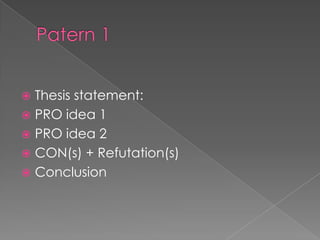
Thesis statement:
 PRO idea 1
 PRO idea 2
 CON(s) + Refutation(s)
 Conclusion

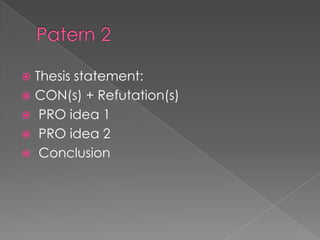
Thesis statement:
 CON(s) + Refutation(s)
 PRO idea 1
 PRO idea 2
 Conclusion

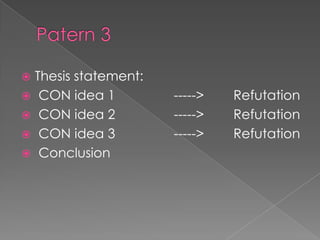
Thesis statement:
 CON idea 1
 CON idea 2
 CON idea 3
 Conclusion


----->
----->
----->

Refutation
Refutation
Refutation
Which patern do you think the
argumentative essay use?
 Define the content for each part.



http://www.buowl.boun.edu.tr/students/
types%20of%20essays/ARGUMENTATIVE%
20ESSAY.htm

Argumentative essay

  • 2.
    In this kindof essay, we not only give information but also present an argument with the PROS (supporting ideas) and CONS (opposing ideas) of an argumentative issue. We should clearly take our stand and write as if we are trying to persuade an opposing audience to adopt new beliefs or behavior. The primary objective is to persuade people to change beliefs that many of them do not want to change.
  • 3.
    it should benarrowed down X Marijuana should be considered illegal. (Not a good topic because it is too general. In some medical cases, marijuana is prescribed by the doctors and the patients are encouraged to use it in case of suffering from too much pain) √ Selling and using marijuana in public places should be considered illegal.  it should contain an argument X We should decide whether we want a bicycle or a car. (our stand is not clear: do we support having bicycles or cars?) √ If we are under the age of 30 and want a healthy life, we should definitely get a bicycle instead of a car.  it should be a topic that can be adequately supported (with statistics, outside source citations, etc.) X I feel that writing an argumentative essay is definitely a challenging task. (feelings cannot be supported; we cannot persuade other people) 
  • 4.
    If you believethat you can find enough evidence to support your idea and refute others effectively, you can choose challenging topics as well. You can enjoy writing about such topics: Topic: Stress is good for the human body. 
  • 5.
    All argumentative topics havePROs and CONs. Before starting writing, it is imperative to make a list of these ideas and choose the most suitable ones among them for supporting and refuting. There are three types of organization:
  • 6.
    Thesis statement:  PROidea 1  PRO idea 2  CON(s) + Refutation(s)  Conclusion 
  • 7.
    Thesis statement:  CON(s)+ Refutation(s)  PRO idea 1  PRO idea 2  Conclusion 
  • 8.
    Thesis statement:  CONidea 1  CON idea 2  CON idea 3  Conclusion  -----> -----> -----> Refutation Refutation Refutation
  • 9.
    Which patern doyou think the argumentative essay use?  Define the content for each part. 
  • 10.