Chapter 2 Assemblers
-- 2.4 Assembler Design Options
Outline

 One-pass assemblers
 Multi-pass assemblers
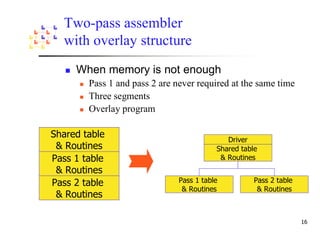
 Two-pass assembler with overlay structure
Load-and-Go Assembler
 Load-and-go assembler generates their object code
 in memory for immediate execution.
 No object program is written out, no loader is needed.
 It is useful in a system oriented toward program
 development and testing such that the efficiency of
 the assembly process is an important consideration.
 Programs are re-assembled nearly every time they
 are run, efficiency of the assembly process is an
 important consideration.
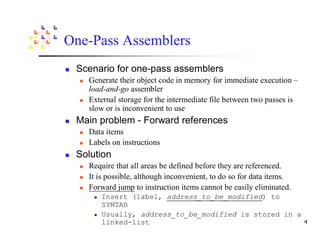
One-Pass Assemblers
 Scenario for one-pass assemblers
   Generate their object code in memory for immediate execution –
   load-and-go assembler
   External storage for the intermediate file between two passes is
   slow or is inconvenient to use
 Main problem - Forward references
   Data items
   Labels on instructions
 Solution
   Require that all areas be defined before they are referenced.
   It is possible, although inconvenient, to do so for data items.
   Forward jump to instruction items cannot be easily eliminated.
      Insert (label, address_to_be_modified) to
      SYMTAB
      Usually, address_to_be_modified is stored in a
      linked-list
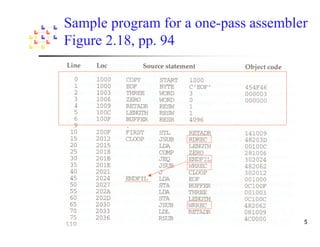
Sample program for a one-pass assembler
Figure 2.18, pp. 94
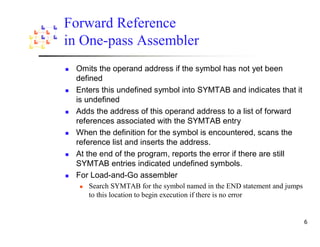
Forward Reference
in One-pass Assembler
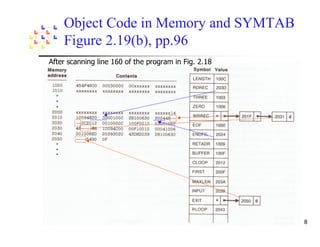
 Omits the operand address if the symbol has not yet been
 defined
 Enters this undefined symbol into SYMTAB and indicates that it
 is undefined
 Adds the address of this operand address to a list of forward
 references associated with the SYMTAB entry
 When the definition for the symbol is encountered, scans the
 reference list and inserts the address.
 At the end of the program, reports the error if there are still
 SYMTAB entries indicated undefined symbols.
 For Load-and-Go assembler
    Search SYMTAB for the symbol named in the END statement and jumps
    to this location to begin execution if there is no error
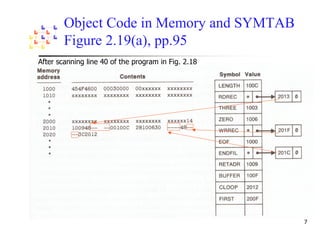
Object Code in Memory and SYMTAB
Figure 2.19(a), pp.95
Object Code in Memory and SYMTAB
Figure 2.19(b), pp.96
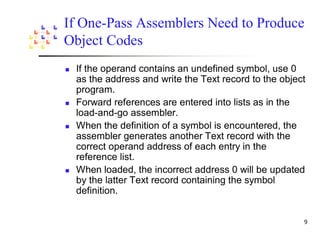
If One-Pass Assemblers Need to Produce
Object Codes
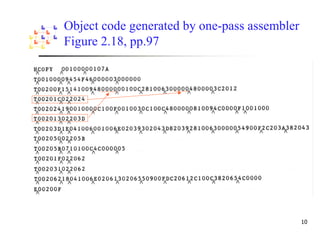
 If the operand contains an undefined symbol, use 0
 as the address and write the Text record to the object
 program.
 Forward references are entered into lists as in the
 load-and-go assembler.
 When the definition of a symbol is encountered, the
 assembler generates another Text record with the
 correct operand address of each entry in the
 reference list.
 When loaded, the incorrect address 0 will be updated
 by the latter Text record containing the symbol
 definition.
Object code generated by one-pass assembler
Figure 2.18, pp.97
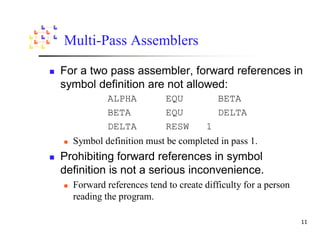
Multi-Pass Assemblers

For a two pass assembler, forward references in
symbol definition are not allowed:
           ALPHA          EQU            BETA
           BETA           EQU            DELTA
           DELTA          RESW       1
  Symbol definition must be completed in pass 1.
Prohibiting forward references in symbol
definition is not a serious inconvenience.
  Forward references tend to create difficulty for a person
  reading the program.
Implementation
 For a forward reference in symbol definition, we store
 in the SYMTAB:
    The symbol name
    The defining expression
    The number of undefined symbols in the defining expression
 The undefined symbol (marked with a flag *)
 associated with a list of symbols depend on this
 undefined symbol.
 When a symbol is defined, we can recursively
 evaluate the symbol expressions depending on the
 newly defined symbol.
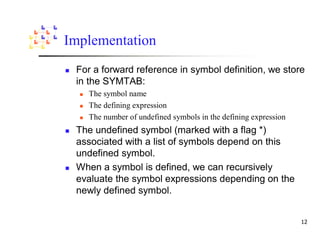
Multi-pass assembler example
      Figure 2.21, pp. 99-101
# of undefined symbols in the
defining expression
                The defining expression


                                          Depending list


   Undefined symbol
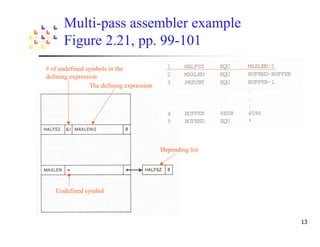
Multi-pass assembler example
       Figure 2.21, pp. 99-101


2 MAXLEN EQU BUFEND-BUFFER   3   PREVBT   EQU   BUFFER-1
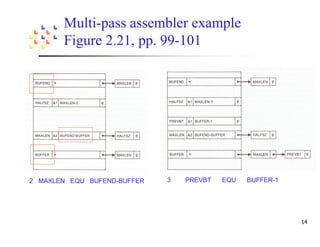
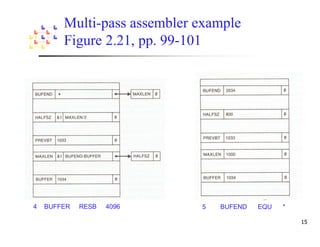
Multi-pass assembler example
        Figure 2.21, pp. 99-101


4   BUFFER   RESB   4096     5   BUFEND   EQU   *
Two-pass assembler
 with overlay structure
   When memory is not enough
       Pass 1 and pass 2 are never required at the same time
       Three segments
       Overlay program


                                          %&
!" #
$                                       !" #
!" #
$                             $                  $
                              !" #               !" #
!" #

Sp2 4

  • 1.
    Chapter 2 Assemblers --2.4 Assembler Design Options
  • 2.
    Outline One-pass assemblers Multi-pass assemblers Two-pass assembler with overlay structure
  • 3.
    Load-and-Go Assembler Load-and-goassembler generates their object code in memory for immediate execution. No object program is written out, no loader is needed. It is useful in a system oriented toward program development and testing such that the efficiency of the assembly process is an important consideration. Programs are re-assembled nearly every time they are run, efficiency of the assembly process is an important consideration.
  • 4.
    One-Pass Assemblers Scenariofor one-pass assemblers Generate their object code in memory for immediate execution – load-and-go assembler External storage for the intermediate file between two passes is slow or is inconvenient to use Main problem - Forward references Data items Labels on instructions Solution Require that all areas be defined before they are referenced. It is possible, although inconvenient, to do so for data items. Forward jump to instruction items cannot be easily eliminated. Insert (label, address_to_be_modified) to SYMTAB Usually, address_to_be_modified is stored in a linked-list
  • 5.
    Sample program fora one-pass assembler Figure 2.18, pp. 94
  • 6.
    Forward Reference in One-passAssembler Omits the operand address if the symbol has not yet been defined Enters this undefined symbol into SYMTAB and indicates that it is undefined Adds the address of this operand address to a list of forward references associated with the SYMTAB entry When the definition for the symbol is encountered, scans the reference list and inserts the address. At the end of the program, reports the error if there are still SYMTAB entries indicated undefined symbols. For Load-and-Go assembler Search SYMTAB for the symbol named in the END statement and jumps to this location to begin execution if there is no error
  • 7.
    Object Code inMemory and SYMTAB Figure 2.19(a), pp.95
  • 8.
    Object Code inMemory and SYMTAB Figure 2.19(b), pp.96
  • 9.
    If One-Pass AssemblersNeed to Produce Object Codes If the operand contains an undefined symbol, use 0 as the address and write the Text record to the object program. Forward references are entered into lists as in the load-and-go assembler. When the definition of a symbol is encountered, the assembler generates another Text record with the correct operand address of each entry in the reference list. When loaded, the incorrect address 0 will be updated by the latter Text record containing the symbol definition.
  • 10.
    Object code generatedby one-pass assembler Figure 2.18, pp.97
  • 11.
    Multi-Pass Assemblers For atwo pass assembler, forward references in symbol definition are not allowed: ALPHA EQU BETA BETA EQU DELTA DELTA RESW 1 Symbol definition must be completed in pass 1. Prohibiting forward references in symbol definition is not a serious inconvenience. Forward references tend to create difficulty for a person reading the program.
  • 12.
    Implementation For aforward reference in symbol definition, we store in the SYMTAB: The symbol name The defining expression The number of undefined symbols in the defining expression The undefined symbol (marked with a flag *) associated with a list of symbols depend on this undefined symbol. When a symbol is defined, we can recursively evaluate the symbol expressions depending on the newly defined symbol.
  • 13.
    Multi-pass assembler example Figure 2.21, pp. 99-101 # of undefined symbols in the defining expression The defining expression Depending list Undefined symbol
  • 14.
    Multi-pass assembler example Figure 2.21, pp. 99-101 2 MAXLEN EQU BUFEND-BUFFER 3 PREVBT EQU BUFFER-1
  • 15.
    Multi-pass assembler example Figure 2.21, pp. 99-101 4 BUFFER RESB 4096 5 BUFEND EQU *
  • 16.
    Two-pass assembler withoverlay structure When memory is not enough Pass 1 and pass 2 are never required at the same time Three segments Overlay program %& !" # $ !" # !" # $ $ $ !" # !" # !" #