SYSTEM SOFTWARE
TEAM 3 :
Abdul Kalam Ashad.A– 13mx01
Darsini.R – 13mx07
Gowri Manohari.M – 13mx13
Manickkavalli. M - 13MX26
Sathasivam.R – 13mx41
ASSIGNMENT PRESENTAION - I
Components Of System Software – A walkthrough.
Introducing loader.
Basic Loader functions.
Steps involved in loading.
Loader Schemes.
Types of loaders.
COMPILER
 Translates high-level language programs into assembly
language programs.
ASSEMBLER
Converts assembly language programs into object files.
 Object files contain a combination of machine
instructions, data, and information needed to place
instructions properly in memory.
LINKER
Tool that merges the object files produced by
separate compilation or assembly and creates an
executable.
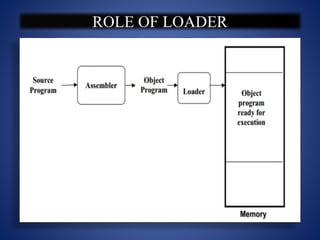
LOADER
 Part of the OS that brings an executable file
residing on disk into memory and starts it running.
Loader is a system program that loads machine
codes of a program into the system memory.
Loading a program involves reading the contents
of executable file into memory.
Once loading is complete, the operating system
starts the program by passing control to the loaded
program
 LOADING- allocates memory location and brings
the object program into memory for execution –
done by Loader.
LINKING - combines two or more separate object
programs and supplies the information needed to allow
references between them – done by Linker.
RELOCATION - modifies the object program so
that it can be loaded at an address different from
the location originally specified – by Linking Loader.
Executable file’ s header is read to determine the
size of text and data segments.
Instructions and data are copied into address
space.
 Arguments passed to the program are copied
on the stack
Machine registers including the stack pointer are
initialized.
The control is transferred to a start-up routine
that copies the program’ s arguments from the
stack to registers and calls the program’ s main
routine.
“Compile-and-Go” Loaders
General Loader Scheme
“COMPILE-AND-GO” LOADERS:
Assembler will be running in one part of
memory.
The assembled data & machine instructions are
directly assigned into the memory locations.
Example : FORTRAN
When the assembly is over, the control transfers
to the starting instruction of the program.
The loader consists of an instruction to make this
control transfer.
DISADVANTAGES :
• Memory wastage due to the unavailability of
assembler to the object program.
Need to assemble the program every time it’s
run.
Difficulty in handling if the source programs are
in different languages.
Uses an object deck as intermediate data.
Here the loader accepts the assembled machine
instructions and data in the object format and places it
in the memory in an executable form.
ADVANTAGES :
Smaller than assembler.
No reassembly is needed.
Possible to write subroutines in different languages.
Absolute Loader.
Bootstrap Loader.
 Relocating Loader (Relative Loader)
 Linking Loader.
Absolute loader loads the object code to specified
locations in the memory.
 At the end the loader jumps to the specified address
to begin execution of the loaded program.
ADVANTAGES : Simple and efficient.
DISADVANTAGES :
• The need for programmer to specify the actual
address.
• Difficulty in using subroutine libraries.
When a computer is first turned on or restarted,
a special type of absolute loader, called bootstrap
loader is executed.
This bootstrap loads the first program to be run
by the computer - usually an operating system.
The bootstrap itself begins at address 0.
Loaders that allow for program relocation are
called Relocating loaders or Relative loaders.
 CONCEPT OF RELOCATION :
• The execution of the object program is done using
any part of the available & sufficient memory.
• The object program is loaded into memory
wherever there is room for it.
• The actual starting address of the object program
is not known until load time.
• Relocation provides the efficient sharing of the
machine with larger memory and when several
independent programs are to be run together.
• It also supports the use of subroutine libraries
efficiently.
Perform all linking and relocation at load time.
The Other Alternatives :
• Linkage editors - which performs linking prior
to load time.
• Dynamic linking – where linking function is
performed at execution time.
 Produces a linked version of the program – called a
load module or an executable image.
 This load module is written to a file or library for
later execution.
The linked program produced is suitable for
processing by a relocating loader.
Using Linkage editor , an absolute object program
can be created, if starting address is already known.
This scheme postpones the linking functions until
execution.
A subroutine is loaded and linked to the rest of
the program when it is first called.
It is usually called dynamic linking, dynamic
loading or load on call.
Allows several executing programs to share one
copy of a subroutine or library.
In an object oriented system, dynamic linking
makes it possible for one object to be shared by
several programs.
Dynamic linking provides the ability to load
the routines only when they are needed.
Run-time linker uses dynamic linking approach
which binds dynamic executables and shared
objects at execution time.
•System Programming by John.J.Donovan
•https://www.classle.net/book/loaders-intoduction
•http://elearning.vtu.ac.in/p7/enotes/CS51/Unit
3-HDP.pdf
•http://www.cs.gmu.edu/~setia/cs365-
S02/assembler.pdf
Loaders

Loaders

  • 1.
    SYSTEM SOFTWARE TEAM 3: Abdul Kalam Ashad.A– 13mx01 Darsini.R – 13mx07 Gowri Manohari.M – 13mx13 Manickkavalli. M - 13MX26 Sathasivam.R – 13mx41 ASSIGNMENT PRESENTAION - I
  • 3.
    Components Of SystemSoftware – A walkthrough. Introducing loader. Basic Loader functions. Steps involved in loading. Loader Schemes. Types of loaders.
  • 4.
    COMPILER  Translates high-levellanguage programs into assembly language programs. ASSEMBLER Converts assembly language programs into object files.  Object files contain a combination of machine instructions, data, and information needed to place instructions properly in memory.
  • 5.
    LINKER Tool that mergesthe object files produced by separate compilation or assembly and creates an executable. LOADER  Part of the OS that brings an executable file residing on disk into memory and starts it running.
  • 7.
    Loader is asystem program that loads machine codes of a program into the system memory. Loading a program involves reading the contents of executable file into memory. Once loading is complete, the operating system starts the program by passing control to the loaded program
  • 8.
     LOADING- allocatesmemory location and brings the object program into memory for execution – done by Loader. LINKING - combines two or more separate object programs and supplies the information needed to allow references between them – done by Linker. RELOCATION - modifies the object program so that it can be loaded at an address different from the location originally specified – by Linking Loader.
  • 10.
    Executable file’ sheader is read to determine the size of text and data segments. Instructions and data are copied into address space.  Arguments passed to the program are copied on the stack
  • 11.
    Machine registers includingthe stack pointer are initialized. The control is transferred to a start-up routine that copies the program’ s arguments from the stack to registers and calls the program’ s main routine.
  • 12.
    “Compile-and-Go” Loaders General LoaderScheme “COMPILE-AND-GO” LOADERS: Assembler will be running in one part of memory. The assembled data & machine instructions are directly assigned into the memory locations. Example : FORTRAN
  • 13.
    When the assemblyis over, the control transfers to the starting instruction of the program. The loader consists of an instruction to make this control transfer. DISADVANTAGES : • Memory wastage due to the unavailability of assembler to the object program.
  • 14.
    Need to assemblethe program every time it’s run. Difficulty in handling if the source programs are in different languages.
  • 16.
    Uses an objectdeck as intermediate data. Here the loader accepts the assembled machine instructions and data in the object format and places it in the memory in an executable form. ADVANTAGES : Smaller than assembler. No reassembly is needed. Possible to write subroutines in different languages.
  • 18.
    Absolute Loader. Bootstrap Loader. Relocating Loader (Relative Loader)  Linking Loader.
  • 19.
    Absolute loader loadsthe object code to specified locations in the memory.  At the end the loader jumps to the specified address to begin execution of the loaded program. ADVANTAGES : Simple and efficient. DISADVANTAGES : • The need for programmer to specify the actual address. • Difficulty in using subroutine libraries.
  • 21.
    When a computeris first turned on or restarted, a special type of absolute loader, called bootstrap loader is executed. This bootstrap loads the first program to be run by the computer - usually an operating system. The bootstrap itself begins at address 0.
  • 22.
    Loaders that allowfor program relocation are called Relocating loaders or Relative loaders.  CONCEPT OF RELOCATION : • The execution of the object program is done using any part of the available & sufficient memory. • The object program is loaded into memory wherever there is room for it.
  • 23.
    • The actualstarting address of the object program is not known until load time. • Relocation provides the efficient sharing of the machine with larger memory and when several independent programs are to be run together. • It also supports the use of subroutine libraries efficiently.
  • 24.
    Perform all linkingand relocation at load time. The Other Alternatives : • Linkage editors - which performs linking prior to load time. • Dynamic linking – where linking function is performed at execution time.
  • 26.
     Produces alinked version of the program – called a load module or an executable image.  This load module is written to a file or library for later execution. The linked program produced is suitable for processing by a relocating loader. Using Linkage editor , an absolute object program can be created, if starting address is already known.
  • 28.
    This scheme postponesthe linking functions until execution. A subroutine is loaded and linked to the rest of the program when it is first called. It is usually called dynamic linking, dynamic loading or load on call. Allows several executing programs to share one copy of a subroutine or library.
  • 29.
    In an objectoriented system, dynamic linking makes it possible for one object to be shared by several programs. Dynamic linking provides the ability to load the routines only when they are needed. Run-time linker uses dynamic linking approach which binds dynamic executables and shared objects at execution time.
  • 30.
    •System Programming byJohn.J.Donovan •https://www.classle.net/book/loaders-intoduction •http://elearning.vtu.ac.in/p7/enotes/CS51/Unit 3-HDP.pdf •http://www.cs.gmu.edu/~setia/cs365- S02/assembler.pdf