ASSEMBLERS
Prof. S.J. Soni, SPCE, Visnagar
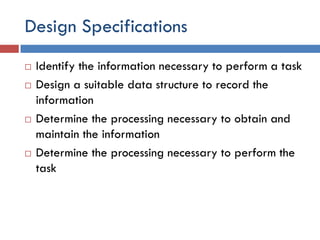
Design Specifications
 Identify the information necessary to perform a task
 Design a suitable data structure to record the
information
 Determine the processing necessary to obtain and
maintain the information
 Determine the processing necessary to perform the
task
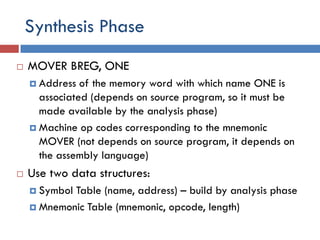
Synthesis Phase
 MOVER BREG, ONE
 Address of the memory word with which name ONE is
associated (depends on source program, so it must be
made available by the analysis phase)
 Machine op codes corresponding to the mnemonic
MOVER (not depends on source program, it depends on
the assembly language)
 Use two data structures:
 Symbol Table (name, address) – build by analysis phase
 Mnemonic Table (mnemonic, opcode, length)
Analysis Phase
 The primary function is of building of the symbol
table.
 Concept of “Memory Allocation”
 To implement memory allocation a data structure
called location counter (LC) is used.
 The LC is always made to contain the address of the
next memory word in the target program.
 It is initialized to the constant specified in the START
statement.
 To update the contents of LC, analysis phase needs
to know lengths of different instructions.
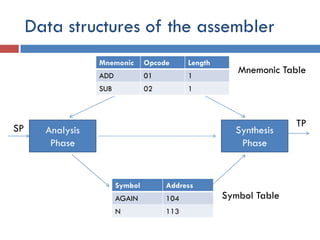
Data structures of the assembler
Analysis
Phase
Synthesis
Phase
Mnemonic Opcode Length
ADD 01 1
SUB 02 1
Symbol Address
AGAIN 104
N 113
Mnemonic Table
Symbol Table
SP TP
Pass Structure of Assembler
 Two Pass Translation
 It can handle forward references easily.
 LC processing is performed in the first pass and symbol
defined in the program are entered into the symbol
table.
 The second pass synthesizes the target form using the
address information found in the symbol table.
 In effect, the first pass performs analysis of the source
program while the second pass performs synthesis of
the target program.
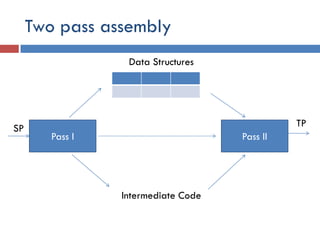
Two pass assembly
Pass I Pass II
SP TP
Intermediate Code
Data Structures
Pass Structure of Assembler
 Single Pass Translation
 LC processing and construction of the symbol table
proceeds as in two pass translation.
 The problem of forward references is tacked using a
process called “backpatching”
 The operand field of an instruction containing a
forward reference is left blank initially. The address of
the forward referenced symbol is put into this field
when its definition is encountered.
 MOVER BREG, ONE [ONE is forward reference]
 Table of Incomplete Instruction (TII)
Advanced Assembler Directives
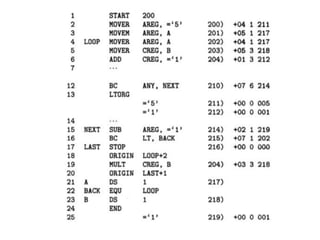
 ORIGIN
 ORIGIN <address spec>
 Where <address spec> is an <operand spec> or
<constant>
 This directive indicates that LC should be set to the
address given by <address spec>.
 It is useful when the target program does not consist of
consecutive memory words.
Advanced Assembler Directives
 EQU
 <symbol> EQU <address spec>
 Where <address spec> is an <operand spec> or
<constant>
 It defines the symbol to represent <address spec>.
 LTORG
 It permits a programmer to specify where literals
should be placed.
 By default, assembler places it after the END statement
Literals
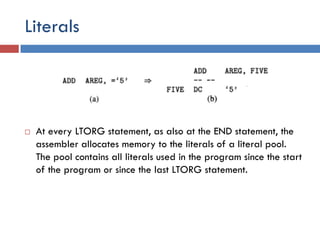
 At every LTORG statement, as also at the END statement, the
assembler allocates memory to the literals of a literal pool.
The pool contains all literals used in the program since the start
of the program or since the last LTORG statement.
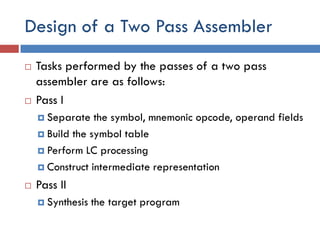
Design of a Two Pass Assembler
 Tasks performed by the passes of a two pass
assembler are as follows:
 Pass I
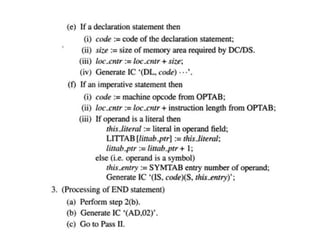
 Separate the symbol, mnemonic opcode, operand fields
 Build the symbol table
 Perform LC processing
 Construct intermediate representation
 Pass II
 Synthesis the target program
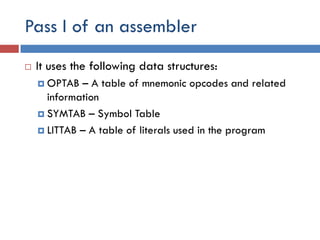
Pass I of an assembler
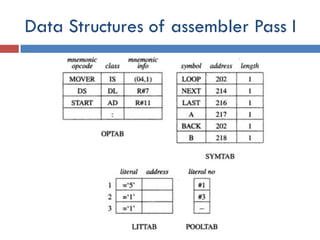
 It uses the following data structures:
 OPTAB – A table of mnemonic opcodes and related
information
 SYMTAB – Symbol Table
 LITTAB – A table of literals used in the program
Data Structures of assembler Pass I
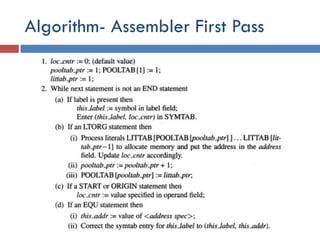
Algorithm- Assembler First Pass
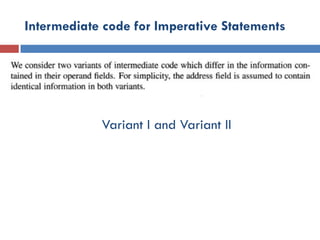
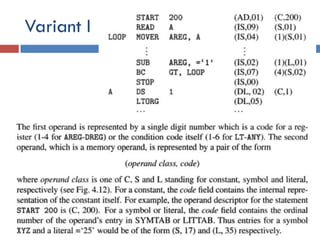
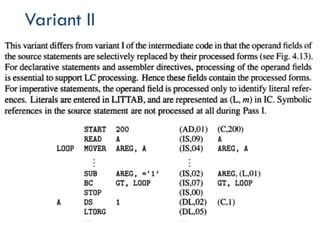
Intermediate code for Imperative Statements
Variant I and Variant II
Variant I
Variant II
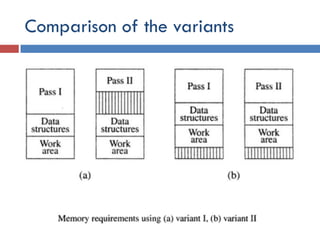
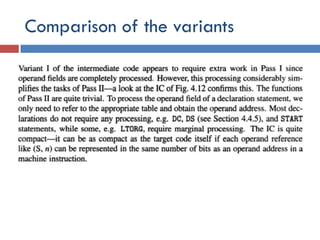
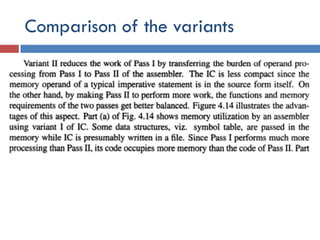
Comparison of the variants
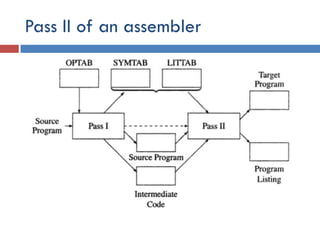
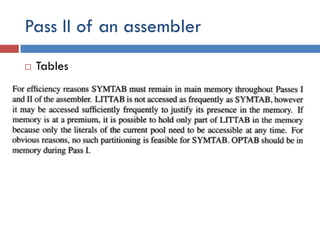
Pass II of an assembler
 Tables
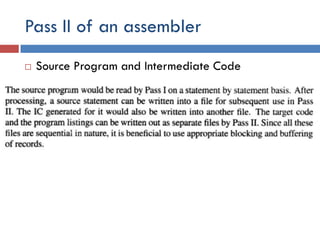
Pass II of an assembler
 Source Program and Intermediate Code

assembler-ppt.pdf

  • 1.
  • 2.
    Design Specifications  Identifythe information necessary to perform a task  Design a suitable data structure to record the information  Determine the processing necessary to obtain and maintain the information  Determine the processing necessary to perform the task
  • 3.
    Synthesis Phase  MOVERBREG, ONE  Address of the memory word with which name ONE is associated (depends on source program, so it must be made available by the analysis phase)  Machine op codes corresponding to the mnemonic MOVER (not depends on source program, it depends on the assembly language)  Use two data structures:  Symbol Table (name, address) – build by analysis phase  Mnemonic Table (mnemonic, opcode, length)
  • 4.
    Analysis Phase  Theprimary function is of building of the symbol table.  Concept of “Memory Allocation”  To implement memory allocation a data structure called location counter (LC) is used.  The LC is always made to contain the address of the next memory word in the target program.  It is initialized to the constant specified in the START statement.  To update the contents of LC, analysis phase needs to know lengths of different instructions.
  • 5.
    Data structures ofthe assembler Analysis Phase Synthesis Phase Mnemonic Opcode Length ADD 01 1 SUB 02 1 Symbol Address AGAIN 104 N 113 Mnemonic Table Symbol Table SP TP
  • 6.
    Pass Structure ofAssembler  Two Pass Translation  It can handle forward references easily.  LC processing is performed in the first pass and symbol defined in the program are entered into the symbol table.  The second pass synthesizes the target form using the address information found in the symbol table.  In effect, the first pass performs analysis of the source program while the second pass performs synthesis of the target program.
  • 7.
    Two pass assembly PassI Pass II SP TP Intermediate Code Data Structures
  • 8.
    Pass Structure ofAssembler  Single Pass Translation  LC processing and construction of the symbol table proceeds as in two pass translation.  The problem of forward references is tacked using a process called “backpatching”  The operand field of an instruction containing a forward reference is left blank initially. The address of the forward referenced symbol is put into this field when its definition is encountered.  MOVER BREG, ONE [ONE is forward reference]  Table of Incomplete Instruction (TII)
  • 9.
    Advanced Assembler Directives ORIGIN  ORIGIN <address spec>  Where <address spec> is an <operand spec> or <constant>  This directive indicates that LC should be set to the address given by <address spec>.  It is useful when the target program does not consist of consecutive memory words.
  • 10.
    Advanced Assembler Directives EQU  <symbol> EQU <address spec>  Where <address spec> is an <operand spec> or <constant>  It defines the symbol to represent <address spec>.  LTORG  It permits a programmer to specify where literals should be placed.  By default, assembler places it after the END statement
  • 11.
    Literals  At everyLTORG statement, as also at the END statement, the assembler allocates memory to the literals of a literal pool. The pool contains all literals used in the program since the start of the program or since the last LTORG statement.
  • 13.
    Design of aTwo Pass Assembler  Tasks performed by the passes of a two pass assembler are as follows:  Pass I  Separate the symbol, mnemonic opcode, operand fields  Build the symbol table  Perform LC processing  Construct intermediate representation  Pass II  Synthesis the target program
  • 14.
    Pass I ofan assembler  It uses the following data structures:  OPTAB – A table of mnemonic opcodes and related information  SYMTAB – Symbol Table  LITTAB – A table of literals used in the program
  • 15.
    Data Structures ofassembler Pass I
  • 16.
  • 18.
    Intermediate code forImperative Statements Variant I and Variant II
  • 19.
  • 20.
  • 21.
  • 22.
  • 23.
  • 24.
    Pass II ofan assembler
  • 25.
    Pass II ofan assembler  Tables
  • 26.
    Pass II ofan assembler  Source Program and Intermediate Code