 Writing academic essays can be
  rather difficult as it requires some
  necessary “skills” in ensuring a piece
  of work remains “academic”.
 I would like to share a simple model
  (or guide) that would help you in
  writing academically.
 Of course, this is not “the” model
  that would transform you into a
  proficient academic writer
  overnight.
   ASPIRE for academic writing (Chuah, 2010)
     Academic Voice
     Scholarly Citations
     Precise Description
     In-depth Elaborations
     Reduce clichés/redundancies
     Effective Structure
   Academic Voice
     Use academic language
      ▪ Formal
      ▪ Use specific terms/technical terms when necessary
      ▪ No contraction = Don’t, Won’t
      ▪ Objective perspective (not personal)
      ▪ Proper spelling (eg: because instead of “coz”)
   Scholarly Citations
     Use scholarly citations to support your
      elaborations.
     Get from reliable sources – journals, books,
      reports.
     Not merely citing resources from unreliable
      online webpages.
   Precise Descriptions
     Provide precise descriptions/elaborations based on
      facts.
     Avoid giving vague descriptions and personal opinions.
      Unless the type of writing is opinion-based.
     When opinion is needed, signal to the reader that it is an
      opinion by using hedgings like “In the author’s opinion,
      the situation may not be applicable to Malaysians.”)
   In-depth Elaborations
     Elaborate your points based on the citations and not
      merely listing them out.
     Learn to integrate the points.
     Avoid explaining the same thing multiple times.
      - Overuse of “This means that...”
      Example:
      Adams (2010) mentions that Malaysians love to use
      Facebook during peak hours. This means that many
      Malaysians are using Facebook when everyone else is
      busy. (This is not extending from the earlier sentence/point)
   Reduce clichés/redundancies
     Avoid using too many clichés or redundancies.
     Clichés - Overused Words/Phrases
      E.g.
      ▪ Nowadays
      ▪ Last but not the least
      ▪ all walks of life
      ▪ in today's society
     Redundancies
      ▪ At the present moment in time
      ▪ By definition, this means that the word implies
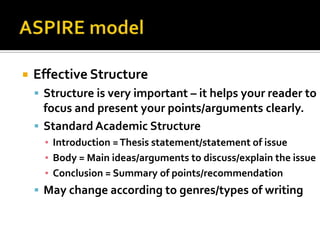
   Effective Structure
     Structure is very important – it helps your reader to
      focus and present your points/arguments clearly.
     Standard Academic Structure
      ▪ Introduction = Thesis statement/statement of issue
      ▪ Body = Main ideas/arguments to discuss/explain the issue
      ▪ Conclusion = Summary of points/recommendation
     May change according to genres/types of writing

ASPIRE Model for Academic Writing

  • 2.
     Writing academicessays can be rather difficult as it requires some necessary “skills” in ensuring a piece of work remains “academic”.  I would like to share a simple model (or guide) that would help you in writing academically.  Of course, this is not “the” model that would transform you into a proficient academic writer overnight.
  • 3.
    ASPIRE for academic writing (Chuah, 2010)  Academic Voice  Scholarly Citations  Precise Description  In-depth Elaborations  Reduce clichés/redundancies  Effective Structure
  • 4.
    Academic Voice  Use academic language ▪ Formal ▪ Use specific terms/technical terms when necessary ▪ No contraction = Don’t, Won’t ▪ Objective perspective (not personal) ▪ Proper spelling (eg: because instead of “coz”)
  • 5.
    Scholarly Citations  Use scholarly citations to support your elaborations.  Get from reliable sources – journals, books, reports.  Not merely citing resources from unreliable online webpages.
  • 6.
    Precise Descriptions  Provide precise descriptions/elaborations based on facts.  Avoid giving vague descriptions and personal opinions. Unless the type of writing is opinion-based.  When opinion is needed, signal to the reader that it is an opinion by using hedgings like “In the author’s opinion, the situation may not be applicable to Malaysians.”)
  • 7.
    In-depth Elaborations  Elaborate your points based on the citations and not merely listing them out.  Learn to integrate the points.  Avoid explaining the same thing multiple times. - Overuse of “This means that...” Example: Adams (2010) mentions that Malaysians love to use Facebook during peak hours. This means that many Malaysians are using Facebook when everyone else is busy. (This is not extending from the earlier sentence/point)
  • 8.
    Reduce clichés/redundancies  Avoid using too many clichés or redundancies.  Clichés - Overused Words/Phrases E.g. ▪ Nowadays ▪ Last but not the least ▪ all walks of life ▪ in today's society  Redundancies ▪ At the present moment in time ▪ By definition, this means that the word implies
  • 9.
    Effective Structure  Structure is very important – it helps your reader to focus and present your points/arguments clearly.  Standard Academic Structure ▪ Introduction = Thesis statement/statement of issue ▪ Body = Main ideas/arguments to discuss/explain the issue ▪ Conclusion = Summary of points/recommendation  May change according to genres/types of writing