Is this your “creative writing”?!
Don’t panic!
Just follow carefully…
A few simple steps…
Writing an essay contains:
Sticking to the topic
Planning the essay
An interesting Introduction
A persuasive Body
An effective Conclusion
Review
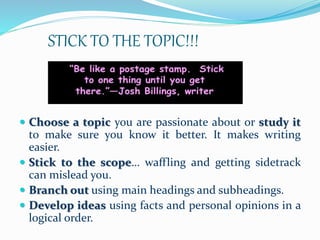
STICK TO THE TOPIC!!!
 Choose a topic you are passionate about or study it
to make sure you know it better. It makes writing
easier.
 Stick to the scope… waffling and getting sidetrack
can mislead you.
 Branch out using main headings and subheadings.
 Develop ideas using facts and personal opinions in a
logical order.
PLAN!!!
 Planning gives you an
idea of where to begin
and how the essay
should flow.
 Make sure your essay is
in chronological order
so it is easy to read.
● Gather facts and put them under headings they belong.
● Bullet point ideas will make writing the essay easier.
● Before you begin writing the essay, make sure your plan is in
order so you won’t miss out on anything to write in the essay.
INTRODUCTION TO THE ESSAY
 Topic and purpose of the essay.
 Indicating structure of the essay.
 Seizing interest and making reader want to read on.
 Forecasting: If the essay is about…
 Conflict = How do you aim to resolve it?
 Challenge = Argue a belief/stereotype!
Introduction indicates whether your essay will be
interesting or boring. So make sure it’s
captivating from the start!!!
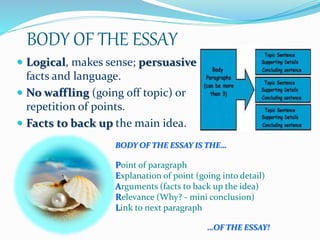
BODY OF THE ESSAY
 Logical, makes sense; persuasive
facts and language.
 No waffling (going off topic) or
repetition of points.
 Facts to back up the main idea.
BODY OF THE ESSAY IS THE…
Point of paragraph
Explanation of point (going into detail)
Arguments (facts to back up the idea)
Relevance (Why? - mini conclusion)
Link to next paragraph
…OF THE ESSAY!
CONCLUSION OF THE ESSAY
 Summarize main points (no new
ideas!)
 Make sure the reader understands
the main point of the essay
 Pass on a moral and make the
reader learn a lesson from your
essay
 Recommend, reaffirm, reflect,
echo, clarify, emphasize
 Give closure
 Effective and powerful!!!
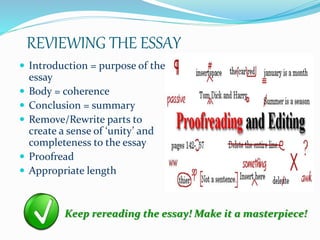
REVIEWING THE ESSAY
 Introduction = purpose of the
essay
 Body = coherence
 Conclusion = summary
 Remove/Rewrite parts to
create a sense of ‘unity’ and
completeness to the essay
 Proofread
 Appropriate length
Keep rereading the essay! Make it a masterpiece!
MAKING YOUR ESSAY STAND OUT
 Structure your essay to make it easy to read and
understand.
 Have a unique point of view so your ideas don’t
sound like the others.
 Back up your ideas with solid facts to persuade the
reader to your side.
 Proofread until your essay is perfect.
 Write with PASSION!!!
How to write an essay

How to write an essay

  • 2.
    Is this your“creative writing”?!
  • 3.
  • 4.
    Just follow carefully… Afew simple steps…
  • 5.
    Writing an essaycontains: Sticking to the topic Planning the essay An interesting Introduction A persuasive Body An effective Conclusion Review
  • 6.
    STICK TO THETOPIC!!!  Choose a topic you are passionate about or study it to make sure you know it better. It makes writing easier.  Stick to the scope… waffling and getting sidetrack can mislead you.  Branch out using main headings and subheadings.  Develop ideas using facts and personal opinions in a logical order.
  • 7.
    PLAN!!!  Planning givesyou an idea of where to begin and how the essay should flow.  Make sure your essay is in chronological order so it is easy to read. ● Gather facts and put them under headings they belong. ● Bullet point ideas will make writing the essay easier. ● Before you begin writing the essay, make sure your plan is in order so you won’t miss out on anything to write in the essay.
  • 8.
    INTRODUCTION TO THEESSAY  Topic and purpose of the essay.  Indicating structure of the essay.  Seizing interest and making reader want to read on.  Forecasting: If the essay is about…  Conflict = How do you aim to resolve it?  Challenge = Argue a belief/stereotype! Introduction indicates whether your essay will be interesting or boring. So make sure it’s captivating from the start!!!
  • 9.
    BODY OF THEESSAY  Logical, makes sense; persuasive facts and language.  No waffling (going off topic) or repetition of points.  Facts to back up the main idea. BODY OF THE ESSAY IS THE… Point of paragraph Explanation of point (going into detail) Arguments (facts to back up the idea) Relevance (Why? - mini conclusion) Link to next paragraph …OF THE ESSAY!
  • 10.
    CONCLUSION OF THEESSAY  Summarize main points (no new ideas!)  Make sure the reader understands the main point of the essay  Pass on a moral and make the reader learn a lesson from your essay  Recommend, reaffirm, reflect, echo, clarify, emphasize  Give closure  Effective and powerful!!!
  • 11.
    REVIEWING THE ESSAY Introduction = purpose of the essay  Body = coherence  Conclusion = summary  Remove/Rewrite parts to create a sense of ‘unity’ and completeness to the essay  Proofread  Appropriate length Keep rereading the essay! Make it a masterpiece!
  • 12.
    MAKING YOUR ESSAYSTAND OUT  Structure your essay to make it easy to read and understand.  Have a unique point of view so your ideas don’t sound like the others.  Back up your ideas with solid facts to persuade the reader to your side.  Proofread until your essay is perfect.  Write with PASSION!!!