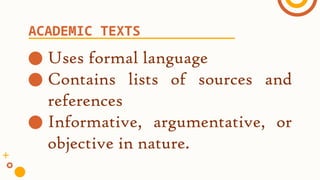
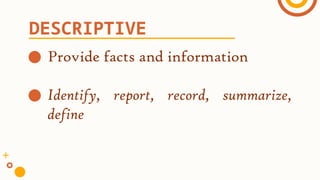
● Provide factsand information
● Identify, report, record, summarize,
define
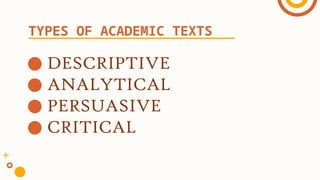
DESCRIPTIVE
10.
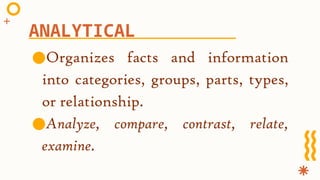
●Organizes facts andinformation
into categories, groups, parts, types,
or relationship.
●Analyze, compare, contrast, relate,
examine.
ANALYTICAL
11.
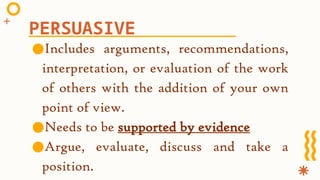
●Includes arguments, recommendations,
interpretation,or evaluation of the work
of others with the addition of your own
point of view.
●Needs to be supported by evidence
●Argue, evaluate, discuss and take a
position.
PERSUASIVE
12.
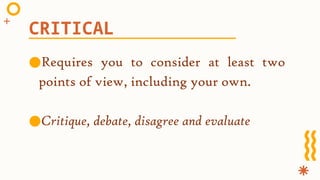
●Requires you toconsider at least two
points of view, including your own.
●Critique, debate, disagree and evaluate
CRITICAL
13.
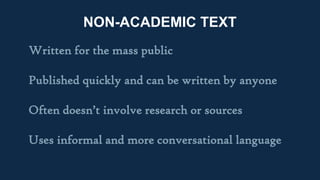
NON-ACADEMIC TEXT
Written forthe mass public
Published quickly and can be written by anyone
Often doesn’t involve research or sources
Uses informal and more conversational language
14.
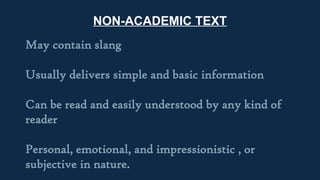
NON-ACADEMIC TEXT
May containslang
Usually delivers simple and basic information
Can be read and easily understood by any kind of
reader
Personal, emotional, and impressionistic , or
subjective in nature.
15.
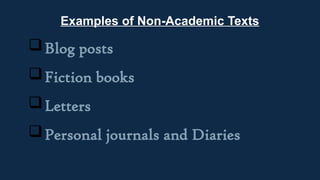
Examples of Non-AcademicTexts
Blog posts
Fiction books
Letters
Personal journals and Diaries
16.
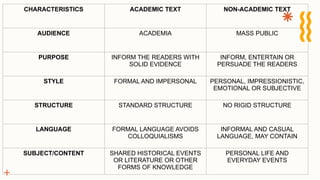
CHARACTERISTICS ACADEMIC TEXTNON-ACADEMIC TEXT
AUDIENCE ACADEMIA MASS PUBLIC
PURPOSE INFORM THE READERS WITH
SOLID EVIDENCE
INFORM, ENTERTAIN OR
PERSUADE THE READERS
STYLE FORMAL AND IMPERSONAL PERSONAL, IMPRESSIONISTIC,
EMOTIONAL OR SUBJECTIVE
STRUCTURE STANDARD STRUCTURE NO RIGID STRUCTURE
LANGUAGE FORMAL LANGUAGE AVOIDS
COLLOQUIALISMS
INFORMAL AND CASUAL
LANGUAGE, MAY CONTAIN
SUBJECT/CONTENT SHARED HISTORICAL EVENTS
OR LITERATURE OR OTHER
FORMS OF KNOWLEDGE
PERSONAL LIFE AND
EVERYDAY EVENTS
● It isimportant to use
unambiguous language. Formal
language and the third person
point-of-view should be used.
LANGUAGE
26.
● Technical languageappropriate
to the area of study may also be
used, however it does not mean
using “big words” just for the
sake of doing so.
LANGUAGE
● Citing sourcesin the body of the
paper and providing a list of
references is a very important
aspect of an academic text.
CITATION
29.
● It isessential to always
acknowledge the source of any
ideas, research findings, data or
quoted text that have been used
in a paper as a defense against
allegations of plagiarism.
CITATION
● What isvalued in an Academic text
is that opinions are based on a sound
understanding of the pertinent body
of knowledge and academic debates
that exist within, and often external
to a specific discipline.
EVIDENCED-BASED ARGUMENTS
● The startingpoint of an academic
text is a particular perspective, idea
or position applied to the chosen
research problem, such as
establishing, proving, or disproving
solutions to the questions posed for
the topic.
THESIS-DRIVEN
● Refers tothe oral, written,
auditory, and visual language
proficiency required to learn
effectively in schools and
academic programs.
ACADEMIC LANGUAGE
45.
● Students whomaster academic
language are more likely to be
successful in academic and
professional settings.
WHY IS ACADEMIC LANGUAGE SO
IMPORTANT?
46.
What is thedifference
between Academic
Language and Social
Language?
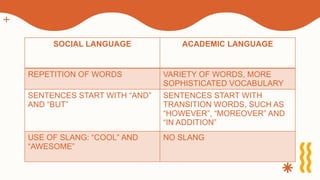
47.
SOCIAL LANGUAGE ACADEMICLANGUAGE
REPETITION OF WORDS VARIETY OF WORDS, MORE
SOPHISTICATED VOCABULARY
SENTENCES START WITH “AND”
AND “BUT”
SENTENCES START WITH
TRANSITION WORDS, SUCH AS
“HOWEVER”, “MOREOVER” AND
“IN ADDITION”
USE OF SLANG: “COOL” AND
“AWESOME”
NO SLANG
48.
CREDITS: This presentationtemplate was created by Slidesgo, and includes icons by
Flaticon, infographics & images by Freepik and content by Swetha Tandri
Thanks!
Do you have any questions?
youremail@freepik.com
+91 620 421 838
yourwebsite.com
Please keep this slide for attribution
49.
CREDITS: This presentationtemplate was created by Slidesgo, and includes icons by
Flaticon, infographics & images by Freepik and content by Swetha Tandri
Thanks!
fac
Please keep this slide for attribution
51.
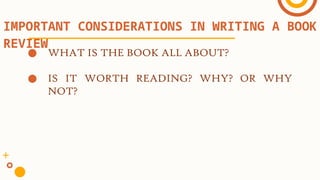
● WHAT ISTHE BOOK ALL ABOUT?
● IS IT WORTH READING? WHY? OR WHY
NOT?
IMPORTANT CONSIDERATIONS IN WRITING A BOOK
REVIEW
52.
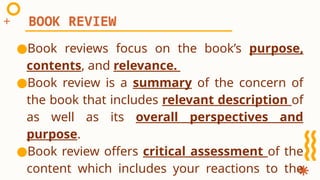
●Book reviews focuson the book’s purpose,
contents, and relevance.
●Book review is a summary of the concern of
the book that includes relevant description of
as well as its overall perspectives and
purpose.
●Book review offers critical assessment of the
content which includes your reactions to the
BOOK REVIEW
53.
●Book review suggestswhether or not
the reader would appreciate it and if
the book is worth reading.
BOOK REVIEW
54.
●Process of gatheringa
comprehensive body of
knowledge that has bearing on the
research study.
Crafting a Literature Review
55.
●Provides information thatmay
support and strengthen the
findings of the study on hand.
Crafting a Literature Review
56.
Present the sampleaction research
conducted in college.
Crafting a Literature Review
57.
Why is aliterature review
important?
Think Critically and Create
58.
Write a literaturereview on any of the following
research topics.
● The reasons for absenteeism in class
● Effects of Technology in education
● Effects of television violence on children
● Teenage Pregnancy
Think Critically and Create
59.
●RESEARCH- is aninvestigation that
leads to the discovery of new
knowledge .
WRITING A RESEARCH REPORT
60.
●Systematic exploration ofpossible
solutions to an existing problem.
●The responsibility of a researcher doesn’t
end after the research.
●Whether the research gets published or not,
it is imperative that findings be
disseminated through a research report.
WRITING A RESEARCH REPORT
61.
●Preparing a researchreport is very
important as it is the stage where
the findings of research are
disseminated to the stakeholders.
WRITING A RESEARCH REPORT
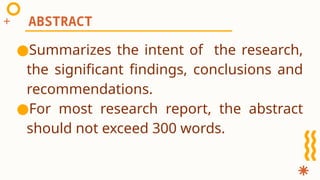
●Summarizes the intentof the research,
the significant findings, conclusions and
recommendations.
●For most research report, the abstract
should not exceed 300 words.
ABSTRACT
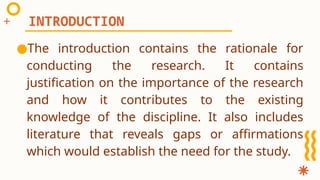
●The introduction containsthe rationale for
conducting the research. It contains
justification on the importance of the research
and how it contributes to the existing
knowledge of the discipline. It also includes
literature that reveals gaps or affirmations
which would establish the need for the study.
INTRODUCTION
66.
● The methodologyincludes the research
design, respondents, sampling technique and
the description of how the study was
conducted.
METHODOLOGY
67.
● This explainsthe results of the study. It also
includes interpretation and in-depth analysis
of the results and their implications.
RESULTS AND DISCUSSION
68.
●A statement ofgeneralization based
on the results of the study.
Conclusions have to be concise ad
explicit.
CONCLUSION
69.
●This is whereyou will indicate the
books, journals, and other online
references that you have read in the
conduct of the research.
REFERENCES
70.
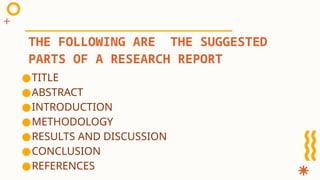
●Why do weneed to write a research
report?
●What are parts of the research
report? Explain each.
WRAP UP
71.
● This typeof Academic text means you are
writing to make an argument about a topic
or situation and its consequent issues, which
are usually debatable or may be considered
controversial.
POSITION PAPER
72.
● Does mytopic reflect a statement of fact
● Could the issue be addressed or resolve with
a simple yes or no?
● Is the topic too broad?
● Is the topic interesting and relevant/
You may use the succeeding guide
questions to find that debatable
angle:
73.
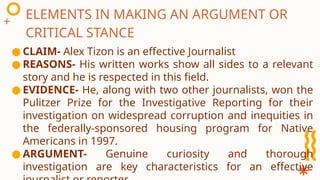
● CLAIM- Thisrefers to your thesis statement, main point,
position or proposed idea.
● REASON(S)- This comprises your sound explanations why
you believe what you do, followed by:
● EVIDENCE- This makes up all the facts, data, examples,
illustrations, and other forms of support you have for
your claim and serve as the grounds (foundations) for
your reasons.
● ARGUMENT- This is simply a logical conclusion or
explanation how the evidence you have mentioned leads
ELEMENTS IN MAKING AN ARGUMENT OR
CRITICAL STANCE
74.
● CLAIM- AlexTizon is an effective Journalist
● REASONS- His written works show all sides to a relevant
story and he is respected in this field.
● EVIDENCE- He, along with two other journalists, won the
Pulitzer Prize for the Investigative Reporting for their
investigation on widespread corruption and inequities in
the federally-sponsored housing program for Native
Americans in 1997.
● ARGUMENT- Genuine curiosity and thorough
investigation are key characteristics for an effective
ELEMENTS IN MAKING AN ARGUMENT OR
CRITICAL STANCE
75.
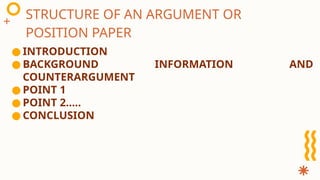
● INTRODUCTION
● BACKGROUNDINFORMATION AND
COUNTERARGUMENT
● POINT 1
● POINT 2…..
● CONCLUSION
STRUCTURE OF AN ARGUMENT OR
POSITION PAPER
76.
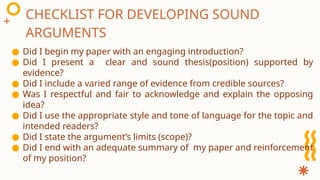
● Did Ibegin my paper with an engaging introduction?
● Did I present a clear and sound thesis(position) supported by
evidence?
● Did I include a varied range of evidence from credible sources?
● Was I respectful and fair to acknowledge and explain the opposing
idea?
● Did I use the appropriate style and tone of language for the topic and
intended readers?
● Did I state the argument’s limits (scope)?
● Did I end with an adequate summary of my paper and reinforcement
of my position?
CHECKLIST FOR DEVELOPING SOUND
ARGUMENTS
77.
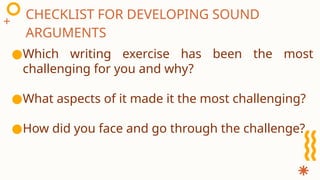
●Which writing exercisehas been the most
challenging for you and why?
●What aspects of it made it the most challenging?
●How did you face and go through the challenge?
CHECKLIST FOR DEVELOPING SOUND
ARGUMENTS
78.
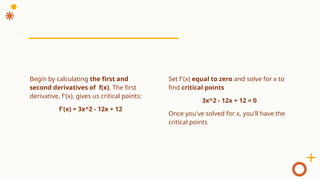
Set f'(x) equalto zero and solve for x to
find critical points
3x^2 - 12x + 12 = 0
Once you've solved for x, you'll have the
critical points
Begin by calculating the first and
second derivatives of f(x). The first
derivative, f'(x), gives us critical points:
f'(x) = 3x^2 - 12x + 12
79.
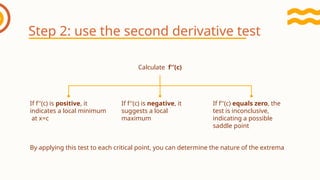
Step 2: usethe second derivative test
Calculate f''(c)
If f''(c) is positive, it
indicates a local minimum
at x=c
If f''(c) is negative, it
suggests a local
maximum
If f''(c) equals zero, the
test is inconclusive,
indicating a possible
saddle point
By applying this test to each critical point, you can determine the nature of the extrema
80.
Alternative resources
Here’s anassortment of alternative resources whose style fits that of this template:
Vectors
● Modern new year party banners with abstract design
81.
Resources
Did you likethe resources used in this template? Get them on these websites:
Vectors
● Flat design minimal makeup artist landing page
82.
As a Premiumuser, you can use this template without attributing Slidesgo or keeping the Thanks slide.
You are allowed to:
● Modify this template.
● Use it for both personal and commercial purposes.
● Hide or delete the “Thanks” slide and the mention to Slidesgo in the credits.
● Share this template in an editable format with people who are not part of your team.
You are not allowed to:
● Sublicense, sell or rent this Slidesgo Template (or a modified version of this Slidesgo Template).
● Distribute this Slidesgo Template (or a modified version of this Slidesgo Template) or include it in a database or in
any other product or service that offers downloadable images, icons or presentations that may be subject to
distribution or resale.
● Use any of the elements that are part of this Slidesgo Template in an isolated and separated way from this
Template.
● Register any of the elements that are part of this template as a trademark or logo, or register it as a work in an
intellectual property registry or similar.
For more information about editing slides, please read our FAQs or visit our blog:
https://slidesgo.com/faqs and https://slidesgo.com/slidesgo-school
Instructions for use (premium users)
83.
This presentation hasbeen made using the following fonts:
Patua One
(https://fonts.google.com/specimen/Patua+One)
Inter
(https://fonts.google.com/specimen/Inter)
Fonts & colors used
#da622e #fdfcf8 #882e06 #ffa900
84.
Create your Storywith our illustrated concepts. Choose the style you like the most, edit its colors, pick
the background and layers you want to show and bring them to life with the animator panel! It will
boost your presentation. Check out how it works.
Storyset
Pana Amico Bro Rafiki Cuate
85.
You can easilyresize these resources without losing quality. To change the color, just ungroup the resource and click
on the object you want to change. Then, click on the paint bucket and select the color you want. Group the resource
again when you’re done. You can also look for more infographics on Slidesgo.
Use our editable graphic resources...
88.
JANUARY FEBRUARY MARCHAPRIL MAY JUNE
PHASE 1
PHASE 2
Task 1
Task 2
Task 1
Task 2
JANUARY FEBRUARY MARCH APRIL
PHASE 1
Task 1
Task 2
91.
You can resizethese icons without losing quality.
You can change the stroke and fill color; just select the icon and click on the paint bucket/pen.
In Google Slides, you can also use Flaticon’s extension, allowing you to customize and add even more icons.
...and our sets of editable icons
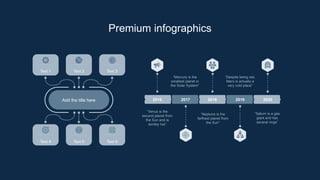
Add the titlehere
Text 1 Text 2 Text 3
Text 4 Text 5 Text 6
2016 2017 2018 2019 2020
“Despite being red,
Mars is actually a
very cold place”
“Mercury is the
smallest planet in
the Solar System”
“Neptune is the
farthest planet from
the Sun”
“Saturn is a gas
giant and has
several rings”
“Venus is the
second planet from
the Sun and is
terribly hot”
Premium infographics
99.
“Despite being red,
Marsis actually a
very cold place”
“Jupiter is the
biggest planet in the
entire Solar System”
“Saturn is a gas
giant and has
several rings”
75%
Premium infographics
“Mercury is the
smallest planet in the
Solar System”
TITLE 1
75%