
Dr. Andree C. Swanson
Copyright @ 2011 - 2013
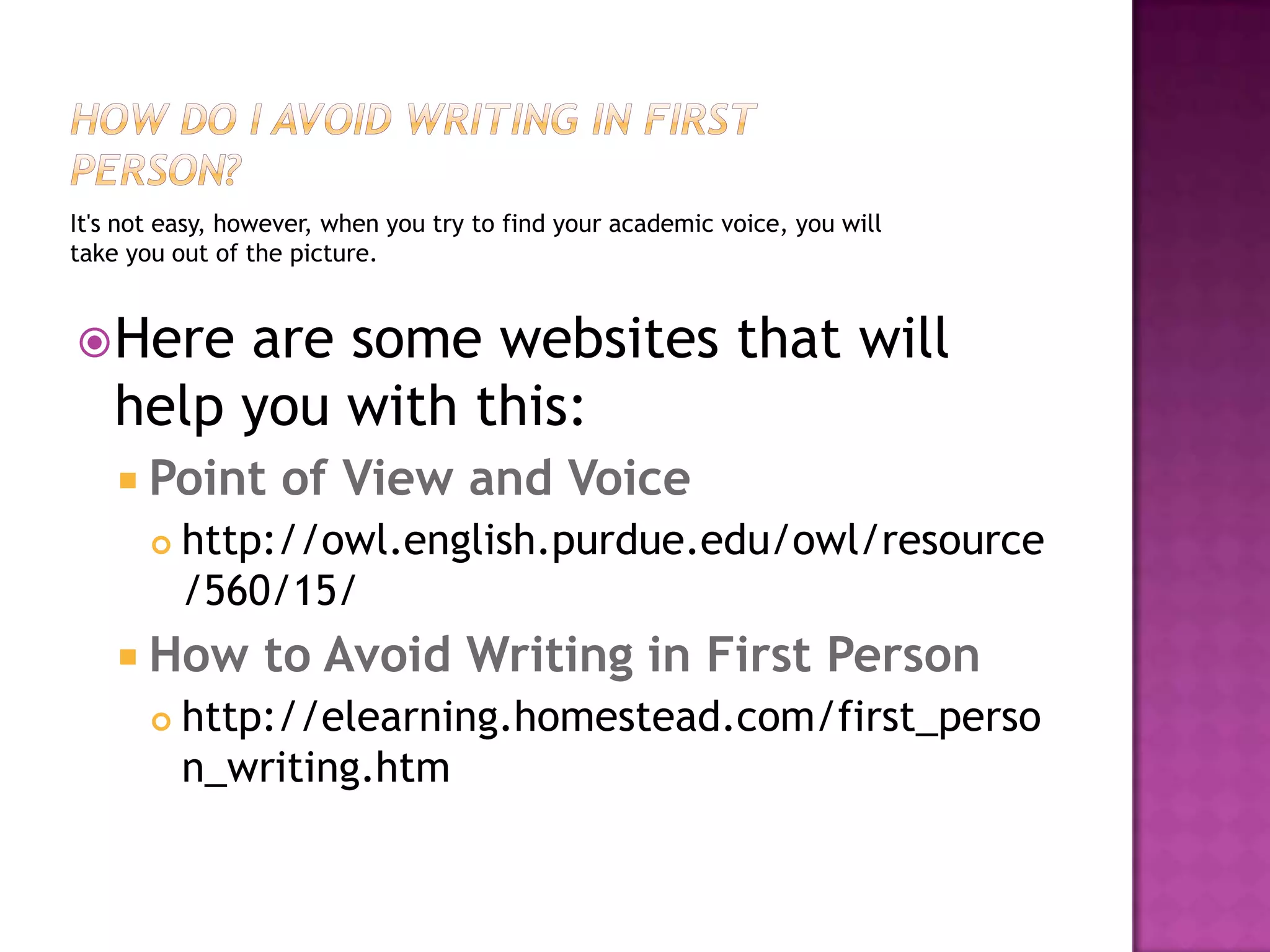
It's not easy, however, when you try to find your academic voice, you will
take you out of the picture.
Here are some websites that will
help you with this:
 Point of View and Voice
 http://owl.english.purdue.edu/owl/resource
/560/15/
 How to Avoid Writing in First Person
 http://elearning.homestead.com/first_perso
n_writing.htm
“It is important to note that
while the avoidance of "I"
has long been part of the
academic tradition, these
days some academics
consider its use to be
acceptable. So, you may
encounter different views
about the use of "I" over the
course of your degree.”
(Monash University, 2007)
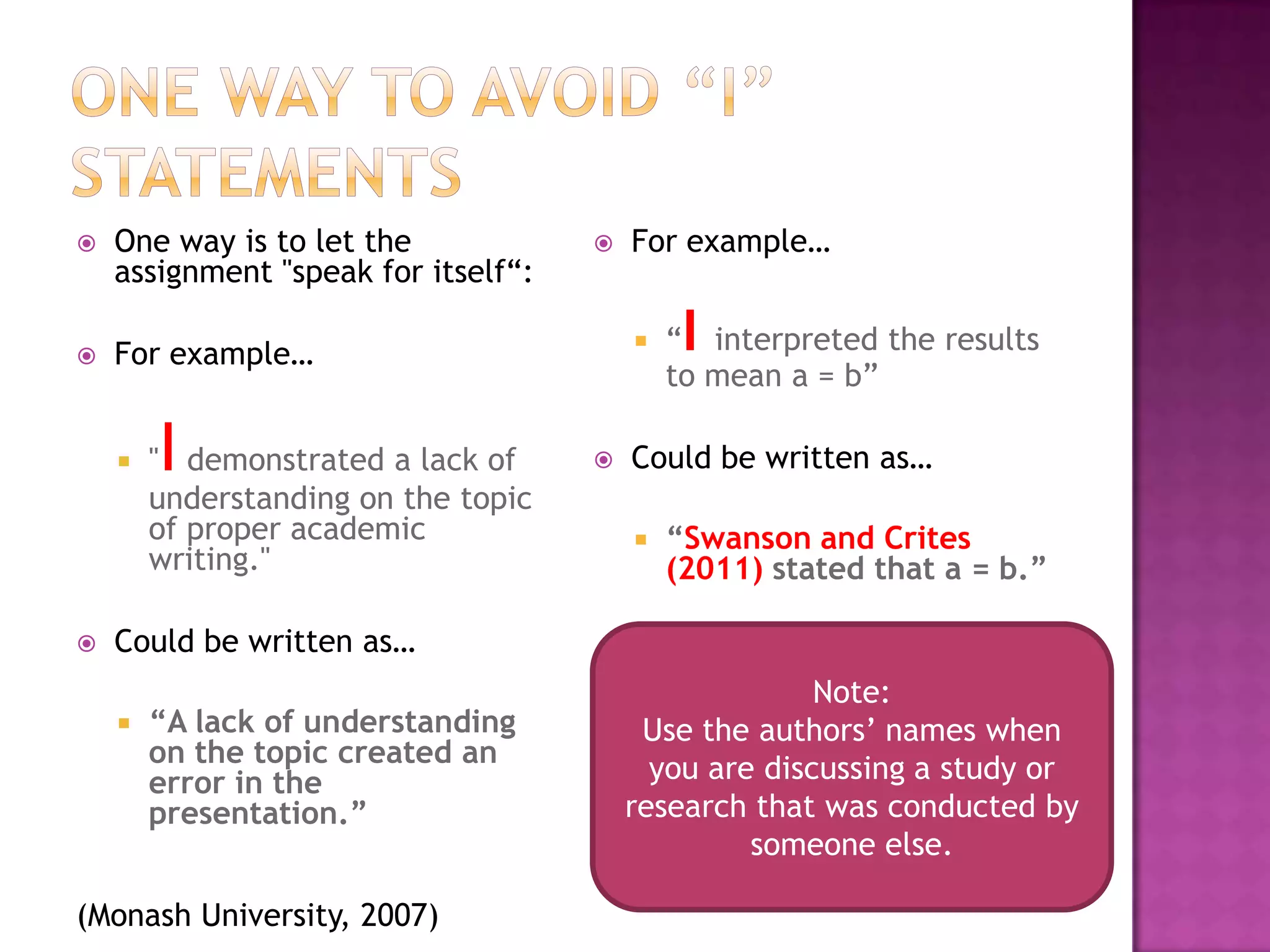
 One way is to let the
assignment "speak for itself“:
 For example…
 "Idemonstrated a lack of
understanding on the topic
of proper academic
writing."
 Could be written as…
 “A lack of understanding
on the topic created an
error in the
presentation.”
 For example…
 “I interpreted the results
to mean a = b”
 Could be written as…
 “Swanson and Crites
(2011) stated that a = b.”
Note:
Use the authors’ names when
you are discussing a study or
research that was conducted by
someone else.
(Monash University, 2007)
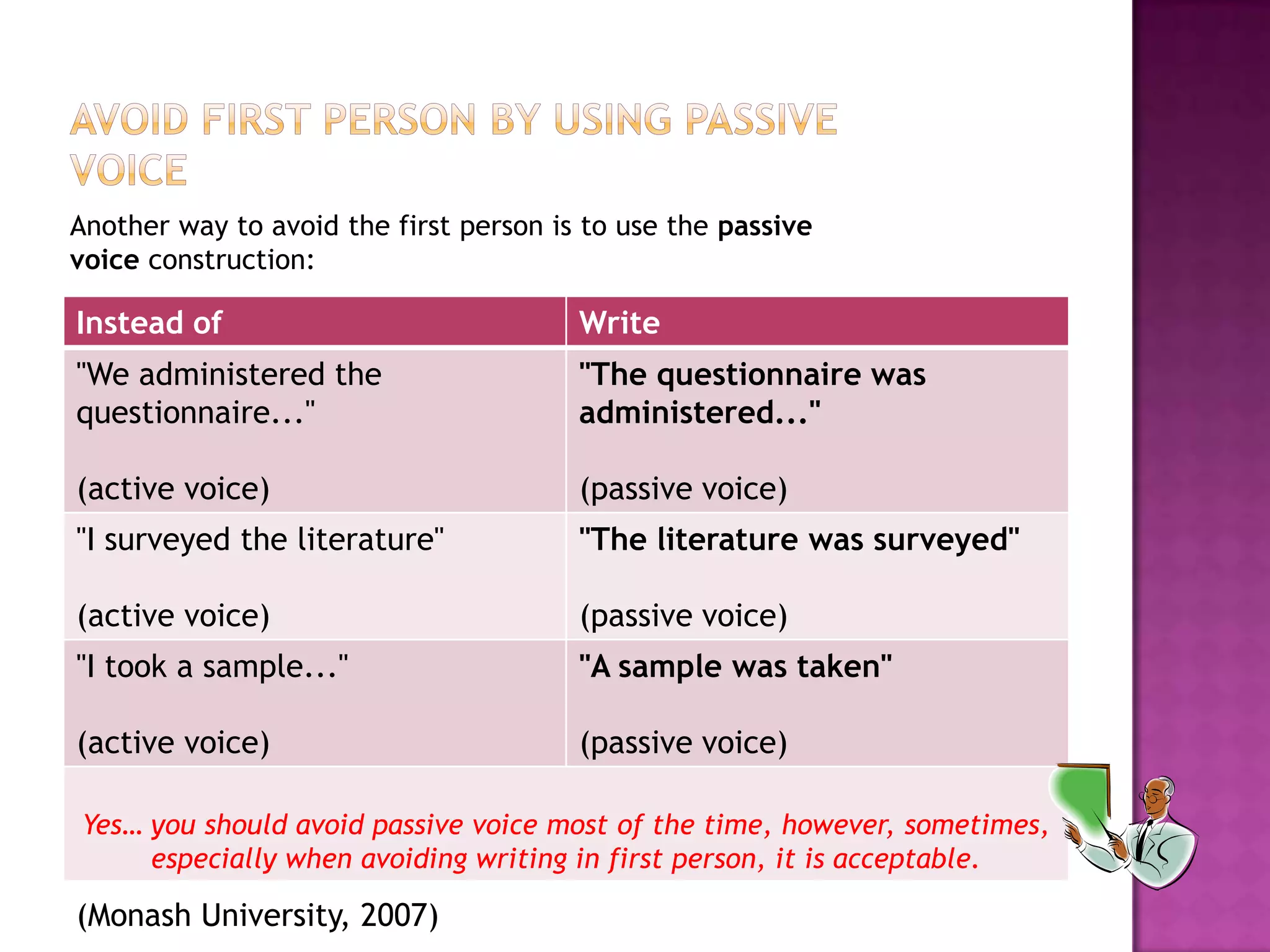
Instead of Write
"We administered the
questionnaire..."
(active voice)
"The questionnaire was
administered..."
(passive voice)
"I surveyed the literature"
(active voice)
"The literature was surveyed"
(passive voice)
"I took a sample..."
(active voice)
"A sample was taken"
(passive voice)
Yes… you should avoid passive voice most of the time, however, sometimes,
especially when avoiding writing in first person, it is acceptable.
Another way to avoid the first person is to use the passive
voice construction:
(Monash University, 2007)
 Bowman, L. (2003). How to avoid writing in
first person. Retrieved from
http://elearning.homestead.com/first_perso
n_writing.htm
 Monash University. (2007). Avoiding the
personal pronoun “I”. Retrieved from
http://www.monash.edu.au/lls/llonline/writ
ing/arts/sociology/2.3.1.xml
 Purdue University. (1995-2011). Point of view
and voice. Retrieved from
http://owl.english.purdue.edu/owl/resource
/560/15/

How to avoid writing in first person

  • 1.
    Dr. Andree C.Swanson Copyright @ 2011 - 2013
  • 2.
    It's not easy,however, when you try to find your academic voice, you will take you out of the picture. Here are some websites that will help you with this:  Point of View and Voice  http://owl.english.purdue.edu/owl/resource /560/15/  How to Avoid Writing in First Person  http://elearning.homestead.com/first_perso n_writing.htm
  • 3.
    “It is importantto note that while the avoidance of "I" has long been part of the academic tradition, these days some academics consider its use to be acceptable. So, you may encounter different views about the use of "I" over the course of your degree.” (Monash University, 2007)
  • 4.
     One wayis to let the assignment "speak for itself“:  For example…  "Idemonstrated a lack of understanding on the topic of proper academic writing."  Could be written as…  “A lack of understanding on the topic created an error in the presentation.”  For example…  “I interpreted the results to mean a = b”  Could be written as…  “Swanson and Crites (2011) stated that a = b.” Note: Use the authors’ names when you are discussing a study or research that was conducted by someone else. (Monash University, 2007)
  • 5.
    Instead of Write "Weadministered the questionnaire..." (active voice) "The questionnaire was administered..." (passive voice) "I surveyed the literature" (active voice) "The literature was surveyed" (passive voice) "I took a sample..." (active voice) "A sample was taken" (passive voice) Yes… you should avoid passive voice most of the time, however, sometimes, especially when avoiding writing in first person, it is acceptable. Another way to avoid the first person is to use the passive voice construction: (Monash University, 2007)
  • 6.
     Bowman, L.(2003). How to avoid writing in first person. Retrieved from http://elearning.homestead.com/first_perso n_writing.htm  Monash University. (2007). Avoiding the personal pronoun “I”. Retrieved from http://www.monash.edu.au/lls/llonline/writ ing/arts/sociology/2.3.1.xml  Purdue University. (1995-2011). Point of view and voice. Retrieved from http://owl.english.purdue.edu/owl/resource /560/15/