FIRE SAFETY
DESIGNATED FIRE MARSHAL TRAINING
Introduction & Objectives
1. The Chemistry Of Fire
2. The Causes Of Fire
3. Basic Safety Features In The Building
4. Introduction To Fire Extinguishers
5. Actions In The Event Of Fire
6. ASL Fire Plan
INTRODUCTION
LEGAL
• The Regulatory Reform (Fire Safety) Order
2005 – implemented 2006
• Onus falls on the ‘Responsible Person’ who is
NOT protected by Corporate Limited Liability
• Ensure as far as is reasonably practicable
employees/visitors protection from damage
due to fire
1. THE CHEMISTRY OF FIRE
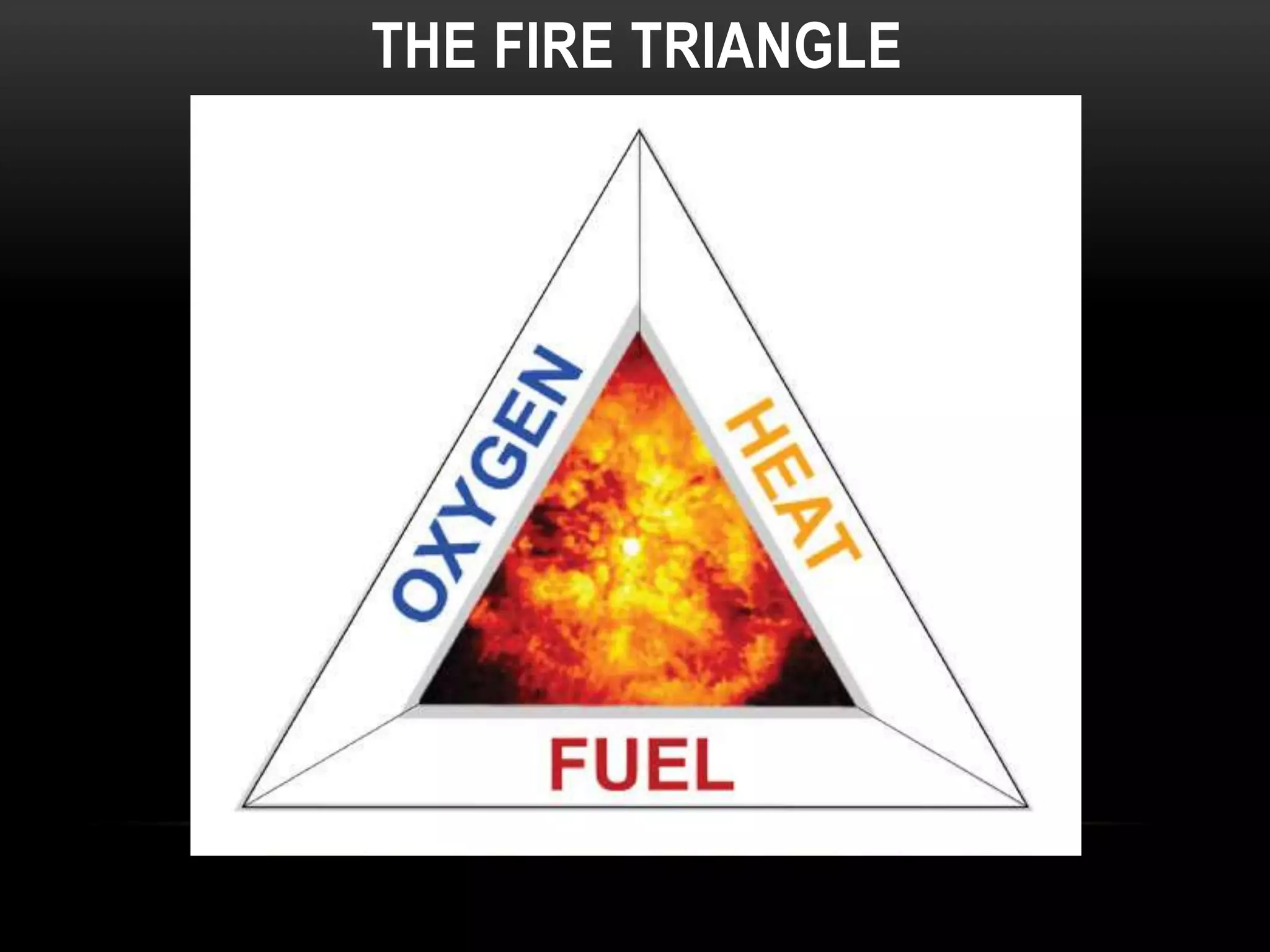
FUEL
HEATOXYGEN
FUEL
Solid
Liquid
Gas
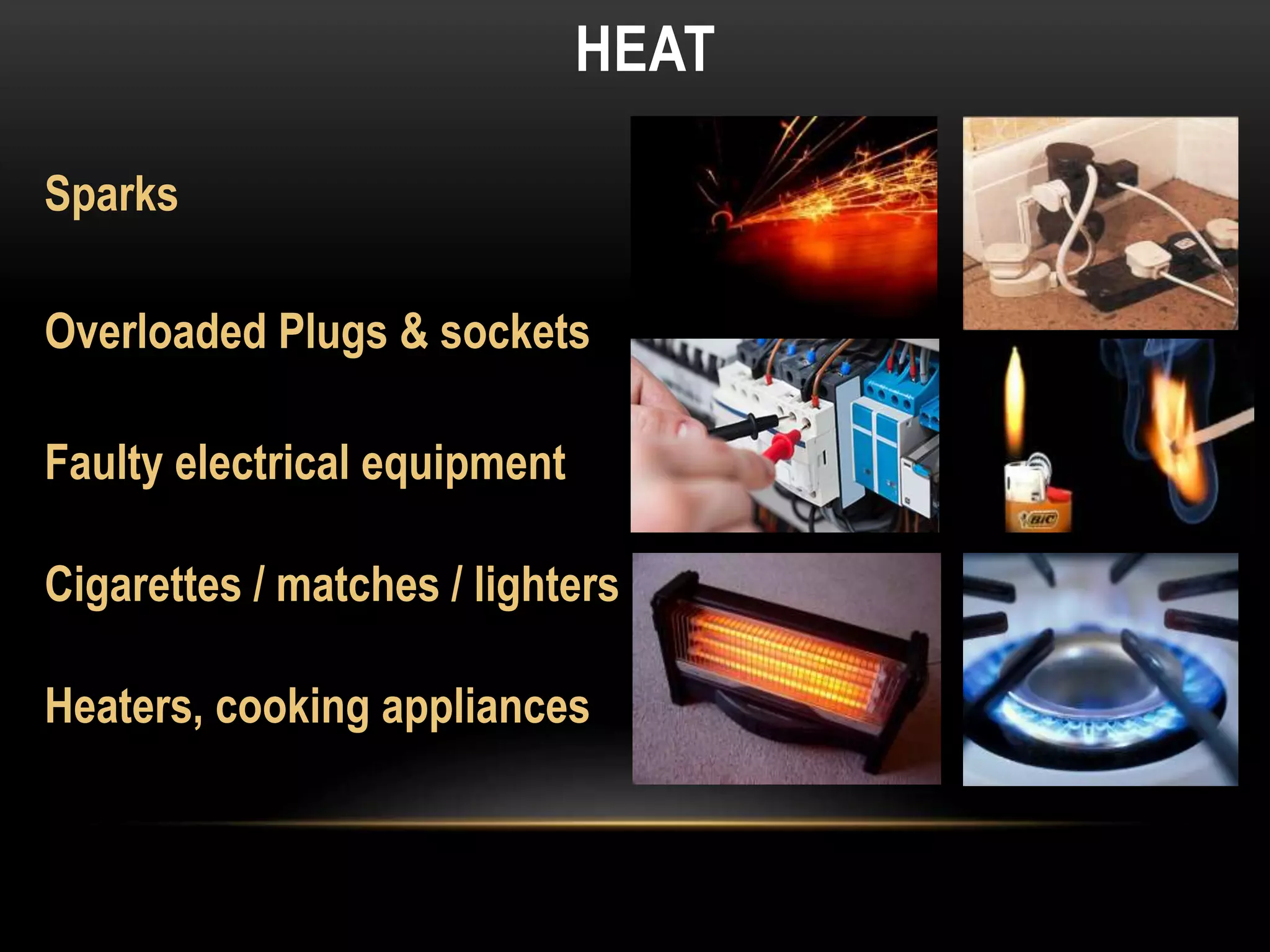
HEAT
Sparks
Overloaded Plugs & sockets
Cigarettes / matches / lighters
Heaters, cooking appliances
Faulty electrical equipment
OXYGEN
THE FIRE TRIANGLE
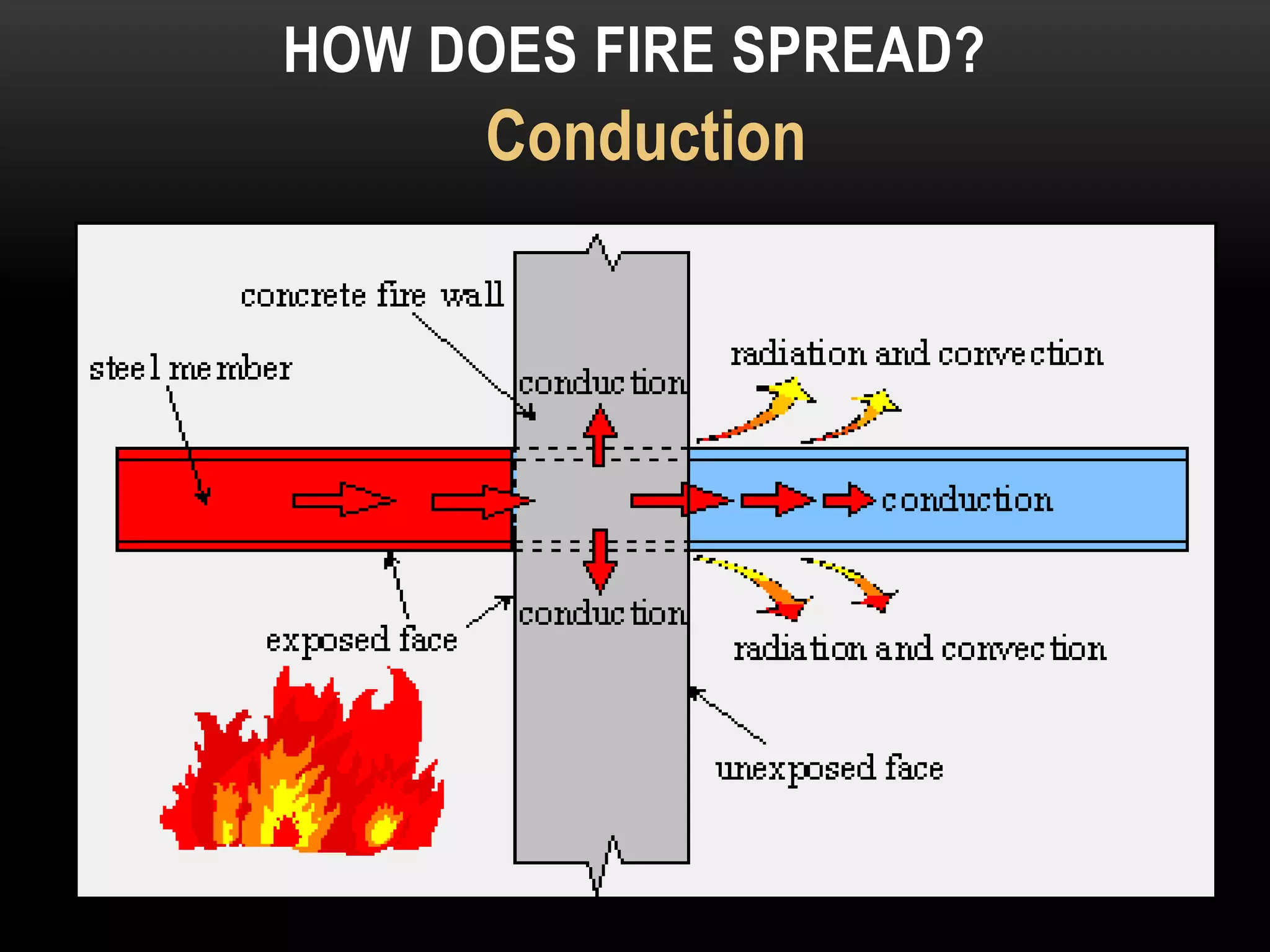
HOW DOES FIRE SPREAD?
Direct Burning
ConvectionConduction
Radiation
HOW DOES FIRE SPREAD?
Conduction
2. THE CAUSES OF FIRE
CAUSES OF FIRE
ARSON
ELECTRICITY
SMOKING
POOR
HOUSEKEEPING
ARSON
CAUSES OF FIRE
ARSON
• 45% of serious fires – opportunist vandalism
• Report suspicious activity
• Challenge people (offer help)
• Check doors & windows are closed
• Keep a record of entry
• Monitor use of entry records – NOTE:
registers will be the Marshall’s
responsibility in the event of a fire
CAUSES OF FIRE
ELECTRICITY
• Never use electrical equipment in poor repair
or with damaged lead
• Report unusual smells or noises
• Report equipment overheating
• Never overload extensions
• Locate electrical equipment at a safe distance
from combustibles
• Switch off when not in use
CAUSES OF FIRE
SMOKING
• Only smoke in designated areas
• Use a substantial ash tray
• Never located near combustible
materials
CAUSES OF FIRE
POOR HOUSEKEEPING
• Never store combustibles under your
desk
• Clean desk policy
• Waste materials in proper containers
• No storage under or near a stairway
3. BASIC SAFETY FEATURES
IN THE BUILDING
FIRE SAFETY FEATURES
Call Points Exit Signs
Smoke & Heat Detectors Emergency Lighting
FIRE SAFETY FEATURES
FIRE DOORS
• HINDER the spread of
fire
• Closed at all times
• Know the nearest fire
door in the building
• Report misuse
4. INTRODUCTION TO FIRE EXTINGUISHERS
FIRE EXTINGUISHERS
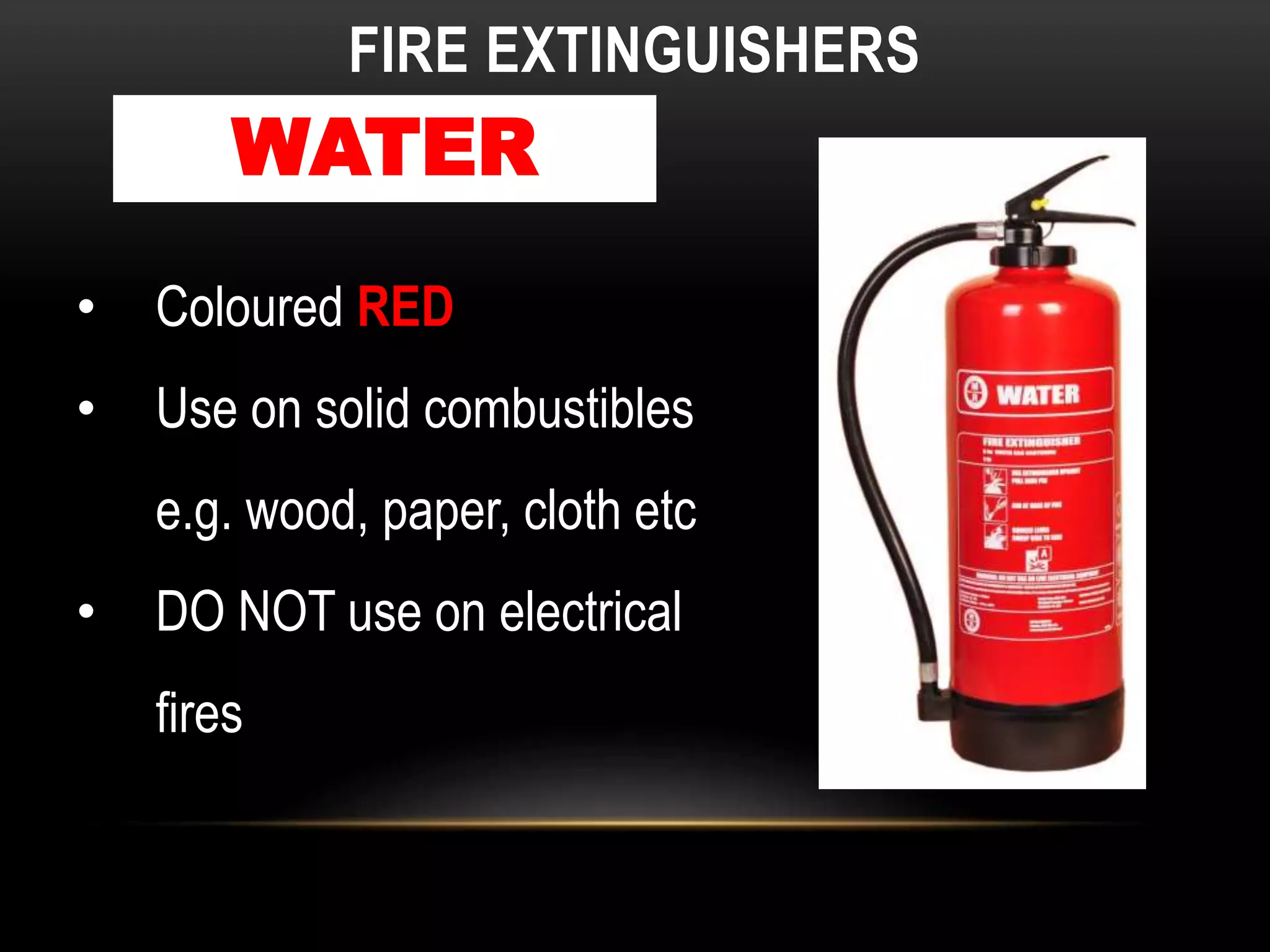
WATER
• Coloured RED
• Use on solid combustibles
e.g. wood, paper, cloth etc
• DO NOT use on electrical
fires
FIRE EXTINGUISHERS
CO2 – Carbon Dioxide
• Coloured BLACK
• Use on electrical fires
• May be used on localised
flammable liquid fires
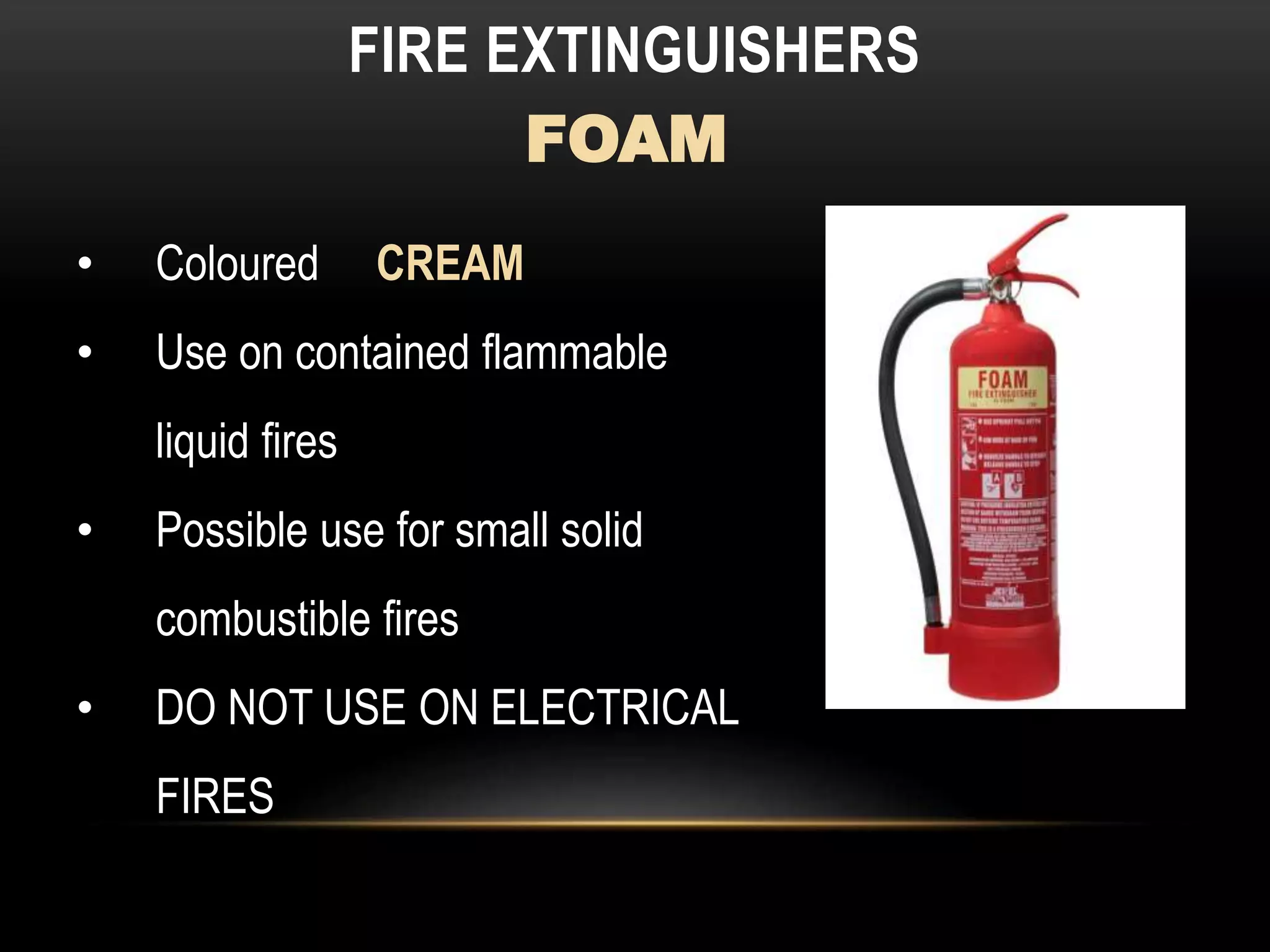
• Coloured CREAM
• Use on contained flammable
liquid fires
• Possible use for small solid
combustible fires
• DO NOT USE ON ELECTRICAL
FIRES
FIRE EXTINGUISHERS
FOAM
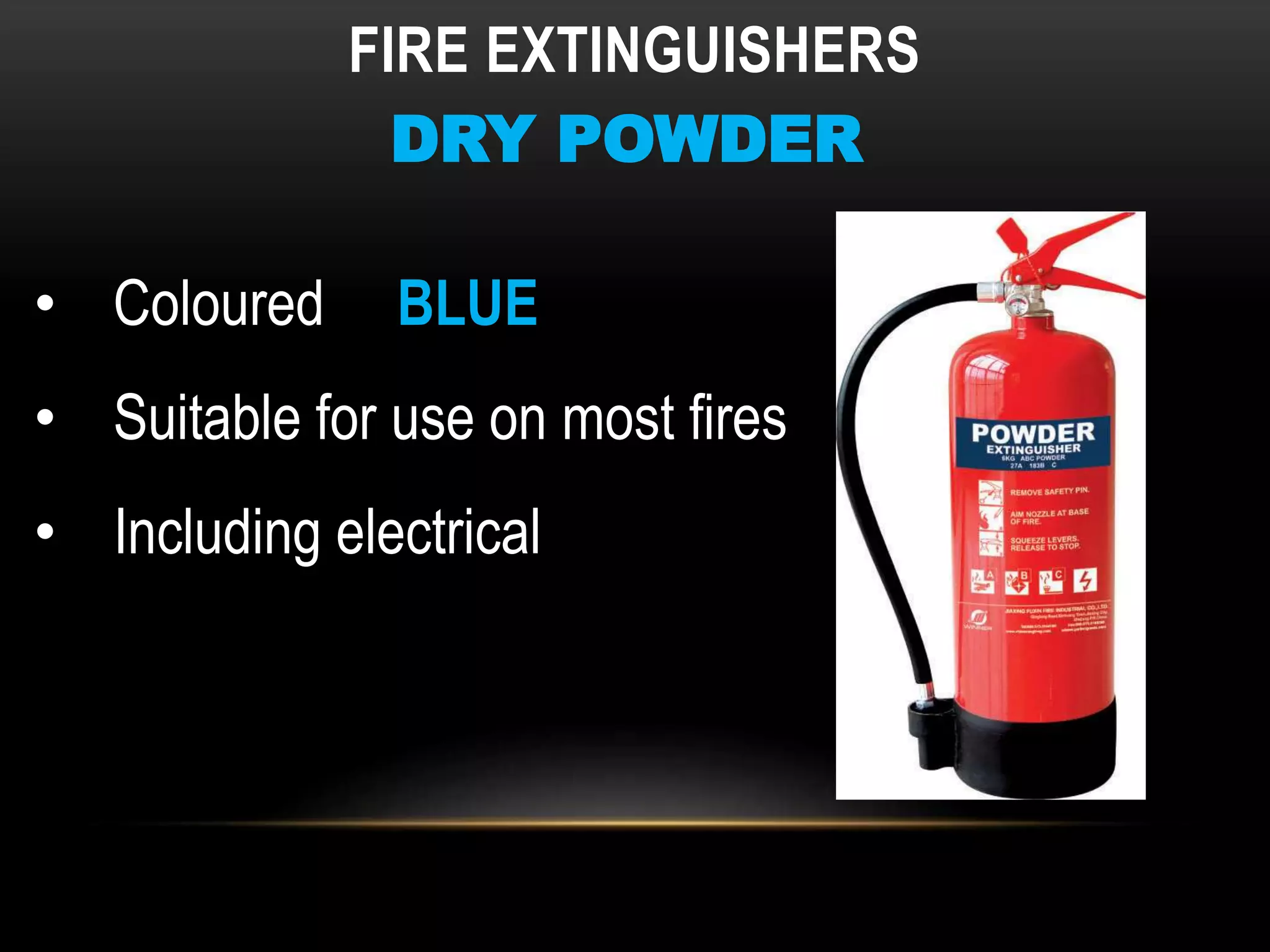
• Coloured BLUE
• Suitable for use on most fires
• Including electrical
FIRE EXTINGUISHERS
DRY POWDER
• Coloured YELLOW
• For use almost exclusively on
deep fat fryers
• DO NOT USE ON
ELECTRICAL FIRES
FIRE EXTINGUISHERS
WET CHEMICAL
• Contained in a RED dispenser
• Use on pan fires, localised solids
& contained flammable liquids
FIRE EXTINGUISHERS
FIRE BLANKET
5. ACTIONS IN THE EVENT OF FIRE
• Studies of human behaviour in emergency
situations show that on average, almost 2/3 of
the time available to escape is taken up by the
initial reaction to the situation.
• The final third is time actually spent on escaping
the situation.
• In an emergency, the reaction time is critical as it
also allows the situation to develop.
5. ACTIONS IN THE EVENT OF FIRE
• Leave the room and close the door behind you
• Sound the alarm at the nearest Call Point
• Contact the fire service (best done by reception staff)
• Leave by the nearest emergency exit
• DO NOT use any lifts
• Confirm your evacuation to the nearest Fire Marshal
• Proceed to the location where the fire service arrive
ACTIONS IF YOU DISCOVER A FIRE
GENERAL
5. ACTIONS IN THE EVENT OF FIRE
• Leave the building immediately via the nearest
emergency exit
• DO NOT use any lifts
• DO NOT collect personal belongings
• DO NOT remove fire extinguishers from the building
• Go DIRECTLY to the assembly point
ACTIONS IF YOU HEAR THE FIRE ALARM-
GENERAL
5. ACTIONS IN THE EVENT OF FIRE
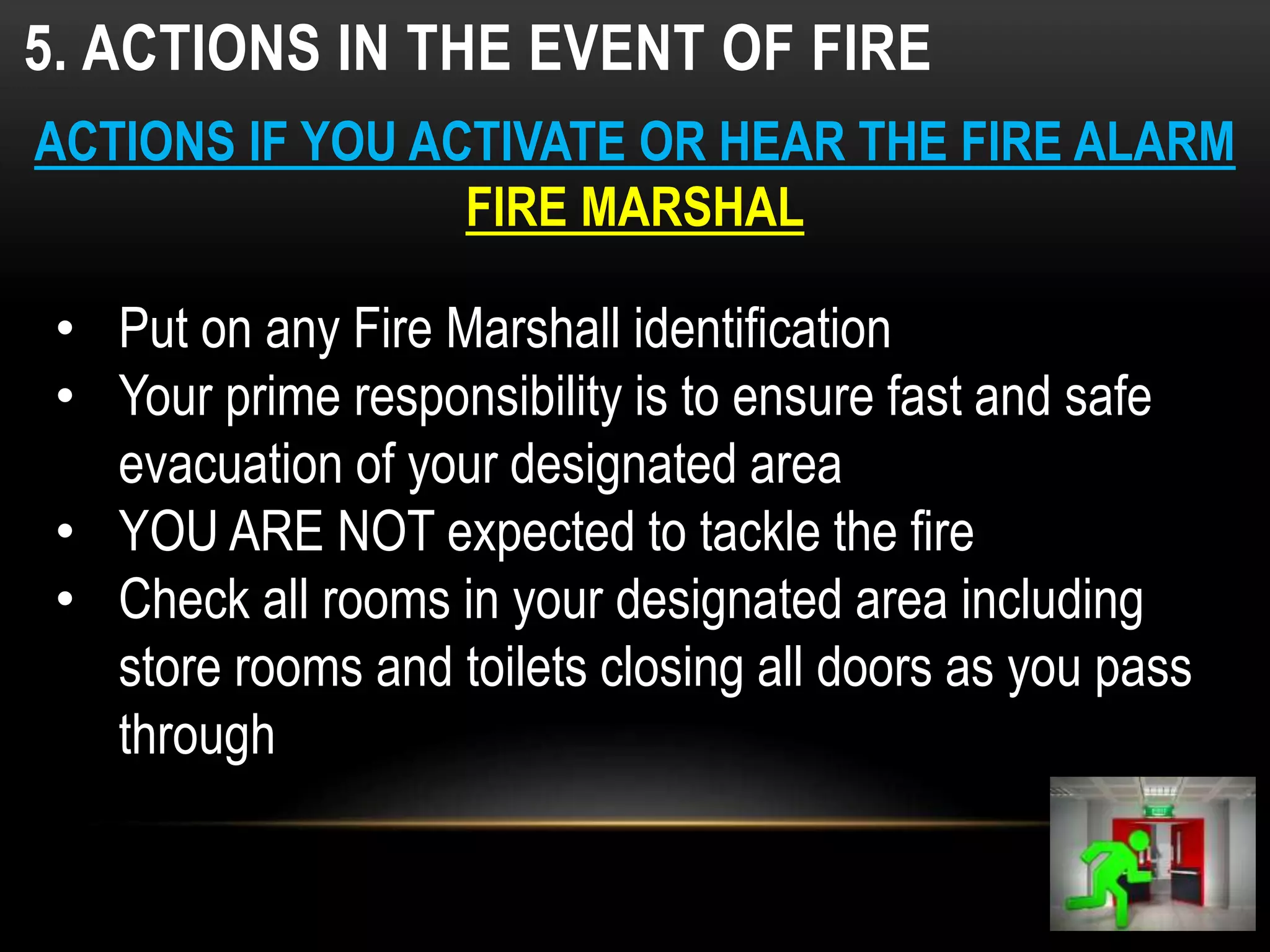
• Put on any Fire Marshall identification
• Your prime responsibility is to ensure fast and safe
evacuation of your designated area
• YOU ARE NOT expected to tackle the fire
• Check all rooms in your designated area including
store rooms and toilets closing all doors as you pass
through
ACTIONS IF YOU ACTIVATE OR HEAR THE FIRE ALARM
FIRE MARSHAL
5. ACTIONS IN THE EVENT OF FIRE
• You should then leave the building through the nearest
emergency exit
• NEVER delay your exit if someone refuses to leave the
building
• DO NOT engage in arguments
• Impress on the individual(s) that it is essential they leave
immediately and establish that they are able to do so
• Take a mental or physical note of who they are, their
description and their location
ACTIONS IF YOU ACTIVATE OR HEAR THE FIRE ALARM
FIRE MARSHAL cont.
5. ACTIONS IN THE EVENT OF FIRE
• Leave the building and report to the assembly point
• Report to the person responsible for co-ordinating
the evacuation and pass any information to him/her
• If you discovered the fire you should then go to the
point the fire service is expected to arrive
ACTIONS IF YOU ACTIVATE OR HEAR THE FIRE ALARM
FIRE MARSHAL cont.
5. ACTIONS IN THE EVENT OF FIRE
• Fire Marshalls Unit 20:
• Mandy Dunn – Faye Webster – Susan Waldron
ASL FIRE PLAN
• Fire Marshalls Units 18 & 19:
• Peter Grimwood – Nick Farrow – Sara De Silva
• Fire Marshalls ASL Cannock:
• Ian Hodson – Mitch Pugh
5. ACTIONS IN THE EVENT OF FIRE
• Full fire drill every 6 months
• Weekly fire alarm tests in ALL units
• Daily checks on FFE
• Monitor security
• Marshalls to know their routes and assembly point(s)
• Be aware of housekeeping issues and take
appropriate action
• Cross train
ASL FIRE PLAN
5. ACTIONS IN THE EVENT OF FIRE
• Fire Risk Assessment
• Update employee handbook
• Update Fire Marshall responsibilities
• Confirm FM PPE
• Create and publish Fire Awareness documentation
and/or carry out staff training
• Update Fire Awareness signage
ASL FIRE PLAN
WORST CASE SCENARIOS
FIRE PROCEDURES

ASL Fire Safety

  • 1.
  • 2.
    DESIGNATED FIRE MARSHALTRAINING Introduction & Objectives 1. The Chemistry Of Fire 2. The Causes Of Fire 3. Basic Safety Features In The Building 4. Introduction To Fire Extinguishers 5. Actions In The Event Of Fire 6. ASL Fire Plan
  • 3.
    INTRODUCTION LEGAL • The RegulatoryReform (Fire Safety) Order 2005 – implemented 2006 • Onus falls on the ‘Responsible Person’ who is NOT protected by Corporate Limited Liability • Ensure as far as is reasonably practicable employees/visitors protection from damage due to fire
  • 4.
    1. THE CHEMISTRYOF FIRE FUEL HEATOXYGEN
  • 5.
  • 6.
    HEAT Sparks Overloaded Plugs &sockets Cigarettes / matches / lighters Heaters, cooking appliances Faulty electrical equipment
  • 7.
  • 8.
  • 9.
    HOW DOES FIRESPREAD? Direct Burning ConvectionConduction Radiation
  • 11.
    HOW DOES FIRESPREAD? Conduction
  • 12.
  • 13.
  • 14.
    CAUSES OF FIRE ARSON •45% of serious fires – opportunist vandalism • Report suspicious activity • Challenge people (offer help) • Check doors & windows are closed • Keep a record of entry • Monitor use of entry records – NOTE: registers will be the Marshall’s responsibility in the event of a fire
  • 15.
    CAUSES OF FIRE ELECTRICITY •Never use electrical equipment in poor repair or with damaged lead • Report unusual smells or noises • Report equipment overheating • Never overload extensions • Locate electrical equipment at a safe distance from combustibles • Switch off when not in use
  • 16.
    CAUSES OF FIRE SMOKING •Only smoke in designated areas • Use a substantial ash tray • Never located near combustible materials
  • 17.
    CAUSES OF FIRE POORHOUSEKEEPING • Never store combustibles under your desk • Clean desk policy • Waste materials in proper containers • No storage under or near a stairway
  • 18.
    3. BASIC SAFETYFEATURES IN THE BUILDING
  • 19.
    FIRE SAFETY FEATURES CallPoints Exit Signs Smoke & Heat Detectors Emergency Lighting
  • 20.
    FIRE SAFETY FEATURES FIREDOORS • HINDER the spread of fire • Closed at all times • Know the nearest fire door in the building • Report misuse
  • 21.
    4. INTRODUCTION TOFIRE EXTINGUISHERS
  • 22.
    FIRE EXTINGUISHERS WATER • ColouredRED • Use on solid combustibles e.g. wood, paper, cloth etc • DO NOT use on electrical fires
  • 23.
    FIRE EXTINGUISHERS CO2 –Carbon Dioxide • Coloured BLACK • Use on electrical fires • May be used on localised flammable liquid fires
  • 24.
    • Coloured CREAM •Use on contained flammable liquid fires • Possible use for small solid combustible fires • DO NOT USE ON ELECTRICAL FIRES FIRE EXTINGUISHERS FOAM
  • 25.
    • Coloured BLUE •Suitable for use on most fires • Including electrical FIRE EXTINGUISHERS DRY POWDER
  • 26.
    • Coloured YELLOW •For use almost exclusively on deep fat fryers • DO NOT USE ON ELECTRICAL FIRES FIRE EXTINGUISHERS WET CHEMICAL
  • 27.
    • Contained ina RED dispenser • Use on pan fires, localised solids & contained flammable liquids FIRE EXTINGUISHERS FIRE BLANKET
  • 28.
    5. ACTIONS INTHE EVENT OF FIRE
  • 29.
    5. ACTIONS INTHE EVENT OF FIRE
  • 30.
    5. ACTIONS INTHE EVENT OF FIRE • Studies of human behaviour in emergency situations show that on average, almost 2/3 of the time available to escape is taken up by the initial reaction to the situation. • The final third is time actually spent on escaping the situation. • In an emergency, the reaction time is critical as it also allows the situation to develop.
  • 31.
    5. ACTIONS INTHE EVENT OF FIRE • Leave the room and close the door behind you • Sound the alarm at the nearest Call Point • Contact the fire service (best done by reception staff) • Leave by the nearest emergency exit • DO NOT use any lifts • Confirm your evacuation to the nearest Fire Marshal • Proceed to the location where the fire service arrive ACTIONS IF YOU DISCOVER A FIRE GENERAL
  • 32.
    5. ACTIONS INTHE EVENT OF FIRE • Leave the building immediately via the nearest emergency exit • DO NOT use any lifts • DO NOT collect personal belongings • DO NOT remove fire extinguishers from the building • Go DIRECTLY to the assembly point ACTIONS IF YOU HEAR THE FIRE ALARM- GENERAL
  • 33.
    5. ACTIONS INTHE EVENT OF FIRE • Put on any Fire Marshall identification • Your prime responsibility is to ensure fast and safe evacuation of your designated area • YOU ARE NOT expected to tackle the fire • Check all rooms in your designated area including store rooms and toilets closing all doors as you pass through ACTIONS IF YOU ACTIVATE OR HEAR THE FIRE ALARM FIRE MARSHAL
  • 34.
    5. ACTIONS INTHE EVENT OF FIRE • You should then leave the building through the nearest emergency exit • NEVER delay your exit if someone refuses to leave the building • DO NOT engage in arguments • Impress on the individual(s) that it is essential they leave immediately and establish that they are able to do so • Take a mental or physical note of who they are, their description and their location ACTIONS IF YOU ACTIVATE OR HEAR THE FIRE ALARM FIRE MARSHAL cont.
  • 35.
    5. ACTIONS INTHE EVENT OF FIRE • Leave the building and report to the assembly point • Report to the person responsible for co-ordinating the evacuation and pass any information to him/her • If you discovered the fire you should then go to the point the fire service is expected to arrive ACTIONS IF YOU ACTIVATE OR HEAR THE FIRE ALARM FIRE MARSHAL cont.
  • 36.
    5. ACTIONS INTHE EVENT OF FIRE • Fire Marshalls Unit 20: • Mandy Dunn – Faye Webster – Susan Waldron ASL FIRE PLAN • Fire Marshalls Units 18 & 19: • Peter Grimwood – Nick Farrow – Sara De Silva • Fire Marshalls ASL Cannock: • Ian Hodson – Mitch Pugh
  • 37.
    5. ACTIONS INTHE EVENT OF FIRE • Full fire drill every 6 months • Weekly fire alarm tests in ALL units • Daily checks on FFE • Monitor security • Marshalls to know their routes and assembly point(s) • Be aware of housekeeping issues and take appropriate action • Cross train ASL FIRE PLAN
  • 38.
    5. ACTIONS INTHE EVENT OF FIRE • Fire Risk Assessment • Update employee handbook • Update Fire Marshall responsibilities • Confirm FM PPE • Create and publish Fire Awareness documentation and/or carry out staff training • Update Fire Awareness signage ASL FIRE PLAN
  • 39.
  • 40.