
Group 11 :
Dinda Pangastuti (1805020036)
Fara Dina (1805020028)
Nur Aina Agustin (1805020008)
Ratna Eli Sutanti (1805020004)
English for Interpersonal Interactions 1
Lecturer :
Syifa Fadhilah Hamid, M.Pd.
DEFINITION
Advice
Is an opinion that
someone offers you about
what you should do or how
you should act in a
particular situation.
(Cambridge Dictionary)
“My father gave me some
advice when I was
young.”
01
“I advise you to learn
English because you will
need it in your higher
studies.”
02
WHAT’S THE DIFFERENCE?
ADVICE VS ADVISE
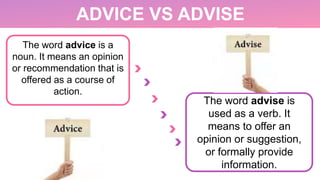
The word advise is
used as a verb. It
means to offer an
opinion or suggestion,
or formally provide
information.
The word advice is a
noun. It means an opinion
or recommendation that is
offered as a course of
action.
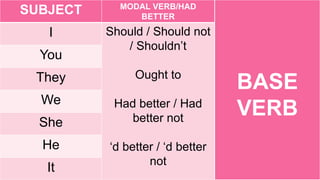
SUBJECT
I
You
They
We
She
He
It
MODAL VERB/HAD
BETTER
Should / Should not
/ Shouldn’t
Ought to
Had better / Had
better not
‘d better / ‘d better
not
BASE
VERB
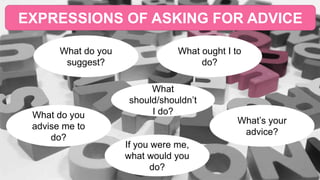
What do you
suggest?
EXPRESSIONS OF ASKING FOR ADVICE
What do you
advise me to
do?
What
should/shouldn’t
I do?
What ought I to
do?
What’s your
advice?
If you were me,
what would you
do?
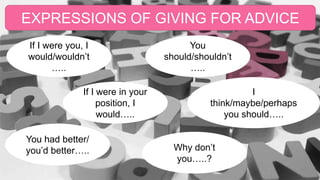
If I were you, I
would/wouldn’t
…..
EXPRESSIONS OF GIVING FOR ADVICE
If I were in your
position, I
would…..
You had better/
you’d better…..
You
should/shouldn’t
…..
I
think/maybe/perhaps
you should…..
Why don’t
you…..?
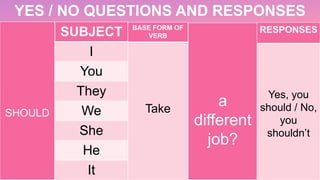
SUBJECT
I
You
They
We
She
He
It
BASE FORM OF
VERB
TakeSHOULD
a
different
job?
RESPONSES
Yes, you
should / No,
you
shouldn’t
YES / NO QUESTIONS AND RESPONSES
Using Should, Ought to, and Had Better for Advice
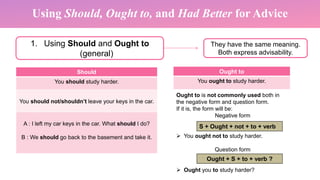
1. Using Should and Ought to
(general)
They have the same meaning.
Both express advisability.
Should
You should study harder.
You should not/shouldn’t leave your keys in the car.
A : I left my car keys in the car. What should I do?
B : We should go back to the basement and take it.
Ought to
You ought to study harder.
Ought to is not commonly used both in
the negative form and question form.
If it is, the form will be:
Negative form
 You ought not to study harder.
Question form
 Ought you to study harder?
S + Ought + not + to + verb
Ought + S + to + verb ?
Using Should, Ought to, and Had Better for Advice
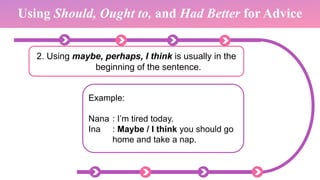
2. Using maybe, perhaps, I think is usually in the
beginning of the sentence.
Example:
Nana : I’m tired today.
Ina : Maybe / I think you should go
home and take a nap.
Using Should, Ought to, and Had Better for Advice
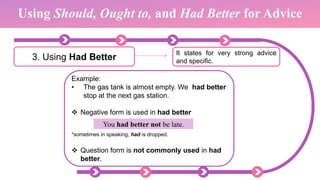
3. Using Had Better
Example:
• The gas tank is almost empty. We had better
stop at the next gas station.
 Negative form is used in had better
*sometimes in speaking, had is dropped.
 Question form is not commonly used in had
better.
It states for very strong advice
and specific.
You had better not be late.
EXAMPLE OFASKING FORAND GIVINGADVICE
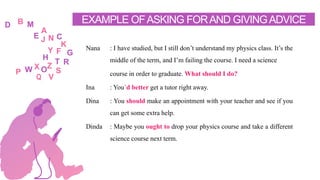
Nana : I have studied, but I still don’t understand my physics class. It’s the
middle of the term, and I’m failing the course. I need a science
course in order to graduate. What should I do?
Ina : You’d better get a tutor right away.
Dina : You should make an appointment with your teacher and see if you
can get some extra help.
Dinda : Maybe you ought to drop your physics course and take a different
science course next term.
EXAMPLE OFASKING FORAND GIVINGADVICE
Ina : Our class is so dirty, almost of the wall is dirty of the glue and
paper.
Nana : How about repainting it again?
Ina : Well, perhaps we should discuss it with our friends and
teachers.
Nana : Oh okay. When we are all at the class, we will start to discuss
it, Ina.
Ina : And don’t forget we ought to ask our teacher about the
permission.
Nana : Yes, I agree.
QUIZ Find and correct five mistakes in the conversation below!
Dina : There are a lot of changes happening at my company. I’m worried I
might lose my job.
Dinda : Well, you better probably start looking for something else.
Dina : I guess so.
Dinda : At the same time, you better try to keep your current job. They say it’s
a lot harder to find a new job when you’re unemployed.
Dina : Is there anything I can do?
Dinda : Yes, there’s a lot of things you can do. First, why not to talk to your
boss? you get along well, right? You could ask for your feedback on
your work. Then, you probably ought tell your boss you’re working on
those things. You might want to keep in touch with her by e-mail.
Dina : Oh okay. What else, Dinda?
Dinda : Well, do extra work you ought take on extra task whenever you can.
And you couldn’t complain about anything.
Dina : That makes sense. Thank you very much, Dinda. I better ask you for
advice more often! Hehehe..
Answer Key:
1. You had / You’d
2. You had / You’d
3. Why don’t you….?
4. Ought to
5. I had / I’d
QUIZ
Give some possible advices for these sentences!
1. Nicola asks me to go to dance party, but I need to help my mother.
What’s your advice?
2. My friend got a nose bleeding! What should I do?
3. My lecturer is mad at me because I do many mistakes in my
presentation. What do you advise me to do?
Possible answers:
1.
a. I think you should tell to Nicola that you can’t come to her dance party, and you ought to tell her the
reasons.
b. If I were you, I would tell her that I can’t come to her dance party because I need to help my mother.
2. You had better go to the hospital or clinic to check up your condition.
3. I think you should/ought to prepare your presentation well and correct the materials to make your
presentation better.
QUIZ
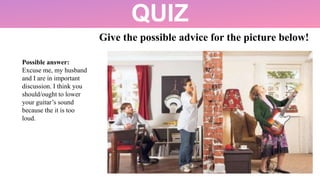
Give the possible advice for the picture below!
Possible answer:
Excuse me, my husband
and I are in important
discussion. I think you
should/ought to lower
your guitar’s sound
because the it is too
loud.
REFERENCES
https://www.cambridge.org/grammarandbeyond/wp-
content/uploads/2011/08/Unit-21.pdf
https://dictionary.cambridge.org/dictionary/english/advice
https://www.myenglishpages.com/site_php_files/communication-
lesson-advice.php
https://blog.maltalingua.com/useful-expressions-english-lesson-
advice/
Azar, Betty Schrampfer, 1941- Fundamentals of English grammar /
Betty S. Azar, Stacy A. Hagrn. -4th ed.
https://www.studybahasainggris.com/contoh-dialog-percakapan-
expressing-giving-advice-memberi-sarannasihat-dalam-bahasa-inggris
ANY QUESTIONS?
Asking for and Giving Advice - English for Interpersonal Interctions I

Asking for and Giving Advice - English for Interpersonal Interctions I

  • 1.
    Group 11 : DindaPangastuti (1805020036) Fara Dina (1805020028) Nur Aina Agustin (1805020008) Ratna Eli Sutanti (1805020004) English for Interpersonal Interactions 1 Lecturer : Syifa Fadhilah Hamid, M.Pd.
  • 2.
    DEFINITION Advice Is an opinionthat someone offers you about what you should do or how you should act in a particular situation. (Cambridge Dictionary)
  • 3.
    “My father gaveme some advice when I was young.” 01 “I advise you to learn English because you will need it in your higher studies.” 02 WHAT’S THE DIFFERENCE?
  • 4.
    ADVICE VS ADVISE Theword advise is used as a verb. It means to offer an opinion or suggestion, or formally provide information. The word advice is a noun. It means an opinion or recommendation that is offered as a course of action.
  • 5.
    SUBJECT I You They We She He It MODAL VERB/HAD BETTER Should /Should not / Shouldn’t Ought to Had better / Had better not ‘d better / ‘d better not BASE VERB
  • 6.
    What do you suggest? EXPRESSIONSOF ASKING FOR ADVICE What do you advise me to do? What should/shouldn’t I do? What ought I to do? What’s your advice? If you were me, what would you do?
  • 7.
    If I wereyou, I would/wouldn’t ….. EXPRESSIONS OF GIVING FOR ADVICE If I were in your position, I would….. You had better/ you’d better….. You should/shouldn’t ….. I think/maybe/perhaps you should….. Why don’t you…..?
  • 8.
    SUBJECT I You They We She He It BASE FORM OF VERB TakeSHOULD a different job? RESPONSES Yes,you should / No, you shouldn’t YES / NO QUESTIONS AND RESPONSES
  • 9.
    Using Should, Oughtto, and Had Better for Advice 1. Using Should and Ought to (general) They have the same meaning. Both express advisability. Should You should study harder. You should not/shouldn’t leave your keys in the car. A : I left my car keys in the car. What should I do? B : We should go back to the basement and take it. Ought to You ought to study harder. Ought to is not commonly used both in the negative form and question form. If it is, the form will be: Negative form  You ought not to study harder. Question form  Ought you to study harder? S + Ought + not + to + verb Ought + S + to + verb ?
  • 10.
    Using Should, Oughtto, and Had Better for Advice 2. Using maybe, perhaps, I think is usually in the beginning of the sentence. Example: Nana : I’m tired today. Ina : Maybe / I think you should go home and take a nap.
  • 11.
    Using Should, Oughtto, and Had Better for Advice 3. Using Had Better Example: • The gas tank is almost empty. We had better stop at the next gas station.  Negative form is used in had better *sometimes in speaking, had is dropped.  Question form is not commonly used in had better. It states for very strong advice and specific. You had better not be late.
  • 12.
    EXAMPLE OFASKING FORANDGIVINGADVICE Nana : I have studied, but I still don’t understand my physics class. It’s the middle of the term, and I’m failing the course. I need a science course in order to graduate. What should I do? Ina : You’d better get a tutor right away. Dina : You should make an appointment with your teacher and see if you can get some extra help. Dinda : Maybe you ought to drop your physics course and take a different science course next term.
  • 13.
    EXAMPLE OFASKING FORANDGIVINGADVICE Ina : Our class is so dirty, almost of the wall is dirty of the glue and paper. Nana : How about repainting it again? Ina : Well, perhaps we should discuss it with our friends and teachers. Nana : Oh okay. When we are all at the class, we will start to discuss it, Ina. Ina : And don’t forget we ought to ask our teacher about the permission. Nana : Yes, I agree.
  • 14.
    QUIZ Find andcorrect five mistakes in the conversation below! Dina : There are a lot of changes happening at my company. I’m worried I might lose my job. Dinda : Well, you better probably start looking for something else. Dina : I guess so. Dinda : At the same time, you better try to keep your current job. They say it’s a lot harder to find a new job when you’re unemployed. Dina : Is there anything I can do? Dinda : Yes, there’s a lot of things you can do. First, why not to talk to your boss? you get along well, right? You could ask for your feedback on your work. Then, you probably ought tell your boss you’re working on those things. You might want to keep in touch with her by e-mail. Dina : Oh okay. What else, Dinda? Dinda : Well, do extra work you ought take on extra task whenever you can. And you couldn’t complain about anything. Dina : That makes sense. Thank you very much, Dinda. I better ask you for advice more often! Hehehe.. Answer Key: 1. You had / You’d 2. You had / You’d 3. Why don’t you….? 4. Ought to 5. I had / I’d
  • 15.
    QUIZ Give some possibleadvices for these sentences! 1. Nicola asks me to go to dance party, but I need to help my mother. What’s your advice? 2. My friend got a nose bleeding! What should I do? 3. My lecturer is mad at me because I do many mistakes in my presentation. What do you advise me to do? Possible answers: 1. a. I think you should tell to Nicola that you can’t come to her dance party, and you ought to tell her the reasons. b. If I were you, I would tell her that I can’t come to her dance party because I need to help my mother. 2. You had better go to the hospital or clinic to check up your condition. 3. I think you should/ought to prepare your presentation well and correct the materials to make your presentation better.
  • 16.
    QUIZ Give the possibleadvice for the picture below! Possible answer: Excuse me, my husband and I are in important discussion. I think you should/ought to lower your guitar’s sound because the it is too loud.
  • 17.
  • 18.