IBN ZOHR UNIVERSITY
FACULTY OF LETTERS
SOCIOLOGY DEPARTMENT
Introduction to General English
S2/ G1
Instructor: Khadija GOUALI
khadijagouali@gmail.com
Facebook: Khadijah Gouali
Course content
 Functional English:
- Greetings and introductions
- Asking for opinion.
- Expressing opinion.
- Expressing agreement and disagreement
- Asking for and giving advice.
- Making requests and offers.
- Making suggestions.
- Making and responding to apologies.
Agreeing and disagreeing
Ahmed: I think English is an interesting language to learn
instead of French. What do you think?
Amina: I'm afraid I disagree. In comparison to French,
English is not valued in Morocco.
Ahmed: I have to side with you on this one. In Morocco,
French is given more importance than English but I
personally find English a very interesting language.
Amina: Yeah, there is no doubt about that!
Agreeing and disagreeing
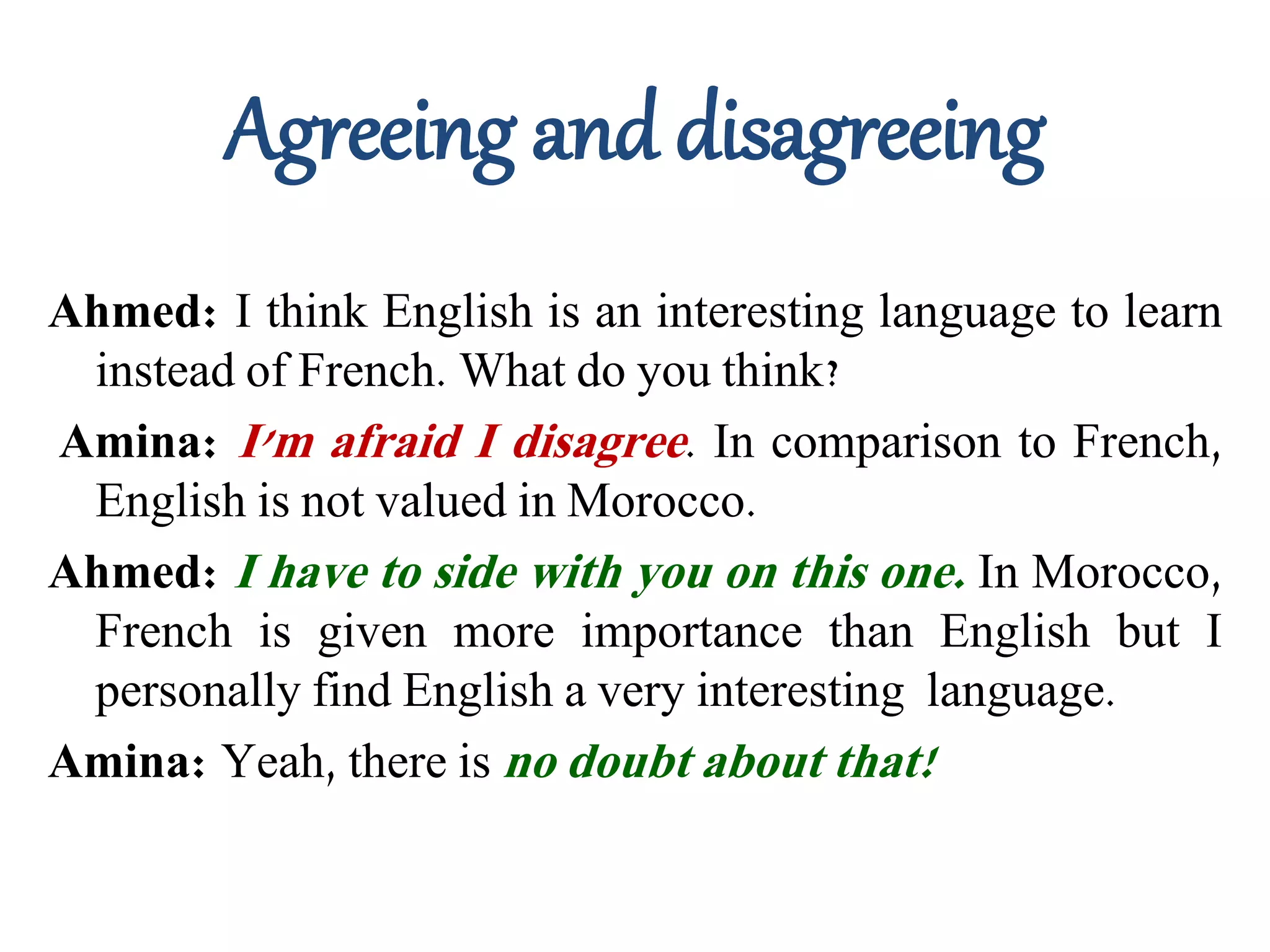
Ahmed: I think English is an interesting language to learn
instead of French. What do you think?
Amina: I'm afraid I disagree. In comparison to French,
English is not valued in Morocco.
Ahmed: I have to side with you on this one. In Morocco,
French is given more importance than English but I
personally find English a very interesting language.
Amina: Yeah, there is no doubt about that!
Agreeing
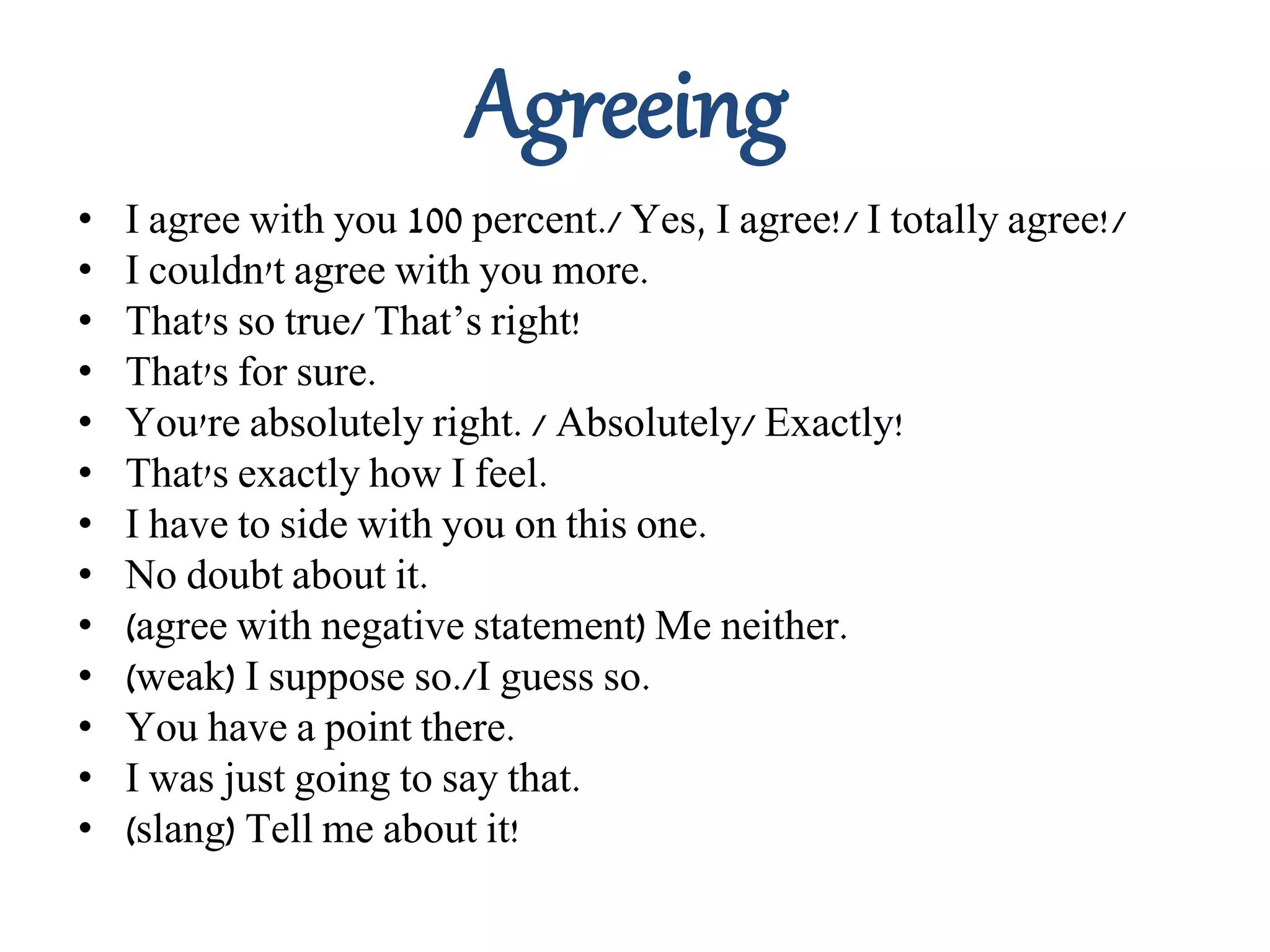
• I agree with you 100 percent./ Yes, I agree!/ I totally agree!/
• I couldn't agree with you more.
• That's so true/ That’s right!
• That's for sure.
• You're absolutely right. / Absolutely/ Exactly!
• That's exactly how I feel.
• I have to side with you on this one.
• No doubt about it.
• (agree with negative statement) Me neither.
• (weak) I suppose so./I guess so.
• You have a point there.
• I was just going to say that.
• (slang) Tell me about it!
Disagreeing
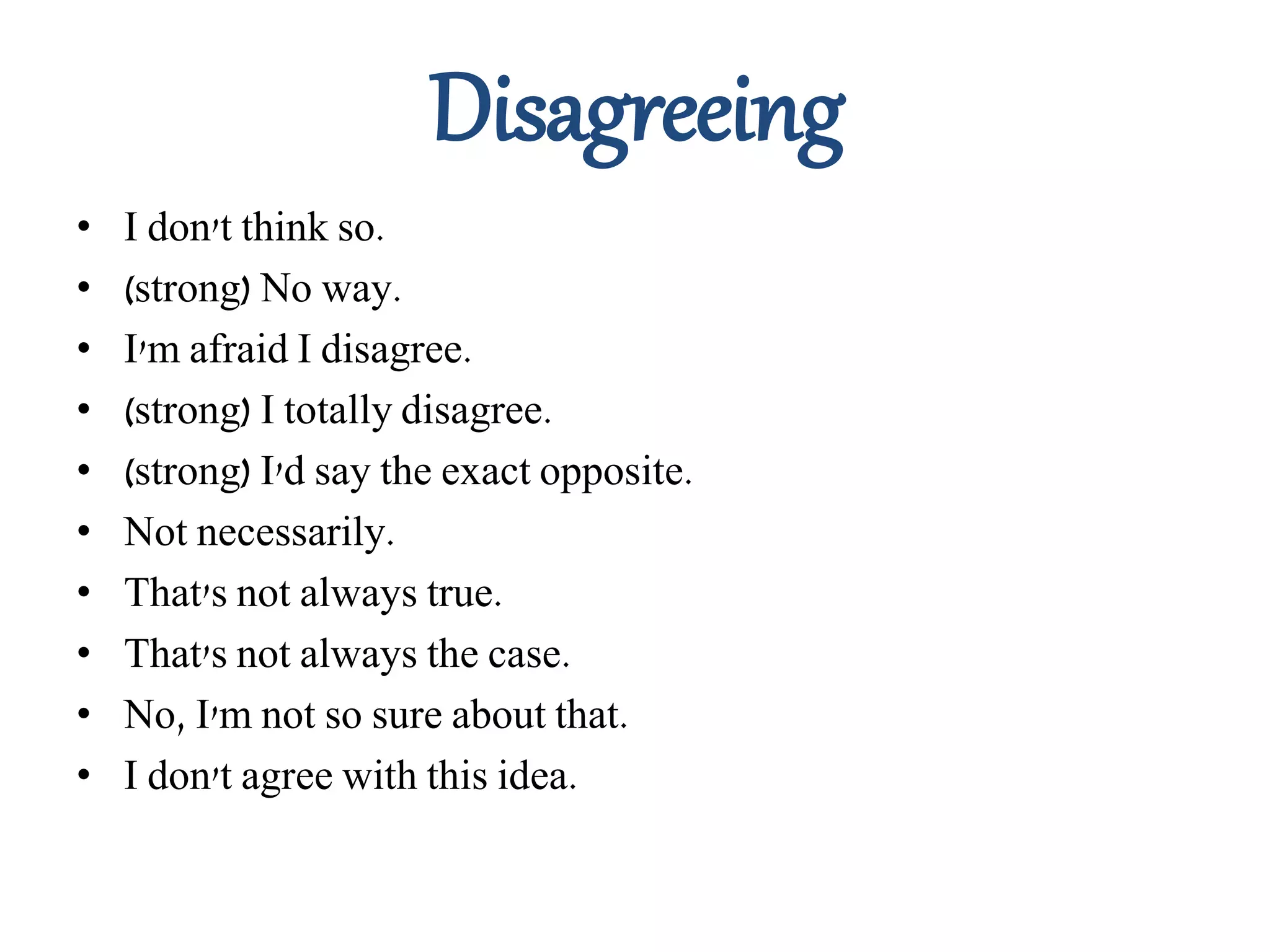
• I don't think so.
• (strong) No way.
• I'm afraid I disagree.
• (strong) I totally disagree.
• (strong) I'd say the exact opposite.
• Not necessarily.
• That's not always true.
• That's not always the case.
• No, I'm not so sure about that.
• I don't agree with this idea.
Let’s practise!
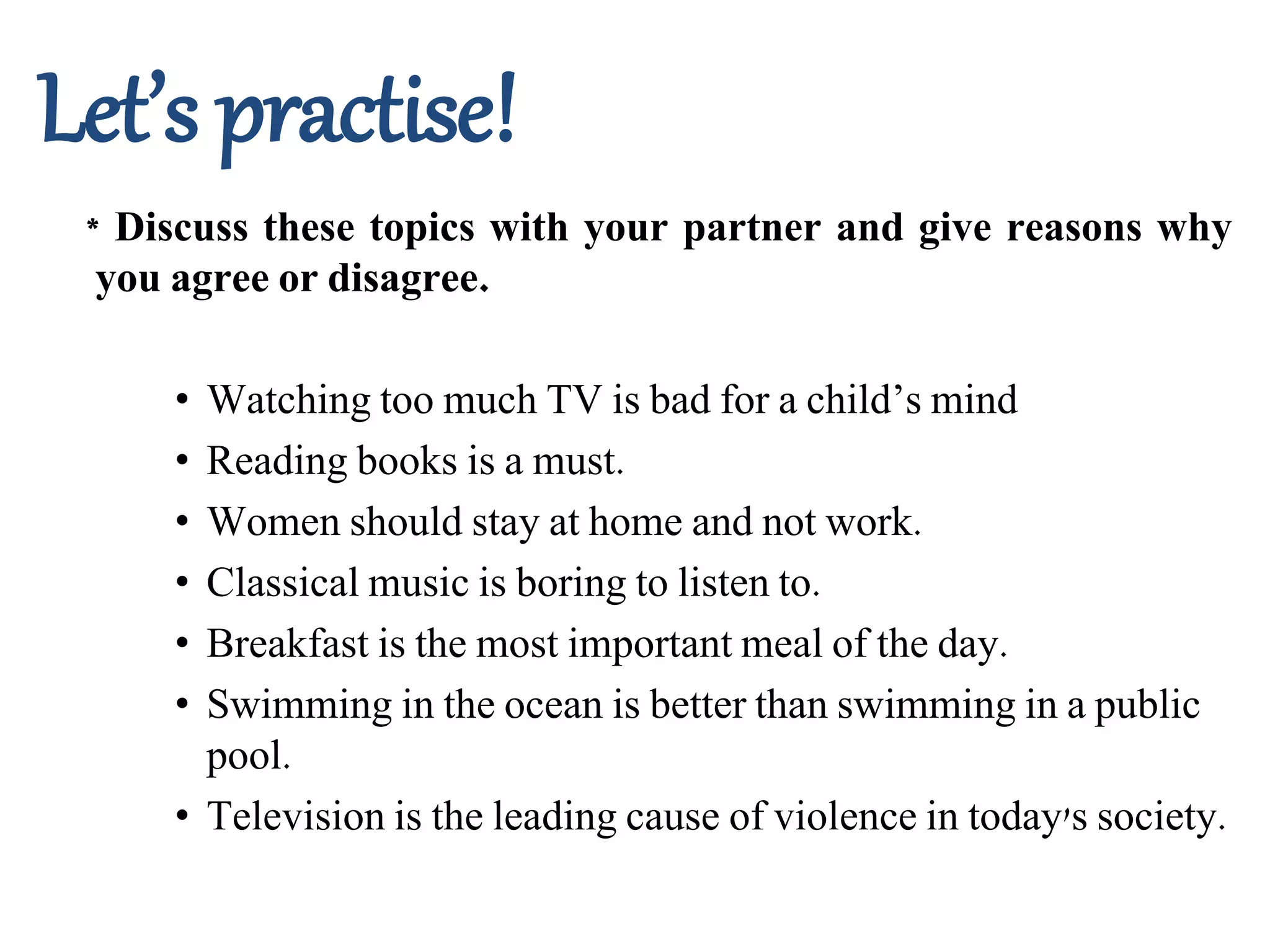
* Discuss these topics with your partner and give reasons why
you agree or disagree.
• Watching too much TV is bad for a child’s mind
• Reading books is a must.
• Women should stay at home and not work.
• Classical music is boring to listen to.
• Breakfast is the most important meal of the day.
• Swimming in the ocean is better than swimming in a public
pool.
• Television is the leading cause of violence in today's society.
Asking for and giving advice
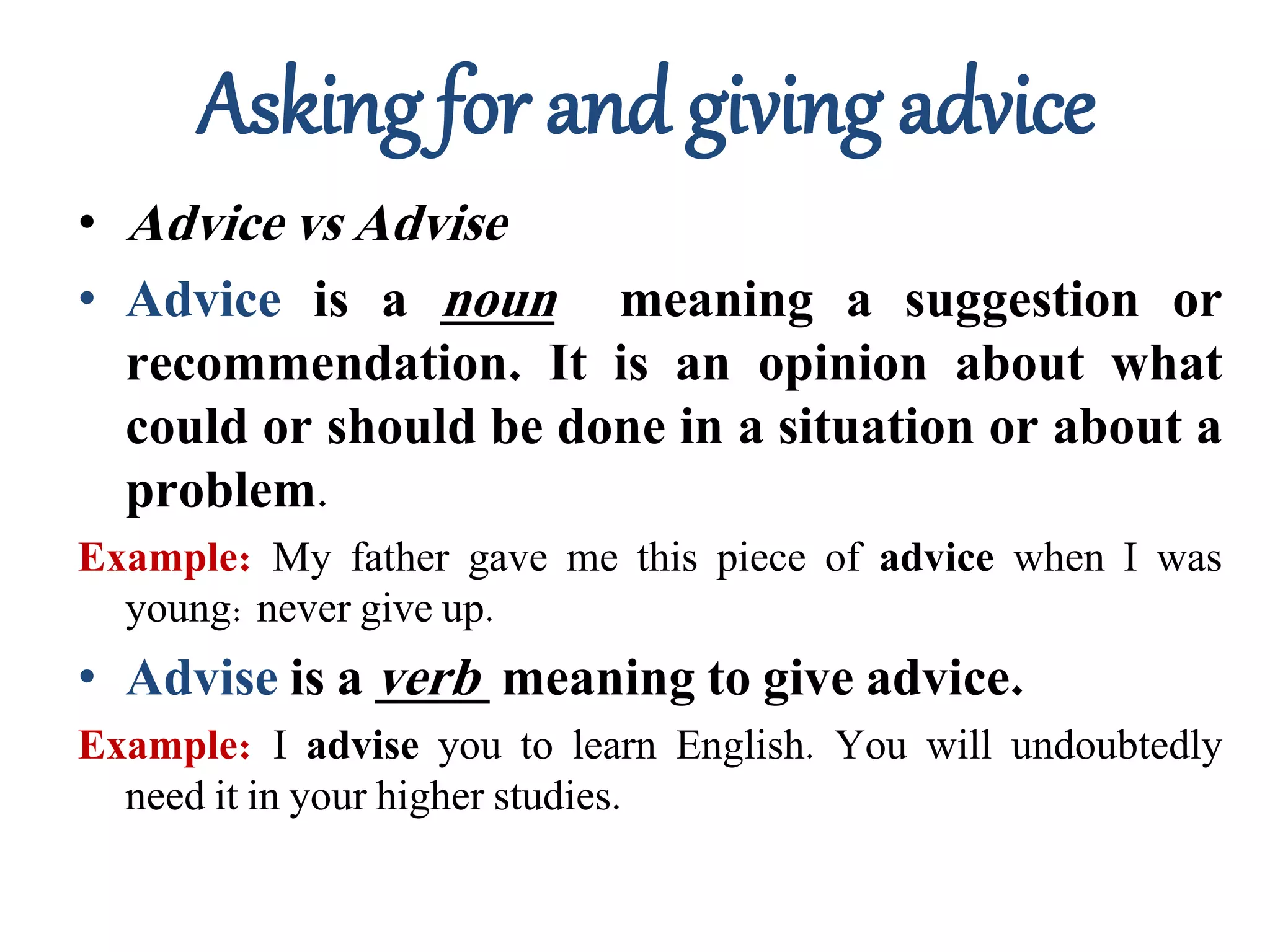
• Advice vs Advise
• Advice is a noun meaning a suggestion or
recommendation. It is an opinion about what
could or should be done in a situation or about a
problem.
Example: My father gave me this piece of advice when I was
young: never give up.
• Advise is a verb meaning to give advice.
Example: I advise you to learn English. You will undoubtedly
need it in your higher studies.
Asking for and giving advice
• Student: I'm terrible at English and I think I should
do something about it. What do you advise me to do?
• Teacher: I think you should try this website. It's a
fantastic website for beginners.
• Student: I've heard about it, but what do you think I
should start with?
• Teacher: You'd better start with the lessons. Then, try
the exercises.
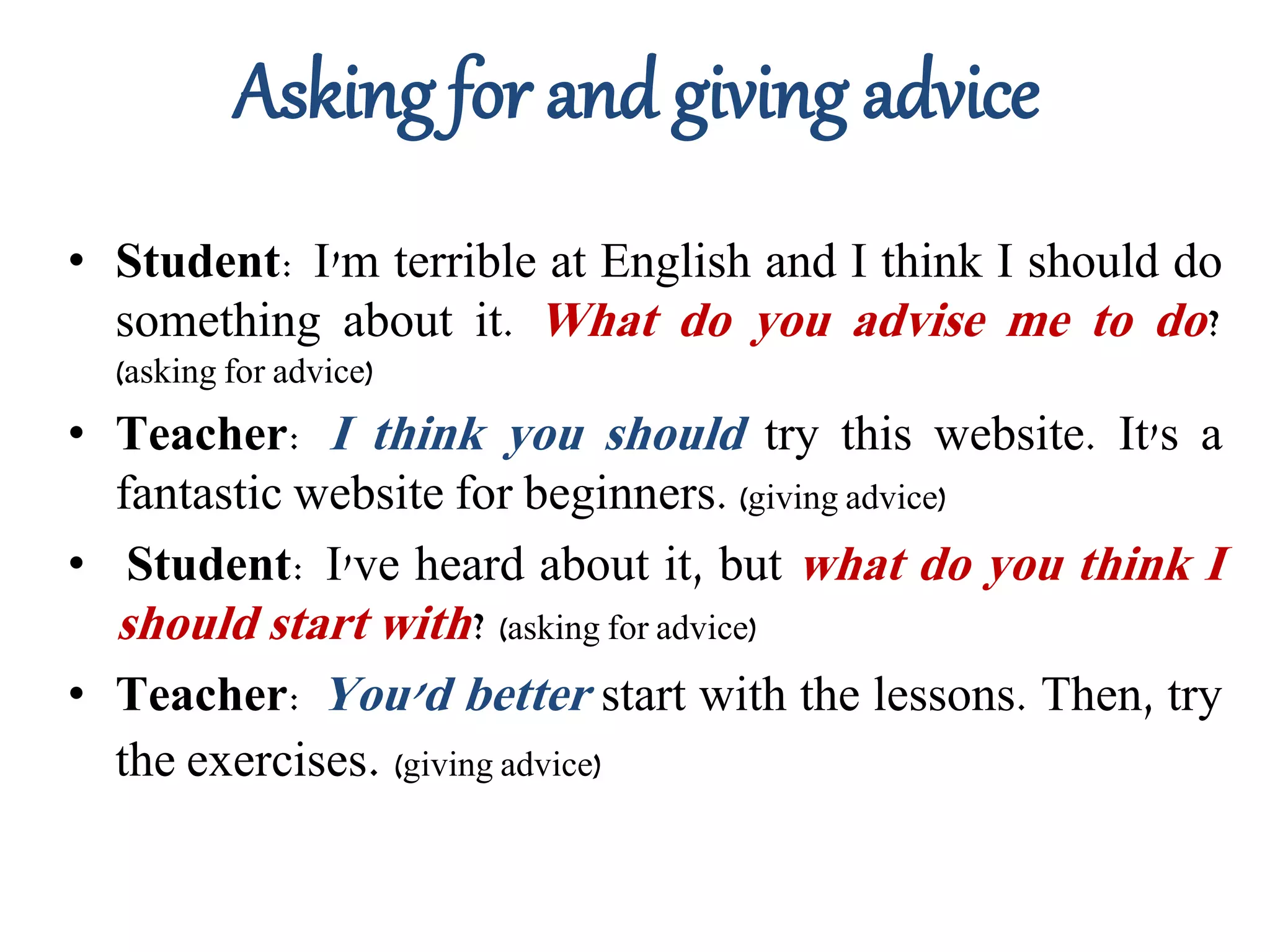
Asking for and giving advice
• Student: I'm terrible at English and I think I should do
something about it. What do you advise me to do?
(asking for advice)
• Teacher: I think you should try this website. It's a
fantastic website for beginners. (giving advice)
• Student: I've heard about it, but what do you think I
should start with? (asking for advice)
• Teacher: You'd better start with the lessons. Then, try
the exercises. (giving advice)
Asking for advice
• I've got a bad toothache. What do you suggest?
• What do you advise me to do?
• What should I do?
• What ought I to do?
• What's your advice?
• If you were me what would you do?
Giving advice
• If I were you, I would go to the dentist.
• Why don't you go to the dentist?
• You'd better brush your teeth regularly.
• You ought to/should avoid eating
sweets.
• If you take my advice, you'll go to the
dentist.
• It might be a good idea to brush your
teeth on a regular basis.
• I advise you to brush your teeth on a
regular basis.
• Have you thought about seeing a
dentist.
• I think you should…
• Maybe you should ...
• You might try (verb+ing...)
• It might be a good idea to ...
• My advice would be to ...
• How about (verb+ing....)?
Another example!
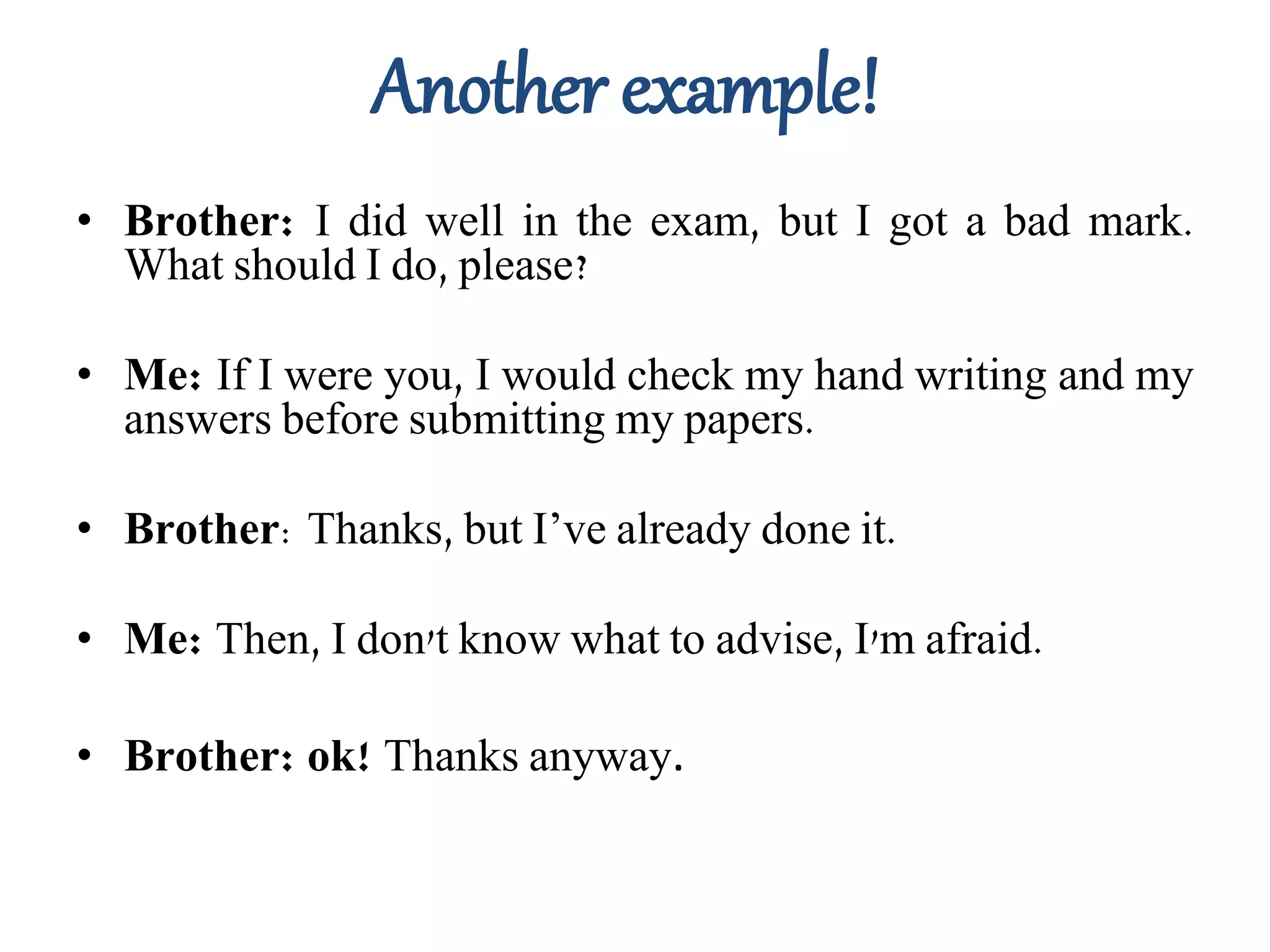
• Brother: I did well in the exam, but I got a bad mark.
What should I do, please?
• Me: If I were you, I would check my hand writing and my
answers before submitting my papers.
• Brother: Thanks, but I’ve already done it.
• Me: Then, I don't know what to advise, I'm afraid.
• Brother: ok! Thanks anyway.
Another example!
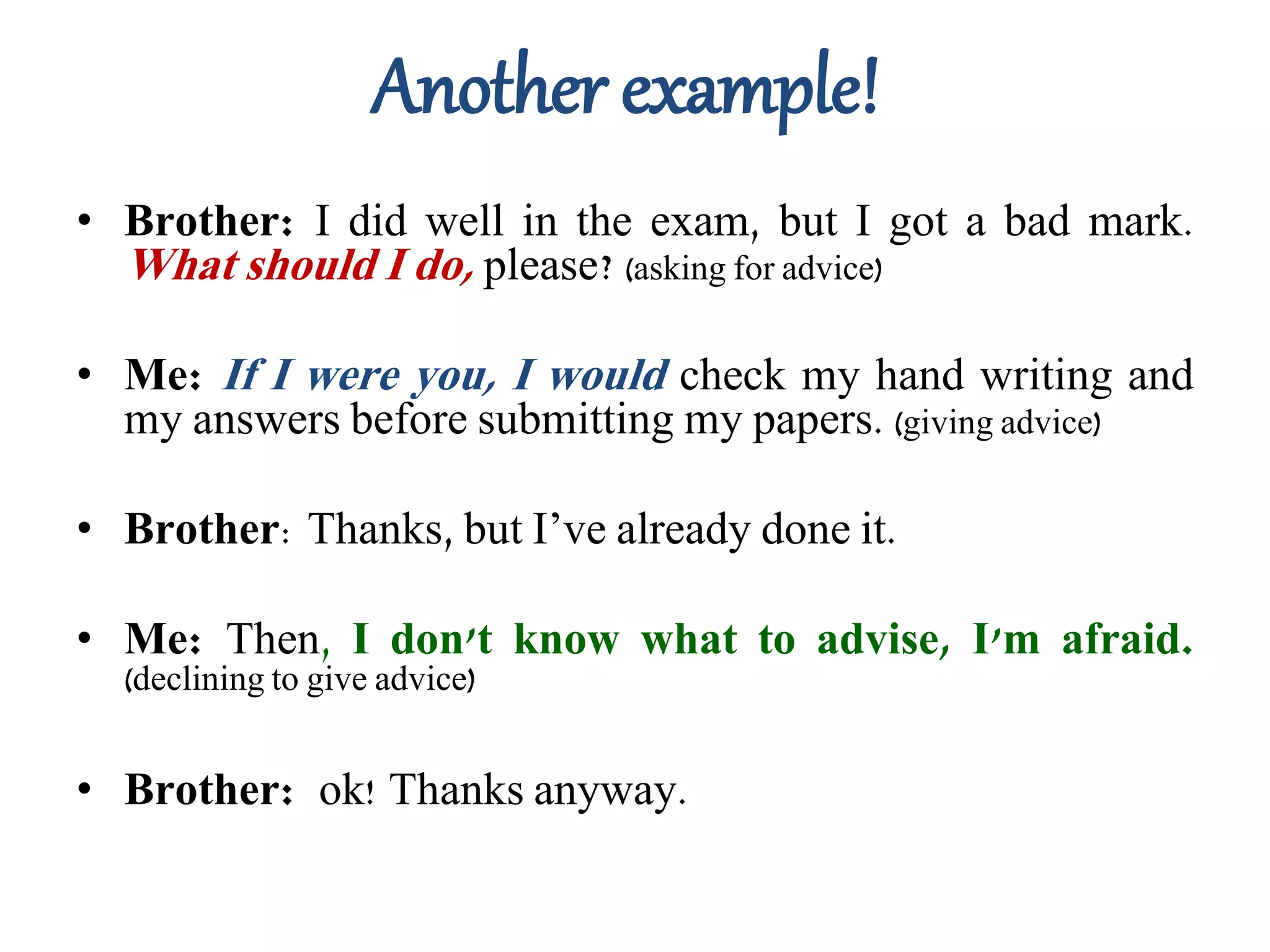
• Brother: I did well in the exam, but I got a bad mark.
What should I do, please? (asking for advice)
• Me: If I were you, I would check my hand writing and
my answers before submitting my papers. (giving advice)
• Brother: Thanks, but I’ve already done it.
• Me: Then, I don't know what to advise, I'm afraid.
(declining to give advice)
• Brother: ok! Thanks anyway.
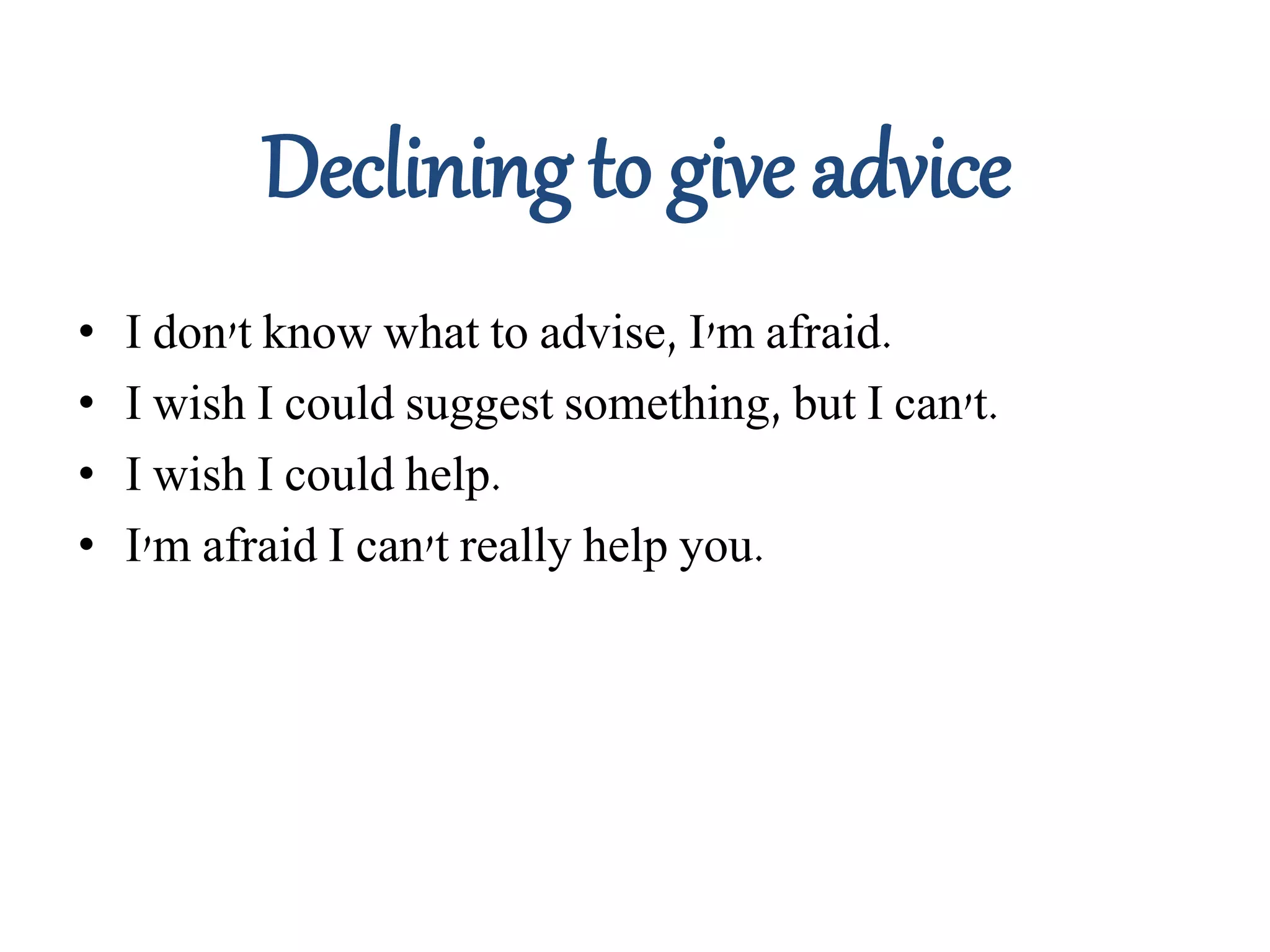
Declining to give advice
• I don't know what to advise, I'm afraid.
• I wish I could suggest something, but I can't.
• I wish I could help.
• I'm afraid I can't really help you.
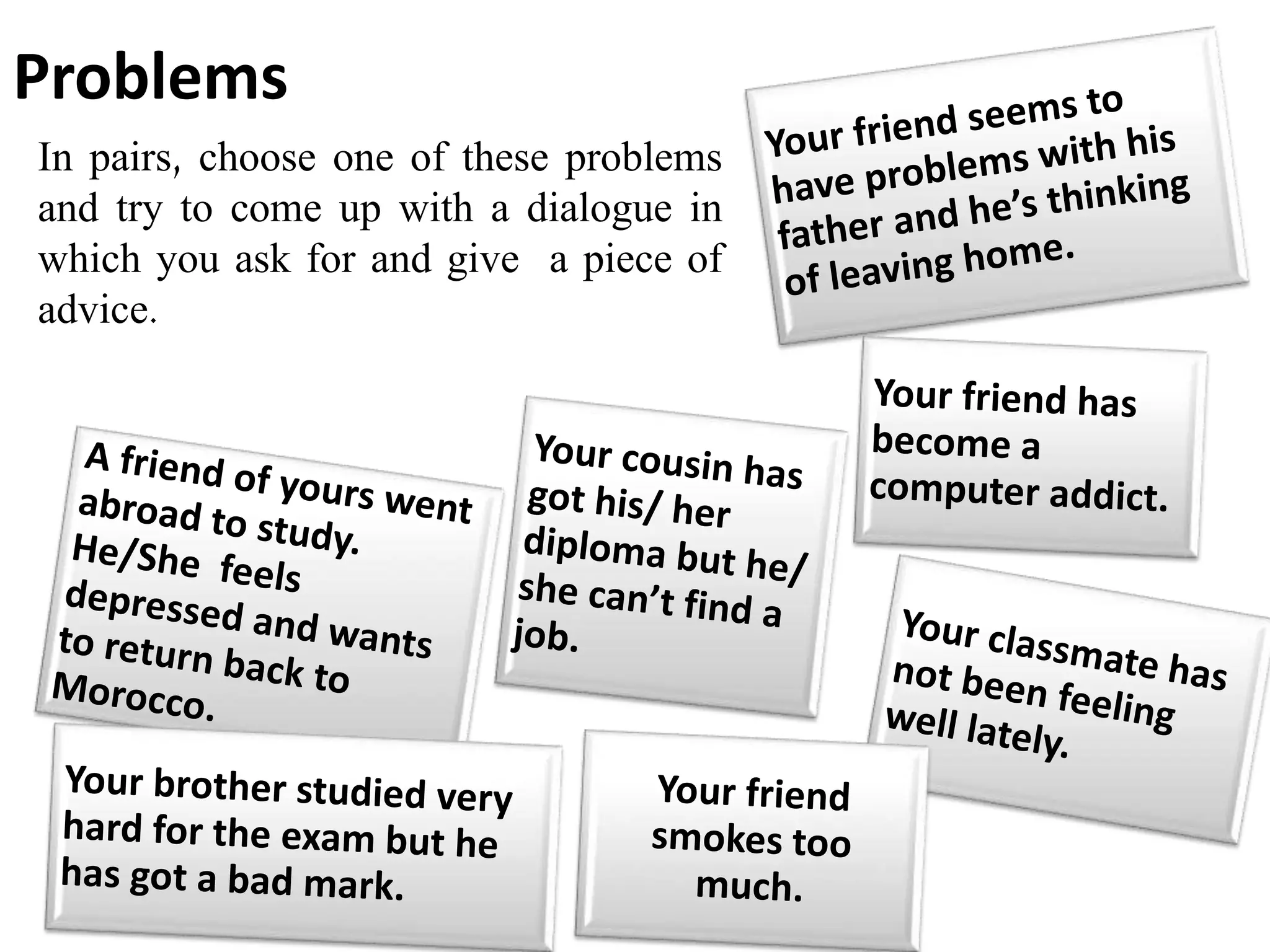
Problems
In pairs, choose one of these problems
and try to come up with a dialogue in
which you ask for and give a piece of
advice.
Best of Luck!

General english course session2

  • 1.
    IBN ZOHR UNIVERSITY FACULTYOF LETTERS SOCIOLOGY DEPARTMENT Introduction to General English S2/ G1 Instructor: Khadija GOUALI khadijagouali@gmail.com Facebook: Khadijah Gouali
  • 2.
    Course content  FunctionalEnglish: - Greetings and introductions - Asking for opinion. - Expressing opinion. - Expressing agreement and disagreement - Asking for and giving advice. - Making requests and offers. - Making suggestions. - Making and responding to apologies.
  • 3.
    Agreeing and disagreeing Ahmed:I think English is an interesting language to learn instead of French. What do you think? Amina: I'm afraid I disagree. In comparison to French, English is not valued in Morocco. Ahmed: I have to side with you on this one. In Morocco, French is given more importance than English but I personally find English a very interesting language. Amina: Yeah, there is no doubt about that!
  • 4.
    Agreeing and disagreeing Ahmed:I think English is an interesting language to learn instead of French. What do you think? Amina: I'm afraid I disagree. In comparison to French, English is not valued in Morocco. Ahmed: I have to side with you on this one. In Morocco, French is given more importance than English but I personally find English a very interesting language. Amina: Yeah, there is no doubt about that!
  • 5.
    Agreeing • I agreewith you 100 percent./ Yes, I agree!/ I totally agree!/ • I couldn't agree with you more. • That's so true/ That’s right! • That's for sure. • You're absolutely right. / Absolutely/ Exactly! • That's exactly how I feel. • I have to side with you on this one. • No doubt about it. • (agree with negative statement) Me neither. • (weak) I suppose so./I guess so. • You have a point there. • I was just going to say that. • (slang) Tell me about it!
  • 6.
    Disagreeing • I don'tthink so. • (strong) No way. • I'm afraid I disagree. • (strong) I totally disagree. • (strong) I'd say the exact opposite. • Not necessarily. • That's not always true. • That's not always the case. • No, I'm not so sure about that. • I don't agree with this idea.
  • 7.
    Let’s practise! * Discussthese topics with your partner and give reasons why you agree or disagree. • Watching too much TV is bad for a child’s mind • Reading books is a must. • Women should stay at home and not work. • Classical music is boring to listen to. • Breakfast is the most important meal of the day. • Swimming in the ocean is better than swimming in a public pool. • Television is the leading cause of violence in today's society.
  • 8.
    Asking for andgiving advice • Advice vs Advise • Advice is a noun meaning a suggestion or recommendation. It is an opinion about what could or should be done in a situation or about a problem. Example: My father gave me this piece of advice when I was young: never give up. • Advise is a verb meaning to give advice. Example: I advise you to learn English. You will undoubtedly need it in your higher studies.
  • 9.
    Asking for andgiving advice • Student: I'm terrible at English and I think I should do something about it. What do you advise me to do? • Teacher: I think you should try this website. It's a fantastic website for beginners. • Student: I've heard about it, but what do you think I should start with? • Teacher: You'd better start with the lessons. Then, try the exercises.
  • 10.
    Asking for andgiving advice • Student: I'm terrible at English and I think I should do something about it. What do you advise me to do? (asking for advice) • Teacher: I think you should try this website. It's a fantastic website for beginners. (giving advice) • Student: I've heard about it, but what do you think I should start with? (asking for advice) • Teacher: You'd better start with the lessons. Then, try the exercises. (giving advice)
  • 11.
    Asking for advice •I've got a bad toothache. What do you suggest? • What do you advise me to do? • What should I do? • What ought I to do? • What's your advice? • If you were me what would you do?
  • 12.
    Giving advice • IfI were you, I would go to the dentist. • Why don't you go to the dentist? • You'd better brush your teeth regularly. • You ought to/should avoid eating sweets. • If you take my advice, you'll go to the dentist. • It might be a good idea to brush your teeth on a regular basis. • I advise you to brush your teeth on a regular basis. • Have you thought about seeing a dentist. • I think you should… • Maybe you should ... • You might try (verb+ing...) • It might be a good idea to ... • My advice would be to ... • How about (verb+ing....)?
  • 13.
    Another example! • Brother:I did well in the exam, but I got a bad mark. What should I do, please? • Me: If I were you, I would check my hand writing and my answers before submitting my papers. • Brother: Thanks, but I’ve already done it. • Me: Then, I don't know what to advise, I'm afraid. • Brother: ok! Thanks anyway.
  • 14.
    Another example! • Brother:I did well in the exam, but I got a bad mark. What should I do, please? (asking for advice) • Me: If I were you, I would check my hand writing and my answers before submitting my papers. (giving advice) • Brother: Thanks, but I’ve already done it. • Me: Then, I don't know what to advise, I'm afraid. (declining to give advice) • Brother: ok! Thanks anyway.
  • 15.
    Declining to giveadvice • I don't know what to advise, I'm afraid. • I wish I could suggest something, but I can't. • I wish I could help. • I'm afraid I can't really help you.
  • 16.
    Problems In pairs, chooseone of these problems and try to come up with a dialogue in which you ask for and give a piece of advice.
  • 17.