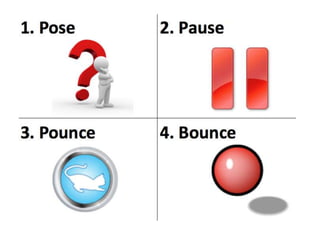
Pose, Pause, Pounce, Bounce
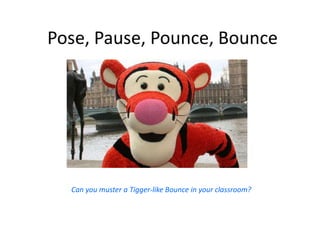
Can you muster a Tigger-like Bounce in your classroom?
What is it?
• PPPB (Pose, Pause, Pounce, Bounce) is a simple, yet sophisticated, AfL
(Assessment for Learning) questioning technique to help teachers move
from good-to-outstanding. It also helps address differentiation in the
classroom and encourages teachers to slow down, take risks and tease out
understanding...
• Content that follows:
1. PPPB characters.
2. How to PPPB?
• Reference:
1. Where hands-up in class is banned! BBC Education News.
2. Content, then process – Solution Tree video featuring Dylan Wiliam.
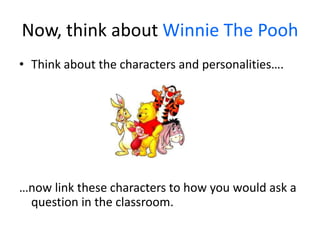
Now, think about Winnie The Pooh
• Think about the characters and personalities….
…now link these characters to how you would ask a
question in the classroom.
The Tao of Pooh
"Just, how do you do it Tigger?“
"Do what?" asked Pooh.
"Become so effortless.“
"I don't do much of anything." Tigger said.
"But all those things of yours get done.“
"They just sort of happen," Tigger said. (edited)
Which character is your
Questioning technique?
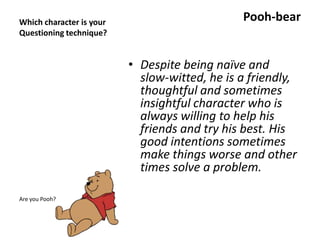
Pooh-bear
• Despite being naïve and
slow-witted, he is a friendly,
thoughtful and sometimes
insightful character who is
always willing to help his
friends and try his best. His
good intentions sometimes
make things worse and other
times solve a problem.
Are you Pooh?
Which character is your
Questioning technique?
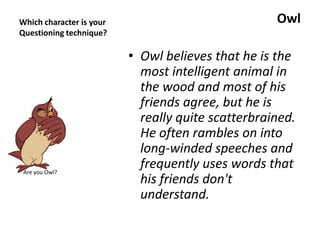
Owl
• Owl believes that he is the
most intelligent animal in
the wood and most of his
friends agree, but he is
really quite scatterbrained.
He often rambles on into
long-winded speeches and
frequently uses words that
his friends don't
understand.
Are you Owl?
Which character is your
Questioning technique?
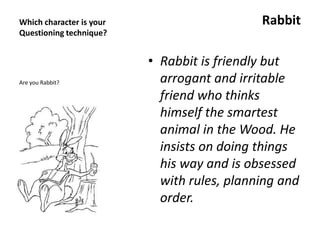
Rabbit
• Rabbit is friendly but
arrogant and irritable
friend who thinks
himself the smartest
animal in the Wood. He
insists on doing things
his way and is obsessed
with rules, planning and
order.
Are you Rabbit?
Which character is your
Questioning technique? Kanga
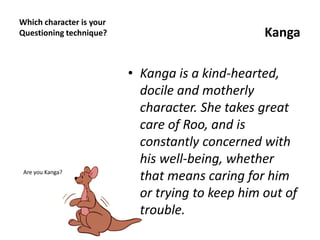
• Kanga is a kind-hearted,
docile and motherly
character. She takes great
care of Roo, and is
constantly concerned with
his well-being, whether
that means caring for him
or trying to keep him out of
trouble.
Are you Kanga?
Which character is your
Questioning technique?
Eeyore
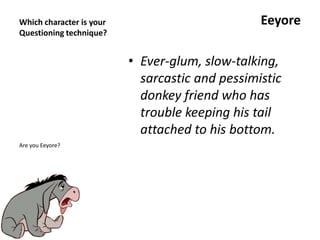
• Ever-glum, slow-talking,
sarcastic and pessimistic
donkey friend who has
trouble keeping his tail
attached to his bottom.
Are you Eeyore?
Which character is your
Questioning technique?
Piglet
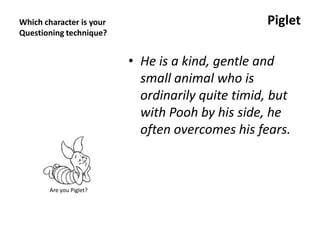
• He is a kind, gentle and
small animal who is
ordinarily quite timid, but
with Pooh by his side, he
often overcomes his fears.
Are you Piglet?
Or, are you a Tigger?
Which character is your
Questioning technique?
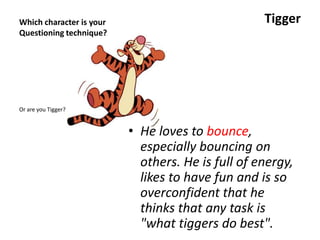
Tigger
• He loves to bounce,
especially bouncing on
others. He is full of energy,
likes to have fun and is so
overconfident that he
thinks that any task is
"what tiggers do best".
Or are you Tigger?
So why is PPPB useful?
• This technique is used to develop an
awareness of the new Ofsted criteria.
• This strategy encourages teachers to take risks
and tease out the "learning" in class.
• It also a useful focus for differentiating
objectives and learning experiences by varying
our questioning techniques.
• NO more closed questions in our classrooms!
How does it work?
• On the following slides, the sequence of PPPB is listed.
• A simple four-part approach with additional information that explains the
methodology.
1. POSE
a. Give the context of your PPPB approach to the class. It is
important they know what is happening before it becomes
common-place…
b. Insist on hands down before the question is delivered.
c. Provide a question or a series of questions, ensuring that
you ask the students to remain reflective.
d. Pose the question to the class; not an individual.
e. Then Pause…
2. PAUSE...
a. This is the difficult part. To stop talking…
b. Ask the class to hold the thought... think... and think again...
c. If students are captivated and engaged, try holding the
silence for a little while longer (take a calculate risk) and...
d. Still push the boundaries. Keep the reflection for as long as
possible….before you,
e. Pounce!
3. POUNCE!
a. Insist that the answer to the question comes from student A and possibly
student B, directly and as fast as possible!
b. Of course plan in your mind who you are going to ask, before speaking to the class.
c. Name student A to respond and don't move from the student…
d. Possibly don't speak and nip any comments, grunts or noises in the bud! Its
magic when you can hear, see and feel a captivated learning audience. We've
all seen it.
e. Wait for an answer... pause... decipher the support needed, especially if no
response is evidently on its way. (Of course, at this stage, you can instigate
various strategies for peers to support the questionable student A).
f. If student A does manage to answer, the fun part starts here...
What’s your
question?
4. BOUNCE!
a. Ask another student B their opinion of student A's answer (immediately) after the
Pounce response.
b. This can be developed by asking student B and C their opinions to student A's
response, irrespective if the answer is correct or not.
c. An additional strategy is to Bounce the question onto a group A...and subsequently, a
sub-group B if group A do not deliver a suitable way forward.
d. This ensures the teacher is engaging a significant number of students with the
question at hand, whilst using this strategy. It also ensures the entire class can be
called upon at any given time by just returning to Pose or Pounce.
e. Many, many teachers are very reluctant to hold onto a question that is a stumbling
block in class. I know because I have done it; but my favourite lessons are often the
ones that involve this ethos being established from the outset and (me) not being
afraid to tease out "why?" student A or B thinks the way they do...
f. Ensure that all your students understand ‘a’ concept. Test it before moving on. Try it
tomorrow. Don't accept student E or student K shouting out the answer to maintain
pace or behaviour. Don't allow student T to answer the question because (you know
they won't let you down and) they will help you move on during an observation
lesson!
Summary
• Teasing out students’ thinking skills and
understanding, is far more important, than
moving onto the next stage of any lesson.
Further reading:
• The Tao of Pooh
• The Te of Piglet
• Pose, Pause, Pounce, Bounce
@TeacherToolkit

Pose, pause, pounce,_bounce_-_according_to_winne_the_pooh

  • 1.
    Pose, Pause, Pounce,Bounce Can you muster a Tigger-like Bounce in your classroom?
  • 3.
    What is it? •PPPB (Pose, Pause, Pounce, Bounce) is a simple, yet sophisticated, AfL (Assessment for Learning) questioning technique to help teachers move from good-to-outstanding. It also helps address differentiation in the classroom and encourages teachers to slow down, take risks and tease out understanding... • Content that follows: 1. PPPB characters. 2. How to PPPB? • Reference: 1. Where hands-up in class is banned! BBC Education News. 2. Content, then process – Solution Tree video featuring Dylan Wiliam.
  • 4.
    Now, think aboutWinnie The Pooh • Think about the characters and personalities…. …now link these characters to how you would ask a question in the classroom.
  • 5.
    The Tao ofPooh "Just, how do you do it Tigger?“ "Do what?" asked Pooh. "Become so effortless.“ "I don't do much of anything." Tigger said. "But all those things of yours get done.“ "They just sort of happen," Tigger said. (edited)
  • 6.
    Which character isyour Questioning technique? Pooh-bear • Despite being naïve and slow-witted, he is a friendly, thoughtful and sometimes insightful character who is always willing to help his friends and try his best. His good intentions sometimes make things worse and other times solve a problem. Are you Pooh?
  • 7.
    Which character isyour Questioning technique? Owl • Owl believes that he is the most intelligent animal in the wood and most of his friends agree, but he is really quite scatterbrained. He often rambles on into long-winded speeches and frequently uses words that his friends don't understand. Are you Owl?
  • 8.
    Which character isyour Questioning technique? Rabbit • Rabbit is friendly but arrogant and irritable friend who thinks himself the smartest animal in the Wood. He insists on doing things his way and is obsessed with rules, planning and order. Are you Rabbit?
  • 9.
    Which character isyour Questioning technique? Kanga • Kanga is a kind-hearted, docile and motherly character. She takes great care of Roo, and is constantly concerned with his well-being, whether that means caring for him or trying to keep him out of trouble. Are you Kanga?
  • 10.
    Which character isyour Questioning technique? Eeyore • Ever-glum, slow-talking, sarcastic and pessimistic donkey friend who has trouble keeping his tail attached to his bottom. Are you Eeyore?
  • 11.
    Which character isyour Questioning technique? Piglet • He is a kind, gentle and small animal who is ordinarily quite timid, but with Pooh by his side, he often overcomes his fears. Are you Piglet?
  • 12.
    Or, are youa Tigger?
  • 13.
    Which character isyour Questioning technique? Tigger • He loves to bounce, especially bouncing on others. He is full of energy, likes to have fun and is so overconfident that he thinks that any task is "what tiggers do best". Or are you Tigger?
  • 14.
    So why isPPPB useful? • This technique is used to develop an awareness of the new Ofsted criteria. • This strategy encourages teachers to take risks and tease out the "learning" in class. • It also a useful focus for differentiating objectives and learning experiences by varying our questioning techniques. • NO more closed questions in our classrooms!
  • 15.
    How does itwork? • On the following slides, the sequence of PPPB is listed. • A simple four-part approach with additional information that explains the methodology.
  • 16.
    1. POSE a. Givethe context of your PPPB approach to the class. It is important they know what is happening before it becomes common-place… b. Insist on hands down before the question is delivered. c. Provide a question or a series of questions, ensuring that you ask the students to remain reflective. d. Pose the question to the class; not an individual. e. Then Pause…
  • 17.
    2. PAUSE... a. Thisis the difficult part. To stop talking… b. Ask the class to hold the thought... think... and think again... c. If students are captivated and engaged, try holding the silence for a little while longer (take a calculate risk) and... d. Still push the boundaries. Keep the reflection for as long as possible….before you, e. Pounce!
  • 18.
    3. POUNCE! a. Insistthat the answer to the question comes from student A and possibly student B, directly and as fast as possible! b. Of course plan in your mind who you are going to ask, before speaking to the class. c. Name student A to respond and don't move from the student… d. Possibly don't speak and nip any comments, grunts or noises in the bud! Its magic when you can hear, see and feel a captivated learning audience. We've all seen it. e. Wait for an answer... pause... decipher the support needed, especially if no response is evidently on its way. (Of course, at this stage, you can instigate various strategies for peers to support the questionable student A). f. If student A does manage to answer, the fun part starts here... What’s your question?
  • 19.
    4. BOUNCE! a. Askanother student B their opinion of student A's answer (immediately) after the Pounce response. b. This can be developed by asking student B and C their opinions to student A's response, irrespective if the answer is correct or not. c. An additional strategy is to Bounce the question onto a group A...and subsequently, a sub-group B if group A do not deliver a suitable way forward. d. This ensures the teacher is engaging a significant number of students with the question at hand, whilst using this strategy. It also ensures the entire class can be called upon at any given time by just returning to Pose or Pounce. e. Many, many teachers are very reluctant to hold onto a question that is a stumbling block in class. I know because I have done it; but my favourite lessons are often the ones that involve this ethos being established from the outset and (me) not being afraid to tease out "why?" student A or B thinks the way they do... f. Ensure that all your students understand ‘a’ concept. Test it before moving on. Try it tomorrow. Don't accept student E or student K shouting out the answer to maintain pace or behaviour. Don't allow student T to answer the question because (you know they won't let you down and) they will help you move on during an observation lesson!
  • 20.
    Summary • Teasing outstudents’ thinking skills and understanding, is far more important, than moving onto the next stage of any lesson. Further reading: • The Tao of Pooh • The Te of Piglet • Pose, Pause, Pounce, Bounce
  • 21.