EXTENDING
THE CONVERSATION:
ASKING QUESTIONS

JANUARY 2012 V. 2
FRAMEWORK FOR EFFECTIVE PRACTICE
SUPPORTING SCHOOL READINESS FOR ALL CHILDREN
FOCUS ON THE FOUNDATION
EXTENDING THE CONVERSATION:
ASKING QUESTIONS

Objectives
• To understand how asking questions
enhances conversations.
• To identify qualities of questions that extend
conversation.
• To gain knowledge of types of questions that
strengthen conversations.
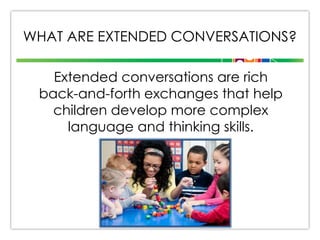
WHAT ARE EXTENDED CONVERSATIONS?
Extended conversations are rich
back-and-forth exchanges that help
children develop more complex
language and thinking skills.
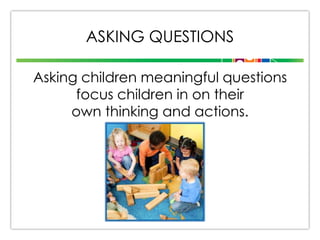
ASKING QUESTIONS
Asking children meaningful questions
focus children in on their
own thinking and actions.
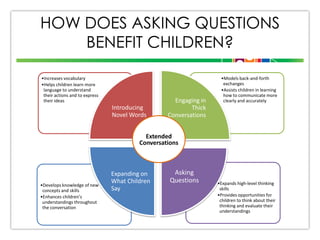
HOW DOES ASKING QUESTIONS
BENEFIT CHILDREN?
•Increases vocabulary
•Helps children learn more
language to understand
their actions and to express
their ideas

Introducing
Novel Words

Engaging in
Thick
Conversations

•Models back-and-forth
exchanges
•Assists children in learning
how to communicate more
clearly and accurately

Extended
Conversations

•Develops knowledge of new
concepts and skills
•Enhances children’s
understandings throughout
the conversation

Expanding on
What Children
Say

Asking
Questions

•Expands high-level thinking
skills
•Provides opportunities for
children to think about their
thinking and evaluate their
understandings
HOW DOES ASKING QUESTIONS TO
EXTEND CONVERSATIONS BENEFIT
TEACHERS?
• Provides a lens into children’s perspectives.
• Informs teachers of children’s thinking
processes.

• Assists with curriculum planning and
assessment.
QUESTIONS THAT CONTINUE
CONVERSATION
• Focus on children’s interests and
excitement.
• Request information teachers do not
already know.
• Match child’s language
ability.
• Stimulate creative thinking.
• Show teacher’s interest.
WHAT ARE OPEN-ENDED QUESTIONS?
• A question with many answers.
• Require more that a one word response.
• Allow children to express their ideas
and opinions.
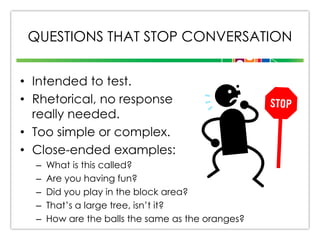
QUESTIONS THAT STOP CONVERSATION
• Intended to test.
• Rhetorical, no response
really needed.
• Too simple or complex.
• Close-ended examples:
–
–
–
–
–

What is this called?
Are you having fun?
Did you play in the block area?
That’s a large tree, isn’t it?
How are the balls the same as the oranges?
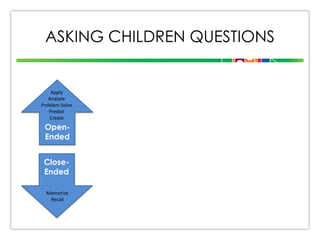
ASKING CHILDREN QUESTIONS

Apply
Analyze
Problem Solve
Predict
Create

OpenEnded
CloseEnded
Memorize
Recall
ASKING CHILDREN QUESTIONS

Apply
Analyze
Problem Solve
Predict
Create

OpenEnded
CloseEnded
Memorize
Recall
ASKING MEANINGFUL QUESTIONS
1) Ask children about what they are doing.
• What are you working on?
• Tell me about your project

2) Ask children to provide explanations.
• Why?
• How?

3) Ask children to make predictions.
• What do you think will happen next?

4) Ask children to connect learning to their
own lives.
• Have you seen one of these before?
• What does this remind you of?
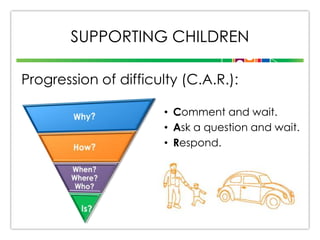
SUPPORTING CHILDREN
Progression of difficulty (C.A.R.):
• Comment and wait.
• Ask a question and wait.
• Respond.
NOW IT’S YOUR TURN!
• Use questions to extend conversations.
• Focus questions on children’s interests.
• Ask questions that access higher
thinking skills.
− Provide explanations.
− Make predictions.
− Connect learning to their own lives.

• Support children when a question is too hard.
For more Information, contact us at: NCQTL@UW.EDU or 877-731-0764
This document was prepared under Grant #90HC0002 for the U.S. Department of Health and Human Services,
Administration for Children and Families, Office of Head Start, by the National Center on Quality Teaching and Learning.

Asking Questions that Extend Conversations

  • 1.
  • 2.
    FRAMEWORK FOR EFFECTIVEPRACTICE SUPPORTING SCHOOL READINESS FOR ALL CHILDREN
  • 3.
    FOCUS ON THEFOUNDATION
  • 4.
    EXTENDING THE CONVERSATION: ASKINGQUESTIONS Objectives • To understand how asking questions enhances conversations. • To identify qualities of questions that extend conversation. • To gain knowledge of types of questions that strengthen conversations.
  • 5.
    WHAT ARE EXTENDEDCONVERSATIONS? Extended conversations are rich back-and-forth exchanges that help children develop more complex language and thinking skills.
  • 6.
    ASKING QUESTIONS Asking childrenmeaningful questions focus children in on their own thinking and actions.
  • 8.
    HOW DOES ASKINGQUESTIONS BENEFIT CHILDREN? •Increases vocabulary •Helps children learn more language to understand their actions and to express their ideas Introducing Novel Words Engaging in Thick Conversations •Models back-and-forth exchanges •Assists children in learning how to communicate more clearly and accurately Extended Conversations •Develops knowledge of new concepts and skills •Enhances children’s understandings throughout the conversation Expanding on What Children Say Asking Questions •Expands high-level thinking skills •Provides opportunities for children to think about their thinking and evaluate their understandings
  • 9.
    HOW DOES ASKINGQUESTIONS TO EXTEND CONVERSATIONS BENEFIT TEACHERS? • Provides a lens into children’s perspectives. • Informs teachers of children’s thinking processes. • Assists with curriculum planning and assessment.
  • 10.
    QUESTIONS THAT CONTINUE CONVERSATION •Focus on children’s interests and excitement. • Request information teachers do not already know. • Match child’s language ability. • Stimulate creative thinking. • Show teacher’s interest.
  • 11.
    WHAT ARE OPEN-ENDEDQUESTIONS? • A question with many answers. • Require more that a one word response. • Allow children to express their ideas and opinions.
  • 12.
    QUESTIONS THAT STOPCONVERSATION • Intended to test. • Rhetorical, no response really needed. • Too simple or complex. • Close-ended examples: – – – – – What is this called? Are you having fun? Did you play in the block area? That’s a large tree, isn’t it? How are the balls the same as the oranges?
  • 13.
    ASKING CHILDREN QUESTIONS Apply Analyze ProblemSolve Predict Create OpenEnded CloseEnded Memorize Recall
  • 14.
    ASKING CHILDREN QUESTIONS Apply Analyze ProblemSolve Predict Create OpenEnded CloseEnded Memorize Recall
  • 15.
    ASKING MEANINGFUL QUESTIONS 1)Ask children about what they are doing. • What are you working on? • Tell me about your project 2) Ask children to provide explanations. • Why? • How? 3) Ask children to make predictions. • What do you think will happen next? 4) Ask children to connect learning to their own lives. • Have you seen one of these before? • What does this remind you of?
  • 16.
    SUPPORTING CHILDREN Progression ofdifficulty (C.A.R.): • Comment and wait. • Ask a question and wait. • Respond.
  • 18.
    NOW IT’S YOURTURN! • Use questions to extend conversations. • Focus questions on children’s interests. • Ask questions that access higher thinking skills. − Provide explanations. − Make predictions. − Connect learning to their own lives. • Support children when a question is too hard.
  • 19.
    For more Information,contact us at: NCQTL@UW.EDU or 877-731-0764 This document was prepared under Grant #90HC0002 for the U.S. Department of Health and Human Services, Administration for Children and Families, Office of Head Start, by the National Center on Quality Teaching and Learning.