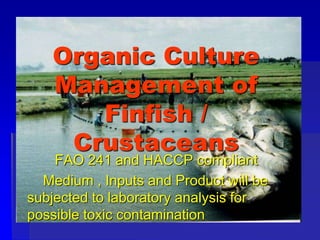
Organic Culture
Management of
Finfish /
Crustaceans
FAO 241 and HACCP compliant
Medium , Inputs and Product will be
subjected to laboratory analysis for
possible toxic contamination
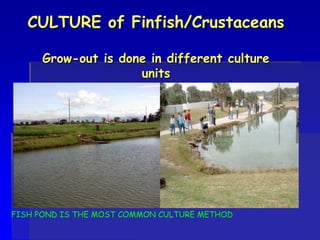
CULTURE of Finfish/Crustaceans
Grow-out is done in different culture
units
- Fishpond
FISH POND IS THE MOST COMMON CULTURE METHOD
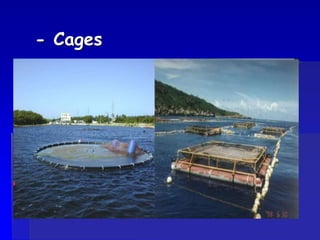
- Cages
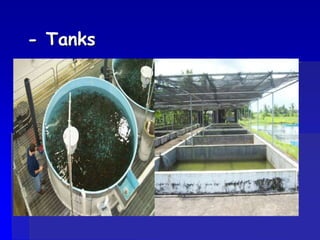
- Tanks
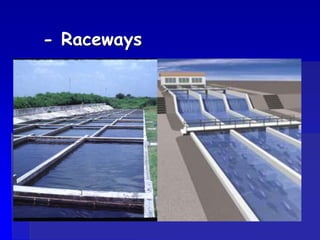
- Raceways
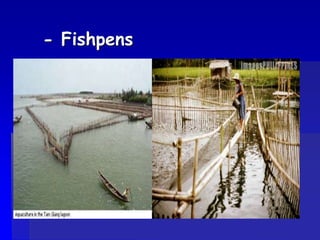
- Fishpens
Success of culture/grow-out depends :
> feasibility of the site
> availability of technology
> availability of good quality
fingerlings
> market
> consumer acceptance/palatability
> production cost (ROI)
> total yield (FCR)
FISHPOND GROW-
OUT OPERATION
FACTORS TO BE CONSIDERED
IN FISHPOND OPERATION:
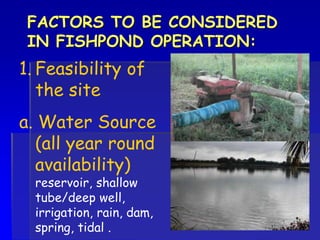
1. Feasibility of
the site
a. Water Source
(all year round
availability)
reservoir, shallow
tube/deep well,
irrigation, rain, dam,
spring, tidal .
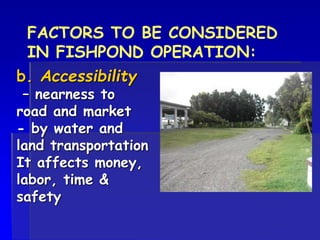
b. Accessibility
– nearness to
road and market
- by water and
land transportation
It affects money,
labor, time &
safety
FACTORS TO BE CONSIDERED
IN FISHPOND OPERATION:
c. Soil Type – clay, clay loam
- can hold water
d. Free from flooding (provision
for overflow/drainage system)
e. Peace and order situation
FACTORS TO BE CONSIDERED
IN FISHPOND OPERATION:
2. QUALITY OF STOCK
a. Growth performance
b. Late maturing
c. Palatability
d. hardiness
Reliable sources of Improved
GET EXCEL fingerlings
- BFAR NFFTC in Science City
of Munoz, Nueva Ecija
- BFAR Regional Hatcheries
nationwide (KFFPRTC
Kisolon, Somilao, Bukidnon
- Accredited private hatcheries
by BFAR
FACTORS TO BE CONSIDERED IN
FISHPOND OPERATION:
3. MANAGEMENT
a. Pond preparation
b. Stocking of Fingerlings
c. Daily feeding/fertilization
d. Water Quality Monitoring
e. Maintenance
cleanliness
water depth
f. Record keeping
4. MARKET ACCEPTANCE
Culture of Fish in Ponds
to have a good yield of fish
farming the farmer must know
about the different steps to be
taken in every pond cycle and its
interactions
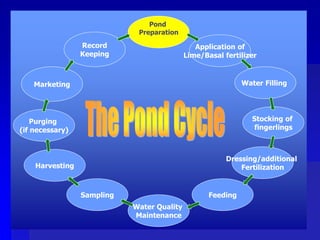
Pond
Preparation
Record
Keeping
Application of
Lime/Basal fertilizer
Water Filling
Marketing
Sampling Feeding
Dressing/additional
Fertilization
Harvesting
Stocking of
fingerlings
Purging
(if necessary)
Water Quality
Maintenance
Pond
Preparation
Tilapia, Pangasius, Catfish, Milkfish,
Shrimp, Crabs,
Pond Preparation
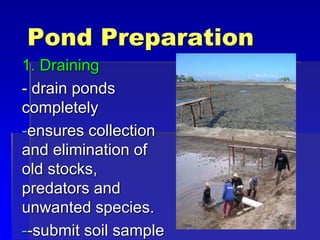
1. Draining
- drain ponds
completely
-ensures collection
and elimination of
old stocks,
predators and
unwanted species.
--submit soil sample
Pond Preparation
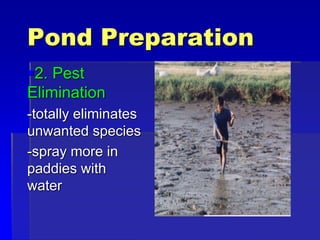
2. Pest
Elimination
-totally eliminates
unwanted species
-spray more in
paddies with
water
Pond Preparation
Pest Elimination
if ponds cannot be dried out completely
it should be treated (7-10 days prior to
stocking) to eliminate predatory fish or
other pests
Common pond treatments:
a. teaseed cake
b. rotenone /derris root
c. tobacco dust/powder
d. hydrated lime + 21-0-0
Pond Preparation
Pest Elimination
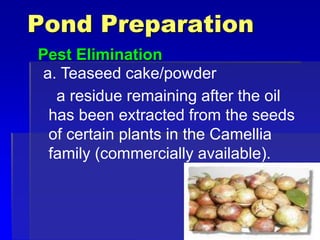
a. Teaseed cake/powder
a residue remaining after the oil
has been extracted from the seeds
of certain plants in the Camellia
family (commercially available).
Pond Preparation
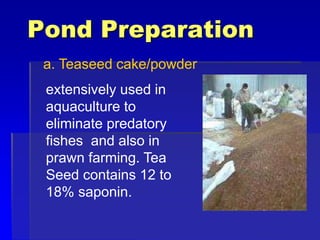
a. Teaseed cake/powder
extensively used in
aquaculture to
eliminate predatory
fishes and also in
prawn farming. Tea
Seed contains 12 to
18% saponin.
Pond Preparation
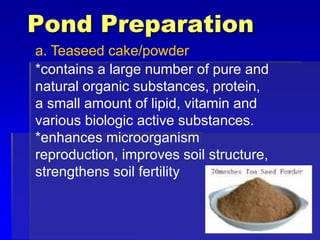
a. Teaseed cake/powder
*contains a large number of pure and
natural organic substances, protein,
a small amount of lipid, vitamin and
various biologic active substances.
*enhances microorganism
reproduction, improves soil structure,
strengthens soil fertility
Pond Preparation
Pest Elimination
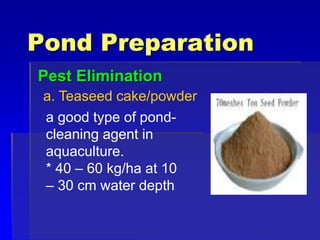
a. Teaseed cake/powder
a good type of pond-
cleaning agent in
aquaculture.
* 40 – 60 kg/ha at 10
– 30 cm water depth
Pond Preparation
Pest Elimination
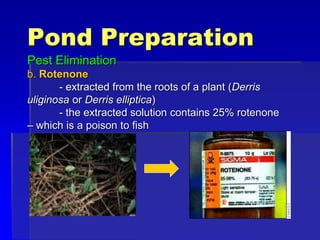
b. Rotenone
- extracted from the roots of a plant (Derris
uliginosa or Derris elliptica)
- the extracted solution contains 25% rotenone
– which is a poison to fish
Pond Preparation
b. Rotenone
Recommended Concentration:
50 g derris roots/ ton of water
or
250g/ha
- mix extract with water
- spray on ponds at 5 cm water
depth
Pond Preparation
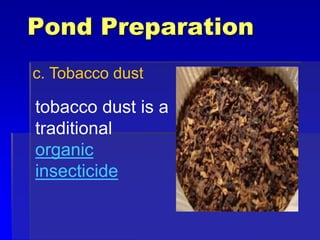
c. Tobacco dust
tobacco dust is a
traditional
organic
insecticide
Pond Preparation
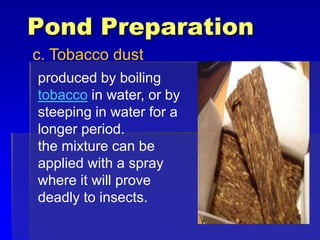
c. Tobacco dust
produced by boiling
tobacco in water, or by
steeping in water for a
longer period.
the mixture can be
applied with a spray
where it will prove
deadly to insects.
Pond Preparation
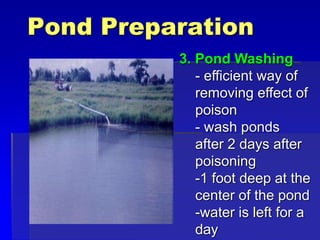
3. Pond Washing
- efficient way of
removing effect of
poison
- wash ponds
after 2 days after
poisoning
-1 foot deep at the
center of the pond
-water is left for a
day
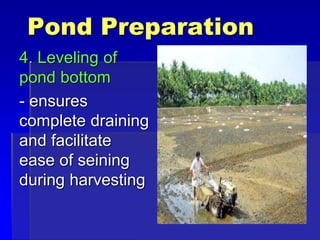
Pond Preparation
4. Leveling of
pond bottom
- ensures
complete draining
and facilitate
ease of seining
during harvesting
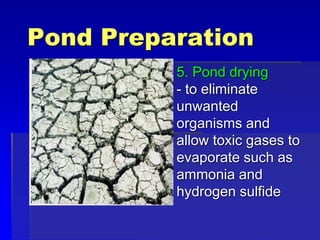
Pond Preparation
5. Pond drying
- to eliminate
unwanted
organisms and
allow toxic gases to
evaporate such as
ammonia and
hydrogen sulfide
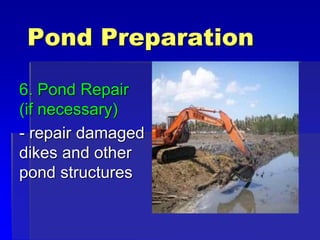
Pond Preparation
6. Pond Repair
(if necessary)
- repair damaged
dikes and other
pond structures
Pond Preparation
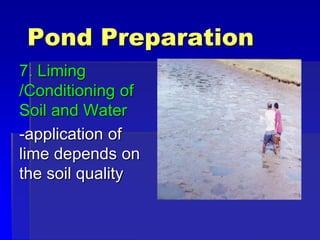
7. Liming
/Conditioning of
Soil and Water
-application of
lime depends on
the soil quality
Pond Preparation
Lime Application
- lime is added to correct acidity in the pond
soil
- pH – measure of soil acidity
- 6.5-9.0 – ideal pH range for optimum growth
of fish
- < 6.5 – ponds must be limed
- acidic water will not support growth of
natural foods (phytoplankton, zooplankton)
these organisms are important to produce a
good environment for fish growth
Pond Preparation
Lime Application
- new ponds are needed to be limed to
reduce soil acidity
- the need for liming and the quantity of
lime used will depend on the soil
characteristics
- analysis of soil pH is necessary
Pond Preparation
Several forms of lime:
A. Agricultural Lime or Powdered
Limestone
- CaCO3 – chemical formula
- most commonly available
- should be added to the pond
bottom before filling the pond with water
Typical Application Rate: 500-1000 kg/ha
(for new ponds)
Pond Preparation
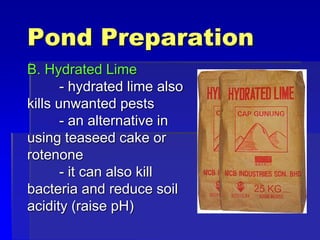
B. Hydrated Lime
- hydrated lime also
kills unwanted pests
- an alternative in
using teaseed cake or
rotenone
- it can also kill
bacteria and reduce soil
acidity (raise pH)
Pond Preparation
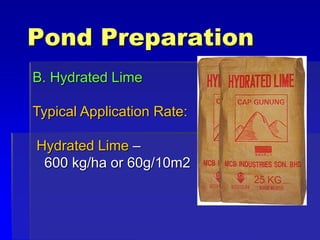
B. Hydrated Lime
Typical Application Rate:
Hydrated Lime –
600 kg/ha or 60g/10m2
Pond Preparation
 Lime can also be pest eliminator
Lime + Inorganic Fertilizer = Piscicide
Effective at a ratio of:
3g (lime):1g (21-0-0-24,ammonium sulphate)/m2
- dissolved in 1 liter of water
- apply in ponds at 3-5 cm water depth
- will work as piscicide
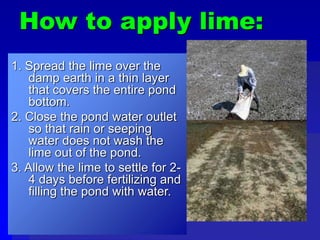
How to apply lime:
1. Spread the lime over the
damp earth in a thin layer
that covers the entire pond
bottom.
2. Close the pond water outlet
so that rain or seeping
water does not wash the
lime out of the pond.
3. Allow the lime to settle for 2-
4 days before fertilizing and
filling the pond with water.
How to apply lime:
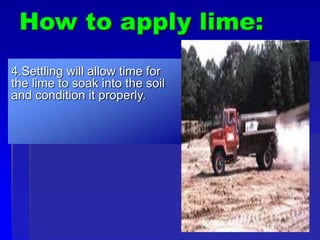
4.Settling will allow time for
the lime to soak into the soil
and condition it properly.
Pond Preparation
8. Installation
of Screens
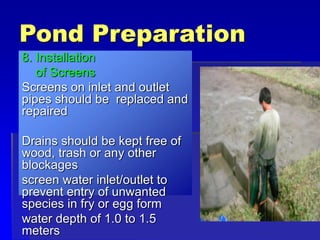
Screens on inlet and outlet
pipes should be replaced and
repaired
Drains should be kept free of
wood, trash or any other
blockages
screen water inlet/outlet to
prevent entry of unwanted
species in fry or egg form
water depth of 1.0 to 1.5
meters
Pond Preparation
9. Water Filling
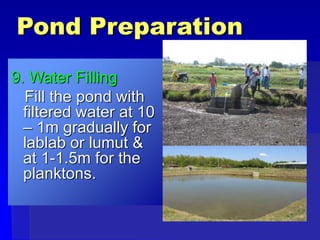
Fill the pond with
filtered water at 10
– 1m gradually for
lablab or lumut &
at 1-1.5m for the
planktons.
Pond Preparation
10. Basal Fertilization
fertilizers promotes the growth of
plankton that will provide natural food
for fish
Cheap way to provide food for the fish
usually done in delayed feeding
technology (tilapia, bangus –extensive
culture)
Types of Fertilizers
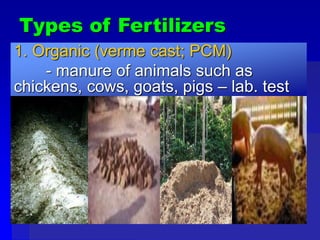
1. Organic (verme cast; PCM)
- manure of animals such as
chickens, cows, goats, pigs – lab. test
Types of Fertilizers
2. Inorganic/commercial – not for Organic Aqua.
a. single element fertilizers – contain single
nutrients like nitrogen or phosphorous
b. incomplete fertilizers – that contain two
nutrients such as nitrogen and phosphorous
c. complete fertilizers – contain the three
important plant nutrients (N-Nitrogen, P-
Phosphorous , K-Potassium)
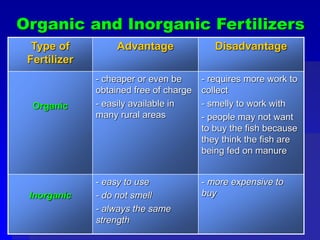
Organic and Inorganic Fertilizers
Type of
Fertilizer
Advantage Disadvantage
Organic
- cheaper or even be
obtained free of charge
- easily available in
many rural areas
- requires more work to
collect
- smelly to work with
- people may not want
to buy the fish because
they think the fish are
being fed on manure
Inorganic
- easy to use
- do not smell
- always the same
strength
- more expensive to
buy
How to apply fertilizers
1. For faster stimulation of plankton
growth (if the pond is initially filled with
water)
- dissolve manure in a drum of
water then pour into the pond
How to apply fertilizers
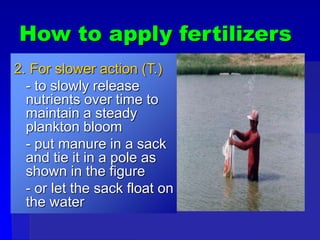
2. For slower action (T.)
- to slowly release
nutrients over time to
maintain a steady
plankton bloom
- put manure in a sack
and tie it in a pole as
shown in the figure
- or let the sack float on
the water
Rate of Application:
Organic Fertilizer
Processed Chicken Manure (PCM)
- -1,000 to 2,000 kgs/ha ;
Verme cast - 750 kg/ha
Rice Bran D1 – 335 kg/ha (shrimp prod.)
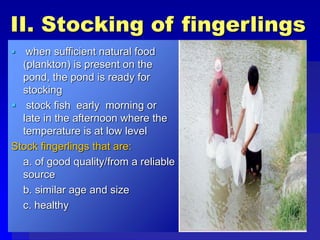
II. Stocking of fingerlings
 when sufficient natural food
(plankton) is present on the
pond, the pond is ready for
stocking
 stock fish early morning or
late in the afternoon where the
temperature is at low level
Stock fingerlings that are:
a. of good quality/from a reliable
source
b. similar age and size
c. healthy
Stocking Density is related to:
- Culture system/ Management
technology
-Water Management/Quality
-Quality and Quantity of Organically
Formulated Feeds (OFF)/Indigenous
Foods Used
CULTURE SYSTEMS
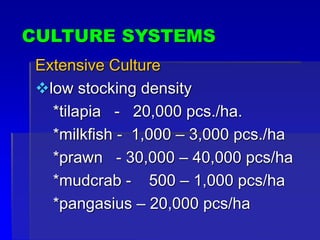
Extensive Culture
low stocking density
*tilapia - 20,000 pcs./ha.
*milkfish - 1,000 – 3,000 pcs./ha
*prawn - 30,000 – 40,000 pcs/ha
*mudcrab - 500 – 1,000 pcs/ha
*pangasius – 20,000 pcs/ha
CULTURE SYSTEMS
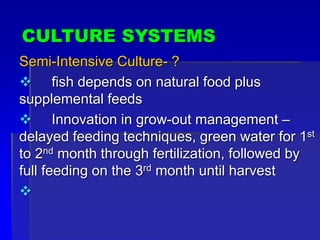
Semi-Intensive Culture- ?
 fish depends on natural food plus
supplemental feeds
 Innovation in grow-out management –
delayed feeding techniques, green water for 1st
to 2nd month through fertilization, followed by
full feeding on the 3rd month until harvest

CULTURE SYSTEMS
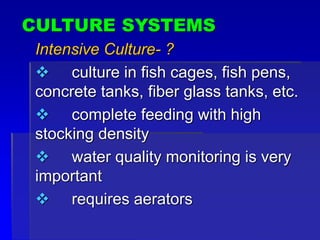
Intensive Culture- ?
 culture in fish cages, fish pens,
concrete tanks, fiber glass tanks, etc.
 complete feeding with high
stocking density
 water quality monitoring is very
important
 requires aerators
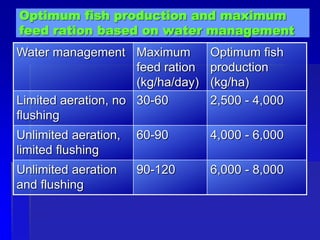
Optimum fish production and maximum
feed ration based on water management
Water management Maximum
feed ration
(kg/ha/day)
Optimum fish
production
(kg/ha)
Limited aeration, no
flushing
30-60 2,500 - 4,000
Unlimited aeration,
limited flushing
60-90 4,000 - 6,000
Unlimited aeration
and flushing
90-120 6,000 - 8,000
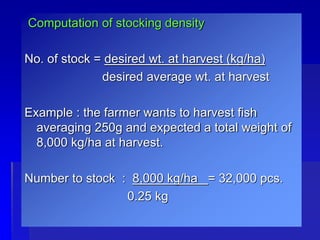
Computation of stocking density
No. of stock = desired wt. at harvest (kg/ha)
desired average wt. at harvest
Example : the farmer wants to harvest fish
averaging 250g and expected a total weight of
8,000 kg/ha at harvest.
Number to stock : 8,000 kg/ha = 32,000 pcs.
0.25 kg
Routine Pond
Management
Routine Pond Management
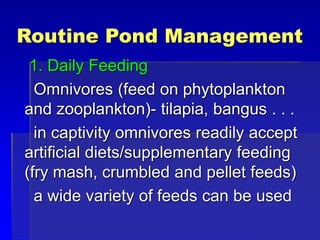
1. Daily Feeding
Omnivores (feed on phytoplankton
and zooplankton)- tilapia, bangus . . .
in captivity omnivores readily accept
artificial diets/supplementary feeding
(fry mash, crumbled and pellet feeds)
a wide variety of feeds can be used
Routine Pond Management
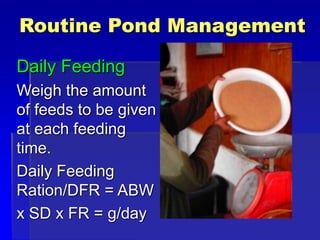
Daily Feeding
Weigh the amount
of feeds to be given
at each feeding
time.
Daily Feeding
Ration/DFR = ABW
x SD x FR = g/day
Routine Pond Management
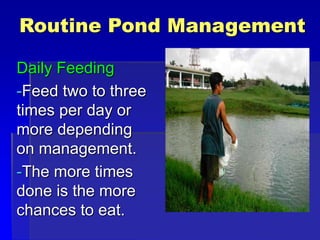
Daily Feeding
-Feed two to three
times per day or
more depending
on management.
-The more times
done is the more
chances to eat.
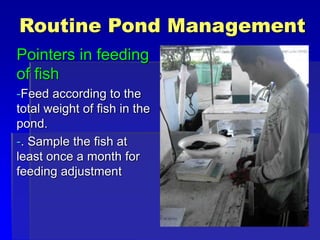
Routine Pond Management
Pointers in feeding
of fish
-Feed according to the
total weight of fish in the
pond.
-. Sample the fish at
least once a month for
feeding adjustment
Routine Pond Management
Pointers
-Feed the fish according to wind direction
-Reduce feeding on; overcast days, heavy
rains, high water temperature, plankton
bloom, low dissolve oxygen in the pond
- Do not overfeed. Watch the fish to ensure
they are feeding properly.
-Do not feed the fish after sunset.
-Increase feed/food after sunset (nocturnal –
catfish).
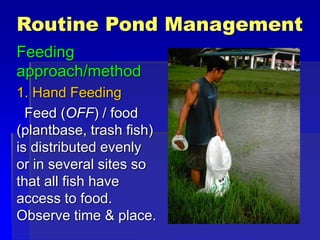
Routine Pond Management
Feeding
approach/method
1. Hand Feeding
Feed (OFF) / food
(plantbase, trash fish)
is distributed evenly
or in several sites so
that all fish have
access to food.
Observe time & place.
Routine Pond Management
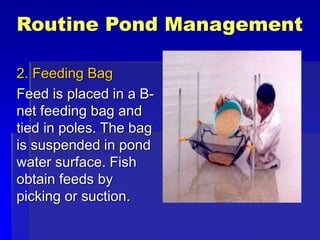
2. Feeding Bag
Feed is placed in a B-
net feeding bag and
tied in poles. The bag
is suspended in pond
water surface. Fish
obtain feeds by
picking or suction.
Routine Pond Management
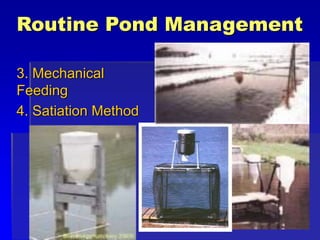
3. Mechanical
Feeding
4. Satiation Method
Routine Pond Management
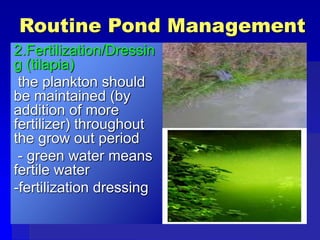
2.Fertilization/Dressin
g (tilapia)
the plankton should
be maintained (by
addition of more
fertilizer) throughout
the grow out period
- green water means
fertile water
-fertilization dressing
Routine Pond Management
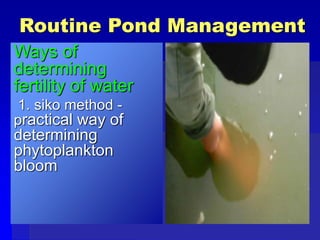
Ways of
determining
fertility of water
1. siko method -
practical way of
determining
phytoplankton
bloom
Routine Pond Management
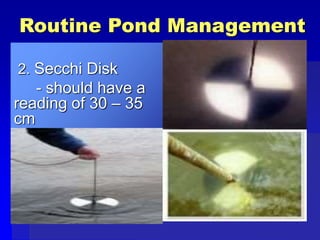
2. Secchi Disk
- should have a
reading of 30 – 35
cm
Routine Pond Management
Fertilization/Dressing for tilapia
Organic Fertilizer
PCM - 375 kg/ha/week
Verme cast – 187.5 kg/ha/week
Inorganic Fertilizer / non organic cltr.
25 to 50 kg/ha/week
1 to 2 bags/ha/week
Routine Pond Management
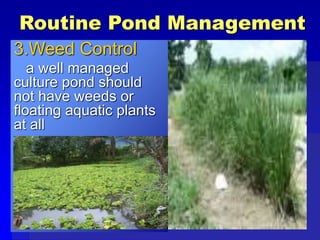
3.Weed Control
a well managed
culture pond should
not have weeds or
floating aquatic plants
at all
Routine Pond Management
Weed Control
a.Biological Control (POLYCULTURE)
- use of animals (common carp, grass carp)
grass carp (herbivorous)
- 100 to 200 pcs/ha
common carp (agitates pond bottom)
- 2,000 pcs/ha
- most effective and most economical is the use of
phytoplankton blooms to shade the pond bottom
Routine Pond Management
Weed Control
b.Chemical - discourage in organic aquaculture.
- effective means of control but it involves certain risks
- dissolved oxygen may be depleted to a point that it
may affect the health of the fish
- may also kill the natural food organisms such as the
phytoplankton
 c.Mechanical
 - use of grass cutter
 d. Manual
 Manual weeding using scythes or bolos
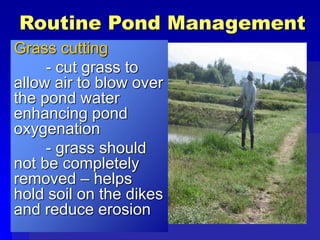
Routine Pond Management
Grass cutting
- cut grass to
allow air to blow over
the pond water
enhancing pond
oxygenation
- grass should
not be completely
removed – helps
hold soil on the dikes
and reduce erosion
Routine Pond Management
4.Water Quantity Maintenance
- maintain a water depth of 1 to 1.5meter
a. extensive – addition of water due to water
loss through seepage and evaporation
b. semi-intensive – necessary to flush out
heavy phytoplankton bloom and fish
fecal
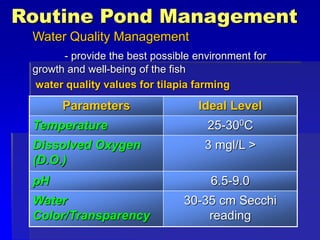
Water Quality Management
- provide the best possible environment for
growth and well-being of the fish
water quality values for tilapia farming
Parameters Ideal Level
Temperature 25-300C
Dissolved Oxygen
(D.O.)
3 mgl/L >
pH 6.5-9.0
Water
Color/Transparency
30-35 cm Secchi
reading
Routine Pond Management
Management of a pond involves a daily
routine
tasks, which may include checks on:
pond water level (at least 1m deep)
activities of fish (actively feeding, or
gasping at surface)
water inlet and outlet, to ensure mesh
screens are in place and not clogged
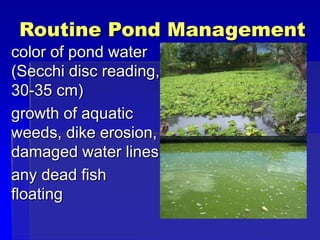
Routine Pond Management
color of pond water
(Secchi disc reading,
30-35 cm)
growth of aquatic
weeds, dike erosion,
damaged water lines
any dead fish
floating
Routine Pond Management
Fish kill may be due to:
thermal shock/abrupt change in
temperature
very low dissolved oxygen
presence of ammonia and hydrogen
sulfide (poisonous gas which evolves from
the pond bottom as a result of decaying
and decomposing organic matter)
heavy water current
Routine Pond Management
Critical period to pay attention
after heavy rain
after stocking
after chemical treatment
Routine Pond Management
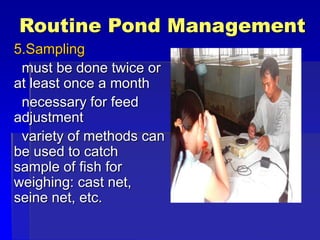
5.Sampling
must be done twice or
at least once a month
necessary for feed
adjustment
variety of methods can
be used to catch
sample of fish for
weighing: cast net,
seine net, etc.
Routine Pond Management
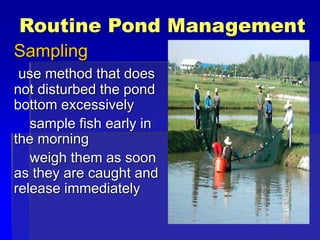
Sampling
use method that does
not disturbed the pond
bottom excessively
sample fish early in
the morning
weigh them as soon
as they are caught and
release immediately
Routine Pond Management
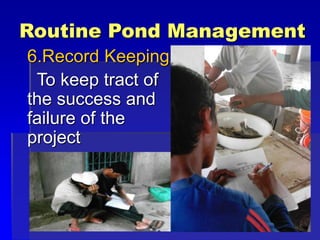
6.Record Keeping
To keep tract of
the success and
failure of the
project
Routine Pond Management
Record Keeping
a fish farm is a business; therefore all
activities in the farm should be recorded
Farm Record – valuable management
tool to measure the cash input and output
can be used to evaluate the farm
performance and plan for future
operations
Routine Pond Management
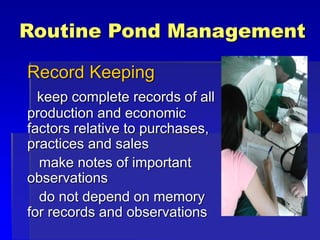
Record Keeping
keep complete records of all
production and economic
factors relative to purchases,
practices and sales
make notes of important
observations
do not depend on memory
for records and observations
Routine Pond Management
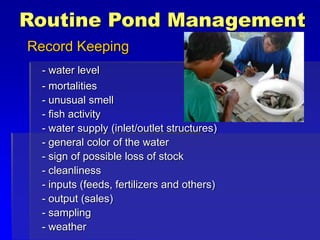
Record Keeping
- water level
- mortalities
- unusual smell
- fish activity
- water supply (inlet/outlet structures)
- general color of the water
- sign of possible loss of stock
- cleanliness
- inputs (feeds, fertilizers and others)
- output (sales)
- sampling
- weather
Routine Pond Management
Sample of “pond Logbook” page
Date: 09 October 2006
Pond 1 – Temperature 29 degrees. Water color is
brownish-green (Secchi = 35cm). Fish are grabbing the
pellets, eating well, look fit and active.
Pond 2 – Temperature 30 degrees. Water very dark
green, has green scum floating on surface (Secchi =
15cm). Only a few fish are grabbing the food, many
were gulping air at the surface in the early morning.
Today opened up the water inlet to flow water and flush
out plankton. Pond looks too shallow (50cm) – tomorrow
will raise upstand pipe on outlet to make water
30cmdeeper.
Harvest
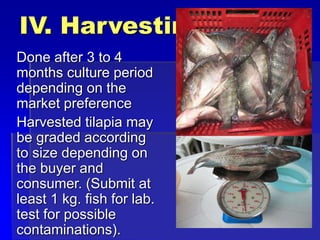
IV. Harvesting
Done after 3 to 4
months culture period
depending on the
market preference
Harvested tilapia may
be graded according
to size depending on
the buyer and
consumer. (Submit at
least 1 kg. fish for lab.
test for possible
contaminations).
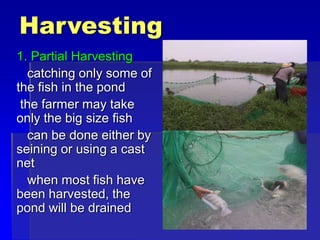
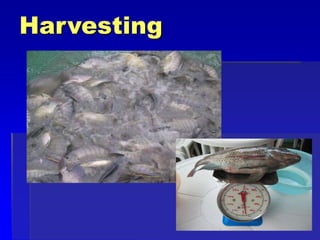
Harvesting
1. Partial Harvesting
catching only some of
the fish in the pond
the farmer may take
only the big size fish
can be done either by
seining or using a cast
net
when most fish have
been harvested, the
pond will be drained
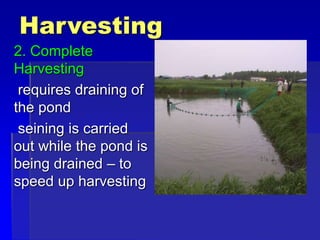
Harvesting
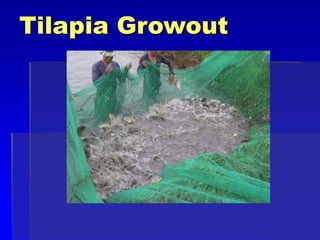
2. Complete
Harvesting
requires draining of
the pond
seining is carried
out while the pond is
being drained – to
speed up harvesting
Harvesting
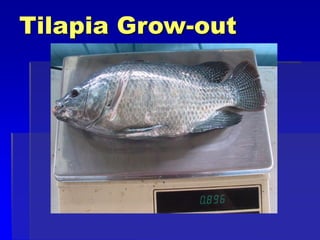
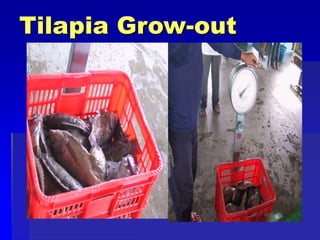
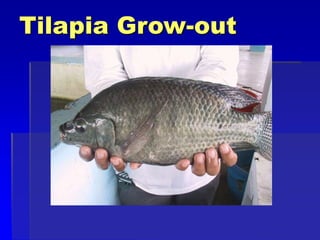
Tilapia Growout
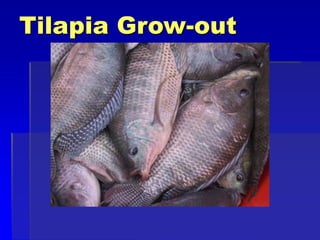
Tilapia Grow-out
Tilapia Grow-out
Tilapia Grow-out
Tilapia Grow-out
Organic Aquaculture.ppt

Organic Aquaculture.ppt

  • 1.
    Organic Culture Management of Finfish/ Crustaceans FAO 241 and HACCP compliant Medium , Inputs and Product will be subjected to laboratory analysis for possible toxic contamination
  • 2.
    CULTURE of Finfish/Crustaceans Grow-outis done in different culture units - Fishpond FISH POND IS THE MOST COMMON CULTURE METHOD
  • 3.
  • 4.
  • 5.
  • 6.
  • 7.
    Success of culture/grow-outdepends : > feasibility of the site > availability of technology > availability of good quality fingerlings > market > consumer acceptance/palatability > production cost (ROI) > total yield (FCR)
  • 8.
  • 9.
    FACTORS TO BECONSIDERED IN FISHPOND OPERATION: 1. Feasibility of the site a. Water Source (all year round availability) reservoir, shallow tube/deep well, irrigation, rain, dam, spring, tidal .
  • 10.
    b. Accessibility – nearnessto road and market - by water and land transportation It affects money, labor, time & safety FACTORS TO BE CONSIDERED IN FISHPOND OPERATION:
  • 11.
    c. Soil Type– clay, clay loam - can hold water d. Free from flooding (provision for overflow/drainage system) e. Peace and order situation
  • 12.
    FACTORS TO BECONSIDERED IN FISHPOND OPERATION: 2. QUALITY OF STOCK a. Growth performance b. Late maturing c. Palatability d. hardiness
  • 13.
    Reliable sources ofImproved GET EXCEL fingerlings - BFAR NFFTC in Science City of Munoz, Nueva Ecija - BFAR Regional Hatcheries nationwide (KFFPRTC Kisolon, Somilao, Bukidnon - Accredited private hatcheries by BFAR
  • 14.
    FACTORS TO BECONSIDERED IN FISHPOND OPERATION: 3. MANAGEMENT a. Pond preparation b. Stocking of Fingerlings c. Daily feeding/fertilization d. Water Quality Monitoring e. Maintenance cleanliness water depth f. Record keeping 4. MARKET ACCEPTANCE
  • 15.
    Culture of Fishin Ponds to have a good yield of fish farming the farmer must know about the different steps to be taken in every pond cycle and its interactions
  • 16.
    Pond Preparation Record Keeping Application of Lime/Basal fertilizer WaterFilling Marketing Sampling Feeding Dressing/additional Fertilization Harvesting Stocking of fingerlings Purging (if necessary) Water Quality Maintenance
  • 17.
  • 18.
    Pond Preparation 1. Draining -drain ponds completely -ensures collection and elimination of old stocks, predators and unwanted species. --submit soil sample
  • 19.
    Pond Preparation 2. Pest Elimination -totallyeliminates unwanted species -spray more in paddies with water
  • 20.
    Pond Preparation Pest Elimination ifponds cannot be dried out completely it should be treated (7-10 days prior to stocking) to eliminate predatory fish or other pests Common pond treatments: a. teaseed cake b. rotenone /derris root c. tobacco dust/powder d. hydrated lime + 21-0-0
  • 21.
    Pond Preparation Pest Elimination a.Teaseed cake/powder a residue remaining after the oil has been extracted from the seeds of certain plants in the Camellia family (commercially available).
  • 22.
    Pond Preparation a. Teaseedcake/powder extensively used in aquaculture to eliminate predatory fishes and also in prawn farming. Tea Seed contains 12 to 18% saponin.
  • 23.
    Pond Preparation a. Teaseedcake/powder *contains a large number of pure and natural organic substances, protein, a small amount of lipid, vitamin and various biologic active substances. *enhances microorganism reproduction, improves soil structure, strengthens soil fertility
  • 24.
    Pond Preparation Pest Elimination a.Teaseed cake/powder a good type of pond- cleaning agent in aquaculture. * 40 – 60 kg/ha at 10 – 30 cm water depth
  • 25.
    Pond Preparation Pest Elimination b.Rotenone - extracted from the roots of a plant (Derris uliginosa or Derris elliptica) - the extracted solution contains 25% rotenone – which is a poison to fish
  • 26.
    Pond Preparation b. Rotenone RecommendedConcentration: 50 g derris roots/ ton of water or 250g/ha - mix extract with water - spray on ponds at 5 cm water depth
  • 27.
    Pond Preparation c. Tobaccodust tobacco dust is a traditional organic insecticide
  • 28.
    Pond Preparation c. Tobaccodust produced by boiling tobacco in water, or by steeping in water for a longer period. the mixture can be applied with a spray where it will prove deadly to insects.
  • 29.
    Pond Preparation 3. PondWashing - efficient way of removing effect of poison - wash ponds after 2 days after poisoning -1 foot deep at the center of the pond -water is left for a day
  • 30.
    Pond Preparation 4. Levelingof pond bottom - ensures complete draining and facilitate ease of seining during harvesting
  • 31.
    Pond Preparation 5. Ponddrying - to eliminate unwanted organisms and allow toxic gases to evaporate such as ammonia and hydrogen sulfide
  • 32.
    Pond Preparation 6. PondRepair (if necessary) - repair damaged dikes and other pond structures
  • 33.
    Pond Preparation 7. Liming /Conditioningof Soil and Water -application of lime depends on the soil quality
  • 34.
    Pond Preparation Lime Application -lime is added to correct acidity in the pond soil - pH – measure of soil acidity - 6.5-9.0 – ideal pH range for optimum growth of fish - < 6.5 – ponds must be limed - acidic water will not support growth of natural foods (phytoplankton, zooplankton) these organisms are important to produce a good environment for fish growth
  • 35.
    Pond Preparation Lime Application -new ponds are needed to be limed to reduce soil acidity - the need for liming and the quantity of lime used will depend on the soil characteristics - analysis of soil pH is necessary
  • 36.
    Pond Preparation Several formsof lime: A. Agricultural Lime or Powdered Limestone - CaCO3 – chemical formula - most commonly available - should be added to the pond bottom before filling the pond with water Typical Application Rate: 500-1000 kg/ha (for new ponds)
  • 37.
    Pond Preparation B. HydratedLime - hydrated lime also kills unwanted pests - an alternative in using teaseed cake or rotenone - it can also kill bacteria and reduce soil acidity (raise pH)
  • 38.
    Pond Preparation B. HydratedLime Typical Application Rate: Hydrated Lime – 600 kg/ha or 60g/10m2
  • 39.
    Pond Preparation  Limecan also be pest eliminator Lime + Inorganic Fertilizer = Piscicide Effective at a ratio of: 3g (lime):1g (21-0-0-24,ammonium sulphate)/m2 - dissolved in 1 liter of water - apply in ponds at 3-5 cm water depth - will work as piscicide
  • 40.
    How to applylime: 1. Spread the lime over the damp earth in a thin layer that covers the entire pond bottom. 2. Close the pond water outlet so that rain or seeping water does not wash the lime out of the pond. 3. Allow the lime to settle for 2- 4 days before fertilizing and filling the pond with water.
  • 41.
    How to applylime: 4.Settling will allow time for the lime to soak into the soil and condition it properly.
  • 42.
    Pond Preparation 8. Installation ofScreens Screens on inlet and outlet pipes should be replaced and repaired Drains should be kept free of wood, trash or any other blockages screen water inlet/outlet to prevent entry of unwanted species in fry or egg form water depth of 1.0 to 1.5 meters
  • 43.
    Pond Preparation 9. WaterFilling Fill the pond with filtered water at 10 – 1m gradually for lablab or lumut & at 1-1.5m for the planktons.
  • 44.
    Pond Preparation 10. BasalFertilization fertilizers promotes the growth of plankton that will provide natural food for fish Cheap way to provide food for the fish usually done in delayed feeding technology (tilapia, bangus –extensive culture)
  • 45.
    Types of Fertilizers 1.Organic (verme cast; PCM) - manure of animals such as chickens, cows, goats, pigs – lab. test
  • 46.
    Types of Fertilizers 2.Inorganic/commercial – not for Organic Aqua. a. single element fertilizers – contain single nutrients like nitrogen or phosphorous b. incomplete fertilizers – that contain two nutrients such as nitrogen and phosphorous c. complete fertilizers – contain the three important plant nutrients (N-Nitrogen, P- Phosphorous , K-Potassium)
  • 47.
    Organic and InorganicFertilizers Type of Fertilizer Advantage Disadvantage Organic - cheaper or even be obtained free of charge - easily available in many rural areas - requires more work to collect - smelly to work with - people may not want to buy the fish because they think the fish are being fed on manure Inorganic - easy to use - do not smell - always the same strength - more expensive to buy
  • 48.
    How to applyfertilizers 1. For faster stimulation of plankton growth (if the pond is initially filled with water) - dissolve manure in a drum of water then pour into the pond
  • 49.
    How to applyfertilizers 2. For slower action (T.) - to slowly release nutrients over time to maintain a steady plankton bloom - put manure in a sack and tie it in a pole as shown in the figure - or let the sack float on the water
  • 50.
    Rate of Application: OrganicFertilizer Processed Chicken Manure (PCM) - -1,000 to 2,000 kgs/ha ; Verme cast - 750 kg/ha Rice Bran D1 – 335 kg/ha (shrimp prod.)
  • 51.
    II. Stocking offingerlings  when sufficient natural food (plankton) is present on the pond, the pond is ready for stocking  stock fish early morning or late in the afternoon where the temperature is at low level Stock fingerlings that are: a. of good quality/from a reliable source b. similar age and size c. healthy
  • 52.
    Stocking Density isrelated to: - Culture system/ Management technology -Water Management/Quality -Quality and Quantity of Organically Formulated Feeds (OFF)/Indigenous Foods Used
  • 53.
    CULTURE SYSTEMS Extensive Culture lowstocking density *tilapia - 20,000 pcs./ha. *milkfish - 1,000 – 3,000 pcs./ha *prawn - 30,000 – 40,000 pcs/ha *mudcrab - 500 – 1,000 pcs/ha *pangasius – 20,000 pcs/ha
  • 54.
    CULTURE SYSTEMS Semi-Intensive Culture-?  fish depends on natural food plus supplemental feeds  Innovation in grow-out management – delayed feeding techniques, green water for 1st to 2nd month through fertilization, followed by full feeding on the 3rd month until harvest 
  • 55.
    CULTURE SYSTEMS Intensive Culture-?  culture in fish cages, fish pens, concrete tanks, fiber glass tanks, etc.  complete feeding with high stocking density  water quality monitoring is very important  requires aerators
  • 56.
    Optimum fish productionand maximum feed ration based on water management Water management Maximum feed ration (kg/ha/day) Optimum fish production (kg/ha) Limited aeration, no flushing 30-60 2,500 - 4,000 Unlimited aeration, limited flushing 60-90 4,000 - 6,000 Unlimited aeration and flushing 90-120 6,000 - 8,000
  • 57.
    Computation of stockingdensity No. of stock = desired wt. at harvest (kg/ha) desired average wt. at harvest Example : the farmer wants to harvest fish averaging 250g and expected a total weight of 8,000 kg/ha at harvest. Number to stock : 8,000 kg/ha = 32,000 pcs. 0.25 kg
  • 58.
  • 59.
    Routine Pond Management 1.Daily Feeding Omnivores (feed on phytoplankton and zooplankton)- tilapia, bangus . . . in captivity omnivores readily accept artificial diets/supplementary feeding (fry mash, crumbled and pellet feeds) a wide variety of feeds can be used
  • 60.
    Routine Pond Management DailyFeeding Weigh the amount of feeds to be given at each feeding time. Daily Feeding Ration/DFR = ABW x SD x FR = g/day
  • 61.
    Routine Pond Management DailyFeeding -Feed two to three times per day or more depending on management. -The more times done is the more chances to eat.
  • 62.
    Routine Pond Management Pointersin feeding of fish -Feed according to the total weight of fish in the pond. -. Sample the fish at least once a month for feeding adjustment
  • 63.
    Routine Pond Management Pointers -Feedthe fish according to wind direction -Reduce feeding on; overcast days, heavy rains, high water temperature, plankton bloom, low dissolve oxygen in the pond - Do not overfeed. Watch the fish to ensure they are feeding properly. -Do not feed the fish after sunset. -Increase feed/food after sunset (nocturnal – catfish).
  • 64.
    Routine Pond Management Feeding approach/method 1.Hand Feeding Feed (OFF) / food (plantbase, trash fish) is distributed evenly or in several sites so that all fish have access to food. Observe time & place.
  • 65.
    Routine Pond Management 2.Feeding Bag Feed is placed in a B- net feeding bag and tied in poles. The bag is suspended in pond water surface. Fish obtain feeds by picking or suction.
  • 66.
    Routine Pond Management 3.Mechanical Feeding 4. Satiation Method
  • 67.
    Routine Pond Management 2.Fertilization/Dressin g(tilapia) the plankton should be maintained (by addition of more fertilizer) throughout the grow out period - green water means fertile water -fertilization dressing
  • 68.
    Routine Pond Management Waysof determining fertility of water 1. siko method - practical way of determining phytoplankton bloom
  • 69.
    Routine Pond Management 2.Secchi Disk - should have a reading of 30 – 35 cm
  • 70.
    Routine Pond Management Fertilization/Dressingfor tilapia Organic Fertilizer PCM - 375 kg/ha/week Verme cast – 187.5 kg/ha/week Inorganic Fertilizer / non organic cltr. 25 to 50 kg/ha/week 1 to 2 bags/ha/week
  • 71.
    Routine Pond Management 3.WeedControl a well managed culture pond should not have weeds or floating aquatic plants at all
  • 72.
    Routine Pond Management WeedControl a.Biological Control (POLYCULTURE) - use of animals (common carp, grass carp) grass carp (herbivorous) - 100 to 200 pcs/ha common carp (agitates pond bottom) - 2,000 pcs/ha - most effective and most economical is the use of phytoplankton blooms to shade the pond bottom
  • 73.
    Routine Pond Management WeedControl b.Chemical - discourage in organic aquaculture. - effective means of control but it involves certain risks - dissolved oxygen may be depleted to a point that it may affect the health of the fish - may also kill the natural food organisms such as the phytoplankton
  • 74.
     c.Mechanical  -use of grass cutter  d. Manual  Manual weeding using scythes or bolos
  • 75.
    Routine Pond Management Grasscutting - cut grass to allow air to blow over the pond water enhancing pond oxygenation - grass should not be completely removed – helps hold soil on the dikes and reduce erosion
  • 76.
    Routine Pond Management 4.WaterQuantity Maintenance - maintain a water depth of 1 to 1.5meter a. extensive – addition of water due to water loss through seepage and evaporation b. semi-intensive – necessary to flush out heavy phytoplankton bloom and fish fecal
  • 77.
    Water Quality Management -provide the best possible environment for growth and well-being of the fish water quality values for tilapia farming Parameters Ideal Level Temperature 25-300C Dissolved Oxygen (D.O.) 3 mgl/L > pH 6.5-9.0 Water Color/Transparency 30-35 cm Secchi reading Routine Pond Management
  • 78.
    Routine Pond Management Managementof a pond involves a daily routine tasks, which may include checks on: pond water level (at least 1m deep) activities of fish (actively feeding, or gasping at surface) water inlet and outlet, to ensure mesh screens are in place and not clogged
  • 79.
    Routine Pond Management colorof pond water (Secchi disc reading, 30-35 cm) growth of aquatic weeds, dike erosion, damaged water lines any dead fish floating
  • 80.
    Routine Pond Management Fishkill may be due to: thermal shock/abrupt change in temperature very low dissolved oxygen presence of ammonia and hydrogen sulfide (poisonous gas which evolves from the pond bottom as a result of decaying and decomposing organic matter) heavy water current
  • 81.
    Routine Pond Management Criticalperiod to pay attention after heavy rain after stocking after chemical treatment
  • 82.
    Routine Pond Management 5.Sampling mustbe done twice or at least once a month necessary for feed adjustment variety of methods can be used to catch sample of fish for weighing: cast net, seine net, etc.
  • 83.
    Routine Pond Management Sampling usemethod that does not disturbed the pond bottom excessively sample fish early in the morning weigh them as soon as they are caught and release immediately
  • 84.
    Routine Pond Management 6.RecordKeeping To keep tract of the success and failure of the project
  • 85.
    Routine Pond Management RecordKeeping a fish farm is a business; therefore all activities in the farm should be recorded Farm Record – valuable management tool to measure the cash input and output can be used to evaluate the farm performance and plan for future operations
  • 86.
    Routine Pond Management RecordKeeping keep complete records of all production and economic factors relative to purchases, practices and sales make notes of important observations do not depend on memory for records and observations
  • 87.
    Routine Pond Management RecordKeeping - water level - mortalities - unusual smell - fish activity - water supply (inlet/outlet structures) - general color of the water - sign of possible loss of stock - cleanliness - inputs (feeds, fertilizers and others) - output (sales) - sampling - weather
  • 88.
    Routine Pond Management Sampleof “pond Logbook” page Date: 09 October 2006 Pond 1 – Temperature 29 degrees. Water color is brownish-green (Secchi = 35cm). Fish are grabbing the pellets, eating well, look fit and active. Pond 2 – Temperature 30 degrees. Water very dark green, has green scum floating on surface (Secchi = 15cm). Only a few fish are grabbing the food, many were gulping air at the surface in the early morning. Today opened up the water inlet to flow water and flush out plankton. Pond looks too shallow (50cm) – tomorrow will raise upstand pipe on outlet to make water 30cmdeeper.
  • 89.
  • 90.
    IV. Harvesting Done after3 to 4 months culture period depending on the market preference Harvested tilapia may be graded according to size depending on the buyer and consumer. (Submit at least 1 kg. fish for lab. test for possible contaminations).

  • 91.
    Harvesting 1. Partial Harvesting catchingonly some of the fish in the pond the farmer may take only the big size fish can be done either by seining or using a cast net when most fish have been harvested, the pond will be drained
  • 92.
    Harvesting 2. Complete Harvesting requires drainingof the pond seining is carried out while the pond is being drained – to speed up harvesting
  • 93.
  • 94.
  • 95.
  • 96.
  • 97.
  • 98.