Food Security and Food
Security Bill in India:
Challenges and Prospects for
the Future
Ashok Gaur
Assistant professor
C.P.Patel & F. H. Shah Commerce
College, Anand, Gujarat

12/5/2013

Ashok Gaur

1
Introduction
Before Green Revolution of 1969.
 After Green Revolution
 Still Problems of unavailability of food
grains and inefficient distribution
system
 ― In India, Production is not problem
but distribution is the problem
 Article-21 –Right to life with dignity.


12/5/2013

Ashok Gaur

2
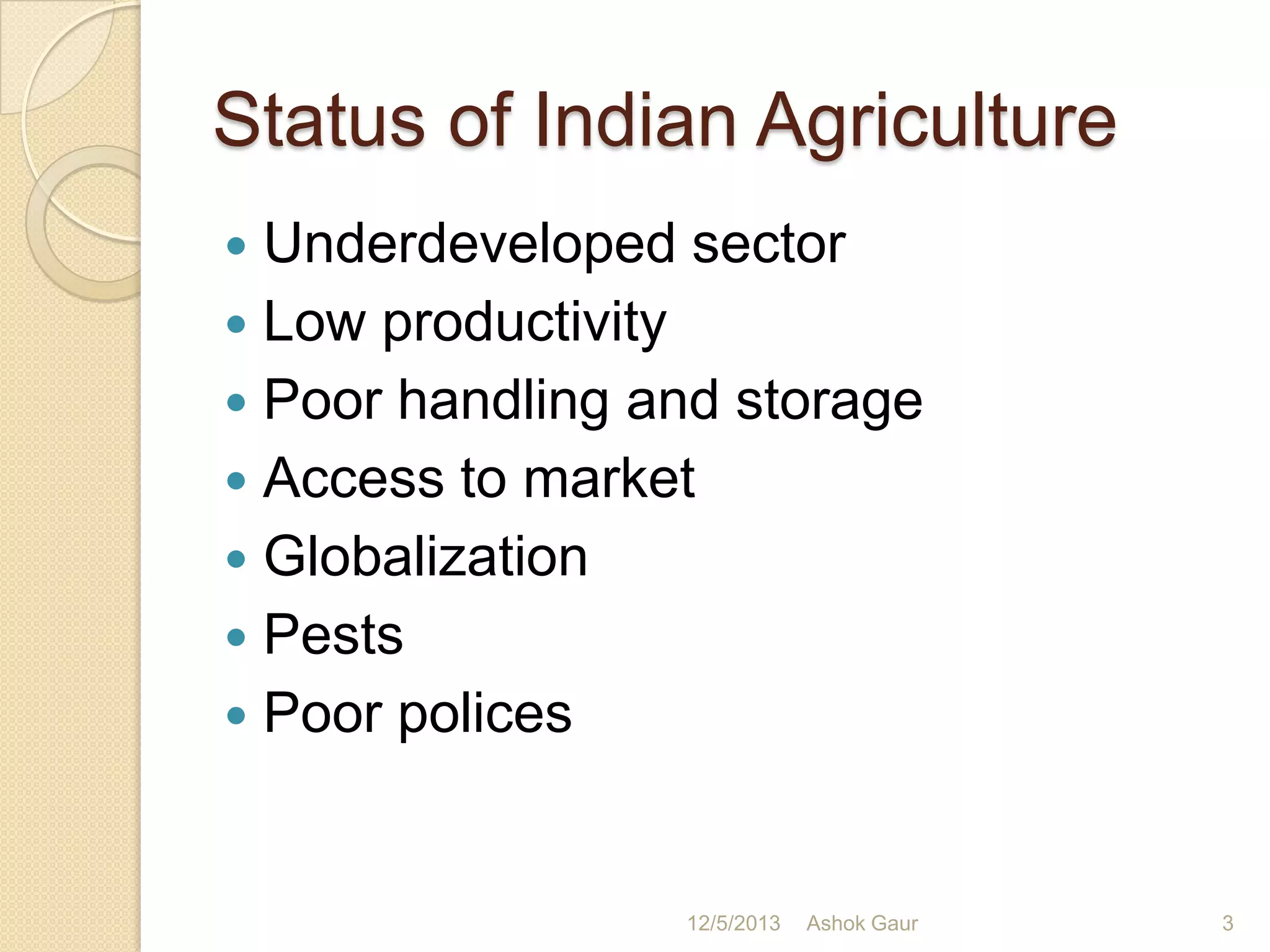
Status of Indian Agriculture
Underdeveloped sector
 Low productivity
 Poor handling and storage
 Access to market
 Globalization
 Pests
 Poor polices


12/5/2013

Ashok Gaur

3
Despite ensuring ample availability of
food, existence of food insecurity at the
micro level in the country has remained a
formidable challenge for India
 Population growth rate and food grain
growth rate
 The recently introduced National Food
Security Bill (NFSB) aims to address this
and marks a paradigm shift in addressing
the problem of food security—from the
current welfare approach to a rights based
approach


12/5/2013

Ashok Gaur

4
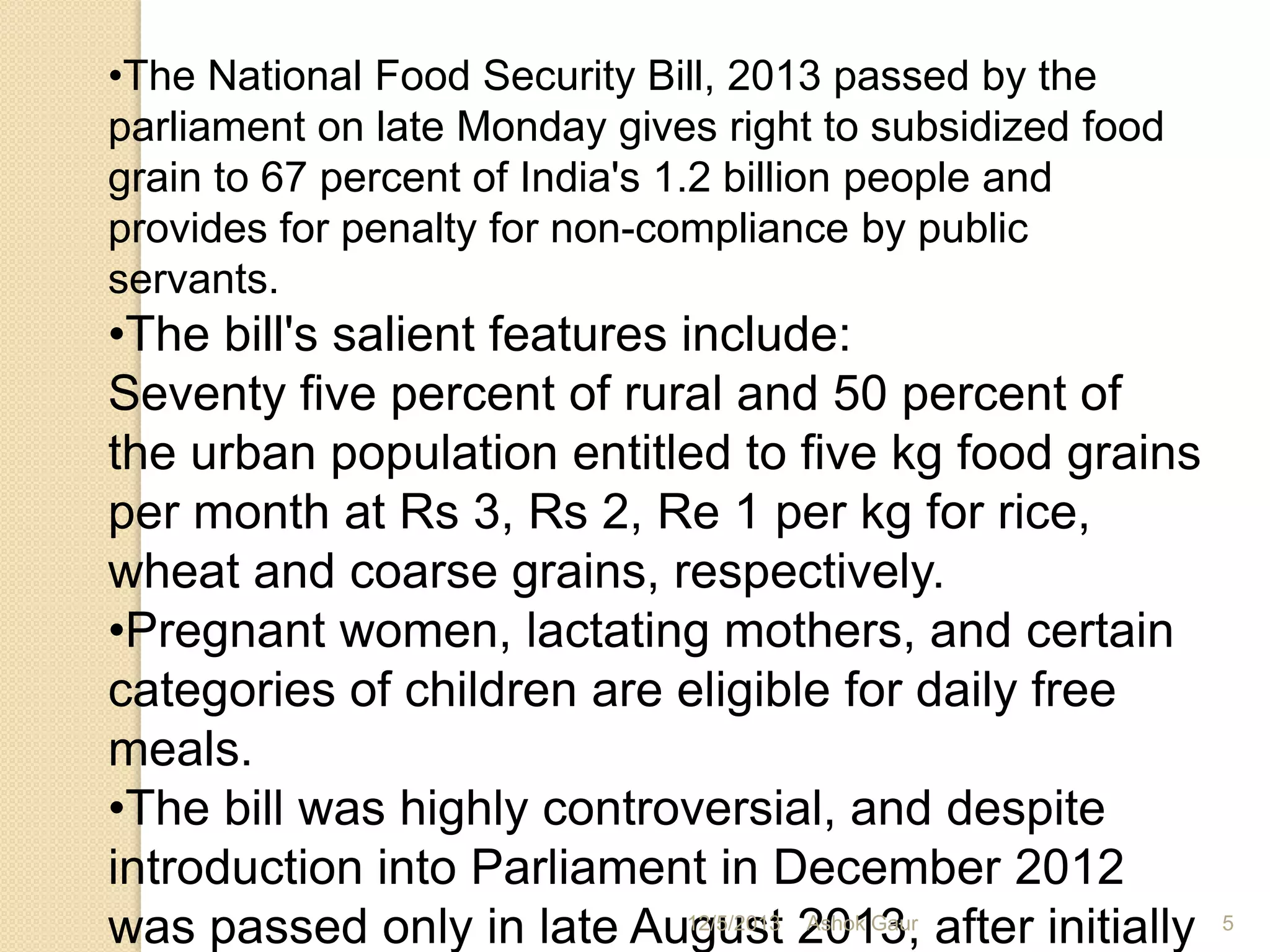
•The National Food Security Bill, 2013 passed by the
parliament on late Monday gives right to subsidized food
grain to 67 percent of India's 1.2 billion people and
provides for penalty for non-compliance by public
servants.

•The bill's salient features include:
Seventy five percent of rural and 50 percent of
the urban population entitled to five kg food grains
per month at Rs 3, Rs 2, Re 1 per kg for rice,
wheat and coarse grains, respectively.
•Pregnant women, lactating mothers, and certain
categories of children are eligible for daily free
meals.
•The bill was highly controversial, and despite
introduction into Parliament in December 2012
12/5/2013 Ashok Gaur
was passed only in late August 2013, after initially

5
Food security challenges in
India
Food Availability
 Matching Income and Price
 Choice of nutritious and safe food
 Adequate safety nets and food
emergency management
 Adequate and relevant information
 Evaluation and reporting of food
security programs


12/5/2013

Ashok Gaur

6
Challenges
Feasibility- Technical, Financial, and
Operation
1. Targeting
2. Determine the number of poor
3. Agriculture unsustainability
4. Crisis in agriculture
5. Low developed agriculture sector
6. Credibility of PDS
7. Direct cash transfer


12/5/2013

Ashok Gaur

7
Cost of food gains
 Disaster emergency situation
 Effect of framer and producers
 Not enough resources
 failure to define beneficiaries
 Budget deficit


12/5/2013

Ashok Gaur

8
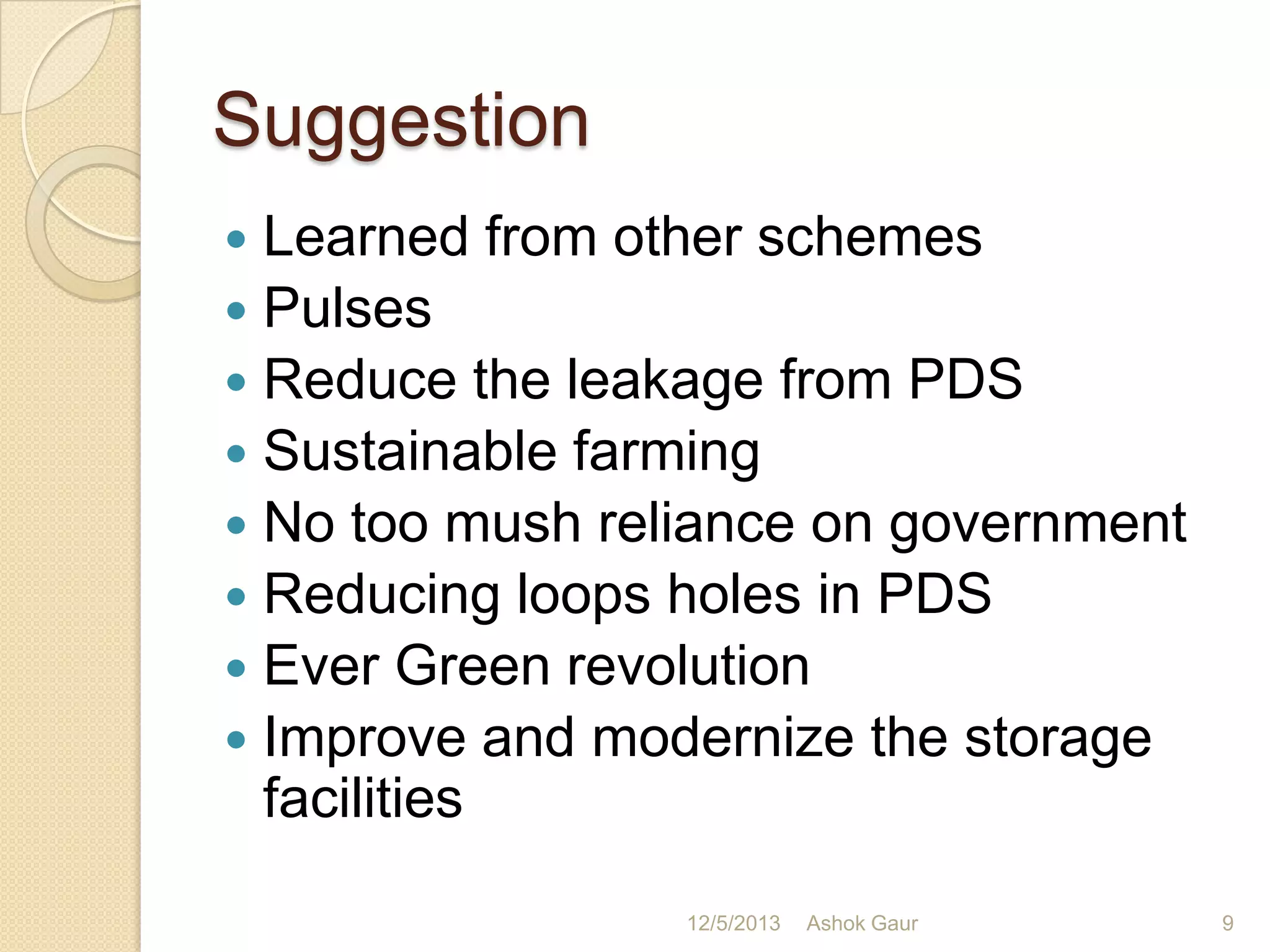
Suggestion
Learned from other schemes
 Pulses
 Reduce the leakage from PDS
 Sustainable farming
 No too mush reliance on government
 Reducing loops holes in PDS
 Ever Green revolution
 Improve and modernize the storage
facilities


12/5/2013

Ashok Gaur

9
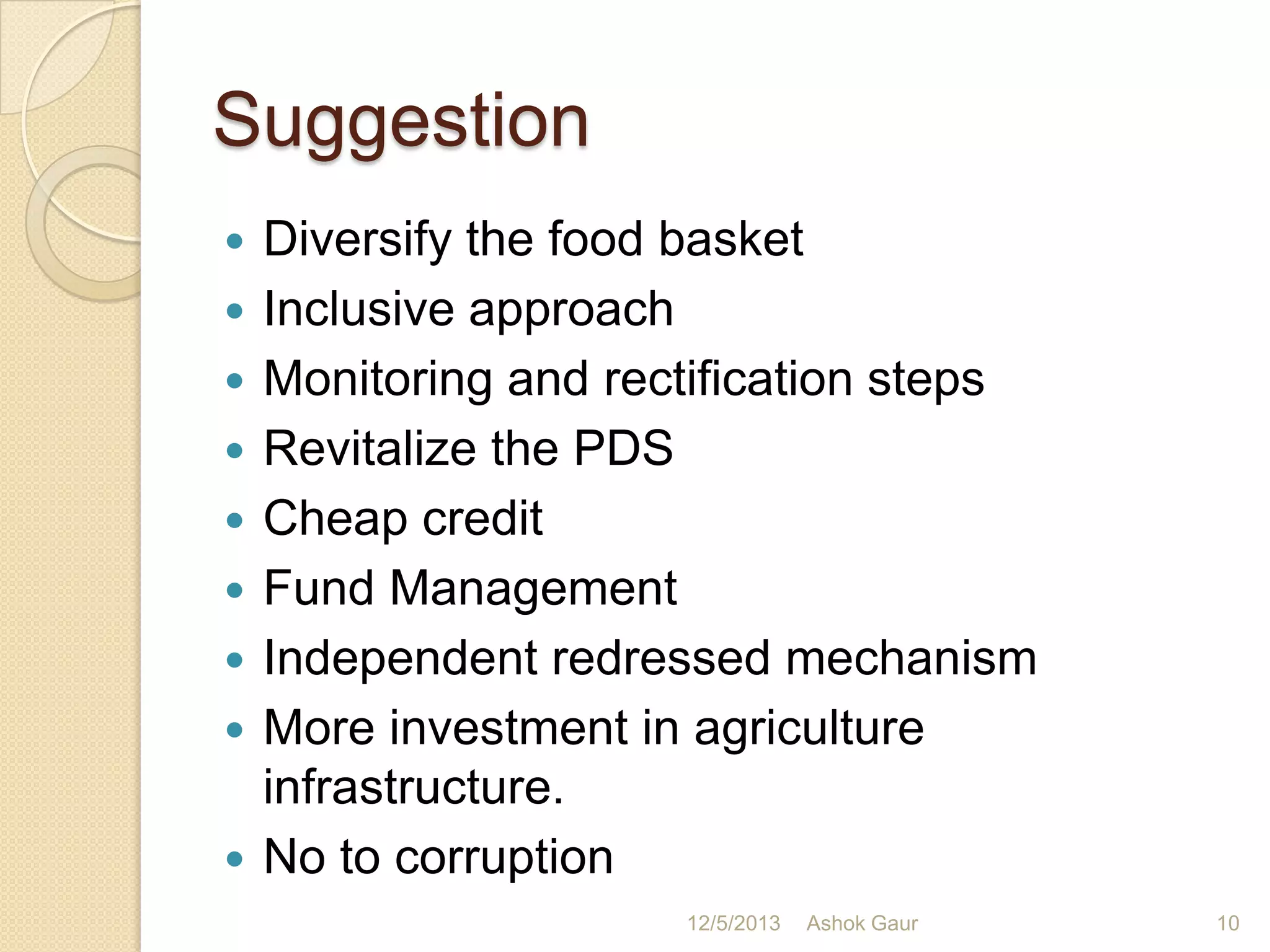
Suggestion










Diversify the food basket
Inclusive approach
Monitoring and rectification steps
Revitalize the PDS
Cheap credit
Fund Management
Independent redressed mechanism
More investment in agriculture
infrastructure.
No to corruption
12/5/2013

Ashok Gaur

10
Conclusion


The challenges in guaranteeing right
to food in India remain complex. The
nation needs an effective policy tools
and implementation to achieve the
end objective of ensuring food and
nutritional security in India.

12/5/2013

Ashok Gaur

11

Ashok gaur food security and food security bill in india

  • 1.
    Food Security andFood Security Bill in India: Challenges and Prospects for the Future Ashok Gaur Assistant professor C.P.Patel & F. H. Shah Commerce College, Anand, Gujarat 12/5/2013 Ashok Gaur 1
  • 2.
    Introduction Before Green Revolutionof 1969.  After Green Revolution  Still Problems of unavailability of food grains and inefficient distribution system  ― In India, Production is not problem but distribution is the problem  Article-21 –Right to life with dignity.  12/5/2013 Ashok Gaur 2
  • 3.
    Status of IndianAgriculture Underdeveloped sector  Low productivity  Poor handling and storage  Access to market  Globalization  Pests  Poor polices  12/5/2013 Ashok Gaur 3
  • 4.
    Despite ensuring ampleavailability of food, existence of food insecurity at the micro level in the country has remained a formidable challenge for India  Population growth rate and food grain growth rate  The recently introduced National Food Security Bill (NFSB) aims to address this and marks a paradigm shift in addressing the problem of food security—from the current welfare approach to a rights based approach  12/5/2013 Ashok Gaur 4
  • 5.
    •The National FoodSecurity Bill, 2013 passed by the parliament on late Monday gives right to subsidized food grain to 67 percent of India's 1.2 billion people and provides for penalty for non-compliance by public servants. •The bill's salient features include: Seventy five percent of rural and 50 percent of the urban population entitled to five kg food grains per month at Rs 3, Rs 2, Re 1 per kg for rice, wheat and coarse grains, respectively. •Pregnant women, lactating mothers, and certain categories of children are eligible for daily free meals. •The bill was highly controversial, and despite introduction into Parliament in December 2012 12/5/2013 Ashok Gaur was passed only in late August 2013, after initially 5
  • 6.
    Food security challengesin India Food Availability  Matching Income and Price  Choice of nutritious and safe food  Adequate safety nets and food emergency management  Adequate and relevant information  Evaluation and reporting of food security programs  12/5/2013 Ashok Gaur 6
  • 7.
    Challenges Feasibility- Technical, Financial,and Operation 1. Targeting 2. Determine the number of poor 3. Agriculture unsustainability 4. Crisis in agriculture 5. Low developed agriculture sector 6. Credibility of PDS 7. Direct cash transfer  12/5/2013 Ashok Gaur 7
  • 8.
    Cost of foodgains  Disaster emergency situation  Effect of framer and producers  Not enough resources  failure to define beneficiaries  Budget deficit  12/5/2013 Ashok Gaur 8
  • 9.
    Suggestion Learned from otherschemes  Pulses  Reduce the leakage from PDS  Sustainable farming  No too mush reliance on government  Reducing loops holes in PDS  Ever Green revolution  Improve and modernize the storage facilities  12/5/2013 Ashok Gaur 9
  • 10.
    Suggestion          Diversify the foodbasket Inclusive approach Monitoring and rectification steps Revitalize the PDS Cheap credit Fund Management Independent redressed mechanism More investment in agriculture infrastructure. No to corruption 12/5/2013 Ashok Gaur 10
  • 11.
    Conclusion  The challenges inguaranteeing right to food in India remain complex. The nation needs an effective policy tools and implementation to achieve the end objective of ensuring food and nutritional security in India. 12/5/2013 Ashok Gaur 11