ASEXUAL REPRODUCTION -
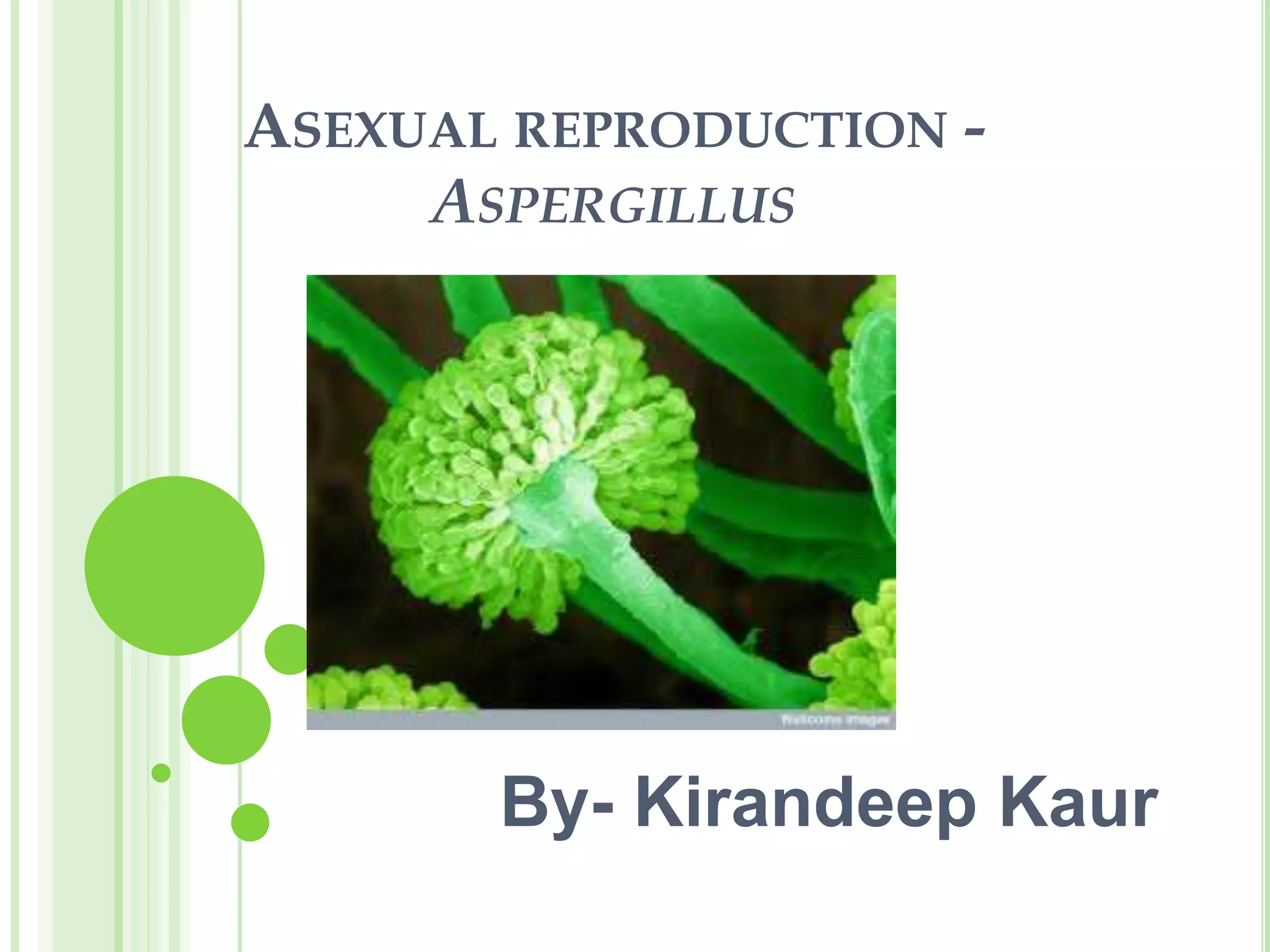
ASPERGILLUS
By- Kirandeep Kaur
CLASSIFICATION
 Division : Mycota
 Sub division : Eumycota
 Class : Ascomycota
 sub-class : Eurotiomycetes
 Order : Eurotiales
 Family : Trichocomacea
 Genus : Aspergillus
 The commonest method of reproduction is through
asexually produced conidia.
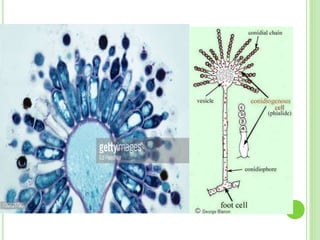
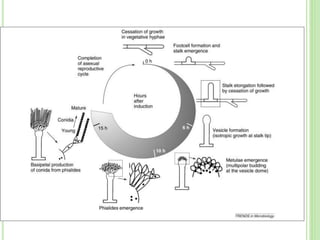
 some cells of the hyphae become larger , develop
thick wall and are called as foot cells.
 Conidiophore ( vertical branch ) arises from foot
cell.
 Conidiophore elongates and terminates into a
bulbous structure, the vesicle.
 Numerous nuclei and protoplasm migrates into the
vesicle from the parent hypha.
 Tubular outgrowths are formed around the surface
of vesicle known as phialides.
 Philades may produce two or more cylindrical
structures, called sterigmata each of which cuts off
conidia in basipetal succession.
 The last generation of sterigmata bear the condia,
while other layers of sterigmata act as support.
 A nucleus present in the sterigma divides into two
and one of the daughter nuclei migrates into the tip.
 The tip expands and gets separated by a septum to
form a uninucleate, conidium.
 The second conidium is then cut off from the
sterigma below the first formed conidium.
 Conidia are thus produced in basipetal sucession.
 Conidia are small, spherical structures, which are
smooth when young but become ornamented at
maturity.
 Conidia are disseminated by air, and on reaching a
suitable substratum, they germinate to form a new
branched mycelium.
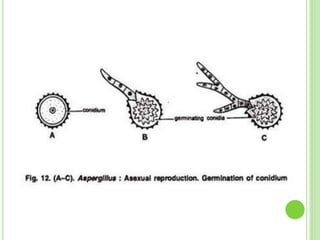
• Structure and Germination of
Conidia:
• Conidia are small, globose, unicellular, uninucleate or
multinucleate, black, brown or yellow green in colour
•They have two layered wall. Outer wall layer is thick
spiny, pigmented and known as epispore, whereas the
inner one is thin,delicate and is called endospore.
• Conidia are dispersed by wind.
• They germinate on suitable substratum by giving out a
germ tube.
• The germ tube becomes septate, branched and forms
a mycelium.
Asexual reproduction in    aspergillus

Asexual reproduction in aspergillus

  • 1.
  • 2.
    CLASSIFICATION  Division :Mycota  Sub division : Eumycota  Class : Ascomycota  sub-class : Eurotiomycetes  Order : Eurotiales  Family : Trichocomacea  Genus : Aspergillus
  • 3.
     The commonestmethod of reproduction is through asexually produced conidia.  some cells of the hyphae become larger , develop thick wall and are called as foot cells.  Conidiophore ( vertical branch ) arises from foot cell.  Conidiophore elongates and terminates into a bulbous structure, the vesicle.  Numerous nuclei and protoplasm migrates into the vesicle from the parent hypha.  Tubular outgrowths are formed around the surface of vesicle known as phialides.
  • 5.
     Philades mayproduce two or more cylindrical structures, called sterigmata each of which cuts off conidia in basipetal succession.  The last generation of sterigmata bear the condia, while other layers of sterigmata act as support.  A nucleus present in the sterigma divides into two and one of the daughter nuclei migrates into the tip.  The tip expands and gets separated by a septum to form a uninucleate, conidium.  The second conidium is then cut off from the sterigma below the first formed conidium.
  • 7.
     Conidia arethus produced in basipetal sucession.  Conidia are small, spherical structures, which are smooth when young but become ornamented at maturity.  Conidia are disseminated by air, and on reaching a suitable substratum, they germinate to form a new branched mycelium.
  • 8.
    • Structure andGermination of Conidia: • Conidia are small, globose, unicellular, uninucleate or multinucleate, black, brown or yellow green in colour •They have two layered wall. Outer wall layer is thick spiny, pigmented and known as epispore, whereas the inner one is thin,delicate and is called endospore. • Conidia are dispersed by wind. • They germinate on suitable substratum by giving out a germ tube. • The germ tube becomes septate, branched and forms a mycelium.