ASEXUAL REPRODUCTION
in
ANIMALS
Not all animals undergo sexual
reproduction, doesn’t require sperm
and egg cell. Ex: jellyfish
Asexual Reproduction
 Offspring comes from only one parent without union
of sex cells
 The offspring is called clone (has traits and
characteristics that are very identical to that of the
parent)
 Common among plants, single-celled organisms, and
simple animals that do not need sex cell to reproduce
 EX: hydras, jellyfish, corals, and sponge
Different Mechanisms in Asexual
Reproduction
1. Budding
2. Parthenogenesis
3. Gemmules
4. Fragmentation
PROCESS OF HYDRA’S
REPRODUCTION
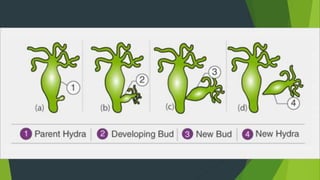
- Parent hydra grows a bud from its
body
- Small bud enlarges and forms
tentacles or slim, flexible limbs
used by animals to move, hold,
and feed
- Newly formed organism detaches
from the parent hydra and
becomes independent.
- Allows organism to
grow our of the
body
- Example: hydra,
corals, and yeast
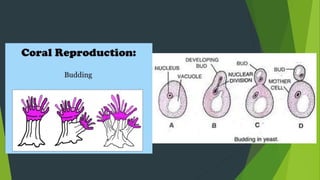
PROCESS OF CORAL’S
REPRODUCTION
Corals – tiny sea animals
that produce outer
skeletons that
resembles shells.
- Unlike hydra, newly
produced coral does not
detach itself from the
parent and it leads to a
formation of groups of
corals on the ocean
floor.
PROCESS OF YEAST’S
REPRODUCTION
- Fungi is a species of
fungi that reproduce
exactly the same with
hydra.
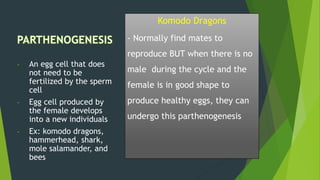
Komodo Dragons
- Normally find mates to
reproduce BUT when there is no
male during the cycle and the
female is in good shape to
produce healthy eggs, they can
undergo this parthenogenesis
- An egg cell that does
not need to be
fertilized by the sperm
cell
- Egg cell produced by
the female develops
into a new individuals
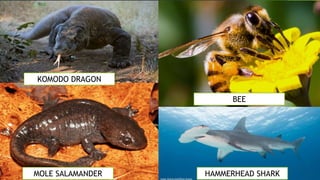
- Ex: komodo dragons,
hammerhead, shark,
mole salamander, and
bees
KOMODO DRAGON
MOLE SALAMANDER
BEE
HAMMERHEAD SHARK
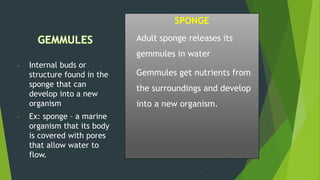
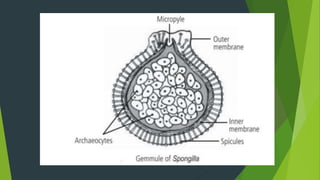
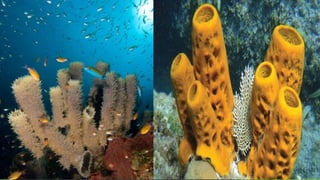
SPONGE
- Adult sponge releases its
gemmules in water
- Gemmules get nutrients from
the surroundings and develop
into a new organism.
- Internal buds or
structure found in the
sponge that can
develop into a new
organism
- Ex: sponge – a marine
organism that its body
is covered with pores
that allow water to
flow.
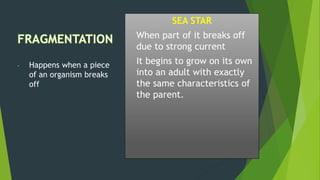
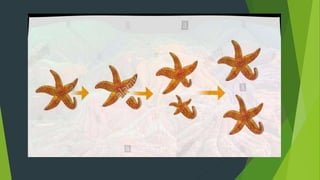
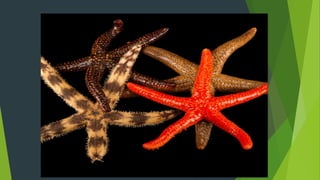
SEA STAR
- When part of it breaks off
due to strong current
- It begins to grow on its own
into an adult with exactly
the same characteristics of
the parent.
- Happens when a piece
of an organism breaks
off
Asexual reproduction

Asexual reproduction

  • 1.
  • 2.
    Not all animalsundergo sexual reproduction, doesn’t require sperm and egg cell. Ex: jellyfish
  • 3.
    Asexual Reproduction  Offspringcomes from only one parent without union of sex cells  The offspring is called clone (has traits and characteristics that are very identical to that of the parent)  Common among plants, single-celled organisms, and simple animals that do not need sex cell to reproduce  EX: hydras, jellyfish, corals, and sponge
  • 4.
    Different Mechanisms inAsexual Reproduction 1. Budding 2. Parthenogenesis 3. Gemmules 4. Fragmentation
  • 5.
    PROCESS OF HYDRA’S REPRODUCTION -Parent hydra grows a bud from its body - Small bud enlarges and forms tentacles or slim, flexible limbs used by animals to move, hold, and feed - Newly formed organism detaches from the parent hydra and becomes independent. - Allows organism to grow our of the body - Example: hydra, corals, and yeast
  • 6.
    PROCESS OF CORAL’S REPRODUCTION Corals– tiny sea animals that produce outer skeletons that resembles shells. - Unlike hydra, newly produced coral does not detach itself from the parent and it leads to a formation of groups of corals on the ocean floor. PROCESS OF YEAST’S REPRODUCTION - Fungi is a species of fungi that reproduce exactly the same with hydra.
  • 9.
    Komodo Dragons - Normallyfind mates to reproduce BUT when there is no male during the cycle and the female is in good shape to produce healthy eggs, they can undergo this parthenogenesis - An egg cell that does not need to be fertilized by the sperm cell - Egg cell produced by the female develops into a new individuals - Ex: komodo dragons, hammerhead, shark, mole salamander, and bees
  • 10.
  • 11.
    SPONGE - Adult spongereleases its gemmules in water - Gemmules get nutrients from the surroundings and develop into a new organism. - Internal buds or structure found in the sponge that can develop into a new organism - Ex: sponge – a marine organism that its body is covered with pores that allow water to flow.
  • 14.
    SEA STAR - Whenpart of it breaks off due to strong current - It begins to grow on its own into an adult with exactly the same characteristics of the parent. - Happens when a piece of an organism breaks off