Sexual vs. Asexual
Reproduction
LEARNING OBJECTIVES:
1.Differentiate asexual and sexual modes of
reproduction.
2.Describe different modes of sexual and asexual
reproduction.
3.Learn the importance of reproduction.
4.Compare the results of uniform or diverse offspring
from sexual or asexual reproduction
Uniform offspring
Diverse offspring
Sexual reproduction
Asexual reproduction
RELEVANT VOCABULARY:
1.Asexual Reproduction-Mode of reproduction that
does not involve the use of gametes or sex cells.
2.Sexual Reproduction-Mode of reproduction that
involves the use of gametes or sex cells.
3.Fission -Type of asexual reproducion involving the
division of body into two or more equal parts.
4.Fragmentation-Type of asexual reproduction where the
body breaks into two or more equal parts, with each
fragment capable of becoming a complete individual; in
animals, fragmentation is usually followed by regeneration
where the missing parts are produced. For example, a lost
arm of the starfish may be generated by mitotic cell
divisions.
5.Budding-Type of asexual reproduction where a new
individual arises as an outgrowth (bud) from its parent,
develops ogans like those of the parent , and then detaches
itself.
6.Sporulation-Type of asexual reproduction where a
new individual foms from an aggregation of cells
surrounded by a resistant capsule or spore, which
later on germintaes.
7.Isogamy-Fusion of similar gametes which are
usually motile.
8.Heterogamy -Fussion of dissimilar gametes. In
oogamy, a large immotile gamete, the egg is fertilized
by a small motile gamete, the sperm.
9.Bisexual reproduction- Type of sexual reproduction
involving the union of gametes from two genetically
different parents.
10. Hermaphrodite- An individual with both male and
female reproductive tissues. In animals “self
fertilization is not common. In worms, a
hermaphrodite needs a male to donate sperms in
order to fertilize the oocytes in its body.
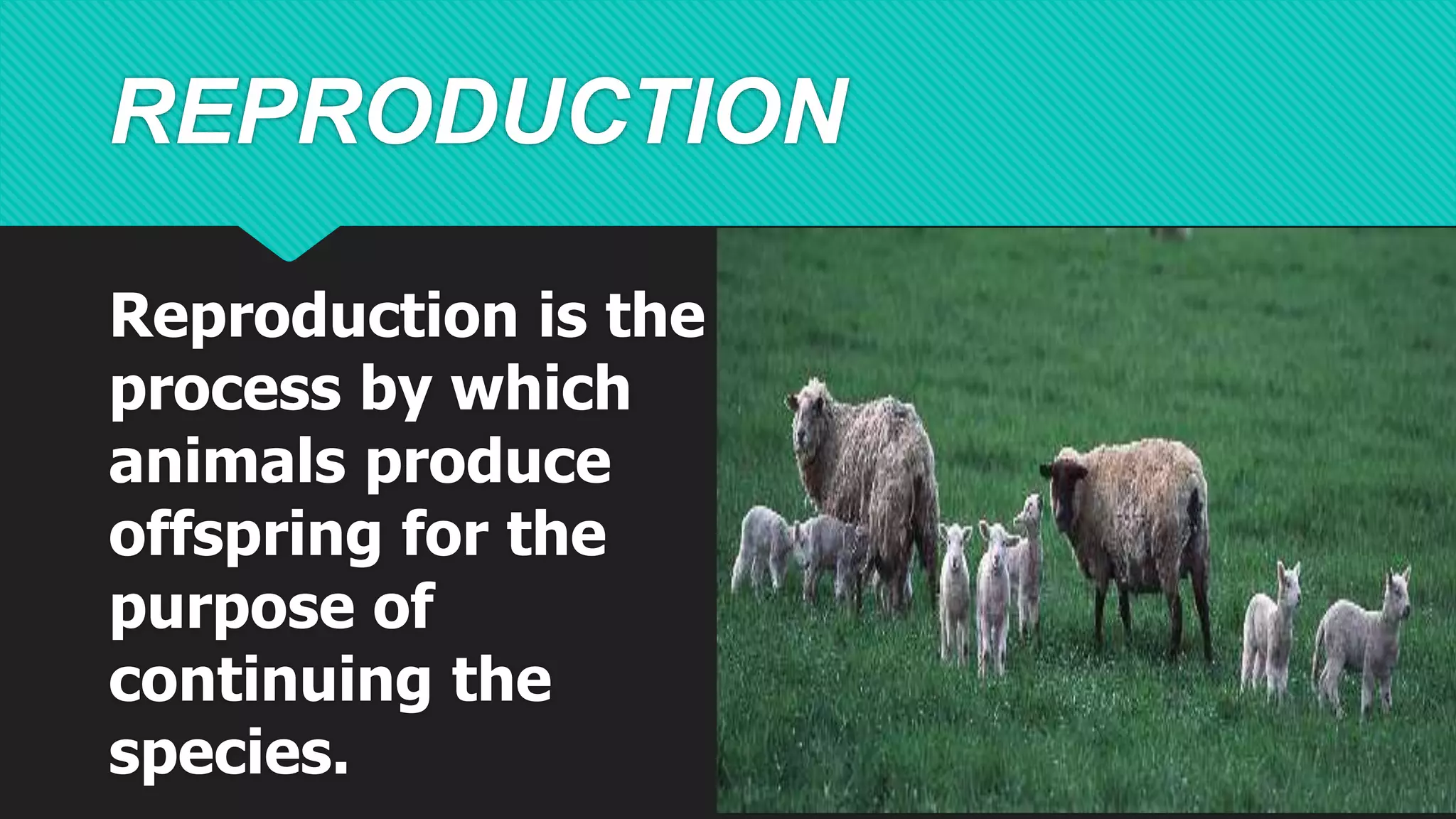
REPRODUCTION
Reproduction is the
process by which
animals produce
offspring for the
purpose of
continuing the
species.
THE FOLLOWING PICTURES DEPICT REPRODUCTION
ACROSS DIFFERNT ORGANISMS. AS ANIMALS, WE ARE
ONLY FAMILIAR WITH ONE FORM OF REPRODUCTION,
PARTICULARLY THE FORM DEPICTED BY THE
LIZARD.HOWEVER, THERE ARE OTHER FORMS OF
REPRODUCTION THAT EXIST IN NATURE,
Sexual Reproduction
A type of reproduction in which the genetic materials from two
different cells combine, producing an offspring
The cells that combine are called sex cells
Female – egg
Male – sperm
Fertilization: an egg cell and a sperm cell join together
A new cell is formed and is called a zygote
Advantages: Sexual Reproduction
 Diverse offspring: genetic variation among offspring
Half of the DNA comes from mom
Half of the DNA comes from dad
 Due to genetic variation, individuals within a population
have slight differences
Plants – resist diseases
Traits can develop to resist harsh environments that
allows an organism survive
Advantages: Sexual Reproduction
Selective Breeding
Used to develop many types of
plants and animals that have
desirable traits
Agriculture/Farming: better plants,
larger animals
Desirable pets
Disadvantages: Sexual Reproduction
Time and Energy
Organisms have to grow and develop until they are old enough
to produce sex cells
Search and find a mate
Searching can expose individuals to predators, diseases, or
harsh environmental conditions
Fertilization cannot take place during pregnancy, which can last
as long as 2 years for some mammals.
Examples: Sexual Reproduction
Asexual Reproduction
One parent: organism produces offspring
without fertilization
Uniform offspring:
Because offspring inherit all of their
DNA from one parent, they are
genetically identical to each other and
to their parent
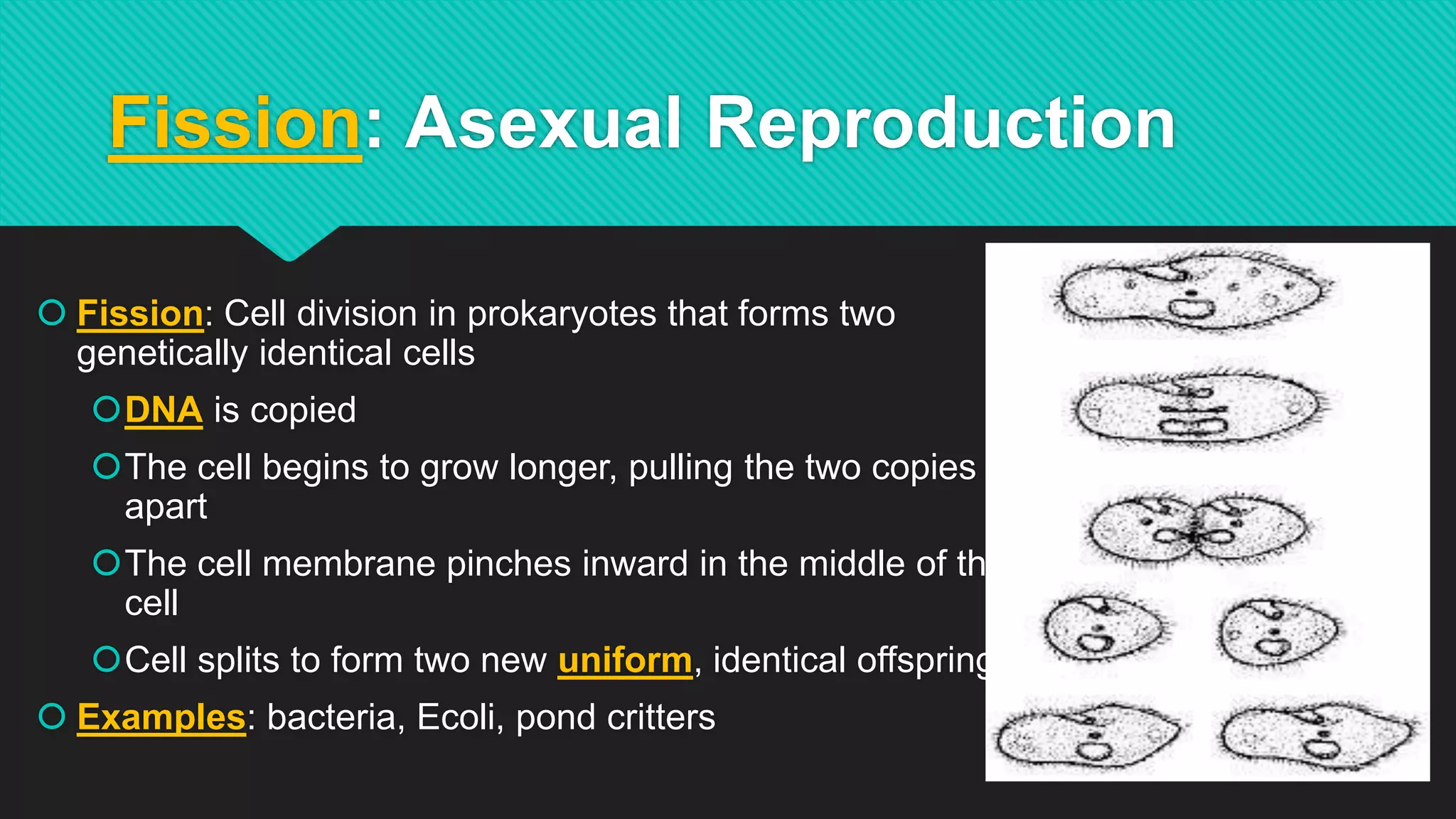
Fission: Asexual Reproduction
 Fission: Cell division in prokaryotes that forms two
genetically identical cells
DNA is copied
The cell begins to grow longer, pulling the two copies
apart
The cell membrane pinches inward in the middle of the
cell
Cell splits to form two new uniform, identical offspring
 Examples: bacteria, Ecoli, pond critters
Budding: Asexual Reproduction
 Budding: a new organism grows by mitosis and cell
division on the body of its parent
The bud, or offspring is identical to the parent
The bud, when large enough, can break off of the
parent and live on its own
Offspring may remain attached and form a colony
 Examples: Yeast, Hydra, cactus
Regeneration: Asexual Reproduction
 Regeneration: occurs when an offspring grows
from a piece of its parent.
Producing new organisms: Sea Stars
Sea urchins, sea cucumber, sponges, and
planarians
Producing new body parts: Gecko
Newts, tadpoles, crabs, hydra, and zebra fish
Vegetative Propagation: Asexual
 Vegetative Propagation: uniform offspring grow
from a part of a parent plant
Parent plants sends out runners
Where the runner touches the ground, roots can
grow
A new plant is produced even if the runner is broken
apart
Each new plant is uniform and identical to the
parent.
Examples: strawberries, potatoes, ivy, crabgrass
Advantages: Asexual Reproduction
Enables organisms to reproduce
without a mate
No wasted time and energy
Enables some organisms to rapidly
reproduce a large number of uniform
offspring
Disadvantages: Asexual Reproduction
 Because their offspring are identical, there is no
genetic variation that can give an organism a
better chance for survival
Example: If a weed killer can kill the parent, it will
also kill the offspring
A whole species can be wiped out from a disease
 Dangerous mutations in DNA – if the parent has
the mutation in their DNA, the offspring will have it
too.
Examples: Asexual Reproduction
Activity:
Create a creature that reproduces asexually.
Draw the creature
Describe how the creature reproduces asexually
Describe 1 advantage of reproducing this way
Describe 1 disadvantage of reproducing this way
Name your creature
How the uniform offspring of your creature

Asexualvssexualreproduction 170311025030

  • 1.
  • 2.
    LEARNING OBJECTIVES: 1.Differentiate asexualand sexual modes of reproduction. 2.Describe different modes of sexual and asexual reproduction. 3.Learn the importance of reproduction.
  • 3.
    4.Compare the resultsof uniform or diverse offspring from sexual or asexual reproduction Uniform offspring Diverse offspring Sexual reproduction Asexual reproduction
  • 4.
    RELEVANT VOCABULARY: 1.Asexual Reproduction-Modeof reproduction that does not involve the use of gametes or sex cells. 2.Sexual Reproduction-Mode of reproduction that involves the use of gametes or sex cells. 3.Fission -Type of asexual reproducion involving the division of body into two or more equal parts.
  • 5.
    4.Fragmentation-Type of asexualreproduction where the body breaks into two or more equal parts, with each fragment capable of becoming a complete individual; in animals, fragmentation is usually followed by regeneration where the missing parts are produced. For example, a lost arm of the starfish may be generated by mitotic cell divisions. 5.Budding-Type of asexual reproduction where a new individual arises as an outgrowth (bud) from its parent, develops ogans like those of the parent , and then detaches itself.
  • 6.
    6.Sporulation-Type of asexualreproduction where a new individual foms from an aggregation of cells surrounded by a resistant capsule or spore, which later on germintaes. 7.Isogamy-Fusion of similar gametes which are usually motile. 8.Heterogamy -Fussion of dissimilar gametes. In oogamy, a large immotile gamete, the egg is fertilized by a small motile gamete, the sperm.
  • 7.
    9.Bisexual reproduction- Typeof sexual reproduction involving the union of gametes from two genetically different parents. 10. Hermaphrodite- An individual with both male and female reproductive tissues. In animals “self fertilization is not common. In worms, a hermaphrodite needs a male to donate sperms in order to fertilize the oocytes in its body.
  • 8.
    REPRODUCTION Reproduction is the processby which animals produce offspring for the purpose of continuing the species.
  • 11.
    THE FOLLOWING PICTURESDEPICT REPRODUCTION ACROSS DIFFERNT ORGANISMS. AS ANIMALS, WE ARE ONLY FAMILIAR WITH ONE FORM OF REPRODUCTION, PARTICULARLY THE FORM DEPICTED BY THE LIZARD.HOWEVER, THERE ARE OTHER FORMS OF REPRODUCTION THAT EXIST IN NATURE,
  • 12.
    Sexual Reproduction A typeof reproduction in which the genetic materials from two different cells combine, producing an offspring The cells that combine are called sex cells Female – egg Male – sperm Fertilization: an egg cell and a sperm cell join together A new cell is formed and is called a zygote
  • 13.
    Advantages: Sexual Reproduction Diverse offspring: genetic variation among offspring Half of the DNA comes from mom Half of the DNA comes from dad  Due to genetic variation, individuals within a population have slight differences Plants – resist diseases Traits can develop to resist harsh environments that allows an organism survive
  • 14.
    Advantages: Sexual Reproduction SelectiveBreeding Used to develop many types of plants and animals that have desirable traits Agriculture/Farming: better plants, larger animals Desirable pets
  • 15.
    Disadvantages: Sexual Reproduction Timeand Energy Organisms have to grow and develop until they are old enough to produce sex cells Search and find a mate Searching can expose individuals to predators, diseases, or harsh environmental conditions Fertilization cannot take place during pregnancy, which can last as long as 2 years for some mammals.
  • 16.
  • 17.
    Asexual Reproduction One parent:organism produces offspring without fertilization Uniform offspring: Because offspring inherit all of their DNA from one parent, they are genetically identical to each other and to their parent
  • 18.
    Fission: Asexual Reproduction Fission: Cell division in prokaryotes that forms two genetically identical cells DNA is copied The cell begins to grow longer, pulling the two copies apart The cell membrane pinches inward in the middle of the cell Cell splits to form two new uniform, identical offspring  Examples: bacteria, Ecoli, pond critters
  • 19.
    Budding: Asexual Reproduction Budding: a new organism grows by mitosis and cell division on the body of its parent The bud, or offspring is identical to the parent The bud, when large enough, can break off of the parent and live on its own Offspring may remain attached and form a colony  Examples: Yeast, Hydra, cactus
  • 20.
    Regeneration: Asexual Reproduction Regeneration: occurs when an offspring grows from a piece of its parent. Producing new organisms: Sea Stars Sea urchins, sea cucumber, sponges, and planarians Producing new body parts: Gecko Newts, tadpoles, crabs, hydra, and zebra fish
  • 21.
    Vegetative Propagation: Asexual Vegetative Propagation: uniform offspring grow from a part of a parent plant Parent plants sends out runners Where the runner touches the ground, roots can grow A new plant is produced even if the runner is broken apart Each new plant is uniform and identical to the parent. Examples: strawberries, potatoes, ivy, crabgrass
  • 22.
    Advantages: Asexual Reproduction Enablesorganisms to reproduce without a mate No wasted time and energy Enables some organisms to rapidly reproduce a large number of uniform offspring
  • 23.
    Disadvantages: Asexual Reproduction Because their offspring are identical, there is no genetic variation that can give an organism a better chance for survival Example: If a weed killer can kill the parent, it will also kill the offspring A whole species can be wiped out from a disease  Dangerous mutations in DNA – if the parent has the mutation in their DNA, the offspring will have it too.
  • 24.
  • 25.
    Activity: Create a creaturethat reproduces asexually. Draw the creature Describe how the creature reproduces asexually Describe 1 advantage of reproducing this way Describe 1 disadvantage of reproducing this way Name your creature How the uniform offspring of your creature