ACCOUNTING STANDRD 10
PROPERTY, PLANT AND
EQUIPMENT
(REVISED 2016)
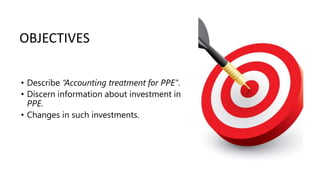
OBJECTIVES
• Describe “Accounting treatment for PPE”.
• Discern information about investment in
PPE.
• Changes in such investments.
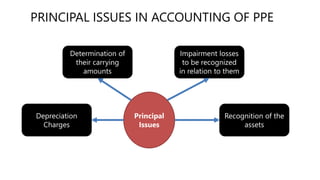
PRINCIPAL ISSUES IN ACCOUNTING OF PPE
Principal
Issues
Depreciation
Charges
Determination of
their carrying
amounts
Impairment losses
to be recognized
in relation to them
Recognition of the
assets
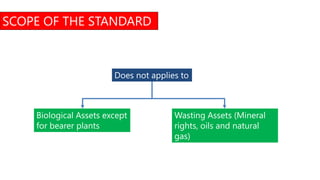
SCOPE OF THE STANDARD
Does not applies to
Biological Assets except
for bearer plants
Wasting Assets (Mineral
rights, oils and natural
gas)
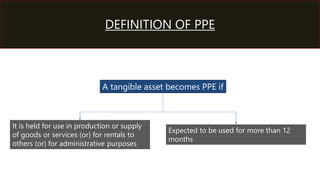
DEFINITION OF PPE
A tangible asset becomes PPE if
It is held for use in production or supply
of goods or services (or) for rentals to
others (or) for administrative purposes
Expected to be used for more than 12
months
BIOLOGICAL ASSETS
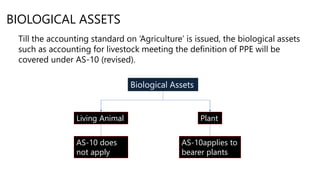
Till the accounting standard on ‘Agriculture’ is issued, the biological assets
such as accounting for livestock meeting the definition of PPE will be
covered under AS-10 (revised).
Biological Assets
Living Animal Plant
AS-10 does
not apply
AS-10applies to
bearer plants
BEARER PLANTS
• Bearer plants are those which are:
• Used in production and supply of
agricultural produce.
• Expected to bear a produce for
more than a period of 12 months.
• Having a remote likelihood of
being sold as an agricultural
produce except for incidental
scrap sales.
RECOGNITION CRITERIA
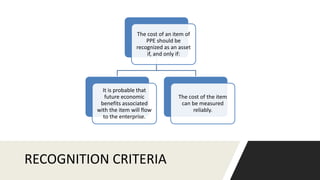
The cost of an item of
PPE should be
recognized as an asset
if, and only if:
It is probable that
future economic
benefits associated
with the item will flow
to the enterprise.
The cost of the item
can be measured
reliably.
WHEN TO APPLY RECOGNITION CRITERIA
An enterprise evaluates under the recognition principle all its cost on PPE at the
time they are incurred.
COSTS INCURRED
Initially Subsequently
To acquire
or
construct
an item of
PPE
To add to,
replace part
of or
service it
TREATMENT OF SPARE PARTS, STAND BY EQUIPMENT
AND SERVICING EQUIPMENT
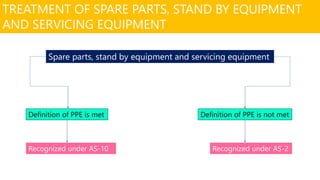
Spare parts, stand by equipment and servicing equipment
Definition of PPE is met Definition of PPE is not met
Recognized under AS-10 Recognized under AS-2
ACCOUNTING TREATMENT FOR SUBSEQUENT COSTS
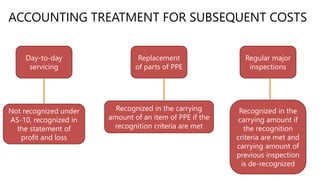
Day-to-day
servicing
Replacement
of parts of PPE
Regular major
inspections
Not recognized under
AS-10, recognized in
the statement of
profit and loss
Recognized in the carrying
amount of an item of PPE if the
recognition criteria are met
Recognized in the
carrying amount if
the recognition
criteria are met and
carrying amount of
previous inspection
is de-recognized
MEASUREMENT OF PPE
MEASUREMENT
At Recognition
After
Recognition
Cost
model
Cost
model
Revaluation
model
MEASUREMENT
At Recognition
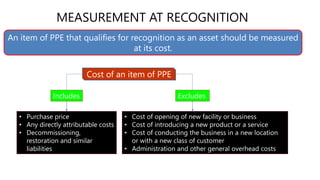
MEASUREMENT AT RECOGNITION
An item of PPE that qualifies for recognition as an asset should be measured
at its cost.
Cost of an item of PPE
Includes Excludes
• Purchase price
• Any directly attributable costs
• Decommissioning,
restoration and similar
liabilities
• Cost of opening of new facility or business
• Cost of introducing a new product or a service
• Cost of conducting the business in a new location
or with a new class of customer
• Administration and other general overhead costs
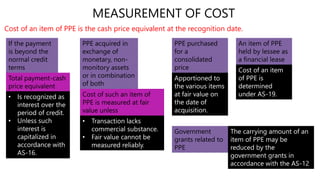
MEASUREMENT OF COST
Cost of an item of PPE is the cash price equivalent at the recognition date.
If the payment
is beyond the
normal credit
terms
Total payment-cash
price equivalent
• Is recognized as
interest over the
period of credit.
• Unless such
interest is
capitalized in
accordance with
AS-16.
PPE acquired in
exchange of
monetary, non-
monitory assets
or in combination
of both
Cost of such an item of
PPE is measured at fair
value unless
• Transaction lacks
commercial substance.
• Fair value cannot be
measured reliably.
PPE purchased
for a
consolidated
price
Apportioned to
the various items
at fair value on
the date of
acquisition.
An item of PPE
held by lessee as
a financial lease
Cost of an item
of PPE is
determined
under AS-19.
Government
grants related to
PPE
The carrying amount of an
item of PPE may be
reduced by the
government grants in
accordance with the AS-12
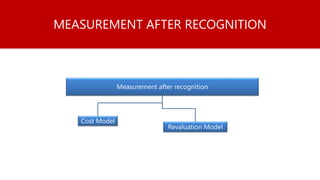
MEASUREMENT AFTER RECOGNITION
Measurement after recognition
Cost Model
Revaluation Model
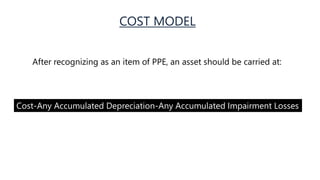
COST MODEL
After recognizing as an item of PPE, an asset should be carried at:
Cost-Any Accumulated Depreciation-Any Accumulated Impairment Losses
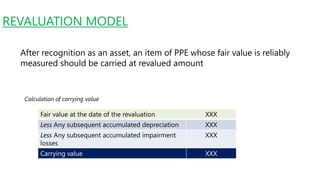
REVALUATION MODEL
After recognition as an asset, an item of PPE whose fair value is reliably
measured should be carried at revalued amount
Calculation of carrying value
Fair value at the date of the revaluation XXX
Less Any subsequent accumulated depreciation XXX
Less Any subsequent accumulated impairment
losses
XXX
Carrying value XXX
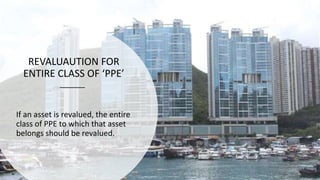
REVALUAUTION FOR
ENTIRE CLASS OF ‘PPE’
If an asset is revalued, the entire
class of PPE to which that asset
belongs should be revalued.
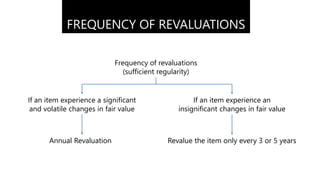
FREQUENCY OF REVALUATIONS
Frequency of revaluations
(sufficient regularity)
If an item experience a significant
and volatile changes in fair value
Annual Revaluation
If an item experience an
insignificant changes in fair value
Revalue the item only every 3 or 5 years
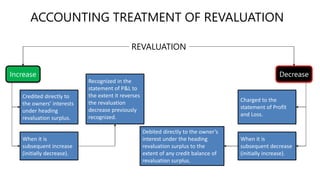
ACCOUNTING TREATMENT OF REVALUATION
REVALUATION
Increase Decrease
Credited directly to
the owners’ interests
under heading
revaluation surplus.
When it is
subsequent increase
(initially decrease).
Recognized in the
statement of P&L to
the extent it reverses
the revaluation
decrease previously
recognized.
Charged to the
statement of Profit
and Loss.
When it is
subsequent decrease
(initially increase).
Debited directly to the owner’s
interest under the heading
revaluation surplus to the
extent of any credit balance of
revaluation surplus.
DEPRECIATION
DEFINITIONS
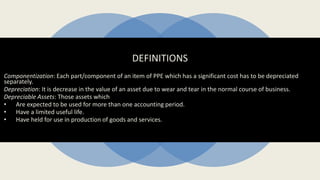
Componentization: Each part/component of an item of PPE which has a significant cost has to be depreciated
separately.
Depreciation: It is decrease in the value of an asset due to wear and tear in the normal course of business.
Depreciable Assets: Those assets which
• Are expected to be used for more than one accounting period.
• Have a limited useful life.
• Have held for use in production of goods and services.
SCOPE • This Standard is applicable to all depreciable
assets except:
• Forests, plantations.
• Wasting assets, minerals and natural gas.
• Expenditure on research and development.
• Goodwill.
• Livestock, cattle, animal husbandry.
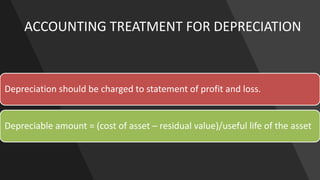
ACCOUNTING TREATMENT FOR DEPRECIATION
Depreciation should be charged to statement of profit and loss.
Depreciable amount = (cost of asset – residual value)/useful life of the asset
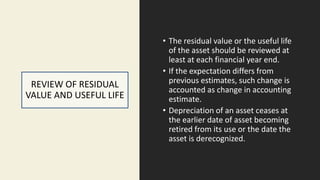
REVIEW OF RESIDUAL
VALUE AND USEFUL LIFE
• The residual value or the useful life
of the asset should be reviewed at
least at each financial year end.
• If the expectation differs from
previous estimates, such change is
accounted as change in accounting
estimate.
• Depreciation of an asset ceases at
the earlier date of asset becoming
retired from its use or the date the
asset is derecognized.
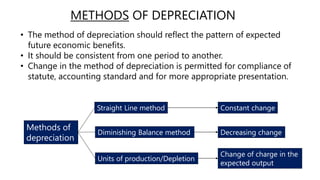
METHODS OF DEPRECIATION
• The method of depreciation should reflect the pattern of expected
future economic benefits.
• It should be consistent from one period to another.
• Change in the method of depreciation is permitted for compliance of
statute, accounting standard and for more appropriate presentation.
Methods of
depreciation
Straight Line method
Diminishing Balance method
Units of production/Depletion
Constant change
Decreasing change
Change of charge in the
expected output
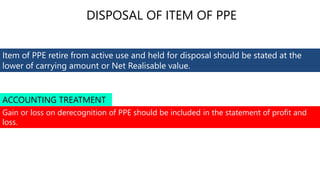
DISPOSAL OF ITEM OF PPE
Item of PPE retire from active use and held for disposal should be stated at the
lower of carrying amount or Net Realisable value.
ACCOUNTING TREATMENT
Gain or loss on derecognition of PPE should be included in the statement of profit and
loss.
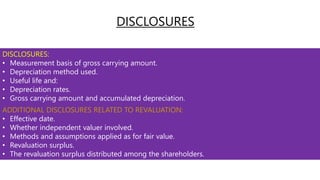
DISCLOSURES:
• Measurement basis of gross carrying amount.
• Depreciation method used.
• Useful life and:
• Depreciation rates.
• Gross carrying amount and accumulated depreciation.
ADDITIONAL DISCLOSURES RELATED TO REVALUATION:
• Effective date.
• Whether independent valuer involved.
• Methods and assumptions applied as for fair value.
• Revaluation surplus.
• The revaluation surplus distributed among the shareholders.
DISCLOSURES
THANK YOU
P. S. K. Kalyan S. Srikar Reddy

Accounting Standard 10 (PPE)

  • 1.
    ACCOUNTING STANDRD 10 PROPERTY,PLANT AND EQUIPMENT (REVISED 2016)
  • 2.
    OBJECTIVES • Describe “Accountingtreatment for PPE”. • Discern information about investment in PPE. • Changes in such investments.
  • 3.
    PRINCIPAL ISSUES INACCOUNTING OF PPE Principal Issues Depreciation Charges Determination of their carrying amounts Impairment losses to be recognized in relation to them Recognition of the assets
  • 4.
    SCOPE OF THESTANDARD Does not applies to Biological Assets except for bearer plants Wasting Assets (Mineral rights, oils and natural gas)
  • 5.
    DEFINITION OF PPE Atangible asset becomes PPE if It is held for use in production or supply of goods or services (or) for rentals to others (or) for administrative purposes Expected to be used for more than 12 months
  • 6.
    BIOLOGICAL ASSETS Till theaccounting standard on ‘Agriculture’ is issued, the biological assets such as accounting for livestock meeting the definition of PPE will be covered under AS-10 (revised). Biological Assets Living Animal Plant AS-10 does not apply AS-10applies to bearer plants
  • 7.
    BEARER PLANTS • Bearerplants are those which are: • Used in production and supply of agricultural produce. • Expected to bear a produce for more than a period of 12 months. • Having a remote likelihood of being sold as an agricultural produce except for incidental scrap sales.
  • 8.
    RECOGNITION CRITERIA The costof an item of PPE should be recognized as an asset if, and only if: It is probable that future economic benefits associated with the item will flow to the enterprise. The cost of the item can be measured reliably.
  • 9.
    WHEN TO APPLYRECOGNITION CRITERIA An enterprise evaluates under the recognition principle all its cost on PPE at the time they are incurred. COSTS INCURRED Initially Subsequently To acquire or construct an item of PPE To add to, replace part of or service it
  • 10.
    TREATMENT OF SPAREPARTS, STAND BY EQUIPMENT AND SERVICING EQUIPMENT Spare parts, stand by equipment and servicing equipment Definition of PPE is met Definition of PPE is not met Recognized under AS-10 Recognized under AS-2
  • 11.
    ACCOUNTING TREATMENT FORSUBSEQUENT COSTS Day-to-day servicing Replacement of parts of PPE Regular major inspections Not recognized under AS-10, recognized in the statement of profit and loss Recognized in the carrying amount of an item of PPE if the recognition criteria are met Recognized in the carrying amount if the recognition criteria are met and carrying amount of previous inspection is de-recognized
  • 12.
    MEASUREMENT OF PPE MEASUREMENT AtRecognition After Recognition Cost model Cost model Revaluation model MEASUREMENT At Recognition
  • 13.
    MEASUREMENT AT RECOGNITION Anitem of PPE that qualifies for recognition as an asset should be measured at its cost. Cost of an item of PPE Includes Excludes • Purchase price • Any directly attributable costs • Decommissioning, restoration and similar liabilities • Cost of opening of new facility or business • Cost of introducing a new product or a service • Cost of conducting the business in a new location or with a new class of customer • Administration and other general overhead costs
  • 14.
    MEASUREMENT OF COST Costof an item of PPE is the cash price equivalent at the recognition date. If the payment is beyond the normal credit terms Total payment-cash price equivalent • Is recognized as interest over the period of credit. • Unless such interest is capitalized in accordance with AS-16. PPE acquired in exchange of monetary, non- monitory assets or in combination of both Cost of such an item of PPE is measured at fair value unless • Transaction lacks commercial substance. • Fair value cannot be measured reliably. PPE purchased for a consolidated price Apportioned to the various items at fair value on the date of acquisition. An item of PPE held by lessee as a financial lease Cost of an item of PPE is determined under AS-19. Government grants related to PPE The carrying amount of an item of PPE may be reduced by the government grants in accordance with the AS-12
  • 15.
    MEASUREMENT AFTER RECOGNITION Measurementafter recognition Cost Model Revaluation Model
  • 16.
    COST MODEL After recognizingas an item of PPE, an asset should be carried at: Cost-Any Accumulated Depreciation-Any Accumulated Impairment Losses
  • 17.
    REVALUATION MODEL After recognitionas an asset, an item of PPE whose fair value is reliably measured should be carried at revalued amount Calculation of carrying value Fair value at the date of the revaluation XXX Less Any subsequent accumulated depreciation XXX Less Any subsequent accumulated impairment losses XXX Carrying value XXX
  • 18.
    REVALUAUTION FOR ENTIRE CLASSOF ‘PPE’ If an asset is revalued, the entire class of PPE to which that asset belongs should be revalued.
  • 19.
    FREQUENCY OF REVALUATIONS Frequencyof revaluations (sufficient regularity) If an item experience a significant and volatile changes in fair value Annual Revaluation If an item experience an insignificant changes in fair value Revalue the item only every 3 or 5 years
  • 20.
    ACCOUNTING TREATMENT OFREVALUATION REVALUATION Increase Decrease Credited directly to the owners’ interests under heading revaluation surplus. When it is subsequent increase (initially decrease). Recognized in the statement of P&L to the extent it reverses the revaluation decrease previously recognized. Charged to the statement of Profit and Loss. When it is subsequent decrease (initially increase). Debited directly to the owner’s interest under the heading revaluation surplus to the extent of any credit balance of revaluation surplus.
  • 21.
  • 22.
    DEFINITIONS Componentization: Each part/componentof an item of PPE which has a significant cost has to be depreciated separately. Depreciation: It is decrease in the value of an asset due to wear and tear in the normal course of business. Depreciable Assets: Those assets which • Are expected to be used for more than one accounting period. • Have a limited useful life. • Have held for use in production of goods and services.
  • 23.
    SCOPE • ThisStandard is applicable to all depreciable assets except: • Forests, plantations. • Wasting assets, minerals and natural gas. • Expenditure on research and development. • Goodwill. • Livestock, cattle, animal husbandry.
  • 24.
    ACCOUNTING TREATMENT FORDEPRECIATION Depreciation should be charged to statement of profit and loss. Depreciable amount = (cost of asset – residual value)/useful life of the asset
  • 25.
    REVIEW OF RESIDUAL VALUEAND USEFUL LIFE • The residual value or the useful life of the asset should be reviewed at least at each financial year end. • If the expectation differs from previous estimates, such change is accounted as change in accounting estimate. • Depreciation of an asset ceases at the earlier date of asset becoming retired from its use or the date the asset is derecognized.
  • 26.
    METHODS OF DEPRECIATION •The method of depreciation should reflect the pattern of expected future economic benefits. • It should be consistent from one period to another. • Change in the method of depreciation is permitted for compliance of statute, accounting standard and for more appropriate presentation. Methods of depreciation Straight Line method Diminishing Balance method Units of production/Depletion Constant change Decreasing change Change of charge in the expected output
  • 27.
    DISPOSAL OF ITEMOF PPE Item of PPE retire from active use and held for disposal should be stated at the lower of carrying amount or Net Realisable value. ACCOUNTING TREATMENT Gain or loss on derecognition of PPE should be included in the statement of profit and loss.
  • 28.
    DISCLOSURES: • Measurement basisof gross carrying amount. • Depreciation method used. • Useful life and: • Depreciation rates. • Gross carrying amount and accumulated depreciation. ADDITIONAL DISCLOSURES RELATED TO REVALUATION: • Effective date. • Whether independent valuer involved. • Methods and assumptions applied as for fair value. • Revaluation surplus. • The revaluation surplus distributed among the shareholders. DISCLOSURES
  • 29.
    THANK YOU P. S.K. Kalyan S. Srikar Reddy