ARTIFICIALTEETH
PRESENTED BY: DR. TABISH ZIA
KHATTAK
INDRODUCTION
CONSTITUTE ONE OF THE MAIN COMPONENTS OF DENTURE.
• Commonly used materials
• Acrylic
• Porcelain
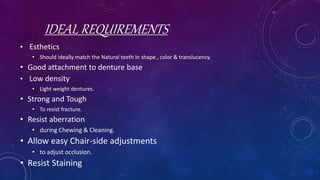
IDEAL REQUIREMENTS
• Esthetics
• Should ideally match the Natural teeth in shape , color & translucency.
• Good attachment to denture base
• Low density
• Light weight dentures.
• Strong and Tough
• To resist fracture.
• Resist aberration
• during Chewing & Cleaning.
• Allow easy Chair-side adjustments
• to adjust occlusion.
• Resist Staining
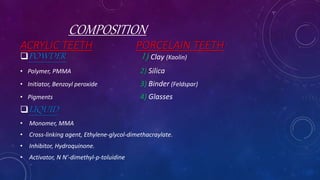
COMPOSITION
ACRYLIC TEETH PORCELAIN TEETH
POWDER 1) Clay (Kaolin)
• Polymer, PMMA 2) Silica
• Initiator, Benzoyl peroxide 3) Binder (Feldspar)
• Pigments 4) Glasses
LIQUID
• Monomer, MMA
• Cross-linking agent, Ethylene-glycol-dimethacraylate.
• Inhibitor, Hydroquinone.
• Activator, N N′-dimethyl-p-toluidine
FABRICATION
ACRYLIC TEETH PORCELAIN TEETH
• Reusable metal moulds using Fabrication involves
a) Dough Moulding Technique. a) Compaction
b) Injection Molding Technique. b) Firing
Standard shapes & sizes produced by
using molds 30% larger than required
to allow shrinkage during firing.
• Highly cross-linked resins Small holes or metal pins are
used to resist crazing incorporated in the base of Porcelain
teeth during their production
Mechanical attachment.
ADVANTAGES OF ACRYLIC TEETH
1)Easy to adjust and trim
2)Chemical bonding to denture base, as they are made of the same
material
3)Acrylic teeth are more compatible with the denture base than
porcelain teeth.
4)No clicking sound
ADVANTAGES OF ACRYLIC TEETH
5) Easy to fabricate
6) Less trauma to denture-bearing area. This is particularly crucial for
people with implants supporting the fake tooth. If they have lost
bone or gum tissues around the implant, acrylic teeth are more
forgiving when you grind your teeth, and will hold their position
longer than porcelain teeth.
7) Dentures made with acrylic teeth are lighter
DISADVANTAGES OF ACRYLIC TEETH
1) Acrylic teeth are susceptible to abrasion, e.g. if the
patient has a habit of teeth-grinding (bruxism) or eats
rough diets, the teeth will wear down with time,
causing changes in the length of the teeth.
2) Easily stained, as they contain microscopic pits that can
hold bacteria
3) In rebasing, difficult to remove acrylic teeth from the
denture base
ADVANTAGES OF PORCELAIN TEETH
1) Although both acrylic and porcelain teeth can be made
to give a natural appearance, the slightly greater
translucency and depth of color achieved with porcelain,
gives this material a slight advantage.
2) Harder than acrylic more durable.
3) Resist wear- this preserves the normal jaw movements
and alignment for a longer period.
4) Resist staining
ADVANTAGES OF PORCELAIN TEETH
5) Occasionally, due to resorption of the edentulous
ridges, the denture becomes loose and does not fit the
mouth at all. Instead of remaking a new denture, the
base of the denture can be replaced (called “rebasing”)
while retaining the artificial teeth so that the Occlusion
will not be altered. Because porcelain teeth do not bond
chemically to the base, they are easily removed from the
base for this purpose.
DISADVANTAGES OF PORCELAIN TEETH
1) Noisy: clicking sounds are made when porcelain
teeth comes into occlusion with another porcelain
tooth
2) Brittle – more likely to fracture than acrylic teeth
3) Do not bond chemically to denture base –Small
holes or metal pins are incorporated in the base of
porcelain teeth during their production to enable
mechanical bonding to the denture base.
DISADVANTAGES OF PORCELAIN TEETH
4) Not as compatible as acrylic teeth with the base of the denture
– There is a serious mismatch in coefficient of thermal and
modulus of elasticity between porcelain and acrylic resin. This may
lead to crazing and cracking of the denture base in the region
around the base of the porcelain teeth.
5) Its density value is about twice that of acrylic teeth; dentures
constructed with porcelain teeth are much heavier.
6) Difficult to fabricate.
DISADVANTAGES OF PORCELAIN TEETH
7) Difficult to trim, due to the hardness of this material.
8) Porcelain teeth exert more force to the underlying
supporting soft tissues, causing more trauma to these tissues.
This is a function of the greater modulus of elasticity of
porcelain. This trauma is capable of accelerating the rate by
which the underlying bone resorbs.
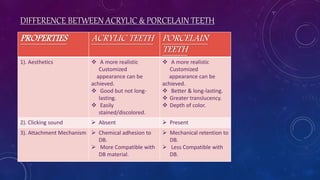
DIFFERENCE BETWEEN ACRYLIC & PORCELAIN TEETH
PROPERTIES ACRYLIC TEETH PORCELAIN
TEETH
1). Aesthetics  A more realistic
Customized
appearance can be
achieved.
 Good but not long-
lasting.
 Easily
stained/discolored.
 A more realistic
Customized
appearance can be
achieved.
 Better & long-lasting.
 Greater translucency.
 Depth of color.
2). Clicking sound  Absent  Present
3). Attachment Mechanism  Chemical adhesion to
DB.
 More Compatible with
DB material.
 Mechanical retention to
DB.
 Less Compatible with
DB.
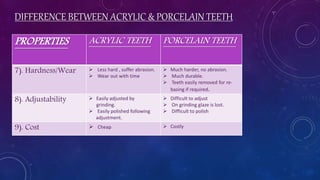
DIFFERENCE BETWEEN ACRYLIC & PORCELAIN TEETH
PROPERTIES ACRYLIC TEETH PORCELAIN TEETH
7). Hardness/Wear  Less hard , suffer abrasion.
 Wear out with time
 Much harder, no abrasion.
 Much durable.
 Teeth easily removed for re-
basing if required.
8). Adjustability  Easily adjusted by
grinding.
 Easily polished following
adjustment.
 Difficult to adjust
 On grinding glaze is lost.
 Difficult to polish
9). Cost  Cheap  Costly
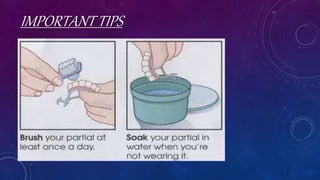
IMPORTANT TIPS
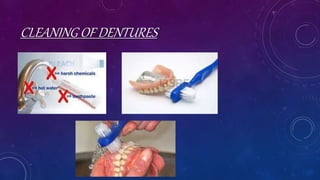
CLEANING OF DENTURES
Artificial Teeth

Artificial Teeth

  • 1.
  • 2.
    INDRODUCTION CONSTITUTE ONE OFTHE MAIN COMPONENTS OF DENTURE. • Commonly used materials • Acrylic • Porcelain
  • 3.
    IDEAL REQUIREMENTS • Esthetics •Should ideally match the Natural teeth in shape , color & translucency. • Good attachment to denture base • Low density • Light weight dentures. • Strong and Tough • To resist fracture. • Resist aberration • during Chewing & Cleaning. • Allow easy Chair-side adjustments • to adjust occlusion. • Resist Staining
  • 4.
    COMPOSITION ACRYLIC TEETH PORCELAINTEETH POWDER 1) Clay (Kaolin) • Polymer, PMMA 2) Silica • Initiator, Benzoyl peroxide 3) Binder (Feldspar) • Pigments 4) Glasses LIQUID • Monomer, MMA • Cross-linking agent, Ethylene-glycol-dimethacraylate. • Inhibitor, Hydroquinone. • Activator, N N′-dimethyl-p-toluidine
  • 5.
    FABRICATION ACRYLIC TEETH PORCELAINTEETH • Reusable metal moulds using Fabrication involves a) Dough Moulding Technique. a) Compaction b) Injection Molding Technique. b) Firing Standard shapes & sizes produced by using molds 30% larger than required to allow shrinkage during firing. • Highly cross-linked resins Small holes or metal pins are used to resist crazing incorporated in the base of Porcelain teeth during their production Mechanical attachment.
  • 6.
    ADVANTAGES OF ACRYLICTEETH 1)Easy to adjust and trim 2)Chemical bonding to denture base, as they are made of the same material 3)Acrylic teeth are more compatible with the denture base than porcelain teeth. 4)No clicking sound
  • 7.
    ADVANTAGES OF ACRYLICTEETH 5) Easy to fabricate 6) Less trauma to denture-bearing area. This is particularly crucial for people with implants supporting the fake tooth. If they have lost bone or gum tissues around the implant, acrylic teeth are more forgiving when you grind your teeth, and will hold their position longer than porcelain teeth. 7) Dentures made with acrylic teeth are lighter
  • 8.
    DISADVANTAGES OF ACRYLICTEETH 1) Acrylic teeth are susceptible to abrasion, e.g. if the patient has a habit of teeth-grinding (bruxism) or eats rough diets, the teeth will wear down with time, causing changes in the length of the teeth. 2) Easily stained, as they contain microscopic pits that can hold bacteria 3) In rebasing, difficult to remove acrylic teeth from the denture base
  • 9.
    ADVANTAGES OF PORCELAINTEETH 1) Although both acrylic and porcelain teeth can be made to give a natural appearance, the slightly greater translucency and depth of color achieved with porcelain, gives this material a slight advantage. 2) Harder than acrylic more durable. 3) Resist wear- this preserves the normal jaw movements and alignment for a longer period. 4) Resist staining
  • 10.
    ADVANTAGES OF PORCELAINTEETH 5) Occasionally, due to resorption of the edentulous ridges, the denture becomes loose and does not fit the mouth at all. Instead of remaking a new denture, the base of the denture can be replaced (called “rebasing”) while retaining the artificial teeth so that the Occlusion will not be altered. Because porcelain teeth do not bond chemically to the base, they are easily removed from the base for this purpose.
  • 11.
    DISADVANTAGES OF PORCELAINTEETH 1) Noisy: clicking sounds are made when porcelain teeth comes into occlusion with another porcelain tooth 2) Brittle – more likely to fracture than acrylic teeth 3) Do not bond chemically to denture base –Small holes or metal pins are incorporated in the base of porcelain teeth during their production to enable mechanical bonding to the denture base.
  • 12.
    DISADVANTAGES OF PORCELAINTEETH 4) Not as compatible as acrylic teeth with the base of the denture – There is a serious mismatch in coefficient of thermal and modulus of elasticity between porcelain and acrylic resin. This may lead to crazing and cracking of the denture base in the region around the base of the porcelain teeth. 5) Its density value is about twice that of acrylic teeth; dentures constructed with porcelain teeth are much heavier. 6) Difficult to fabricate.
  • 13.
    DISADVANTAGES OF PORCELAINTEETH 7) Difficult to trim, due to the hardness of this material. 8) Porcelain teeth exert more force to the underlying supporting soft tissues, causing more trauma to these tissues. This is a function of the greater modulus of elasticity of porcelain. This trauma is capable of accelerating the rate by which the underlying bone resorbs.
  • 14.
    DIFFERENCE BETWEEN ACRYLIC& PORCELAIN TEETH PROPERTIES ACRYLIC TEETH PORCELAIN TEETH 1). Aesthetics  A more realistic Customized appearance can be achieved.  Good but not long- lasting.  Easily stained/discolored.  A more realistic Customized appearance can be achieved.  Better & long-lasting.  Greater translucency.  Depth of color. 2). Clicking sound  Absent  Present 3). Attachment Mechanism  Chemical adhesion to DB.  More Compatible with DB material.  Mechanical retention to DB.  Less Compatible with DB.
  • 15.
    DIFFERENCE BETWEEN ACRYLIC& PORCELAIN TEETH PROPERTIES ACRYLIC TEETH PORCELAIN TEETH 7). Hardness/Wear  Less hard , suffer abrasion.  Wear out with time  Much harder, no abrasion.  Much durable.  Teeth easily removed for re- basing if required. 8). Adjustability  Easily adjusted by grinding.  Easily polished following adjustment.  Difficult to adjust  On grinding glaze is lost.  Difficult to polish 9). Cost  Cheap  Costly
  • 16.
  • 17.