Dr. lakshya kumar
Asstt. Professor
Deptt of Prosthodontics
Lecture-9 am to 10 am
6/9/2014
PART 1
At the end of this Topic
 Define denture base, denture base material
and denture.
 Classify of denture base materials.
 Enumerate ideal requirements of denture base
materials.
 Enumerate stages in addition polymerization.
 Manipulate denture base resin.

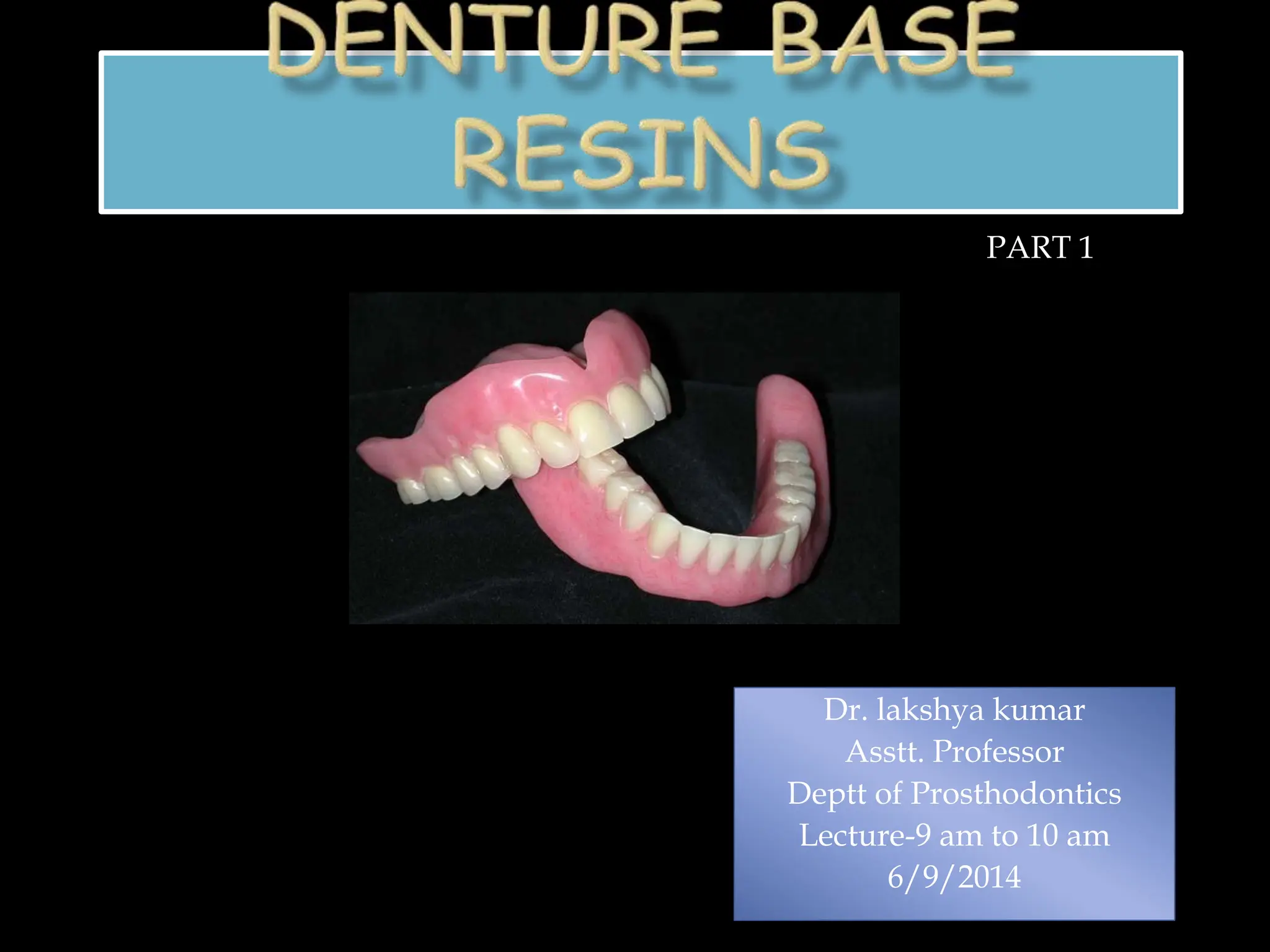
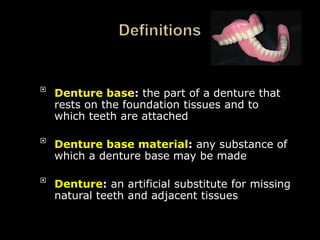
Denture base: the part of a denture that
rests on the foundation tissues and to
which teeth are attached

Denture base material: any substance of
which a denture base may be made

Denture: an artificial substitute for missing
natural teeth and adjacent tissues
All through the history of the making of dentures,we find a
constant struggle of the dentist to find a suitable denture base
material.
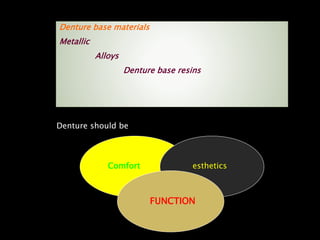
Denture base materials
Metallic
Alloys
Denture base resins
FUNCTION
esthetics
Comfort
Denture should be
 1. Physiologic compatability
 Nontoxic, Noncarcinogenic , Nonallergenic
 2. Acceptability to patients' senses
 Acceptable to all five senses-sight, sound, smell,
taste, and touch
 Color stable, Odorless, Tasteless
 Light weight
 3. Cost factors
 Inexpensive equipment for processing
 Moderate cost of fabrication
 Good shelf life
4. Functional usefulness
 Rigid enough so that teeth penetrate the bolus ( food)
 No interference with oral functions of chewing,
swallowing, self cleansing, singing, speech, sneezing,
breathing, laughing, coughing, etc.
5. Hygienic factors
 Sterilizable
 Nonporous to microorganisms
 Low fluid absorption
 Easily cleaned
6. Durability
 Not affected by oral environment-bacteria, food,
medicines, etc. Unbreakable (not brittle)
 Dimensionally stable
 Good bond between base and teeth
 Resistant to weak acids and alkalies
 Resistant to abrasion and wear
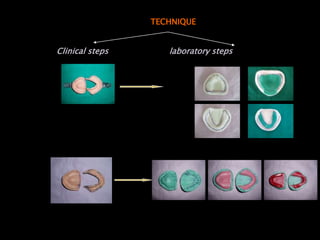
TECHNIQUE
Clinical steps laboratory steps
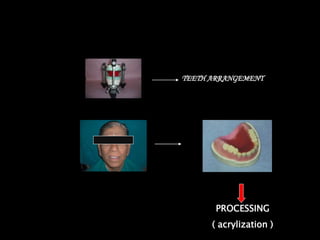
PROCESSING
( acrylization )
TEETH ARRANGEMENT
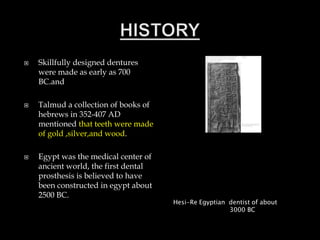
 Skillfully designed dentures
were made as early as 700
BC.and
 Talmud a collection of books of
hebrews in 352-407 AD
mentioned that teeth were made
of gold ,silver,and wood.
 Egypt was the medical center of
ancient world, the first dental
prosthesis is believed to have
been constructed in egypt about
2500 BC.
Hesi-Re Egyptian dentist of about
3000 BC
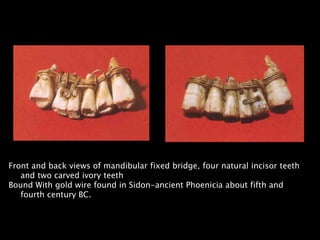
Front and back views of mandibular fixed bridge, four natural incisor teeth
and two carved ivory teeth
Bound With gold wire found in Sidon-ancient Phoenicia about fifth and
fourth century BC.
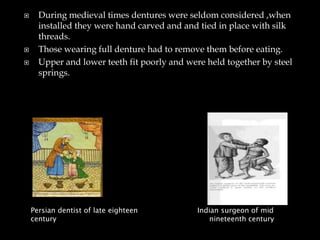
 During medieval times dentures were seldom considered ,when
installed they were hand carved and and tied in place with silk
threads.
 Those wearing full denture had to remove them before eating.
 Upper and lower teeth fit poorly and were held together by steel
springs.
Persian dentist of late eighteen
century
Indian surgeon of mid
nineteenth century
WOOD
 For years, dentures were fashioned from wood .
 Wood was chosen
-readily available
-relatively inexpensive
-can be carved to desired shape
 Disadvantages
-warped and cracked in moisture
-esthetic and hygienic challenges
-degradation in oral environment
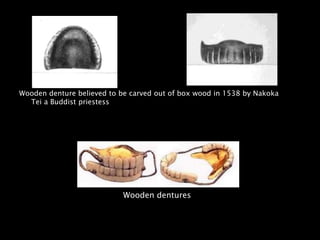
Wooden denture believed to be carved out of box wood in 1538 by Nakoka
Tei a Buddist priestess
Wooden dentures
Bone
 Bone was chosen due to its availability, reasonable cost and
carvability .
 It is reported that Fauchard fabricated dentures by measuring
individual arches with a compass and cutting bone to fit the
arches .
 It had better dimensional stability than wood, esthetic and
hygienic concerns remained.
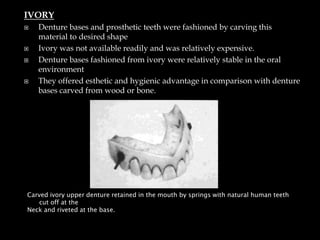
IVORY
 Denture bases and prosthetic teeth were fashioned by carving this
material to desired shape
 Ivory was not available readily and was relatively expensive.
 Denture bases fashioned from ivory were relatively stable in the oral
environment
 They offered esthetic and hygienic advantage in comparison with denture
bases carved from wood or bone.
Carved ivory upper denture retained in the mouth by springs with natural human teeth
cut off at the
Neck and riveted at the base.
 Since ancient times the most
common material for false teeth
were animal bone or
ivory,especially from elephants
or hippopotomus.
 Human teeth were also
used,pulled from the deceased
or sold by poor people from
their own mouths.
 Waterloo dentures
 1788 A.D. Improvement and
development of porcelain dentures
by DeChemant.
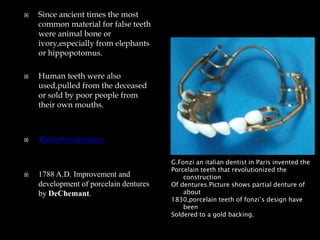
G.Fonzi an italian dentist in Paris invented the
Porcelain teeth that revolutionized the
construction
Of dentures.Picture shows partial denture of
about
1830,porcelain teeth of fonzi’s design have
been
Soldered to a gold backing.
CERAMICS
 Porcelain denture bases were relatively expensive
 During subsequent years secrets of porcelain denture became
known and it became common and inexpensive.
 ADVANTAGES over wood, bone , ivory were
-Could be shaped using additive technique rather than
subtractive (carving).
-Additive technique facilitated correction of denture base
surface.
-this permitted more intimate contact with underlying soft tissues.
-Could be tinted to simulate the colors of teeth and oral soft
tissues.
-stable in oral environment.
-Minimal water sorption, porosity, and solubility.
-Smooth surface provided hygienic properties.
 Among the drawbacks BRITTLENESS was most significant,
fractures were common, often irreparable.
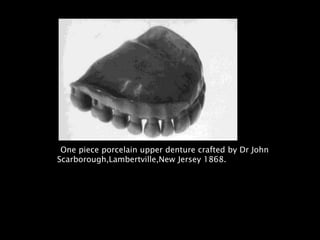
One piece porcelain upper denture crafted by Dr John
Scarborough,Lambertville,New Jersey 1868.
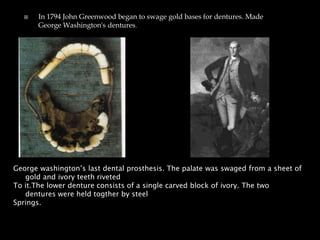
 In 1794 John Greenwood began to swage gold bases for dentures. Made
George Washington's dentures.
George washington’s last dental prosthesis. The palate was swaged from a sheet of
gold and ivory teeth riveted
To it.The lower denture consists of a single carved block of ivory. The two
dentures were held togther by steel
Springs.
 In 1839 an important development took place CHARLES GOODYEAR
discovered VULCANIZATION of natural rubber with sulphur(30%) and
was patented by Hancock in england in 1843.
 NELSON GOODYEAR (brother of charles goodyear) got the patent for
vulcanite dentures in 1864.
 . They proceeded to license dentists who used their material, and charged
a royalty for all dentures made. Dentists who would not comply were
sued.
 The Goodyear patents expired in 1881, and the company did not again
seek to license dentists or dental products.
 Vulcanite dentures were very popular until the 1940s, when acrylic
denture bases replaced them.
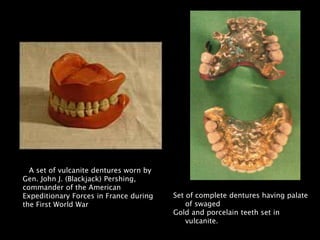
A set of vulcanite dentures worn by
Gen. John J. (Blackjack) Pershing,
commander of the American
Expeditionary Forces in France during
the First World War
Set of complete dentures having palate
of swaged
Gold and porcelain teeth set in
vulcanite.
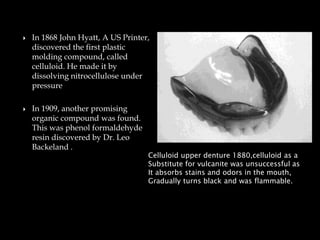
 In 1868 John Hyatt, A US Printer,
discovered the first plastic
molding compound, called
celluloid. He made it by
dissolving nitrocellulose under
pressure
 In 1909, another promising
organic compound was found.
This was phenol formaldehyde
resin discovered by Dr. Leo
Backeland .
Celluloid upper denture 1880,celluloid as a
Substitute for vulcanite was unsuccessful as
It absorbs stains and odors in the mouth,
Gradually turns black and was flammable.
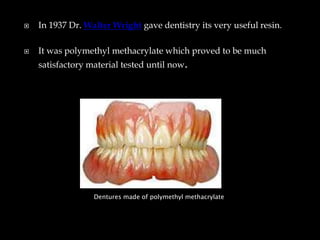
 In 1937 Dr. Walter Wright gave dentistry its very useful resin.
 It was polymethyl methacrylate which proved to be much
satisfactory material tested until now.
Dentures made of polymethyl methacrylate
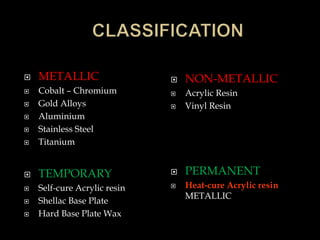
 METALLIC
 Cobalt – Chromium
 Gold Alloys
 Aluminium
 Stainless Steel
 Titanium
 TEMPORARY
 Self-cure Acrylic resin
 Shellac Base Plate
 Hard Base Plate Wax
 NON-METALLIC
 Acrylic Resin
 Vinyl Resin
 PERMANENT
 Heat-cure Acrylic resin
METALLIC
 1. Vulcanite :
In 1839 Vulcanized rubber was discovered and
introduced as a Vulcanite and Ebonite.
For the next 75 years Vulcanite rubber was the principal
Denture base Material. But failed because of following
reasons :
Disadvantages
 It absorbs Saliva and becomes unhygienic due to
bacterial proliferation.
 Esthetics were poor.
 Dimensionally unstable.
 Objectionable taste and odor
2. Celluloid
Although it was having tissue like color but
having principal disadvantages like
Disadvantages
 Lack of stability
 Unpleasant taste
 Unpleasant odor
 Stainability
 Flammable
3. Bakelite
It was formed by heating and compressing a
mixture of phenol and formaldehyde.
Disadvantages
 Lack of uniform quality
 Variable strength
 Variable color
 Dimensional unstability.
Chronology of events
 Charles Goodyear discovery of vulcanized rubber in 1839.
 John hyatt discovered celluloid in 1868
 Dr Leo Bakeland discovered phenol-formaldehyde resin
(Bakelite).
 In the 1930’s Dr Walter Wright and the Vernon brothers working
at the Rohn and Haas company in Philadelphia developed
Polymethylmethacrylate (PMMA), a hard plastic.
 Although other materials were used for dental prosthesis, none
could come close to PMMA and by the 1940;s 95% of all dentures
were made from this acrylic polymer.
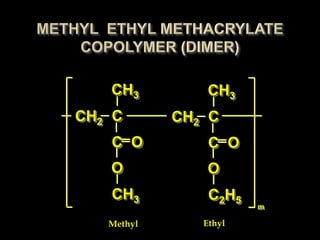
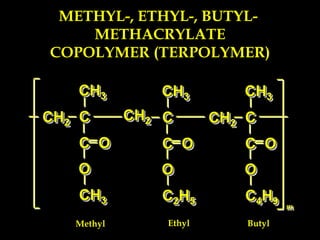
 Dimer - Polymer from two different mers
 Terpolymer - Polymer from three
different mers
CH3
C
C
CH3
O
O
CH2
CH3
C
C
C2H5
O
O
CH2
m
Methyl Ethyl
CH3
C
C
CH3
O
O
CH2
CH3
C
C
C2H5
O
O
CH2
m
CH3
C
C
C4H9
O
O
CH2
METHYL-, ETHYL-, BUTYL-
METHACRYLATE
COPOLYMER (TERPOLYMER)
Ethyl
Methyl Butyl
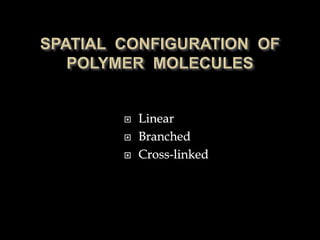
 Linear
 Branched
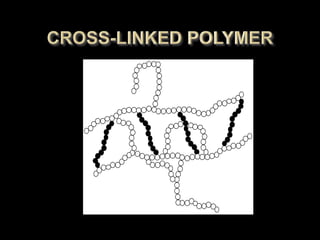
 Cross-linked
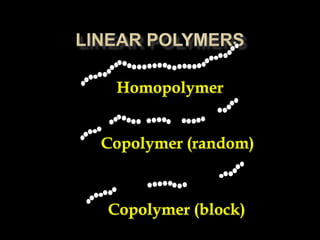
Homopolymer
Copolymer (random)
Copolymer (block)
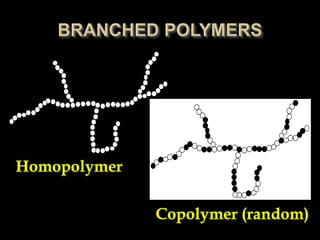
Homopolymer
Copolymer (random)
C O
O
C4H9
O
C O C4H9
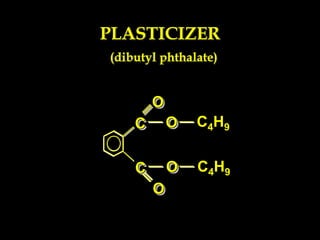
PLASTICIZER
(dibutyl phthalate)
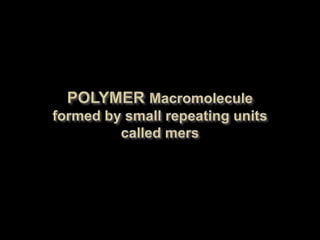
DEFINITION: A polymer is a long chain organic
molecule .It is produced by the reaction of many
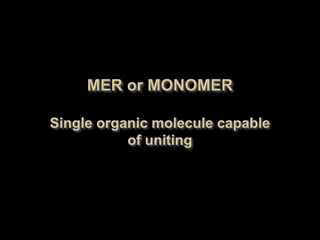
smaller molecules called monomers,or mers.
 Resin : A broad term used to describe natural or
synthetic substances that form plastic materials after
polymerization (GPT-7th edition).
USES IN DENTISTRY
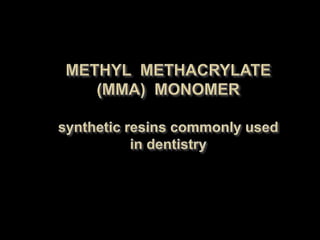
 Denture bases and artificial teeth.
 Denture liners and tissue conditioners.
 composite restorative and pit and fissure sealent.
 Impression materials
 Custom trays for impression
 Temporary restoratives.
 Mouth-guards.
 Maxillofacial prosthesis.
 Space maintainers.
 Veneers.
 Cements and adhesives.
CHEMISTRY OF POLYMERIZATION
 Monomers react to form polymer by a chemical
reaction called polymerization.
 The most common polymerization reaction for
polymers used in dentistry is addition polymerization.
ADDITION POLYMERIZATION
 INDUCTION
 PROPOGATION
 CHAIN TRANSFER
 TERMINATION
ACTIVATION
Free radicals can be generated by activation of radical producing
molecule using.
 Second chemical
 Heat
 Visible light
 Ultraviolet light
 Energy transfer from another compound that acts as a free radical.
 Commonly employed initiator is Benzoyl peroxide
which is activated rapidly between 50 degree and 100
degree C to release two free radicals per benzoyl
peroxide molecule.
 Second type is chemically activated ,consists of two
reactants when mixed undergo reaction eg tertiary
amine (the activator) and benzoyl peroxide (the
initiator).
 Third type is light activated .The visible light light
cured dental restoratives,camphorquinone and an
organic amine (dimethylaminoethylmethacrylate)
generate free radicals when irradiated by light in the
blue to violet region.
 Light with a wavelength of about 470nm is needed to
trigger this reaction.

denture_base_resins used in dentistry ppt

  • 1.
    Dr. lakshya kumar Asstt.Professor Deptt of Prosthodontics Lecture-9 am to 10 am 6/9/2014 PART 1
  • 2.
    At the endof this Topic  Define denture base, denture base material and denture.  Classify of denture base materials.  Enumerate ideal requirements of denture base materials.  Enumerate stages in addition polymerization.  Manipulate denture base resin.
  • 3.
     Denture base: thepart of a denture that rests on the foundation tissues and to which teeth are attached  Denture base material: any substance of which a denture base may be made  Denture: an artificial substitute for missing natural teeth and adjacent tissues
  • 4.
    All through thehistory of the making of dentures,we find a constant struggle of the dentist to find a suitable denture base material.
  • 5.
    Denture base materials Metallic Alloys Denturebase resins FUNCTION esthetics Comfort Denture should be
  • 6.
     1. Physiologiccompatability  Nontoxic, Noncarcinogenic , Nonallergenic  2. Acceptability to patients' senses  Acceptable to all five senses-sight, sound, smell, taste, and touch  Color stable, Odorless, Tasteless  Light weight  3. Cost factors  Inexpensive equipment for processing  Moderate cost of fabrication  Good shelf life
  • 7.
    4. Functional usefulness Rigid enough so that teeth penetrate the bolus ( food)  No interference with oral functions of chewing, swallowing, self cleansing, singing, speech, sneezing, breathing, laughing, coughing, etc. 5. Hygienic factors  Sterilizable  Nonporous to microorganisms  Low fluid absorption  Easily cleaned
  • 8.
    6. Durability  Notaffected by oral environment-bacteria, food, medicines, etc. Unbreakable (not brittle)  Dimensionally stable  Good bond between base and teeth  Resistant to weak acids and alkalies  Resistant to abrasion and wear
  • 9.
  • 10.
  • 12.
     Skillfully designeddentures were made as early as 700 BC.and  Talmud a collection of books of hebrews in 352-407 AD mentioned that teeth were made of gold ,silver,and wood.  Egypt was the medical center of ancient world, the first dental prosthesis is believed to have been constructed in egypt about 2500 BC. Hesi-Re Egyptian dentist of about 3000 BC
  • 13.
    Front and backviews of mandibular fixed bridge, four natural incisor teeth and two carved ivory teeth Bound With gold wire found in Sidon-ancient Phoenicia about fifth and fourth century BC.
  • 14.
     During medievaltimes dentures were seldom considered ,when installed they were hand carved and and tied in place with silk threads.  Those wearing full denture had to remove them before eating.  Upper and lower teeth fit poorly and were held together by steel springs. Persian dentist of late eighteen century Indian surgeon of mid nineteenth century
  • 15.
    WOOD  For years,dentures were fashioned from wood .  Wood was chosen -readily available -relatively inexpensive -can be carved to desired shape  Disadvantages -warped and cracked in moisture -esthetic and hygienic challenges -degradation in oral environment
  • 16.
    Wooden denture believedto be carved out of box wood in 1538 by Nakoka Tei a Buddist priestess Wooden dentures
  • 17.
    Bone  Bone waschosen due to its availability, reasonable cost and carvability .  It is reported that Fauchard fabricated dentures by measuring individual arches with a compass and cutting bone to fit the arches .  It had better dimensional stability than wood, esthetic and hygienic concerns remained.
  • 18.
    IVORY  Denture basesand prosthetic teeth were fashioned by carving this material to desired shape  Ivory was not available readily and was relatively expensive.  Denture bases fashioned from ivory were relatively stable in the oral environment  They offered esthetic and hygienic advantage in comparison with denture bases carved from wood or bone. Carved ivory upper denture retained in the mouth by springs with natural human teeth cut off at the Neck and riveted at the base.
  • 19.
     Since ancienttimes the most common material for false teeth were animal bone or ivory,especially from elephants or hippopotomus.  Human teeth were also used,pulled from the deceased or sold by poor people from their own mouths.  Waterloo dentures  1788 A.D. Improvement and development of porcelain dentures by DeChemant. G.Fonzi an italian dentist in Paris invented the Porcelain teeth that revolutionized the construction Of dentures.Picture shows partial denture of about 1830,porcelain teeth of fonzi’s design have been Soldered to a gold backing.
  • 20.
    CERAMICS  Porcelain denturebases were relatively expensive  During subsequent years secrets of porcelain denture became known and it became common and inexpensive.  ADVANTAGES over wood, bone , ivory were -Could be shaped using additive technique rather than subtractive (carving). -Additive technique facilitated correction of denture base surface.
  • 21.
    -this permitted moreintimate contact with underlying soft tissues. -Could be tinted to simulate the colors of teeth and oral soft tissues. -stable in oral environment. -Minimal water sorption, porosity, and solubility. -Smooth surface provided hygienic properties.  Among the drawbacks BRITTLENESS was most significant, fractures were common, often irreparable.
  • 22.
    One piece porcelainupper denture crafted by Dr John Scarborough,Lambertville,New Jersey 1868.
  • 23.
     In 1794John Greenwood began to swage gold bases for dentures. Made George Washington's dentures. George washington’s last dental prosthesis. The palate was swaged from a sheet of gold and ivory teeth riveted To it.The lower denture consists of a single carved block of ivory. The two dentures were held togther by steel Springs.
  • 24.
     In 1839an important development took place CHARLES GOODYEAR discovered VULCANIZATION of natural rubber with sulphur(30%) and was patented by Hancock in england in 1843.  NELSON GOODYEAR (brother of charles goodyear) got the patent for vulcanite dentures in 1864.  . They proceeded to license dentists who used their material, and charged a royalty for all dentures made. Dentists who would not comply were sued.  The Goodyear patents expired in 1881, and the company did not again seek to license dentists or dental products.  Vulcanite dentures were very popular until the 1940s, when acrylic denture bases replaced them.
  • 25.
    A set ofvulcanite dentures worn by Gen. John J. (Blackjack) Pershing, commander of the American Expeditionary Forces in France during the First World War Set of complete dentures having palate of swaged Gold and porcelain teeth set in vulcanite.
  • 26.
     In 1868John Hyatt, A US Printer, discovered the first plastic molding compound, called celluloid. He made it by dissolving nitrocellulose under pressure  In 1909, another promising organic compound was found. This was phenol formaldehyde resin discovered by Dr. Leo Backeland . Celluloid upper denture 1880,celluloid as a Substitute for vulcanite was unsuccessful as It absorbs stains and odors in the mouth, Gradually turns black and was flammable.
  • 27.
     In 1937Dr. Walter Wright gave dentistry its very useful resin.  It was polymethyl methacrylate which proved to be much satisfactory material tested until now. Dentures made of polymethyl methacrylate
  • 28.
     METALLIC  Cobalt– Chromium  Gold Alloys  Aluminium  Stainless Steel  Titanium  TEMPORARY  Self-cure Acrylic resin  Shellac Base Plate  Hard Base Plate Wax  NON-METALLIC  Acrylic Resin  Vinyl Resin  PERMANENT  Heat-cure Acrylic resin METALLIC
  • 29.
     1. Vulcanite: In 1839 Vulcanized rubber was discovered and introduced as a Vulcanite and Ebonite. For the next 75 years Vulcanite rubber was the principal Denture base Material. But failed because of following reasons : Disadvantages  It absorbs Saliva and becomes unhygienic due to bacterial proliferation.  Esthetics were poor.  Dimensionally unstable.  Objectionable taste and odor
  • 30.
    2. Celluloid Although itwas having tissue like color but having principal disadvantages like Disadvantages  Lack of stability  Unpleasant taste  Unpleasant odor  Stainability  Flammable
  • 31.
    3. Bakelite It wasformed by heating and compressing a mixture of phenol and formaldehyde. Disadvantages  Lack of uniform quality  Variable strength  Variable color  Dimensional unstability.
  • 32.
    Chronology of events Charles Goodyear discovery of vulcanized rubber in 1839.  John hyatt discovered celluloid in 1868  Dr Leo Bakeland discovered phenol-formaldehyde resin (Bakelite).  In the 1930’s Dr Walter Wright and the Vernon brothers working at the Rohn and Haas company in Philadelphia developed Polymethylmethacrylate (PMMA), a hard plastic.  Although other materials were used for dental prosthesis, none could come close to PMMA and by the 1940;s 95% of all dentures were made from this acrylic polymer.
  • 38.
     Dimer -Polymer from two different mers  Terpolymer - Polymer from three different mers
  • 39.
  • 40.
  • 41.
  • 42.
  • 43.
  • 46.
    C O O C4H9 O C OC4H9 PLASTICIZER (dibutyl phthalate)
  • 47.
    DEFINITION: A polymeris a long chain organic molecule .It is produced by the reaction of many smaller molecules called monomers,or mers.  Resin : A broad term used to describe natural or synthetic substances that form plastic materials after polymerization (GPT-7th edition).
  • 48.
    USES IN DENTISTRY Denture bases and artificial teeth.  Denture liners and tissue conditioners.  composite restorative and pit and fissure sealent.  Impression materials  Custom trays for impression  Temporary restoratives.  Mouth-guards.  Maxillofacial prosthesis.  Space maintainers.  Veneers.  Cements and adhesives.
  • 49.
    CHEMISTRY OF POLYMERIZATION Monomers react to form polymer by a chemical reaction called polymerization.  The most common polymerization reaction for polymers used in dentistry is addition polymerization. ADDITION POLYMERIZATION  INDUCTION  PROPOGATION  CHAIN TRANSFER  TERMINATION
  • 50.
    ACTIVATION Free radicals canbe generated by activation of radical producing molecule using.  Second chemical  Heat  Visible light  Ultraviolet light  Energy transfer from another compound that acts as a free radical.
  • 51.
     Commonly employedinitiator is Benzoyl peroxide which is activated rapidly between 50 degree and 100 degree C to release two free radicals per benzoyl peroxide molecule.  Second type is chemically activated ,consists of two reactants when mixed undergo reaction eg tertiary amine (the activator) and benzoyl peroxide (the initiator).
  • 52.
     Third typeis light activated .The visible light light cured dental restoratives,camphorquinone and an organic amine (dimethylaminoethylmethacrylate) generate free radicals when irradiated by light in the blue to violet region.  Light with a wavelength of about 470nm is needed to trigger this reaction.