JOURNAL PRESENTATION
Dr. ARYASREE P M
1st year pg student
DEPARTMENT OF PROSTHODONTICS
Malabar Dental College
EVOLUTION OF DENTURE BASE MATERIALS FROM
PAST TO NEW ERA
 Dr Sheejith M, Dr Swapna C, Dr Roshy George, Dr Niveditha S Prasad
 IOSR Journal of Dental and Medical Sciences (IOSR-JDMS) e-ISSN:
2279-0853, p-ISSN: 2279-0861.Volume 17, Issue 11 Ver. 11
(November. 2018), PP 23-27 www.iosrjournals.org
DEFINITIONS
 DENTURE BASE : The part of a denture that rests on
the foundation tissues and to which teeth are attached
(GPT-9)
 RESIN : A broad term used to describe natural or
synthetic substances that form plastic materials after
polymerization (GPT-9)
INTRODUCTION
 Dentistry has begun about 3000 BC in Egypt.
 As civilization progressed the quantity and quality of
useful materials changed accordingly .
 For that, Materials should be biologically simple to
manipulate and technically controlled to develop a
prosthesis ,that is functionally effective and pleasing in
appearance.
AIM AND OBJECTIVE
 To review all the materials that were introduced in dentistry from 8th
Century to 20th Century.
 To analyze the existing literature on denture base materials for
fabricating Complete denture and provide the reader with a
historical background, current status and future perspectives on the
emerging technology .
EVOLUTION
 352 – 407 AD – “Talmund” By Hebrews
• Teeth were made of Gold, Silver and Wood.
• The dentures were hand carved and tied in place with silk thread .
(Has to remove them before eating ).
Upper and lower teeth were held together by steel springs.
Materials USED Before 18th Century
Wood, bone and ivory
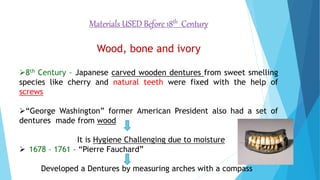
8th Century – Japanese carved wooden dentures from sweet smelling
species like cherry and natural teeth were fixed with the help of
screws
“George Washington” former American President also had a set of
dentures made from wood
It is Hygiene Challenging due to moisture
 1678 – 1761 – “Pierre Fauchard”
Developed a Dentures by measuring arches with a compass
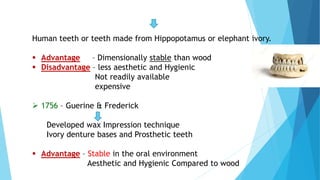
Human teeth or teeth made from Hippopotamus or elephant ivory.
 Advantage – Dimensionally stable than wood
 Disadvantage – less aesthetic and Hygienic
Not readily available
expensive
 1756 – Guerine & Frederick
Developed wax Impression technique
Ivory denture bases and Prosthetic teeth
 Advantage – Stable in the oral environment
Aesthetic and Hygienic Compared to wood
Materials used in the 18th Century
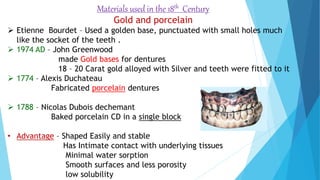
Gold and porcelain
 Etienne Bourdet – Used a golden base, punctuated with small holes much
like the socket of the teeth .
 1974 AD – John Greenwood
made Gold bases for dentures
18 – 20 Carat gold alloyed with Silver and teeth were fitted to it
 1774 – Alexis Duchateau
Fabricated porcelain dentures
 1788 – Nicolas Dubois dechemant
Baked porcelain CD in a single block
• Advantage – Shaped Easily and stable
Has Intimate contact with underlying tissues
Minimal water sorption
Smooth surfaces and less porosity
low solubility
 Disadvantage – Brittle
Difficulty in grinding and polishing
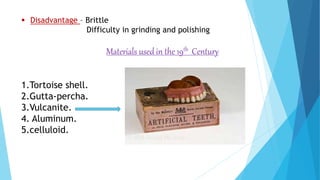
Materials used in the 19th Century
1.Tortoise shell.
2.Gutta-percha.
3.Vulcanite.
4. Aluminum.
5.celluloid.
 1808 – Giuseppangeio Fonzi
Individually baked porcelain teeth
Teeth were attached to the denture base by a small platinum hook
 1839 – Charles Goodyear
developed Method of producing rubber
 1851 – Nelson Goodyear
developed Process for making hard rubber or vulcanite(presence of
sulfur)
 Disadvantage-displeasing appearance
 Advantage –highly durable
economical
light weight
 1854 – Loomis - First porcelain denture with artificial teeth
 1855 – Charles Goodyear
Patent a process for making denture bases from vulcanite
 1850 – C.F Harrington
used Tortoise Shell base as the first thermoplastic denture
material
 1851 – Edwin Trueman
used Gutta-percha as denture base
 Disadvantage – Unstable
 1868 – John Westley Hyatt
developed First organic plastic molding compound
eg: Cellulose nitrate or celluloid
 1888 – Carroll
developed a Method for Casting Aluminum base under Pressure
 1890 – Charles H Land
developed a Porcelain dentures with platinum bases known as
continuous gum dentures
Materials used in the 20th Century
 1909 – Dr. Leo Bake land
developed Phenol formaldehyde resin(Bakelite)
• Advantage – Easily available
• Disadvantage – Lacks Color quality
Repair difficulties
 1907 – Haynes
Nickel chromium and Cobalt chromium
 1930 – a Mixture of polymerized vinyl chloride and vinyl acetate were
made.
 1935 – Resins were developed from a reaction between glycerin and
phthalic anhydrite.
 1936 – Rohm Hass
PMMA in the form of transparent sheet
 1937 – Du dout de Nemours.
PMMA in powder form
First acrylic- vernonite
 1937 – Wright – Methyl methacrylate
Clinically fulfilled all the requirements of an ideal denture base
material
 1942 – Charles Dimmer
Vinyl acrylic copolymer (luxene 44)
Poly styrene (jectron)
 1950 – Nylon introduced as denture base material
• Disadvantage – Poor ability to resist oral condition
Swelling of denture base due to absorption of moisture
 1968 – Masamishinishi
developed the Use of microwave energy to polymerize
acrylic denture base at 400 watt ,2.5 mints.
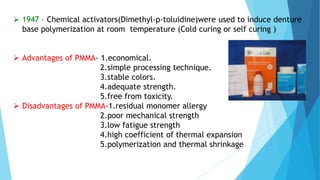
 1947 – Chemical activators(Dimethyl-p-toluidine)were used to induce denture
base polymerization at room temperature (Cold curing or self curing )
 Advantages of PMMA- 1.economical.
2.simple processing technique.
3.stable colors.
4.adequate strength.
5.free from toxicity.
 Disadvantages of PMMA-1.residual monomer allergy
2.poor mechanical strength
3.low fatigue strength
4.high coefficient of thermal expansion
5.polymerization and thermal shrinkage
CLASSIFICATION OF DENTURE BASE RESINS
A.Based on metallic contend present
 Non Metallic-Acrylic resins ,vinyl resins
 Metallic-Cobalt chromium,gold alloys, stainless steel
B.Based on durability
 Temporary-Base plate wax ,injection molded resins
 Permanent-heat cure denture resins, light cure resins
C.ADA classification
 Type 1-heat polymerizable polymers
 Type 2-auto polymerizable polymers
 Type 3-thermoplastic powders
 Type 4-light activated materials
 Type 5-microwave-cured materials
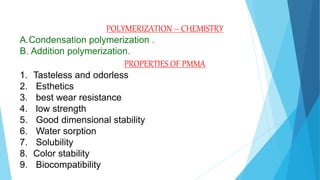
POLYMERIZATION – CHEMISTRY
A.Condensation polymerization .
B. Addition polymerization.
PROPERTIES OF PMMA
1. Tasteless and odorless
2. Esthetics
3. best wear resistance
4. low strength
5. Good dimensional stability
6. Water sorption
7. Solubility
8. Color stability
9. Biocompatibility
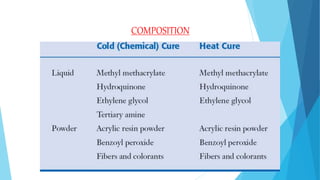
COMPOSITION
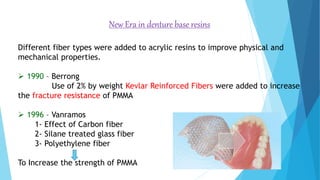
New Era in denture base resins
Different fiber types were added to acrylic resins to improve physical and
mechanical properties.
 1990 – Berrong
Use of 2% by weight Kevlar Reinforced Fibers were added to increase
the fracture resistance of PMMA
 1996 – Vanramos
1- Effect of Carbon fiber
2- Silane treated glass fiber
3- Polyethylene fiber
To Increase the strength of PMMA
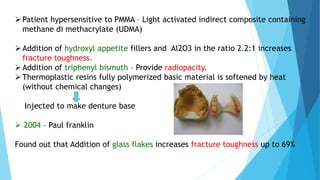
Patient hypersensitive to PMMA – Light activated indirect composite containing
methane di methacrylate (UDMA)
Addition of hydroxyl appetite fillers and Al2O3 in the ratio 2.2:1 increases
fracture toughness.
Addition of triphenyl bismuth – Provide radiopacity.
Thermoplastic resins fully polymerized basic material is softened by heat
(without chemical changes)
Injected to make denture base
 2004 – Paul franklin
Found out that Addition of glass flakes increases fracture toughness up to 69%
 2007 – Mesopourous silica (MCM 48)
Used as reinforcement agent for PMMA .
High mechanical and thermo physical properties.
 2017 -0.4% Tio2 Nanoparticles into a 3D printed denture base.
It Increases Antibacterial & Mechanical properties.
 2018 – “Malvika Nagrath” Stated that PCL-PMMA surface are capable of
releasing the drug on sustained time periods and was able to reduce candida
albicans colonization
• In CAD - CAM fabrication of denture bases are milled from fully polymerized
acrylic resin.
Increased retention due to less shrinkage, reduced denture related traumatic
ulcer and Decreased manual errors
RECENT ADVANCES IN DENTURE BASE RESINS
1.Reinforced resin
2.Hypo allergic resins
3.Resin with modified chemicals structures
4.Thermoplastic resins
SUPPORTING ARTICLE
 1.Evolution of denture base materials
S. K. Khindria, Sanjeev Mittal, Urvashi Sukhija
 Discussion
 Currently researches are going on to incorporate various materials
to increase the strength of PMMA resins.
 The approach to strengthening the acrylic resin prosthesis had
included modification or reinforcement of acrylic resin denture
base materials with fibers.
 Different fiber types have been added to acrylic resin to improve
physical and mechanical properties.
 Larson(1991),Sonit(1991),Van Ramos(1996) evaluate the effect of
carbon fiber ,silane treated glass fiber and polyethylene fibers in
increasing the strength of PMMA.
 2.Monomer Modifications of Denture Base Acrylic Resin: A
Systematic Review and Meta-analysis
R. Ajay, K. Suma1, Syed Ashraf Ali
 Discussion
Poly methyl methacrylate (PMMA) is the most commonly used denture base
material for the past 60 years.
 The use of alternative materials with considerable improvement in
strength would resist the denture fracture.
 PMMA resin with antimicrobial properties would be ideal to improve the
patient quality of life.
MODIFICATION OF METHYL METHACRYLATE
1.Fluromonomers
 Water shedding property(because of fluoride ions).
 So water absorption will be less(hydrophobicity).
 Decreased microbial adhesion.
2.Methacrilic acid(MMA)
 It also decreases microbial adhesion.
3.Itaconate monomers
 Results in Copolymerization.
 Decrease in residual monomers due to increase in degree of conversion
of the monomers to polymeric units.
PROS OF THE ARTICLE
1. Provide the reader with a clear picture of historical background
2. Explains about the current status of denture base resins
3. Clear picture of various developments that have taken place in this field
CONS OF THE ARTICLE
1.Review about other denture base material other than acrylic is not mentioned
2.Lack of future perspectives on the emerging technology
CONCLUSION
 The transition from naturally occurring materials to the application of
synthetic resins in denture construction indicates the extend of development
taking place.
 The ability to manufacture complete denture using computer aided
technology has untold educational ,investigational and clinical possibilities for
the future.
Thank you

Journal Presentaion - Dr.Aryasree.P.M

  • 1.
    JOURNAL PRESENTATION Dr. ARYASREEP M 1st year pg student DEPARTMENT OF PROSTHODONTICS Malabar Dental College
  • 2.
    EVOLUTION OF DENTUREBASE MATERIALS FROM PAST TO NEW ERA  Dr Sheejith M, Dr Swapna C, Dr Roshy George, Dr Niveditha S Prasad  IOSR Journal of Dental and Medical Sciences (IOSR-JDMS) e-ISSN: 2279-0853, p-ISSN: 2279-0861.Volume 17, Issue 11 Ver. 11 (November. 2018), PP 23-27 www.iosrjournals.org
  • 3.
    DEFINITIONS  DENTURE BASE: The part of a denture that rests on the foundation tissues and to which teeth are attached (GPT-9)  RESIN : A broad term used to describe natural or synthetic substances that form plastic materials after polymerization (GPT-9)
  • 4.
    INTRODUCTION  Dentistry hasbegun about 3000 BC in Egypt.  As civilization progressed the quantity and quality of useful materials changed accordingly .  For that, Materials should be biologically simple to manipulate and technically controlled to develop a prosthesis ,that is functionally effective and pleasing in appearance.
  • 5.
    AIM AND OBJECTIVE To review all the materials that were introduced in dentistry from 8th Century to 20th Century.  To analyze the existing literature on denture base materials for fabricating Complete denture and provide the reader with a historical background, current status and future perspectives on the emerging technology .
  • 6.
    EVOLUTION  352 –407 AD – “Talmund” By Hebrews • Teeth were made of Gold, Silver and Wood. • The dentures were hand carved and tied in place with silk thread . (Has to remove them before eating ). Upper and lower teeth were held together by steel springs.
  • 7.
    Materials USED Before18th Century Wood, bone and ivory 8th Century – Japanese carved wooden dentures from sweet smelling species like cherry and natural teeth were fixed with the help of screws “George Washington” former American President also had a set of dentures made from wood It is Hygiene Challenging due to moisture  1678 – 1761 – “Pierre Fauchard” Developed a Dentures by measuring arches with a compass
  • 8.
    Human teeth orteeth made from Hippopotamus or elephant ivory.  Advantage – Dimensionally stable than wood  Disadvantage – less aesthetic and Hygienic Not readily available expensive  1756 – Guerine & Frederick Developed wax Impression technique Ivory denture bases and Prosthetic teeth  Advantage – Stable in the oral environment Aesthetic and Hygienic Compared to wood
  • 9.
    Materials used inthe 18th Century Gold and porcelain  Etienne Bourdet – Used a golden base, punctuated with small holes much like the socket of the teeth .  1974 AD – John Greenwood made Gold bases for dentures 18 – 20 Carat gold alloyed with Silver and teeth were fitted to it  1774 – Alexis Duchateau Fabricated porcelain dentures  1788 – Nicolas Dubois dechemant Baked porcelain CD in a single block • Advantage – Shaped Easily and stable Has Intimate contact with underlying tissues Minimal water sorption Smooth surfaces and less porosity low solubility
  • 10.
     Disadvantage –Brittle Difficulty in grinding and polishing Materials used in the 19th Century 1.Tortoise shell. 2.Gutta-percha. 3.Vulcanite. 4. Aluminum. 5.celluloid.
  • 11.
     1808 –Giuseppangeio Fonzi Individually baked porcelain teeth Teeth were attached to the denture base by a small platinum hook  1839 – Charles Goodyear developed Method of producing rubber  1851 – Nelson Goodyear developed Process for making hard rubber or vulcanite(presence of sulfur)  Disadvantage-displeasing appearance  Advantage –highly durable economical light weight  1854 – Loomis - First porcelain denture with artificial teeth  1855 – Charles Goodyear Patent a process for making denture bases from vulcanite
  • 12.
     1850 –C.F Harrington used Tortoise Shell base as the first thermoplastic denture material  1851 – Edwin Trueman used Gutta-percha as denture base  Disadvantage – Unstable  1868 – John Westley Hyatt developed First organic plastic molding compound eg: Cellulose nitrate or celluloid  1888 – Carroll developed a Method for Casting Aluminum base under Pressure  1890 – Charles H Land developed a Porcelain dentures with platinum bases known as continuous gum dentures
  • 13.
    Materials used inthe 20th Century  1909 – Dr. Leo Bake land developed Phenol formaldehyde resin(Bakelite) • Advantage – Easily available • Disadvantage – Lacks Color quality Repair difficulties  1907 – Haynes Nickel chromium and Cobalt chromium  1930 – a Mixture of polymerized vinyl chloride and vinyl acetate were made.  1935 – Resins were developed from a reaction between glycerin and phthalic anhydrite.  1936 – Rohm Hass PMMA in the form of transparent sheet
  • 14.
     1937 –Du dout de Nemours. PMMA in powder form First acrylic- vernonite  1937 – Wright – Methyl methacrylate Clinically fulfilled all the requirements of an ideal denture base material  1942 – Charles Dimmer Vinyl acrylic copolymer (luxene 44) Poly styrene (jectron)  1950 – Nylon introduced as denture base material • Disadvantage – Poor ability to resist oral condition Swelling of denture base due to absorption of moisture  1968 – Masamishinishi developed the Use of microwave energy to polymerize acrylic denture base at 400 watt ,2.5 mints.
  • 15.
     1947 –Chemical activators(Dimethyl-p-toluidine)were used to induce denture base polymerization at room temperature (Cold curing or self curing )  Advantages of PMMA- 1.economical. 2.simple processing technique. 3.stable colors. 4.adequate strength. 5.free from toxicity.  Disadvantages of PMMA-1.residual monomer allergy 2.poor mechanical strength 3.low fatigue strength 4.high coefficient of thermal expansion 5.polymerization and thermal shrinkage
  • 16.
    CLASSIFICATION OF DENTUREBASE RESINS A.Based on metallic contend present  Non Metallic-Acrylic resins ,vinyl resins  Metallic-Cobalt chromium,gold alloys, stainless steel B.Based on durability  Temporary-Base plate wax ,injection molded resins  Permanent-heat cure denture resins, light cure resins C.ADA classification  Type 1-heat polymerizable polymers  Type 2-auto polymerizable polymers  Type 3-thermoplastic powders  Type 4-light activated materials  Type 5-microwave-cured materials
  • 17.
    POLYMERIZATION – CHEMISTRY A.Condensationpolymerization . B. Addition polymerization. PROPERTIES OF PMMA 1. Tasteless and odorless 2. Esthetics 3. best wear resistance 4. low strength 5. Good dimensional stability 6. Water sorption 7. Solubility 8. Color stability 9. Biocompatibility
  • 18.
  • 19.
    New Era indenture base resins Different fiber types were added to acrylic resins to improve physical and mechanical properties.  1990 – Berrong Use of 2% by weight Kevlar Reinforced Fibers were added to increase the fracture resistance of PMMA  1996 – Vanramos 1- Effect of Carbon fiber 2- Silane treated glass fiber 3- Polyethylene fiber To Increase the strength of PMMA
  • 20.
    Patient hypersensitive toPMMA – Light activated indirect composite containing methane di methacrylate (UDMA) Addition of hydroxyl appetite fillers and Al2O3 in the ratio 2.2:1 increases fracture toughness. Addition of triphenyl bismuth – Provide radiopacity. Thermoplastic resins fully polymerized basic material is softened by heat (without chemical changes) Injected to make denture base  2004 – Paul franklin Found out that Addition of glass flakes increases fracture toughness up to 69%
  • 21.
     2007 –Mesopourous silica (MCM 48) Used as reinforcement agent for PMMA . High mechanical and thermo physical properties.  2017 -0.4% Tio2 Nanoparticles into a 3D printed denture base. It Increases Antibacterial & Mechanical properties.  2018 – “Malvika Nagrath” Stated that PCL-PMMA surface are capable of releasing the drug on sustained time periods and was able to reduce candida albicans colonization • In CAD - CAM fabrication of denture bases are milled from fully polymerized acrylic resin. Increased retention due to less shrinkage, reduced denture related traumatic ulcer and Decreased manual errors
  • 22.
    RECENT ADVANCES INDENTURE BASE RESINS 1.Reinforced resin 2.Hypo allergic resins 3.Resin with modified chemicals structures 4.Thermoplastic resins
  • 23.
    SUPPORTING ARTICLE  1.Evolutionof denture base materials S. K. Khindria, Sanjeev Mittal, Urvashi Sukhija  Discussion  Currently researches are going on to incorporate various materials to increase the strength of PMMA resins.  The approach to strengthening the acrylic resin prosthesis had included modification or reinforcement of acrylic resin denture base materials with fibers.  Different fiber types have been added to acrylic resin to improve physical and mechanical properties.  Larson(1991),Sonit(1991),Van Ramos(1996) evaluate the effect of carbon fiber ,silane treated glass fiber and polyethylene fibers in increasing the strength of PMMA.
  • 24.
     2.Monomer Modificationsof Denture Base Acrylic Resin: A Systematic Review and Meta-analysis R. Ajay, K. Suma1, Syed Ashraf Ali  Discussion Poly methyl methacrylate (PMMA) is the most commonly used denture base material for the past 60 years.  The use of alternative materials with considerable improvement in strength would resist the denture fracture.  PMMA resin with antimicrobial properties would be ideal to improve the patient quality of life.
  • 25.
    MODIFICATION OF METHYLMETHACRYLATE 1.Fluromonomers  Water shedding property(because of fluoride ions).  So water absorption will be less(hydrophobicity).  Decreased microbial adhesion. 2.Methacrilic acid(MMA)  It also decreases microbial adhesion. 3.Itaconate monomers  Results in Copolymerization.  Decrease in residual monomers due to increase in degree of conversion of the monomers to polymeric units.
  • 26.
    PROS OF THEARTICLE 1. Provide the reader with a clear picture of historical background 2. Explains about the current status of denture base resins 3. Clear picture of various developments that have taken place in this field CONS OF THE ARTICLE 1.Review about other denture base material other than acrylic is not mentioned 2.Lack of future perspectives on the emerging technology
  • 27.
    CONCLUSION  The transitionfrom naturally occurring materials to the application of synthetic resins in denture construction indicates the extend of development taking place.  The ability to manufacture complete denture using computer aided technology has untold educational ,investigational and clinical possibilities for the future.
  • 28.