Sweet Stuff
How Sugars and Sweeteners Affect Your
Health
En español Send us your comments
(link sends e-mail)
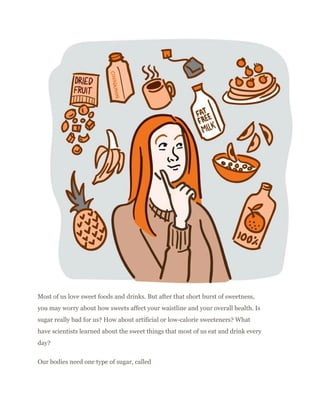
Most of us love sweet foods and drinks. But after that short burst of sweetness,
you may worry about how sweets affect your waistline and your overall health. Is
sugar really bad for us? How about artificial or low-calorie sweeteners? What
have scientists learned about the sweet things that most of us eat and drink every
day?
Our bodies need one type of sugar, called
glucose, to survive. “Glucose is the number one food for the brain, and it’s an
extremely important source of fuel throughout the body,” says Dr. Kristina
Rother, an NIH pediatrician and expert on sweeteners. But there’s no need to
add glucose to your diet, because your body can make the glucose it needs by
breaking down food molecules like
carbohydrates, proteins, and fats.
Some sugars are found naturally in foods, such as fruits, vegetables, and milk.
“These are healthful additions to your diet,” says Dr. Andrew Bremer, a
pediatrician and NIH expert on sweeteners. “When you eat an orange, for
instance, you’re getting a lot of nutrients and dietary fiber along with the natural
sugars.”
Although sugar itself isn’t bad, says Rother, “sugar has a bad reputation that’s
mostly deserved because we consume too much of it. It’s now in just about every
food we eat.”
Experts agree that Americans eat and drink way too much sugar, and it’s
contributing to the obesity epidemic. Much of the sugar we eat isn’t found
naturally in food but is added during processing or preparation.
About 15% of the calories in the American adult diet come from added sugars.
That’s about 22 teaspoons of added sugar a day. Sugars are usually added to
make foods and drinks taste better. But such foods can be high in calories and
offer none of the healthful benefits of fruits and other naturally sweet foods.
Sugar-sweetened beverages like soda, energy drinks, and sports drinks are the
leading source of added sugars in the American diet. Juices naturally contain a
lot of sugar. But sometimes, even more is added to make them taste sweeter.
“Juices offer some vitamins and other nutrients, but I think those benefits are
greatly offset by the harmful effects of too much sugar,” says Bremer.
Over time, excess sweeteners can take a toll on your health. “Several studies have
found a direct link between excess sugar consumption and obesity and
cardiovascular problems worldwide,” Bremer says.
Because of these harmful effects, many health organizations recommend that
Americans cut back on added sugars. But added sugars can be hard to identify.
On a list of ingredients, they may be listed as sucrose (table sugar), corn
sweetener, high-fructose corn syrup, fruit-juice concentrates, nectars, raw sugar,
malt syrup, maple syrup, fructose sweeteners, liquid fructose, honey, molasses,
anhydrous dextrose, or other words ending in “-ose,” the chemical suffix for
sugars. If any of these words are among the first few ingredients on a food label,
the food is likely high in sugar. The total amount of sugar in a food is listed under
“Total Carbohydrate” on the Nutrition Facts label.
Many people try cutting back on calories by switching from sugar-sweetened to
diet foods and drinks that contain low- or no-calorie sweeteners. These artificial
sweeteners—also known as sugar substitutes—are many times sweeter than table
sugar, so smaller amounts are needed to create the same level of sweetness.
People have debated the safety of artificial sweeteners for decades. To date,
researchers have found no clear evidence that any artificial sweeteners approved
for use in the U.S. cause cancer or other serious health problems in humans.
But can they help with weight loss? Scientific evidence is mixed. Some studies
suggest that diet drinks can help you drop pounds in the short term, but weight
tends to creep back up over time. Rother and other NIH-funded researchers are
now working to better understand the complex effects that artificial sweeteners
can have on the human body.
Studies of rodents and small numbers of people suggest that artificial sweeteners
can affect the healthful gut microbes that help us digest food. This in turn can
alter the body’s ability to use glucose, which might then lead to weight gain. But
until larger studies are done in people, the long-term impact of these sweeteners
on gut microbes and weight remains uncertain.
“There’s much controversy about the health effects of artificial sweeteners and
the differences between sugars and sweeteners,” says Dr. Ivan de Araujo of Yale
University. “Some animal studies indicate that sweeteners can produce
physiological effects. But depending on what kind of measurement is taken,
including in humans, the outcomes may be conflicting.”
De Araujo and others have been studying the effects that sugars and low-calorie
sweeteners might have on the brain. His animal studies found that sugar and
sweeteners tap differently into the brain’s reward circuitry, with sugars having a
more powerful and pleasurable effect.
“The part of the brain that mediates the ‘I can’t stop’ kinds of behaviors seems to
be especially sensitive to sugars and largely insensitive to artificial sweeteners,”
de Araujo says. “Our long-term goal is really to understand if sugars or caloric
sweeteners drive persistent intake of food. If exposed to too much sugar, does the
brain eventually change in ways that lead to excess consumption? That’s what
we’d like to know.”
Some research suggests that the intensely sweet taste of artificial, low-calorie
sweeteners can lead to a “sweet tooth,” or a preference for sweet things. This in
turn might lead to overeating. But more studies are needed to confirm the
relative effects of caloric vs. non-caloric sweeteners.
“In the long run, if you want to lose weight, you need to establish a healthy
lifestyle that contains unprocessed foods, moderate calories, and more exercise,”
Rother says.
When kids grow up eating a lot of sweet foods, they tend to develop a preference
for sweets. But if you give them a variety of healthy foods like fruits and
vegetables early in life, they’ll develop a liking for them too.
“It’s important for parents to expose children to a variety of tastes early on, but
realize that it often takes several attempts to get a child to eat such foods,” says
Bremer. “Don’t give up too soon.”
The key to good health is eating a well-balanced diet with a variety of foods and
getting plenty of physical activity. Focus on nutrition-rich whole foods without
added sugars. Get tips on healthy eating and weight control at
http://win.niddk.nih.gov.
Popular Stories
When Blood Vessels Grow Awry
Buffering Childhood Stress
The Mighty Fruit Fly
Beyond Basic Blood Tests
Wise Choices
Cut Added Sugars
​ Choose water, fat-free milk, or unsweetened tea or coffee instead of sodas,
sports drinks, energy drinks, and fruit drinks.
​ Reduce sugar in recipes. If a recipe says 1 cup, use 2/3 cup.
​ To enhance flavor, add vanilla, cinnamon, or nutmeg.
​ Eat fresh, canned, frozen, and dried fruits without added sugar. Choose
fruits canned in their own juice rather than syrup.
​ Use fruits to top foods like cereal and pancakes rather than sugars, syrups,
or other sweet toppings.
​ Read the ingredients list to pick food with little or no added sugar.
​ Use the Nutrition Facts label to choose packaged foods with less total
sugar.
Find More Information
​ Limit Fat and Sugar, Eat Right
​ Counting Carbs?
​ Artificial Sweeteners and Cancer
​ Dietary Guidelines for Americans, 2010 (HHS)
​ Nutrition: NIH Health Information
​ Breaking Bad Habits
​ Shape Your Family’s Habits: Helping Kids Make Healthy Choices
NIH Office of Communications and Public Liaison
Building 31, Room 5B52
Bethesda, MD 20892-2094
nihnewsinhealth@od.nih.gov
Tel: 301-451-8224
Editor: Harrison Wein, Ph.D.
Managing Editor: Tianna Hicklin, Ph.D.
Illustrator: Alan Defibaugh
Attention Editors: Reprint our articles and illustrations in your own publication. Our
material is not copyrighted. Please acknowledge NIH News in Health as the source and
send us a copy.
For more consumer health news and information, visit health.nih.gov.
For wellness toolkits, visit www.nih.gov/wellnesstoolkits.

get services with sweet experts Stuff.pdf

  • 1.
    Sweet Stuff How Sugarsand Sweeteners Affect Your Health En español Send us your comments (link sends e-mail)
  • 2.
    Most of uslove sweet foods and drinks. But after that short burst of sweetness, you may worry about how sweets affect your waistline and your overall health. Is sugar really bad for us? How about artificial or low-calorie sweeteners? What have scientists learned about the sweet things that most of us eat and drink every day? Our bodies need one type of sugar, called
  • 3.
    glucose, to survive.“Glucose is the number one food for the brain, and it’s an extremely important source of fuel throughout the body,” says Dr. Kristina Rother, an NIH pediatrician and expert on sweeteners. But there’s no need to add glucose to your diet, because your body can make the glucose it needs by breaking down food molecules like carbohydrates, proteins, and fats. Some sugars are found naturally in foods, such as fruits, vegetables, and milk. “These are healthful additions to your diet,” says Dr. Andrew Bremer, a pediatrician and NIH expert on sweeteners. “When you eat an orange, for instance, you’re getting a lot of nutrients and dietary fiber along with the natural sugars.” Although sugar itself isn’t bad, says Rother, “sugar has a bad reputation that’s mostly deserved because we consume too much of it. It’s now in just about every food we eat.” Experts agree that Americans eat and drink way too much sugar, and it’s contributing to the obesity epidemic. Much of the sugar we eat isn’t found naturally in food but is added during processing or preparation. About 15% of the calories in the American adult diet come from added sugars. That’s about 22 teaspoons of added sugar a day. Sugars are usually added to make foods and drinks taste better. But such foods can be high in calories and offer none of the healthful benefits of fruits and other naturally sweet foods. Sugar-sweetened beverages like soda, energy drinks, and sports drinks are the leading source of added sugars in the American diet. Juices naturally contain a lot of sugar. But sometimes, even more is added to make them taste sweeter.
  • 4.
    “Juices offer somevitamins and other nutrients, but I think those benefits are greatly offset by the harmful effects of too much sugar,” says Bremer. Over time, excess sweeteners can take a toll on your health. “Several studies have found a direct link between excess sugar consumption and obesity and cardiovascular problems worldwide,” Bremer says. Because of these harmful effects, many health organizations recommend that Americans cut back on added sugars. But added sugars can be hard to identify. On a list of ingredients, they may be listed as sucrose (table sugar), corn sweetener, high-fructose corn syrup, fruit-juice concentrates, nectars, raw sugar, malt syrup, maple syrup, fructose sweeteners, liquid fructose, honey, molasses, anhydrous dextrose, or other words ending in “-ose,” the chemical suffix for sugars. If any of these words are among the first few ingredients on a food label, the food is likely high in sugar. The total amount of sugar in a food is listed under “Total Carbohydrate” on the Nutrition Facts label. Many people try cutting back on calories by switching from sugar-sweetened to diet foods and drinks that contain low- or no-calorie sweeteners. These artificial sweeteners—also known as sugar substitutes—are many times sweeter than table sugar, so smaller amounts are needed to create the same level of sweetness. People have debated the safety of artificial sweeteners for decades. To date, researchers have found no clear evidence that any artificial sweeteners approved for use in the U.S. cause cancer or other serious health problems in humans. But can they help with weight loss? Scientific evidence is mixed. Some studies suggest that diet drinks can help you drop pounds in the short term, but weight tends to creep back up over time. Rother and other NIH-funded researchers are now working to better understand the complex effects that artificial sweeteners can have on the human body.
  • 5.
    Studies of rodentsand small numbers of people suggest that artificial sweeteners can affect the healthful gut microbes that help us digest food. This in turn can alter the body’s ability to use glucose, which might then lead to weight gain. But until larger studies are done in people, the long-term impact of these sweeteners on gut microbes and weight remains uncertain. “There’s much controversy about the health effects of artificial sweeteners and the differences between sugars and sweeteners,” says Dr. Ivan de Araujo of Yale University. “Some animal studies indicate that sweeteners can produce physiological effects. But depending on what kind of measurement is taken, including in humans, the outcomes may be conflicting.” De Araujo and others have been studying the effects that sugars and low-calorie sweeteners might have on the brain. His animal studies found that sugar and sweeteners tap differently into the brain’s reward circuitry, with sugars having a more powerful and pleasurable effect. “The part of the brain that mediates the ‘I can’t stop’ kinds of behaviors seems to be especially sensitive to sugars and largely insensitive to artificial sweeteners,” de Araujo says. “Our long-term goal is really to understand if sugars or caloric sweeteners drive persistent intake of food. If exposed to too much sugar, does the brain eventually change in ways that lead to excess consumption? That’s what we’d like to know.” Some research suggests that the intensely sweet taste of artificial, low-calorie sweeteners can lead to a “sweet tooth,” or a preference for sweet things. This in turn might lead to overeating. But more studies are needed to confirm the relative effects of caloric vs. non-caloric sweeteners.
  • 6.
    “In the longrun, if you want to lose weight, you need to establish a healthy lifestyle that contains unprocessed foods, moderate calories, and more exercise,” Rother says. When kids grow up eating a lot of sweet foods, they tend to develop a preference for sweets. But if you give them a variety of healthy foods like fruits and vegetables early in life, they’ll develop a liking for them too. “It’s important for parents to expose children to a variety of tastes early on, but realize that it often takes several attempts to get a child to eat such foods,” says Bremer. “Don’t give up too soon.” The key to good health is eating a well-balanced diet with a variety of foods and getting plenty of physical activity. Focus on nutrition-rich whole foods without added sugars. Get tips on healthy eating and weight control at http://win.niddk.nih.gov. Popular Stories
  • 7.
  • 8.
  • 9.
  • 10.
    Beyond Basic BloodTests Wise Choices Cut Added Sugars ​ Choose water, fat-free milk, or unsweetened tea or coffee instead of sodas, sports drinks, energy drinks, and fruit drinks. ​ Reduce sugar in recipes. If a recipe says 1 cup, use 2/3 cup. ​ To enhance flavor, add vanilla, cinnamon, or nutmeg. ​ Eat fresh, canned, frozen, and dried fruits without added sugar. Choose fruits canned in their own juice rather than syrup.
  • 11.
    ​ Use fruitsto top foods like cereal and pancakes rather than sugars, syrups, or other sweet toppings. ​ Read the ingredients list to pick food with little or no added sugar. ​ Use the Nutrition Facts label to choose packaged foods with less total sugar. Find More Information ​ Limit Fat and Sugar, Eat Right ​ Counting Carbs? ​ Artificial Sweeteners and Cancer ​ Dietary Guidelines for Americans, 2010 (HHS) ​ Nutrition: NIH Health Information ​ Breaking Bad Habits ​ Shape Your Family’s Habits: Helping Kids Make Healthy Choices NIH Office of Communications and Public Liaison Building 31, Room 5B52 Bethesda, MD 20892-2094 nihnewsinhealth@od.nih.gov Tel: 301-451-8224 Editor: Harrison Wein, Ph.D. Managing Editor: Tianna Hicklin, Ph.D. Illustrator: Alan Defibaugh Attention Editors: Reprint our articles and illustrations in your own publication. Our material is not copyrighted. Please acknowledge NIH News in Health as the source and send us a copy.
  • 12.
    For more consumerhealth news and information, visit health.nih.gov. For wellness toolkits, visit www.nih.gov/wellnesstoolkits.