Approaches to International Business:
Ethnocentric and Polycentric
Presented By:
Pranav Kishor Choudhary
Roll No. 180554
MBA 1st
Presented to:
Dr. Ajai Pal Sharma
International Business Approaches
• Initially known as EPG Model
• Introduced by Howard V. Perlmutter
• In 1969
• "The Tortuous Evolution of Multinational Enterprises". Columbia
Journal of World Business
• Expanded by David A. Heenan in 1979.
• Became EPRG Framework
International Business Approaches
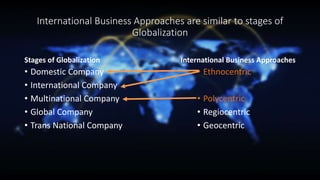
International Business Approaches are similar to stages of
Globalization
Stages of Globalization
• Domestic Company
• International Company
• Multinational Company
• Global Company
• Trans National Company
International Business Approaches
• Ethnocentric
• Polycentric
• Regiocentric
• Geocentric
Ethnocentric Approach
• Preferred by small companies.
• Mostly Companies are just trying their hands in Overseas Business.
• Business is usually restricted to exports.
• Overseas markets are only to absorb their surplus production.
• Overseas market serve as buffer for domestic market’s demand
fluctuation.
• Marketing is based on similarities.
Ethnocentric Approach
• Domestic Marketing Extension.
• Product are made for domestic market only.
• Surplus is exported to suitable market
• Assumption is that foreign market have same needs.
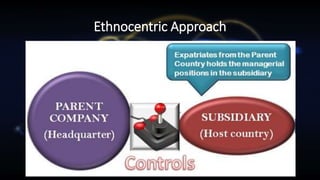
• Managers from the home country are expatriated.
• Decision making is centralized.
Ethnocentric Approach
Advantage and Disadvantage of Ethnocentric Approach
Advantage
• Creates a unified corporate culture.
• Effective control over the
subsidiary.
• No need to have a well-developed
local labour market.
• Better transfer of technical know-
how.
• Keeps traditions and practices
alive
Disadvantage
• Creates cultural myopia.
• Unutilized Local Talent.
• The cultural clashes between the
executives and the staff members.
• Fewer innovations.
• Lack of flexibility and local
responsiveness
• The organization may see capital
flight.
• The failure rate is very high
Polycentric Approach
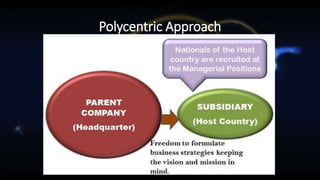
• Foreign Subsidiaries are established.
• Autonomy is given to Overseas Units.
• Head offices provide only strategic guidelines.
• Controls are decentralized.
• Subsidiaries behave as domestic companies in Host country.
• Hence Multi domestic marketing.
• The companies usually become multinational corporations at this
stage.
Polycentric Approach
• Attuned to the needs and cultures of the Host Countries.
• Products are tailored according to the foreign market.
• Overseas operations are in forms of:
• Joint ventures
• Licensing
• Overseas manufacturing
• Contract Manufacturing
• Marketing
Polycentric Approach
Advantage and Disadvantage of Polycentric Approach
Advantage
• Mitigates the chance of cultural
myopia
• Hiring of locals of the host country is
comparatively less expensive.
• The morale of the local staff
increases.
• Intense exploitation of local markets.
• Better sales and productivity.
• Better host government support.
• Chances of success are high.
Disadvantage
• Isolate headquarters from foreign
subsidiaries.
• Lack of coordination (between the host
and the parent company).
• Difficult to exercise control over the
subsidiary.
• Conflict (between the managers of both
the host and the parent company).
• Loss of synergy.
• Development of economies of scale
cannot be realized
• Waste due Duplication of facilities.
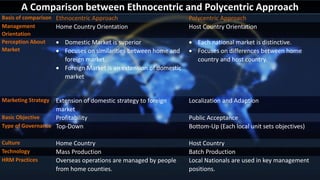
A Comparison between Ethnocentric and Polycentric Approach
Basis of comparison Ethnocentric Approach Polycentric Approach
Management
Orientation
Home Country Orientation Host Country Orientation
Perception About
Market
 Domestic Market is superior
 Focuses on similarities between home and
foreign market.
 Foreign Market is an extension of domestic
market
 Each national market is distinctive.
 Focuses on differences between home
country and host country.
Marketing Strategy Extension of domestic strategy to foreign
market
Localization and Adaption
Basic Objective Profitability Public Acceptance
Type of Governance Top-Down Bottom-Up (Each local unit sets objectives)
Culture Home Country Host Country
Technology Mass Production Batch Production
HRM Practices Overseas operations are managed by people
from home counties.
Local Nationals are used in key management
positions.
Example
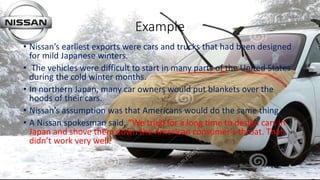
• Nissan’s earliest exports were cars and trucks that had been designed
for mild Japanese winters.
• The vehicles were difficult to start in many parts of the United States
during the cold winter months.
• In northern Japan, many car owners would put blankets over the
hoods of their cars.
• Nissan’s assumption was that Americans would do the same thing.
• A Nissan spokesman said, “We tried for a long time to design cars in
Japan and shove them down the American consumer’s throat. That
didn’t work very well.”
References
• Turner, Colin; Johnson, Debra - International business; themes and
issues in the modern global economy-Taylor & Francis e-Library
(2004)
• Charles W. L. Hill - International Business - Competing in the Global
Marketplace-McGraw-Hill Irwin (2010).
• Perlmutter, Howard (1969). "The Tortuous Evolution of Multinational
Enterprises". Columbia Journal of World Business;Jan/Feb69, Vol. 4
Issue 1, p9
THANK YOU
Any Quarries

Ethnocentric and Polycentric

  • 1.
    Approaches to InternationalBusiness: Ethnocentric and Polycentric Presented By: Pranav Kishor Choudhary Roll No. 180554 MBA 1st Presented to: Dr. Ajai Pal Sharma
  • 2.
    International Business Approaches •Initially known as EPG Model • Introduced by Howard V. Perlmutter • In 1969 • "The Tortuous Evolution of Multinational Enterprises". Columbia Journal of World Business • Expanded by David A. Heenan in 1979. • Became EPRG Framework
  • 3.
  • 4.
    International Business Approachesare similar to stages of Globalization Stages of Globalization • Domestic Company • International Company • Multinational Company • Global Company • Trans National Company International Business Approaches • Ethnocentric • Polycentric • Regiocentric • Geocentric
  • 5.
    Ethnocentric Approach • Preferredby small companies. • Mostly Companies are just trying their hands in Overseas Business. • Business is usually restricted to exports. • Overseas markets are only to absorb their surplus production. • Overseas market serve as buffer for domestic market’s demand fluctuation. • Marketing is based on similarities.
  • 6.
    Ethnocentric Approach • DomesticMarketing Extension. • Product are made for domestic market only. • Surplus is exported to suitable market • Assumption is that foreign market have same needs. • Managers from the home country are expatriated. • Decision making is centralized.
  • 7.
  • 8.
    Advantage and Disadvantageof Ethnocentric Approach Advantage • Creates a unified corporate culture. • Effective control over the subsidiary. • No need to have a well-developed local labour market. • Better transfer of technical know- how. • Keeps traditions and practices alive Disadvantage • Creates cultural myopia. • Unutilized Local Talent. • The cultural clashes between the executives and the staff members. • Fewer innovations. • Lack of flexibility and local responsiveness • The organization may see capital flight. • The failure rate is very high
  • 9.
    Polycentric Approach • ForeignSubsidiaries are established. • Autonomy is given to Overseas Units. • Head offices provide only strategic guidelines. • Controls are decentralized. • Subsidiaries behave as domestic companies in Host country. • Hence Multi domestic marketing. • The companies usually become multinational corporations at this stage.
  • 10.
    Polycentric Approach • Attunedto the needs and cultures of the Host Countries. • Products are tailored according to the foreign market. • Overseas operations are in forms of: • Joint ventures • Licensing • Overseas manufacturing • Contract Manufacturing • Marketing
  • 11.
  • 12.
    Advantage and Disadvantageof Polycentric Approach Advantage • Mitigates the chance of cultural myopia • Hiring of locals of the host country is comparatively less expensive. • The morale of the local staff increases. • Intense exploitation of local markets. • Better sales and productivity. • Better host government support. • Chances of success are high. Disadvantage • Isolate headquarters from foreign subsidiaries. • Lack of coordination (between the host and the parent company). • Difficult to exercise control over the subsidiary. • Conflict (between the managers of both the host and the parent company). • Loss of synergy. • Development of economies of scale cannot be realized • Waste due Duplication of facilities.
  • 13.
    A Comparison betweenEthnocentric and Polycentric Approach Basis of comparison Ethnocentric Approach Polycentric Approach Management Orientation Home Country Orientation Host Country Orientation Perception About Market  Domestic Market is superior  Focuses on similarities between home and foreign market.  Foreign Market is an extension of domestic market  Each national market is distinctive.  Focuses on differences between home country and host country. Marketing Strategy Extension of domestic strategy to foreign market Localization and Adaption Basic Objective Profitability Public Acceptance Type of Governance Top-Down Bottom-Up (Each local unit sets objectives) Culture Home Country Host Country Technology Mass Production Batch Production HRM Practices Overseas operations are managed by people from home counties. Local Nationals are used in key management positions.
  • 14.
    Example • Nissan’s earliestexports were cars and trucks that had been designed for mild Japanese winters. • The vehicles were difficult to start in many parts of the United States during the cold winter months. • In northern Japan, many car owners would put blankets over the hoods of their cars. • Nissan’s assumption was that Americans would do the same thing. • A Nissan spokesman said, “We tried for a long time to design cars in Japan and shove them down the American consumer’s throat. That didn’t work very well.”
  • 15.
    References • Turner, Colin;Johnson, Debra - International business; themes and issues in the modern global economy-Taylor & Francis e-Library (2004) • Charles W. L. Hill - International Business - Competing in the Global Marketplace-McGraw-Hill Irwin (2010). • Perlmutter, Howard (1969). "The Tortuous Evolution of Multinational Enterprises". Columbia Journal of World Business;Jan/Feb69, Vol. 4 Issue 1, p9
  • 16.

Editor's Notes

  • #2 These two are part of EPRG Framework.
  • #7 Give cake surplus eg.
  • #8 Give cake surplus eg.
  • #10 The subsidiaries operating in overseas markets are recognized as independent business units with autonomy to operate in their markets. Within their respective markets, the subsidiaries behave as domestic companies, deriving only strategic guidelines from their head offices The companies usually become multinational corporations at this stage controls are decentralized to facilitate local operations under the EPRG schema
  • #11 Eg. of foxconn Tailored : frequency band IN 1900, 2100, 2300, PAK 1800, 850, 2100
  • #12 Eg. of foxconn Tailored : frequency band IN 1900, 2100, 2300, PAK 1800, 850, 2100