Artificial intelligence
 WHAT IS ARTIFICAL INTELLIGENCE ?
 According to the father of Artificial
Intelligence John McCarthy, it is the
science and
 engineering of making intelligent
machines, especially intelligent
computer programs”.
 Artificial Intelligence is a way of
making a computer, a computer-
controlled robot, or a
 software think intelligently, in the
similar manner the intelligent humans
think.
 AI is accomplished by studying how
human brain thinks, and how humans
learn, decide, and
 work while trying to solve a problem,
and then using the outcomes of this
study as a basis of
 developing intelligent software and
systems.
PHILOSOPHY OF AI
 While exploiting the power of the
computer systems, the curiosity of
human, lead him to
 wonder, “Can a machine think and
behave like humans do?”
 Thus, the development of AI
started with the intention of
creating similar intelligence in
 machines that we find and regard
high in human
 The philosophy of artificial
intelligence is a branch of the
philosophy of technology that
explores artificial intelligence and
its implications for knowledge and
understanding of intelligence,
ethics, consciousness,
epistemology, and free will.
GOALS OF AI
 To Create Expert Systems: The
systems which exhibit intelligent
behavior, learn,
 demonstrate, explain, and advice
its users.
 To Implement Human
Intelligence in Machines: Creating
systems that
 understand, think, learn, and
behave like humans.
 A Bayesian network (BN) is a
probabilistic graphical model for
representing knowledge about an
uncertain domain where each
node corresponds to a random
variable and each edge
represents the conditional
probability for the corresponding
random variables [9]. BNs are
also called belief networks or
Bayes nets.
WHAT CONTRIBUTION TO AI
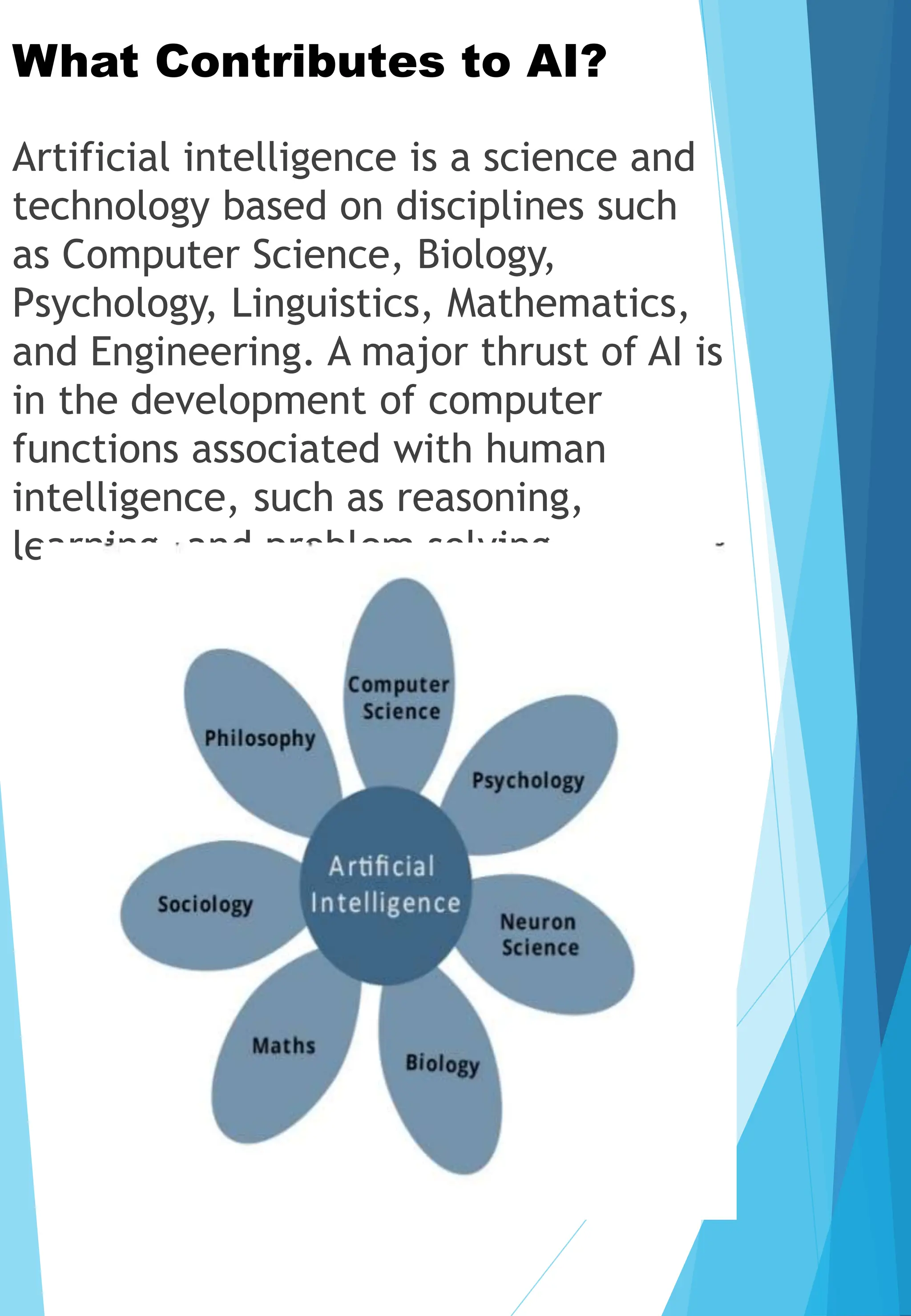
 Artificial intelligence is a
science and technology based
on disciplines such as
Computer
 Science, Biology, Psychology,
Linguistics, Mathematics, and
Engineering. A major thrust of
AI
 is in the development of
computer functions associated
with human intelligence, such
as
 reasoning, learning, and
problem solving.
 Out of the following areas, one
or multiple areas can contribute
to build an intelligent system.
What Contributes to AI?
Artificial intelligence is a science and
technology based on disciplines such
as Computer Science, Biology,
Psychology, Linguistics, Mathematics,
and Engineering. A major thrust of AI is
in the development of computer
functions associated with human
intelligence, such as reasoning,
learning, and problem solving.
What is AI Technique?
 In the real world, the
knowledge has some
unwelcomed properties: Its
volume is huge, next to
unimaginable. It is not well-
organized or well-formatted.
It keeps changing constantly. AI
Technique is a manner to
organize and use the
knowledge efficiently in such a
way that: It should be
perceivable by the people who
provide it. It should be easily
modifiable to correct errors.
It should be useful in many
situations though it is
incomplete or inaccurate. AI
techniques elevate the speed
of execution of the complex
program it is equipped with
Applications of AI
GAMING: AI plays crucial role in
strategic games such as chess,
poker, tic-tac-toe, etc., where
machine can think of large number
of possible positions based on
heuristic knowledge.
Natural Language Processing
:It is possible to interact with the
computer that understands natural
language spoken by humans.
Expert Systems: There are some
applications which integrate
machine, software, and special
information to impart reasoning
and advising. They provide
explanation and advice to the
users.
Vision Systems :These systems
understand, interpret, and
comprehend visual input on the
computer. For example,
2. IntelligenT Systems
What is Intelligence?
The ability of a system to
calculate, reason, perceive
relationships and analogies,
learn from experience, store
and retrieve information from
memory, solve problems,
comprehend complex ideas,
use natural language fluently,
classify, generalize, and adapt
new situations.
The intelligence is intangible.
It is composed of:
Task Classificationof AI
Humans learn mundane
(ordinary) tasks since their
birth. They learn by perception,
speaking, using language, and
locomotives. They learn Formal
Tasks and Expert Tasks later, in
that order. For humans, the
mundane tasks are easiest to
learn. The same was considered
true before trying to implement
mundane tasks in machines.
Earlier, all work of AI was
concentrated in the mundane
task domain. Later, it turned
out that the machine requires
more knowledge, complex
knowledge representation, and
complicated algorithms for
handling mundane tasks. This is
the reason why AI work is more
prospering in the Expert Task
domain now, as the expert task
domain needs expert knowledge
without common sense, which
can be easier to represent and
handle.
3. Agents and Environments
 An agent is anything that can
perceive its environment
through sensors and acts upon
that environment through
effectors.
 A human agent has sensory
organs such as eyes, ears,
nose, tongue and skin parallel
to the sensors, and other
organs such as hands, legs,
mouth, for effectors
 A robotic agent replaces
cameras and infrared range
finders for the sensors, and
various motors and actuators
for effectors.
 A software agent has encoded
bit strings as its programs and
actions
Rationality
Rationality is nothing but status of
being reasonable, sensible, and
having good sense of judgment.
Rationality is concerned with
expected actions and results
depending upon what the agent
has perceived. Performing
actions with the aim of obtaining
useful information is an
important part of rationality.
What is Ideal Rational Agent?
An ideal rational agent is the
one, which is capable of doing
expected actions to maximize its
performance measure, on the
basis of:
1.The performance measures,
which determine the degree of
success.
2.Agent’s Percept Sequence till
now.
3.The agent’s prior knowledge
about the environment.
4. The actions that the agent can
carry out.
A rational agent always
performs right action, where
the right action means the
action that causes the agent
to be most successful in the
given percept sequence. The
problem the agent solves is
characterized by Performance
Measure, Environment,
Actuators, and Sensors (PEAS)
The Structure of Intelligent
Agents
 Agent’s structure can be
viewed as: • Agent =
Architecture + Agent Program •
Architecture = the machinery
that an agent executes on. •
Agent Program = an
implementation of an agent
function. Simple Reflex Agents
They choose actions only based
on the current percept. They
are rational only if a correct
decision is made only on the
basis of current precept.
Their environment is
completely observable.
Condition-Action Rule – It is a
rule that maps a state
(condition) to an action.
Application Areasof
Fuzzy Logic
 Automotive Systems Automatic
Gearboxes, Four-Wheel
Steering , Vehicle environment
control
 Consumer Electronics Hi-Fi
Systems Photocopiers Still
and Video Cameras Television
 Domestic Goods Microwave
Ovens Refrigerators
Toasters Vacuum Cleaner
 Environment Control Air
Conditioners/Dryers/Heaters
Humidifiers
Advantages of FLSs
Mathematical concepts within
fuzzy reasoning are very simple.
You can modify a FIS by just
adding or deleting rules due to
flexibility of fuzzy logic.
Fuzzy logic Systems can take
imprecise, distorted, noisy input
information.
FLSs are easy to construct and
understand. Fuzzy logic is a
solution to complex problems in all
fields of life, including medicine,
as it resembles human reasoning
and decision making
4.Expert Systems
What are Expert Systems?
The expert systems are the
computer applications developed
to solve complex problems in a
particular domain, at the level
of extra-ordinary human
intelligence and expertise
Robotics
What are Robots?
Robots are the artificial agents
acting in real world environment
Robotics is a domain in artificial
intelligence that deals with the
study of creating intelligent and
efficient robots.
Difference in Robot
System and Other
AI Program
AI Programs
 They usually
operate in
computer-
stimulated
worlds.
 The input to an
AI program is in
symbols and
rules.
 They need
general purpose
computers to
operate on.
Robots
 They operate in
real physical world
 d rules. Inputs to
robots is analog
signal in the form
of speech
waveform or
images
 They need special
hardware with
sensors and
effectors.
Robot Locomotion
Locomotion is the mechanism that
makes a robot capable of moving in
its environment. There are various
types of locomotions:
Legged
Wheeled
Combination of Legged and
Wheeled Locomotion
Tracked
Legged Locomotion
This type of locomotion
consumes more power while
demonstrating walk, jump, trot,
hop, climb up or down, etc
It requires more number of motors to
accomplish a movement. It is suited
for rough as well as smooth terrain
where irregular or too smooth
surface makes it consume more
power for a wheeled locomotion.
Components of a Robot
Power Supply: The robots are
powered by batteries, solar power,
hydraulic, or pneumatic power
sources. Actuators: They convert
energy into movement. Electric
motors (AC/DC): They are required
for rotational movement.
Pneumatic Air Muscles: They
contract almost 40% when air is
sucked in them. Muscle Wires:
They contract by 5% when electric
current is passed through them.
Piezo Motors and Ultrasonic
Motors: Best for industrial robots.
Sensors: They provide knowledge
of real time information on the task
environment. Robots are equipped
with vision sensors to be to
compute the depth in the
environment. A tactile sensor
imitates the mechanical properties
of touch receptors of human
fingertips.
Computer Vision
This is a technology of AI with
which the robots can see. The
computer vision plays vital role in
the domains of safety, security,
health, access, and entertainment.
Computer vision automatically
extracts, analyzes, and
comprehends useful information
from a single image or an array of
images. This process involves
development of algorithms to
accomplish automatic visual
comprehension.
Hardware of Computer
Vision System :
Power supply
2. Image acquisition device such as
camera
3. A processor
4. A software
5. A display device for monitoring the
system
Accessories such as camera stands,
cables, and connector
Tasks of Computer Visio
OCR: In the domain of
computers, Optical
Character Reader, a software
to convert scanned
documents into editable
text, which accompanies a
scanner.
Bayesian Networks [BN]
These are the graphical structures
used to represent the probabilistic
relationship among a set of random
variables. Bayesian networks are also
called Belief Networks or Bayes Nets.
BNs reason about uncertain domain
In these networks, each node
represents a random variable with
specific propositions. For example, in
a medical diagnosis domain, the node
Cancer represents the proposition
that a patient has cancer
The edges connecting the nodes
represent probabilistic dependencies
among those random variables. If out
of two nodes, one is affecting the
other then they must be directly
connected in the directions of the
effect. The strength of the
relationship between variables is
quantified by the probability
associated with each node
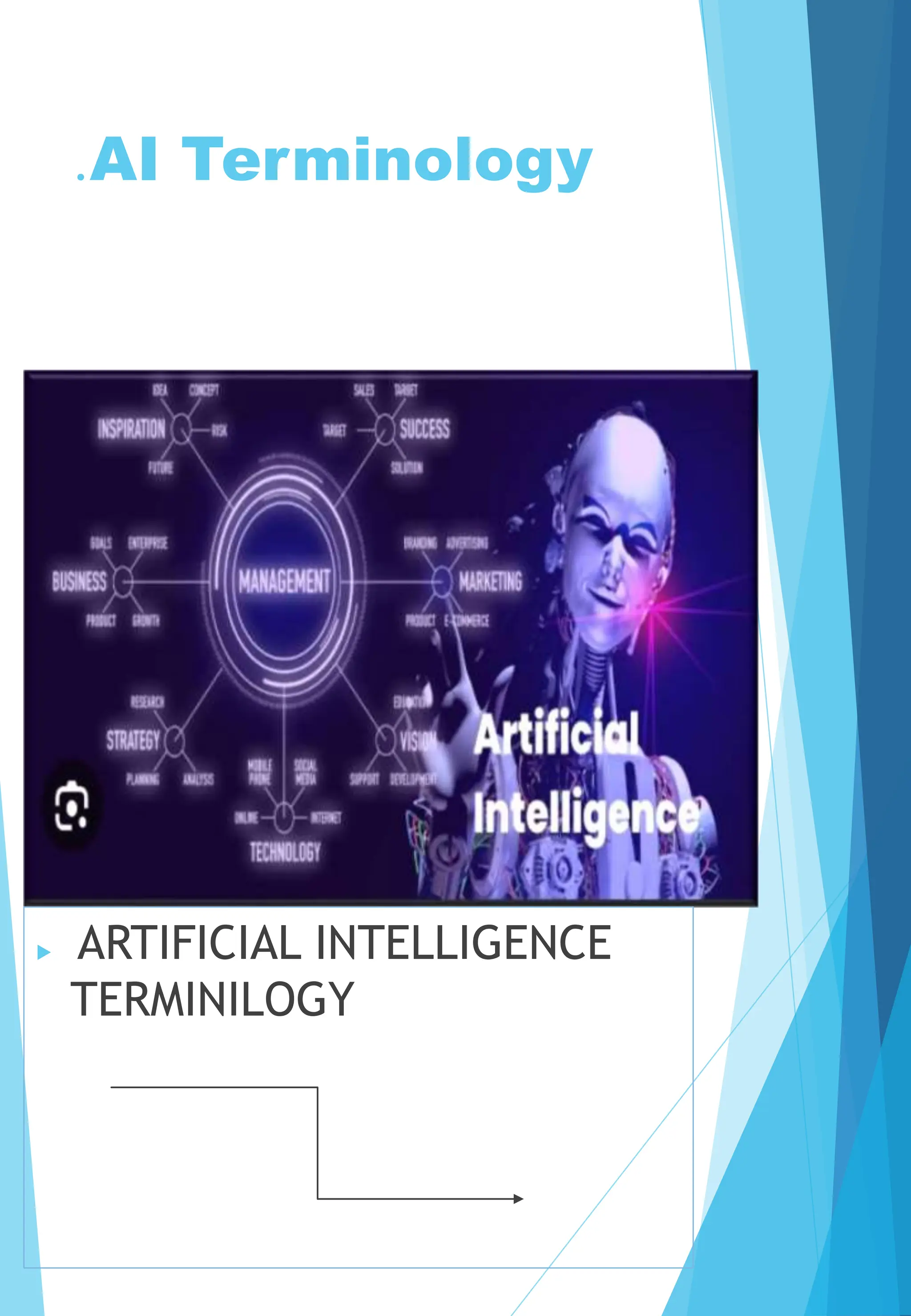
.AI Terminology
 ARTIFICIAL INTELLIGENCE
TERMINILOGY
AI Issues
 AI is developing with such an
incredible speed, sometimes it seems
magical. There is an opinion among
researchers and developers that AI
could grow so immensely strong that it
would be difficult for humans to
control.
 Humans developed AI systems by
introducing into them every possible
intelligence they could, for which the
humans themselves now seem
threatened.
Threat to Privacy
An AI program that recognizes
speech and understands natural
language is theoretically
capable of understanding each
conversation on e-mails and
telephones
Threat to Human
Dignity
Threat to Safety
The self-improving AI systems can
become so mighty than humans
that could be very difficult to stop
from achieving their goals, which
may lead to unintended
consequences.
AI systems have already started
replacing the human beings in
few industries. It should not
replace people in the sectors
where they are holding dignified
positions which are pertaining to
ethics such as nursing, surgeon,
judge, police officer, etc.
Back Propagation
Algorithm
It is the training or learning
algorithm. It learns by example. If
you submit to the algorithm the
example of what you want the
network to do, it changes the
network’s weights so that it can
produce desired output for a
particular input on finishing the
training
Back Propagation networks are
ideal for simple Pattern
Recognition and Mapping Tasks
his strategy built on observation.
The ANN makes a decision by
observing its environment. If the
observation is negative, the
network adjusts its weights to be
able to make a different required
decision the next time
Specify Topology
Conventionally, BNs are laid out so
that the arcs point from top to
bottom. The set of parent nodes of
a node X is given by Parents(X).
The Lung-Cancer node has two
parents (reasons or causes):
Pollution and Smoker, while node
Smoker is an ancestor of node X-
Ray. Similarly, X-Ray is a child
(con
Conditional Probabilities
 Now quantify the relationships
between connected nodes: this is
done by specifying a conditional
probability distribution for each
node. As only discrete variables are
considered here, this takes the form
of a Conditional Probability Table
(CPT).
 First, for each node we need to look
at all the possible combinations of
values of those parent nodes. Each
such combination is called an
instantiation of the parent set. For
each distinct instantiation of parent
node values, we need to specify the
probability that the child will take.
 For example, the Lung-Cancer node’s
parents are Pollution and Smoking.
They take the possible values = {
(H,T), ( H,F), (L,T), (L,F)}. The CPT
specifies the probability of cancer
for each of these cases as
respectively.
Applications of Neural
Networks
 Financial
Real estate appraisal, loan
advisor, mortgage
screening, corporate bond
rating, portfolio trading
program, corporate
financial analysis, currency
value prediction, document
readers, credit application
evaluators.
Manufacturing process control,
product design and analysis, quality
inspection systems, welding quality
analysis, paper quality prediction,
chemical product design analysis,
dynamic modeling of chemical
process systems, machine
maintenance analysis, project
bidding, planning, and
management.
AI Issues
 AI is developing with such an
incredible speed, sometimes it seems
magical. There is an opinion among
researchers and developers that AI
could grow so immensely strong that
it would be difficult for humans to
control. Humans developed AI
systems by introducing into them
every possible intelligence they
could, for which the humans
themselves now seem threatened.
Threat to Privacy : An AI program
that recognizes speech and
understands natural language is
theoretically capable of
understanding each conversation on
e-mails and telephones.
Threat to Human Dignity :
 I systems have already started
replacing the human beings in few
industries. It should not replace
people in the sectors where they
are holding dignified positions
which are pertaining to ethics
such as nursing, surgeon, judge,
police officer, etc.
Threat to Safety : The self-
improving AI systems can become
so mighty than humans that could
be very difficult to stop from
achieving their goals, which may
lead to unintended consequences.
Software:Pattern
Recognition in facial
recognition, optical character
recognition, etc.
Signal Processing:
 Neural networks can be trained to
process an audio signal and filter it
appropriately in the hearing aids.
 Time Series Prediction:
ANNs are used to make predictions on
stocks and natural calamities
As ANNs are expert at recognizing
patterns, they can also be trained to
generate an output when something
unusual occurs that misfits the
pattern.
Image and data compression,
automated information services, real-
time spoken language translation.
Speech recognition, speech
classification, text to speech
conversion.
Code sequence prediction, IC chip
layout, chip failure analysis, machine
vision, voice synthesis
Specify Topology
 Conventionally, BNs are laid out so
that the arcs point from top to
bottom. The set of parent nodes of a
node X is given by Parents(X).
 The Lung-Cancer node has two
parents (reasons or causes): Pollution
and Smoker, while node Smoker is an
ancestor of node X-Ray. Similarly, X-
Ray is a child (consequence
 First, for each node we need to look
at all the possible combinations of
values of those parent nodes
 For example, the Lung-Cancer node’s
parents are Pollution and Smoking.
They take the possible values = {
(H,T), ( H,F), (L,T), (L,F)}. The CPT
specifies the probability of cancer for
each of these cases as respectively
 Each node will have conditional
probability associated as follows:
Types of Artificial
Neural Networks
There are two Artificial Neural
Network topologies: FeedForward
and Feedback.
FeedForward ANN
In this ANN, the information flow is
unidirectional. A unit sends
information to other unit from which
it does not receive any information.
There are no feedback loops. They
are used in pattern
generation/recognition/classificatio
n. They have fixed inputs and
outputs.
Feedback ANN
Here, feedback loops are
allowed. They are used in
content addressable memories
Artificial intelligence_ class 12  KATHIR.pptx

Artificial intelligence_ class 12 KATHIR.pptx

  • 2.
  • 3.
     WHAT ISARTIFICAL INTELLIGENCE ?  According to the father of Artificial Intelligence John McCarthy, it is the science and  engineering of making intelligent machines, especially intelligent computer programs”.  Artificial Intelligence is a way of making a computer, a computer- controlled robot, or a  software think intelligently, in the similar manner the intelligent humans think.  AI is accomplished by studying how human brain thinks, and how humans learn, decide, and  work while trying to solve a problem, and then using the outcomes of this study as a basis of  developing intelligent software and systems.
  • 4.
    PHILOSOPHY OF AI While exploiting the power of the computer systems, the curiosity of human, lead him to  wonder, “Can a machine think and behave like humans do?”  Thus, the development of AI started with the intention of creating similar intelligence in  machines that we find and regard high in human  The philosophy of artificial intelligence is a branch of the philosophy of technology that explores artificial intelligence and its implications for knowledge and understanding of intelligence, ethics, consciousness, epistemology, and free will.
  • 5.
    GOALS OF AI To Create Expert Systems: The systems which exhibit intelligent behavior, learn,  demonstrate, explain, and advice its users.  To Implement Human Intelligence in Machines: Creating systems that  understand, think, learn, and behave like humans.  A Bayesian network (BN) is a probabilistic graphical model for representing knowledge about an uncertain domain where each node corresponds to a random variable and each edge represents the conditional probability for the corresponding random variables [9]. BNs are also called belief networks or Bayes nets.
  • 6.
    WHAT CONTRIBUTION TOAI  Artificial intelligence is a science and technology based on disciplines such as Computer  Science, Biology, Psychology, Linguistics, Mathematics, and Engineering. A major thrust of AI  is in the development of computer functions associated with human intelligence, such as  reasoning, learning, and problem solving.  Out of the following areas, one or multiple areas can contribute to build an intelligent system.
  • 8.
    What Contributes toAI? Artificial intelligence is a science and technology based on disciplines such as Computer Science, Biology, Psychology, Linguistics, Mathematics, and Engineering. A major thrust of AI is in the development of computer functions associated with human intelligence, such as reasoning, learning, and problem solving.
  • 9.
    What is AITechnique?  In the real world, the knowledge has some unwelcomed properties: Its volume is huge, next to unimaginable. It is not well- organized or well-formatted. It keeps changing constantly. AI Technique is a manner to organize and use the knowledge efficiently in such a way that: It should be perceivable by the people who provide it. It should be easily modifiable to correct errors. It should be useful in many situations though it is incomplete or inaccurate. AI techniques elevate the speed of execution of the complex program it is equipped with
  • 10.
    Applications of AI GAMING:AI plays crucial role in strategic games such as chess, poker, tic-tac-toe, etc., where machine can think of large number of possible positions based on heuristic knowledge. Natural Language Processing :It is possible to interact with the computer that understands natural language spoken by humans. Expert Systems: There are some applications which integrate machine, software, and special information to impart reasoning and advising. They provide explanation and advice to the users. Vision Systems :These systems understand, interpret, and comprehend visual input on the computer. For example,
  • 11.
    2. IntelligenT Systems Whatis Intelligence? The ability of a system to calculate, reason, perceive relationships and analogies, learn from experience, store and retrieve information from memory, solve problems, comprehend complex ideas, use natural language fluently, classify, generalize, and adapt new situations. The intelligence is intangible. It is composed of:
  • 12.
  • 13.
    Humans learn mundane (ordinary)tasks since their birth. They learn by perception, speaking, using language, and locomotives. They learn Formal Tasks and Expert Tasks later, in that order. For humans, the mundane tasks are easiest to learn. The same was considered true before trying to implement mundane tasks in machines. Earlier, all work of AI was concentrated in the mundane task domain. Later, it turned out that the machine requires more knowledge, complex knowledge representation, and complicated algorithms for handling mundane tasks. This is the reason why AI work is more prospering in the Expert Task domain now, as the expert task domain needs expert knowledge without common sense, which can be easier to represent and handle.
  • 14.
    3. Agents andEnvironments  An agent is anything that can perceive its environment through sensors and acts upon that environment through effectors.  A human agent has sensory organs such as eyes, ears, nose, tongue and skin parallel to the sensors, and other organs such as hands, legs, mouth, for effectors  A robotic agent replaces cameras and infrared range finders for the sensors, and various motors and actuators for effectors.  A software agent has encoded bit strings as its programs and actions
  • 15.
    Rationality Rationality is nothingbut status of being reasonable, sensible, and having good sense of judgment. Rationality is concerned with expected actions and results depending upon what the agent has perceived. Performing actions with the aim of obtaining useful information is an important part of rationality. What is Ideal Rational Agent? An ideal rational agent is the one, which is capable of doing expected actions to maximize its performance measure, on the basis of:
  • 16.
    1.The performance measures, whichdetermine the degree of success. 2.Agent’s Percept Sequence till now. 3.The agent’s prior knowledge about the environment. 4. The actions that the agent can carry out. A rational agent always performs right action, where the right action means the action that causes the agent to be most successful in the given percept sequence. The problem the agent solves is characterized by Performance Measure, Environment, Actuators, and Sensors (PEAS)
  • 17.
    The Structure ofIntelligent Agents  Agent’s structure can be viewed as: • Agent = Architecture + Agent Program • Architecture = the machinery that an agent executes on. • Agent Program = an implementation of an agent function. Simple Reflex Agents They choose actions only based on the current percept. They are rational only if a correct decision is made only on the basis of current precept. Their environment is completely observable. Condition-Action Rule – It is a rule that maps a state (condition) to an action.
  • 18.
    Application Areasof Fuzzy Logic Automotive Systems Automatic Gearboxes, Four-Wheel Steering , Vehicle environment control  Consumer Electronics Hi-Fi Systems Photocopiers Still and Video Cameras Television  Domestic Goods Microwave Ovens Refrigerators Toasters Vacuum Cleaner  Environment Control Air Conditioners/Dryers/Heaters Humidifiers
  • 19.
    Advantages of FLSs Mathematicalconcepts within fuzzy reasoning are very simple. You can modify a FIS by just adding or deleting rules due to flexibility of fuzzy logic. Fuzzy logic Systems can take imprecise, distorted, noisy input information. FLSs are easy to construct and understand. Fuzzy logic is a solution to complex problems in all fields of life, including medicine, as it resembles human reasoning and decision making
  • 20.
    4.Expert Systems What areExpert Systems? The expert systems are the computer applications developed to solve complex problems in a particular domain, at the level of extra-ordinary human intelligence and expertise
  • 21.
    Robotics What are Robots? Robotsare the artificial agents acting in real world environment Robotics is a domain in artificial intelligence that deals with the study of creating intelligent and efficient robots.
  • 22.
    Difference in Robot Systemand Other AI Program AI Programs  They usually operate in computer- stimulated worlds.  The input to an AI program is in symbols and rules.  They need general purpose computers to operate on. Robots  They operate in real physical world  d rules. Inputs to robots is analog signal in the form of speech waveform or images  They need special hardware with sensors and effectors.
  • 23.
    Robot Locomotion Locomotion isthe mechanism that makes a robot capable of moving in its environment. There are various types of locomotions: Legged Wheeled Combination of Legged and Wheeled Locomotion Tracked Legged Locomotion This type of locomotion consumes more power while demonstrating walk, jump, trot, hop, climb up or down, etc It requires more number of motors to accomplish a movement. It is suited for rough as well as smooth terrain where irregular or too smooth surface makes it consume more power for a wheeled locomotion.
  • 24.
    Components of aRobot Power Supply: The robots are powered by batteries, solar power, hydraulic, or pneumatic power sources. Actuators: They convert energy into movement. Electric motors (AC/DC): They are required for rotational movement. Pneumatic Air Muscles: They contract almost 40% when air is sucked in them. Muscle Wires: They contract by 5% when electric current is passed through them. Piezo Motors and Ultrasonic Motors: Best for industrial robots. Sensors: They provide knowledge of real time information on the task environment. Robots are equipped with vision sensors to be to compute the depth in the environment. A tactile sensor imitates the mechanical properties of touch receptors of human fingertips.
  • 25.
    Computer Vision This isa technology of AI with which the robots can see. The computer vision plays vital role in the domains of safety, security, health, access, and entertainment. Computer vision automatically extracts, analyzes, and comprehends useful information from a single image or an array of images. This process involves development of algorithms to accomplish automatic visual comprehension.
  • 27.
    Hardware of Computer VisionSystem : Power supply 2. Image acquisition device such as camera 3. A processor 4. A software 5. A display device for monitoring the system Accessories such as camera stands, cables, and connector Tasks of Computer Visio OCR: In the domain of computers, Optical Character Reader, a software to convert scanned documents into editable text, which accompanies a scanner.
  • 28.
    Bayesian Networks [BN] Theseare the graphical structures used to represent the probabilistic relationship among a set of random variables. Bayesian networks are also called Belief Networks or Bayes Nets. BNs reason about uncertain domain In these networks, each node represents a random variable with specific propositions. For example, in a medical diagnosis domain, the node Cancer represents the proposition that a patient has cancer The edges connecting the nodes represent probabilistic dependencies among those random variables. If out of two nodes, one is affecting the other then they must be directly connected in the directions of the effect. The strength of the relationship between variables is quantified by the probability associated with each node
  • 29.
    .AI Terminology  ARTIFICIALINTELLIGENCE TERMINILOGY
  • 30.
    AI Issues  AIis developing with such an incredible speed, sometimes it seems magical. There is an opinion among researchers and developers that AI could grow so immensely strong that it would be difficult for humans to control.  Humans developed AI systems by introducing into them every possible intelligence they could, for which the humans themselves now seem threatened. Threat to Privacy An AI program that recognizes speech and understands natural language is theoretically capable of understanding each conversation on e-mails and telephones
  • 31.
    Threat to Human Dignity Threatto Safety The self-improving AI systems can become so mighty than humans that could be very difficult to stop from achieving their goals, which may lead to unintended consequences. AI systems have already started replacing the human beings in few industries. It should not replace people in the sectors where they are holding dignified positions which are pertaining to ethics such as nursing, surgeon, judge, police officer, etc.
  • 32.
    Back Propagation Algorithm It isthe training or learning algorithm. It learns by example. If you submit to the algorithm the example of what you want the network to do, it changes the network’s weights so that it can produce desired output for a particular input on finishing the training Back Propagation networks are ideal for simple Pattern Recognition and Mapping Tasks his strategy built on observation. The ANN makes a decision by observing its environment. If the observation is negative, the network adjusts its weights to be able to make a different required decision the next time
  • 33.
    Specify Topology Conventionally, BNsare laid out so that the arcs point from top to bottom. The set of parent nodes of a node X is given by Parents(X). The Lung-Cancer node has two parents (reasons or causes): Pollution and Smoker, while node Smoker is an ancestor of node X- Ray. Similarly, X-Ray is a child (con
  • 34.
    Conditional Probabilities  Nowquantify the relationships between connected nodes: this is done by specifying a conditional probability distribution for each node. As only discrete variables are considered here, this takes the form of a Conditional Probability Table (CPT).  First, for each node we need to look at all the possible combinations of values of those parent nodes. Each such combination is called an instantiation of the parent set. For each distinct instantiation of parent node values, we need to specify the probability that the child will take.  For example, the Lung-Cancer node’s parents are Pollution and Smoking. They take the possible values = { (H,T), ( H,F), (L,T), (L,F)}. The CPT specifies the probability of cancer for each of these cases as respectively.
  • 35.
    Applications of Neural Networks Financial Real estate appraisal, loan advisor, mortgage screening, corporate bond rating, portfolio trading program, corporate financial analysis, currency value prediction, document readers, credit application evaluators. Manufacturing process control, product design and analysis, quality inspection systems, welding quality analysis, paper quality prediction, chemical product design analysis, dynamic modeling of chemical process systems, machine maintenance analysis, project bidding, planning, and management.
  • 36.
    AI Issues  AIis developing with such an incredible speed, sometimes it seems magical. There is an opinion among researchers and developers that AI could grow so immensely strong that it would be difficult for humans to control. Humans developed AI systems by introducing into them every possible intelligence they could, for which the humans themselves now seem threatened. Threat to Privacy : An AI program that recognizes speech and understands natural language is theoretically capable of understanding each conversation on e-mails and telephones.
  • 37.
    Threat to HumanDignity :  I systems have already started replacing the human beings in few industries. It should not replace people in the sectors where they are holding dignified positions which are pertaining to ethics such as nursing, surgeon, judge, police officer, etc. Threat to Safety : The self- improving AI systems can become so mighty than humans that could be very difficult to stop from achieving their goals, which may lead to unintended consequences. Software:Pattern Recognition in facial recognition, optical character recognition, etc.
  • 38.
    Signal Processing:  Neuralnetworks can be trained to process an audio signal and filter it appropriately in the hearing aids.  Time Series Prediction: ANNs are used to make predictions on stocks and natural calamities As ANNs are expert at recognizing patterns, they can also be trained to generate an output when something unusual occurs that misfits the pattern. Image and data compression, automated information services, real- time spoken language translation. Speech recognition, speech classification, text to speech conversion. Code sequence prediction, IC chip layout, chip failure analysis, machine vision, voice synthesis
  • 39.
    Specify Topology  Conventionally,BNs are laid out so that the arcs point from top to bottom. The set of parent nodes of a node X is given by Parents(X).  The Lung-Cancer node has two parents (reasons or causes): Pollution and Smoker, while node Smoker is an ancestor of node X-Ray. Similarly, X- Ray is a child (consequence  First, for each node we need to look at all the possible combinations of values of those parent nodes  For example, the Lung-Cancer node’s parents are Pollution and Smoking. They take the possible values = { (H,T), ( H,F), (L,T), (L,F)}. The CPT specifies the probability of cancer for each of these cases as respectively  Each node will have conditional probability associated as follows:
  • 40.
    Types of Artificial NeuralNetworks There are two Artificial Neural Network topologies: FeedForward and Feedback. FeedForward ANN In this ANN, the information flow is unidirectional. A unit sends information to other unit from which it does not receive any information. There are no feedback loops. They are used in pattern generation/recognition/classificatio n. They have fixed inputs and outputs. Feedback ANN Here, feedback loops are allowed. They are used in content addressable memories